REVIEW 2 major objections 8 minor 3 references
Generative Video Matting
T0 review · 2 major / 8 minor · reviewed 2026-08-05 · deepseek-v4-flash
Pith's one-line read Diffusion video model retrained to pull fine hair, fur mattes
desk verdict A solid, novel empirical recipe for video matting via diffusion fine-tuning; the VAE-bottleneck evidence is weakened by a swapped-metric table and a 'zero-shot' mislabel, but the core results hold. read the letter →
The pith
A machine-rendered reading of the paper's core claim, the machinery that carries it, and where it could break.
The reading
What carries the argument
The engine is Stable Video Diffusion's 3D-UNet, kept as a video denoiser with its VAE frozen. Conditioning works by encoding the input video frames and the noisy alpha latent with the same VAE encoder, concatenating them frame-wise, and replacing the CLIP embedding with zero embeddings. The noise schedule is switched from EDM to a flow-matching interpolation phi_t(z_alpha) = t z_alpha + (1 - t) epsilon with target velocity v_t = z_alpha - epsilon, so one to three ODE steps generate the matte latent. Training mixes a latent flow-matching loss with image-space L1, Laplacian pyramid, and gradient-penalty losses, and proceeds in three stages: full-UNet pre-training on BEDLAM, Dynamic Replica, an
What would settle it
Encode a high-resolution alpha matte with the frozen SVD VAE and decode it immediately; if the round-trip PSNR on hair-boundary regions falls well below the quality of the model's reported outputs, the fine-detail claim fails. Concretely, recompute correct PSNR and SSIM for the alpha channel on V-HIM60, since the paper's Appendix C table appears to have swapped row labels, and check whether replacing the frozen VAE with a trainable decoder changes benchmark scores.
Extended reading notes
Core claim
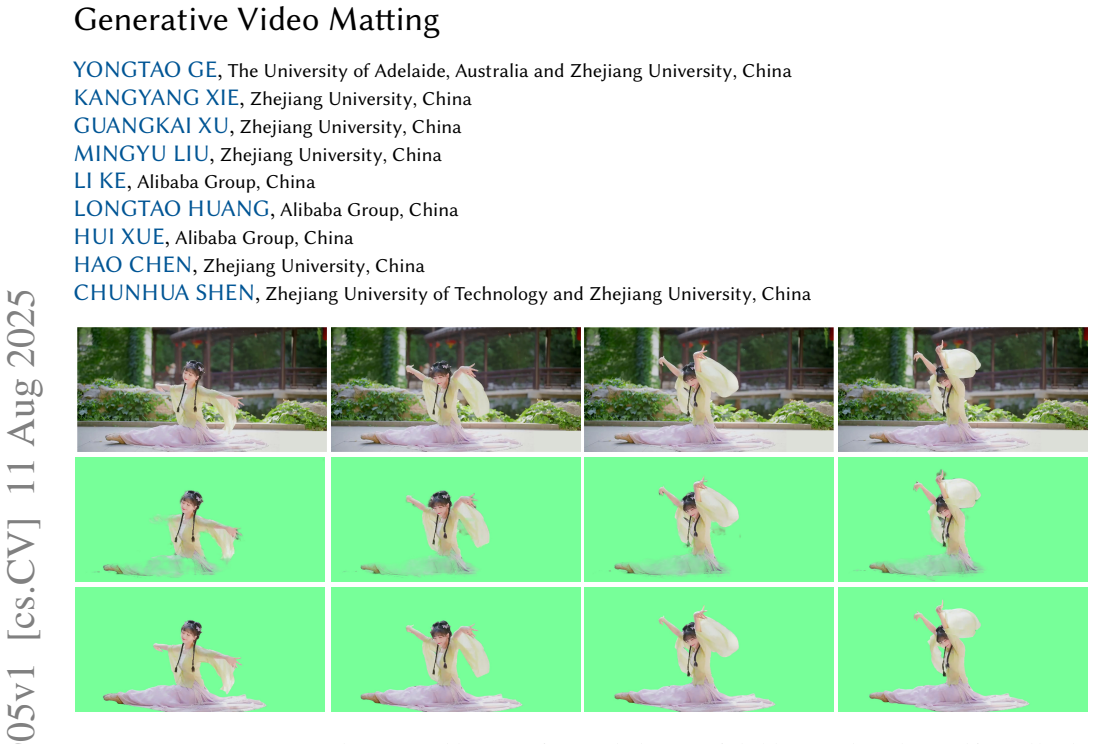
The central claim is that the rich spatial and temporal priors of a pre-trained video diffusion model can be transferred to video matting with minimal architectural change, and that those priors, combined with large-scale synthetic and pseudo-labeled pre-training, give the model zero-shot generalization to unseen categories and fine-grained boundaries. The paper formulates matting as learning the conditional distribution p(alpha | video) via flow matching in latent space, decoding predicted alpha latents through a frozen VAE, and adding pixel-space losses to sharpen hair and fur. It reports state-of-the-art results on V-HIM60, VideoMatte240K, and zero-shot on P3M-500 and AM-2K, with the best
Load-bearing premise
The load-bearing premise is that the frozen pre-trained VAE can encode and decode alpha mattes without losing hair-level detail; the paper's own Appendix C states this sets the upper bound, yet its supporting table reports implausible metric values (PSNR around 0.87, SSIM around 30.3), so the actual ceiling remains undemonstrated.
Editorial extensions
If this is right
- If the central claim holds, trimap-free, interaction-free matting of humans and animals in arbitrary video becomes possible at generative-model quality rather than regression-model quality.
- The three-stage recipe—large-scale synthetic segmentation pre-training, pseudo-labeled real video, then small high-quality matte fine-tuning—gives a template for other dense per-pixel video tasks that lack ground truth.
- Modeling alpha mattes as a generation target means the same model can output temporally coherent transparency maps directly, without recurrent aggregation or optical-flow post-processing.
- The reported zero-shot animal results suggest the diffusion prior supplies category-general boundary knowledge, not just human-portrait statistics.
- Because the VAE is frozen, any improvement in VAE reconstruction fidelity should transfer directly to matting quality, per the paper's own Appendix C.
Reading between the lines
- The natural next experiment is to replace the frozen SVD VAE with a 3D video VAE or a VAE fine-tuned on alpha images; if quality improves, the paper's own stated ceiling is confirmed as the binding constraint.
- The flow-matching formulation used here for matting could be reinterpreted as a general conditional-transport framework for other ill-posed video tasks, such as depth or optical flow, that suffer from the same annotation scarcity.
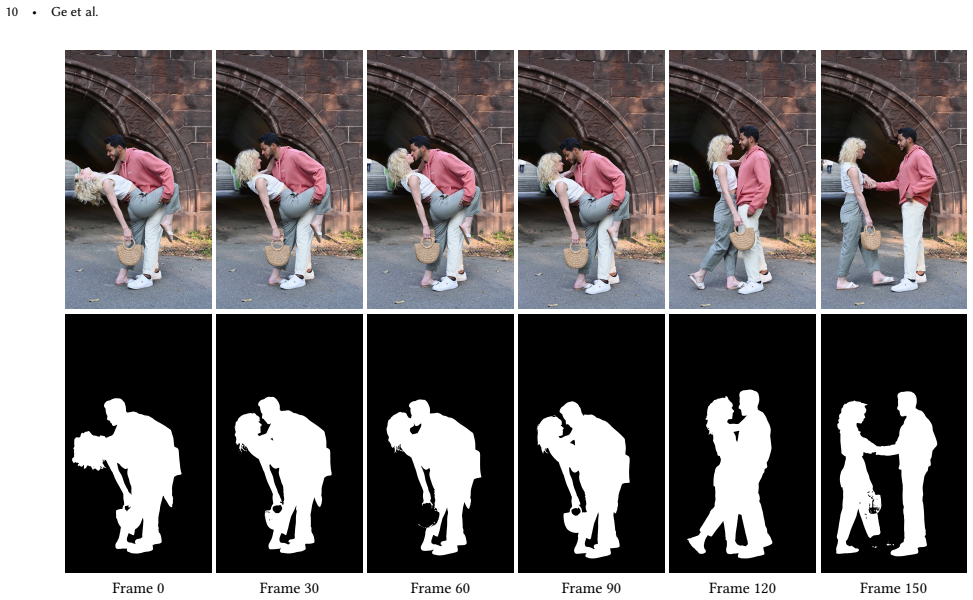
- Pseudo-label noise from SAM2, which the paper shows can lose objects temporarily (e.g., a bag in Frame 30), appears to be tolerated by the generative formulation; a regression model would likely memorize or smooth such label errors, suggesting the generative framing may be more robust to annotation noise than the paper's ablations fully isolate.
- The one-to-three-step flow-matching schedule plus LoRA suggests the model could run at interactive rates once the decoder bottleneck is removed.
Editorial analysis
A structured set of objections, weighed in public.
Referee Report
Summary. The paper proposes GVM, a generative video matting method built by fine-tuning Stable Video Diffusion. The matting task is reformulated as conditional distribution transport: the input video is VAE-encoded and concatenated with a noisy alpha latent, and a 3D-UNet is trained with a conditional flow-matching objective (Eqs. 2–5) plus optional pixel-space losses (Eq. 6). The VAE is frozen throughout and the UNet is frozen in the final stage, with only LoRA trained. Training data combine synthetic segmentation datasets (BEDLAM, Dynamic Replica), a pseudo-labeled real-video set (VideoHuman60, labeled via SAM2/Sapiens), a newly rendered fine-hair portrait matting dataset (SynHairMan, 200 clips), and VideoMatte240K. The method is evaluated on V-HIM60, VideoMatte240K, P3M-500, and AM-2K, with claimed consistent improvements over RVM, SparseMat, and MaGGle, particularly on gradient error and temporal coherence (dtSSD), and zero-shot generalization to unseen animals. The paper also provides data and training-strategy ablations, an inference-speed comparison, and an appendix measuring VAE reconstruction quality.
Significance. If the results hold, the contribution is significant: it is, to my knowledge, the first video matting system built on a pre-trained video diffusion prior, and the three-stage data strategy (synthetic segmentation pre-training, pseudo-label pre-training, high-quality matte fine-tuning) is a reusable recipe. The flow-matching formulation (Eqs. 2–5) is standard and correctly stated, and the paper deserves credit for evaluating on external benchmarks (V-HIM60, P3M-500, AM-2K) that the model was not trained on, making the zero-shot claims specific and falsifiable. The ablations (Tables 6–7) are informative, and the SynHairMan dataset plus the stated code release would be useful community resources. The main risks are the unquantified frozen-VAE ceiling — Appendix C's only supporting table is internally invalid — and the comparison protocol for mask-guided baselines. These affect the strength of the headline claims but not the core viability of the approach.
major comments (2)
- [Appendix C, Table 8] The PSNR and SSIM rows in Table 8 are internally invalid: PSNR values of 0.82–0.89 dB are physically impossible (VAE reconstruction PSNR is typically in the 20–40 dB range), and SSIM values of 28–33 exceed the metric's [0,1] domain. Read with the row labels exchanged, the table would report PSNR ≈ 28.8–32.6 dB and SSIM ≈ 0.82–0.89, which is plausible. This error is load-bearing for the limitation analysis: Appendix C argues that the frozen SVD VAE constrains the upper bound of matting performance, and Table 8 is the only quantitative support for 'substantial variance in reconstruction quality.' As printed, the bottleneck is unquantified, and the paper's central fine-detail claim (Section 1; Grad columns in Tables 1, 4, 5) passes through this same frozen decoder. Please correct the row labels and report alpha-specific reconstruction metrics (SAD/Grad/Conn/dtSSD of decoded alpha) so the cl
- [Section 4, Tables 1/4/5] The comparison protocol for SparseMat and MaGGle is questionable. The paper states these methods 'rely on additional guidance masks as input,' yet evaluates them without any guidance input. This yields pathological numbers — e.g., SparseMat MAD 441.49 / MSE 270.74 / Conn 908.79 on VideoMatte240K (Table 5) versus MAD 6.51–23.48 on V-HIM60 (Table 1), and MaGGle MAD 99.76 on P3M-500-NP (Table 4). Consequently, the summary claim that the method 'consistently outperforms the competition, reducing errors across all the evaluation metrics' (Section 4.1) overreaches, since the mask-guided baselines are handicapped by being run outside their intended operating regime. Please either supply these baselines with their required guidance masks (e.g., using the official protocol or a provided mask source) or restrict the headline claim to mask-free methods such as RVM.
minor comments (8)
- [Section 4.3] The phrase 'we choose VideoMatte240K as the zero-shot evaluation dataset' is inaccurate for the full model, which was trained on VideoMatte240K in Stages 2 and 3 (Section 3.4 and Table 2). It holds only for the Table 6 ablation variants, whose training sets exclude VideoMatte240K. Please rephrase to distinguish in-distribution test evaluation from zero-shot evaluation.
- [Abstract] The abstract states 'comprehensive quantitative evaluation across three benchmark datasets,' but the paper evaluates on four datasets: V-HIM60, VideoMatte240K, P3M-500, and AM-2K (Tables 1, 3, 4, 5).
- [Section 3.1, Eq. (1)] The notation is inconsistent: the text introduces a video V = {C_i}_{i=1}^N of N frames, but Eq. (1) and surrounding text use the index T as the frame count. Harmonize N/T.
- [Section 3.4] The number of GPUs is inconsistent: the first paragraph says 'trained using the AdamW optimizer across 4 Nvidia A100 GPUs,' while the 'Training details' paragraph says 'All stages are performed across 8 Nvidia A100 80G GPUs.'
- [Section 3.4, Stage 3] The dataset name is spelled 'SynthHairMan' in Stage 3 but 'SynHairMan' elsewhere (e.g., contributions, Table 2, Table 6). Pick one spelling.
- [Appendix F] The sentence 'We provide more video results in ??, ??, Figure 11 and Figure 12' contains unfilled citation placeholders ('??') that must be completed or removed.
- [Table 4 / Section 4.1] The claim of 'reducing errors across all the evaluation metrics' is not literally met: on P3M-500-PM the proposed method's MSE (8.51) is slightly worse than RVM's (7.84), even though MAD, SAD, Grad, and Conn improve. Qualify the claim accordingly.
- [Table 3 / Figure 2] Minor formatting: 'GVM20.4 24.3 10.2' in Table 3 lacks a separator between method name and values; Figure 2's caption 'P3M sample Annotation AM2K sample Annotation' needs a delimiter. Also, Section 2 spells 'Dinstinctions-646' and 'Video240K' inconsistently with the referenced dataset names.
Circularity Check
No significant circularity: the core results are empirical fine-tuning evaluations against external zero-shot benchmarks; the VAE-ceiling limitation and VideoMatte240K 'zero-shot' mislabeling are correctness/quality issues, not circular derivations.
full rationale
The paper's central claim is that fine-tuning a pre-trained video diffusion model (SVD) with flow-matching supervision and a three-stage data curriculum yields a video matting model that generalizes to unseen benchmarks. This is an empirical claim, not a first-principles derivation, so circularity could only arise if a stated 'prediction' is identical to a training input by construction or if a fitted parameter is renamed as a prediction. No such reduction is present. Training uses Eq. (5) L_latent = E_t || v_theta(phi_t(z_alpha), z_c, t) - v_t(z_alpha)||^2 and Eq. (6) pixel-space losses, with v_t(z_alpha) = z_alpha - epsilon being the standard flow-matching velocity, not the evaluation metric. The strongest generalization evidence is genuinely external: V-HIM60, P3M-500, and AM-2K do not appear in the training datasets listed in Table 2/Section 3.4, and Section 4.2 explicitly states the model was not trained on the P3M or AM-2K training sets. Therefore the headline gains are not forced by construction. The VideoMatte240K evaluation is less clean: Stages 2 and 3 fine-tune on VideoMatte240K, yet Section 4.3 says 'we choose VideoMatte240K as the zero-shot evaluation dataset'; this is a mislabeling or train/test overlap risk, but it is a held-out test-set evaluation, not a circular equation, and the generalization claim is not carried by that table alone. Appendix C explicitly flags a real limitation: 'the upper bound of video matting performance is constrained by the reconstruction capability of the VAE.' This, together with the internally impossible Table 8 values (PSNR ~0.87 dB, SSIM ~30), is a data-quality/correctness concern, not circularity. Self-citations for standard losses (e.g., Lu et al. 2019 for L_lap, Dai et al. 2022 for L_gp) are not load-bearing. No equation reduces to its own input, and no fitted parameter is renamed as a prediction; the derivation chain is self-contained as an empirical method.
Assumptions & free parameters
free parameters (5)
- Lambda (pixel-loss weight, Eq. 7) =
not reported
- Lambda_gp (gradient penalty weight, Eq. 6) =
not reported
- Dataset sampling ratios (stages 1-3) =
0.4/0.3/0.3; 0.4/0.3/0.1/0.2; 0.4/0.6
- Learning rates and total iterations =
1e-5, 1e-4; 20,000 (ablation only)
- LoRA rank (stage 3) =
32
assumptions (7)
- domain assumption Alpha compositing model C = alpha*F + (1-alpha)*B (Eq. 1)
- standard math Flow-matching linear interpolation and straight velocity field (Eqs. 2-4)
- domain assumption SVD pretrained spatial-temporal priors transfer to alpha prediction
- domain assumption Frozen SVD VAE can represent alpha mattes with sufficient fidelity
- domain assumption SAM2/Sapiens pseudo-labels are a valid matting training signal despite boundary noise
- domain assumption BEDLAM/Dynamic Replica segmentation masks suffice as matte supervision in stages 1-2
- ad hoc to paper Zero alpha embedding can replace SVD's CLIP conditioning
Cite this review
Pith. "Pith review of Generative Video Matting." pith.science (2026). https://pith.science/paper/YL4W3TXW
@misc{pith2026250807905,
  author       = {Pith},
  title        = {Pith review of: Generative Video Matting},
  year         = {2026},
  howpublished = {\url{https://pith.science/paper/YL4W3TXW}},
  note         = {Machine review of arXiv:2508.07905}
}
read the original abstract
Video matting has traditionally been limited by the lack of high-quality ground-truth data. Most existing video matting datasets provide only human-annotated imperfect alpha and foreground annotations, which must be composited to background images or videos during the training stage. Thus, the generalization capability of previous methods in real-world scenarios is typically poor. In this work, we propose to solve the problem from two perspectives. First, we emphasize the importance of large-scale pre-training by pursuing diverse synthetic and pseudo-labeled segmentation datasets. We also develop a scalable synthetic data generation pipeline that can render diverse human bodies and fine-grained hairs, yielding around 200 video clips with a 3-second duration for fine-tuning. Second, we introduce a novel video matting approach that can effectively leverage the rich priors from pre-trained video diffusion models. This architecture offers two key advantages. First, strong priors play a critical role in bridging the domain gap between synthetic and real-world scenes. Second, unlike most existing methods that process video matting frame-by-frame and use an independent decoder to aggregate temporal information, our model is inherently designed for video, ensuring strong temporal consistency. We provide a comprehensive quantitative evaluation across three benchmark datasets, demonstrating our approach's superior performance, and present comprehensive qualitative results in diverse real-world scenes, illustrating the strong generalization capability of our method. The code is available at https://github.com/aim-uofa/GVM.
Figures


Figures from the paper (9 more)




Reference graph
Works this paper leans on
-
[2002]
Video matting of complex scenes. InACM Trans. Graph.243–248. Blender Online Community. 2018.Blender - a 3D modelling and rendering package. Blender Foundation, Stichting Blender Foundation, Amsterdam. http://www.blender. org Yutong Dai, Brian Price, He Zhang, and Chunhua Shen. 2022. Boosting robustness of image matting with context assembling and strong d...
arXiv 2018
-
[2022]
High-resolution image synthesis with latent diffusion models. InProc. IEEE Conf. Comp. Vis. Patt. Recogn. Olaf Ronneberger, Philipp Fischer, and Thomas Brox. 2015. U-net: Convolutional networks for biomedical image segmentation. InMedical image computing and computer-assisted intervention–MICCAI 2015: 18th international conference, Munich, Germany, Octobe...
arXiv 2015
-
[2023]
Flow Matching for Generative Modeling. InProc. Int. Conf. Learn. Representa- tions. Hao Lu, Yutong Dai, Chunhua Shen, and Songcen Xu. 2019. Context-Aware Image Matting for Simultaneous Foreground and Alpha Estimation. InProc. IEEE Int. Conf. Comp. Vis. Sihan Ma, Jizhizi Li, Jing Zhang, He Zhang, and Dacheng Tao. 2023. Rethinking Portrait Matting with Pirv...
arXiv 2019
Reviewed August 5, 2026 · model on record in the stance chip above.
Discussion (0). Sign in to comment.