Preprocessing Algorithm Leveraging Geometric Modeling for Scale Correction in Hyperspectral Images for Improved Unmixing Performance
Pith reviewed 2026-05-21 22:38 UTC · model grok-4.3
The pith
Correcting scale distortions in hyperspectral pixels using geometric modeling improves unmixing accuracy by roughly 50 percent.
A machine-rendered reading of the paper's core claim, the machinery that carries it, and where it could break.
Core claim
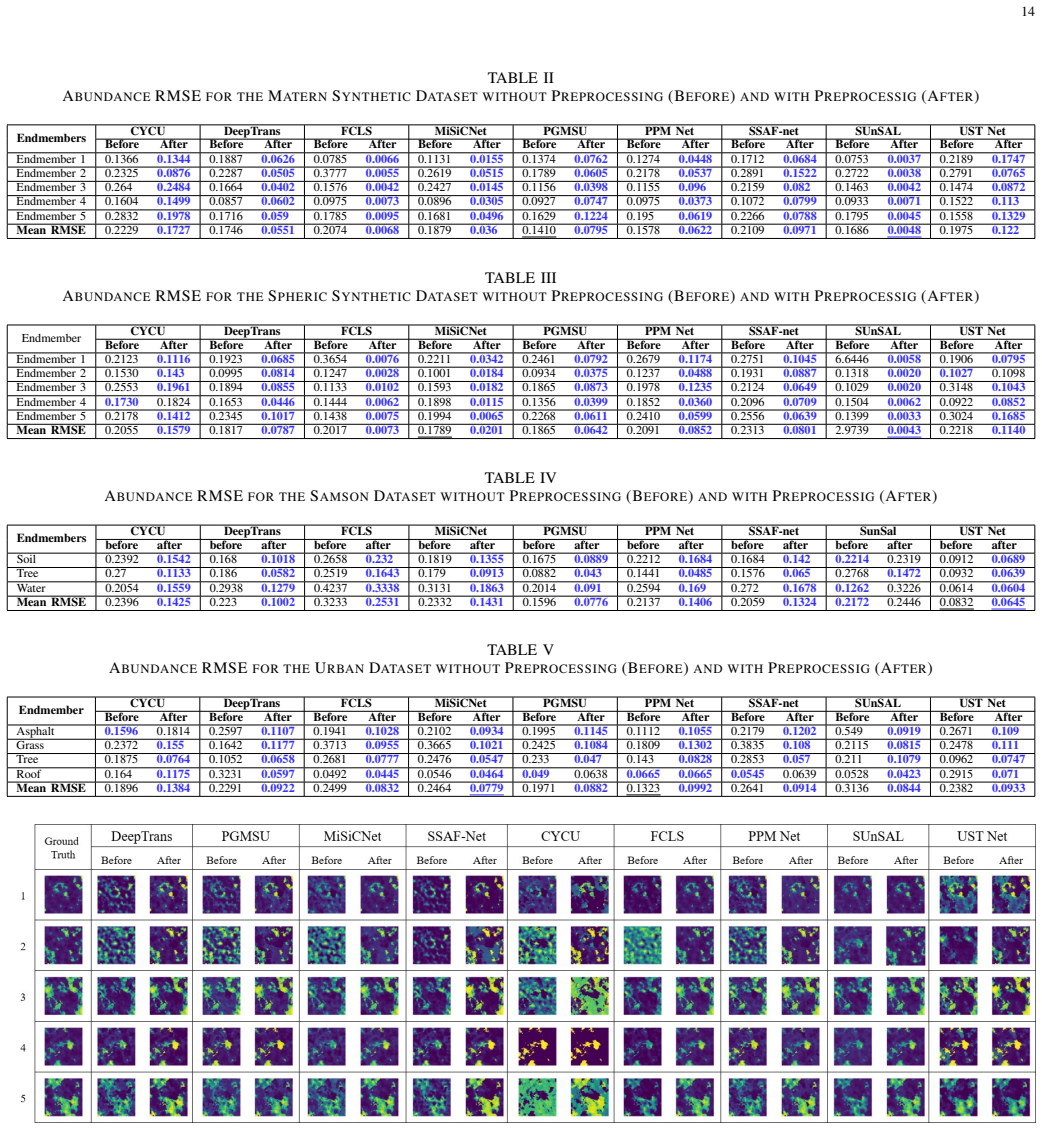
By estimating and correcting distortions to the scale of the pixel signatures using a geometric model, the preprocessing algorithm produces pixel signatures with minimal distortions in scale. These corrected signatures allow unmixing algorithms to achieve significantly improved abundance estimation, with error reductions of around 50% across various methods on synthetic and real datasets.
What carries the argument
The preprocessing algorithm that uses geometric modeling to estimate and correct scale distortions in observed pixel signatures prior to unmixing.
If this is right
- The algorithm improves the performance of many state-of-the-art unmixing methods, including those designed to handle spectral variability.
- Scale correction serves as a complementary preprocessing step that facilitates more accurate unmixing with existing methods.
- The method shows consistent error reductions of around 50% on both synthetic and real hyperspectral datasets.
- It highlights the potential for integration as a key component in practical hyperspectral unmixing pipelines.
Where Pith is reading between the lines
- This approach might generalize to other types of spectral variability if the geometric model can be extended.
- Future work could test the preprocessing on datasets with more complex topography to verify robustness.
- Combining this scale correction with variability-handling unmixing methods may yield even greater improvements.
Load-bearing premise
That distortions to the scale of pixel signatures from topography, illumination, and shadowing can be accurately estimated and corrected using geometric modeling without interfering with other spectral variability factors or losing information critical for unmixing.
What would settle it
Running the preprocessing on a hyperspectral dataset with known ground-truth material abundances and observing whether the unmixing error decreases compared to the original data; if the error stays the same or increases, the claim that scale correction improves abundance estimation would be challenged.
Figures






read the original abstract
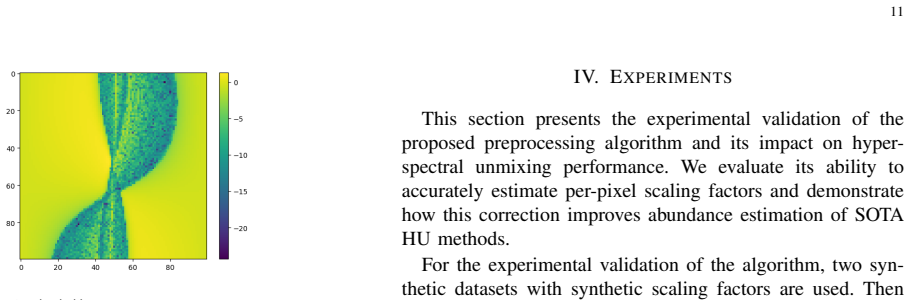
Spectral variability significantly impacts the accuracy and convergence of hyperspectral unmixing algorithms. Many methods address complex spectral variability; yet large-scale distortions to the scale of the observed pixel signatures due to topography, illumination, and shadowing remain a major challenge. These variations often degrade unmixing performance and complicate model fitting. Because of this, correcting these variations can offer significant advantages in real-world GIS applications. In this paper, we propose a novel preprocessing algorithm that corrects scale-induced spectral variability prior to unmixing. By estimating and correcting these distortions to the scale of the pixel signatures, the algorithm produces pixel signatures with minimal distortions in scale. Since these distortions in scale (which hinder the performance of many unmixing methods) are greatly minimized in the output provided by the proposed method, the abundance estimation of the unmixing algorithms is significantly improved. We present a rigorous mathematical framework to describe and correct for scale variability and provide extensive experimental validation of the proposed algorithm. Furthermore, the algorithm's impact is evaluated across a wide range of state-of-the-art unmixing methods on two synthetic and two real hyperspectral datasets. The proposed preprocessing step consistently improves the performance of these algorithms, achieving error reductions of around 50%, even for algorithms specifically designed to handle spectral variability. This demonstrates that scale correction acts as a complementary step, facilitating more accurate unmixing with existing methods. The algorithm's generality, consistent impact, and significant influence highlight its potential as a key component in practical hyperspectral unmixing pipelines. The implementation code will be made publicly available upon publication.
Editorial analysis
A structured set of objections, weighed in public.
Referee Report
Summary. The paper proposes a preprocessing algorithm that uses geometric modeling to estimate and correct large-scale distortions to the scale of hyperspectral pixel signatures arising from topography, illumination, and shadowing. The corrected signatures are then fed to existing unmixing algorithms, with the central claim that this step yields approximately 50% reduction in abundance estimation error across multiple state-of-the-art methods on two synthetic and two real datasets. A mathematical framework is presented to describe the scale variability and its correction, and the algorithm is positioned as a general, complementary preprocessing step that improves performance even for variability-aware unmixing techniques.
Significance. If the separability assumption holds and the correction does not distort the linear mixing model or effective endmember directions, the method could serve as a practical, low-overhead addition to hyperspectral unmixing pipelines in GIS applications. The evaluation across a wide range of unmixing algorithms and the commitment to release code are strengths that would support reproducibility and adoption if the technical concerns are addressed.
major comments (2)
- [Mathematical Framework] Mathematical Framework section: The derivation of the scale correction operator assumes that distortions due to topography/illumination/shadowing are separable from other sources of spectral variability (e.g., material BRDF, atmospheric effects, or endmember variability) and can be removed without coupling to the linear mixing model. In mixed pixels this separability may not hold; any residual multiplicative factor would rescale the observed signatures in a manner that could shift effective endmember directions or increase the condition number of the mixing matrix. A concrete demonstration that the correction commutes with the unmixing objective or bounds on the perturbation to the mixing matrix is needed to support the central claim.
- [Experimental Validation] Experimental section (synthetic and real datasets): The reported ~50% error reductions are load-bearing for the claim of consistent improvement, yet the manuscript does not appear to include error bars, statistical significance tests across runs, or explicit rules for data exclusion. Without these, it is difficult to assess whether the gains are robust or sensitive to particular scene characteristics.
minor comments (2)
- [Abstract] The abstract states that the algorithm produces 'pixel signatures with minimal distortions in scale,' but a short illustrative equation or diagram showing the input/output signature before and after correction would improve immediate clarity for readers.
- [Mathematical Framework] Notation for the geometric scale factor and the corrected signature should be introduced once and used consistently; occasional shifts between symbols for the same quantity hinder readability.
Simulated Author's Rebuttal
We thank the referee for the detailed and constructive review of our manuscript. The comments raise important points regarding the mathematical assumptions and the statistical rigor of the experiments. We address each major comment below and will revise the manuscript accordingly to strengthen the presentation.
read point-by-point responses
-
Referee: [Mathematical Framework] Mathematical Framework section: The derivation of the scale correction operator assumes that distortions due to topography/illumination/shadowing are separable from other sources of spectral variability (e.g., material BRDF, atmospheric effects, or endmember variability) and can be removed without coupling to the linear mixing model. In mixed pixels this separability may not hold; any residual multiplicative factor would rescale the observed signatures in a manner that could shift effective endmember directions or increase the condition number of the mixing matrix. A concrete demonstration that the correction commutes with the unmixing objective or bounds on the perturbation to the mixing matrix is needed to support the central claim.
Authors: We appreciate the referee's observation on the separability assumption. The current framework derives the scale correction under the premise that topography/illumination/shadowing effects act as a per-pixel multiplicative scale factor separable from other variability sources. In the revised manuscript we will add a dedicated subsection that (i) derives explicit bounds on the perturbation induced to the mixing matrix when residual coupling is present and (ii) shows that, for the class of unmixing objectives that are invariant to global scaling of the observed signatures, the correction commutes with the abundance estimation step. We will also discuss the practical impact on the condition number and note the limitations that remain when strong endmember variability or atmospheric effects violate the separability assumption. revision: yes
-
Referee: [Experimental Validation] Experimental section (synthetic and real datasets): The reported ~50% error reductions are load-bearing for the claim of consistent improvement, yet the manuscript does not appear to include error bars, statistical significance tests across runs, or explicit rules for data exclusion. Without these, it is difficult to assess whether the gains are robust or sensitive to particular scene characteristics.
Authors: We agree that additional statistical reporting is necessary to substantiate the robustness of the reported gains. In the revised manuscript we will augment all quantitative tables and figures with error bars (standard deviation over repeated runs or cross-validation folds for the synthetic data and multiple spatial subsets for the real data). We will also include paired statistical significance tests (e.g., Wilcoxon signed-rank or t-tests) comparing results with and without the proposed preprocessing. Finally, we will add an explicit paragraph describing the data exclusion criteria and any preprocessing steps applied to the real hyperspectral scenes. revision: yes
Circularity Check
Derivation chain is self-contained with no reduction to fitted inputs or self-citations
full rationale
The paper presents a preprocessing algorithm with a claimed rigorous mathematical framework for scale correction based on geometric modeling of topography, illumination, and shadowing effects. The abstract and provided context describe estimating distortions independently and applying correction prior to unmixing, with experimental validation on synthetic and real datasets showing performance gains. No equations or steps are shown that define the correction operator in terms of the unmixing outputs it is meant to improve, nor are predictions fitted to the same data they claim to forecast. No self-citations are invoked as load-bearing uniqueness theorems or ansatzes. The central claim rests on the proposed geometric correction and reported error reductions rather than circular redefinition or renaming of known results. This is the expected non-finding for a method paper whose value is demonstrated through external benchmarks and experiments.
Axiom & Free-Parameter Ledger
free parameters (1)
- scale estimation parameters
axioms (1)
- domain assumption Scale distortions from topography, illumination, and shadowing can be modeled and corrected geometrically prior to unmixing without affecting other spectral information.
Lean theorems connected to this paper
-
IndisputableMonolith/Cost/FunctionalEquation.leanwashburn_uniqueness_aczel unclear?
unclearRelation between the paper passage and the cited Recognition theorem.
By estimating and correcting distortions to the scale of the pixel signatures, the algorithm produces pixel signatures with minimal distortions in scale... achieving error reductions of around 50%.
-
IndisputableMonolith/Foundation/AlexanderDuality.leanalexander_duality_circle_linking unclear?
unclearRelation between the paper passage and the cited Recognition theorem.
the set of y*_i lie in a (K-1) dimensional hyperplane... (y*_i - c*)^T n* = 0
What do these tags mean?
- matches
- The paper's claim is directly supported by a theorem in the formal canon.
- supports
- The theorem supports part of the paper's argument, but the paper may add assumptions or extra steps.
- extends
- The paper goes beyond the formal theorem; the theorem is a base layer rather than the whole result.
- uses
- The paper appears to rely on the theorem as machinery.
- contradicts
- The paper's claim conflicts with a theorem or certificate in the canon.
- unclear
- Pith found a possible connection, but the passage is too broad, indirect, or ambiguous to say the theorem truly supports the claim.
Reference graph
Works this paper leans on
-
[1]
Hyperspectral Unmixing Overview: Geometrical, Statistical, and Sparse Regression-Based Approaches,
J. M. Bioucas-Dias, A. Plaza, N. Dobigeon, M. Parente, Q. Du, P. Gader, and J. Chanussot, “Hyperspectral Unmixing Overview: Geometrical, Statistical, and Sparse Regression-Based Approaches,”IEEE Journal of Selected Topics in Applied Earth Observations and Remote Sensing, vol. 5, no. 2, pp. 354–379, Apr. 2012
work page 2012
-
[2]
M. Ekanayake, SSP. Vithana, E. M. H. Ekanayake, ARMAN. Rath- nayake, AMR. Abeysekara, TSJ. Oorloff, HMVR. Herath, G. M. R. Godaliyadda, M. Ekanayake, and A. Senaratne, “Mapping ilmenite deposit in Pulmudai, Sri Lanka using a hyperspectral imaging-based surface mineral mapping method,”Journal of the National Science F oundation of Sri Lanka, vol. 47, p. 27...
work page 2019
-
[3]
Comparison of airborne hyperspectral data and EO-1 Hyperion for mineral mapping,
F. Kruse, J. Boardman, and J. Huntington, “Comparison of airborne hyperspectral data and EO-1 Hyperion for mineral mapping,”IEEE Transactions on Geoscience and Remote Sensing, vol. 41, no. 6, pp. 1388–1400, Jun. 2003
work page 2003
-
[4]
A. Khan, A. D. Vibhute, S. Mali, and C. H. Patil, “A systematic review on hyperspectral imaging technology with a machine and deep learn- ing methodology for agricultural applications,”Ecological Informatics, vol. 69, p. 101678, Jul. 2022
work page 2022
-
[5]
Crop Classification for Agricultural Applications in Hyperspectral Remote Sensing Images,
L. Agilandeeswari, M. Prabukumar, V . Radhesyam, K. L. N. B. Phaneen- dra, and A. Farhan, “Crop Classification for Agricultural Applications in Hyperspectral Remote Sensing Images,”Applied Sciences, vol. 12, no. 3, p. 1670, Jan. 2022
work page 2022
-
[6]
M. Shimoni, R. Haelterman, and C. Perneel, “Hyperspectral Imaging for Military and Security Applications: Combining Myriad Processing and Sensing Techniques,”IEEE Geoscience and Remote Sensing Magazine, vol. 7, no. 2, pp. 101–117, Jun. 2019
work page 2019
-
[7]
The Potential of Hyperspectral Image Classification for Oil Spill Mapping,
X. Kang, Z. Wang, P. Duan, and X. Wei, “The Potential of Hyperspectral Image Classification for Oil Spill Mapping,”IEEE Transactions on Geoscience and Remote Sensing, vol. 60, pp. 1–15, 2022
work page 2022
-
[8]
Application of hyperspectral remote sensing for environment monitoring in mining areas,
B. Zhang, D. Wu, L. Zhang, Q. Jiao, and Q. Li, “Application of hyperspectral remote sensing for environment monitoring in mining areas,”Environmental Earth Sciences, vol. 65, no. 3, pp. 649–658, Feb. 2012
work page 2012
-
[9]
N. Keshava and J. Mustard, “Spectral unmixing,”IEEE Signal Process- ing Magazine, vol. 19, no. 1, pp. 44–57, Jan. 2002
work page 2002
-
[10]
A Review of Nonlinear Hyper- spectral Unmixing Methods,
R. Heylen, M. Parente, and P. Gader, “A Review of Nonlinear Hyper- spectral Unmixing Methods,”IEEE Journal of Selected Topics in Applied Earth Observations and Remote Sensing, vol. 7, no. 6, pp. 1844–1868, Jun. 2014
work page 2014
-
[11]
Spectral Variability in Hyperspectral Data Unmixing: A Comprehensive Review,
R. A. Borsoi, T. Imbiriba, J. C. M. Bermudez, C. Richard, J. Chanussot, L. Drumetz, J.-Y . Tourneret, A. Zare, and C. Jutten, “Spectral Variability in Hyperspectral Data Unmixing: A Comprehensive Review,”IEEE Geoscience and Remote Sensing Magazine, vol. 9, no. 4, pp. 223–270, Dec. 2021
work page 2021
-
[12]
J. Theiler, A. Ziemann, S. Matteoli, and M. Diani, “Spectral Variability of Remotely Sensed Target Materials: Causes, Models, and Strategies for Mitigation and Robust Exploitation,”IEEE Geoscience and Remote Sensing Magazine, vol. 7, no. 2, pp. 8–30, Jun. 2019
work page 2019
-
[13]
A Detailed Analysis of Datasets Used in HSI in the Context of Mixture Models for Unmixing,
D. M. U. P. Sumanasekara, R. M. K. L. Ratnayake, H. M. K. D. Wickramathilaka, G. M. R. I. Godaliyadda, M. P. B. Ekanayake, and H. M. V . R. Herath, “A Detailed Analysis of Datasets Used in HSI in the Context of Mixture Models for Unmixing,” in2024 Moratuwa Engineering Research Conference (MERCon), Aug. 2024, pp. 217–222
work page 2024
-
[14]
Spectral Imaging for Remote Sensing,
G. Shaw and H.-h. K. Burke, “Spectral Imaging for Remote Sensing,” 2003
work page 2003
-
[15]
Does independent component analysis play a role in unmixing hyperspectral data?
J. Nascimento and J. Dias, “Does independent component analysis play a role in unmixing hyperspectral data?”IEEE Transactions on Geoscience and Remote Sensing, vol. 43, no. 1, pp. 175–187, Jan. 2005
work page 2005
-
[16]
“Hierarchical Multiple Endmember Spectral Mixture Analysis (MESMA) of hyperspectral imagery for urban environments.”
-
[17]
Sparse Unmixing of Hyperspectral Data,
M.-D. Iordache, J. M. Bioucas-Dias, and A. Plaza, “Sparse Unmixing of Hyperspectral Data,”IEEE Transactions on Geoscience and Remote Sensing, vol. 49, no. 6, pp. 2014–2039, Jun. 2011
work page 2014
-
[18]
A Classification-Based Model for Multi-Objective Hyperspectral Sparse Unmixing,
X. Xu, Z. Shi, B. Pan, and X. Li, “A Classification-Based Model for Multi-Objective Hyperspectral Sparse Unmixing,”IEEE Transactions on Geoscience and Remote Sensing, vol. 57, no. 12, pp. 9612–9625, Dec. 2019
work page 2019
-
[19]
Deep Generative Endmember Modeling: An Application to Unsupervised Spectral Un- mixing,
R. A. Borsoi, T. Imbiriba, and J. C. M. Bermudez, “Deep Generative Endmember Modeling: An Application to Unsupervised Spectral Un- mixing,”IEEE Transactions on Computational Imaging, vol. 6, pp. 374– 384, 2020
work page 2020
-
[20]
Hyperspectral Unmixing With Spectral Variability Using a Perturbed Linear Mixing Model,
P.-A. Thouvenin, N. Dobigeon, and J.-Y . Tourneret, “Hyperspectral Unmixing With Spectral Variability Using a Perturbed Linear Mixing Model,”IEEE Transactions on Signal Processing, vol. 64, no. 2, pp. 525–538, Jan. 2016
work page 2016
-
[21]
Joint Bayesian Endmember Extraction and Linear Unmixing for Hyperspectral Imagery,
N. Dobigeon, S. Moussaoui, M. Coulon, J.-Y . Tourneret, and A. O. Hero, “Joint Bayesian Endmember Extraction and Linear Unmixing for Hyperspectral Imagery,”IEEE Transactions on Signal Processing, vol. 57, no. 11, pp. 4355–4368, Nov. 2009
work page 2009
-
[22]
M. A. Veganzones, G. Tochon, M. Dalla-Mura, A. J. Plaza, and J. Chanussot, “Hyperspectral Image Segmentation Using a New Spectral Unmixing-Based Binary Partition Tree Representation,”IEEE Transac- tions on Image Processing, vol. 23, no. 8, pp. 3574–3589, Aug. 2014
work page 2014
-
[23]
J. Jin, B. Wang, and L. Zhang, “A Novel Approach Based on Fisher Discriminant Null Space for Decomposition of Mixed Pixels in Hyper- spectral Imagery,”IEEE Geoscience and Remote Sensing Letters, vol. 7, no. 4, pp. 699–703, Oct. 2010
work page 2010
-
[24]
Minimum-volume transforms for remotely sensed data,
M. Craig, “Minimum-volume transforms for remotely sensed data,” IEEE Transactions on Geoscience and Remote Sensing, vol. 32, no. 3, pp. 542–552, May 1994
work page 1994
-
[25]
An automated waveband selection technique for optimized hyperspectral mixture analysis,
B. Somers, S. Delalieux, W. W. Verstraeten, J. A. N. van Aardt, G. L. Albrigo, and P. Coppin, “An automated waveband selection technique for optimized hyperspectral mixture analysis,”International Journal of Remote Sensing, vol. 31, no. 20, pp. 5549–5568, Oct. 2010
work page 2010
-
[26]
Feedback Information-Guided Spec- tral Variability Attention Network for Hyperspectral Unmixing,
S. Xiang, X. Li, and S. Chen, “Feedback Information-Guided Spec- tral Variability Attention Network for Hyperspectral Unmixing,”IEEE Transactions on Geoscience and Remote Sensing, vol. 62, pp. 1–17, 2024
work page 2024
-
[27]
Normalized spectral mixture analysis for monitoring urban composition using ETM+ imagery,
C. Wu, “Normalized spectral mixture analysis for monitoring urban composition using ETM+ imagery,”Remote Sensing of Environment, vol. 93, no. 4, pp. 480–492, Dec. 2004
work page 2004
-
[28]
CyCU-Net: Cycle-Consistency Unmixing Network by Learning Cascaded Autoen- coders,
L. Gao, Z. Han, D. Hong, B. Zhang, and J. Chanussot, “CyCU-Net: Cycle-Consistency Unmixing Network by Learning Cascaded Autoen- coders,”IEEE Transactions on Geoscience and Remote Sensing, vol. 60, pp. 1–14, 2022
work page 2022
-
[29]
GAUSS: Guided encoder - decoder Architecture for hyperspectral Unmixing with Spatial Smoothness,
H. Wickramathilaka, D. Fernando, D. Jayasundara, D. Wickramas- inghe, D. Ranasinghe, G. Godaliyadda, M. Ekanayake, H. Herath, L. Ramanayake, N. Senarath, and H. Weerasooriya, “GAUSS: Guided encoder - decoder Architecture for hyperspectral Unmixing with Spatial Smoothness,”European Journal of Remote Sensing, vol. 56, no. 1, p. 2277213, Dec. 2023
work page 2023
-
[30]
MiSiCNet: Minimum Simplex Convolutional Network for Deep Hyperspectral Un- mixing,
B. Rasti, B. Koirala, P. Scheunders, and J. Chanussot, “MiSiCNet: Minimum Simplex Convolutional Network for Deep Hyperspectral Un- mixing,”IEEE Transactions on Geoscience and Remote Sensing, vol. 60, pp. 1–15, 2022
work page 2022
-
[31]
Deep Hy- perspectral Unmixing using Transformer Network,
P. Ghosh, S. K. Roy, B. Koirala, B. Rasti, and P. Scheunders, “Deep Hy- perspectral Unmixing using Transformer Network,”IEEE Transactions on Geoscience and Remote Sensing, vol. 60, pp. 1–16, 2022
work page 2022
-
[32]
W. Gao, J. Yang, Y . Zhang, Y . Akoudad, and J. Chen, “SSAF-Net: A Spatial-Spectral Adaptive Fusion Network for Hyperspectral Unmixing with Endmember Variability,”IEEE Transactions on Geoscience and Remote Sensing, 2025
work page 2025
-
[33]
Spatial-Spectral Attention Bilateral Network for Hyperspectral Unmixing,
Z. Yang, M. Xu, S. Liu, H. Sheng, and H. Zheng, “Spatial-Spectral Attention Bilateral Network for Hyperspectral Unmixing,”IEEE Geo- science and Remote Sensing Letters, vol. 20, pp. 1–5, 2023
work page 2023
-
[34]
Graph-Based Blind Hyperspectral Unmixing via Nonnegative Matrix Factorization,
B. Rathnayake, E. M. M. B. Ekanayake, K. Weerakoon, G. M. R. I. Go- daliyadda, M. P. B. Ekanayake, and H. M. V . R. Herath, “Graph-Based Blind Hyperspectral Unmixing via Nonnegative Matrix Factorization,” IEEE Transactions on Geoscience and Remote Sensing, vol. 58, no. 9, pp. 6391–6409, Sep. 2020. 20
work page 2020
-
[35]
E. M. M. B. Ekanayake, H. M. H. K. Weerasooriya, D. Y . L. Ranasinghe, S. Herath, B. Rathnayake, G. M. R. I. Godaliyadda, M. P. B. Ekanayake, and H. M. V . R. Herath, “Constrained Nonnegative Matrix Factorization for Blind Hyperspectral Unmixing Incorporating Endmember Indepen- dence,”IEEE Journal of Selected Topics in Applied Earth Observations and Remot...
work page 2021
-
[36]
Minimum-volume Rank-deficient Nonnegative Matrix Factorizations,
V . Leplat, A. M. Ang, and N. Gillis, “Minimum-volume Rank-deficient Nonnegative Matrix Factorizations,” inICASSP 2019 - 2019 IEEE International Conference on Acoustics, Speech and Signal Processing (ICASSP). Brighton, United Kingdom: IEEE, May 2019, pp. 3402– 3406
work page 2019
-
[37]
O. Eches, N. Dobigeon, C. Mailhes, and J.-Y . Tourneret, “Bayesian Estimation of Linear Mixtures Using the Normal Compositional Model. Application to Hyperspectral Imagery,”IEEE Transactions on Image Processing, vol. 19, no. 6, pp. 1403–1413, Jun. 2010
work page 2010
-
[38]
Vertex component analysis: A fast algorithm to unmix hyperspectral data,
J. Nascimento and J. Dias, “Vertex component analysis: A fast algorithm to unmix hyperspectral data,”IEEE Transactions on Geoscience and Remote Sensing, vol. 43, no. 4, pp. 898–910, Apr. 2005
work page 2005
-
[39]
N-FINDR: An algorithm for fast autonomous spectral end-member determination in hyperspectral data,
M. E. Winter, “N-FINDR: An algorithm for fast autonomous spectral end-member determination in hyperspectral data,” inImaging Spectrom- etry V, vol. 3753. SPIE, Oct. 1999, pp. 266–275
work page 1999
-
[40]
R. M. K. L. Ratnayake, D. M. U. P. Sumanasekara, H. M. K. D. Wickramathilaka, G. M. R. I. Godaliyadda, H. M. V . R. Herath, and M. P. B. Ekanayake, “Hyperspectral unmixing with spatial context and endmember ensemble learning with attention mechanism,”ISPRS Open Journal of Photogrammetry and Remote Sensing, vol. 15, p. 100086, Jan. 2025
work page 2025
-
[41]
UST-Net: A U- Shaped Transformer Network Using Shifted Windows for Hyperspectral Unmixing,
Z. Yang, M. Xu, S. Liu, H. Sheng, and J. Wan, “UST-Net: A U- Shaped Transformer Network Using Shifted Windows for Hyperspectral Unmixing,”IEEE Transactions on Geoscience and Remote Sensing, vol. 61, pp. 1–15, 2023
work page 2023
-
[42]
Deep Half- Siamese Networks for Hyperspectral Unmixing,
Z. Han, D. Hong, L. Gao, B. Zhang, and J. Chanussot, “Deep Half- Siamese Networks for Hyperspectral Unmixing,”IEEE Geoscience and Remote Sensing Letters, vol. 18, no. 11, pp. 1996–2000, Nov. 2021
work page 1996
-
[43]
A. Zare and K. Ho, “Endmember Variability in Hyperspectral Analysis: Addressing Spectral Variability During Spectral Unmixing,”IEEE Signal Processing Magazine, vol. 31, no. 1, pp. 95–104, Jan. 2014
work page 2014
-
[44]
Bidirectional reflectance spectroscopy: 1. Theory,
B. Hapke, “Bidirectional reflectance spectroscopy: 1. Theory,”Journal of Geophysical Research: Solid Earth, vol. 86, no. B4, pp. 3039–3054, 1981
work page 1981
-
[45]
The effect of small topographic variations on reflectance,
B. Combal and H. Isaka, “The effect of small topographic variations on reflectance,”IEEE Transactions on Geoscience and Remote Sensing, vol. 40, no. 3, pp. 663–670, Mar. 2002
work page 2002
-
[46]
Blind Hyperspectral Unmixing Using an Extended Linear Mixing Model to Address Spectral Variability,
L. Drumetz, M.-A. Veganzones, S. Henrot, R. Phlypo, J. Chanussot, and C. Jutten, “Blind Hyperspectral Unmixing Using an Extended Linear Mixing Model to Address Spectral Variability,”IEEE Transactions on Image Processing, vol. 25, no. 8, pp. 3890–3905, Aug. 2016
work page 2016
-
[47]
X. Zhang, C. Li, J. Zhang, Q. Chen, J. Feng, L. Jiao, and H. Zhou, “Hyperspectral Unmixing via Low-Rank Representation with Space Consistency Constraint and Spectral Library Pruning,”Remote Sensing, vol. 10, no. 2, p. 339, Feb. 2018
work page 2018
-
[48]
J. Feng, “The topographic normalization of hyperspectral data: Implica- tions for the selection of spectral end members and lithologic mapping,” Remote Sensing of Environment, vol. 85, no. 2, pp. 221–231, May 2003
work page 2003
-
[49]
Comparison of Topo- graphic Correction Methods,
R. Richter, T. Kellenberger, and H. Kaufmann, “Comparison of Topo- graphic Correction Methods,”Remote Sensing, vol. 1, no. 3, pp. 184– 196, Sep. 2009
work page 2009
-
[50]
Probabilistic Generative Model for Hyperspectral Unmixing Accounting for Endmem- ber Variability,
S. Shi, M. Zhao, L. Zhang, Y . Altmann, and J. Chen, “Probabilistic Generative Model for Hyperspectral Unmixing Accounting for Endmem- ber Variability,”IEEE Transactions on Geoscience and Remote Sensing, vol. 60, pp. 1–15, 2022
work page 2022
-
[51]
DAAN: A Deep Autoencoder-Based Augmented Network for Blind Multilinear Hyperspectral Unmixing,
Y . Su, Z. Zhu, L. Gao, A. Plaza, P. Li, X. Sun, and X. Xu, “DAAN: A Deep Autoencoder-Based Augmented Network for Blind Multilinear Hyperspectral Unmixing,”IEEE Transactions on Geoscience and Re- mote Sensing, vol. 62, pp. 1–15, 2024
work page 2024
-
[52]
K. Wickramathilaka, K. Ratnayake, P. Sumanasekara, G. M. R. Go- daliyadda, M. P. Ekanayake, and V . Herath,Endmember Abundance Prediction in Hyperspectral Unmixing: The Impact of Endmember Extraction Algorithms and Self-Attention in Autoencoders, Aug. 2023
work page 2023
-
[53]
Fully Constrained Least Squares Spectral Unmixing by Simplex Projection,
R. Heylen, D. Burazerovic, and P. Scheunders, “Fully Constrained Least Squares Spectral Unmixing by Simplex Projection,”IEEE Transactions on Geoscience and Remote Sensing, vol. 49, no. 11, pp. 4112–4122, Nov. 2011
work page 2011
-
[54]
UnDIP: Hyper- spectral Unmixing Using Deep Image Prior,
B. Rasti, B. Koirala, P. Scheunders, and P. Ghamisi, “UnDIP: Hyper- spectral Unmixing Using Deep Image Prior,”IEEE Transactions on Geoscience and Remote Sensing, vol. PP, pp. 1–15, Mar. 2021
work page 2021
-
[55]
J. Kennedy and R. Eberhart, “Particle swarm optimization,” inProceed- ings of ICNN’95 - International Conference on Neural Networks, vol. 4, 1995, pp. 1942–1948 vol.4
work page 1995
-
[56]
M. M. Noel, “A new gradient based particle swarm optimization algorithm for accurate computation of global minimum,”Applied Soft Computing, vol. 12, no. 1, pp. 353–359, 2012. [Online]. Available: https://www.sciencedirect.com/science/article/pii/S1568494611003206
work page 2012
-
[57]
D. Heinz and Chein-I-Chang, “Fully constrained least squares linear spectral mixture analysis method for material quantification in hy- perspectral imagery,”IEEE Transactions on Geoscience and Remote Sensing, vol. 39, no. 3, pp. 529–545, Mar. 2001
work page 2001
-
[58]
J. M. Bioucas-Dias and M. A. T. Figueiredo, “Alternating direction al- gorithms for constrained sparse regression: Application to hyperspectral unmixing,” in2010 2nd Workshop on Hyperspectral Image and Signal Processing: Evolution in Remote Sensing, Jun. 2010, pp. 1–4
work page 2010
-
[59]
Proportional Perturbation Model for Hyperspectral Unmixing Accounting for Endmember Variability,
W. Gao, J. Yang, and J. Chen, “Proportional Perturbation Model for Hyperspectral Unmixing Accounting for Endmember Variability,”IEEE Geoscience and Remote Sensing Letters, vol. 21, pp. 1–5, 2024
work page 2024
-
[60]
Hyperspectral imagery synthesis (eias) toolbox
Grupo de Inteligencia Computacional, Universidad del Pa ´ıs Vasco / Euskal Herriko Unibertsitatea (UPV/EHU), “Hyperspectral imagery synthesis (eias) toolbox.”
discussion (0)
Sign in with ORCID, Apple, or X to comment. Anyone can read and Pith papers without signing in.