REVIEW 4 major objections 5 minor 81 references
CitySeg: A 3D Open Vocabulary Semantic Segmentation Foundation Model in City-scale Scenarios
T0 review · 4 major / 5 minor · reviewed 2026-08-05 · deepseek-v4-flash
Pith's one-line read CitySeg claims that a single text-conditioned model can label city-scale point clouds it has never seen, with no image data at all.
desk verdict Real idea, overstated claims: the zero-shot result is unverifiable as written, and the abstract's SOTA rests on fine-tuning. read the letter →
The pith
A machine-rendered reading of the paper's core claim, the machinery that carries it, and where it could break.
The reading
What carries the argument
The central object is a hierarchical graph H=(V,E), a tree of labels built from the annotation rules of all merged datasets. Each non-root node is one textual label; edges connect it to its broader superclass, and a graph encoder applies message passing over this tree to produce hierarchical text embeddings from frozen CLIP text embeddings, so the same text like “car” can occupy different granularity levels in different datasets. The second mechanism is a local-global cross-attention module: local point features act as queries, while features from a sparser, ten-times-larger global point sample act as keys and values, giving fine-grained local predictions access to city-scale context. Two-st
What would settle it
Build a training mixture of two datasets whose rules assign the same word, e.g. “car”, to different granularity levels under the stated hierarchy; if training requires extra hand-designed nodes or accuracy drops sharply, the claim that annotation rules alone resolve label discrepancies fails. A second check: hold out all training datasets whose class names overlap with UrbanBIS and rerun the zero-shot test; if UrbanBIS mIoU falls far below the reported 65.1, the result is driven by shared vocabulary rather than open-vocabulary alignment.
Extended reading notes
Core claim
CitySeg's central claim is that city-scale point-cloud semantic segmentation can be reduced to point-text embedding alignment with no 2D image pathway, and that the two obstacles to training one model on many datasets—domain distribution shifts and inconsistent annotation granularity—can be removed by architectural and label-hierarchy design. The model is trained jointly on nine datasets. On the closed-set benchmarks, CitySeg-FM with shared weights outperforms domain-specific models on five of nine datasets, and CitySeg-FT after fine-tuning surpasses all prior methods on all nine. On the held-out UrbanBIS open-set benchmark, CitySeg-FM reports OA 89.7 and mIoU 65.1, close to the fully superv
Load-bearing premise
The method assumes every dataset's annotation rules can be arranged into one tree where each label has exactly one parent; if two datasets attach the same word to incompatible levels of meaning, the scheme gives no procedure for resolving the conflict.
Editorial extensions
If this is right
- UAV systems that carry only LiDAR and positioning could perform open-vocabulary semantic segmentation by prompting with text, with no image sensor or 2D vision-language model.
- Merging datasets with different annotation protocols becomes feasible: the same label text can occupy different levels of a shared hierarchy, and jointly trained shared weights beat per-dataset models on most of nine benchmarks.
- Fine-tuning on a target dataset after joint pretraining gives the best closed-set numbers on all nine benchmarks, surpassing every method compared.
- New categories can be added by inserting leaf nodes into the hierarchy, supporting zero-shot inference and replay-based incremental learning without full retraining.
Reading between the lines
- The UrbanBIS zero-shot result may partly reflect label-name overlap: classes like “terrain”, “building”, “vehicle” and “water” already occur in other training datasets, so a stricter test with labels absent from all training text would better isolate genuine open-vocabulary transfer.
- The assumption of a strict tree with exactly one parent per label rules out partial overlaps, such as one dataset's “car” being a subset of another's “vehicle” while also overlapping “truck”; real ontologies may require a DAG or probabilistic label relations.
- The local-global cross-attention design is generic and could transfer to other city-scale LiDAR tasks such as instance segmentation or change detection, since global context is the main disambiguator for flat surfaces like ground versus rooftop.
Editorial analysis
A structured set of objections, weighed in public.
Referee Report
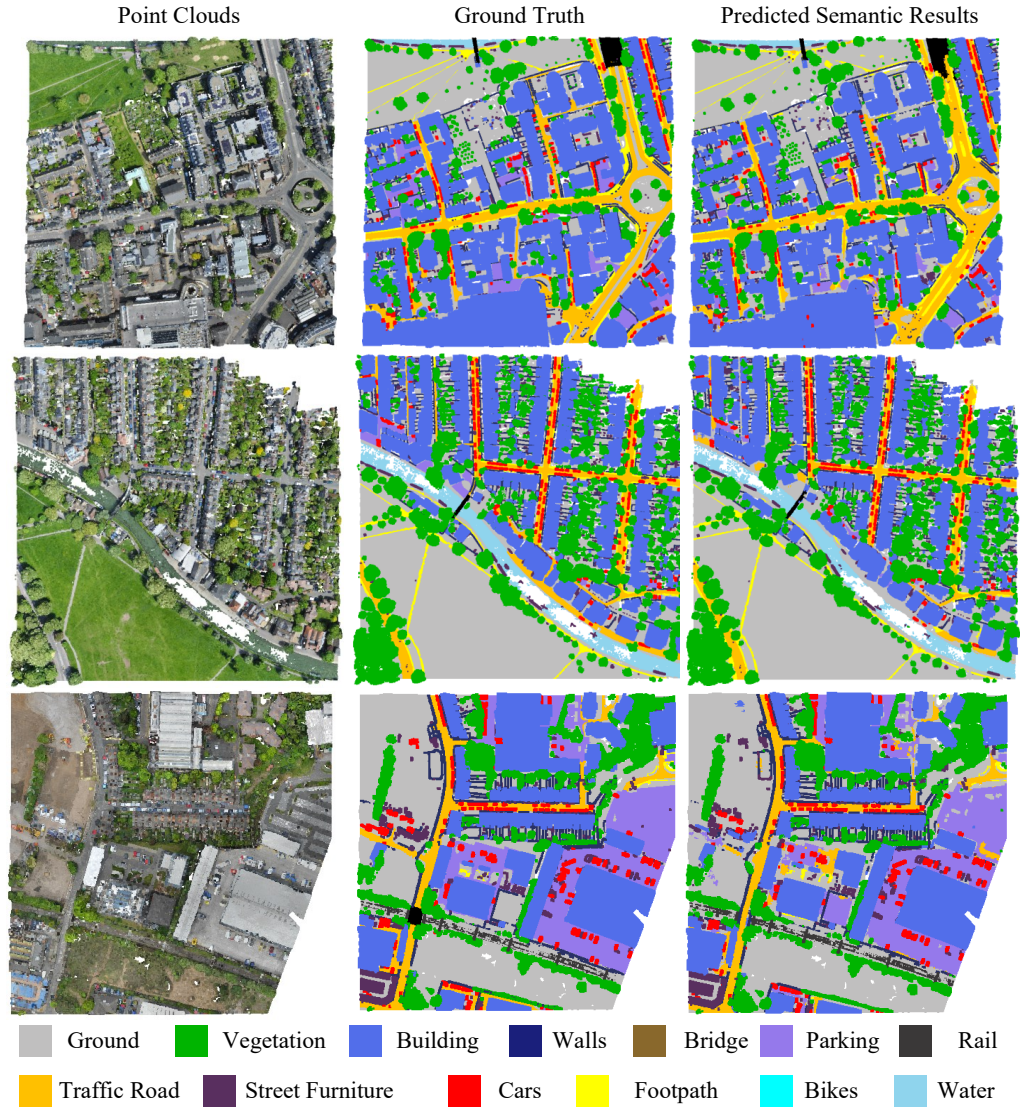
Summary. The paper proposes CitySeg, a 3D open-vocabulary semantic segmentation model for city-scale point clouds. The architecture combines a PTv3 backbone with a local-global cross-attention module, a hierarchical graph over labels intended to reconcile annotation granularity across datasets, a frozen CLIP text encoder, and a two-stage training procedure with a hinge loss. The authors evaluate CitySeg on nine closed-set benchmarks and one open-set benchmark (UrbanBIS), claiming state-of-the-art performance after fine-tuning and, for the shared-weight foundation model, zero-shot generalization in city-scale scenarios without using images.
Significance. If the claims hold, this would be a useful step: it is one of the first attempts at point-only open-vocabulary segmentation for city-scale UAV data, and it provides a systematic treatment of multi-dataset training with hierarchical labels. The paper contains broad comparative experiments across nine datasets and ablations of the main components. However, the headline zero-shot result is currently compromised by a direct contradiction in the benchmark description, and the state-of-the-art claim in the abstract relies on per-dataset fine-tuning rather than on the shared-weight foundation model. The hierarchical graph idea is attractive, but its construction is underspecified for incompatible label semantics. These issues must be resolved before the central contribution can be accepted.
major comments (4)
- [Section 4.2, Open-set Benchmark] There is a direct contradiction in the benchmark setting. The first paragraph lists UrbanBIS among the datasets jointly trained, and the list actually contains ten datasets while saying nine. The very next paragraph says UrbanBIS is excluded from training and used as an unseen test domain. These statements cannot both be true. Since Table 2's zero-shot numbers (OA 89.7, mIoU 65.1) are the central evidence for the paper's main claim, the contradiction must be resolved with an explicit train/test split and, ideally, a data manifest or released checkpoint. Without this, the zero-shot result is unverifiable.
- [Section 3.3, Hierarchical Graph] The hierarchical graph assumes 'each node has exactly one parent node and a unique path from the root node,' while also stating that 'the texts of labels remain unchanged.' This cannot represent a label that appears at different granularities in different datasets: for example, 'car' covers all vehicles in STPLS3D but is one of several vehicle subcategories in DALES. A single tree node cannot simultaneously have 'vehicle' as parent and also be the parent of 'truck'. The paper asserts that annotation rules resolve this, but gives no construction procedure or conflict-resolution protocol. This is load-bearing for the claim that the method generalizes across datasets with inconsistent label semantics.
- [Table 1 and Abstract] The abstract claims 'CitySeg achieves state-of-the-art (SOTA) performance on nine closed-set benchmarks.' Table 1 shows that this is true only for CitySeg-FT, which is fine-tuned on each test dataset. The shared-weight foundation model CitySeg-FM does not consistently beat PTv3 trained per dataset: e.g., on SensatUrban mIoU is 67.8 vs 68.4, and on DALES 80.7 vs 83.2. The claim should be qualified, and the paper should report how many of the nine benchmarks CitySeg-FM actually wins.
- [Section 3.4 and Eq. (7)] The zero-shot inference section is too underspecified. The paper says zero-shot inference is implemented 'analogously to the fine-tuning process, except that parameter updates are disabled,' but it does not explain how a novel label's hierarchical text embedding is obtained when the label is not in the training graph. Does the graph encoder operate on a newly inserted node without gradient updates? How is the parent chosen for a truly unseen label? This matters because Table 2's zero-shot protocol must be reproducible.
minor comments (5)
- [Section 3.1] Typo: 'STPLSD' should be 'STPLS3D'.
- [Section 4.2] Dataset name is spelled inconsistently: 'UrbanBis' in the paragraph and 'UrbanBIS' in the table caption. Also the sentence 'For the joint training of multiple datasets, we further compare CitySeg to PPT [2] and Sonata [68]' appears in the closed-set paragraph, but the open-set paragraph also discusses joint training; clarify which comparisons use which training split.
- [Table 2] The PTv3 entry is cited as [74], but reference [74] is a different paper (Zhao et al., Computers & Graphics); the correct PTv3 citation is [1]. Please verify all references in the tables.
- [Section 4.1] The paper says 'Data augmentation and other hyperparameter settings follow those established for PTv3,' but the specific grid-sampling sizes and local/global sample counts are only partly specified. For reproducibility, please report the full set of preprocessing and training hyperparameters, and clarify whether the CLIP text encoder is used with prompt templates or raw label names.
- [Section 4.4, Ablation on Hierarchical Classification] The text says 'incorporating the hierarchical classification method leads to a substantial increase ... OA improves from 71.4 to 93.6,' but Table 4 shows 'w/o Hier. Class' with OA 71.9, not 71.4. Please correct the inconsistency.
Circularity Check
No circular derivation found; the UrbanBIS train/test contradiction is a validity/reproducibility defect, not a circularity.
full rationale
Walking the derivation chain, CitySeg's core mechanism is a point-text contrastive alignment (Eqs. 6-8) trained against frozen CLIP text embeddings, with a hand-constructed hierarchical graph derived from dataset annotation rules. Nothing in the equations defines the predicted label from the test label itself; the graph and text prompts are inputs, not outputs of the evaluation. The closed-set results are independent benchmark scores, and the open-set UrbanBIS evaluation is explicitly described as held out ('For open-set evaluation, the UrbanBIS [32] dataset is excluded from model training and used as an unseen test domain.'). If that exclusion holds, the zero-shot result is an external test, not a fitted prediction. I find no self-citation chain (PTv3 and CLIP are external, not prior work by these authors), no imported uniqueness theorem, and no ansatz smuggled via citation. The notable issue is an internal contradiction in Section 4.2: the sentence 'CitySeg is jointly trained on 9 city-scale point cloud datasets: SensatUrban [34], Campus3D [71], UrbanBis [32], STPLS3D [46], Swiss3Dcities [35], Hessigheim 3D [33], SUM [72], DALES [24], DUBLINCITY [23], and ECLAIR [73]' lists UrbanBIS as a training dataset (and actually lists ten datasets), while the next paragraph excludes it. If the training list is literal, Table 2's 'zero-shot' UrbanBIS numbers would be in-sample and the flagship claim would collapse; if the exclusion is literal, the numbers are zero-shot but the paper provides no code, checkpoint, or data manifest to confirm the split. This is a serious benchmark-integrity and reproducibility defect, but it is not a circularity of derivation: the paper's own stated protocol is a held-out test, and the contradictory sentence is a reporting error or unresolved ambiguity rather than an equation-level reduction of prediction to input. Hence circularity score 0.
Assumptions & free parameters
free parameters (7)
- temperature tau in Eq. 6
- margin m in hinge loss (Eq. 7)
- alpha loss weight (Eq. 8) =
0.3
- Grid sampling sizes for local and global branches =
0.2 m local, 1 m global
- Local and global sample counts M and 10M =
65536 and 655360
- Number of base categories in first training stage =
5
- Hierarchical graph topology
assumptions (5)
- domain assumption Frozen CLIP text embeddings provide a semantic space suitable for aligning with point cloud features.
- domain assumption PTv3 pretrained features transfer to aerial/city-scale point clouds despite different sensors and densities.
- domain assumption All dataset annotation rules can be represented as a tree with one parent per label.
- domain assumption Grid sampling at 0.2 m and 1 m preserves the semantics needed for city-scale segmentation.
- domain assumption The authors correctly interpret and encode the annotation rules of all 9-10 datasets into the hierarchy.
Cite this review
Pith. "Pith review of CitySeg: A 3D Open Vocabulary Semantic Segmentation Foundation Model in City-scale Scenarios." pith.science (2026). https://pith.science/paper/V23THGSR
@misc{pith2026250809470,
  author       = {Pith},
  title        = {Pith review of: CitySeg: A 3D Open Vocabulary Semantic Segmentation Foundation Model in City-scale Scenarios},
  year         = {2026},
  howpublished = {\url{https://pith.science/paper/V23THGSR}},
  note         = {Machine review of arXiv:2508.09470}
}
read the original abstract
Semantic segmentation of city-scale point clouds is a critical technology for Unmanned Aerial Vehicle (UAV) perception systems, enabling the classification of 3D points without relying on any visual information to achieve comprehensive 3D understanding. However, existing models are frequently constrained by the limited scale of 3D data and the domain gap between datasets, which lead to reduced generalization capability. To address these challenges, we propose CitySeg, a foundation model for city-scale point cloud semantic segmentation that incorporates text modality to achieve open vocabulary segmentation and zero-shot inference. Specifically, in order to mitigate the issue of non-uniform data distribution across multiple domains, we customize the data preprocessing rules, and propose a local-global cross-attention network to enhance the perception capabilities of point networks in UAV scenarios. To resolve semantic label discrepancies across datasets, we introduce a hierarchical classification strategy. A hierarchical graph established according to the data annotation rules consolidates the data labels, and the graph encoder is used to model the hierarchical relationships between categories. In addition, we propose a two-stage training strategy and employ hinge loss to increase the feature separability of subcategories. Experimental results demonstrate that the proposed CitySeg achieves state-of-the-art (SOTA) performance on nine closed-set benchmarks, significantly outperforming existing approaches. Moreover, for the first time, CitySeg enables zero-shot generalization in city-scale point cloud scenarios without relying on visual information.
Figures


Figures from the paper (3 more)


Reference graph
Works this paper leans on
-
[1]
Point transformer v3: Simpler faster stronger,
X. Wu, L. Jiang, P.-S. Wang, Z. Liu, X. Liu, Y . Qiao, W. Ouyang, T. He, and H. Zhao, “Point transformer v3: Simpler faster stronger,” in Proceedings of the IEEE/CVF Conference on Computer Vision and Pat- tern Recognition, 2024, pp. 4840–4851
2024
-
[2]
Towards large-scale 3d representa- tion learning with multi-dataset point prompt train- ing,
X. Wu, Z. Tian, X. Wen, B. Peng, X. Liu, K. Yu, and H. Zhao, “Towards large-scale 3d representa- tion learning with multi-dataset point prompt train- ing,” in Proceedings of the IEEE/CVF Conference on Computer Vision and Pattern Recognition , 2024, pp. 19 551–19 562
work page 2024
-
[3]
Ex- ploring data-efficient 3d scene understanding with contrastive scene contexts,
J. Hou, B. Graham, M. Nießner, and S. Xie, “Ex- ploring data-efficient 3d scene understanding with contrastive scene contexts,” in Proceedings of the IEEE/CVF conference on computer vision and pattern recognition, 2021, pp. 15 587–15 597
work page 2021
-
[4]
Clip2scene: Towards label-efficient 3d scene understanding by clip,
R. Chen, Y . Liu, L. Kong, X. Zhu, Y . Ma, Y . Li, Y . Hou, Y . Qiao, and W. Wang, “Clip2scene: Towards label-efficient 3d scene understanding by clip,” inPro- ceedings of the IEEE/CVF Conference on Computer Vision and Pattern Recognition, 2023, pp. 7020–7030
work page 2023
-
[5]
3d scene un- derstanding by voxel-crf,
B.-s. Kim, P. Kohli, and S. Savarese, “3d scene un- derstanding by voxel-crf,” in Proceedings of the IEEE International Conference on Computer Vision , 2013, pp. 1425–1432
work page 2013
-
[6]
A review of applications and potential applications of uav,
G. Muchiri and S. Kimathi, “A review of applications and potential applications of uav,” in Proceedings of the Sustainable Research and Innovation Conference, 2022, pp. 280–283
work page 2022
-
[7]
Uav for 3d mapping ap- plications: a review,
F. Nex and F. Remondino, “Uav for 3d mapping ap- plications: a review,” Applied geomatics, vol. 6, pp. 1–15, 2014
work page 2014
-
[8]
A re- view on uav-based applications for precision agricul- ture,
D. C. Tsouros, S. Bibi, and P. G. Sarigiannidis, “A re- view on uav-based applications for precision agricul- ture,” Information, vol. 10, no. 11, p. 349, 2019
work page 2019
Show all 81 references
-
[9]
Openscene: 3d scene understanding with open vocabularies,
S. Peng, K. Genova, C. Jiang, A. Tagliasacchi, M. Pollefeys, T. Funkhouser et al., “Openscene: 3d scene understanding with open vocabularies,” in Pro- ceedings of the IEEE/CVF conference on computer vi- sion and pattern recognition, 2023, pp. 815–824
2023
-
[10]
Open-vocabulary 3d semantic segmentation with foundation models,
L. Jiang, S. Shi, and B. Schiele, “Open-vocabulary 3d semantic segmentation with foundation models,” in Proceedings of the IEEE/CVF Conference on Com- puter Vision and Pattern Recognition , 2024, pp. 21 284–21 294
2024
-
[11]
Open- vocabulary 3d semantic segmentation with text-to- image diffusion models,
X. Zhu, H. Zhou, P. Xing, L. Zhao, H. Xu, J. Liang, A. Hauptmann, T. Liu, and A. Gallagher, “Open- vocabulary 3d semantic segmentation with text-to- image diffusion models,” in European Conference on Computer Vision. Springer, 2024, pp. 357–375
2024
-
[12]
Weakly super- vised 3d open-vocabulary segmentation,
K. Liu, F. Zhan, J. Zhang, M. Xu, Y . Yu, A. El Sad- dik, C. Theobalt, E. Xing, and S. Lu, “Weakly super- vised 3d open-vocabulary segmentation,”Advances in Neural Information Processing Systems , vol. 36, pp. 53 433–53 456, 2023
2023
-
[13]
Seg- ment3d: Learning fine-grained class-agnostic 3d seg- mentation without manual labels,
R. Huang, S. Peng, A. Takmaz, F. Tombari, M. Polle- feys, S. Song, G. Huang, and F. Engelmann, “Seg- ment3d: Learning fine-grained class-agnostic 3d seg- mentation without manual labels,” in European Con- ference on Computer Vision . Springer, 2024, pp. 278–295
2024
-
[14]
Re- gionplc: Regional point-language contrastive learning for open-world 3d scene understanding,
J. Yang, R. Ding, W. Deng, Z. Wang, and X. Qi, “Re- gionplc: Regional point-language contrastive learning for open-world 3d scene understanding,” in Proceed- ings of the IEEE/CVF Conference on Computer Vision and Pattern Recognition, 2024, pp. 19 823–19 832
2024
-
[15]
Unim-ov3d: Uni-modality open-vocabulary 3d scene understand- ing with fine-grained feature representation,
Q. He, J. Peng, Z. Jiang, K. Wu, X. Ji, J. Zhang, Y . Wang, C. Wang, M. Chen, and Y . Wu, “Unim-ov3d: Uni-modality open-vocabulary 3d scene understand- ing with fine-grained feature representation,” arXiv preprint arXiv:2401.11395, 2024
2024 arXiv
-
[16]
Segment any point cloud se- quences by distilling vision foundation models,
Y . Liu, L. Kong, J. Cen, R. Chen, W. Zhang, L. Pan, K. Chen, and Z. Liu, “Segment any point cloud se- quences by distilling vision foundation models,” Ad- vances in Neural Information Processing Systems , vol. 36, 2024
2024
-
[17]
3d open-vocabulary panoptic segmen- tation with 2d-3d vision-language distillation,
Z. Xiao, L. Jing, S. Wu, A. Z. Zhu, J. Ji, C. M. Jiang, W.-C. Hung, T. Funkhouser, W. Kuo, A. An- gelova et al., “3d open-vocabulary panoptic segmen- tation with 2d-3d vision-language distillation,” in Eu- ropean Conference on Computer Vision . Springer, 2024, pp. 21–38
2024
-
[18]
Pla: Language-driven open-vocabulary 3d scene un- derstanding,
R. Ding, J. Yang, C. Xue, W. Zhang, S. Bai, and X. Qi, “Pla: Language-driven open-vocabulary 3d scene un- derstanding,” in Proceedings of the IEEE/CVF con- ference on computer vision and pattern recognition , 2023, pp. 7010–7019
2023
-
[19]
Open3dis: Open- vocabulary 3d instance segmentation with 2d mask guidance,
P. Nguyen, T. D. Ngo, E. Kalogerakis, C. Gan, A. Tran, C. Pham, and K. Nguyen, “Open3dis: Open- vocabulary 3d instance segmentation with 2d mask guidance,” in Proceedings of the IEEE/CVF Confer- ence on Computer Vision and Pattern Recognition , 2024, pp. 4018–4028
2024
-
[20]
Search3d: Hierarchi- cal open-vocabulary 3d segmentation,
A. Takmaz, A. Delitzas, R. W. Sumner, F. Engel- mann, J. Wald, and F. Tombari, “Search3d: Hierarchi- cal open-vocabulary 3d segmentation,”IEEE Robotics and Automation Letters, 2025
2025
-
[21]
Pop-3d: Open- vocabulary 3d occupancy prediction from images,
A. V obecky, O. Sim ´eoni, D. Hurych, S. Gidaris, A. Bursuc, P. P ´erez, and J. Sivic, “Pop-3d: Open- vocabulary 3d occupancy prediction from images,” Advances in Neural Information Processing Systems , vol. 36, pp. 50 545–50 557, 2023
2023
-
[22]
Lidarclip or: How i learned to talk to point clouds,
G. Hess, A. Tonderski, C. Petersson, K. ˚Astr¨om, and L. Svensson, “Lidarclip or: How i learned to talk to point clouds,” inProceedings of the IEEE/CVF Winter 13 Conference on Applications of Computer Vision, 2024, pp. 7438–7447
2024
-
[23]
Dublincity: An- notated lidar point cloud and its applications,
S. Zolanvari, S. Ruano, A. Rana, A. Cummins, R. E. Da Silva, M. Rahbar, and A. Smolic, “Dublincity: An- notated lidar point cloud and its applications,” arXiv preprint arXiv:1909.03613, 2019
1909 arXiv
-
[24]
Dales: A large-scale aerial lidar data set for semantic segmenta- tion,
N. Varney, V . K. Asari, and Q. Graehling, “Dales: A large-scale aerial lidar data set for semantic segmenta- tion,” in Proceedings of the IEEE/CVF conference on computer vision and pattern recognition workshops , 2020, pp. 186–187
2020
-
[25]
Grounding dino: Marrying dino with grounded pre-training for open-set object detection,
S. Liu, Z. Zeng, T. Ren, F. Li, H. Zhang, J. Yang, Q. Jiang, C. Li, J. Yang, H. Suet al., “Grounding dino: Marrying dino with grounded pre-training for open-set object detection,” in European Conference on Com- puter Vision. Springer, 2024, pp. 38–55
2024
-
[26]
Learning transferable visual models from natural language supervision,
A. Radford, J. W. Kim, C. Hallacy, A. Ramesh, G. Goh, S. Agarwal, G. Sastry, A. Askell, P. Mishkin, J. Clark et al., “Learning transferable visual models from natural language supervision,” in International conference on machine learning. PMLR, 2021, pp. 8748–8763
2021
-
[27]
Enhancing vehicle detection in intelli- gent transportation systems via autonomous uav plat- form and yolov8 integration,
M. Bakirci, “Enhancing vehicle detection in intelli- gent transportation systems via autonomous uav plat- form and yolov8 integration,” Applied Soft Comput- ing, vol. 164, p. 112015, 2024
2024
-
[28]
Exploring the role of drones and uavs in logistics and supply chain management: a novel text- based literature review,
H. Jahani, Y . Khosravi, B. Kargar, K.-L. Ong, and S. Arisian, “Exploring the role of drones and uavs in logistics and supply chain management: a novel text- based literature review,”International Journal of Pro- duction Research, pp. 1–25, 2024
2024
-
[29]
A review of electric uav visual detection and navigation technologies for emer- gency rescue missions,
P. Tang, J. Li, and H. Sun, “A review of electric uav visual detection and navigation technologies for emer- gency rescue missions,” Sustainability, vol. 16, no. 5, p. 2105, 2024
2024
-
[30]
K-means online-learning routing protocol (k-morp) for un- manned aerial vehicles (uav) adhoc networks,
Z. Ren, K. Hussain, M. Faheem et al. , “K-means online-learning routing protocol (k-morp) for un- manned aerial vehicles (uav) adhoc networks,”Ad Hoc Networks, vol. 154, p. 103354, 2024
2024
-
[31]
Uav-sim: Nerf-based synthetic data generation for uav-based perception,
C. Maxey, J. Choi, H. Lee, D. Manocha, and H. Kwon, “Uav-sim: Nerf-based synthetic data generation for uav-based perception,” in 2024 IEEE International Conference on Robotics and Automation (ICRA) . IEEE, 2024, pp. 5323–5329
2024
-
[32]
Urbanbis: a large-scale benchmark for fine-grained urban building instance segmentation,
G. Yang, F. Xue, Q. Zhang, K. Xie, C.-W. Fu, and H. Huang, “Urbanbis: a large-scale benchmark for fine-grained urban building instance segmentation,” in ACM SIGGRAPH 2023 Conference Proceedings , 2023, pp. 1–11
2023
-
[33]
The hessigheim 3d (h3d) benchmark on semantic segmen- tation of high-resolution 3d point clouds and textured meshes from uav lidar and multi-view-stereo,
M. K ¨olle, D. Laupheimer, S. Schmohl, N. Haala, F. Rottensteiner, J. D. Wegner, and H. Ledoux, “The hessigheim 3d (h3d) benchmark on semantic segmen- tation of high-resolution 3d point clouds and textured meshes from uav lidar and multi-view-stereo,” ISPRS Open Journal of Pho...
2021
-
[34]
Sensaturban: Learning semantics from urban-scale photogrammetric point clouds,
Q. Hu, B. Yang, S. Khalid, W. Xiao, N. Trigoni, and A. Markham, “Sensaturban: Learning semantics from urban-scale photogrammetric point clouds,” Interna- tional Journal of Computer Vision, vol. 130, no. 2, pp. 316–343, 2022
2022
-
[35]
Semantic segmentation on swiss3dcities: A benchmark study on aerial photogrammetric 3d pointcloud dataset,
G. Can, D. Mantegazza, G. Abbate, S. Chappuis, and A. Giusti, “Semantic segmentation on swiss3dcities: A benchmark study on aerial photogrammetric 3d pointcloud dataset,” Pattern Recognition Letters, vol. 150, pp. 108–114, 2021
2021
-
[36]
Meta-rangeseg: Lidar sequence semantic segmentation using multiple fea- ture aggregation,
S. Wang, J. Zhu, and R. Zhang, “Meta-rangeseg: Lidar sequence semantic segmentation using multiple fea- ture aggregation,”IEEE Robotics and Automation Let- ters, vol. 7, no. 4, pp. 9739–9746, 2022
2022
-
[37]
Mvpnet: A multi-scale voxel- point adaptive fusion network for point cloud seman- tic segmentation in urban scenes,
H. Li, H. Guan, L. Ma, X. Lei, Y . Yu, H. Wang, M. R. Delavar, and J. Li, “Mvpnet: A multi-scale voxel- point adaptive fusion network for point cloud seman- tic segmentation in urban scenes,” International Jour- nal of Applied Earth Observation and Geoinforma- tion, vol. 122, ...
2023
-
[38]
Openins3d: Snap and lookup for 3d open-vocabulary instance segmentation,
Z. Huang, X. Wu, X. Chen, H. Zhao, L. Zhu, and J. Lasenby, “Openins3d: Snap and lookup for 3d open-vocabulary instance segmentation,” inEuropean Conference on Computer Vision. Springer, 2024, pp. 169–185
2024
-
[39]
All points matter: entropy-regularized distribution alignment for weakly-supervised 3d segmentation,
L. Tang, Z. Chen, S. Zhao, C. Wang, and D. Tao, “All points matter: entropy-regularized distribution alignment for weakly-supervised 3d segmentation,” Advances in Neural Information Processing Systems , vol. 36, pp. 78 657–78 673, 2023
2023
-
[40]
Randla-net: Ef- ficient semantic segmentation of large-scale point clouds,
Q. Hu, B. Yang, L. Xie, S. Rosa, Y . Guo, Z. Wang, N. Trigoni, and A. Markham, “Randla-net: Ef- ficient semantic segmentation of large-scale point clouds,” in Proceedings of the IEEE/CVF conference on computer vision and pattern recognition, 2020, pp. 11 108–11 117
2020
-
[41]
Kpconv: Flexible and deformable convolution for point clouds,
H. Thomas, C. R. Qi, J.-E. Deschaud, B. Marcotegui, F. Goulette, and L. J. Guibas, “Kpconv: Flexible and deformable convolution for point clouds,” inProceed- ings of the IEEE/CVF international conference on computer vision, 2019, pp. 6411–6420
2019
-
[42]
Push-the-boundary: Boundary-aware feature propa- gation for semantic segmentation of 3d point clouds,
S. Du, N. Ibrahimli, J. Stoter, J. Kooij, and L. Nan, “Push-the-boundary: Boundary-aware feature propa- gation for semantic segmentation of 3d point clouds,” in 2022 International Conference on 3D Vision (3DV). IEEE, 2022, pp. 1–10
2022
-
[43]
Semantic abstraction: Open- world 3d scene understanding from 2d vision- language models,
H. Ha and S. Song, “Semantic abstraction: Open- world 3d scene understanding from 2d vision- language models,” arXiv preprint arXiv:2207.11514 , 2022. 14
2022 arXiv
-
[44]
nuscenes: A multimodal dataset for au- tonomous driving,
H. Caesar, V . Bankiti, A. H. Lang, S. V ora, V . E. Liong, Q. Xu, A. Krishnan, Y . Pan, G. Baldan, and O. Beijbom, “nuscenes: A multimodal dataset for au- tonomous driving,” in Proceedings of the IEEE/CVF conference on computer vision and pattern recogni- tion, 2020, pp. 11 6...
2020
-
[45]
In- door segmentation and support inference from rgbd images,
N. Silberman, D. Hoiem, P. Kohli, and R. Fergus, “In- door segmentation and support inference from rgbd images,” in Computer Vision–ECCV 2012: 12th Eu- ropean Conference on Computer Vision, Florence, Italy, October 7-13, 2012, Proceedings, Part V 12 . Springer, 2012, pp. 746–760
2012
-
[46]
Stpls3d: A large-scale synthetic and real aerial pho- togrammetry 3d point cloud dataset,
M. Chen, Q. Hu, Z. Yu, H. Thomas, A. Feng, Y . Hou, K. McCullough, F. Ren, and L. Soibelman, “Stpls3d: A large-scale synthetic and real aerial pho- togrammetry 3d point cloud dataset,” arXiv preprint arXiv:2203.09065, 2022
2022
-
[47]
Oa-cnns: Omni-adaptive sparse cnns for 3d semantic segmentation,
B. Peng, X. Wu, L. Jiang, Y . Chen, H. Zhao, Z. Tian, and J. Jia, “Oa-cnns: Omni-adaptive sparse cnns for 3d semantic segmentation,” in CVPR, 2024
2024
-
[48]
Learning context-aware classifier for se- mantic segmentation,
Z. Tian, J. Cui, L. Jiang, X. Qi, X. Lai, Y . Chen, S. Liu, and J. Jia, “Learning context-aware classifier for se- mantic segmentation,” in Proceedings of the Thirty- Seventh AAAI Conference on Artificial Intelligence , 2023
2023
-
[49]
Scannet: Richly- annotated 3d reconstructions of indoor scenes,
A. Dai, A. X. Chang, M. Savva, M. Halber, T. Funkhouser, and M. Nießner, “Scannet: Richly- annotated 3d reconstructions of indoor scenes,” in Proceedings of the IEEE conference on computer vi- sion and pattern recognition, 2017, pp. 5828–5839
2017
-
[50]
3d shapenets: A deep representation for volumetric shapes,
Z. Wu, S. Song, A. Khosla, F. Yu, L. Zhang, X. Tang, and J. Xiao, “3d shapenets: A deep representation for volumetric shapes,” in Proceedings of the IEEE con- ference on computer vision and pattern recognition , 2015, pp. 1912–1920
2015
-
[51]
Shapenet: An information-rich 3d model repository,
A. X. Chang, T. Funkhouser, L. Guibas, P. Hanra- han, Q. Huang, Z. Li, S. Savarese, M. Savva, S. Song, H. Su et al., “Shapenet: An information-rich 3d model repository,”arXiv preprint arXiv:1512.03012, 2015
2015 arXiv
-
[52]
3dgraphseg: A unified graph representation- based point cloud segmentation framework for full- range high-speed railway environments,
Y . Geng, Z. Wang, L. Jia, Y . Qin, Y . Chai, K. Liu, and L. Tong, “3dgraphseg: A unified graph representation- based point cloud segmentation framework for full- range high-speed railway environments,”IEEE Trans- actions on Industrial Informatics, vol. 19, no. 12, pp. 11 430–...
2023
-
[53]
K-nearest neighbor,
L. E. Peterson, “K-nearest neighbor,” Scholarpedia, vol. 4, no. 2, p. 1883, 2009
2009
-
[54]
Peano and G
G. Peano and G. Peano, Sur une courbe, qui remplit toute une aire plane. Springer, 1990
1990
-
[55]
Multi-space alignments towards universal lidar segmentation,
Y . Liu, L. Kong, X. Wu, R. Chen, X. Li, L. Pan, Z. Liu, and Y . Ma, “Multi-space alignments towards universal lidar segmentation,” in Proceedings of the IEEE/CVF Conference on Computer Vision and Pattern Recogni- tion, 2024, pp. 14 648–14 661
2024
-
[56]
Open- vocabulary semantic segmentation with mask-adapted clip,
F. Liang, B. Wu, X. Dai, K. Li, Y . Zhao, H. Zhang, P. Zhang, P. Vajda, and D. Marculescu, “Open- vocabulary semantic segmentation with mask-adapted clip,” in Proceedings of the IEEE/CVF Conference on Computer Vision and Pattern Recognition , 2023, pp. 7061–7070
2023
-
[57]
Hierarchical multi-view graph pooling with structure learning,
Z. Zhang, J. Bu, M. Ester, J. Zhang, Z. Li, C. Yao, H. Dai, Z. Yu, and C. Wang, “Hierarchical multi-view graph pooling with structure learning,” IEEE Trans- actions on Knowledge and Data Engineering, vol. 35, no. 1, pp. 545–559, 2021
2021
-
[58]
A comprehensive survey on graph neural net- works,
Z. Wu, S. Pan, F. Chen, G. Long, C. Zhang, and S. Y . Philip, “A comprehensive survey on graph neural net- works,” IEEE transactions on neural networks and learning systems, vol. 32, no. 1, pp. 4–24, 2020
2020
-
[59]
Scaling language-image pre-training via masking,
Y . Li, H. Fan, R. Hu, C. Feichtenhofer, and K. He, “Scaling language-image pre-training via masking,” in Proceedings of the IEEE/CVF Conference on Com- puter Vision and Pattern Recognition , 2023, pp. 23 390–23 400
2023
-
[60]
Representation learning with contrastive predictive coding,
A. v. d. Oord, Y . Li, and O. Vinyals, “Representation learning with contrastive predictive coding,” arXiv preprint arXiv:1807.03748, 2018
2018 arXiv
-
[61]
Are loss functions all the same?
L. Rosasco, E. De Vito, A. Caponnetto, M. Piana, and A. Verri, “Are loss functions all the same?” Neural computation, vol. 16, no. 5, pp. 1063–1076, 2004
2004
-
[62]
Class- incremental exemplar compression for class- incremental learning,
Z. Luo, Y . Liu, B. Schiele, and Q. Sun, “Class- incremental exemplar compression for class- incremental learning,” in Proceedings of the IEEE/CVF Conference on Computer Vision and Pattern Recognition, 2023, pp. 11 371–11 380
2023
-
[63]
Mnemonics training: Multi-class incremental learn- ing without forgetting,
Y . Liu, Y . Su, A.-A. Liu, B. Schiele, and Q. Sun, “Mnemonics training: Multi-class incremental learn- ing without forgetting,” in Proceedings of the IEEE/CVF conference on Computer Vision and Pat- tern Recognition, 2020, pp. 12 245–12 254
2020
-
[64]
Gradient episodic memory for continual learning,
D. Lopez-Paz and M. Ranzato, “Gradient episodic memory for continual learning,” Advances in neural information processing systems, vol. 30, 2017
2017
-
[65]
Pointnet++: Deep hierarchical feature learning on point sets in a metric space,
C. R. Qi, L. Yi, H. Su, and L. J. Guibas, “Pointnet++: Deep hierarchical feature learning on point sets in a metric space,” Advances in neural information pro- cessing systems, vol. 30, 2017
2017
-
[66]
Octformer: Octree-based transformers for 3d point clouds,
P.-S. Wang, “Octformer: Octree-based transformers for 3d point clouds,” ACM Transactions on Graphics (TOG), vol. 42, no. 4, pp. 1–11, 2023
2023
-
[67]
Spherical transformer for lidar-based 3d recognition,
X. Lai, Y . Chen, F. Lu, J. Liu, and J. Jia, “Spherical transformer for lidar-based 3d recognition,” in Pro- ceedings of the IEEE/CVF Conference on Computer Vision and Pattern Recognition , 2023, pp. 17 545– 17 555. 15
2023
-
[68]
Sonata: Self-supervised learning of reliable point representations,
X. Wu, D. DeTone, D. Frost, T. Shen, C. Xie, N. Yang, J. Engel, R. Newcombe, H. Zhao, and J. Straub, “Sonata: Self-supervised learning of reliable point representations,” in CVPR, 2025
2025
-
[69]
Pointcept: A codebase for point cloud perception research,
P. Contributors, “Pointcept: A codebase for point cloud perception research,” https : / / github . com / Pointcept/Pointcept, 2023
2023
-
[70]
Decoupled weight decay regulariza- tion,
I. Loshchilov, “Decoupled weight decay regulariza- tion,” arXiv preprint arXiv:1711.05101, 2017
2017 arXiv
-
[71]
Campus3d: A photogrammetry point cloud benchmark for hierarchical understanding of outdoor scene,
X. Li, C. Li, Z. Tong, A. Lim, J. Yuan, Y . Wu, J. Tang, and R. Huang, “Campus3d: A photogrammetry point cloud benchmark for hierarchical understanding of outdoor scene,” in Proceedings of the 28th ACM In- ternational Conference on Multimedia, 2020, pp. 238– 246
2020
-
[72]
Sum: A benchmark dataset of semantic urban meshes,
W. Gao, L. Nan, B. Boom, and H. Ledoux, “Sum: A benchmark dataset of semantic urban meshes,” ISPRS Journal of Photogrammetry and Remote Sensing, vol. 179, pp. 108–120, 2021
2021
-
[73]
Eclair: A high-fidelity aerial lidar dataset for semantic segmentation,
I. Melekhov, A. Umashankar, H.-J. Kim, V . Serkov, and D. Argyle, “Eclair: A high-fidelity aerial lidar dataset for semantic segmentation,” in Proceedings of the IEEE/CVF Conference on Computer Vision and Pattern Recognition, 2024, pp. 7627–7637
2024
-
[74]
A large-scale point cloud semantic segmentation net- work via local dual features and global correlations,
Y . Zhao, X. Ma, B. Hu, Q. Zhang, M. Ye, and G. Zhou, “A large-scale point cloud semantic segmentation net- work via local dual features and global correlations,” Computers & Graphics, vol. 111, pp. 133–144, 2023
2023
-
[75]
Pointnet: Deep learning on point sets for 3d classification and segmentation,
C. R. Qi, H. Su, K. Mo, and L. J. Guibas, “Pointnet: Deep learning on point sets for 3d classification and segmentation,” inProceedings of the IEEE conference on computer vision and pattern recognition, 2017, pp. 652–660
2017
-
[76]
Tangent convolutions for dense prediction in 3d,
M. Tatarchenko, J. Park, V . Koltun, and Q.-Y . Zhou, “Tangent convolutions for dense prediction in 3d,” in Proceedings of the IEEE conference on computer vi- sion and pattern recognition, 2018, pp. 3887–3896
2018
-
[77]
Large-scale point cloud semantic segmentation with superpoint graphs,
L. Landrieu and M. Simonovsky, “Large-scale point cloud semantic segmentation with superpoint graphs,” in Proceedings of the IEEE conference on computer vision and pattern recognition, 2018, pp. 4558–4567
2018
-
[78]
Lcpformer: To- wards effective 3d point cloud analysis via local con- text propagation in transformers,
Z. Huang, Z. Zhao, B. Li, and J. Han, “Lcpformer: To- wards effective 3d point cloud analysis via local con- text propagation in transformers,” IEEE Transactions on Circuits and Systems for Video Technology, vol. 33, no. 9, pp. 4985–4996, 2023
2023
-
[79]
Mvp-net: multiple view pointwise semantic seg- mentation of large-scale point clouds,
C. Luo, X. Li, N. Cheng, H. Li, S. Lei, and P. Li, “Mvp-net: multiple view pointwise semantic seg- mentation of large-scale point clouds,” arXiv preprint arXiv:2201.12769, 2022
2022 arXiv
-
[80]
Point and voxel cross perception with lightweight cosformer for large-scale point cloud semantic seg- mentation,
S. Zhang, B. Wang, Y . Chen, S. Zhang, and W. Zhang, “Point and voxel cross perception with lightweight cosformer for large-scale point cloud semantic seg- mentation,” International Journal of Applied Earth Observation and Geoinformation, vol. 131, p. 103951, 2024
2024
-
[81]
Semantic seg- mentation of large-scale point cloud scenes via dual neighborhood feature and global spatial-aware,
T. Liu, T. Ma, P. Du, and D. Li, “Semantic seg- mentation of large-scale point cloud scenes via dual neighborhood feature and global spatial-aware,” In- ternational Journal of Applied Earth Observation and Geoinformation, vol. 129, p. 103862, 2024. 16
2024
Reviewed August 5, 2026 · model on record in the stance chip above.
Discussion (0). Sign in to comment.