Chiral Altermagnetic Magnetoelectrics
Pith reviewed 2026-05-18 23:08 UTC · model grok-4.3
The pith
K[Co(HCOO)3] shows chirality-locked altermagnetic spin splitting with dual-mode switchable electric polarization.
A machine-rendered reading of the paper's core claim, the machinery that carries it, and where it could break.
Core claim
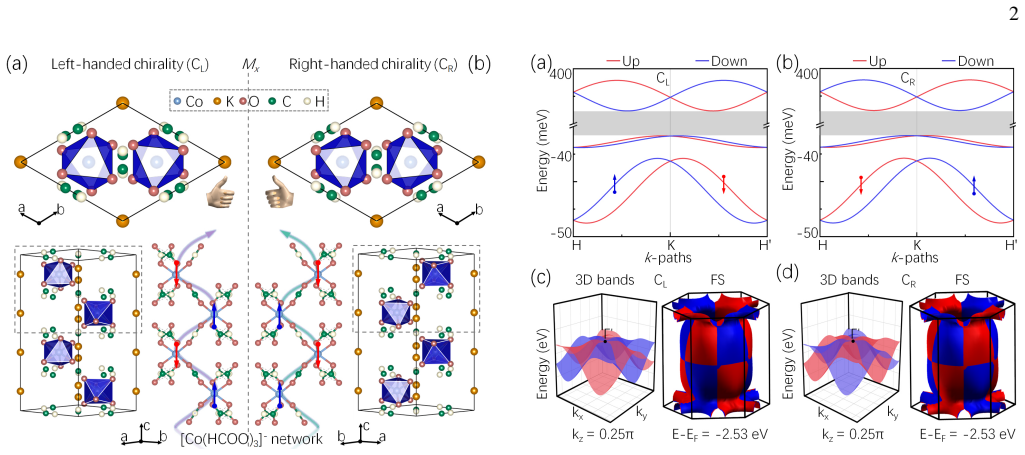
In this work, we introduce a new class of chiral altermagnetic magnetoelectrics in structurally chiral, nonpolar altermagnetic systems and identify the experimentally well-characterized three-dimensional metal-organic framework K[Co(HCOO)3] as a promising material platform. K[Co(HCOO)3] exhibits chirality-locked g-wave altermagnetic spin splitting together with dual-mode switchable electric polarization controlled by Néel-vector reorientation and structural chirality. Specifically, Néel-vector reorientation generates a finite electric polarization and reverses its sign, whereas chirality switching between left- and right-handed enantiomers produces an additional sign reversal. The associated
What carries the argument
Dual-mode switchable electric polarization in K[Co(HCOO)3], where Néel-vector reorientation and structural chirality each independently set the polarization sign while the g-wave altermagnetic spin splitting remains locked to chirality.
If this is right
- Néel-vector reorientation generates a finite electric polarization whose sign reverses with the reorientation.
- Switching between left- and right-handed enantiomers produces an additional sign reversal of the polarization.
- Electronic and optical responses provide readout channels for the controlled states.
- The combination supplies a route to chirality- and Néel-vector-controlled nonvolatile multifunctional spintronics.
Where Pith is reading between the lines
- Analogous dual control might appear in other chiral altermagnetic frameworks if the same locking of spin splitting to handedness holds.
- The mechanism could be combined with existing spintronic architectures to add electric readout without separate electrodes.
- Real-device tests would need to check whether surface or defect contributions alter the bulk-predicted sign reversals.
Load-bearing premise
First-principles calculations on the bulk crystal accurately capture the coupled magnetoelectric response without significant surface or defect effects that would appear in real samples.
What would settle it
Measurement in a single crystal of K[Co(HCOO)3] that shows the electric polarization reversing sign upon Néel-vector reorientation and reversing again upon switching between left- and right-handed structural forms.
Figures


read the original abstract
In this work, we introduce a new class of chiral altermagnetic magnetoelectrics in structurally chiral, nonpolar altermagnetic systems and identify the experimentally well-characterized three-dimensional metal-organic framework K[Co(HCOO)$_3$] as a promising material platform. K[Co(HCOO)$_3$] exhibits chirality-locked \emph{g}-wave altermagnetic spin splitting together with dual-mode switchable electric polarization controlled by N\'eel-vector reorientation and structural chirality. Specifically, N\'eel-vector reorientation generates a finite electric polarization and reverses its sign, whereas chirality switching between left- and right-handed enantiomers produces an additional sign reversal. The associated electronic and optical responses provide effective readout channels for these switchable states. Our results establish chiral altermagnetic magnetoelectrics as a promising route to chirality- and N\'eel-vector-controlled nonvolatile multifunctional spintronics.
Editorial analysis
A structured set of objections, weighed in public.
Referee Report
Summary. The manuscript introduces a new class of chiral altermagnetic magnetoelectrics in structurally chiral, nonpolar altermagnetic systems and identifies the experimentally characterized three-dimensional metal-organic framework K[Co(HCOO)3] as a promising material platform. It reports chirality-locked g-wave altermagnetic spin splitting together with dual-mode switchable electric polarization, where Néel-vector reorientation generates a finite polarization and reverses its sign while structural chirality switching between left- and right-handed enantiomers produces an additional sign reversal. Associated electronic and optical responses are proposed as readout channels, positioning the platform for chirality- and Néel-vector-controlled nonvolatile multifunctional spintronics.
Significance. If the computational predictions hold, the work would be significant for establishing a concrete route to couple altermagnetic order with magnetoelectric control in a chiral nonpolar system, offering potential for multifunctional spintronic devices with nonvolatile switching and effective readout. The choice of an experimentally known MOF strengthens the proposal by providing a bridge to realizable samples.
major comments (1)
- [§4.2 and §5] The central claim that Néel-vector reorientation produces a finite, reversible electric polarization whose sign is controlled by structural chirality rests on first-principles results for the perfect bulk crystal (see §4.2 on magnetoelectric response and §5 on material identification). No supercell defect or slab calculations are referenced to bound the impact of surface termination or vacancies, which could screen the bulk polarization or decouple its sign from the Néel vector in this soft MOF; this is load-bearing for mapping the computed response to observable device behavior.
minor comments (2)
- [Abstract] The abstract states the central effects but provides no quantitative values for the polarization magnitude, spin-splitting energy scale, or error estimates from the DFT calculations.
- [Introduction] Notation for the g-wave altermagnetic splitting and the dual-mode polarization should be defined more explicitly when first introduced to aid readability.
Simulated Author's Rebuttal
We thank the referee for the positive evaluation of our work's significance and for the detailed comment. We address the concern regarding the mapping of bulk first-principles results to observable behavior in the presence of surfaces and defects below.
read point-by-point responses
-
Referee: [§4.2 and §5] The central claim that Néel-vector reorientation produces a finite, reversible electric polarization whose sign is controlled by structural chirality rests on first-principles results for the perfect bulk crystal (see §4.2 on magnetoelectric response and §5 on material identification). No supercell defect or slab calculations are referenced to bound the impact of surface termination or vacancies, which could screen the bulk polarization or decouple its sign from the Néel vector in this soft MOF; this is load-bearing for mapping the computed response to observable device behavior.
Authors: We agree that surface terminations and vacancies represent an important consideration for device applications in a soft MOF such as K[Co(HCOO)3]. Our calculations establish the intrinsic bulk magnetoelectric response arising from the symmetry-allowed coupling between the Néel vector, structural chirality, and electric polarization, as derived in §4.2. This bulk mechanism is protected by the combination of altermagnetic order and the chiral nonpolar space group. In the revised manuscript we have added a paragraph in the discussion section that explicitly acknowledges possible screening by surfaces or defects and outlines mitigation approaches, including the use of high-quality single crystals, encapsulation, or thin-film geometries with controlled interfaces. While the sign reversal tied to Néel-vector reorientation and enantiomer switching remains a symmetry consequence that should persist away from surfaces, we recognize that quantitative bounds on screening would require additional supercell or slab calculations. Such computations are computationally demanding for the large unit cell of this MOF and lie beyond the scope of the present theoretical identification of the material platform; they are planned for follow-up studies. revision: partial
Circularity Check
No significant circularity; derivation is self-contained via independent DFT computations
full rationale
The paper derives its claims about chirality-locked g-wave altermagnetic spin splitting and dual-mode switchable polarization in K[Co(HCOO)3] from first-principles DFT calculations on the bulk crystal, symmetry analysis of the nonpolar altermagnetic structure, and explicit modeling of Néel-vector reorientation and enantiomer switching. These steps produce the reported electric polarization and electronic/optical responses as outputs of the computational workflow rather than by redefinition or fitting of the inputs themselves. No self-citation chain, ansatz smuggling, or fitted-parameter renaming is load-bearing for the central results; the material platform identification rests on external experimental characterization of the MOF combined with the present calculations, which remain falsifiable against independent measurements.
Axiom & Free-Parameter Ledger
axioms (1)
- domain assumption Altermagnetic spin splitting is allowed by symmetry in the chosen crystal class when the Néel vector is oriented appropriately.
Reference graph
Works this paper leans on
- [1]
- [2]
- [3]
-
[4]
H.-Y . Ma, M. Hu, N. Li, J. Liu, W. Yao, J.-F. Jia, and J. Liu, Nat. Commun. 12, 2846 (2021)
work page 2021
-
[5]
X. Zhou, W. Feng, R.-W. Zhang, L. ˇSmejkal, J. Sinova, Y . Mokrousov, and Y . Yao, Phys. Rev. Lett. 132, 056701 (2024)
work page 2024
- [6]
-
[7]
S. Lee, S. Lee, S. Jung, J. Jung, D. Kim, Y . Lee, B. Seok, J. Kim, B. G. Park, L. ˇSmejkal, et al. , Phys. Rev. Lett. 132, 036702 (2024)
work page 2024
-
[8]
J. Ding, Z. Jiang, X. Chen, Z. Tao, Z. Liu, T. Li, J. Liu, J. Sun, J. Cheng, J. Liu, et al., Phys. Rev. Lett. 133, 206401 (2024)
work page 2024
-
[9]
J. Krempask `y, L. ˇSmejkal, S. D’souza, M. Hajlaoui, G. Springholz, K. Uhl´ıˇrov´a, F. Alarab, P. Constantinou, V . Stro- cov, D. Usanov,et al., Nature 626, 517 (2024)
work page 2024
-
[10]
S. Reimers, L. Odenbreit, L. ˇSmejkal, V . N. Strocov, P. Con- stantinou, A. B. Hellenes, R. Jaeschke Ubiergo, W. H. Cam- pos, V . K. Bharadwaj, A. Chakraborty, et al. , Nat. Commun. 15, 2116 (2024)
work page 2024
-
[11]
Y . Che, H. Lv, X. Wu, and J. Yang, Phys. Rev. Lett. 135, 036701 (2025)
work page 2025
- [12]
- [13]
-
[14]
R. Gonz ´alez-Hern´andez, L. ˇSmejkal, K. V `yborn`y, Y . Yahagi, J. Sinova, T. Jungwirth, and J. ˇZelezn`y, Phys. Rev. Lett. 126, 127701 (2021)
work page 2021
-
[15]
H. Bai, Y . C. Zhang, Y . J. Zhou, P. Chen, C. H. Wan, L. Han, W. X. Zhu, S. X. Liang, Y . C. Su, X. F. Han, F. Pan, and C. Song, Phys. Rev. Lett. 130, 216701 (2023)
work page 2023
-
[16]
H. Bai, L. Han, X. Y . Feng, Y . J. Zhou, R. X. Su, Q. Wang, L. Y . Liao, W. X. Zhu, X. Z. Chen, F. Pan, X. L. Fan, and C. Song, Phys. Rev. Lett. 128, 197202 (2022)
work page 2022
- [17]
-
[18]
T. He, L. Li, C. Cui, R.-W. Zhang, Z.-M. Yu, G. Liu, and X. Zhang, Phys. Rev. Lett. 133, 146602 (2024)
work page 2024
-
[19]
L. ˇSmejkal, R. Gonz ´alez-Hern´andez, T. Jungwirth, and J. Sinova, Sci. Adv. 6, eaaz8809 (2020)
work page 2020
-
[20]
Z. Feng, X. Zhou, L. ˇSmejkal, L. Wu, Z. Zhu, H. Guo, R. Gonz´alez-Hern´andez, X. Wang, H. Yan, P. Qin, et al., Nat. Electron. 5, 735 (2022)
work page 2022
-
[21]
T. Sato, S. Haddad, I. C. Fulga, F. F. Assaad, and J. van den Brink, Phys. Rev. Lett. 133, 086503 (2024)
work page 2024
-
[22]
Z. Zhou, X. Cheng, M. Hu, R. Chu, H. Bai, L. Han, J. Liu, F. Pan, and C. Song, Nature 638, 645 (2025)
work page 2025
-
[23]
R. Gonzalez Betancourt, J. Zub ´aˇc, R. Gonzalez-Hernandez, K. Geishendorf, Z. ˇSob´aˇn, G. Springholz, K. Olejn ´ık, L. ˇSmejkal, J. Sinova, T. Jungwirth,et al., Phys. Rev. Lett.130, 036702 (2023)
work page 2023
- [24]
- [25]
-
[26]
L. Han, X. Fu, W. He, Y . Zhu, J. Dai, W. Yang, W. Zhu, H. Bai, C. Chen, C. Wan, et al. , arXiv:2403.13427 (2024), 10.48550/arXiv.2403.13427
-
[27]
X. Zhou, W. Feng, X. Yang, G.-Y . Guo, and Y . Yao, Phys. Rev. B 104, 024401 (2021)
work page 2021
-
[28]
K. Samanta, M. Le ˇzai´c, M. Merte, F. Freimuth, S. Bl¨ugel, and Y . Mokrousov, J. Appl. Phys.127, 213904 (2020)
work page 2020
-
[29]
I. I. Mazin, K. Koepernik, M. D. Johannes, R. Gonz ´alez- Hern´andez, and L. ˇSmejkal, Proc. Natl. Acad. Sci. U.S.A. 118, e2108924118 (2021)
work page 2021
-
[30]
I. Gray, Q. Deng, Q. Tian, M. Chilcote, J. S. Dodge, M. Brahlek, and L. Wu, Appl. Phys. Lett. 125 (2024), 10.1063/5.0244878
-
[31]
W. Sun, C. Yang, W. Wang, Y . Liu, X. Wang, S. Huang, and Z. Cheng, Adv. Mater. , 2502575 (2025)
work page 2025
-
[32]
W. Chen, X. Zhou, W.-K. Lou, and K. Chang, Phys. Rev. B 111, 064428 (2025)
work page 2025
-
[33]
C. Xinfeng, D. Ning, P. Barone, C. Rizza, S. Dong, W. Ren, P. G. Radaelli, G. Gou, and A. Stroppa, arXiv preprint arXiv:2507.06638 (2025), 10.48550/arXiv.2507.06638
- [34]
-
[35]
M. Weber, S. Wust, L. Haag, A. Akashdeep, K. Leck- ron, C. Schmitt, R. Ramos, T. Kikkawa, E. Saitoh, M. Kl ¨aui, et al. , arXiv preprint arXiv:2408.05187 (2024), 10.48550/arXiv.2408.05187
-
[36]
O. Fedchenko, J. Min´ar, A. Akashdeep, S. W. D’Souza, D. Vasi- lyev, O. Tkach, L. Odenbreit, Q. Nguyen, D. Kutnyakhov, N. Wind, et al., Sci. Adv. 10, eadj4883 (2024)
work page 2024
-
[37]
L. ˇSmejkal, A. B. Hellenes, R. Gonz´alez-Hern´andez, J. Sinova, and T. Jungwirth, Phys. Rev. X12, 011028 (2022)
work page 2022
-
[38]
F. Liu, Z. Zhang, X. Yuan, Y . Liu, S. Zhu, Z. Lu, and R. Xiong, Phys. Rev. B 110, 134437 (2024). 6
work page 2024
- [39]
-
[40]
W. Sun, W. Wang, C. Yang, R. Hu, S. Yan, S. Huang, and Z. Cheng, Nano Lett. 24, 11179 (2024)
work page 2024
-
[41]
W. Sun, W. Wang, C. Yang, S. Huang, N. Ding, S. Dong, and Z. Cheng, Adv. Sci. , e03235 (2025)
work page 2025
-
[42]
X. Duan, J. Zhang, Z. Zhu, Y . Liu, Z. Zhang, I. ˇZuti´c, and T. Zhou, Phys. Rev. Lett.134, 106801 (2025)
work page 2025
-
[43]
Y . Zhu, M. Gu, Y . Liu, X. Chen, Y . Li, S. Du, and Q. Liu, Phys. Rev. Lett. 135, 056801 (2025)
work page 2025
-
[44]
M. Gu, Y . Liu, H. Zhu, K. Yananose, X. Chen, Y . Hu, A. Stroppa, and Q. Liu, Phys. Rev. Lett. 134, 106802 (2025)
work page 2025
-
[45]
Z. Zhu, X. Duan, J. Zhang, B. Hao, I. Zutic, and T. Zhou, Nano Letters , 25 (2025)
work page 2025
-
[46]
Z. Guo, X. Wang, W. Wang, G. Zhang, X. Zhou, and Z. Cheng, Adv. Mater. (2025), 10.1002/adma.202505779
- [47]
-
[48]
L. Bai, W. Feng, S. Liu, L. ˇSmejkal, Y . Mokrousov, and Y . Yao, Adv. Funct. Mater. 34, 2409327 (2024)
work page 2024
-
[49]
C. Song, H. Bai, Z. Zhou, L. Han, H. Reichlova, J. H. Dil, J. Liu, X. Chen, and F. Pan, Nat. Rev. Mater. , 1 (2025)
work page 2025
-
[50]
M. Nespolo, M. I. Aroyo, and B. Souvignier, J. Appl. Crystal- logr. 51, 1481 (2018)
work page 2018
- [51]
-
[52]
N. J. Ghimire, A. Botana, J. Jiang, J. Zhang, Y .-S. Chen, and J. Mitchell, Nat. Commun. 9, 3280 (2018)
work page 2018
-
[53]
Y . Fujishiro, N. Kanazawa, R. Kurihara, H. Ishizuka, T. Hori, F. S. Yasin, X. Yu, A. Tsukazaki, M. Ichikawa, M. Kawasaki, et al., Nat. Commun. 12, 317 (2021)
work page 2021
-
[54]
X. Zhou, W. Feng, Y . Li, and Y . Yao, Nano Lett. 23, 5680 (2023)
work page 2023
-
[55]
K. Konishi, M. Nomura, N. Kumagai, S. Iwamoto, Y . Arakawa, and M. Kuwata-Gonokami, Phys. Rev. Lett. 106, 057402 (2011)
work page 2011
- [56]
-
[57]
J. Crassous, M. J. Fuchter, D. E. Freedman, N. A. Kotov, J. Moon, M. C. Beard, and S. Feldmann, Nat. Rev. Mater. 8, 365 (2023)
work page 2023
-
[58]
S. W. Im, H.-Y . Ahn, R. M. Kim, N. H. Cho, H. Kim, Y .-C. Lim, H.-E. Lee, and K. T. Nam, Adv. Mater. 32, 1905758 (2020)
work page 2020
-
[59]
Q. Yang, G. Li, K. Manna, F. Fan, C. Felser, and Y . Sun, Adv. Mater. 32, 1908518 (2020)
work page 2020
-
[60]
X. Wang, Q. Yang, S. Singh, H. Borrmann, V . Hasse, C. Yi, Y . Li, M. Schmidt, X. Li, G. H. Fecher, et al., Nat. Energy 10, 101 (2025)
work page 2025
- [61]
-
[62]
D. S. Sanchez, I. Belopolski, T. A. Cochran, X. Xu, J.-X. Yin, G. Chang, W. Xie, K. Manna, V . S¨uß, C.-Y . Huang,et al., Na- ture 567, 500 (2019)
work page 2019
-
[63]
N. B. Schr ¨oter, D. Pei, M. G. Vergniory, Y . Sun, K. Manna, F. De Juan, J. A. Krieger, V . S¨uss, M. Schmidt, P. Dudin, et al., Nat. Phys. 15, 759 (2019)
work page 2019
-
[64]
M. Z. Hasan, G. Chang, I. Belopolski, G. Bian, S.-Y . Xu, and J.-X. Yin, Nat. Rev. Mater.6, 784 (2021)
work page 2021
-
[65]
G. Chang, S.-Y . Xu, B. J. Wieder, D. S. Sanchez, S.-M. Huang, I. Belopolski, T.-R. Chang, S. Zhang, A. Bansil, H. Lin, et al., Phys. Rev. Lett. 119, 206401 (2017)
work page 2017
- [66]
-
[67]
D. Wang, C. Cui, X.-P. Li, and R.-W. Zhang, Phys. Rev. B107, 195125 (2023)
work page 2023
-
[68]
Z. Duan, Z. Wang, and S. Gao, Dalton Trans. 40, 4465 (2011)
work page 2011
-
[69]
K. Anzenhofer, J. Van Den Berg, P. Cossee, and J. Helle, J. Phys. Chem. Solids 31, 1057 (1970)
work page 1970
- [70]
- [71]
- [72]
-
[73]
H. Zhu, J. Li, X. Chen, Y . Yu, and Q. Liu, Nature Communica- tions 16, 4882 (2025)
work page 2025
-
[74]
Structural chemistry data, software, and insights,
Cambridge Crystallographic Data Centre, “Structural chemistry data, software, and insights,” (2025)
work page 2025
-
[75]
C. Chen, X.-T. Zeng, Z. Chen, Y . Zhao, X.-L. Sheng, and S. A. Yang, Phys. Rev. Lett.128, 026405 (2022)
work page 2022
-
[76]
X. Wang, J. Bai, J. Wang, Z. Cheng, S. Qian, W. Wang, G. Zhang, Z.-M. Yu, and Y . Yao, Adv. Mater. 36, 2407437 (2024)
work page 2024
-
[77]
J. Wang, T.-T. Zhang, Q. Zhang, X. Cheng, W. Wang, S. Qian, Z. Cheng, G. Zhang, and X. Wang, Adv. Funct. Mater. 34, 2316079 (2024)
work page 2024
-
[78]
J. Cao, W. Jiang, X.-P. Li, D. Tu, J. Zhou, J. Zhou, and Y . Yao, Phys. Rev. Lett. 130, 166702 (2023)
work page 2023
-
[79]
P. van Engen, K. Buschow, and M. Erman, J. Magn. Magn. Mater. 30, 374 (1983)
work page 1983
-
[80]
T. Higo, H. Man, D. B. Gopman, L. Wu, T. Koretsune, O. M. J. van’t Erve, Y . P. Kabanov, D. Rees, Y . Li, M.-T. Suzuki, S. Patankar, M. Ikhlas, C. L. Chien, R. Arita, R. D. Shull, J. Orenstein, and S. Nakatsuji, Nat. Photonics 12, 73 (2018)
work page 2018
discussion (0)
Sign in with ORCID, Apple, or X to comment. Anyone can read and Pith papers without signing in.