REVIEW 3 major objections 5 minor 76 references
The Milky Way's molecular disk thickens and warps together, with a ~220 pc unwarped floor, implying warp and flare share one origin.
Reviewed by Pith at T0; open to challenge. T0 means a machine referee read the full paper against a public rubric. the ladder, T0–T4 →
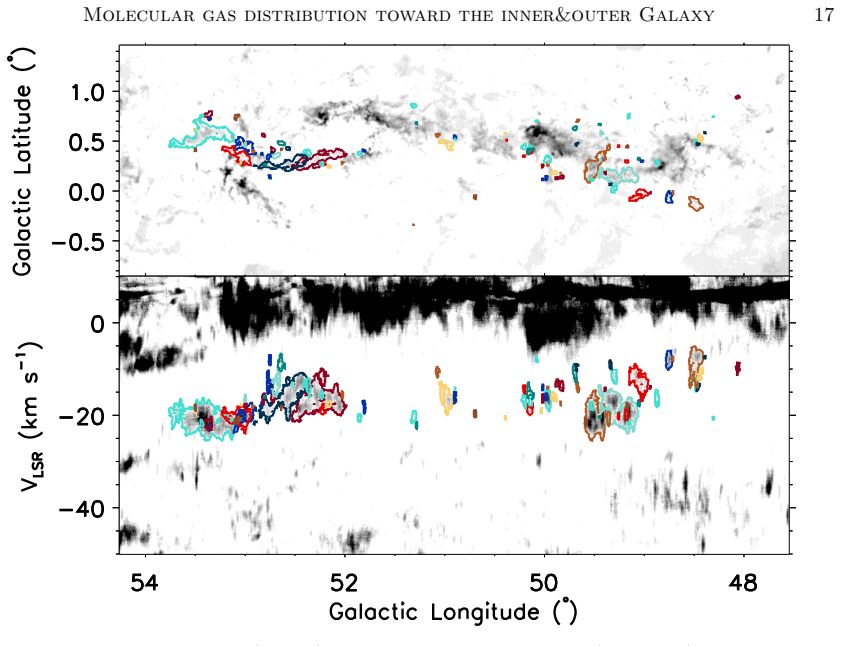
A 24,724-cloud catalog from the MWISP CO survey reveals nearby sheet-like curtain clouds, interarm spurs, a ~220 pc inner molecular disk thickness, and a falling cloud velocity dispersion with galactocentric radius.
T0 review reviewed 2026-08-05 challenge →
load-bearing objection Strong catalog and new structures; the thickness–warp correlation is likely an artifact of distance priors and should not be taken at face value. the 3 major comments →
Molecular Gas Distribution toward the Inner and Outer Galaxy Revealed by MWISP -- the Galactic Longitude 45\deg--60\deg and 120\deg--130\deg
The pith
A machine-rendered reading of the paper's core claim, the machinery that carries it, and where it could break.
The reading
Core claim
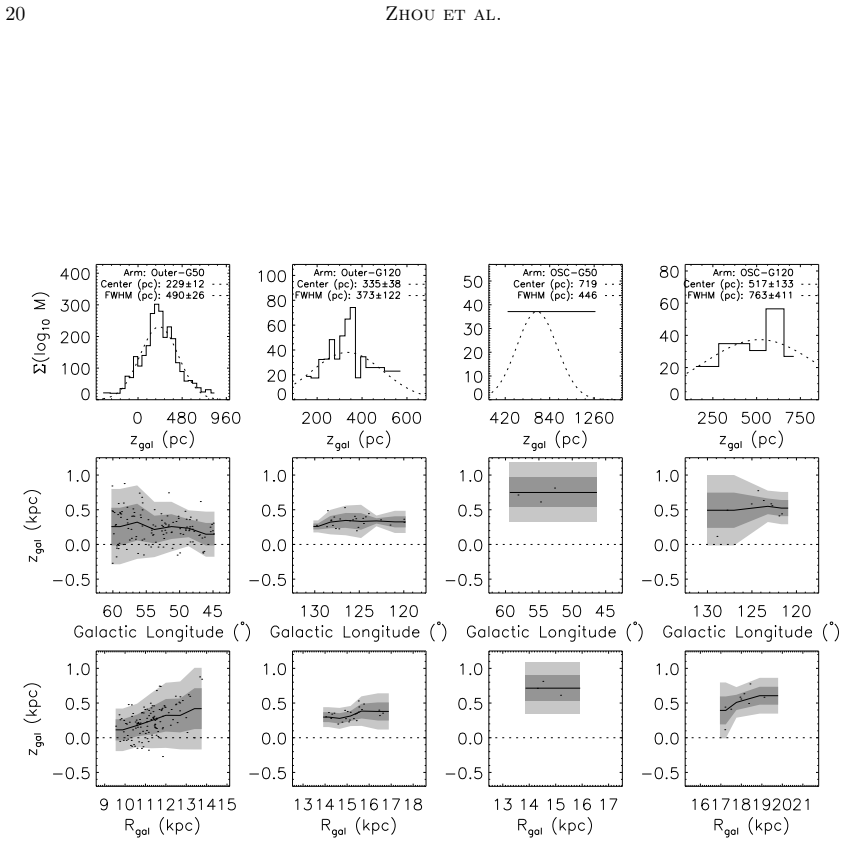
The paper builds a 24,724-cloud catalog from MWISP CO data in two Galactic fields, assigns kinematic distances (with a full distance-probability density function for the ambiguous positive-velocity clouds in G50), and Gaussian-fits each spiral-arm segment's height distribution. The central result is a linear relation between segment FWHM thickness and segment height (warp amplitude), with a ~220 pc intercept at zero warp height. That intercept is read as the molecular disk's intrinsic unwarped thickness, matching the thick molecular disk and thin H I disk in the inner Galaxy. Because segments at similar galactocentric radius that differ in both thickness and warp still fall on the same line,
What carries the argument
The load-bearing object is the catalog of 24,724 molecular clouds extracted by connectivity in position–position–velocity space from the MWISP CO data cubes, combined with per-segment Gaussian fits to the cloud height distribution. Kinematic distances come from the Brand & Blitz rotation curve, with a full distance-probability density function (Reid et al. 2016, 2019) resolving near/far ambiguity for positive-velocity G50 clouds; each spiral-arm segment's zgal histogram is fit by a Gaussian, and the FWHM (thickness) is plotted against the Gaussian center (warp height). The linear fit to that plot carries the central claim.
Load-bearing premise
The inner-Galaxy thickness and warp measurements rest on kinematic distances assigned by a method whose priors assume clouds sit near spiral arms within a disk scale height; if those priors compress the derived heights, the ~220 pc intercept and the thickness–warp correlation could be partly manufactured by the distance assignment rather than measured from the Milky Way.
What would settle it
Measure parallax- or extinction-based distances for a few dozen molecular clouds in the Sagittarius-G50 and Perseus-G50 segments, recompute their zgal heights without the spiral-arm and disk-height priors, and check whether the Gaussian FWHM and the ~220 pc thickness–warp intercept survive; if independent heights give a thinner disk or no linear relation, the reported correlation is a distance-prior artifact.
If this is right
- The molecular disk has an intrinsic FWHM thickness near 220 pc when unwarped, consistent with the thick molecular disk and thin H I disk in the inner Galaxy.
- Warp and flare of the Galactic disk are homologous; models such as a tilted dark halo gain support.
- Inter-arm molecular gas exists as spurs, and the inter-arm disk is thinner than adjacent spiral-arm regions, complicating simple spiral-pattern pictures.
- Kinematic distance errors shrink with galactocentric radius because cloud-to-cloud velocity dispersion falls, improving outer-Galaxy mapping.
- The Perseus-G120 segment's split velocity distribution and large dispersion indicate a spiral shock there, a kinematic signature to test elsewhere.
Where Pith is reading between the lines
- If confirmed with independent distances, the same ~220 pc intercept should appear at other longitudes where the molecular disk can be traced into the warp, making it a global disk property rather than a feature of these two fields.
- The thickness–warp slope could be compared across tracers (H I, stars, molecular gas); a common slope would point to a gravitational, halo-driven origin rather than local gas physics.
- The falling velocity dispersion with radius implies CO-based maps of the outer Galaxy become more distance-accurate farther out, which could sharpen spiral-arm models beyond the solar circle once shock regions like Perseus-G120 are masked.
Editorial analysis
A structured set of objections, weighed in public.
Referee Report
Summary. Using MWISP 12CO, 13CO, and C18O (J=1–0) data, the paper builds a catalog of 24,724 molecular clouds in two Galactic longitude fields, G50 (44.75°–60.25°) and G120 (119.75°–130.25°). It reports new nearby sheet-like 'curtain' clouds, a catalog-based view of spiral-arm aggregation, interarm substructures ('G50 Perseus-Outer interarm spurs'), a thinner molecular layer in the interarm region, a linear correlation between disk thickness and warp height with a ~220 pc unwarped inner-Galaxy thickness, and a decreasing cloud-to-cloud velocity dispersion with galactocentric radius. The catalog and the outer-Galaxy spatial distributions are the main observational deliverables; the thickness–warp correlation is the central physical claim.
Significance. If confirmed, the study provides a valuable public MC catalog (doi:10.57750/sciencedb.21145) from an unbiased survey, with explicit extraction criteria and useful comparisons against GRS, SEDIGISM, CHIMPS, and COHRS. The outer-Galaxy estimates are based on kinematic distances that are comparatively free of the inner-Galaxy near/far ambiguity, making the warp/flare trends in G120 and the outer G50 plausible. The curtain MCs and interarm spurs are observationally interesting, though their physical interpretation remains preliminary. The central claim of a universal thickness–warp relation with a 220 pc intercept is not yet established: it depends on inner-Galaxy distances assigned with a prior-based method that encodes the very disk properties being measured, and the linear fit includes several segments the authors themselves describe as poorly constrained. The potential reward is real, but the required robustness analysis is currently missing.
major comments (3)
- The inner-disk thickness and warp measurements are at risk of circularity. For positive-velocity G50 clouds, distances are assigned using the Reid et al. full distance-probability-density-function method, whose priors include spiral-arm positions and a disk scale height. The paper explicitly warns at the end of Section 3.3 that this sample is 'unsuitable for analysing inter-arm structures or structures distant from the Galactic plane.' Yet Section 3.4 uses exactly these distances for the Gaussian zgal fits of the Sagittarius-G50 and Perseus-G50 segments, which provide the low-warp/low-thickness anchor points of the Fig. 14 linear relation and hence the ~220 pc intercept. The additional 5σ-z cut (zgal ≳ 590 pc) also truncates the high-z tail. Please show quantitatively that the posterior z distribution is not prior-dominated, e.g., via injection-recovery tests, rerunning the analysis with
- The linear thickness–warp fit includes segments whose constraints are acknowledged to be weak: the paper states that the Outer-G120 and OSC-G120 segments are 'not well-constrained due to the limited number of MC samples,' and the Perseus-G120 segment has known distance systematics from the spiral shock. No error bars or covariance are shown for the Gaussian FWHM and mean-z values, and no sensitivity analysis is reported. A linear relation fit to roughly seven points, several of which are poorly constrained or systematically uncertain, is not robust. Please provide segment-by-segment fit parameters with uncertainties and recompute the fitted intercept and slope after removing each questionable segment (especially Perseus-G120 and Outer-G120), and after excluding all G50 positive-velocity/ambiguous-distance clouds.
- The claim that the G50 inter-arm molecular disk is thinner than the adjacent spiral-arm regions is supported only by a visual comparison and a statement that a 'statistical examination' shows significantly smaller variance. The test is not described: no statistic, null distribution, sample definition, or p-value is given. Since the inter-arm sample is selected partly from the distance-ambiguous positive-velocity G50 clouds (Section 3.3), it is important to show that the variance difference is not an artifact of the distance-PDF filtering. Please document the statistical test and provide the relevant numbers.
minor comments (5)
- [Throughout] Typos include 'repectively' (Section 3.1), 'Gravitional' (Introduction), and 'for for CCL4 and CCL5' (Figure 6 caption).
- [Fig. 14] The figure would benefit from visible error bars on both axes and labels identifying each segment, since the fitted relation is the paper's central claim.
- [Fig. 7 / Table 2] The radius definition differs between MWISP clouds (HWHM) and GRS clouds (equivalent radius); please state explicitly in the caption or text that this systematic difference affects the comparison and the fitted slope.
- [Section 3.4] The sentence 'The thickness of the Galactic molecular disk at a distance can be detected in its entirety' is difficult to parse; please rephrase.
- [Section 4] The summary lists 4753 MCs with unreliable distance measurements, but Section 3.3 does not explicitly define this total in one place; please reconcile the exclusion numbers for clarity.
Circularity Check
Inner-disk thickness–warp correlation is partially manufactured: the ambiguous-distance sample whose distances are assigned with a disk/arm-prior PDF is, by the paper's own admission, unsuitable for the thickness/warp analysis that anchors the 220 pc intercept; a self-cited 590 pc prior cut further truncates the sample.
specific steps
-
self definitional
[Section 3.3 and Section 3.4, Figure 14]
"Since this method determines distance probabilities based on the measured deviation of clouds from both the spiral arms and the Galactic disk, the relevant sample is unsuitable for analysing inter-arm structures or structures distant from the Galactic plane."
The full distance-PDF (Reid et al. 2016, 2019) assigns distances to positive-velocity G50 clouds using priors that include the spiral-arm loci and the Galactic disk. Section 3.4 then uses these same distance assignments to measure the vertical thickness (FWHM) and mean height (warp amplitude) of the Sagittarius-G50 and Perseus-G50 segments, which are included in Figure 14 and anchor the low-warp/low-thickness end of the fitted linear relation. The paper itself states this sample is unsuitable for analysing structures distant from the plane or inter-arm structures; using it for the disk-thickness and warp measurement means the output (FWHM ~ 220 pc intercept) is not independent of the assumed disk prior, so the derived thickness-warp correlation is partly self-defined.
-
self citation load bearing
[Section 3.3, distance exclusion; Section 3.4, Figures 12-14]
"we additionally exclude those with mass exceeding the 1σ range of the Larson σv-M relation fitted here and those with heights exceeding the 5σ thickness of the Galactic thick molecular disk (i.e., zgal ≳ 590 pc; Su et al. 2021), to largely eliminate bias from samples affected by near- and far-distance ambiguities. According to this, 4106 MCs are eliminated from the analysis"
The 590 pc height cut is taken from Su et al. (2021), a previous work by overlapping authors, and is used to truncate the ambiguous-distance sample before measuring the height distribution. Section 3.4 then fits Gaussian FWHMs and means to the surviving clouds of the same inner-Galaxy segments. The prior thickness value from the authors' own catalog therefore operates as an input cut on the very quantity later reported as the measured disk thickness; this makes the self-citation load-bearing for the 220 pc intercept and the warp-thickness correlation.
full rationale
The paper is largely a survey paper: the 24,724-cloud catalog, the cloud identification, the outer-Galaxy G120 distances (mostly beyond the tangent-point ambiguity), the inter-arm spur detection, the curtain MCs, and the velocity-dispersion gradient are all independent, externally checkable results and are not circular. The central new physical claim, however, is the linear thickness-warp relation with a ~220 pc unwarped thickness and the inference of homologous origins. That claim depends on the Sagittarius-G50 and Perseus-G50 disk segments (Figure 14). For positive-velocity G50 clouds, distances are assigned by a full distance-probability-density-function method whose priors include the Galactic disk and spiral arms, and the paper explicitly warns this sample is unsuitable for analyzing inter-arm or far-from-plane structures. Section 3.4 nevertheless uses these distances for exactly that purpose, and additionally applies a 5σ cut at 590 pc based on the same group's prior work. The low-warp/low-thickness anchor of the fit is therefore partly generated by the assumed disk prior and by the self-cited truncation, rather than measured independently. The outer-Galaxy segments and the inter-arm-vs-arm thin-disk comparison provide some independent support, so the circularity is partial rather than total; but the headline intercept and the 'homologous origins' conclusion are significantly weakened.
Axiom & Free-Parameter Ledger
free parameters (5)
- Intercept of thickness-warp linear relation =
~220 pc
- Slope of thickness-warp linear relation =
not quoted in text (shown in Figure 14)
- Radial gradient of cloud-to-cloud velocity dispersion =
-0.71 +/- 0.05 km/s/kpc
- Tangent-point velocity offset =
15 km/s
- Larson sigma_v-M fit parameters =
not stated
axioms (6)
- domain assumption Galactic rotation curve of Brand & Blitz (1993) with R0=8.15 kpc and Theta0=236 km/s (Reid et al. 2019)
- domain assumption Full distance-probability density function method (Reid et al. 2016, 2019) with priors on spiral arm locations and disk scale height
- domain assumption X_CO conversion factor N(H2)/W(12CO)=1.8e20 cm-2 (K km/s)-1 (Dame et al. 2001)
- domain assumption Sun's height above Galactic midplane = 15.7 pc (Zhou et al. 2023; Su et al. 2019)
- domain assumption Larson relations are valid for Milky Way MCs and can be used to reject near/far distance solutions
- domain assumption Perseus arm spiral shock model (Roberts 1972; Schwarz et al. 1995)
invented entities (1)
-
Curtain molecular clouds
independent evidence
Cite this review
Pith. "Pith review of Molecular Gas Distribution toward the Inner and Outer Galaxy Revealed by MWISP -- the Galactic Longitude 45\deg--60\deg and 120\deg--130\deg." pith.science (2026). https://pith.science/paper/P6JY3UKK
@misc{pith2026250814547,
  author       = {Pith},
  title        = {Pith review of: Molecular Gas Distribution toward the Inner and Outer Galaxy Revealed by MWISP -- the Galactic Longitude 45\deg--60\deg and 120\deg--130\deg},
  year         = {2026},
  howpublished = {\url{https://pith.science/paper/P6JY3UKK}},
  note         = {Machine review of arXiv:2508.14547}
}
abstract
Molecular clouds (MCs) are cradles of star and planet formation, thereby playing an important role in the evolution of galaxies. Based on the unbiased Milky Way Imaging Scroll Painting (MWISP) survey data of $^{12}$CO, $^{13}$CO, and C$^{18}$O (J=1--0) line emission in two regions toward the inner and outer Galaxy, i.e. the G50 ($44.75\deg \le l \le 60.25\deg$) and G120 ($119.75\deg \le l \le 130.25\deg$) regions, the distribution of molecular gas is studied. Both regions have Galactic latitudes of $|b| \le 5.25\deg$. A catalog containing 24724 MCs is constructed from the data. In our proximity, several molecular structures with large angular scales and small velocity dispersions are discovered, resembling curtains of mist. Beyond the nearby molecular gas, a clear aggregation of MCs along coherent structures in the Galactic plane is visible, sketching spiral arm structures. Nevertheless, the aggregation of MCs is also detected in the inter-arm region between the Perseus and Outer arms in the G50 region. The Galactic molecular disk in this inter-arm region is found to be thinner than that in the adjacent spiral arm region. In addition, the thickness of the Galactic molecular disk examined here is found to be correlated with the warp of it, indicating their homologous origins. The molecular disk has a typical thickness of ~220 pc in the inner Galaxy. Moreover, the dispersion of the MC systemic velocity decreases with increasing galactocentric radius, resulting in lower kinematic distance uncertainties at larger radii. However, the Perseus arm segment in the G120 region exhibits a relatively large cloud-to-cloud velocity dispersion and split components in its MC velocity distribution.
Figures






Reference graph
Works this paper leans on
-
[1]
Bergin, E. A., & Tafalla, M. 2007, ARA&A, 45, 339, doi: 10.1146/annurev.astro.45.071206.100404
arXiv 2007
-
[2]
Braiding, C., Burton, M. G., Blackwell, R., et al. 2015, PASA, 32, e020, doi: 10.1017/pasa.2015.20 Molecular gas distribution toward the inner&outer Galaxy 27
-
[3]
Braiding, C., Wong, G. F., Maxted, N. I., et al. 2018, PASA, 35, e029, doi: 10.1017/pasa.2018.18
-
[4]
1993, A&A, 275, 67
Brand, J., & Blitz, L. 1993, A&A, 275, 67
1993
-
[5]
G., Braiding, C., Glueck, C., et al
Burton, M. G., Braiding, C., Glueck, C., et al. 2013, PASA, 30, e044, doi: 10.1017/pasa.2013.22
-
[6]
Carpenter, J. M., & Sanders, D. B. 1998, AJ, 116, 1856, doi: 10.1086/300534
doi:10.1086/300534 1998
-
[7]
2019, Nature Astronomy, 3, 320, doi: 10.1038/s41550-018-0686-7
Chen, X., Wang, S., Deng, L., et al. 2019, Nature Astronomy, 3, 320, doi: 10.1038/s41550-018-0686-7
-
[8]
2023, AJ, 165, 16, doi: 10.3847/1538-3881/ac9ea2
Chen, X., Sun, L., Feng, J., et al. 2023, AJ, 165, 16, doi: 10.3847/1538-3881/ac9ea2
-
[9]
2020, SSRv, 216, 50, doi: 10.1007/s11214-020-00674-x
Vazquez-Semadeni, E., et al. 2020, SSRv, 216, 50, doi: 10.1007/s11214-020-00674-x
-
[10]
Clarke, S. D., Jaffa, S. E., & Whitworth, A. P. 2022, MNRAS, 516, 2782, doi: 10.1093/mnras/stac2318
-
[11]
Solomon, P. M. 1986, ApJS, 60, 297, doi: 10.1086/191087
-
[12]
2015, MNRAS, 454, 2067, doi: 10.1093/mnras/stv2063
Duarte-Cabral, A., & Hughes, A. 2015, MNRAS, 454, 2067, doi: 10.1093/mnras/stv2063
-
[13]
2019, MNRAS, 483, 4291, doi: 10.1093/mnras/sty3283
Colombo, D., Rosolowsky, E., Duarte-Cabral, A., et al. 2019, MNRAS, 483, 4291, doi: 10.1093/mnras/sty3283
-
[14]
Cubuk, K. O., Burton, M. G., Braiding, C., et al. 2023, PASA, 40, e047, doi: 10.1017/pasa.2023.44
-
[15]
Dame, T. M. 2011, arXiv e-prints, arXiv:1101.1499. https://arxiv.org/abs/1101.1499
Pith/arXiv arXiv 2011
-
[16]
M., Hartmann, D., & Thaddeus, P
Dame, T. M., Hartmann, D., & Thaddeus, P. 2001, ApJ, 547, 792, doi: 10.1086/318388
doi:10.1086/318388 2001
-
[17]
Dame, T. M., & Thaddeus, P. 2011, ApJL, 734, L24, doi: 10.1088/2041-8205/734/1/L24 —. 2022, ApJS, 262, 5, doi: 10.3847/1538-4365/ac7e53
-
[18]
Dickey, J. M., & Lockman, F. J. 1990, ARA&A, 28, 215, doi: 10.1146/annurev.aa.28.090190.001243
-
[19]
Duarte-Cabral, A., Colombo, D., Urquhart, J. S., et al. 2021, The SEDIGISM survey: molecular clouds in the inner Galaxy, OUP, doi: 10.1093/mnras/staa2480
- [20]
-
[21]
Dutra, C. M., & Bica, E. 2002, A&A, 383, 631, doi: 10.1051/0004-6361:20011761 Gaia Collaboration, Drimmel, R., Romero-G´ omez, M., et al. 2023, A&A, 674, A37, doi: 10.1051/0004-6361/202243797
-
[22]
Goldsmith, P. F., & Langer, W. D. 1978, ApJ, 222, 881, doi: 10.1086/156206
doi:10.1086/156206 1978
-
[23]
A., Lebrun, F., Arnaud, M., Dame, T
Grenier, I. A., Lebrun, F., Arnaud, M., Dame, T. M., & Thaddeus, P. 1989, ApJ, 347, 231, doi: 10.1086/168112
-
[24]
J., Conroy, C., & Hernquist, L
Han, J. J., Conroy, C., & Hernquist, L. 2023, Nature Astronomy, 7, 1481, doi: 10.1038/s41550-023-02076-9
-
[25]
Heyer, M., & Dame, T. M. 2015, ARA&A, 53, 583, doi: 10.1146/annurev-astro-082214-122324
-
[26]
Heyer, M. H., Brunt, C., Snell, R. L., et al. 1998, ApJS, 115, 241, doi: 10.1086/313086
doi:10.1086/313086 1998
-
[27]
Heyer, M. H., Carpenter, J. M., & Snell, R. L. 2001, ApJ, 551, 852, doi: 10.1086/320218
doi:10.1086/320218 2001
-
[28]
1934, ApJ, 79, 8, doi: 10.1086/143517
Hubble, E. 1934, ApJ, 79, 8, doi: 10.1086/143517
-
[29]
Jackson, J. M., Rathborne, J. M., Shah, R. Y., et al. 2006, ApJS, 163, 145, doi: 10.1086/500091
doi:10.1086/500091 2006
-
[30]
L., Noriega-Crespo, A., & Martin, P
Karr, J. L., Noriega-Crespo, A., & Martin, P. G. 2005, AJ, 129, 954, doi: 10.1086/426912 Kauffmann, J., Bertoldi, F., Bourke, T. L.,
-
[31]
Evans, N. J., I., & Lee, C. W. 2008, A&A, 487, 993, doi: 10.1051/0004-6361:200809481
-
[32]
M., Ward-Thompson, D., Di Francesco, J., et al
Kirk, J. M., Ward-Thompson, D., Di Francesco, J., et al. 2009, ApJS, 185, 198, doi: 10.1088/0067-0049/185/1/198
-
[33]
Larson, R. B. 1981, MNRAS, 194, 809, doi: 10.1093/mnras/194.4.809 28 Zhou et al
-
[34]
Levine, E. S., Blitz, L., & Heiles, C. 2006, ApJ, 643, 881, doi: 10.1086/503091
doi:10.1086/503091 2006
-
[35]
Lockman, F. J., & Gehman, C. S. 1991, ApJ, 382, 182, doi: 10.1086/170706
-
[36]
Lynds, B. T. 1962, ApJS, 7, 1, doi: 10.1086/190072
doi:10.1086/190072 1962
-
[37]
Narayan, C. A., & Jog, C. J. 2002, A&A, 394, 89, doi: 10.1051/0004-6361:20021128
-
[38]
R., Colombo, D., Duarte-Cabral, A., et al
Neralwar, K. R., Colombo, D., Duarte-Cabral, A., et al. 2022a, A&A, 664, A84, doi: 10.1051/0004-6361/202142513 —. 2022b, A&A, 663, A56, doi: 10.1051/0004-6361/202142428
-
[39]
Olling, R. P., & Merrifield, M. R. 2000, MNRAS, 311, 361, doi: 10.1046/j.1365-8711.2000.03053.x Planck Collaboration, Ade, P. A. R., Aghanim, N., et al. 2016, A&A, 594, A28, doi: 10.1051/0004-6361/201525819 Ram´ on-Fox, F. G., & Bonnell, I. A. 2018, MNRAS, 474, 2028, doi: 10.1093/mnras/stx2866
arXiv 2000
-
[40]
Rathborne, J. M., Johnson, A. M., Jackson, J. M., Shah, R. Y., & Simon, R. 2009, ApJS, 182, 131, doi: 10.1088/0067-0049/182/1/131
-
[41]
2016, ApJ, 823, 77, doi: 10.3847/0004-637X/823/2/77
Brunthaler, A. 2016, ApJ, 823, 77, doi: 10.3847/0004-637X/823/2/77
-
[42]
Reid, M. J., Menten, K. M., Brunthaler, A., et al. 2019, ApJ, 885, 131, doi: 10.3847/1538-4357/ab4a11
-
[43]
Beaumont, C., & Dame, T. M. 2016, ApJ, 822, 52, doi: 10.3847/0004-637X/822/1/52
-
[44]
Rigby, A. J., Moore, T. J. T., Eden, D. J., et al. 2019, A&A, 632, A58, doi: 10.1051/0004-6361/201935236
-
[45]
1972, ApJ, 173, 259, doi: 10.1086/151418
Roberts, William W., J. 1972, ApJ, 173, 259, doi: 10.1086/151418
-
[46]
Roman-Duval, J., Jackson, J. M., Heyer, M., et al. 2009, ApJ, 699, 1153, doi: 10.1088/0004-637X/699/2/1153
-
[47]
2010, ApJ, 723, 492, doi: 10.1088/0004-637X/723/1/492
Rathborne, J., & Simon, R. 2010, ApJ, 723, 492, doi: 10.1088/0004-637X/723/1/492
-
[48]
Solomon, P. M. 1986, ApJS, 60, 1, doi: 10.1086/191086
-
[49]
Schuller, F., Csengeri, T., Urquhart, J. S., et al. 2017, A&A, 601, A124, doi: 10.1051/0004-6361/201628933
-
[50]
Schuller, F., Urquhart, J. S., Csengeri, T., et al. 2021, MNRAS, 500, 3064, doi: 10.1093/mnras/staa2369
- [51]
-
[52]
Shan, W. L., Yang, J., Shi, S. C., et al. 2012, IEEE Transactions on Terahertz Science and Technology, 2, 593, doi: 10.1109/TTHZ.2012.2213818
-
[53]
Shirley, Y. L. 2015, PASP, 127, 299, doi: 10.1086/680342
doi:10.1086/680342 2015
-
[54]
Klessen, R. S., & Springel, V. 2014, MNRAS, 441, 1628, doi: 10.1093/mnras/stu616
-
[55]
1987, ApJ, 319, 730, doi: 10.1086/165493
Yahil, A. 1987, ApJ, 319, 730, doi: 10.1086/165493
doi:10.1086/165493 1987
-
[56]
Stark, A. A. 1984, ApJ, 281, 624, doi: 10.1086/162137
-
[57]
Stark, A. A., & Brand, J. 1989, ApJ, 339, 763, doi: 10.1086/167334
doi:10.1086/167334 1989
-
[58]
2019, ApJS, 240, 9, doi: 10.3847/1538-4365/aaf1c8
Su, Y., Yang, J., Zhang, S., et al. 2019, ApJS, 240, 9, doi: 10.3847/1538-4365/aaf1c8
-
[59]
2020, ApJ, 893, 91, doi: 10.3847/1538-4357/ab7fff —
Su, Y., Yang, J., Yan, Q.-Z., et al. 2020, ApJ, 893, 91, doi: 10.3847/1538-4357/ab7fff —. 2021, ApJ, 910, 131, doi: 10.3847/1538-4357/abe5ab
-
[60]
2023, Research in Astronomy and Astrophysics, 23, 015019, doi: 10.1088/1674-4527/aca64a
Sun, L., Chen, X., Feng, J., et al. 2023, Research in Astronomy and Astrophysics, 23, 015019, doi: 10.1088/1674-4527/aca64a
-
[61]
Sun, Y., Xu, Y., Yang, J., et al. 2015, ApJL, 798, L27, doi: 10.1088/2041-8205/798/2/L27 Molecular gas distribution toward the inner&outer Galaxy 29
-
[62]
2020, ApJS, 246, 7, doi: 10.3847/1538-4365/ab5b97
Sun, Y., Yang, J., Xu, Y., et al. 2020, ApJS, 246, 7, doi: 10.3847/1538-4365/ab5b97
-
[63]
2021, ApJS, 256, 32, doi: 10.3847/1538-4365/ac11fe
Sun, Y., Yang, J., Yan, Q.-Z., et al. 2021, ApJS, 256, 32, doi: 10.3847/1538-4365/ac11fe
-
[64]
2024, ApJL, 977, L35, doi: 10.3847/2041-8213/ad9605
Sun, Y., Yang, J., Zhang, S., et al. 2024, ApJL, 977, L35, doi: 10.3847/2041-8213/ad9605
-
[65]
2017, PASJ, 69, 78, doi: 10.1093/pasj/psx061 Vall´ ee, J
Umemoto, T., Minamidani, T., Kuno, N., et al. 2017, PASJ, 69, 78, doi: 10.1093/pasj/psx061 Vall´ ee, J. P. 2008, AJ, 135, 1301, doi: 10.1088/0004-6256/135/4/1301 —. 2020, ApJ, 896, 19, doi: 10.3847/1538-4357/ab8eab
-
[66]
Wouterloot, J. G. A., Brand, J., Burton, W. B., & Kwee, K. K. 1990, A&A, 230, 21
1990
-
[67]
Xu, Y., Reid, M. J., Zheng, X. W., & Menten, K. M. 2006, Science, 311, 54, doi: 10.1126/science.1120914
-
[68]
2020, ApJ, 898, 80, doi: 10.3847/1538-4357/ab9f9c
Yan, Q.-Z., Yang, J., Su, Y., Sun, Y., & Wang, C. 2020, ApJ, 898, 80, doi: 10.3847/1538-4357/ab9f9c
-
[69]
2022, AJ, 164, 55, doi: 10.3847/1538-3881/ac77ea
Yan, Q.-Z., Yang, J., Su, Y., et al. 2022, AJ, 164, 55, doi: 10.3847/1538-3881/ac77ea
-
[70]
1990, ApJ, 362, 538, doi: 10.1086/169290
Chen, H. 1990, ApJ, 362, 538, doi: 10.1086/169290
-
[71]
1995, ApJ, 455, 175, doi: 10.1086/176565
Yang, J., Ohashi, N., & Fukui, Y. 1995, ApJ, 455, 175, doi: 10.1086/176565
-
[72]
1991, ApJ, 373, 137, doi: 10.1086/170032
Yang, J., Umemoto, T., Iwata, T., & Fukui, Y. 1991, ApJ, 373, 137, doi: 10.1086/170032
-
[73]
Cloud-to-cloud velocity dispersions across a Local arm segment
Yuan, L., & Yang, J. 2025, arXiv e-prints, arXiv:2506.13424, doi: 10.48550/arXiv.2506.13424
work page internal anchor Pith review Pith/arXiv arXiv doi:10.48550/arxiv.2506.13424 2025
-
[74]
2021, ApJS, 257, 51, doi: 10.3847/1538-4365/ac242a
Yuan, L., Yang, J., Du, F., et al. 2021, ApJS, 257, 51, doi: 10.3847/1538-4365/ac242a
-
[75]
2023, ApJS, 268, 61, doi: 10.3847/1538-4365/acee7f
Zhou, X., Su, Y., Yang, J., et al. 2023, ApJS, 268, 61, doi: 10.3847/1538-4365/acee7f
-
[76]
Zucker, C., Goodman, A. A., Alves, J., et al. 2022, Nature, 601, 334, doi: 10.1038/s41586-021-04286-5
This paper was first reviewed by deepseek-v4-flash on August 5, 2026.
discussion (0)
Sign in with ORCID, Apple, or X to comment. Anyone can read and Pith papers without signing in.