Generation of Quantum Entanglement in Autonomous Thermal Machines: Effects of Non-Markovianity, Hilbert Space Structure, and Quantum Coherence
Pith reviewed 2026-05-18 21:34 UTC · model grok-4.3
The pith
A quantum autonomous thermal machine generates entanglement in an external system only through one thermodynamic cycle tied to stronger non-Markovian effects.
A machine-rendered reading of the paper's core claim, the machinery that carries it, and where it could break.
Core claim
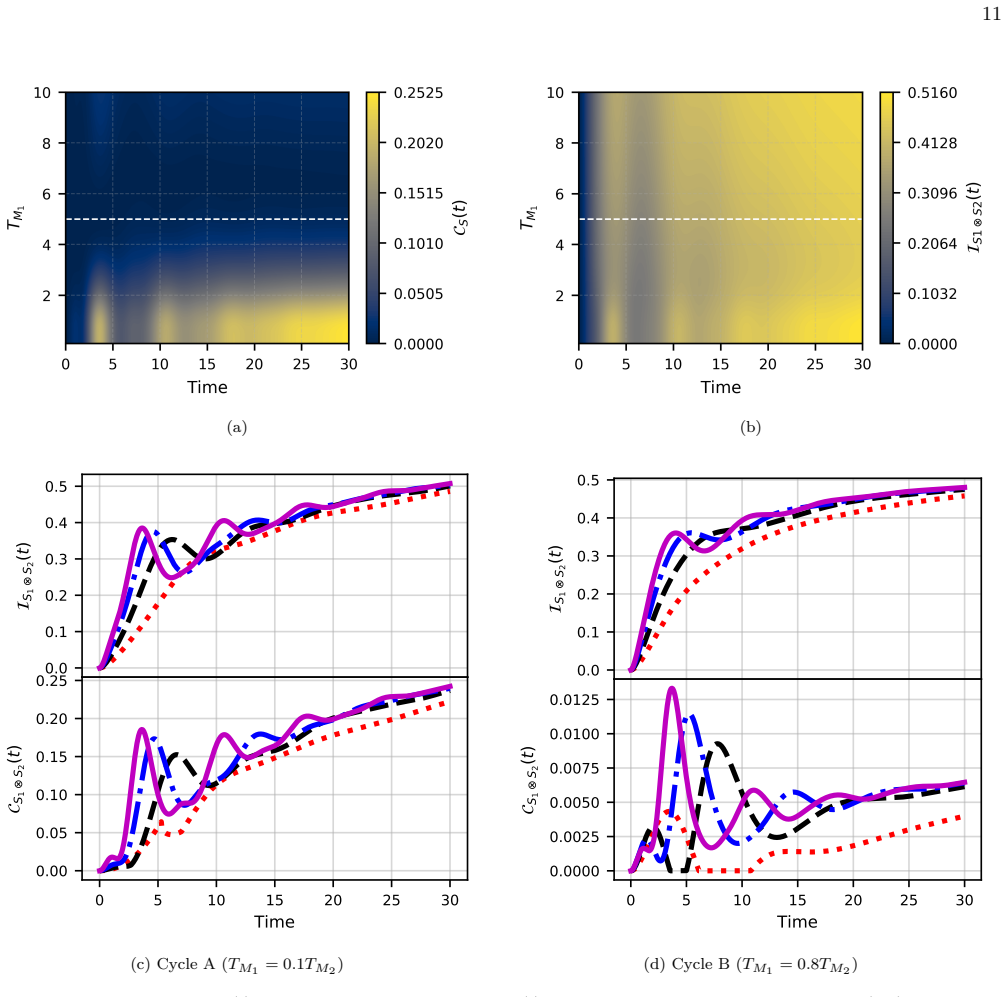
The QATM acts as a structured reservoir that induces non-Markovian dynamics, evidenced by negative entropy production rates, and generates entanglement in the external system solely under cycle A. This cycle is distinguished by its virtual temperature configuration and energy level structure that support higher coherence correlations, while cycle B does not produce entanglement. Mutual information and concurrence both confirm the presence of entanglement only when the system follows cycle A.
What carries the argument
The definition of two thermodynamic cycles (A and B) arising from the common interaction between QATM qubits and external qubits, governed by virtual temperatures and energy-conserving transitions.
Load-bearing premise
The common interaction between the QATM qubits and the external system qubits permits the clean separation into two distinct thermodynamic cycles A and B.
What would settle it
A numerical simulation or experiment that finds nonzero concurrence under cycle B, or finds that negative entropy production rates fail to correlate with entanglement measures in cycle A, would contradict the central claim.
Figures



read the original abstract
We present a theoretical investigation of entanglement generation in an external quantum system via interaction with a quantum autonomous thermal machine (QATM) under non-Markovian dynamics. The QATM, composed of two qubits each coupled to independent thermal reservoirs, interacts with an external system of two additional qubits. By analyzing the Hilbert space structure, energy level configurations, and temperature gradients, we define a common interaction between the QATM qubits and the external system qubits, which allows the definition of two thermodynamic cycles (A and B) governed by virtual temperatures and energy-conserving transitions. We demonstrate that the QATM can act as a structured reservoir capable of inducing non-Markovian memory effects, as highlighted by negative entropy production rates. Using mutual information and concurrence, we show that entanglement is generated only under cycle A, which is associated with stronger non-Markovian behavior and higher coherence correlations. Our results demonstrate that temperature differences, Hilbert space structure, and coherence serve as quantum resources for controlling and enhancing entanglement in quantum thermodynamic settings, with parameters consistent with experimental superconducting qubit platforms.
Editorial analysis
A structured set of objections, weighed in public.
Referee Report
Summary. The manuscript investigates the generation of quantum entanglement in an external two-qubit system through interaction with a quantum autonomous thermal machine (QATM) under non-Markovian dynamics. The QATM consists of two qubits coupled to independent thermal baths, and a common interaction with the external qubits is defined to partition the system into two thermodynamic cycles, A and B, based on virtual temperatures and energy-conserving transitions. The authors use measures of mutual information and concurrence to show that entanglement is generated only in cycle A, which is linked to stronger non-Markovian effects (negative entropy production) and higher coherence. The work positions temperature gradients, Hilbert space structure, and coherence as controllable quantum resources for entanglement in thermodynamic settings, with parameters suitable for superconducting qubit experiments.
Significance. If the central claims hold, this work would demonstrate a mechanism for using autonomous thermal machines to induce entanglement via non-Markovianity and coherence, offering a resource-based approach in quantum thermodynamics. The explicit connection to experimental platforms strengthens its relevance. The analysis of Hilbert space structure and cycle definitions provides a structured way to control entanglement generation.
major comments (1)
- §3 and Figure 2: The partitioning into cycles A and B relies on specific energy level configurations and the form of the interaction Hamiltonian. The paper should demonstrate that this distinction and the associated entanglement selectivity remain stable under small perturbations to the coupling parameters or detunings, as the current analysis does not address the robustness of the cycle definitions while preserving energy conservation.
minor comments (2)
- The abstract could benefit from a brief mention of the key equations or numerical methods used to compute the concurrence and entropy production rates.
- Figure captions should include more details on the specific parameter values and initial conditions used in the simulations for reproducibility.
Simulated Author's Rebuttal
We thank the referee for their constructive comments on our manuscript. We address the single major comment below and indicate where revisions will be incorporated to improve the work.
read point-by-point responses
-
Referee: §3 and Figure 2: The partitioning into cycles A and B relies on specific energy level configurations and the form of the interaction Hamiltonian. The paper should demonstrate that this distinction and the associated entanglement selectivity remain stable under small perturbations to the coupling parameters or detunings, as the current analysis does not address the robustness of the cycle definitions while preserving energy conservation.
Authors: We agree that an explicit demonstration of robustness would strengthen the generality of the cycle definitions. In the revised manuscript we will add a short subsection to §3 together with an inset to Figure 2. The new material shows that, for detunings and coupling-strength variations up to approximately 10 % while strictly preserving the energy-conserving condition on the interaction Hamiltonian, the virtual-temperature ordering that distinguishes cycles A and B remains intact. Numerical integration of the non-Markovian master equation under these perturbed parameters confirms that concurrence is still generated exclusively in cycle A and that the associated negative entropy-production signature persists. We therefore view the referee’s suggestion as a useful clarification rather than a fundamental objection to the central claims. revision: yes
Circularity Check
No circularity: entanglement result derived from explicit model dynamics
full rationale
The paper defines cycles A and B from the chosen interaction Hamiltonian, energy level alignments, and virtual temperatures in the model setup. It then solves the dynamics (presumably via a non-Markovian master equation) and computes concurrence and mutual information to obtain the result that entanglement appears only under cycle A. This is a direct consequence of the time evolution under the defined Hamiltonian and reservoirs, not a quantity that equals its own input by construction. No fitted parameters are relabeled as predictions, no self-citation chain supplies the central claim, and the Hilbert-space partitioning is an explicit modeling choice whose consequences are calculated rather than presupposed. The derivation remains self-contained against the external benchmarks of concurrence and entropy production.
Axiom & Free-Parameter Ledger
axioms (1)
- domain assumption Standard quantum mechanics and non-Markovian open-system dynamics govern the QATM and external qubits.
Lean theorems connected to this paper
-
IndisputableMonolith/Cost/FunctionalEquation.leanwashburn_uniqueness_aczel unclear?
unclearRelation between the paper passage and the cited Recognition theorem.
We define a common interaction ... which allows the definition of two thermodynamic cycles (A and B) governed by virtual temperatures and energy-conserving transitions ... entanglement is generated only under cycle A
-
IndisputableMonolith/Foundation/ArrowOfTime.leanarrow_from_z unclear?
unclearRelation between the paper passage and the cited Recognition theorem.
negative entropy production rate ... non-Markovianity ... concurrence
What do these tags mean?
- matches
- The paper's claim is directly supported by a theorem in the formal canon.
- supports
- The theorem supports part of the paper's argument, but the paper may add assumptions or extra steps.
- extends
- The paper goes beyond the formal theorem; the theorem is a base layer rather than the whole result.
- uses
- The paper appears to rely on the theorem as machinery.
- contradicts
- The paper's claim conflicts with a theorem or certificate in the canon.
- unclear
- Pith found a possible connection, but the passage is too broad, indirect, or ambiguous to say the theorem truly supports the claim.
Reference graph
Works this paper leans on
-
[1]
Quantum ther- modynamic devices: From theoretical proposals to exper- imental reality,
N. M. Myers, O. Abah, and S. Deffner, “Quantum ther- modynamic devices: From theoretical proposals to exper- imental reality,”A VS Quantum Sci.4, 027101 (2022)
work page 2022
-
[2]
Introduction to quantum ther- modynamics: History and prospects,
R. Alicki and R. Kosloff, “Introduction to quantum ther- modynamics: History and prospects,” inThermodynam- ics in the Quantum Regime: Fundamental Aspects and New Directions, edited by F. Binder, L. A. Correa, C. Gogolin, J. Anders, and G. Adesso (Springer, Cham, 2019), pp. 1–33
work page 2019
-
[3]
Perspective on quantum ther- modynamics,
J. Millen and A. Xuereb, “Perspective on quantum ther- modynamics,”New J. Phys.18, 011002 (2016)
work page 2016
-
[4]
Quantum thermal ma- chines and batteries,
S. Bhattacharjee and A. Dutta, “Quantum thermal ma- chines and batteries,”Eur. Phys. J. B94, 239 (2021)
work page 2021
-
[5]
Quantum thermal machine as a thermome- ter,
P. P. Hofer, JA. B. Brask, M. Perarnau-Llobet, and N. Brunner, “Quantum thermal machine as a thermome- ter,”Phys. Rev. Lett.119, 090603 (2017)
work page 2017
-
[6]
Quantum many- body thermal machines enabled by atom-atom correla- tions,
R. S. Watson and K. Kheruntsyan, “Quantum many- body thermal machines enabled by atom-atom correla- tions,”SciPost Phys.18, 190 (2025)
work page 2025
-
[7]
Maximal steady-state en- tanglement in autonomous quantum thermal machines,
S. Khandelwal, B. Annby-Andersson, G. F. Diotallevi, A. Wacker, and A. Tavakoli, “Maximal steady-state en- tanglement in autonomous quantum thermal machines,” 14 npj Quantum Inf.11, 28 (2025)
work page 2025
-
[8]
Autonomous quantum thermal machine for generating steady-state entanglement,
J. B. Brask, G. Haack, N. Brunner, and M. Huber, “Autonomous quantum thermal machine for generating steady-state entanglement,”New J. Phys.17, 113029 (2015)
work page 2015
-
[9]
G. F. Diotallevi, B. Annby-Andersson, P. Samuelsson, A. Tavakoli, and P. Bakhshinezhad, “Steady-state entan- glement production in a quantum thermal machine with continuous feedback control,”New J. Phys.26, 053005 (2024)
work page 2024
-
[10]
Entanglement generation in quantum thermal machines,
M. Aguilar, N. Freitas, and J. P. Paz, “Entanglement generation in quantum thermal machines,”Phys. Rev. A 102, 062422 (2020)
work page 2020
-
[11]
R. Silva, G. Manzano, P. Skrzypczyk, and N. Brun- ner, “Performance of autonomous quantum thermal ma- chines: Hilbert space dimension as a thermodynamical resource,”Phys. Rev. E94, 032120 (2016)
work page 2016
-
[12]
How small can thermal machines be? The smallest possible refrig- erator,
N. Linden, S. Popescu, and P. Skrzypczyk, “How small can thermal machines be? The smallest possible refrig- erator,”Phys. Rev. Lett.105, 130401 (2010)
work page 2010
-
[13]
Virtual qubits, virtual temperatures, and the founda- tions of thermodynamics,
N. Brunner, N. Linden, S. Popescu, and P. Skrzypczyk, “Virtual qubits, virtual temperatures, and the founda- tions of thermodynamics,”Phys. Rev. E85, 051117 (2012)
work page 2012
-
[14]
Simplifying the design of multilevel thermal machines using virtual qubits,
A. Usui, W. Niedenzu, and M. Huber, “Simplifying the design of multilevel thermal machines using virtual qubits,”Phys. Rev. A104, 042224 (2021)
work page 2021
-
[15]
A. Khoudiri, A. El Allati, ¨O. E. M¨ ustecaplıo˘ glu, and K. El Anouz, “Non-Markovianity and a generalized Lan- dauer bound for a minimal quantum autonomous thermal machine with a work qubit,”Phys. Rev. E111, 044124 (2025)
work page 2025
-
[16]
Break- down of the Landauer bound for information erasure in the quantum regime,
A. E. Allahverdyan and T. M. Nieuwenhuizen, “Break- down of the Landauer bound for information erasure in the quantum regime,”Phys. Rev. E64, 056117 (2001)
work page 2001
-
[17]
Resources of the quantum world,
G. Gour, “Resources of the quantum world,” arXiv:2402.05474 [quant-ph] (2024)
-
[18]
E. Chitambar and G. Gour, “Quantum resource theo- ries,”Rev. Mod. Phys.91, 025001 (2019). Y. Zhou, Q. Zhao, X. Yuan, and X. Ma, “Detecting multipartite en- tanglement structure with minimal resources,”npj Quan- tum Inf.5, 83 (2019)
work page 2019
-
[19]
Non-Markovian thermal reservoirs for autonomous entanglement distribution
J. Agust´ ı, C. M. Schneider, K. G. Fedorov, S. Filipp, and P. Rabl, “Non-Markovian thermal reservoirs for au- tonomous entanglement distribution,” arXiv:2506.20742 [quant-ph] (2025)
work page internal anchor Pith review Pith/arXiv arXiv 2025
-
[20]
Quantum processes as ther- modynamic resources: the role of non-Markovianity,
G. Zambon and G. Adesso, “Quantum processes as ther- modynamic resources: the role of non-Markovianity,” Phys. Rev. Lett.134, 200401 (2025)
work page 2025
-
[21]
Improving different thermodynamic quantities in non-Markovian regime,
M. H. Chakour, K. El Anouz, Y. Hassouni, and A. El Allati, “Improving different thermodynamic quantities in non-Markovian regime,”Quantum Inf. Process.24, 1 (2025)
work page 2025
-
[22]
Entanglement estimation of Werner states with a quantum extreme learning machine,
H. Assil, A. El Allati, and G. L. Giorgi, “Entanglement estimation of Werner states with a quantum extreme learning machine,”Phys. Rev. A111, 022412 (2025)
work page 2025
-
[23]
Engineering entanglement between resonators by hot environment,
M. T. Naseem and ¨O. E. M¨ ustecaplıo˘ glu, “Engineering entanglement between resonators by hot environment,” Quantum Sci. Technol.7, 045012 (2022)
work page 2022
-
[24]
Quantum machines pow- ered by correlated baths,
G. De Chiara and M. Antezza, “Quantum machines pow- ered by correlated baths,”Phys. Rev. Res.2, 033315 (2020)
work page 2020
-
[25]
P. Doyeux, B. Leggio, R. Messina, and M. Antezza, “Quantum thermal machine acting on a many-body quantum system: Role of correlations in thermodynamic tasks,”Phys. Rev. E93, 022134 (2016)
work page 2016
-
[26]
Entanglement enhances cooling in microscopic quantum refrigerators,
N. Brunner, M. Huber, N. Linden, S. Popescu, R. Silva, and P. Skrzypczyk, “Entanglement enhances cooling in microscopic quantum refrigerators,”Phys. Rev. E89, 032115 (2014)
work page 2014
-
[27]
Quantum thermodynamics for quantum computing,
M. S. Blok and G. T. Landi, “Quantum thermodynamics for quantum computing,”Nat. Phys.21, 187 (2025)
work page 2025
-
[28]
Irreversible entropy production: From classical to quantum,
G. T. Landi and M. Paternostro, “Irreversible entropy production: From classical to quantum,”Rev. Mod. Phys.93, 035008 (2021)
work page 2021
-
[29]
Nonequilibrium entropy produc- tion for open quantum systems,
S. Deffner and E. Lutz, “Nonequilibrium entropy produc- tion for open quantum systems,”Phys. Rev. Lett.107, 140404 (2011)
work page 2011
-
[30]
Entropy pro- duction and correlations in a controlled non-Markovian setting,
M. Popovic, B. Vacchini, and S. Campbell, “Entropy pro- duction and correlations in a controlled non-Markovian setting,”Phys. Rev. A98, 012130 (2018)
work page 2018
-
[31]
Measure for the degree of non-Markovian behavior of quantum processes in open systems,
H. P. Breuer, E. M. Laine, and J. Piilo, “Measure for the degree of non-Markovian behavior of quantum processes in open systems,”Phys. Rev. Lett.103, 210401 (2009)
work page 2009
-
[32]
Quantum mutual information as a probe for many-body localization,
G. De Tomasi, S. Bera, J. H. Bardarson, and F. Poll- mann, “Quantum mutual information as a probe for many-body localization,”Phys. Rev. Lett.118, 016804 (2017)
work page 2017
-
[33]
Concurrence percola- tion in quantum networks,
X. Meng, J. Gao, and S. Havlin, “Concurrence percola- tion in quantum networks,”Phys. Rev. Lett.126, 170501 (2021)
work page 2021
-
[34]
Generalized coherence concurrence and path distinguishability,
S. Chin, “Generalized coherence concurrence and path distinguishability,”J. Phys. A: Math. Theor.50, 475302 (2017)
work page 2017
-
[35]
Nonlocal advantage of quantum coherence,
D. Mondal, T. Pramanik, and A. K. Pati, “Nonlocal advantage of quantum coherence,”Phys. Rev. A95, 010301(R) (2017)
work page 2017
-
[36]
Four-qubit device with mixed couplings,
M. Grajcar, A. Izmalkov, S. H. W. Van der Ploeg, S. Linzen, T. Plecenik, T. Wagner, and A. M. Zagoskin, “Four-qubit device with mixed couplings,”Phys. Rev. Lett.96, 047006 (2006)
work page 2006
-
[37]
Thermally driven quantum refrigera- tor autonomously resets a superconducting qubit,
M. A. Aamir, P. Jamet Suria, J. A. Mar´ ın Guzm´ an, C. Castillo-Moreno, J. M. Epstein, N. Yunger Halpern, and S. Gasparinetti, “Thermally driven quantum refrigera- tor autonomously resets a superconducting qubit,”Nat. Phys.21, 318 (2025)
work page 2025
-
[38]
Identifying optimal cy- cles in quantum thermal machines with reinforcement- learning,
P. A. Erdman and F. No´ e, “Identifying optimal cy- cles in quantum thermal machines with reinforcement- learning,”npj Quantum Inf.8, 1 (2022)
work page 2022
- [39]
-
[40]
H. P. Breuer, F. Petruccione, ”The Theory of Open Quantum Systems”. Oxford: OUP Oxford (2002)
work page 2002
discussion (0)
Sign in with ORCID, Apple, or X to comment. Anyone can read and Pith papers without signing in.