Greybody factors of Proca fields in Schwarzschild spacetime: A supplemental analysis based on decoupled master equations related to the Frolov-Krtouv{s}-Kubizv{n}\'ak-Santos separation
Pith reviewed 2026-05-18 20:51 UTC · model grok-4.3
The pith
Proca fields around Schwarzschild black holes show higher transmission probabilities than massless fields in a low-mass regime for even-parity vector modes.
A machine-rendered reading of the paper's core claim, the machinery that carries it, and where it could break.
Core claim
By decoupling the even-parity Proca equations via the Frolov-Krtouš-Kubizňák-Santos transformation in static Schwarzschild spacetime, the authors compute transmission probabilities that reveal a low-mass regime in the vector mode where the massive transmission exceeds the massless case for certain parameters, and in the scalar mode the massive transmission is systematically lower than that of a massive scalar field with matching parameters.
What carries the argument
The Frolov-Krtouš-Kubizňák-Santos transformation that decouples the even-parity sector of the Proca field equations, allowing independent treatment of the radial master equations for transmission calculations.
If this is right
- The transmission probability for even-parity vector Proca modes exceeds the massless limit in a low-mass regime.
- The even-parity scalar mode for massive Proca reproduces the massless scalar result in the massless limit and acts as a pure gauge mode.
- The massive even-parity scalar transmission is lower than for a massive scalar field at the same parameters.
- These features affect the greybody factors that shape the Hawking radiation spectrum for vector fields.
Where Pith is reading between the lines
- Such enhanced transmission at low masses could alter the expected particle emission rates from evaporating black holes in the massive vector channel.
- Analog black hole systems in condensed matter might be used to test these transmission differences experimentally.
- The decoupling method could extend to rotating black holes or other spacetimes for similar fields.
Load-bearing premise
The Frolov-Krtouš-Kubizňák-Santos transformation decouples the even-parity Proca equations completely in the static limit without leftover mixing terms.
What would settle it
Direct numerical integration of the original coupled Proca equations in Schwarzschild spacetime that finds no low-mass regime where vector mode transmission exceeds the massless case would falsify the result.
Figures




read the original abstract
Greybody factors for Proca fields in Schwarzschild black hole spacetime are investigated. The radial equations are derived by separating the field equations using vector spherical harmonics and decoupling the even-parity sector through Frolov-Krtou\v{s}-Kubiz\v{n}\'ak-Santos transformation in the static limit. Semi-analytical methods, including a rigorous bound and the Wentzel-Kramers-Brillouin approximation, are used to compute the transmission probabilities. In addition to reproducing known results, two distinctive features are identified. In the even-parity vector mode, a low-mass regime is found where the transmission probability exceeds that of the massless case for a set of common energy and angular momentum parameters. In the even-parity scalar mode, the massless limit reproduces the result of massless scalar perturbations and corresponds to a pure gauge mode in Maxwell theory. In the same mode, the transmission probability in the massive case is systematically lower than that of a massive scalar field with the same parameters.
Editorial analysis
A structured set of objections, weighed in public.
Referee Report
Summary. The manuscript investigates greybody factors for Proca fields in Schwarzschild spacetime. It separates the field equations using vector spherical harmonics and decouples the even-parity sector via the Frolov-Krtouš-Kubizňák-Santos transformation in the static limit. Semi-analytical methods (rigorous bounds and WKB approximation) are used to compute transmission probabilities, reproducing known massless results while reporting two distinctive features: in the even-parity vector mode a low-mass regime exists where transmission exceeds the massless case for certain energy and angular momentum parameters, and in the even-parity scalar mode the massive transmission probability is systematically lower than that of a massive scalar field with the same parameters (with the massless limit corresponding to a pure gauge mode).
Significance. If the decoupling is exact, the work provides a useful supplemental analysis of massive vector perturbations and their greybody factors, quantities relevant to Hawking radiation spectra. The reported low-mass transmission enhancement in the vector sector is a counter-intuitive result that, if confirmed, could motivate further numerical or analytic studies. The reproduction of established massless limits using standard tools is a positive feature of the approach.
major comments (2)
- [§3] §3 (FKKKS decoupling of even-parity sector): the central claim that the even-parity vector and scalar modes can be treated via independent radial master equations for finite Proca mass rests on the transformation eliminating all cross terms. The manuscript reproduces massless limits but does not include an explicit substitution of the transformed fields back into the original coupled Proca equations to verify that residual couplings vanish identically when m > 0. This verification is load-bearing for the reported distinctive features in the massive regime and for the validity of the subsequent bound and WKB calculations.
- [Results section] Results section (discussion of low-mass regime): the statement that transmission probability exceeds the massless case 'for a set of common energy and angular momentum parameters' is not accompanied by the specific numerical ranges or example values of (ω, l, m) at which the excess occurs, nor by a quantitative comparison (e.g., difference plot or table). Without these details the claim cannot be independently assessed or reproduced from the given semi-analytical expressions.
minor comments (1)
- [Abstract] Abstract: the phrase 'a set of common energy and angular momentum parameters' is vague; a brief parenthetical reference to the specific values or figure used would improve precision.
Simulated Author's Rebuttal
We thank the referee for the careful reading of our manuscript and the constructive comments. We respond to each major comment below and will revise the manuscript to incorporate the suggested clarifications.
read point-by-point responses
-
Referee: [§3] §3 (FKKKS decoupling of even-parity sector): the central claim that the even-parity vector and scalar modes can be treated via independent radial master equations for finite Proca mass rests on the transformation eliminating all cross terms. The manuscript reproduces massless limits but does not include an explicit substitution of the transformed fields back into the original coupled Proca equations to verify that residual couplings vanish identically when m > 0. This verification is load-bearing for the reported distinctive features in the massive regime and for the validity of the subsequent bound and WKB calculations.
Authors: We thank the referee for this observation. The FKKKS transformation is constructed to remove cross terms in the static limit, and consistency with the massless case provides supporting evidence. Nevertheless, to strengthen the presentation, we will add an explicit substitution of the transformed fields back into the original Proca equations in the revised §3, demonstrating that all residual couplings vanish identically for m > 0. This verification will be included prior to the semi-analytical calculations. revision: yes
-
Referee: [Results section] Results section (discussion of low-mass regime): the statement that transmission probability exceeds the massless case 'for a set of common energy and angular momentum parameters' is not accompanied by the specific numerical ranges or example values of (ω, l, m) at which the excess occurs, nor by a quantitative comparison (e.g., difference plot or table). Without these details the claim cannot be independently assessed or reproduced from the given semi-analytical expressions.
Authors: We agree that concrete parameter values and a quantitative comparison would improve reproducibility. In the revised Results section we will provide specific example values of (ω, l, m) in the low-mass regime where the even-parity vector-mode transmission exceeds the massless case, together with a table of selected differences or a description of the quantitative excess obtained from the WKB and bound expressions. revision: yes
Circularity Check
No circularity: derivation uses external FKKKS decoupling and benchmarks against known massless limits
full rationale
The paper separates Proca equations with vector spherical harmonics, applies the Frolov-Krtouš-Kubizňák-Santos transformation in the static limit to obtain independent radial master equations for even-parity modes, then computes transmission probabilities via bounds and WKB. It explicitly reproduces known massless scalar and Maxwell greybody factors as validation. The reported low-mass transmission excess (vector) and suppression (scalar) are presented as numerical outputs from these decoupled equations rather than fitted parameters or self-referential definitions. No load-bearing step reduces by construction to the target results; the decoupling is imported from prior literature and cross-checked via massless limits. This is self-contained against external benchmarks.
Axiom & Free-Parameter Ledger
axioms (2)
- domain assumption The Schwarzschild metric provides the background spacetime for the Proca field equations.
- domain assumption The Frolov-Krtouš-Kubizňák-Santos transformation decouples the even-parity sector in the static limit.
Lean theorems connected to this paper
-
IndisputableMonolith/Foundation/RealityFromDistinction.leanreality_from_one_distinction unclear?
unclearRelation between the paper passage and the cited Recognition theorem.
The radial equations are derived by separating the field equations using vector spherical harmonics and decoupling the even-parity sector through Frolov-Krtouš-Kubizňák-Santos transformation in the static limit.
-
IndisputableMonolith/Cost/FunctionalEquation.leanwashburn_uniqueness_aczel unclear?
unclearRelation between the paper passage and the cited Recognition theorem.
We reduce the resulting equations to Schrödinger-like form and study the greybody factor using the rigorous bound method and the Wentzel-Kramers-Brillouin (WKB) approximation.
What do these tags mean?
- matches
- The paper's claim is directly supported by a theorem in the formal canon.
- supports
- The theorem supports part of the paper's argument, but the paper may add assumptions or extra steps.
- extends
- The paper goes beyond the formal theorem; the theorem is a base layer rather than the whole result.
- uses
- The paper appears to rely on the theorem as machinery.
- contradicts
- The paper's claim conflicts with a theorem or certificate in the canon.
- unclear
- Pith found a possible connection, but the passage is too broad, indirect, or ambiguous to say the theorem truly supports the claim.
Reference graph
Works this paper leans on
-
[1]
(2.30), the leading-order term in the series expansion of the effective potential, Eq
Even-parity scalar modes As mentioned in Eq. (2.30), the leading-order term in the series expansion of the effective potential, Eq. (2.27), as µ → 0, is exactly the effective potential of the Regge–Wheeler scalar equation. The corresponding rmax at leading order, denoted as r0, can be solved as r0(l) = −3 + 3l(l + 1) + p l(l + 1) (9l(l + 1) + 14) + 9 2l(l...
-
[2]
(2.28) is similar to that of the even-parity scalar modes in Eq
Even-parity vector modes For the even-parity vector modes, the mathematical structure of the effective potential in Eq. (2.28) is similar to that of the even-parity scalar modes in Eq. (2.27); the only difference lies in the “+” sign in Eq. (2.23). This difference leads to a distinct convergence behavior of the parameter ν in the massless limit, and the l...
-
[3]
General comparison The general comparison of the greybody factors for odd-parity, even-parity vector, and scalar modes obtained using the WKB approximation is presented in Fig. 6, with l = 2 and varying µ. As usual, the solid line and the dotted line represent the odd-parity mode and the even-parity scalar mode, respectively. The solid line with dots repl...
-
[4]
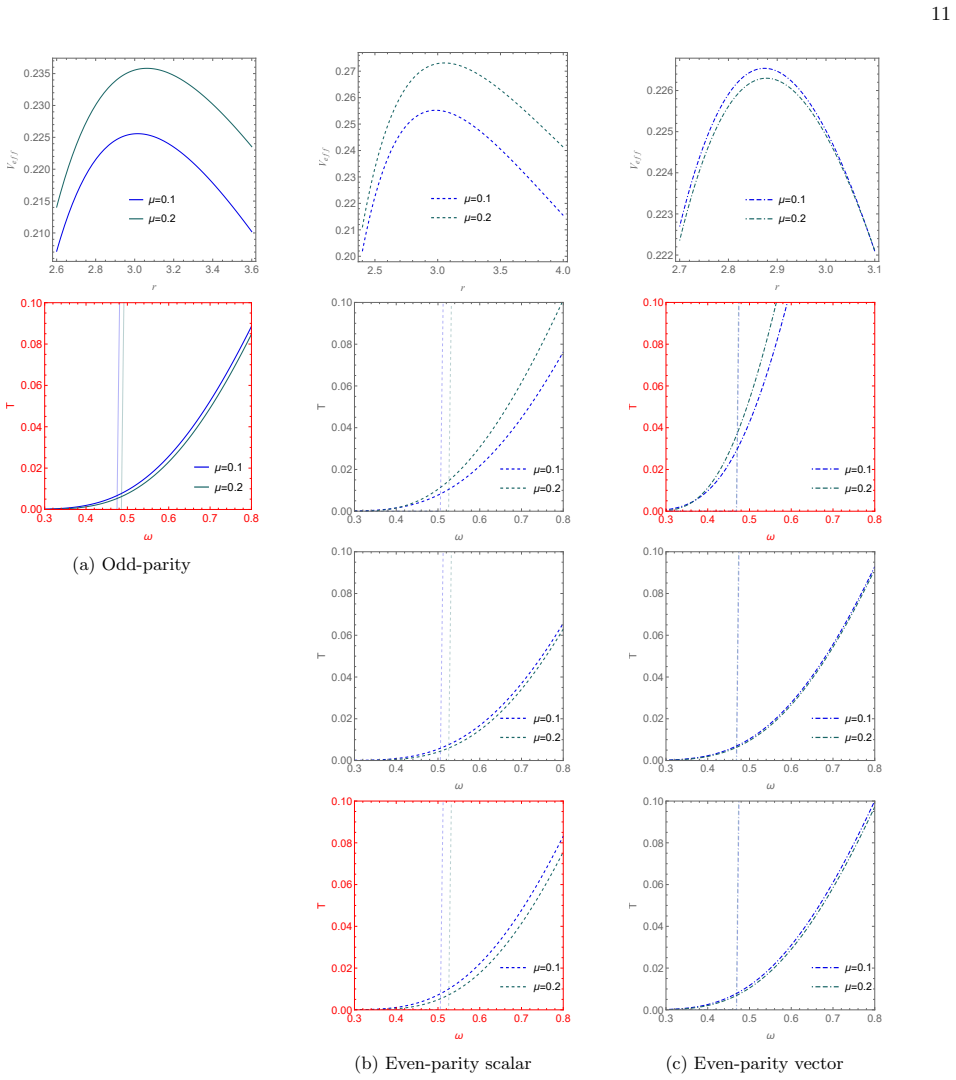
Isospectrality in the massless limit An important result for massless vector perturbations in the Schwarzschild black hole is that the even-parity and odd-parity modes share the same radial equation, which takes the Regge–Wheeler form. Upon introducing the Proca mass, the vector-type polarization splits into odd-parity and even-parity vector modes. The de...
-
[5]
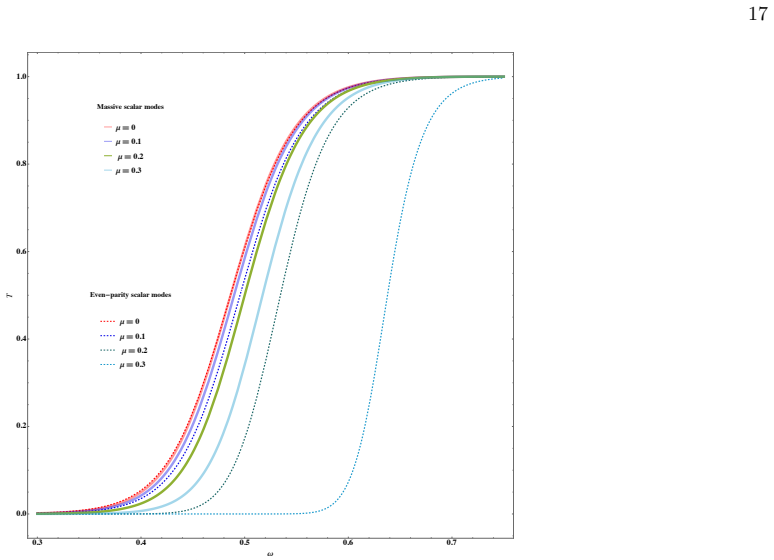
Comparison for the even-parity scalar and massive scalar modes Since the leading-order term of the effective potential for even-parity scalar modes converges to the Regge–Wheeler scalar potential when the Proca mass is small, as shown in Eq. (2.30), it is of interest to compare the greybody factors between even-parity scalar modes and massive scalar pertu...
-
[6]
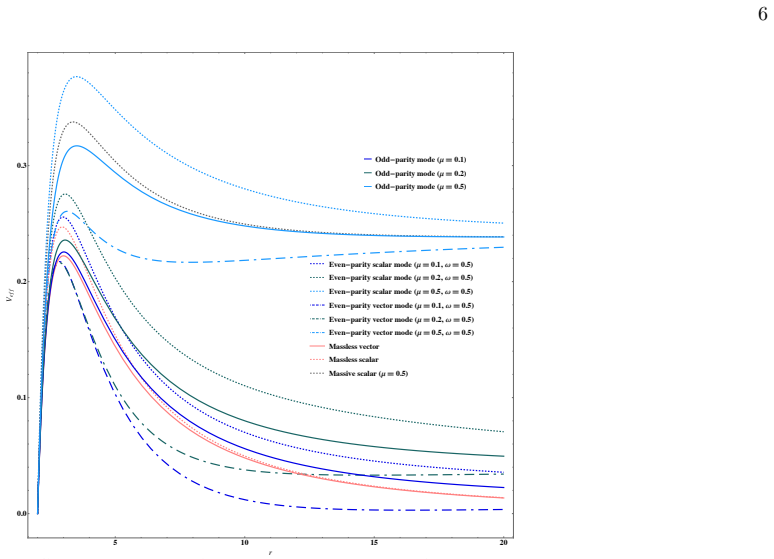
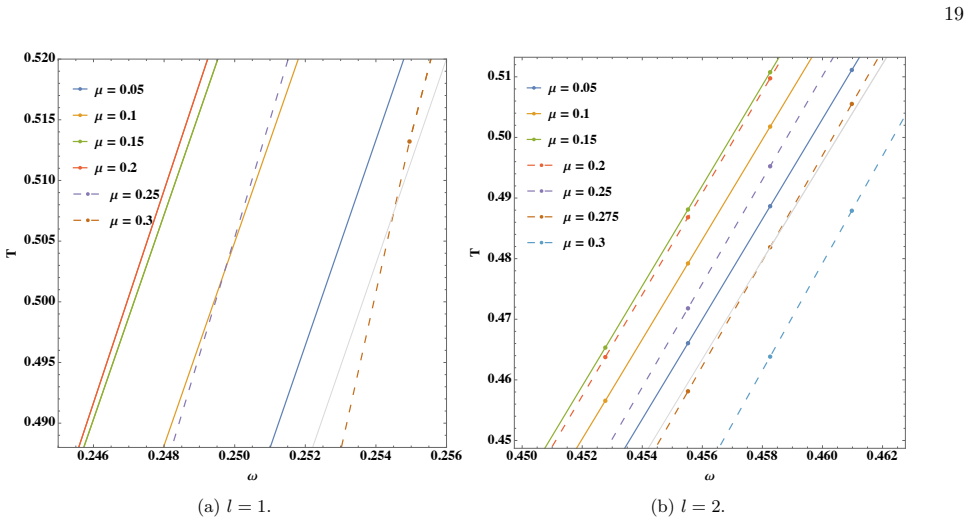
The turning behavior of the even-parity vector modes The turning behavior occurs only for the even-parity vector modes, which is supported by the effective potentials shown in Fig. 1. More specifically, for a fixed set of l and ω, the maxima of the effective potentials first decrease and then increase as µ increases. In this region, the greybody factor fo...
-
[7]
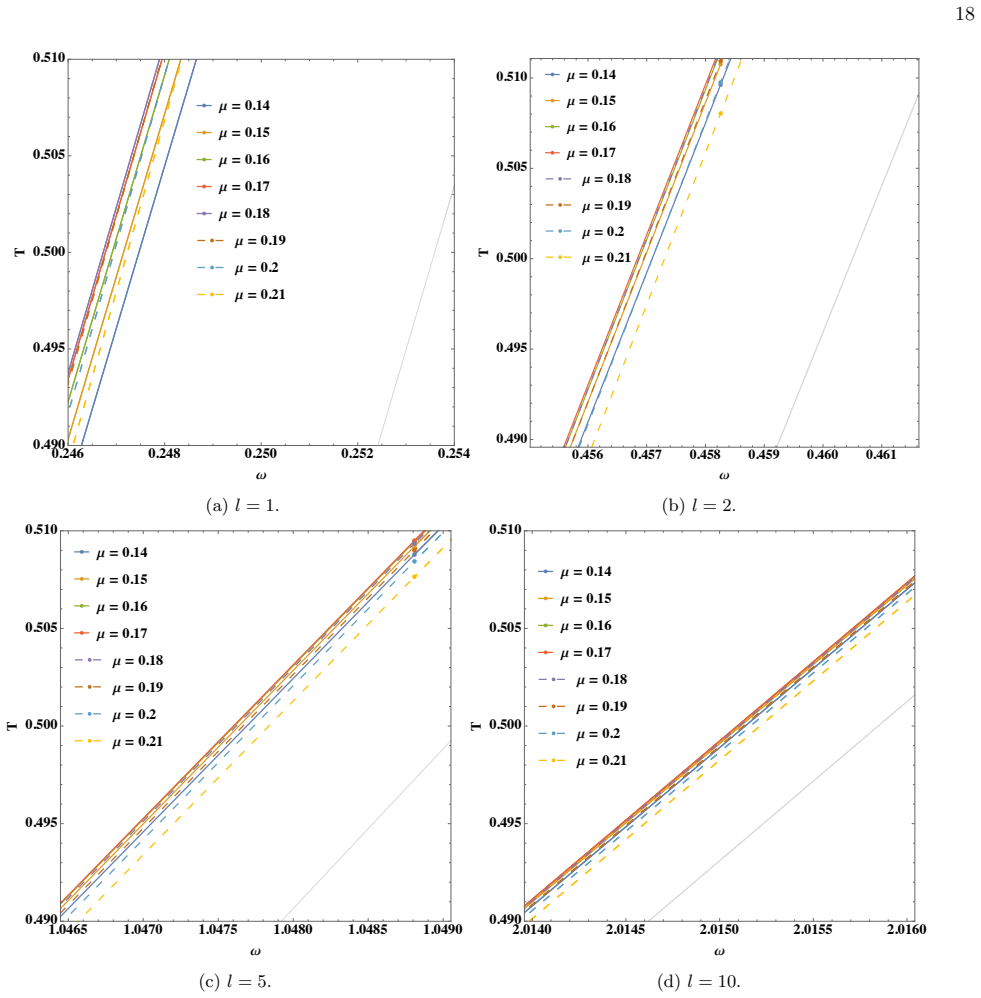
Example for the critical region of the even-parity vector modes After crossing the turning region, the greybody factor for even-parity vector modes exhibits a rightward shift as the Proca mass µ increases. Consequently, for each specific value of l and transmission probability T , there exists a particular Proca mass at which the required energy ω matches...
-
[8]
R. A. Konoplya, Phys. Rev. D 73, 024009 (2006)
work page 2006
-
[9]
J. G. Rosa and S. R. Dolan, Phys. Rev. D 85, 044043 (2012)
work page 2012
-
[10]
C. Herdeiro, M. O. P. Sampaio, and M. Wang, Phys. Rev. D 85, 024005 (2012)
work page 2012
-
[11]
M. Wang, M. O. P. Sampaio, and C. Herdeiro, Phys. Rev. D 87, 044011 (2013)
work page 2013
-
[12]
P. Pani, V. Cardoso, L. Gualtieri, E. Berti, and A. Ishibashi, Phys. Rev. D 86, 104017 (2012)
work page 2012
-
[13]
V. P. Frolov, P. Krtouˇ s, D. Kubizˇ n´ ak, and J. E. Santos, Phys. Rev. Lett.120, 231103 (2018)
work page 2018
-
[14]
V. P. Frolov, P. Krtouˇ s, and D. Kubizˇ n´ ak, Phys. Rev. D97, 104071 (2018)
work page 2018
-
[15]
P. Krtouˇ s, V. P. Frolov, and D. Kubizˇ n´ ak, Nuclear Physics B934, 7 (2018)
work page 2018
-
[16]
S. R. Dolan, Phys. Rev. D 98, 104006 (2018)
work page 2018
- [17]
-
[18]
T. V. Fernandes, D. Hilditch, J. P. S. Lemos, and V. Cardoso, Phys. Rev. D 105, 044017 (2022)
work page 2022
- [19]
- [20]
-
[21]
C. M. Will and J. W. Guinn, Phys. Rev. A 37, 3674 (1988)
work page 1988
- [22]
-
[23]
P. Boonserm, T. Ngampitipan, and M. Visser, J. High Energ. Phys. 1403, 113 (2014)
work page 2014
-
[24]
P. Boonserm, S. Phalungsongsathit, K. Sansuk, and P. Wongjun, Eur. Phys. J. C 83, 657 (2023)
work page 2023
-
[25]
R. A. Konoplya, Phys. Rev. D 68, 024018 (2003)
work page 2003
-
[26]
R. A. Konoplya, A. Zhidenko, and A. F. Zinhailo, Classical and Quantum Gravity 36, 155002 (2019)
work page 2019
-
[27]
H. T. Cho, Phys. Rev. D 68, 024003 (2003)
work page 2003
-
[28]
C.-H. Chen, H.-T. Cho, A. S. Cornell, and G. E. Harmsen, Phys. Rev. D 100, 104018 (2019)
work page 2019
-
[29]
S. A. Teukolsky, Phys. Rev. Lett. 29, 1114 (1972)
work page 1972
-
[30]
P. Boonserm, T. Ngampitipan, and P. Wongjun, Eur. Phys. J. C 78, 492 (2018)
work page 2018
-
[31]
S. Polkong, P. Wongjun, and R. Nakarachinda, (2025), arXiv:2501.02247 [gr-qc]
- [32]
-
[33]
H. T. Cho, A. S. Cornell, J. Doukas, and W. Naylor, Phys. Rev. D 77, 016004 (2008)
work page 2008
-
[34]
L. E. Simone and C. M. Will, Classical and Quantum Gravity 9, 963 (1992). 22
work page 1992
-
[35]
P. Boonserm, C. H. Chen, T. Ngampitipan, and P. Wongjun, Phys. Rev. D 104, 084054 (2021)
work page 2021
-
[36]
S. Chandrasekhar and S. Detweiler, Proc. R. Soc. Lond. A. 344, 441 (1975)
work page 1975
- [37]
-
[38]
H. T. Cho and Y.-C. Lin, Classical and Quantum Gravity 22, 775 (2005)
work page 2005
-
[39]
R. A. Konoplya and A. Zhidenko, Classical and Quantum Gravity 40, 245005 (2023)
work page 2023
-
[40]
R. Konoplya and A. Zhidenko, Journal of Cosmology and Astroparticle Physics 2024, 068 (2024)
work page 2024
- [41]
- [42]
-
[43]
G. Cacciapaglia, S. Hohenegger, and F. Sannino, Nuclear Physics B 1018, 117021 (2025)
work page 2025
-
[44]
S. D. McDermott and S. J. Witte, Phys. Rev. D 101, 063030 (2020)
work page 2020
-
[45]
P. Tantirangsri, D. Samart, and C. Pongkitivanichkul, Physics of the Dark Universe 44, 101432 (2024)
work page 2024
- [46]
discussion (0)
Sign in with ORCID, Apple, or X to comment. Anyone can read and Pith papers without signing in.