REVIEW 5 major objections 5 minor 28 references
CodecBench introduces a benchmark that scores audio codecs on both acoustic fidelity and semantic content across four audio domains.
Reviewed by Pith at T0; open to challenge. T0 means a machine referee read the full paper against a public rubric. the ladder, T0–T4 →
CodecBench ranks 14 audio codecs on acoustic fidelity and semantic preservation across 19 datasets and four audio domains, revealing a reconstruction-versus-semantics tradeoff.
T0 review reviewed 2026-08-05 challenge →
load-bearing objection CodecBench is a genuinely useful benchmark artifact with real new data and multi-domain coverage, but its semantic probe results should be read as provisional until validated against token-based generative use. the 5 major comments →
CodecBench: A Comprehensive Benchmark for Acoustic and Semantic Evaluation
The pith
A machine-rendered reading of the paper's core claim, the machinery that carries it, and where it could break.
The reading
Core claim
The paper's central claim is that audio codec evaluation should not be collapsed into reconstruction metrics alone. CodecBench evaluates codecs along two axes, acoustic fidelity and semantic content, across four domains. Acoustic quality is measured with eight signal-level and perceptual metrics on resynthesized audio. Semantic quality is measured by fixing the codec, extracting its embeddings, and training lightweight probes: an ASR model reporting word error rate, and classifiers over emotion, genre, and sound labels reporting accuracy. The results show that acoustic and semantic rankings do not coincide: DAC variants lead reconstruction at high bitrates, BigCodec leads among single-codebo
What carries the argument
The load-bearing mechanism is the dual-probe evaluation protocol: acoustic metrics on reconstructed waveforms plus embedding-based semantic probes. For the semantic side, the codec is frozen and its quantized embeddings are fed to a two-layer bidirectional LSTM trained with CTC for ASR, and to classifiers trained on frozen embeddings for emotion, genre, and sound labels. These probes convert raw audio datasets into a semantic ranking, and the divergence between that ranking and the acoustic ranking is the paper's main output.
Load-bearing premise
The semantic rankings assume that a classifier or ASR head trained on frozen codec embeddings reveals how much usable semantic information the codec would supply to a downstream generative speech language model; if probe accuracy does not transfer to generation, the rankings could mislead model choice.
What would settle it
Train a fixed generative speech language model on the same data twice, differing only in which codec tokenizes the input; if a codec that CodecBench ranks lower on semantic probes outperforms the top-ranked codec on spoken question answering or continuation quality, the probe-based semantic ranking does not transfer to the language-model use case the benchmark is designed for.
If this is right
- If CodecBench's acoustic rankings hold, high-bitrate codecs such as DAC remain the safe default for applications where reconstruction fidelity is the primary goal.
- BigCodec's strong single-codebook performance means low-bitrate speech coding does not require multi-codebook architectures, which simplifies the token sequences a language model must learn.
- The divergence between ASR word error rate and classification accuracy implies that semantic evaluation must be split into at least lexical and paralinguistic axes.
- The embedding-probe method can be applied to any frozen audio encoder, including ASR tokenizers and self-supervised speech representations, extending the benchmark beyond dedicated audio codecs.
- Low-bitrate codecs degrade more on music and sound than on speech, so those non-speech domains should be the stress test for future low-bitrate codec design.
Where Pith is reading between the lines
- An unstated consequence is that CodecBench's semantic rankings are only as trustworthy as their transfer to generative speech language models; the paper's own Section 5 concedes the semantic probes are relatively simplistic.
- A testable extension is to add a generative end-task, such as spoken question answering or dialogue continuation, where codec tokens actually feed a language model, and to check whether CodecBench's semantic rankings predict end-task quality.
- The finding that high-bitrate codecs win acoustic metrics while different models win semantic metrics suggests future codecs should be judged on a Pareto frontier across bitrate, acoustic quality, and semantic preservation, rather than on a single aggregate score.
Editorial analysis
A structured set of objections, weighed in public.
Referee Report
Summary. The paper introduces CodecBench, a benchmark for evaluating audio codecs along acoustic and semantic dimensions across four data domains (speech, music, sound, general audio), using 19 datasets. Fourteen codec configurations are compared on reconstruction metrics (Mel loss, PESQ, SC, SDR, SI-SDR, SIM, STOI, ViSQOL, plus MSE) and a subset is evaluated on two semantic probes: an ASR probing task adapted from SUPERB and embedding-based classifiers inspired by ARCH. The headline findings are that DAC variants lead at high bitrates on most acoustic metrics, BigCodec is the best single-codebook speech codec, and semantic rankings diverge from acoustic rankings (e.g., DAC's poor ASR-probing WER despite strong reconstruction). The authors release code and acknowledge in Section 5 that the semantic evaluation methods are 'relatively simplistic.'
Significance. If the presented numbers are reliable, CodecBench would be a useful community resource: it broadens the scenario coverage of codec evaluation beyond clean speech, applies a standard set of acoustic metrics, and attempts to measure semantic information via probes. The paper's main strengths are the breadth of datasets, the use of third-party independently trained codecs (no fitting-to-prediction loop), and the release of the evaluation code. However, the central contribution is only partially validated: the semantic-probe bridge to downstream speech-LM use is explicitly conceded as limited, and the headline aggregate table has reproducibility issues relative to the per-domain appendix. These problems are fixable, but they currently weaken the benchmark's claims.
major comments (5)
- [§4.1, Table 3 vs. Appendix D (Tables 7–10)] The aggregation method that produces Table 3 from the per-domain results is not described. For example, DAC-24k-rvq32 has SI-SDR 1.748 in Table 3, but the unweighted average of the four domain values (1.110, 3.146, 1.743, 4.616) is about 2.65; the SDR value 6.143 likewise does not match the unweighted mean (≈7.10). If the aggregate is a corpus-size-weighted average, the weights must be reported; if not, the table is internally inconsistent. Because Table 3 is the paper's headline comparison, this is a load-bearing reproducibility issue.
- [§3.2.2, §4.3.3, §5] The semantic evaluation is the paper's claimed novelty over Codec-SUPERB, but the two probe methods operate on continuous, upsampled codec embeddings, whereas speech LMs consume discrete codec tokens. The token-based experiment in §4.3.3 is described only by an unsupported sentence ('the results ... align with the overall trends') with no numbers, hyperparameters, or evaluation details, and §5 concedes that the embedding-based methods are 'relatively simplistic.' This leaves the semantic rankings (e.g., Mimi > DAC > X-codec-2.0 on classification; DAC's poor ASR WER) unvalidated as predictors of downstream LM performance. I ask the authors to either add a token-level generative evaluation (e.g., fine-tuning a small speech LM and reporting WER/SIM on held-out data) or to explicitly restrict the semantic claims to 'embedding probing' rather than 'information conveyed to a speech LM.'
- [Table 5 and Figure 2] No variance or error bars are reported for any semantic metric. Classification accuracies are obtained with a single training run per dataset (batch 16, 20 epochs), and many ranking differences are small (e.g., MELD 0.485 vs. 0.487; MaskGCT-8 vs. MaskGCT-12 on several datasets). Without multiple seeds and standard deviations, the paper's ranking statements (e.g., 'Mimi achieves the best performance on the music dataset') are not statistically supported. Please provide at least three seeds with mean/std, or a significance test, for the classification and ASR probing results.
- [Table 5 vs. Table 3 and Table 4] The semantic evaluation uses 'MaskGCT Codec 10' with nq=10, but the acoustic evaluation lists MaskGCT Codec with nq=12 as the 6.0 kbps variant (Table 3) and Table 4 uses 'MaskGCT Codec-12'. This inconsistency makes it impossible to know which codec configuration is being ranked semantically. Clarify the exact model variant, bitrate, and why a different nq was used; if it is a typo, correct it.
- [Tables 7–10, DAC-24k-rvq32] The SDR/SI-SDR gap for DAC-24k-rvq32 is anomalously large in every domain (e.g., Music SDR 14.382 vs. SI-SDR 3.146), while DAC-44k-rvq9 has near-equal values (Music 14.539 vs. 13.545). SDR and SI-SDR should be closely related up to scale/channel alignment, so this pattern suggests a possible metric-implementation artifact or an unusual gain/scale behavior of this codec. Since Table 3's SI-SDR ranking (1.748 for DAC-24-rvq32) is materially affected, please diagnose the discrepancy, report whether a reference implementation was used, and provide per-channel analysis or otherwise explain the pattern.
minor comments (5)
- [Table 1 vs. Table 3] Table 3 reports MSE but Table 1's metric list does not define it. Please add MSE to the metric table or remove it from results.
- [Table 4, Sound category] The MaskGCT Codec-8 PESQ-NB entry is '0.013', which is inconsistent with the corresponding value in Table 9 (2.484). This appears to be a typographical error.
- [§3.1 / Appendix B] The self-collected dataset is described only as '400 entries' from Bilibili. Please report its duration, annotation scheme, speaker/scene statistics, and the exact license/release terms, since it is one of the benchmark's contributions.
- [Appendix C] The upsampling to a 50 Hz minimum frame rate is a free parameter that can affect ASR probing results substantially. Please report the frame rates of each codec before upsampling and the resulting sequence lengths, and justify the 50 Hz choice.
- [Throughout] Some dataset descriptions in Appendix B appear copied or minimally edited from original sources (e.g., 'We used the test clean set' under CREMA-D, which is not a standard split name for that dataset). Please verify and rewrite these descriptions.
Circularity Check
No significant circularity: benchmark evaluations use independently trained third-party codecs, standard metrics, and external probing frameworks; self-citations are not load-bearing.
full rationale
CodecBench is an evaluation benchmark, not a derivation, and its reported rankings are measurements of independently trained third-party codecs against standard acoustic metrics (PESQ, STOI, SDR, SI-SDR, ViSQOL, Mel Loss, SC, SIM) and supervised semantic probes. The ASR probing task is "adapted from the SUPERB framework" and the classification method is "Inspired by ARCH", both external prior benchmarks; classifiers are trained on labeled train splits and evaluated on test splits, so accuracy is not a fitted input renamed as a prediction. No equation in the paper reduces a claimed result to its inputs: DAC, BigCodec, Mimi, and the other codecs were not trained or tuned by CodecBench, and none of the benchmark's conclusions is used to define the codecs' scores. Self-citations to SpeechGPT, SpeechTokenizer, and MOSS appear only in related-work survey context (Sections 2.1, 2.2, and references) and do not support any benchmark conclusion, so they are not load-bearing. Section 5 does contain a limitation statement—"current methods for evaluating semantic information are still not enough. The two embedding-based approaches employed are relatively simplistic and fail to capture the full spectrum of semantic information"—and Section 4.3.3's token-based result is asserted without numbers; these are validity/evidence concerns, not circularity, and they do not change the score. The benchmark is therefore self-contained relative to its stated purpose, and no circular step can be exhibited from the paper's text.
Axiom & Free-Parameter Ledger
free parameters (5)
- Minimum frame rate for ASR probing upsampling =
50 Hz
- ASR probing training steps =
400,000
- Classifier training epochs =
20
- Resampling rate =
16 kHz
- Dataset subset selections =
Laughterscape 8170/11413; VocalSound 3591/21024; Libri2Mix and CREMA-D 'test clean'
axioms (5)
- standard math CTC requires T >= U and ideally T >= 2U + 1, justifying the 50 Hz upsampling floor.
- domain assumption Classification accuracy on frozen codec embeddings reflects the semantic information the codec preserves for downstream LMs.
- domain assumption LibriSpeech train-clean-100 is a sufficient training set for the ASR probe to rank codec semantic quality.
- domain assumption Resampling all inputs to 16 kHz is a fair comparison across codecs with different native sample rates.
- domain assumption Whisper-small embeddings are an appropriate semantic baseline for non-speech classification.
Cite this review
Pith. "Pith review of CodecBench: A Comprehensive Benchmark for Acoustic and Semantic Evaluation." pith.science (2026). https://pith.science/paper/DN5MUGFD
@misc{pith2026250820660,
  author       = {Pith},
  title        = {Pith review of: CodecBench: A Comprehensive Benchmark for Acoustic and Semantic Evaluation},
  year         = {2026},
  howpublished = {\url{https://pith.science/paper/DN5MUGFD}},
  note         = {Machine review of arXiv:2508.20660}
}
read the original abstract
With the rise of multimodal large language models (LLMs), audio codec plays an increasingly vital role in encoding audio into discrete tokens, enabling integration of audio into text-based LLMs. Current audio codec captures two types of information: acoustic and semantic. As audio codec is applied to diverse scenarios in speech language model , it needs to model increasingly complex information and adapt to varied contexts, such as scenarios with multiple speakers, background noise, or richer paralinguistic information. However, existing codec's own evaluation has been limited by simplistic metrics and scenarios, and existing benchmarks for audio codec are not designed for complex application scenarios, which limits the assessment performance on complex datasets for acoustic and semantic capabilities. We introduce CodecBench, a comprehensive evaluation dataset to assess audio codec performance from both acoustic and semantic perspectives across four data domains. Through this benchmark, we aim to identify current limitations, highlight future research directions, and foster advances in the development of audio codec. The codes are available at https://github.com/RayYuki/CodecBench.
Figures

Reference graph
Works this paper leans on
-
[7]
Jonathan Le Roux, Scott Wisdom, Hakan Erdogan, and John R Hershey. Sdr–half-baked or well done? In ICASSP 2019-2019 IEEE International Conference on Acoustics, Speech and Signal Processing (ICASSP), pp. 626–630. IEEE,
work page 2019
-
[10]
Librispeech: an asr corpus based on public domain audio books
Vassil Panayotov, Guoguo Chen, Daniel Povey, and Sanjeev Khudanpur. Librispeech: an asr corpus based on public domain audio books. In 2015 IEEE international conference on acoustics, speech and signal processing (ICASSP), pp. 5206–5210. IEEE,
work page 2015
-
[12]
Meld: A multimodal multi-party dataset for emotion recognition in conversations
Soujanya Poria, Devamanyu Hazarika, Navonil Majumder, Gautam Naik, Erik Cambria, and Rada Mihalcea. Meld: A multimodal multi-party dataset for emotion recognition in conversations. arXiv preprint arXiv:1810.02508,
-
[15]
A short-time objective intelligibility measure for time-frequency weighted noisy speech
Cees H Taal, Richard C Hendriks, Richard Heusdens, and Jesper Jensen. A short-time objective intelligibility measure for time-frequency weighted noisy speech. In 2010 IEEE international conference on acoustics, speech and signal processing, pp. 4214–4217. IEEE,
work page 2010
-
[17]
Neural codec language models are zero-shot text to speech synthesizers
Chengyi Wang, Sanyuan Chen, Yu Wu, Ziqiang Zhang, Long Zhou, Shujie Liu, Zhuo Chen, Yanqing Liu, Huaming Wang, Jinyu Li, et al. Neural codec language models are zero-shot text to speech synthesizers. arXiv preprint arXiv:2301.02111,
-
[18]
Maskgct: Zero-shot text-to-speech with masked generative codec transformer
Yuancheng Wang, Haoyue Zhan, Liwei Liu, Ruihong Zeng, Haotian Guo, Jiachen Zheng, Qiang Zhang, Xueyao Zhang, Shunsi Zhang, and Zhizheng Wu. Maskgct: Zero-shot text-to-speech with masked generative codec transformer. arXiv preprint arXiv:2409.00750,
-
[19]
Flowdec: A flow-based full-band general audio codec with high perceptual quality
Simon Welker, Matthew Le, Ricky TQ Chen, Wei-Ning Hsu, Timo Gerkmann, Alexander Richard, and Yi-Chiao Wu. Flowdec: A flow-based full-band general audio codec with high perceptual quality. arXiv preprint arXiv:2503.01485,
-
[20]
Codec-superb: An in-depth analysis of sound codec models
Haibin Wu, Ho-Lam Chung, Yi-Cheng Lin, Yuan-Kuei Wu, Xuanjun Chen, Yu-Chi Pai, Hsiu-Hsuan Wang, Kai-Wei Chang, Alexander H Liu, and Hung-yi Lee. Codec-superb: An in-depth analysis of sound codec models. arXiv preprint arXiv:2402.13071,
-
[21]
Laughter Synthesis using Pseudo Phonetic Tokens with a Large-scale In-the-wild Laughter Corpus
Detai Xin, Shinnosuke Takamichi, Ai Morimatsu, and Hiroshi Saruwatari. Laughter synthesis using pseudo phonetic tokens with a large-scale in-the-wild laughter corpus. arXiv preprint arXiv:2305.12442,
work page internal anchor Pith review Pith/arXiv arXiv
-
[22]
Bigcodec: Pushing the limits of low-bitrate neural speech codec
Detai Xin, Xu Tan, Shinnosuke Takamichi, and Hiroshi Saruwatari. Bigcodec: Pushing the limits of low-bitrate neural speech codec. arXiv preprint arXiv:2409.05377,
-
[23]
An Yang, Baosong Yang, Beichen Zhang, Binyuan Hui, Bo Zheng, Bowen Yu, Chengyuan Li, Dayiheng Liu, Fei Huang, Haoran Wei, et al. Qwen2. 5 technical report. arXiv preprint arXiv:2412.15115, 2024a. Qian Yang, Jin Xu, Wenrui Liu, Yunfei Chu, Ziyue Jiang, Xiaohuan Zhou, Yichong Leng, Yuanjun Lv, Zhou Zhao, Chang Zhou, et al. Air-bench: Benchmarking large audi...
-
[24]
URL https://arxiv.org/abs/2502.04128. Aohan Zeng, Zhengxiao Du, Mingdao Liu, Kedong Wang, Shengmin Jiang, Lei Zhao, Yuxiao Dong, and Jie Tang. Glm-4-voice: Towards intelligent and human-like end-to-end spoken chatbot. arXiv preprint arXiv:2412.02612,
-
[25]
Speechgpt: Empowering large language models with intrinsic cross-modal conversational abilities
Dong Zhang, Shimin Li, Xin Zhang, Jun Zhan, Pengyu Wang, Yaqian Zhou, and Xipeng Qiu. Speechgpt: Empowering large language models with intrinsic cross-modal conversational abilities. arXiv preprint arXiv:2305.11000,
-
[26]
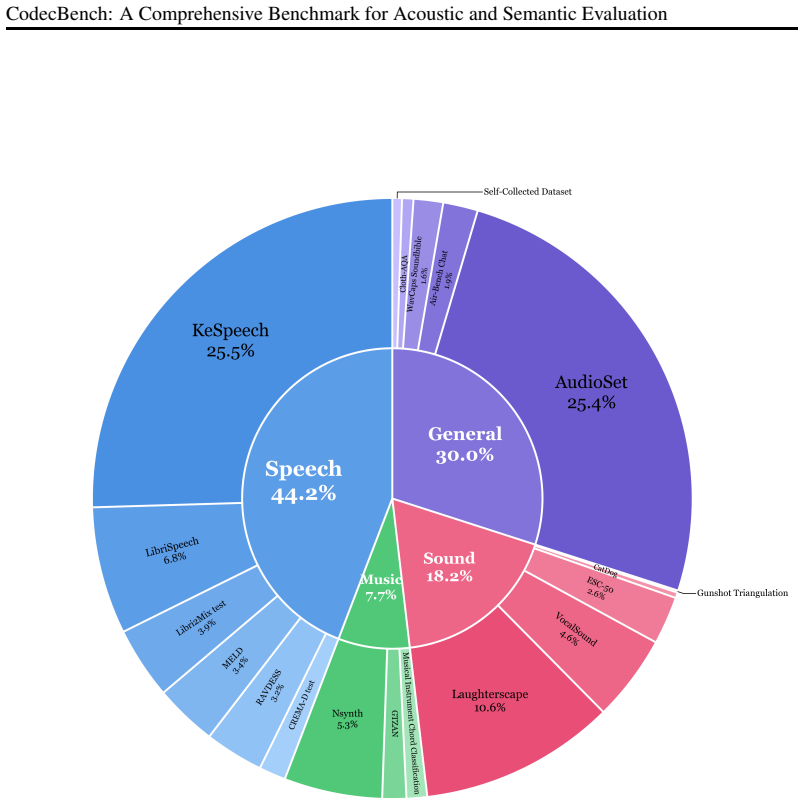
URL https://arxiv.org/abs/2308.16692. 12 CodecBench: A Comprehensive Benchmark for Acoustic and Semantic Evaluation A Appendix B Datasets Details CodecBench has 18 open-source datasets and 1 self-collected dataset, including 6 speech datasets, 3 music datasets, 5 sound datasets and 5 general audio datasets. Licenses of open-source datasets re shown in Table
-
[27]
encompasses 2000 environmental sounds categorized into 50 classes. The clips within this dataset are manually selected from public field recordings compiled by the Freesound.org project. CatDog CatDog (marc moreaux,
work page 2000
-
[28]
is a dataset for Audio question answering consisting of 1991 audio files each between 15 to 30 seconds duration selected from the Clotho dataset. Self-collected Dataset We collected more exaggerated and complex speaker scenes from the Bilibili, such as quarrels and speech with background music and vocal, which have higher requirements for audio codec perf...
work page 1991
-
[2001]
Versa: A versatile evaluation toolkit for speech, audio, and music
Jiatong Shi, Hye-jin Shim, Jinchuan Tian, Siddhant Arora, Haibin Wu, Darius Petermann, Jia Qi Yip, You Zhang, Yuxun Tang, Wangyou Zhang, et al. Versa: A versatile evaluation toolkit for speech, audio, and music. arXiv preprint arXiv:2412.17667, 2024a. 10 CodecBench: A Comprehensive Benchmark for Acoustic and Semantic Evaluation Jiatong Shi, Jinchuan Tian,...
Pith/arXiv arXiv 2024
-
[2005]
Audio set: An ontology and human-labeled dataset for audio events
Jort F Gemmeke, Daniel PW Ellis, Dylan Freedman, Aren Jansen, Wade Lawrence, R Channing Moore, Manoj Plakal, and Marvin Ritter. Audio set: An ontology and human-labeled dataset for audio events. In 2017 IEEE international conference on acoustics, speech and signal processing (ICASSP), pp. 776–780. IEEE,
work page 2017
-
[2014]
Visqol v3: An open source production ready objective speech and audio metric
Michael Chinen, Felicia SC Lim, Jan Skoglund, Nikita Gureev, Feargus O’Gorman, and Andrew Hines. Visqol v3: An open source production ready objective speech and audio metric. In 2020 twelfth international conference on quality of multimedia experience (QoMEX), pp. 1–6. IEEE,
work page 2020
-
[2015]
Scaling transformers for low-bitrate high-quality speech coding
Julian D Parker, Anton Smirnov, Jordi Pons, CJ Carr, Zack Zukowski, Zach Evans, and Xubo Liu. Scaling transformers for low-bitrate high-quality speech coding. arXiv preprint arXiv:2411.19842,
- [2016]
-
[2017]
V ocalsound: A dataset for improving human vocal sounds recognition
Yuan Gong, Jin Yu, and James Glass. V ocalsound: A dataset for improving human vocal sounds recognition. In ICASSP 2022-2022 IEEE International Conference on Acoustics, Speech and Signal Processing (ICASSP), pp. 151–155. IEEE,
work page 2022
-
[2019]
Baichuan-audio: A unified framework for end-to-end speech interaction
Tianpeng Li, Jun Liu, Tao Zhang, Yuanbo Fang, Da Pan, Mingrui Wang, Zheng Liang, Zehuan Li, Mingan Lin, Guosheng Dong, et al. Baichuan-audio: A unified framework for end-to-end speech interaction. arXiv preprint arXiv:2502.17239,
-
[2020]
Librimix: An open-source dataset for generalizable speech separation
Joris Cosentino, Manuel Pariente, Samuele Cornell, Antoine Deleforge, and Emmanuel Vin- cent. Librimix: An open-source dataset for generalizable speech separation. arXiv preprint arXiv:2005.11262,
Pith/arXiv arXiv 2005
-
[2022]
Antony W Rix, John G Beerends, Michael P Hollier, and Andries P Hekstra
URL https://arxiv.org/ abs/2212.04356. Antony W Rix, John G Beerends, Michael P Hollier, and Andries P Hekstra. Perceptual evaluation of speech quality (pesq)-a new method for speech quality assessment of telephone networks and codecs. In 2001 IEEE international conference on acoustics, speech, and signal processing. Proceedings (Cat. No. 01CH37221), volu...
Pith/arXiv arXiv 2001
-
[2023]
Benchmarking representations for speech, music, and acoustic events
Moreno La Quatra, Alkis Koudounas, Lorenzo Vaiani, Elena Baralis, Luca Cagliero, Paolo Garza, and Sabato Marco Siniscalchi. Benchmarking representations for speech, music, and acoustic events. In 2024 IEEE International Conference on Acoustics, Speech, and Signal Processing Workshops (ICASSPW), pp. 505–509. IEEE,
work page 2024
-
[2024]
URL https://www.kaggle.com/ datasets/deepcontractor/musical-instrument-chord-classification . Accessed: 2024- 10-01. Alexandre Défossez, Laurent Mazaré, Manu Orsini, Amélie Royer, Patrick Pérez, Hervé Jégou, Edouard Grave, and Neil Zeghidour. Moshi: a speech-text foundation model for real-time dialogue. arXiv preprint arXiv:2410.00037,
Pith/arXiv arXiv 2024
-
[2025]
Clotho- aqa: A crowdsourced dataset for audio question answering
Samuel Lipping, Parthasaarathy Sudarsanam, Konstantinos Drossos, and Tuomas Virtanen. Clotho- aqa: A crowdsourced dataset for audio question answering. In 2022 30th European Signal Processing Conference (EUSIPCO), pp. 1140–1144. IEEE,
work page 2022
This paper was first reviewed by deepseek-v4-flash on August 5, 2026.
discussion (0)
Sign in with ORCID, Apple, or X to comment. Anyone can read and Pith papers without signing in.