REVIEW 3 major objections 5 minor 2 cited by
CosmoGEMS builds globular cluster stellar streams star by star in a fully cosmological, time-evolving galactic potential, and shows that clumps, shells, and orbital-plane precession arise from episodic tidal stripping and potential evolutio
Reviewed by Pith at T0; open to challenge. T0 means a machine referee read the full paper against a public rubric. the ladder, T0–T4 →
A new framework produces globular cluster stellar streams star by star using a time-evolving cosmological Milky Way potential, revealing orbital plane precession and episodic stripping effects.
T0 review reviewed 2026-08-05 challenge →
load-bearing objection A genuinely new integration of CMC escapers with a time-evolving BFE potential from the same FIRE simulation, showing plausible stream morphologies from two examples; the main soft spot is that stream-level convergence against BFE snapshot cadence is not demonstrated. the 3 major comments →
Breaking Down the $\textsf{CosmoGEMS}$: Toward Modeling and Understanding Globular Cluster Stellar Streams in a Fully Cosmological Context
The pith
A machine-rendered reading of the paper's core claim, the machinery that carries it, and where it could break.
The reading
Core claim
CosmoGEMS couples three previously separate modeling layers into one chain: cluster formation from giant molecular clouds in the FIRE m12i simulation, collisional cluster evolution with CMC, and orbit integration of every escaped star in a basis-function-expanded, time-dependent potential of the same host galaxy. The central demonstration is that two clusters on different eccentric orbits produce qualitatively different streams. GC1, on a milder orbit, yields a long cold stream with velocity dispersion below 5 km/s and a local density clump; GC2, on a more eccentric orbit, produces a thin stream segment embedded in a diffuse shell, similar to features observed in the Jhelum stream. Both stre
What carries the argument
The load-bearing piece is the time-evolving basis-function-expansion (BFE) representation of the host galaxy potential, built from each snapshot of the FIRE m12i simulation. It feeds two stages: CMC uses the tidal tensor to strip stars, and the escaped stars are integrated in the time-interpolated BFE potential plus a Plummer model of the cluster's own gravity. The BFE's limited snapshot cadence (about 20 Myr) is what forces the analysis to the last 2 Gyr of stream formation.
Load-bearing premise
The reconstructed time-evolving potential, built from snapshots spaced about 20 million years apart, faithfully reproduces the real gravitational forces over the full integration; the paper's own orbit checks show growing divergence, so any stream structure older than about 2 Gyr could be an artifact of the snapshot cadence.
What would settle it
Run the same CMC escape lists through a higher-cadence potential reconstruction, with snapshots every 2–5 Myr instead of 20 Myr, and check whether the GC1 clump, the GC2 thin-plus-shell split, and the orbital-phase-dependent track misalignment persist; if they shift or vanish, those morphological claims are artifacts of BFE cadence. On the observational side, measure the orbital-plane precession of real Milky Way globular clusters over the last few Gyr and ask whether precession of tens of degrees is typical.
If this is right
- Stream-finding tools that assume a fixed great circle or a single progenitor orbit will misclassify cosmological streams, so physics-agnostic search methods may perform better.
- Clumps and thin-plus-shell morphologies can arise from orbital phase and potential evolution alone, without requiring exotic dark subhalo encounters.
- Velocity dispersion along a stream is not a clean proxy for progenitor mass in an evolving potential.
- Streams are reliable probes of the Galactic potential only back to about 2 Gyr at the current snapshot cadence; older escapers are too phase-mixed or orbitally unreliable.
- Survey-depth mass cuts do not change the apparent width or length of the GC1 stream, so shallow surveys see the same overall stream shape.
Where Pith is reading between the lines
- If the 2 Gyr cutoff is typical for cosmological stream models, population-level predictions will systematically undercount old, phase-mixed stream material; higher-cadence potential reconstructions or live-force reruns would be needed to recover it.
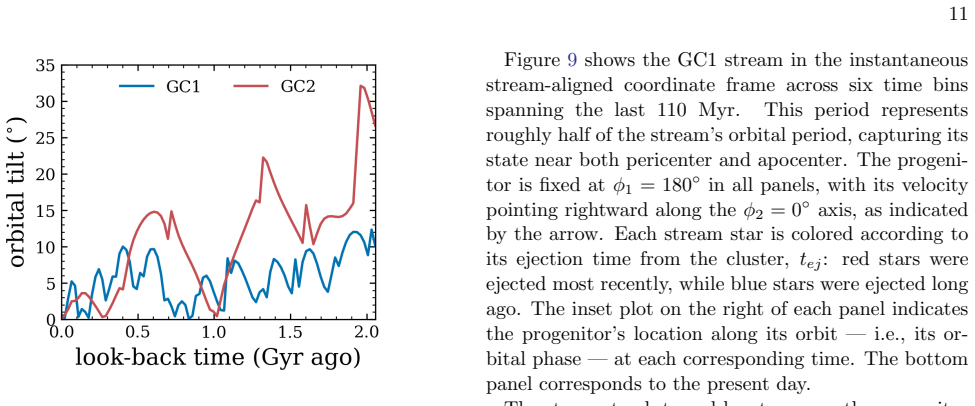
- Precession rates of 10–30 degrees over 2 Gyr imply that fitting observed stream tracks with fixed orbital poles may bias Milky Way halo shape constraints; marginalizing over time-varying pole directions would be a testable extension.
- The clump in GC1, tentatively attributed to a disk interaction about 1 Gyr ago, suggests a concrete observational search: look for similar density clumps in real streams on disk-aligned, retrograde orbits near apocenter.
- Because both example clusters ejected all their black holes more than 8 Gyr ago and their orbits have since changed, the model implies that black holes like Gaia BH3 should rarely be found near present-day stream tracks; a detection would challenge the assumption of orbit stability.
Editorial analysis
A structured set of objections, weighed in public.
Referee Report
Summary. The paper presents CosmoGEMS, a post-processing pipeline that produces globular cluster (GC) stellar streams star-by-star in a fully cosmological context. It combines (1) the FIRE m12i zoom-in cosmological simulation, (2) a cluster formation model (Grudić et al. 2023) followed by collisional evolution with CMC (Rodriguez et al. 2023), and (3) orbit integration of escaped stars in a time-dependent basis-function-expansion (BFE) potential of the host galaxy. Two example GC streams are presented: GC1, on a less eccentric orbit, forms a long, thin stream with an internal velocity dispersion below ~5 km/s, a local overdensity ('clump'), and an orbital-phase-dependent stream-track misalignment; GC2, on a more eccentric orbit, develops both a thin tail and a diffuse shell-like component. The authors argue these morphologies arise naturally from episodic tidal stripping and a time-evolving Galactic potential, and they discuss implications for stream-finding methods that assume static potentials or fixed orbital planes.
Significance. If the numerical concerns are resolved, CosmoGEMS is a significant step forward. It is the first framework to connect star-by-star GC escape with a fully cosmological, time-evolving host potential, and the stream features are emergent rather than fitted to observations. The use of published, independently tested codes (FIRE, CMC, BFE) and the explicit acknowledgment of limitations are strengths. The resulting streams could serve as a realistic testbed for stream-finding algorithms and for interpreting upcoming survey data. However, the current paper is a proof of concept with two clusters, and the central physical claims depend on the accuracy of the BFE potential reconstruction over the relevant integration time.
major comments (3)
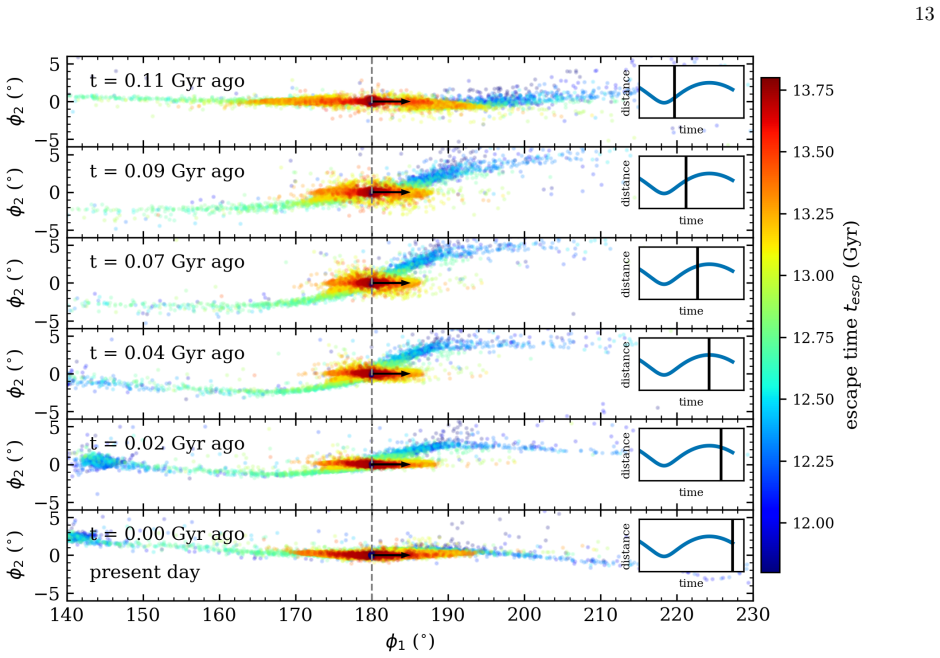
- [Sections 2.3.1, 2.3.3, 4.5; Figure 3] The orbit validation shows growing phase shifts, especially for GC2, and the analysis is restricted to the last 2 Gyr because of this. However, the key features—GC1's clump at phi1≈140°, the stream-track misalignment in Figure 9, and GC2's thin tail—are built from stars that escaped 1–2 Gyr ago, exactly the population with the largest accumulated integration error. The convergence tests in §4.5 vary ell_max, timestep, and integrator, but not the temporal cadence of the BFE snapshots or the resulting stream morphology. Because the streams are cold (σ<~5 km/s) and the misalignments are degree-level, systematic BFE force errors could plausibly create or mask these features. Please provide a test of sensitivity to the BFE time sampling—e.g., using every other snapshot, or perturbing the BFE coefficients at the level of reported force errors—and show that the clump and track misalignment are
- [Section 3.2] The GC1 clump is presented as a key result, but its physical origin is not established. The proposed explanation (interaction with a massive subhalo plus apocentric pile-up) rests on a timing coincidence: the clump contains stars that escaped 1–2 Gyr ago, and a subhalo reached pericenter ~1 Gyr ago. The paper itself states 'Further investigation is required.' For the abstract's claim that the clump arises from the evolving potential, a direct test is needed—e.g., re-running the integration without the subhalo encounter, or in a smoothed/static potential—to check whether the clump persists. Without such a test, the causal attribution is speculative.
- [Sections 2.3.3 and 2.4] Escaped stars are injected at tej with isotropic angular position and velocity direction. In reality, stars escape through the Lagrange points, so the escape direction is correlated with the cluster's orbital phase and the tidal field orientation. This approximation could affect the leading/trailing arm asymmetry (GC1) and the thin-tail selection (GC2). The paper does not test the sensitivity of the final stream morphology to this injection prescription. Please either justify the isotropic assumption with a physical argument or a numerical test (e.g., comparing with injection at L1/L2), or demonstrate that the stream features are unchanged when the injection is varied.
minor comments (5)
- [Section 2, first paragraph] Typo: 'establing' should be 'establishing'.
- [Section 4.5, last paragraph] Typo: 'Cook at al.' should be 'Cook et al.'.
- [Section 3.1] The observer is placed at the host galaxy center rather than at a realistic Solar position. This is fine for the proof-of-concept, but consider clarifying how line-of-sight projection would change the appearance, since this may be relevant for comparing with real streams.
- [Section 4.1 and Figure 9] The colorbar in Figure 9 is not described in the caption; consider adding a note that red is recent and blue is old, though the text mentions this.
- [Section 4.2] The comparison with Balbinot & Gieles (2018) is well framed, but the wording 'only ~1.4–1.5 times their initial masses' is confusing because the initial mass here is defined at 2 Gyr ago; please clarify.
Circularity Check
No significant circularity: stream features are emergent outputs; pipeline components are independently validated despite same-group citations.
full rationale
CosmoGEMS treats the FIRE m12i galaxy, GBoF1/2 cluster initial conditions and CMC evolution, and the Arora et al. BFE potential as inputs, then integrates escaped stars forward; none of the target stream properties (GC1 clump at phi1~140 deg, orbital-phase track misalignment, GC2 thin+shell morphology) are used to define the potential, the escape criterion, or any fitted parameter. The rthreshold=100 pc and 2 Gyr integration window are explicit modeling/validation choices (Sections 2.3.3, 2.4, 4.5), not fits to the stream outputs. The heavy self-citation (GBoF1/2, Arora et al.) supplies the input pipeline, but those are published codes with external validation (CMC vs NBODY6, BFE force/orbit checks including Figure 3 in this paper), so the self-citations are real evidence rather than circular premises. The main limitation acknowledged in Section 4.5 is the BFE snapshot cadence (~20 Myr), which motivates restricting analysis to the last 2 Gyr; this is a numerical accuracy concern that could affect old stream stars, but it is not a circularity because the interpretation does not reduce to the reconstruction error by construction. Score 0-2 range: no fitted-input-called-prediction, no self-definitional equivalence, no uniqueness imported from authors.
Axiom & Free-Parameter Ledger
free parameters (3)
- rthreshold = 100 pc =
100 pc
- Integration window of 2 Gyr =
2 Gyr
- Mass bins for detectability analysis =
0.5 and 0.8 Msun cutoffs
axioms (4)
- domain assumption CMC's spherical symmetry and Monte Carlo treatment of two-body encounters reliably predicts cluster mass-loss rates.
- domain assumption The cluster formation model calibrated to higher-resolution simulations (Grudić et al. 2021) applies to m12i GMCs.
- domain assumption The tracer particle in FIRE tracks the cluster's true orbit and the BFE potential accurately reproduces tidal forces.
- domain assumption A Plummer sphere with evolving mass and scale radius is an adequate model for the cluster's self-gravity during escape.
Cite this review
Pith. "Pith review of Breaking Down the $\textsf{CosmoGEMS}$: Toward Modeling and Understanding Globular Cluster Stellar Streams in a Fully Cosmological Context." pith.science (2026). https://pith.science/paper/J3KLLIAM
@misc{pith2026250903599,
  author       = {Pith},
  title        = {Pith review of: Breaking Down the $\textsfCosmoGEMS$: Toward Modeling and Understanding Globular Cluster Stellar Streams in a Fully Cosmological Context},
  year         = {2026},
  howpublished = {\url{https://pith.science/paper/J3KLLIAM}},
  note         = {Machine review of arXiv:2509.03599}
}
abstract
Next-generation surveys are expected to uncover thousands of globular cluster (GC) stellar streams, motivating the need for a theoretical framework that produces realistic GC streams in a fully cosmological, Milky Way-like environment. We present $\textsf{CosmoGEMS}$, a star-by-star cosmological GC stream framework that self-consistently links small-scale cluster physics with large-scale Galactic dynamics. The initial phase-space positions of stream stars are informed by post-processed GC populations within the FIRE cosmological simulation. Escaped stars are orbit-integrated from their time of escape to the present day in a time-evolving Galactic potential extracted from the same simulation using a basis function expansion. We explore two example streams on different orbits. One forms a long, thin stream with a velocity dispersion consistent with Milky Way GC streams. However, it exhibits a clump and orbital-phase-dependent misalignments due to the evolving potential. The other stream develops both a thin component and a diffuse, shell-like structure, similar to features observed in streams like Jhelum. These results highlight the power of fully cosmological models in producing realistic stream morphologies and kinematics. Unlike idealized simulations, our models naturally incorporate time-dependent changes in the progenitor's orbit, including orbital plane evolution, which significantly affects stream structure. This challenges common assumptions in stream-finding algorithms and interpretation. $\textsf{CosmoGEMS}$ provides a key step toward connecting future stellar stream observations with the physics of globular cluster evolution and hierarchical galaxy formation in a cosmological context.
Figures




Forward citations
Cited by 2 Pith papers
-
Reconstructing Galactic Gravitational Potentials from Stellar Kinematics with Physics-Informed Neural Networks
A PINN approach learns galactic gravitational potentials from acceleration data, achieving sub-percent errors on simulations while outperforming analytic models and retaining interpretability via structured priors.
-
Measurement of Substructure from the Kinematics of the GD-1 Stellar Stream
GD-1's radial velocity dispersion rises to about 5 km/s, more than 4 sigma above smooth-potential stream models, and is best matched by dark-matter subhalos that are roughly 60-70% more compact than CDM expectations.
Reference graph
Works this paper leans on
-
[1]
2024, ApJ, 962, 151, doi: 10.3847/1538-4357/ad159c
Aganze, C., Pearson, S., Starkenburg, T., et al. 2024, ApJ, 962, 151, doi: 10.3847/1538-4357/ad159c
-
[2]
2014, MNRAS, 442, 1265, doi: 10.1093/mnras/stu899
Baumgardt, H. 2014, MNRAS, 442, 1265, doi: 10.1093/mnras/stu899
-
[3]
Amorisco, N. C. 2015, MNRAS, 450, 575, doi: 10.1093/mnras/stv648
-
[4]
Amorisco, N. C., G´ omez, F. A., Vegetti, S., & White, S. D. M. 2016, MNRAS, 463, L17, doi: 10.1093/mnrasl/slw148
-
[5]
Arora, A., Sanderson, R. E., Panithanpaisal, N., et al. 2022, ApJ, 939, 2, doi: 10.3847/1538-4357/ac93fb
-
[6]
2024, ApJ, 977, 23, doi: 10.3847/1538-4357/ad88f0
Arora, A., Sanderson, R., Regan, C., et al. 2024, ApJ, 977, 23, doi: 10.3847/1538-4357/ad88f0
-
[7]
Arora, A., Garavito-Camargo, N., Sanderson, R. E., et al. 2025, ApJ, 988, 190, doi: 10.3847/1538-4357/ade30d
-
[8]
2018, MNRAS, 474, 2479, doi: 10.1093/mnras/stx2708
Balbinot, E., & Gieles, M. 2018, MNRAS, 474, 2479, doi: 10.1093/mnras/stx2708
-
[9]
2023, A&A, 678, A115, doi: 10.1051/0004-6361/202347076
Balbinot, E., Helmi, A., Callingham, T., et al. 2023, A&A, 678, A115, doi: 10.1051/0004-6361/202347076
-
[10]
2024, A&A, 687, L3, doi: 10.1051/0004-6361/202450425
Balbinot, E., Dodd, E., Matsuno, T., et al. 2024, A&A, 687, L3, doi: 10.1051/0004-6361/202450425
-
[11]
Banik, N., Bovy, J., Bertone, G., Erkal, D., & de Boer, T. J. L. 2021, JCAP, 2021, 043, doi: 10.1088/1475-7516/2021/10/043
-
[13]
2003, MNRAS, 340, 227, doi: 10.1046/j.1365-8711.2003.06286.x
Baumgardt, H., & Makino, J. 2003, MNRAS, 340, 227, doi: 10.1046/j.1365-8711.2003.06286.x
arXiv 2003
-
[14]
2016, ARA&A, 54, 529, doi: 10.1146/annurev-astro-081915-023441
Bland-Hawthorn, J., & Gerhard, O. 2016, ARA&A, 54, 529, doi: 10.1146/annurev-astro-081915-023441
-
[15]
Bonaca, A., Conroy, C., Price-Whelan, A. M., & Hogg, D. W. 2019, ApJL, 881, L37, doi: 10.3847/2041-8213/ab36ba
-
[16]
Bonaca, A., Geha, M., K¨ upper, A. H. W., et al. 2014, ApJ, 795, 94, doi: 10.1088/0004-637X/795/1/94
-
[17]
Bonaca, A., & Price-Whelan, A. M. 2025, NewAR, 100, 101713, doi: 10.1016/j.newar.2024.101713
arXiv 2025
-
[18]
Bonaca, A., Conroy, C., Hogg, D. W., et al. 2020, ApJL, 892, L37, doi: 10.3847/2041-8213/ab800c
-
[19]
Bonnell, I. A., & Davies, M. B. 1998, Monthly Notices of the Royal Astronomical Society, 295, 691, doi: 10.1046/j.1365-8711.1998.01372.x 18
arXiv 1998
-
[20]
2015, ApJS, 216, 29, doi: 10.1088/0067-0049/216/2/29
Bovy, J. 2015, ApJS, 216, 29, doi: 10.1088/0067-0049/216/2/29
-
[21]
Bovy, J., Bahmanyar, A., Fritz, T. K., & Kallivayalil, N. 2016, ApJ, 833, 31, doi: 10.3847/1538-4357/833/1/31
-
[22]
2020, ApJ, 898, 71, doi: 10.3847/1538-4357/ab9d85
Breivik, K., Coughlin, S., Zevin, M., et al. 2020, ApJ, 898, 71, doi: 10.3847/1538-4357/ab9d85
-
[23]
Cabrera, T., & Rodriguez, C. L. 2023, ApJ, 953, 19, doi: 10.3847/1538-4357/acdc22
-
[24]
Carlberg, R. G. 2012, ApJ, 748, 20, doi: 10.1088/0004-637X/748/1/20 —. 2013, ApJ, 775, 90, doi: 10.1088/0004-637X/775/2/90 —. 2020, ApJ, 889, 107, doi: 10.3847/1538-4357/ab61f0
-
[25]
Chen, Y., & Gnedin, O. Y. 2022, MNRAS, 514, 4736, doi: 10.1093/mnras/stac1651 —. 2023, MNRAS, 522, 5638, doi: 10.1093/mnras/stad1328 —. 2024, MNRAS, 527, 3692, doi: 10.1093/mnras/stad3345
-
[26]
Chen, Y., Valluri, M., Gnedin, O. Y., & Ash, N. 2025, ApJS, 276, 32, doi: 10.3847/1538-4365/ad9904
-
[27]
2018, MNRAS, 479, 4720, doi: 10.1093/mnras/sty1726
Dehnen, W., & Hasanuddin. 2018, MNRAS, 479, 4720, doi: 10.1093/mnras/sty1726
-
[28]
Dehnen, W., Odenkirchen, M., Grebel, E. K., & Rix, H.-W. 2004, AJ, 127, 2753, doi: 10.1086/383214
doi:10.1086/383214 2004
-
[29]
Erkal, D., Koposov, S. E., & Belokurov, V. 2017, MNRAS, 470, 60, doi: 10.1093/mnras/stx1208
-
[30]
Erkal, D., Sanders, J. L., & Belokurov, V. 2016, MNRAS, 461, 1590, doi: 10.1093/mnras/stw1400
-
[32]
Fardal, M. A., Huang, S., & Weinberg, M. D. 2015, MNRAS, 452, 301, doi: 10.1093/mnras/stv1198
-
[33]
Fukushige, T., & Heggie, D. C. 2000, MNRAS, 318, 753, doi: 10.1046/j.1365-8711.2000.03811.x Gaia Collaboration, Panuzzo, P., Mazeh, T., et al. 2024, A&A, 686, L2, doi: 10.1051/0004-6361/202449763
arXiv 2000
-
[34]
Gialluca, M. T., Naidu, R. P., & Bonaca, A. 2021, ApJL, 911, L32, doi: 10.3847/2041-8213/abf491
-
[35]
Gibbons, S. L. J., Belokurov, V., & Evans, N. W. 2014, MNRAS, 445, 3788, doi: 10.1093/mnras/stu1986
-
[36]
2014, MNRAS, 437, 916, doi: 10.1093/mnras/stt1980
Baumgardt, H. 2014, MNRAS, 437, 916, doi: 10.1093/mnras/stt1980
-
[37]
Gnedin, O. Y., & Ostriker, J. P. 1997, ApJ, 474, 223, doi: 10.1086/303441 Grudi´ c, M. Y., Hafen, Z., Rodriguez, C. L., et al. 2023, MNRAS, 519, 1366, doi: 10.1093/mnras/stac3573 Grudi´ c, M. Y., Kruijssen, J. M. D., Faucher-Gigu` ere, C.-A., et al. 2021, MNRAS, 506, 3239, doi: 10.1093/mnras/stab1894
doi:10.1086/303441 1997
-
[38]
Guszejnov, D., Grudi´ c, M. Y., Hopkins, P. F., Offner, S. S. R., & Faucher-Gigu` ere, C.-A. 2020, MNRAS, 496, 5072, doi: 10.1093/mnras/staa1883
-
[39]
Hattori, K., Erkal, D., & Sanders, J. L. 2016, MNRAS, 460, 497, doi: 10.1093/mnras/stw1006
-
[40]
Hendel, D., & Johnston, K. V. 2015, MNRAS, 454, 2472, doi: 10.1093/mnras/stv2035 H´ enon, M. 1971, Ap&SS, 13, 284, doi: 10.1007/BF00649159
-
[41]
Hopkins, P. F. 2015, MNRAS, 450, 53, doi: 10.1093/mnras/stv195
-
[42]
F., Wetzel, A., Kereˇ s, D., et al
Hopkins, P. F., Wetzel, A., Kereˇ s, D., et al. 2018, MNRAS, 480, 800, doi: 10.1093/mnras/sty1690
-
[43]
2024, ApJ, 967, 89, doi: 10.3847/1538-4357/ad382d
Ibata, R., Malhan, K., Tenachi, W., et al. 2024, ApJ, 967, 89, doi: 10.3847/1538-4357/ad382d
-
[44]
Ibata, R. A., Lewis, G. F., Irwin, M. J., & Quinn, T. 2002, MNRAS, 332, 915, doi: 10.1046/j.1365-8711.2002.05358.x
arXiv 2002
-
[45]
2017, ApJ, 842, 120, doi: 10.3847/1538-4357/aa7514 Ivezi´ c,ˇZ., Kahn, S
Chapman, S. 2017, ApJ, 842, 120, doi: 10.3847/1538-4357/aa7514 Ivezi´ c,ˇZ., Kahn, S. M., Tyson, J. A., et al. 2019, ApJ, 873, 111, doi: 10.3847/1538-4357/ab042c
-
[46]
Johnston, K. V., Spergel, D. N., & Haydn, C. 2002, ApJ, 570, 656, doi: 10.1086/339791
doi:10.1086/339791 2002
-
[47]
Joshi, K. J., Rasio, F. A., & Portegies Zwart, S. 2000, ApJ, 540, 969, doi: 10.1086/309350
doi:10.1086/309350 2000
-
[48]
Just, A., Berczik, P., Petrov, M. I., & Ernst, A. 2009, MNRAS, 392, 969, doi: 10.1111/j.1365-2966.2008.14099.x
arXiv 2009
-
[49]
Rasio, F. A. 2019, ApJ, 871, 38, doi: 10.3847/1538-4357/aaf646
-
[50]
Rasio, F. A. 2018, ApJL, 855, L15, doi: 10.3847/2041-8213/aab26c
-
[51]
2001, MNRAS, 322, 231, doi: 10.1046/j.1365-8711.2001.04022.x K¨ upper, A
Kroupa, P. 2001, MNRAS, 322, 231, doi: 10.1046/j.1365-8711.2001.04022.x K¨ upper, A. H. W., Balbinot, E., Bonaca, A., et al. 2015, ApJ, 803, 80, doi: 10.1088/0004-637X/803/2/80 K¨ upper, A. H. W., Lane, R. R., & Heggie, D. C. 2012, MNRAS, 420, 2700, doi: 10.1111/j.1365-2966.2011.20242.x K¨ upper, A. H. W., MacLeod, A., & Heggie, D. C. 2008, MNRAS, 387, 12...
arXiv 2001
-
[52]
Kuzma, P. B., Ferguson, A. M. N., Varri, A. L., et al. 2022, MNRAS, 512, 315, doi: 10.1093/mnras/stac381
-
[53]
Lane, R. R., K¨ upper, A. H. W., & Heggie, D. C. 2012, MNRAS, 423, 2845, doi: 10.1111/j.1365-2966.2012.21093.x
arXiv 2012
-
[54]
2011, arXiv e-prints, arXiv:1110.3193, doi: 10.48550/arXiv.1110.3193 19
Laureijs, R., Amiaux, J., Arduini, S., et al. 2011, arXiv e-prints, arXiv:1110.3193, doi: 10.48550/arXiv.1110.3193 19
-
[55]
Li, T. S., Ji, A. P., Pace, A. B., et al. 2022, ApJ, 928, 30, doi: 10.3847/1538-4357/ac46d3
-
[56]
Malhan, K., & Ibata, R. A. 2018, MNRAS, 477, 4063, doi: 10.1093/mnras/sty912
-
[57]
2023, MNRAS, 520, 5225, doi: 10.1093/mnras/stad321
Mateu, C. 2023, MNRAS, 520, 5225, doi: 10.1093/mnras/stad321
-
[58]
Mateu, C., Cooper, A. P., Font, A. S., et al. 2017, Monthly Notices of the Royal Astronomical Society, 469, 721, doi: 10.1093/mnras/stx872
-
[59]
McMillan, P. J. 2017, MNRAS, 465, 76, doi: 10.1093/mnras/stw2759
-
[60]
Myeong, G. C., Evans, N. W., Belokurov, V., Koposov, S. E., & Sanders, J. L. 2017, MNRAS, 469, L78, doi: 10.1093/mnrasl/slx051
-
[61]
2025, arXiv e-prints, arXiv:2504.07187, doi: 10.48550/arXiv.2504.07187
Nibauer, J., & Bonaca, A. 2025, arXiv e-prints, arXiv:2504.07187, doi: 10.48550/arXiv.2504.07187
-
[62]
Nibauer, J., Bonaca, A., Spergel, D. N., et al. 2025, ApJ, 983, 68, doi: 10.3847/1538-4357/adb8e8
-
[63]
Palau, C. G., & Miralda-Escud´ e, J. 2023, MNRAS, 524, 2124, doi: 10.1093/mnras/stad1930
-
[64]
2013, ApJS, 204, 15, doi: 10.1088/0067-0049/204/2/15
Pattabiraman, B., Umbreit, S., Liao, W.-k., et al. 2013, ApJS, 204, 15, doi: 10.1088/0067-0049/204/2/15
-
[65]
Pearson, S., Bonaca, A., Chen, Y., & Gnedin, O. Y. 2024, ApJ, 976, 54, doi: 10.3847/1538-4357/ad8348
-
[66]
Pearson, S., Clark, S. E., Demirjian, A. J., et al. 2022, ApJ, 926, 166, doi: 10.3847/1538-4357/ac4496
-
[67]
Price-Whelan, A. M. 2015, ApJ, 799, 28, doi: 10.1088/0004-637X/799/1/28
-
[68]
Pearson, S., Price-Whelan, A. M., & Johnston, K. V. 2017, Nature Astronomy, 1, 633, doi: 10.1038/s41550-017-0220-3
-
[69]
Pearson, S., Starkenburg, T. K., Johnston, K. V., et al. 2019, ApJ, 883, 87, doi: 10.3847/1538-4357/ab3e06
-
[70]
Price-Whelan, A. M. 2017, The Journal of Open Source Software, 2, 388, doi: 10.21105/joss.00388
-
[71]
Price-Whelan, A. M., & Bonaca, A. 2018, ApJL, 863, L20, doi: 10.3847/2041-8213/aad7b5
-
[72]
M., Mateu, C., Iorio, G., et al
Price-Whelan, A. M., Mateu, C., Iorio, G., et al. 2019, AJ, 158, 223, doi: 10.3847/1538-3881/ab4cef
-
[73]
Reino, S., Rossi, E. M., Sanderson, R. E., et al. 2021, MNRAS, 502, 4170, doi: 10.1093/mnras/stab304
-
[75]
Roberts, D., Gieles, M., Erkal, D., & Sanders, J. L. 2025, MNRAS, 538, 454, doi: 10.1093/mnras/staf321
-
[76]
Rodriguez, C. L., Hafen, Z., Grudi´ c, M. Y., et al. 2023, MNRAS, 521, 124, doi: 10.1093/mnras/stad578
-
[77]
Rodriguez, C. L., Weatherford, N. C., Coughlin, S. C., et al. 2022, ApJS, 258, 22, doi: 10.3847/1538-4365/ac2edf
-
[78]
Sanders, J. L., & Binney, J. 2013a, MNRAS, 433, 1813, doi: 10.1093/mnras/stt806 —. 2013b, MNRAS, 433, 1826, doi: 10.1093/mnras/stt816
-
[79]
Shih, D., Buckley, M. R., & Necib, L. 2024, MNRAS, 529, 4745, doi: 10.1093/mnras/stae446
-
[80]
Shih, D., Buckley, M. R., Necib, L., & Tamanas, J. 2022, MNRAS, 509, 5992, doi: 10.1093/mnras/stab3372
-
[81]
2020, MNRAS, 495, 2222, doi: 10.1093/mnras/staa1209
Sollima, A. 2020, MNRAS, 495, 2222, doi: 10.1093/mnras/staa1209
-
[82]
2015, arXiv e-prints, arXiv:1503.03757, doi: 10.48550/arXiv.1503.03757
Spergel, D., Gehrels, N., Baltay, C., et al. 2015, arXiv e-prints, arXiv:1503.03757, doi: 10.48550/arXiv.1503.03757
-
[83]
1987, Dynamical evolution of globular clusters
Spitzer, L. 1987, Dynamical evolution of globular clusters
1987
This paper was first reviewed by deepseek-v4-flash on August 5, 2026.
discussion (0)
Sign in with ORCID, Apple, or X to comment. Anyone can read and Pith papers without signing in.