REVIEW 3 major objections 5 minor 29 references
A high-lying isomer in ^{92}Zr with lifetime modulated by the atomic charge states: a proposed approach for a nuclear gamma-ray laser
T0 review · 3 major / 5 minor · reviewed 2026-08-05 · deepseek-v4-flash
Pith's one-line read The paper reports evidence that an unseen high-lying isomer in zirconium-92 has a charge-state-dependent lifetime, and proposes this as the pump mechanism for a nuclear gamma-ray laser.
desk verdict A plausible but unconfirmed new high-lying isomer in 92Zr; the NGL framing is reasonable but the evidence is thin. read the letter →
The pith
A machine-rendered reading of the paper's core claim, the machinery that carries it, and where it could break.
The reading
What carries the argument
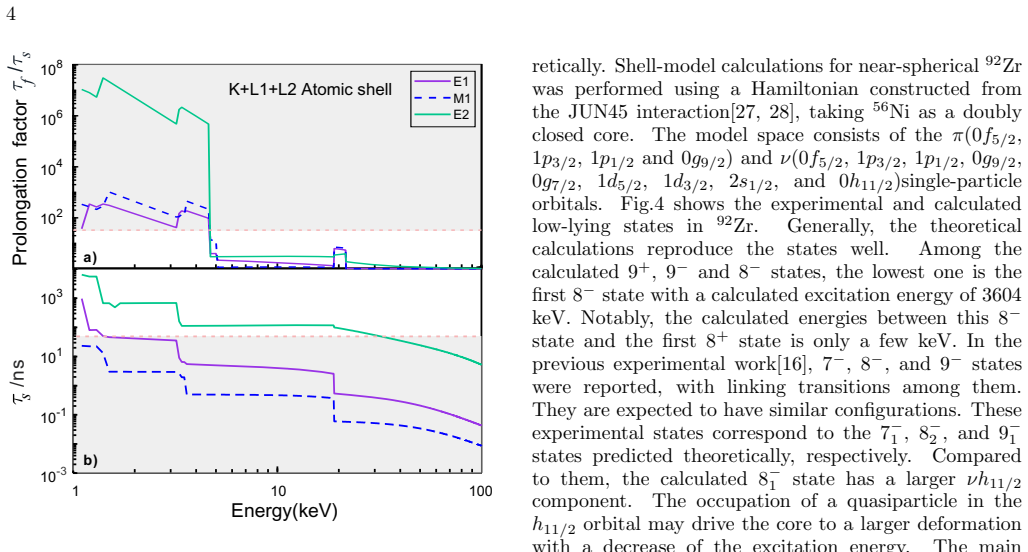
The key object is the inferred isomer 92mZr and the charge-state-dependent decay switch around it. The carrying identity is the prolongation factor τf/τs = (1+α_total)/(1+α_Q): the isomeric lifetime in flight over the lifetime after stopping equals the ratio of total internal conversion coefficient in the neutral atom to the coefficient with the ion in charge state Q. Because internal conversion dominates a low-energy (<5 keV) nuclear transition, removing the relevant bound electrons by stripping raises the lifetime by orders of magnitude; recapturing electrons in the foil restores the short lifetime. This conversion-blocking switch is what turns the ordinary decay cascade into a four-level
What would settle it
Search for the missing decay: stop 92Zr ions in a foil and look for a transition or conversion electrons below 5 keV in coincidence with the 352-keV gamma ray. Also vary the production-to-implantation flight time; if the 8+ cascade intensity stays constant as flight time increases, the feeding isomer cannot be the source. A third check is to compare the cascade rate for ions stripped to different charge states—no charge-state dependence would contradict the blocking mechanism.
Extended reading notes
Core claim
At the core of the paper is a missing state inferred from timing. 92Zr residues were transported through a radioactive-ion-beam line for about 1.14 μs and implanted in a carbon foil, where four gamma rays—352, 1462, 561, and 935 keV—were observed in coincidence within a few nanoseconds. These energies match the 8+→6+→4+→2+→0+ cascade of 92Zr, but the 8+ state has a known lifetime of 1.7 ns, too short to survive the flight. The paper therefore posits an unobserved isomer sitting just above the 8+ state. In flight the ions carry charges 30+ to 36+, with K and part of L shells filled; if the isomer's decay energy is below the binding energies of those occupied shells, internal conversion—normal
Load-bearing premise
The central assumption is that the 8+ gamma rays observed after 1.14 μs come from an unobserved isomer feeding that state; if a secondary reaction, Coulomb excitation, or a long-lived highly charged component of the 8+ state itself produces them instead, the inferred isomer does not exist.
Editorial extensions
If this is right
- Establishing 92mZr would give a concrete four-level nuclear system in which population inversion is created by an atomic physics step—changing charge state—rather than by direct pumping.
- The inferred lifetime limits force the hidden transition below 5 keV with E1 or M1 character; any future observation of the isomer must find that low-energy decay.
- The paper's survey narrows nuclear gamma-ray laser candidates to two known isomers, 92mZr and 208mPo; confirming 92mZr doubles the experimental playground.
- In 92Zr the 6+ lower laser level is expected to live about three orders of magnitude shorter than the 8+ upper level, so the laser transition would self-empty and maintain inversion.
Reading between the lines
- A decisive check the authors did not perform is direct observation of the sub-keV/keV depopulating transition or its conversion electrons; a storage-ring or ion-trap measurement correlating charge state with decay rate could turn the conjecture into a numbered level.
- The charge-state switch suggests a general search strategy: medium-mass nuclei with high-lying isomers and low-energy transitions should be re-examined in highly charged beams, not only in neutral solids.
- The timing argument could be sharpened by varying the flight path or stripping after the foil; if the delayed 8+ yield does not fall with increased flight time, the feeding-isomer interpretation would need revision.
Editorial analysis
A structured set of objections, weighed in public.
Referee Report
Summary. The paper reports the observation of four γ rays (352, 1462, 561, 935 keV) de-exciting the first 8+ state of 92Zr, detected in coincidence with implantation of a radioactive beam after ~1.14 μs flight. Since the known 8+ lifetime in neutral atoms is 1.7(10) ns, the authors infer an unobserved isomeric state slightly above the 8+ state, whose lifetime is prolonged in highly charged ions by blocking of internal conversion and restored to a short value after electron capture in the stopping foil. From the stopped (τ_s ≈ 1 ns, <39 ns at 3σ) and in-flight (τ_f > 853 ns) lifetime limits, they constrain the depopulating transition to an E1 of 3.2–5 keV or M1 <5 keV, and propose spin-parity 8− based on shell-model calculations with the JUN45 interaction. They suggest this state forms a four-level scheme suitable for a nuclear gamma-ray laser.
Significance. If the inferred isomer is real, it would be a rare example of a high-lying isomer depopulated by a low-energy transition whose lifetime is controlled by the atomic charge state, and it would provide a concrete candidate system for a nuclear gamma-ray laser. The paper combines an experimental observation with a theoretical interpretation and clearly states the conjectural nature of the isomer. It also gives falsifiable predictions (transition energy and multipolarity) that could be checked in future experiments. However, the experimental evidence is indirect and statistically limited; the central claim is not yet established to the standard that would make the proposed application concrete.
major comments (3)
- [Results (Fig. 2)] The central inference that an unseen isomer feeds the 8+ state is not uniquely established. The transition directly depopulating the isomer is not observed (acknowledged in the text). Coulomb excitation is dismissed by arguing it would preferentially populate low-lying states, but no cross-section estimate for 92Zr at 5 A MeV on carbon is given. Secondary fusion-evaporation reactions are dismissed because no γ rays from secondary products are observed, but the beam composition and expected 92Zr yields are not quantified. Given the low statistics in Fig. 2(c), the authors must supply quantitative upper limits on alternative production mechanisms or additional experimental tags (e.g., charge-state or position correlations) to support the isomer interpretation.
- [Lifetime analysis (Fig. 2c)] The extracted stopped lifetime τ_s = 1 ns with a 3σ upper limit of 39 ns is statistically weak. The time spectrum has very few counts; no fit function, background model, or χ² is given. The lower limit τ_f > 853 ns is derived from 'loss of isomeric ions during flight' with references to LISE++ and other codes, but none of the simulation inputs (charge-state distribution, transmission efficiency, decay losses) are documented. These limits are load-bearing: they set the prolongation factor (>22) and the allowed transition-energy ranges in Fig. 3. A full statistical and systematic treatment is required before the multipolarity constraints can be accepted.
- [Multipolarity analysis (Eq. 1, Fig. 3)] The prolongation factor calculation is incomplete. The manuscript states ions have charge states 30+ to 36+ with K and partial L electrons, but does not provide the charge-state distribution or the computed α_Q values used in Eq. (1). For a 3–5 keV transition, L-shell internal conversion is energetically allowed (Zr L binding energies ≈ 2.5 keV) if L electrons are present; the blocking may therefore be partial. The authors should tabulate α_Q for the relevant charge states and show that the inferred prolongation factor >22 is robust across the distribution. Without this, the allowed E1/M1 energy ranges (3.2–5 keV and <5 keV) are not substantiated.
minor comments (5)
- [Title] Missing space in 'in92Zr' in the title; should read 'in 92Zr'.
- [Four-level laser discussion] The statement that the 6+→4+ transition energy is four times the 4+→2+ energy is numerically incorrect (1462 keV vs 561 keV, ratio ≈2.6). The estimated 10^3 lifetime ratio should be re-evaluated.
- [References] References [19] and [22] are the same LISE++ paper; one should be removed.
- [Fig. 3] The curves for E1, M1 and E2 are not distinguished by line styles in the text; please make the figure self-explanatory.
- [Grammar] In the text: 'The four γ rays emitted almost simultaneously with the implantation events' should read '... were emitted ...'.
Circularity Check
No significant circularity: the isomer is inferred from a measured 8+ cascade and independent lifetime/conversion-coefficient analysis; self-citations are contextual, not load-bearing.
full rationale
The central derivation is not circular. The four γ rays (352, 1462, 561, 935 keV) are identified as the 8+→6+→4+→2+→0+ cascade in 92Zr using measured energies and coincidences, with level data referenced to independent compilations and prior work ([13],[14]). The proposed isomer is introduced as an explanation for the 8+ state surviving the 1.14 μs flight despite its short neutral-atom lifetime; this is an inference from the data, not a quantity defined by the model. The paper explicitly acknowledges that the depopulating transition from the inferred isomer was not observed, so it does not claim direct measurement. The lifetimes τs and τf are extracted from time spectra and survival-rate arguments, respectively; the prolongation factor in Eq. (1) uses standard internal-conversion coefficients (BrIcc) and ionization corrections, independent of the proposed state. The allowed transition-energy ranges for E1/M1 follow from these measured lifetime limits and external transition-strength tabulations. The shell-model calculation uses the standard JUN45 interaction and is not fitted to the conjectured isomer; the near-degeneracy of the calculated 8− state with 8+ is a theoretical prediction that lends plausibility but is not the source of the isomer claim. Self-citations ([12],[16]) provide experimental method details and previously reported high-spin states; they do not carry the core inference. One presentation issue in the applications section (using the 2023 Atlas [30] to say that 92mZr meets the NGL conditions, although 92mZr is the present conjecture) is logically awkward but occurs after the derivation and does not feed back into the evidence for the isomer. Overall, the paper's central claim is self-contained against external benchmarks, with only minor and non-load-bearing self-citations.
Assumptions & free parameters
free parameters (2)
- τs (stopped isomeric lifetime) =
1 ns, 3σ upper limit 39 ns
- τf (in-flight isomeric lifetime) =
>853 ns
assumptions (5)
- domain assumption Internal conversion is blocked when the transition energy is below the binding energies of occupied electron shells, extending the nuclear lifetime in highly charged ions.
- domain assumption The four observed gamma rays (352, 561, 1462, 935 keV) are in prompt coincidence and arise from the 8+ state of 92Zr.
- domain assumption The known lifetime of the 8+ state (1.7(10) ns) is too short to survive the 1.14 μs flight even in highly charged states.
- domain assumption Alternative sources of the delayed 8+ population (secondary fusion-evaporation reactions, Coulomb excitation) are negligible.
- domain assumption The JUN45 shell-model interaction reliably predicts low-lying states in near-spherical 92Zr.
invented entities (1)
-
92mZr isomer (conjectured high-lying isomer)
Cite this review
Pith. "Pith review of A high-lying isomer in ^{92}Zr with lifetime modulated by the atomic charge states: a proposed approach for a nuclear gamma-ray laser." pith.science (2026). https://pith.science/paper/GTZJEEWS
@misc{pith2026250903797,
  author       = {Pith},
  title        = {Pith review of: A high-lying isomer in ^92Zr with lifetime modulated by the atomic charge states: a proposed approach for a nuclear gamma-ray laser},
  year         = {2026},
  howpublished = {\url{https://pith.science/paper/GTZJEEWS}},
  note         = {Machine review of arXiv:2509.03797}
}
read the original abstract
The nuclides ^{92}Zr are produced and transported by using a radioactive beam line to a lowbackground detection station. After a flight time of about 1.14 {\mu}s, the ions are implanted into a carbon foil, and four {\gamma} rays deexciting the 8+ state in ^{92}Zr are observed in coincidence with the implantation signals within a few nanoseconds. We conjecture that there exists an isomer located slightly above the 8^{+} state in ^{92}Zr. The isomeric lifetime in highly charged states is extended significantly due to the blocking of internal conversion decay channels, enabling its survival over the transportation. During the slowing-down process in the carbon foil, the ^{92}Zr ions capture electron and evolve toward neutral atoms, and consequently the lifetime is restored to a normal short value. Such a high-lying isomer depopulated by a low-energy transition may provide unique opportunity to develop nuclear {\gamma} laser.
Figures


Figures from the paper (1 more)

Reference graph
Works this paper leans on
-
[1]
L. A. Rivlin, Nuclear gamma-ray laser: the evolution of the idea, Quantum Electronics 37, 723 (2007)
work page 2007
-
[2]
G. C. Baldwin and J. C. Solem, Recoilless gamma-ray lasers, Rev. Mod. Phys. 69, 1085 (1997)
work page 1997
-
[3]
M. Hausner, V. Proch´ azka, and V. Vrba, Stimulated emission and coherent control of gamma photons de- scribed by quantum mechanical model, Phys. Rev. Res. 7, 023229 (2025)
work page 2025
-
[4]
E. V. Tkalya, Proposal for a nuclear gamma-ray laser of optical range, Phys. Rev. Lett. 106, 162501 (2011)
work page 2011
-
[5]
P. M. Walker and J. J. Carroll, Ups and Downs of Nuclear Isomers, Physics Today 58, 39 (2005)
work page 2005
-
[6]
W. Demtroder, Laser spectroscopy : basic concepts and instrumentation, Optical Engineering 35, 3361 (2003)
work page 2003
-
[7]
W. R. Phillips, I. Ahmad, D. W. Banes, B. G. Glagola, W. Henning, W. Kutschera, K. E. Rehm, J. P. Schif- fer, and T. F. Wang, Charge-state dependence of nuclear lifetimes, Phys. Rev. Lett. 62, 1025 (1989)
work page 1989
-
[8]
Rose, Chapter ii - internal conversion the- ory††partially supported by the u
M. Rose, Chapter ii - internal conversion the- ory††partially supported by the u. s. atomic energy com- mission., in Internal Conversion Processes, edited by J. H. Hamilton (Academic Press, 1966) pp. 15–33
work page 1966
Show all 29 references
-
[9]
Attallah, M
F. Attallah, M. Aiche, J. F. Chemin, J. N. Scheurer, W. E. Meyerhof, J. P. Grandin, P. Aguer, G. Bogaert, J. Kiener, A. Lefebvre, J. P. Thibaud, and C. Grunberg, Charge state blocking of K -shell internal conversion in 125te, Phys. Rev. Lett. 75, 1715 (1995)
1995
-
[10]
Akber, M
A. Akber, M. W. Reed, P. M. Walker, Y. A. Litvinov, G. J. Lane, T. Kib´ edi, K. Blaum, F. Bosch, C. Bran- dau, J. J. Carroll, D. M. Cullen, I. J. Cullen, A. Y. Deo, B. Detwiler, C. Dimopoulou, G. D. Dracoulis, F. Farinon, H. Geissel, E. Haettner, M. Heil, R. S. Kempley, R. Kn¨...
2015
-
[11]
Sun, W.-L
Z. Sun, W.-L. Zhan, Z.-Y. Guo, G. Xiao, and J.-X. Li, Ribll, the radioactive ion beam line in lanzhou, Nuclear Instruments and Methods in Physics Research Section A: Accelerators, Spectrometers, Detectors and Associated Equipment 503, 496 (2003)
2003
-
[12]
S. Guo, B. Ding, X. H. Zhou, Y. B. Wu, J. G. Wang, 6 S. W. Xu, Y. D. Fang, C. M. Petrache, E. A. Lawrie, Y. H. Qiang, Y. Y. Yang, H. J. Ong, J. B. Ma, J. L. Chen, F. Fang, Y. H. Yu, B. F. Lv, F. F. Zeng, Q. B. Zeng, H. Huang, Z. H. Jia, C. X. Jia, W. Liang, Y. Li, N. W. Huang,...
2022
-
[13]
Sugawara, Y
M. Sugawara, Y. Toh, M. Koizumi, M. Oshima, A. Kimura, T. Kin, Y. Hatsukawa, and H. Kusakari, Intermediate-spin states of 92Zr and a large b(e2) value between the 10+ 1 and 8+ 1 states, Phys. Rev. C 96, 024314 (2017)
2017
-
[14]
C. M. Baglin, Nuclear data sheets for a = 92, Nuclear Data Sheets 113, 2187 (2012)
2012
-
[15]
Q. Zeng, M. Wang, X. H. Zhou, Y. H. Zhang, X. L. Tu, X. C. Chen, X. Xu, Y. A. Litvinov, H. S. Xu, K. Blaum, R. J. Chen, C. Y. Fu, Z. Ge, W. J. Huang, H. F. Li, J. H. Liu, B. Mei, P. Shuai, M. Si, B. H. Sun, M. Z. Sun, Q. Wang, G. Q. Xiao, Y. M. Xing, T. Yamaguchi, X. L. Yan, J...
2017
-
[16]
Z. G. Wang, M. L. Liu, Y. H. Zhang, X. H. Zhou, S. Guo, J. G. Wang, X. G. Lei, Y. Zheng, Y. D. Fang, Y. H. Qiang, N. T. Zhang, B. Ding, G. S. Li, F. Ma, X. L. Yan, S. C. Wang, B. S. Gao, F. Fang, B. T. Hu, X. G. Wu, C. Y. He, and Y. Zheng, High-spin level structures of the nea...
2014
-
[17]
K. L. Wang, J. G. Wang, X. H. Zhou, M. L. Liu, Y. H. Qiang, S. Guo, Z. Y. Zhang, B. F. Lv, B. S. Gao, Y. H. Zhang, Y. Zheng, G. S. Li, Y. D. Fang, B. Ding, W. Q. Zhang, K. K. Zheng, J. S. Wang, Y. Y. Yang, Z. Bai, P. Ma, S. L. Jin, J. B. Ma, F. F. Duan, X. Zhang, L. Jiao, and ...
2016
-
[18]
H. Mach, R. Gill, and M. Moszy´ nski, A method for picosecond lifetime measurements for neutron-rich nu- clei: (1) outline of the method, Nuclear Instruments and Methods in Physics Research Section A: Acceler- ators, Spectrometers, Detectors and Associated Equip- ment 280, 49 (1989)
1989
-
[20]
Bethe, Zur theorie des durchgangs schneller korpusku- larstrahlen durch materie, Annalen der Physik 397, 325 (1930)
H. Bethe, Zur theorie des durchgangs schneller korpusku- larstrahlen durch materie, Annalen der Physik 397, 325 (1930)
1930
-
[21]
Reisdorf, Analysis of fissionability data at high excita- tion energies, Zeitschrift f¨ ur Physik A Atoms and Nuclei 300, 227 (1981)
W. Reisdorf, Analysis of fissionability data at high excita- tion energies, Zeitschrift f¨ ur Physik A Atoms and Nuclei 300, 227 (1981)
1981
-
[22]
Tarasov and D
O. Tarasov and D. Bazin, Lise++: Radioactive beam production with in-flight separators, Nuclear Instruments and Methods in Physics Research Section B: Beam Inter- actions with Materials and Atoms 266, 4657 (2008), pro- ceedings of the XVth International Conference on Elec- tro...
2008
-
[23]
Singh, R
P. Singh, R. G. Pillay, J. A. Sheikh, and H. G. Devare, Spectroscopy of high spin states in 92mo and 90mo, Phys Rev C Nucl Phys 45, 2161 (1992)
1992
-
[24]
Kib´ edi, T
T. Kib´ edi, T. W. Burrows, M. B. Trzhaskovskaya, P. M. Davidson, and C. W. Nestor, Evaluation of theoretical conversion coefficients using BrIcc, Nuclear Instruments and Methods in Physics Research A 589, 202 (2008)
2008
-
[25]
Kramida, Yu
A. Kramida, Yu. Ralchenko, J. Reader, and and NIST ASD Team, NIST Atomic Spectra Database (ver. 5.12), [Online]. Available: https://physics.nist.gov/asd [2025, April 1]. National Institute of Standards and Tech- nology, Gaithersburg, MD. (2024)
2025
-
[26]
Ricard-Mccutchan, Summary of bases for spin and parity assignments, Nuclear Data Sheets 114, viii (2013)
E. Ricard-Mccutchan, Summary of bases for spin and parity assignments, Nuclear Data Sheets 114, viii (2013)
2013
-
[27]
Honma, T
M. Honma, T. Otsuka, T. Mizusaki, and M. Hjorth- Jensen, New effective interaction for f5pg9-shell nuclei, Phys. Rev. C 80, 064323 (2009)
2009
-
[28]
Otsuka, T
T. Otsuka, T. Suzuki, M. Honma, Y. Utsuno, N. Tsun- oda, K. Tsukiyama, and M. Hjorth-Jensen, Novel fea- tures of nuclear forces and shell evolution in exotic nuclei, Phys. Rev. Lett. 104, 012501 (2010)
2010
-
[29]
Y. Hao, Z. Ren, J.-B. Lu, G.-L. Zhang, Y.-H. Wu, R. Guo, L.-H. Zhu, Z. Huang, X.-G. Wu, C.-B. Li, H.- Q. Zhang, G.-X. Zhang, S.-P. Hu, H.-B. Sun, D. Testov, D. Mengoni, D. Bazzacco, J. J. Valiente-Dobon, A. Goas- duff, F. Galtarossa, and M. Siciliano, Reinvestigation of the le...
2025
-
[30]
S. Garg, B. Maheshwari, B. Singh, Y. Sun, A. Goel, and A. K. Jain, Atlas of nuclear isomers—second edi- tion, Atomic Data and Nuclear Data Tables 150, 101546 (2023)
2023
Reviewed August 5, 2026 · model on record in the stance chip above.
Discussion (0). Sign in to comment.