REVIEW 4 major objections 5 minor 2 references
WaveMixings.jl: a Julia package for performing on-the-fly time-resolved nonlinear electronic spectra from quasi-classical trajectories
T0 review · 4 major / 5 minor · reviewed 2026-08-05 · deepseek-v4-flash
Pith's one-line read WaveMixings.jl is an open-source Julia package that computes time-resolved nonlinear electronic spectra—integral and dispersed transient absorption, 2D, 2D-FLEX, strong-field, and fluorescence—directly from quasi-classical trajectory data.
desk verdict Useful, well-documented software package that needs stronger validation than a visual match to its own prior code. read the letter →
The pith
A machine-rendered reading of the paper's core claim, the machinery that carries it, and where it could break.
The reading
What carries the argument
The central object is the WaveMixing struct and its typed signal functions (gsb, se, esa, with dispersion, strong-field, 2D, and fluorescence variants). The carrying mechanism is the doorway-window factorization of third-order signals: a doorway function D, built from the ground-state Wigner distribution, pump power spectrum, and transition dipoles, prepares the system, and a window function W, built from probe spectrum and transition dipoles at the trajectory endpoint, reads it out, with the field-free population time T bridged by surface-hopping trajectories and Monte Carlo averaging. Ground-state bleach and stimulated emission enter with positive sign, excited-state absorption with negati
What would settle it
Take the public pyrazine trajectory logs and pulse parameters, implement the doorway-window formulas independently in a different language, and compare the resulting spectra with WaveMixings.jl output: a difference larger than Monte Carlo sampling noise would falsify the reproduction claim. A separate, stronger test would compare the simulated signals to experimental transient-absorption spectra of pyrazine.
Extended reading notes
Core claim
The paper's central claim is that the quasi-classical doorway-window approximation can be implemented as a general, efficient post-processing engine: all spectroscopic signals are built from the same factorization, signal = Re sum_k a_k < W_k(R(T),P(T)) D(R,P) >_MC, in which the doorway D samples initial conditions from the ground-state Wigner distribution weighted by the pump spectrum and transition dipoles, and the window W_k is evaluated at each trajectory's endpoint with the probe spectrum and transition dipoles. WaveMixings.jl codes this factorization for integral and dispersed transient-absorption pump-probe, 2D, 2D-FLEX, strong-field, and fluorescence signals, with ground-state bleach
Load-bearing premise
The validation assumes the earlier in-house results are the correct ground truth; agreement with them demonstrates consistency between the two codebases, not correctness against experiment.
Editorial extensions
If this is right
- A research group using any trajectory surface-hopping, Ehrenfest, or mapping-approach code can obtain six different femtosecond nonlinear spectra from one input pipeline instead of writing bespoke scripts.
- The pyrazine test demonstrates that full spectra can be computed on a laptop (591 trajectories, 128 seconds), so the method is practical as a routine post-processing step rather than a specialized high-performance task.
- Because the formulas are modular, new doorway-window-based spectroscopy variants—such as polarization-resolved or six-wave-mixing signals the authors list as future work—can be added without reimplementing the input/output, filtering, and plotting machinery.
- Reproducing earlier results with a documented open-source implementation makes the quasi-classical doorway-window approximation a feasible standard tool for comparing simulated and measured transient spectra.
Reading between the lines
- Editorial inference: the validation strategy tests internal consistency against an older implementation, not agreement with experiment; comparing the package's signals directly to measured pyrazine transient-absorption data would test the quasi-classical doorway-window approximation itself.
- Editorial inference: because the 2D-FLEX signal isolates stimulated emission, it offers a clean observable for benchmarking surface-hopping internal-conversion dynamics, a use the paper notes only in passing.
- Editorial inference: the package's trajectory-format interface could be extended to serve as a general conversion layer between ab initio dynamics codes and spectroscopic observables, lowering the cost of comparing methods.
Editorial analysis
A structured set of objections, weighed in public.
Referee Report
Summary. The paper presents WaveMixings.jl, an open-source Julia package for computing time-resolved nonlinear electronic spectra from quasi-classical (surface-hopping) trajectories within the doorway-window (DW) approximation. The manuscript restates the quasi-classical DW expressions for integral and dispersed transient absorption pump-probe, time-resolved fluorescence, 2D electronic, 2D-FLEX, and strong-field TA PP signals (Section III), describes the package architecture and input/output handling (Section V), and demonstrates the code on pyrazine (Section VI). The central validation claim is that WaveMixings.jl reproduces the TA PP signals of Gelin et al. (Ref. 63) for pyrazine, as stated in Section VI.A and Figure 2.
Significance. If the implementation is correct, the package fills a real need: it provides an open-source, dependency-light Julia platform for a class of spectroscopic simulations that were previously tied to undocumented in-house scripts. The coverage of several signal types, the use of standard-library Julia only, and the included tutorials and example data are concrete strengths. However, the paper's central correctness claim rests entirely on a visual, internal comparison with the authors' earlier implementation, using the same equations and the same trajectory inputs. No independent benchmark, analytic test, or numerical agreement metric is provided. Thus the significance of the package is clear, but the manuscript as written does not yet establish the reliability of the code beyond internal consistency.
major comments (4)
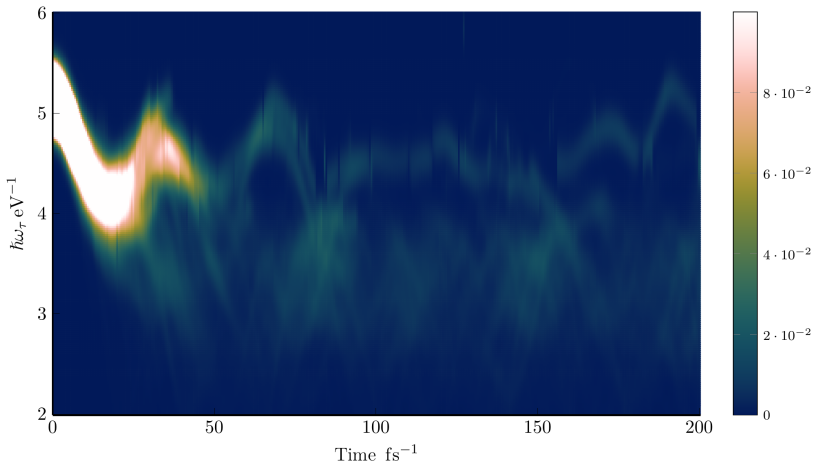
- [Section VI.A, Figure 2, and Section V] The central claim that WaveMixings.jl 'reproduces the TA PP signals of Gelin et al. for pyrazine as depicted Figure 2' is supported only by visual inspection. Figure 2 shows the WaveMixings.jl output but does not overlay or quantitatively compare the Ref. 63 result. Moreover, the comparison is with the authors' own earlier in-house implementation of the same formulas using the same trajectory inputs; agreement therefore demonstrates self-consistency, not correctness against an independent standard. Please provide a numerical agreement metric (e.g., normalized root-mean-square deviation over the (omega_pr, T) grid) for the total signal and for the GSB, SE, and ESA components, and, if possible, an independent check such as an analytic model, a limiting case, or a comparison with an independently written implementation.
- [Section VI.A and Section V] The pyrazine validation uses only 591 of 600 trajectories, selected by completing successfully, while Section V explicitly cautions that 'For realistic simulations, more trajectories are required to obtain converged signals.' This makes the reference result itself an unconverged benchmark, and the visual agreement could be sensitive to trajectory count. Please report convergence behavior, include error bars or confidence intervals, or use the full 600-trajectory set; at minimum, quantify how the displayed signals change with trajectory number.
- [Section V and Refs. 71-72] The paper cites WaveMixings.jl version v0.3.5 and a Zenodo DOI for inputs/outputs, but does not provide a pinned commit hash, tag, or an archived copy of the exact source code version used for the reported results. For a software paper, this is a reproducibility gap: the reader cannot verify that the code evaluated in the paper corresponds to the version in the repository. Please provide a specific commit/tag and, if possible, include the source code in the Zenodo archive or state that the Zenodo record contains the exact version.
- [Section III.F, Eqs. (29)-(31)] In the strong-field window functions, the pulse duration appearing in the cosine terms is written as tau_pu in Eqs. (29)-(31), whereas for the window functions one would expect the probe-pulse duration tau_pr. This is inconsistent with the doorway-window picture and with the doorway function of Eq. (27), which uses tau_pu. Please correct the equations or, if the code intentionally uses tau_pu, explain the choice and ensure the code matches the corrected formulas. This is especially important because the strong-field functionality is claimed in the package but is not demonstrated in Section VI.
minor comments (5)
- [Section III.E, Eq. (24)] The expression for \tilde E_pr(omega) is typeset ambiguously: 'exp(-omega^2/4/\tau_pr^2 + 8/\tau_nu^2)' should be written as exp[-omega^2 / (4/\tau_pr^2 + 8/\tau_nu^2)]. Please clarify whether the 4 and 8 are intended as written and define E_pr(omega) consistently.
- [Section VI.D, Listing 2] The text states the excitation frequency range is 1.5 to 7.0 eV, but the code in Listing 2 uses make_probe_freq(1.5, 6.0, 200). Please make the text and code consistent.
- [Section VI.A] There is a typo in the opening sentence: 'obtainded' should be 'obtained'.
- [Figure 3 caption] The caption reads 'Dispersed TA PPP signals'; 'PPP' should likely be 'PP'.
- [Section VI] The Introduction lists strong-field TA PP and time-resolved fluorescence as package capabilities, but Section VI does not show a strong-field example. If the strong-field module is implemented and tested, adding an example would strengthen the paper; otherwise, clarify that it is not demonstrated in the current version.
Circularity Check
Central validation is a self-comparison: WaveMixings.jl is checked against the authors' own prior in-house implementation of the same quasi-classical DW equations on the same trajectory data, so the match demonstrates internal consistency rather than independent correctness.
-
self citation load bearing
[Section VI.A (Integral TA PP signal for pyrazine); cf. Section III and Section V]
"Our implementation of the quasi-classical DW approximation within WaveMixings.jl reproduces the TA PP signals of Gelin et al. for pyrazine as depicted Figure 2. 63 ... The ab initio trajectory data are those of Ref. 63 (see supplementary information). The details of the SH simulation calculations are identical to those outlined in Ref. 63."
Ref. 63 is by the present group and contains the same quasi-classical DW equations that WaveMixings.jl implements (Section III states the expressions follow Ref. 69 and the implementation was developed in Ref. 63). The trajectory inputs and SH simulation details are explicitly taken from Ref. 63. Therefore the agreement in Section VI.A is a comparison of a new implementation with an earlier in-house implementation of the same formulas on the same inputs; it establishes internal consistency, not correctness against independent experiment, independent software, or a different dataset. The paper even states its objective was to generate signals that were 'previously generated using in-house scripts.' No quantitative agreement metric is provided, only visual inspection of Figure 2. The central
full rationale
The mathematical derivation in the paper is not circular: the quasi-classical DW expressions are stated explicitly and the code is an open-source implementation of those formulas. The circularity concern is confined to the validation strategy. Section VI.A's only evidence that the package 'reproduces' the TA PP signals is agreement with Ref. 63, which is authored by the same group, used the same trajectory data, and was generated by undocumented in-house scripts implementing the same equations. That makes the validation a self-consistency check between two implementations, not an independent benchmark. The paper also acknowledges in Section V that 'For realistic simulations, more trajectories are required to obtain converged signals,' yet Section VI.A uses 591 of 600 trajectories and the comparison is purely visual. These issues lower confidence in the correctness claim, but they are not cases where a derived quantity is equal to an input by construction: a buggy implementation could fail to reproduce Ref. 63, so the test has some content. The score of 4 reflects that the central claim still has independent content (the package, formulas, and tutorials are provided), but the load-bearing validation is self-referential.
Assumptions & free parameters
free parameters (2)
- Electronic dephasing rate nu =
0.001 eV in dispersed/2D examples
- Gaussian dephasing time tau_nu (2D-FLEX) =
not specified in text
assumptions (7)
- domain assumption Assumption (i): pump and probe pulses do not overlap.
- domain assumption Assumption (ii): nuclear dynamics during each laser pulse can be neglected.
- domain assumption Assumption (iii): evolution of electronic coherences during coherence times tau and tau_t is evaluated for fixed nuclei.
- domain assumption Assumption (iv): quantum evolution during population time T is replaced by quasi-classical trajectories and Monte Carlo sampling.
- domain assumption Neglect of nonadiabatic couplings between manifolds {0}-{I}, {I}-{II}, {0}-{II}; NACs within {II} are ignored.
- domain assumption The quasi-classical DW expressions of Section III (Eqs 5-34) are taken as given from Refs 63-69.
- standard math Wigner distribution sampling of initial conditions and Monte Carlo averaging over trajectories.
Cite this review
Pith. "Pith review of WaveMixings.jl: a Julia package for performing on-the-fly time-resolved nonlinear electronic spectra from quasi-classical trajectories." pith.science (2026). https://pith.science/paper/EBO4P45M
@misc{pith2026250903917,
  author       = {Pith},
  title        = {Pith review of: WaveMixings.jl: a Julia package for performing on-the-fly time-resolved nonlinear electronic spectra from quasi-classical trajectories},
  year         = {2026},
  howpublished = {\url{https://pith.science/paper/EBO4P45M}},
  note         = {Machine review of arXiv:2509.03917}
}
read the original abstract
We present an efficient numerical implementation of the quasi-classical doorway-window approximation, specifically designed for on-the-fly simulations of time-resolved nonlinear spectroscopic signals in the Julia package WaveMixings.jl. The package contains modules that facilitate standard tasks such as input/output data handling, data filtering, and post-processing, among others. WaveMixings.jl includes implementations of various methods developed by the authors, including integral and dispersed transient absorption pump-probe signals and two-dimensional spectra. By developing WaveMixings.jl we aim to create a versatile platform to perform simulations and develop methodologies within the quasi-classical doorway-window approximation framework.
Figures


Figures from the paper (3 more)


Reference graph
Works this paper leans on
-
[1]
on the fly
1O. Travnikova, T. Piteša, A. Ponzi, M. Sapunar, R. J. Squibb, R. Richter, P. Finetti, M. Di Fraia, A. De Fanis, and N. et al . Mahne, ‘Photochemical ring-opening reaction of 1,3- cyclohexadiene: Identifying the true reactive state,’ J. Am. Chem. Soc. 144, 21878–21886 (2022). 2K. S. Zinchenko, F. Ardana-Lamas, I. Seidu, S. P. Neville, J. van der Veen, V. ...
2022
-
[2011]
pp. 497–568. 63M. F. Gelin, X. Huang, W. Xie, L. Chen, N. Došlić, and W. Domcke, ‘Ab initio surface hopping simulation of femtosecond transient-absorption pump-probe signals of nonadia- batic excited-state dynamics using the doorway-window representation,’ J. Chem. Theory. Comput. 17, 2394–2408 (2021). 64X. Huang, W. Xie, N. Došlić, M. F. Gelin, and W. Do...
work page 2021
Reviewed August 5, 2026 · model on record in the stance chip above.
Discussion (0). Sign in to comment.