REVIEW 2 major objections 5 minor 61 references
A quiet-Sun filament eruption on 2014 June 25 produced a persistent coronal hole, not just a transient dimming.
Reviewed by Pith at T0; open to challenge. T0 means a machine referee read the full paper against a public rubric. the ladder, T0–T4 →
A quiet-Sun filament eruption created a coronal dimming that evolved into a persistent coronal hole, migrating 150 arcseconds to a region of modeled open magnetic flux and surviving for more than one solar rotation.
T0 review reviewed 2026-08-05 challenge →
load-bearing objection A well-observed single event that makes a solid case for a filament-eruption-formed coronal hole, provided you accept a tuned PFSS source surface. the 2 major comments →
Formation of a Coronal Hole by a quiet-Sun Filament Eruption
The pith
A machine-rendered reading of the paper's core claim, the machinery that carries it, and where it could break.
The reading
Core claim
The central claim is that coronal holes can, under certain conditions, form as a consequence of quiet-Sun filament eruptions. The paper documents one event in which a filament eruption produced a coronal dimming that, instead of recovering, migrated roughly 150 arcseconds north-west over 15.5 hours, reached a location where potential-field source-surface extrapolations show open magnetic field lines, and then stabilized. There, the emission measure decreased exponentially at about 3% per hour, which the authors interpret as plasma outflow into interplanetary space. The structure remained identifiable through the next solar rotation, setting a lower bound on its lifetime of one rotation, and
What carries the argument
The staged transition from dimming to coronal hole is the mechanism. The filament eruption stretches its leg's field quasi-radially and evacuates plasma, producing a coronal dimming; over 15.5 hours the dimming's boundaries move across the photosphere, requiring interchange reconnection (reconnection that swaps open and closed field footpoints without changing total flux) at the leading and trailing edges. The joint temperature-emission-measure diagnostic carries the physical argument: during formation and migration the pair follows adiabatic cooling, T proportional to EM^{1/3}, and after stabilization the EM decays steadily, taken as outflow. The potential-field source-surface extrapolation
Load-bearing premise
The claim that the dimming became a coronal hole rather than an unusually long-lived dimming depends on the potential-field model showing open magnetic field lines at the structure's final location, and that model only shows them when the source surface is placed at the non-standard low height of 1.6 solar radii.
What would settle it
Compute the same potential-field source-surface extrapolation with the source surface at the standard 2.5 solar radii: if the open-field region where the structure settles disappears, the magnetic-support argument collapses and the feature is better classed as an unusually long-lived dimming. Alternatively, take EUV spectra of the region at the next rotation and look for persistent blue-shifted outflows; their absence would rule out the coronal-hole interpretation.
If this is right
- Transient coronal dimmings are not a closed category: some evolve into persistent coronal holes, so dimming surveys should separate a long-lived tail instead of assuming all dimmings recover.
- Filament eruptions join decaying active regions as a direct, observable route for low-latitude coronal hole formation, with 22 candidate cases from 2010-2024 implying the route is not rare.
- A coronal hole's birth site and stable site can differ by about 150 arcseconds; holes can open in closed-field modeled regions and then walk to open-field regions.
- Because the structure drifts over stationary photospheric magnetic elements, coronal-hole motion is governed by the large-scale open-field topology through interchange reconnection, not by fixed photospheric roots.
- The adiabatic-cooling signature observed in the temperature-emission-measure plane provides a testable thermometer for the formation process of coronal holes.
Where Pith is reading between the lines
- If filament-eruption coronal holes are as common as the 22 candidates suggest, eruptive events may regularly refresh the Sun's low-latitude open flux, feeding slow-to-high-speed solar wind streams and affecting space-weather recurrence.
- The paper's distinction criterion (persistence, emission-measure decline, and settling on modeled open field) could be automated for real-time coronal-hole detection, flagging dimmings that are likely to become holes.
- The required low source-surface height implies the open-field region may be only marginally open; non-potential or time-dependent extrapolations of the same magnetograms would test whether the stabilization site is genuinely open rather than a model artifact.
- A direct spectroscopic follow-up of a filament-eruption coronal hole at the next rotation, searching for blue-shifted outflow lines, would confirm the coronal-hole interpretation without relying solely on brightness thresholds.
Editorial analysis
A structured set of objections, weighed in public.
Referee Report
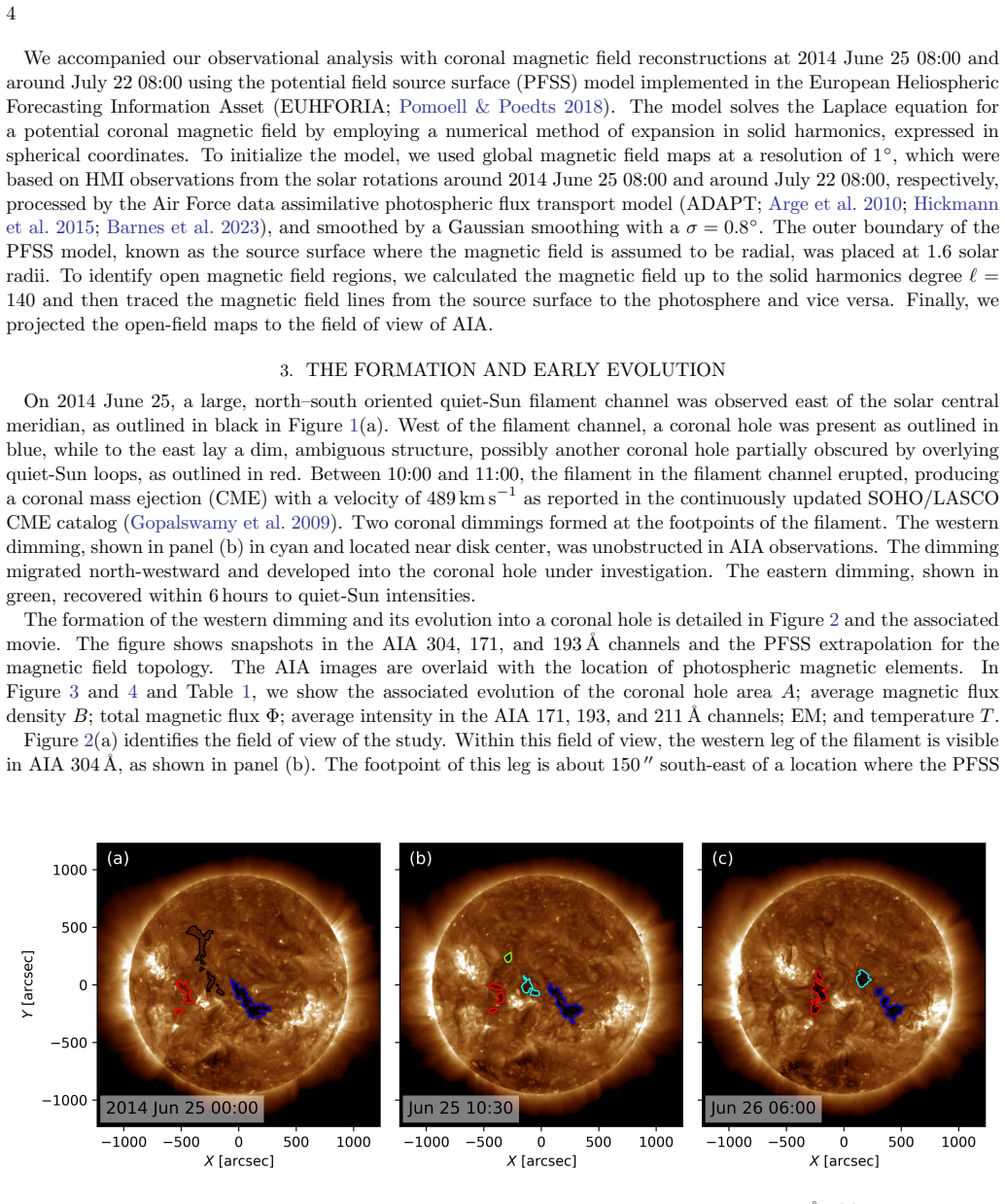
Summary. The paper uses SDO/AIA/HMI observations of the 2014 June 25 quiet-Sun filament eruption to track the formation, migration, and stabilization of a coronal dimming that the authors identify as a newly formed coronal hole. They divide the evolution into precursor/eruption, migration, and stabilization phases, derive area, intensity, EM, temperature, and magnetic flux, and compare the T–EM relationship with adiabatic cooling. They argue that the dimming migrated about 150 arcsec to a region where a PFSS extrapolation with source surface at 1.6 R_sun shows open field lines, stabilized there, merged with a pre-existing coronal hole, and remained visible at the next solar rotation, implying a lifetime >1 rotation. A secondary survey lists 22 additional coronal holes that may have formed from filament eruptions.
Significance. If accepted, this would be one of the few direct, well-observed cases of a coronal hole forming from a quiet-Sun filament eruption, with implications for dimming–coronal-hole relationships, interchange reconnection, and the origin of small coronal holes. The analysis is largely transparent: SDO data are reliable, the DEM and magnetic-field methods are standard, and the authors explicitly present two boundary sets and discuss many caveats. The strength of the claim is currently limited by the model-dependence of the open-field identification and by the qualitative nature of the persistence evidence after the structure merged with a pre-existing hole.
major comments (2)
- [§2, §4.3] The central claim that the dimming 'transitioned into a coronal hole' relies on identifying the stabilization site as a region of open magnetic flux. The only support for this is the PFSS model, and §4.3 states that the source surface had to be lowered to 1.6 R_sun because at 2.0–2.5 R_sun 'the model would not have shown open field lines in the region where the coronal hole settled.' Since the authors themselves call the open-field region 'not very stable,' the load-bearing magnetic foundation is weak. Please add a sensitivity study varying R_sun (e.g., 1.4, 1.6, 1.8, 2.0, 2.5), ADAPT realizations, and harmonic degree, or provide independent evidence for open topology (e.g., spectral outflow signatures or consistency with other coronal-hole detection methods). If the open-field region is not robust, the conclusion should be rephrased so that the modeled open field is only a plausibility
- [§3.3, §4.1] The >1 solar rotation lifetime is a key discriminator between a genuine coronal hole and a long-lived dimming. However, after 2014 June 26 18:00 the boundaries are no longer robustly identified, and the feature merges with a pre-existing coronal hole. At the next rotation, the evidence is described as 'seems again apparent' and 'remains well recognizable,' which is purely visual. Because the merged structure contains the pre-existing hole, persistence of the newly formed portion is not quantitatively established. Please add rotation-to-rotation co-registration, area/centroid or intensity tracking of the specific new portion, or at least overlay quantitative contours from both rotations. If this is not possible, the text should not state that the structure is 'certainly not a coronal dimming anymore' on the basis of lifetime alone; it should be presented as suggestive.
minor comments (5)
- [§2] The thresholding technique is manually adjusted for every image. The two boundary sets help, but a simple sensitivity test (e.g., varying the threshold by ±10%) would make the area and flux evolution more robust.
- [§3.2] The conclusion that drift across quasi-stationary magnetic elements 'necessarily occurred via interchange reconnection' is an interpretation, not a direct observation. The wording should make the inference step explicit.
- [§4.2] The 22-event survey is interesting but is presented with minimal quantitative selection criteria. Please state the exact screening rules, how 'clear' filament disappearance and coronal-hole appearance were judged, and the uncertainties in the reported lifetimes.
- [§3.3] The statement that 'EM decreased exponentially by 3% h^-1' is not accompanied by a fit range or uncertainty; please give the fitted interval and confidence bounds.
- [§4.4] The adiabatic cooling discussion is honest about the paradox, but the earlier sections present the T–EM agreement as a firm result. It would help to refer forward to §4.4 when interpreting Equation (3).
Circularity Check
Partial circularity: the modeled open-field region used to mark the dimming-to-coronal-hole transition is produced by setting the PFSS source surface to 1.6 Rsun, a non-standard value chosen because standard heights show no open field there; the observational lifetime and EM evolution are independent.
specific steps
-
fitted input called prediction
[Section 4.3, 'Why did the coronal hole migrate?']
"To observe the open field lines in our study, we had to set the source surface height of the PFSS model, i.e., the altitude at which the magnetic field lines are considered open, to a low value of 1.6 solar radii. If we had used higher source surface heights, such as the standard values of 2 or 2.5 solar radii, the model would not have shown open field lines in the region where the coronal hole settled."
The transition from coronal dimming to coronal hole is argued to occur when the structure migrates to a region of modeled open magnetic field (Abstract; Section 3; Section 4.3). But the only evidence for open field is the PFSS model, and the source-surface height—the free parameter that determines which field lines count as open—was set to 1.6 Rsun precisely because the standard values of 2.0–2.5 Rsun do not produce open field lines at that location. The 'open field' region is therefore not an independent model prediction; it is produced by tuning the model parameter to match the observed dark structure. The authors acknowledge this by noting the low source surface 'might indicate that this open magnetic field region is not very stable.' The stabilization-at-open-field sub-claim thus partl
full rationale
The derivation chain is largely observational and self-contained: the filament eruption, dimming formation, migration, EM/temperature decrease, and >1-rotation lifetime are tracked directly in AIA/HMI data rather than derived from a fitted model. The adiabatic-cooling comparison uses an independently stated formula and is not fitted to the data. No load-bearing self-citation or uniqueness theorem is invoked. The one exhibitable circular step is the magnetic-topology support: the paper labels the stabilization at 'modeled open magnetic field' as the transition into a coronal hole, but the PFSS open-field map is obtained by setting the source surface to 1.6 Rsun, a non-standard value chosen because standard heights show no open field at that location (Section 4.3). Thus the open-field evidence is, to a degree, an input chosen by the modeler rather than a prediction. The authors explicitly acknowledge this limitation. The observational lifetime and progressive EM decrease provide independent support for the central claim, so the circularity is partial and confined to a supporting sub-claim, not the whole derivation.
Axiom & Free-Parameter Ledger
free parameters (2)
- PFSS source surface height =
1.6 solar radii
- Photospheric magnetic element threshold =
50 G
axioms (4)
- domain assumption The corona is static, potential, and force-free with a source surface at 1.6 Rsun (PFSS assumptions).
- domain assumption DEM inversion with coronal abundances and no FIP effect yields valid plasma parameters.
- domain assumption Single-temperature adiabatic cooling relation T * n^(gamma-1) = constant applies.
- ad hoc to paper The dark structure is a coronal hole rather than a long-lived dimming.
Cite this review
Pith. "Pith review of Formation of a Coronal Hole by a quiet-Sun Filament Eruption." pith.science (2026). https://pith.science/paper/4DZZFZHX
@misc{pith2026250904663,
  author       = {Pith},
  title        = {Pith review of: Formation of a Coronal Hole by a quiet-Sun Filament Eruption},
  year         = {2026},
  howpublished = {\url{https://pith.science/paper/4DZZFZHX}},
  note         = {Machine review of arXiv:2509.04663}
}
read the original abstract
A coronal hole formed as a result of a quiet-Sun filament eruption close to the solar disk center on 2014 June 25. We studied this formation using images from the Atmospheric Imaging Assembly (AIA), magnetograms from the Helioseismic and Magnetic Imager (HMI), and a differential emission measure (DEM) analysis derived from the AIA images. The coronal hole developed in three stages: (1) formation, (2) migration, and (3) stabilization. In the formation phase, the emission measure (EM) and temperature started to decrease six hours before the filament erupted. Then, the filament erupted and a large coronal dimming formed over the following three hours. Subsequently, in a phase lasting $15.5$~hours, the coronal dimming migrated by 150" from its formation site to a location where potential field source surface extrapolations indicate the presence of open magnetic field lines, marking the transition into a coronal hole. During this migration, the coronal hole drifted across quasi-stationary magnetic elements in the photosphere, implying the occurrence of magnetic interchange reconnection at the boundaries of the coronal hole. In the stabilization phase, the magnetic properties and area of the coronal hole became constant. The EM of the coronal hole decreased, which we interpret as a reduction in plasma density due to the onset of plasma outflow into interplanetary space. As the coronal hole rotated towards the solar limb, it merged with a nearby pre-existing coronal hole. At the next solar rotation, the coronal hole was still apparent, indicating a lifetime of >1 solar rotation.
Figures


Reference graph
Works this paper leans on
-
[1]
Arge, C. N., Henney, C. J., Koller, J., et al. 2010, in American Institute of Physics Conference Series, Vol. 1216, Twelfth International Solar Wind Conference, ed. M. Maksimovic, K. Issautier, N. Meyer-Vernet, M. Moncuquet, & F. Pantellini, 343–346
work page 2010
-
[2]
Aschwanden, M. J. 2005, Physics of the Solar Corona. An Introduction with Problems and Solutions (2nd edition) 15 Astropy Collaboration, Price-Whelan, A. M., Lim, P. L., et al. 2022, ApJ, 935, 167 Astropy Collaboration, Price-Whelan, A. M., Sip˝ ocz, B. M., et al. 2018, AJ, 156, 123 Astropy Collaboration, Robitaille, T. P., Tollerud, E. J., et al. 2013, A...
work page 2005
-
[3]
Asvestari, E., Heinemann, S. G., Temmer, M., et al. 2019, Journal of Geophysical Research (Space Physics), 124, 8280
work page 2019
-
[4]
Attrill, G. D. R., Narukage, N., Shibata, K., & Harra, L. K. 2005, in ESA Special Publication, Vol. 596, Chromospheric and Coronal Magnetic Fields, ed. D. E
work page 2005
-
[5]
Attrill, G. D. R., van Driel-Gesztelyi, L., D´ emoulin, P., et al. 2008, SoPh, 252, 349
work page 2008
-
[6]
Badman, S. T., Bale, S. D., Mart ´ ınez Oliveros, J. C., et al. 2020, ApJS, 246, 23
work page 2020
- [7]
-
[8]
Bohlin, J. D. & Sheeley, N. R., J. 1978, SoPh, 56, 125
work page 1978
-
[9]
Cheung, M. C. M., Boerner, P., Schrijver, C. J., et al. 2015, ApJ, 807, 143
work page 2015
-
[10]
Cranmer, S. R. 2009, Living Reviews in Solar Physics, 6, 3
work page 2009
-
[11]
Delouille, V., Hofmeister, S. J., Reiss, M. A., et al. 2018, in In: Machine Learning Techniques for Space Weather, 365–395
work page 2018
-
[12]
Fainshtein, V. G. & Rudenko, G. V. 2004, in IAU
work page 2004
- [13]
-
[14]
Freeland, S. L. & Handy, B. N. 1998, SoPh, 182, 497
work page 1998
-
[15]
2009, Earth Moon and Planets, 104, 295
Gopalswamy, N., Yashiro, S., Michalek, G., et al. 2009, Earth Moon and Planets, 104, 295
work page 2009
-
[16]
Hahn, M., Landi, E., & Savin, D. W. 2011, ApJ, 736, 101
work page 2011
-
[17]
R., Millman, K
Harris, C. R., Millman, K. J., van der Walt, S. J., et al. 2020, Nature, 585, 357
2020
-
[18]
Heinemann, S. G., Hofmeister, S. J., Turtle, J. A., et al. 2023, A&A, 679, A100
work page 2023
-
[19]
G., Jerˇ ci´ c, V., Temmer, M., et al
Heinemann, S. G., Jerˇ ci´ c, V., Temmer, M., et al. 2020, A&A, 638, A68
work page 2020
-
[20]
Heinemann, S. G., Pomoell, J., Caplan, R. M., et al. 2025, ApJ, 986, 166
work page 2025
-
[21]
Heinemann, S. G., Saqri, J., Veronig, A. M., Hofmeister, S. J., & Temmer, M. 2021, SoPh, 296, 18
work page 2021
-
[22]
Heinemann, S. G., Temmer, M., Hofmeister, S. J., Veronig, A. M., & Vennerstrøm, S. 2018, ApJ, 861, 151
work page 2018
-
[23]
Hickmann, K. S., Godinez, H. C., Henney, C. J., & Arge, C. N. 2015, SoPh, 290, 1105
work page 2015
-
[24]
Hofmeister, S., Savin, D. W., & Hahn, M. 2025, arXiv e-prints, arXiv:2410.08967
work page internal anchor Pith review Pith/arXiv arXiv 2025
-
[25]
Hofmeister, S. J. 2024, SoPh, 299, 77
work page 2024
-
[26]
Hofmeister, S. J., Veronig, A., Reiss, M. A., et al. 2017, ApJ, 835, 268
work page 2017
-
[27]
Hunter, J. D. 2007, Computing in Science & Engineering, 9, 90
2007
-
[28]
Inglis, A. R., O’Connor, R. E., Pesnell, W. D., Kirk, M. S., & Karna, N. 2019, ApJ, 880, 98
work page 2019
-
[29]
Karachik, N. V., Pevtsov, A. A., & Abramenko, V. I. 2010, The Astrophysical Journal, 714, 1672
work page 2010
-
[30]
Krista, L. D., Manning, D., & West, M. J. 2022, ApJ, 930, 165
work page 2022
-
[31]
Krista, L. D. & Reinard, A. A. 2017, ApJ, 839, 50
work page 2017
- [32]
-
[33]
Lee, C. O., Luhmann, J. G., Hoeksema, J. T., et al. 2011, SoPh, 269, 367
work page 2011
-
[34]
R., Title, A
Lemen, J. R., Title, A. M., Akin, D. J., et al. 2012, SoPh, 275, 17
2012
-
[35]
M., Andretta, V., Murabito, M., & Del Zanna, G
Lezzi, S. M., Andretta, V., Murabito, M., & Del Zanna, G. 2023, A&A, 680, A61
work page 2023
-
[36]
McIntosh, S. W. 2009, ApJ, 693, 1306
work page 2009
-
[37]
T., Krieger, A
Nolte, J. T., Krieger, A. S., Timothy, A. F., et al. 1976, SoPh, 46, 303
1976
-
[38]
Panasenco, O., Velli, M., D’Amicis, R., et al. 2020, ApJS, 246, 54
work page 2020
-
[39]
D., Thompson, B
Pesnell, W. D., Thompson, B. J., & Chamberlin, P. C. 2012, SoPh, 275, 3
2012
-
[40]
Petrie, G. J. D. & Haislmaier, K. J. 2013, ApJ, 775, 100
work page 2013
-
[41]
Plowman, J. E. & Berger, T. E. 2020, SoPh, 295, 144
work page 2020
-
[42]
& Poedts, S
Pomoell, J. & Poedts, S. 2018, Journal of Space Weather and Space Climate, 8, A35
2018
- [43]
-
[44]
Reinard, A. A. & Biesecker, D. A. 2008, ApJ, 674, 576
2008
-
[45]
M., Chikunova, G., Dissauer, K., Podladchikova, T., & Veronig, A
Ronca, G. M., Chikunova, G., Dissauer, K., Podladchikova, T., & Veronig, A. M. 2024, A&A, 691, A195
work page 2024
-
[46]
Rotter, T., Veronig, A. M., Temmer, M., & Vrˇ snak, B. 2012, SoPh, 281, 793
work page 2012
-
[47]
Rust, D. M. 1983, SSRv, 34, 21
work page 1983
-
[48]
Saqri, J., Veronig, A. M., Heinemann, S. G., et al. 2020, SoPh, 295, 6
work page 2020
-
[49]
H., Schou, J., Bush, R
Scherrer, P. H., Schou, J., Bush, R. I., et al. 2012, SoPh, 275, 207
2012
-
[50]
H., Bush, R
Schou, J., Scherrer, P. H., Bush, R. I., et al. 2012, SoPh, 275, 229
2012
- [51]
- [52]
-
[53]
Sterling, A. C. & Hudson, H. S. 1997, ApJL, 491, L55 16 The SunPy Community, Barnes, W. T., Bobra, M. G., et al. 2020, The Astrophysical Journal, 890, 68
work page 1997
-
[54]
Thompson, B. J., Cliver, E. W., Nitta, N., Delann´ ee, C., & Delaboudini` ere, J. P. 2000, Geophys. Res. Lett., 27, 1431
work page 2000
-
[55]
Tian, H., Harra, L., Baker, D., Brooks, D. H., & Xia, L. 2021, SoPh, 296, 47
work page 2021
- [56]
-
[57]
M., Dissauer, K., Kliem, B., et al
Veronig, A. M., Dissauer, K., Kliem, B., et al. 2025, arXiv e-prints, arXiv:2505.19228
Pith/arXiv arXiv 2025
-
[58]
E., et al
Virtanen, P., Gommers, R., Oliphant, T. E., et al. 2020, Nature Methods, 17, 261
2020
-
[59]
Wang, Y. M. 2009, SSRv, 144, 383
work page 2009
-
[60]
Yang, D., Heinemann, S. G., Cameron, R. H., & Gizon, L. 2024, SoPh, 299, 161
work page 2024
-
[61]
Yang, L., Jiang, Y., & Zhang, J. 2010, in IAU Symposium, Vol. 264, Solar and Stellar Variability: Impact on Earth and Planets, ed. A. G. Kosovichev, A. H. Andrei, & J.-P. Rozelot, 295–297
work page 2010
This paper was first reviewed by deepseek-v4-flash on August 5, 2026.
discussion (0)
Sign in with ORCID, Apple, or X to comment. Anyone can read and Pith papers without signing in.