REVIEW 2 major objections 3 minor 1 cited by
Two-loop QCD corrections to $ZH$ and off-shell $Z$ boson pair production in gluon fusion
T0 review · 2 major / 3 minor · reviewed 2026-08-04 · deepseek-v4-flash
Pith's one-line read By combining deep high-energy and forward-limit expansions, this paper delivers two-loop NLO virtual corrections for gg->ZH and, for the first time, off-shell gg->Z*Z*, with full dependence on s, t, the two final-state virtualities, and the
desk verdict Technically impressive expansion calculation with a real completeness gap: the off-shell ZZ claim outruns the computed results because the double-triangle contribution is missing. read the letter →
The pith
A machine-rendered reading of the paper's core claim, the machinery that carries it, and where it could break.
The reading
What carries the argument
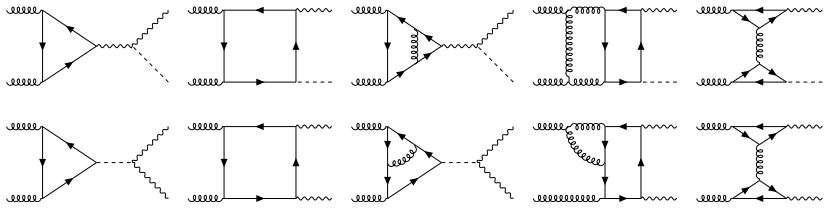
The machinery is a pair of complementary analytic expansions of the same two-loop amplitudes expressed through 161 master integrals. (i) A forward-limit expansion: a Taylor expansion in the Mandelstam variable t (equivalently in delta q = q1+q3) that simultaneously expands in q3^2 and q4^2, computed both before and after integration-by-parts reduction as a cross-check. (ii) A high-energy expansion in m_t -> 0, carried to m_t^100-112 and turned into rational-function approximants (Padé approximants) in m_t. The two expansions are stitched in the intermediate p_T region where their agreement is best—the paper quotes p_T = 150 GeV as the switching point for gg->ZH, and uses the forward expansio
What would settle it
An independent numerical two-loop evaluation of a single off-shell gg->Z*Z* helicity amplitude away from the on-shell point (for example sqrt(s)=400 GeV, p_T=100 GeV, q3^2=q4^2=(100 GeV)^2), compared directly with the expansion, would settle whether the convergence observed in the q3^2,q4^2 series persists at two loops; disagreement beyond the claimed uncertainty would invalidate the off-shell extrapolation.
Extended reading notes
Core claim
On the paper's own terms, the central claim is that the helicity amplitudes for gg->Z*Z* and the form factors for gg->ZH can be written, over the entire physical phase space, as a combination of a forward-limit Taylor expansion and a high-energy expansion supplemented by Padé approximants, with a switch in the intermediate transverse-momentum region where the two expansions agree to many digits. The forward expansion includes terms up to t^5 (ZH) or t^10 (Z*Z*) in the massless parts, together with simultaneous expansion in the final-state virtualities q3^2 and q4^2; the high-energy expansion reaches up to m_t^112 (ZH) or m_t^100 (Z*Z*). At two loops both expansions are constructed from the s
Load-bearing premise
The results stand or fall on the assumption that expansions validated at one loop and for on-shell Z pairs also converge for off-shell Z virtualities—where the paper notes after Eq. (27) in Sec. 3.1 that even the double-triangle contribution is not yet known, and no independent two-loop off-shell benchmark exists.
Editorial extensions
If this is right
- The analytic expressions evaluate in milliseconds per phase-space point, so scans over masses, kinematics, and renormalization schemes need no precomputed grids.
- The gg->Z*Z* amplitudes open the off-shell region up to virtualities near the Higgs mass, where interference between Higgs-mediated and non-resonant amplitudes is used to constrain the Higgs width.
- The by-product gg->gamma*gamma* and gg->Z*gamma* amplitudes give heavy-quark-loop contributions to off-shell diphoton and photon-Z production.
- For tested phase-space points the ZZ virtual corrections agree with numerical benchmarks below 0.02% (below 0.005% for p_T below 210 GeV), and the ZH corrections are generally far below the percent level.
- Combined with existing real-emission contributions, these finite virtual corrections complete NLO predictions for gluon-initiated ZH and ZZ production at the LHC.
Reading between the lines
- Beyond the paper: the observed convergence as q3^2 and q4^2 increase—roughly one lost digit per 20 GeV of virtuality—suggests a testable map of the approximation's validity ceiling in the off-shell two-loop region.
- Beyond the paper: because the off-shell double-triangle contribution is still missing, the current off-shell Z*Z* results are not yet a complete NLO virtual set; a future exact expression for that term could be added linearly, since the present expansions are linear in the amplitude pieces.
- Beyond the paper: the same paired-expansion strategy may transfer to other 2->2 gluon-fusion processes with two different final-state virtualities, where exact two-loop evaluation is hardest.
- Beyond the paper: the fast evaluation and explicit parameter dependence make these amplitudes well suited for embedding in event generators with dynamic scales and coupling variations, a step the paper flags as planned but does not demonstrate.
Signed reviews
Editorial analysis
A structured set of objections, weighed in public.
Referee Report
Summary. The paper computes two-loop QCD corrections to gg→ZH and to off-shell Z-boson pair production gg→Z*Z*, mediated by top-quark loops. The method combines a deep high-energy expansion (up to m_t^112) with a forward-limit/t-expansion (up to t^10 for ZZ and t^5 for ZH, including several orders in the final-state virtualities), supplemented by Padé approximants. The resulting helicity amplitudes and form factors are used to construct finite NLO virtual corrections. The authors validate the expansions against exact one-loop results, against agreement of the two expansion regimes, and against pySecDec-based numerical results for on-shell ZZ and for ZH. They also obtain gg→γγ and gg→Zγ amplitudes as by-products. A central caveat is that the double-triangle contribution to off-shell Z*Z* is not computed; the manuscript states explicitly that the off-shell result is not yet known.
Significance. If the computed amplitudes are correct, this is a technically valuable step: it provides an analytic, fast-evaluable representation of the top-quark-mediated two-loop box contributions to gg→ZH and gg→Z*Z*, with full dependence on s, t, q3^2, q4^2 and m_t. The paper benefits from strong cross-checks: the one-loop approximations are compared to exact results, the two independent expansions agree, and the finite remainders agree with independent pySecDec results at the 0.02% level for ZZ and at the per-mille level for ZH. No constants are fitted to the target cross sections. The main limitation is that the off-shell Z*Z* amplitudes omit the double-triangle contribution, so the abstract's claim that the results 'constitute the next-to-leading order virtual corrections' is not supported for off-shell ZZ production.
major comments (2)
- [Sec. 3.1, Eq. (27) and following text] The decomposition in Eq. (27) includes the double-triangle contribution A^(i),dt, but the text immediately after states: 'To our knowledge, the off-shell result is not yet known.' No off-shell expression is provided anywhere. Since the two-loop double-triangle diagrams contribute to on-shell ZZ via their interference (Ref. [15]) and the H→Z*Z* vertex is non-vanishing for q3^2,q4^2≠0, the off-shell amplitudes are not complete NLO virtual corrections. The abstract's statement 'Our results constitute the next-to-leading order virtual corrections to these processes' therefore overreaches for off-shell ZZ. The authors should either compute and include the off-shell double-triangle term or explicitly rescope the claims to the v_t^2, a_t^2, and triangle contributions and amend the abstract and conclusions accordingly.
- [Sec. 3.4, Eq. (29) and Figs. 8–9] The finite remainder V_fin^ZZ is defined from the helicity amplitudes, but since A^(1) lacks the double-triangle part, V_fin^ZZ for off-shell kinematics omits the corresponding two-loop interference with the LO amplitude. The excellent agreement with the on-shell numerical results of Refs. [21,23] does not validate the off-shell region, because those reference points are on-shell. The convergence tests in Figs. 5–7 only assess the terms that were actually computed; they cannot detect a systematically omitted contribution. Please state precisely which contributions enter V_fin^ZZ and provide either an off-shell numerical benchmark or an explicit statement of this limitation.
minor comments (3)
- [Sec. 3.5] The statement that the gg→γγ amplitudes can be used off-shell up to q^2 ∼ (125 GeV)^2 is an extrapolation from the behaviour seen for gg→HH and gg→Z*Z*; no direct off-shell check for γγ is provided. Please label this as an expectation or add a numerical test.
- [Sec. 4.1, footnote 6] The footnote claims that the ZH form factors can be immediately applied to off-shell Z and Higgs bosons. The double-triangle contribution for ZH is taken from Ref. [13], which is derived for on-shell kinematics; the off-shell extension of that contribution should be justified or qualified.
- [Sec. 2.3.3] The construction of the Padé approximants is described verbally (range of m_t orders, treatment of log(m_t) terms). For reproducibility, please give the precise algorithm or point to a code/ancillary file defining the window and the uncertainty estimate.
Circularity Check
No circularity in the derivation; amplitude expansion is benchmarked externally, though the off-shell ZZ double-triangle term is omitted (a completeness gap, not circularity).
full rationale
The derivation chain is self-contained and non-circular. The two-loop helicity amplitudes are computed by diagram generation, reduction to master integrals, and deep expansions in t and the high-energy limit; no parameter is fitted to the target cross sections. The expansions are validated against exact one-loop results (Figs. 2-4, 12-13) and, at two loops, against independent pySecDec numerical results for gg->ZZ (Refs. [21,23], Figs. 8-9) and gg->ZH (Ref. [20], Figs. 16-18), with agreement at the per-mille level or better. The reuse of the same group's 161 two-loop master integrals and expansion technology (Refs. [24,39,40,50]) is a technical self-reliance, but it is not circular: those integrals are not constructed from the target amplitudes, and the final results agree with external benchmarks. The one genuinely load-bearing caveat is a completeness gap, not a circularity: after Eq. (27) the paper states that analytic off-shell double-triangle results are not known ('To our knowledge, the off-shell result is not yet known'), and Sections 3.2-3.4 present only the box contributions. Hence the abstract's phrase 'next-to-leading order virtual corrections' overstates the off-shell ZZ amplitude. That is a missing contribution, not an equivalence between input and output, so it does not raise the circularity score.
Assumptions & free parameters
free parameters (3)
- Expansion truncation orders
- Pade approximant window =
ZZ: m_t^88 to m_t^100; ZH: m_t^98 to m_t^112
- Matching point between expansions =
p_T = 150 GeV
assumptions (4)
- domain assumption Correctness of the 161 two-loop master integrals and their expansions from Refs. [24,39,40,50].
- ad hoc to paper Dual expansion plus Pade approximants converge across the entire phase space.
- domain assumption Standard renormalization and infrared subtraction define the finite virtual corrections.
- domain assumption The top-quark loop is the only heavy-quark contribution, and the external numerical benchmarks are accurate.
Cite this review
Pith. "Pith review of Two-loop QCD corrections to $ZH$ and off-shell $Z$ boson pair production in gluon fusion." pith.science (2026). https://pith.science/paper/LLBEXNPS
@misc{pith2026250907072,
  author       = {Pith},
  title        = {Pith review of: Two-loop QCD corrections to $ZH$ and off-shell $Z$ boson pair production in gluon fusion},
  year         = {2026},
  howpublished = {\url{https://pith.science/paper/LLBEXNPS}},
  note         = {Machine review of arXiv:2509.07072}
}
abstract
We compute two-loop corrections to the associated production of a Higgs boson with a $Z$ boson and to off-shell $Z$ boson pair production in the gluon fusion channel, mediated by a heavy quark. We perform deep expansions in the high-energy region and around the forward limit and show that their combination covers the whole phase space. Our results constitute the next-to-leading order virtual corrections to these processes. Their numerical evaluation is fast and the dependence on all parameters is maintained, thus a change of parameter values or renormalization scheme is straightforward. As a by-product of our calculation, we also obtain the two-loop heavy quark mediated virtual corrections to the processes of off-shell di-photon and photon-$Z$ production.
Figures


Figures from the paper (16 more)


Forward citations
Cited by 1 Pith paper
-
ggxy: Fast and flexible NLO QCD corrections to gluon-initiated processes
The ggxy library implements NLO QCD corrections for gg→ZH and gg→ZZ with full top-quark mass dependence using high-energy and forward-limit expansions, validated against existing results and interfaced to POWHEG for p...
Reference graph
Works this paper leans on
-
[15]
J. M. Campbell, R. K. Ellis, M. Czakon and S. Kirchner,Two loop correction to interference ingg→ZZ,JHEP08(2016) 011 [1605.01380]
arXiv 2016
-
[2]
O. Brein, R. V. Harlander and T. J. E. Zirke,vh@nnlo - Higgs Strahlung at hadron colliders,Comput. Phys. Commun.184(2013) 998 [1210.5347]. [3]ATLAScollaboration,Measurements of WH and ZH production with Higgs boson decays into bottom quarks and direct constraints on the charm Yukawa coupling in 13 TeV pp collisions with the ATLAS detector,JHEP04(2025) 075...
arXiv 2013
-
[5]
N. Kauer and G. Passarino,Inadequacy of zero-width approximation for a light Higgs boson signal,JHEP08(2012) 116 [1206.4803]
arXiv 2012
-
[6]
F. Caola and K. Melnikov,Constraining the Higgs boson width with ZZ production at the LHC,Phys. Rev. D88(2013) 054024 [1307.4935]
arXiv 2013
-
[7]
J. M. Campbell, R. K. Ellis and C. Williams,Bounding the Higgs Width at the LHC Using Full Analytic Results forgg−> e −e+µ−µ+,JHEP04(2014) 060 [1311.3589]
arXiv 2014
-
[8]
B. A. Kniehl,Associated Production of Higgs and Z Bosons From Gluon Fusion in Hadron Collisions,Phys. Rev. D42(1990) 2253
1990
-
[9]
D. A. Dicus and C. Kao,Higgs Boson -Z 0 Production From Gluon Fusion,Phys. Rev. D38(1988) 1008
work page 1988
-
[10]
D. A. Dicus, C. Kao and W. W. Repko,Gluon Production of Gauge Bosons,Phys. Rev. D36(1987) 1570. 31
work page 1987
Show all 65 references
-
[11]
E. W. N. Glover and J. J. van der Bij,Z BOSON PAIR PRODUCTION VIA GLUON FUSION,Nucl. Phys. B321(1989) 561
1989
-
[12]
Hasselhuhn, T
A. Hasselhuhn, T. Luthe and M. Steinhauser,On top quark mass effects to gg→ZHat NLO,JHEP01(2017) 073 [1611.05881]
2017 arXiv
-
[13]
Davies, G
J. Davies, G. Mishima and M. Steinhauser,Virtual corrections togg→ZHin the high-energy and large-m t limits,JHEP03(2021) 034 [2011.12314]
2021 arXiv
-
[14]
Melnikov and M
K. Melnikov and M. Dowling,Production of two Z-bosons in gluon fusion in the heavy top quark approximation,Phys. Lett. B744(2015) 43 [1503.01274]
2015 arXiv
-
[16]
Davies, G
J. Davies, G. Mishima, M. Steinhauser and D. Wellmann,gg→ZZ: analytic two-loop results for the low- and high-energy regions,JHEP04(2020) 024 [2002.05558]
2020 arXiv
-
[17]
G. Wang, X. Xu, Y. Xu and L. L. Yang,Next-to-leading order corrections for gg→ZHwith top quark mass dependence,Phys. Lett. B829(2022) 137087 [2107.08206]
2022 arXiv
-
[18]
Alasfar, G
L. Alasfar, G. Degrassi, P. P. Giardino, R. Gr¨ ober and M. Vitti,Virtual corrections togg→ZHvia a transverse momentum expansion,JHEP05(2021) 168 [2103.06225]
2021 arXiv
-
[19]
Degrassi, R
G. Degrassi, R. Gr¨ ober and M. Vitti,Virtual QCD corrections to gg→ZZ: top-quark loops from a transverse-momentum expansion,JHEP07(2024) 244 [2404.15113]
2024 arXiv
-
[20]
L. Chen, G. Heinrich, S. P. Jones, M. Kerner, J. Klappert and J. Schlenk,ZH production in gluon fusion: two-loop amplitudes with full top quark mass dependence,JHEP03(2021) 125 [2011.12325]
2021 arXiv
-
[21]
Agarwal, S
B. Agarwal, S. P. Jones and A. von Manteuffel,Two-loop helicity amplitudes for gg→ZZwith full top-quark mass effects,JHEP05(2021) 256 [2011.15113]
2021 arXiv
-
[22]
L. Chen, J. Davies, G. Heinrich, S. P. Jones, M. Kerner, G. Mishima et al.,ZH production in gluon fusion at NLO in QCD,JHEP08(2022) 056 [2204.05225]
2022 arXiv
-
[23]
Agarwal, S
B. Agarwal, S. Jones, M. Kerner and A. von Manteuffel,Complete Next-to-Leading Order QCD Corrections to ZZ Production in Gluon Fusion,Phys. Rev. Lett.134 (2025) 031901 [2404.05684]
2025 arXiv
-
[24]
Davies, G
J. Davies, G. Mishima, K. Sch¨ onwald and M. Steinhauser,Analytic approximations of 2→2 processes with massive internal particles,JHEP06(2023) 063 [2302.01356]. 32
2023 arXiv
-
[25]
von Manteuffel and L
A. von Manteuffel and L. Tancredi,The two-loop helicity amplitudes for gg→V 1V2 →4 leptons,JHEP06(2015) 197 [1503.08835]
2015 arXiv
-
[26]
Caola, J
F. Caola, J. M. Henn, K. Melnikov, A. V. Smirnov and V. A. Smirnov,Two-loop helicity amplitudes for the production of two off-shell electroweak bosons in gluon fusion,JHEP06(2015) 129 [1503.08759]
2015 arXiv
-
[27]
Bellafronte, G
L. Bellafronte, G. Degrassi, P. P. Giardino, R. Gr¨ ober and M. Vitti,Gluon fusion production at NLO: merging the transverse momentum and the high-energy expansions,JHEP07(2022) 069 [2202.12157]
2022 arXiv
-
[28]
Degrassi, R
G. Degrassi, R. Gr¨ ober, M. Vitti and X. Zhao,On the NLO QCD corrections to gluon-initiated ZH production,JHEP08(2022) 009 [2205.02769]
2022 arXiv
-
[29]
Maltoni, M
F. Maltoni, M. K. Mandal and X. Zhao,Top-quark effects in diphoton production through gluon fusion at next-to-leading order in QCD,Phys. Rev. D100(2019) 071501 [1812.08703]
2019 arXiv
-
[30]
L. Chen, G. Heinrich, S. Jahn, S. P. Jones, M. Kerner, J. Schlenk et al.,Photon pair production in gluon fusion: Top quark effects at NLO with threshold matching, JHEP04(2020) 115 [1911.09314]
2020 arXiv
-
[31]
Becchetti, F
M. Becchetti, F. Coro, C. Nega, L. Tancredi and F. J. Wagner,Analytic two-loop amplitudes forq q→γγand gg→γγmediated by a heavy-quark loop,JHEP06 (2025) 033 [2502.00118]
2025 arXiv
-
[32]
Ahmed, A
T. Ahmed, A. Chakraborty, E. Chaubey and M. Kaur,Two-loop helicity amplitudes for diphoton production with massive quark loop,2502.03282
-
[33]
Nogueira,Automatic Feynman Graph Generation,J
P. Nogueira,Automatic Feynman Graph Generation,J. Comput. Phys.105(1993) 279
1993
-
[34]
Gerlach, F
M. Gerlach, F. Herren and M. Lang,tapir: A tool for topologies, amplitudes, partial fraction decomposition and input for reductions,Comput. Phys. Commun.282 (2023) 108544 [2201.05618]
2023 arXiv
-
[35]
Harlander, T
R. Harlander, T. Seidensticker and M. Steinhauser,Complete corrections of Order alpha alpha-s to the decay of the Z boson into bottom quarks,Phys. Lett. B426 (1998) 125 [hep-ph/9712228]
1998 arXiv
-
[36]
T. Seidensticker,Automatic application of successive asymptotic expansions of Feynman diagrams, in6th International Workshop on New Computing Techniques in Physics Research: Software Engineering, Artificial Intelligence Neural Nets, Genetic Algorithms, Symbolic Algebra, Automa...
1999 arXiv
- [37]
-
[38]
Davies, G
J. Davies, G. Heinrich, S. P. Jones, M. Kerner, G. Mishima, M. Steinhauser et al., Double Higgs boson production at NLO: combining the exact numerical result and high-energy expansion,JHEP11(2019) 024 [1907.06408]
2019 arXiv
-
[39]
Davies, G
J. Davies, G. Mishima, M. Steinhauser and D. Wellmann,Double-Higgs boson production in the high-energy limit: planar master integrals,JHEP03(2018) 048 [1801.09696]
2018 arXiv
-
[40]
Davies, G
J. Davies, G. Mishima, M. Steinhauser and D. Wellmann,Double Higgs boson production at NLO in the high-energy limit: complete analytic results,JHEP01 (2019) 176 [1811.05489]
2019 arXiv
-
[41]
Klappert, F
J. Klappert, F. Lange, P. Maierh¨ ofer and J. Usovitsch,Integral reduction with Kira 2.0 and finite field methods,Comput. Phys. Commun.266(2021) 108024 [2008.06494]
2021 arXiv
-
[42]
A. V. Smirnov and F. S. Chukharev,FIRE6: Feynman Integral REduction with modular arithmetic,Comput. Phys. Commun.247(2020) 106877 [1901.07808]
2020 arXiv
-
[43]
A. V. Smirnov and M. Zeng,FIRE 6.5: Feynman integral reduction with new simplification library,Comput. Phys. Commun.302(2024) 109261 [2311.02370]
2024 arXiv
-
[44]
Bonciani, G
R. Bonciani, G. Degrassi, P. P. Giardino and R. Gr¨ ober,Analytical Method for Next-to-Leading-Order QCD Corrections to Double-Higgs Production,Phys. Rev. Lett.121(2018) 162003 [1806.11564]
2018 arXiv
-
[45]
Goode, F
J. Goode, F. Herzog and S. Teale,OPITeR: A program for tensor reduction of multi-loop Feynman integrals,Comput. Phys. Commun.312(2025) 109606 [2411.02233]
2025 arXiv
-
[46]
R. N. Lee,LiteRed 1.4: a powerful tool for reduction of multiloop integrals,J. Phys. Conf. Ser.523(2014) 012059 [1310.1145]
2014 arXiv
-
[47]
M. Fael, F. Lange, K. Sch¨ onwald and M. Steinhauser,A semi-analytic method to compute Feynman integrals applied to four-loop corrections to the MS-pole quark mass relation,JHEP09(2021) 152 [2106.05296]
2021 arXiv
-
[48]
M. Fael, F. Lange, K. Sch¨ onwald and M. Steinhauser,A semi-numerical method for one-scale problems applied to the MS-on-shell relation,SciPost Phys. Proc.7(2022) 041 [2110.03699]
2022 arXiv
-
[49]
M. Fael, F. Lange, K. Sch¨ onwald and M. Steinhauser,Singlet and nonsinglet three-loop massive form factors,Phys. Rev. D106(2022) 034029 [2207.00027]
2022 arXiv
-
[50]
Mishima,High-Energy Expansion of Two-Loop Massive Four-Point Diagrams, JHEP02(2019) 080 [1812.04373]
G. Mishima,High-Energy Expansion of Two-Loop Massive Four-Point Diagrams, JHEP02(2019) 080 [1812.04373]. 34
2019 arXiv
-
[51]
S. A. Larin,The Renormalization of the axial anomaly in dimensional regularization,Phys. Lett. B303(1993) 113 [hep-ph/9302240]
1993 arXiv
-
[52]
Catani,The Singular behavior of QCD amplitudes at two loop order,Phys
S. Catani,The Singular behavior of QCD amplitudes at two loop order,Phys. Lett. B427(1998) 161 [hep-ph/9802439]
1998 arXiv
-
[53]
Ancillary files at:https://www.ttp.kit.edu/preprints/2025/ttp25-029/
2025
-
[54]
van Hameren,OneLOop: For the evaluation of one-loop scalar functions, Comput
A. van Hameren,OneLOop: For the evaluation of one-loop scalar functions, Comput. Phys. Commun.182(2011) 2427 [1007.4716]
2011 arXiv
-
[55]
Heinrich, S
G. Heinrich, S. P. Jones, M. Kerner, G. Luisoni and E. Vryonidou,NLO predictions for Higgs boson pair production with full top quark mass dependence matched to parton showers,JHEP08(2017) 088 [1703.09252]
2017 arXiv
-
[56]
Borowka, G
S. Borowka, G. Heinrich, S. Jahn, S. P. Jones, M. Kerner, J. Schlenk et al., pySecDec: a toolbox for the numerical evaluation of multi-scale integrals,Comput. Phys. Commun.222(2018) 313 [1703.09692]
2018 arXiv
-
[57]
Borowka, G
S. Borowka, G. Heinrich, S. Jahn, S. P. Jones, M. Kerner and J. Schlenk,A GPU compatible quasi-Monte Carlo integrator interfaced to pySecDec,Comput. Phys. Commun.240(2019) 120 [1811.11720]
2019 arXiv
-
[58]
Heinrich, S
G. Heinrich, S. Jahn, S. P. Jones, M. Kerner, F. Langer, V. Magerya et al., Expansion by regions with pySecDec,Comput. Phys. Commun.273(2022) 108267 [2108.10807]
2022 arXiv
-
[59]
Becchetti, R
M. Becchetti, R. Bonciani, L. Cieri, F. Coro and F. Ripani,Two-loop form factors for diphoton production in quark annihilation channel with heavy quark mass dependence,JHEP12(2023) 105 [2308.11412]
2023 arXiv
-
[60]
Becchetti, R
M. Becchetti, R. Bonciani, L. Cieri, F. Coro and F. Ripani,Full top-quark mass dependence in diphoton production at NNLO in QCD,Phys. Lett. B848(2024) 138362 [2308.10885]
2024 arXiv
-
[61]
Gehrmann, L
T. Gehrmann, L. Tancredi and E. Weihs,Two-loop QCD helicity amplitudes for g g→Z gandg g→Z γ,JHEP04(2013) 101 [1302.2630]
2013 arXiv
-
[62]
Grazzini, S
M. Grazzini, S. Kallweit and D. Rathlev,W γandZγproduction at the LHC in NNLO QCD,JHEP07(2015) 085 [1504.01330]
2015 arXiv
-
[63]
Buccioni, F
F. Buccioni, F. Devoto, A. Djouadi, J. Ellis, J. Quevillon and L. Tancredi, Interference effects ingg→HZγbeyond leading order,Phys. Lett. B851(2024) 138596 [2312.12384]
2024 arXiv
-
[64]
Lombardi, M
D. Lombardi, M. Wiesemann and G. Zanderighi,Advancing MıNNLO P Sto diboson processes: Zγproduction at NNLO+PS,JHEP06(2021) 095 [2010.10478]. 35
2021 arXiv
-
[65]
Wiesemann, L
M. Wiesemann, L. Rottoli and P. Torrielli,The Zγtransverse-momentum spectrum at NNLO+N 3LL,Phys. Lett. B809(2020) 135718 [2006.09338]
2020 arXiv
-
[66]
Hahn and M
T. Hahn and M. Perez-Victoria,Automatized one loop calculations in four-dimensions and D-dimensions,Comput. Phys. Commun.118(1999) 153 [hep-ph/9807565]
1999 arXiv
-
[67]
Campillo Aveleira et al.,gg→ZH: updated predictions at NLO QCD, 8, 2025, 2508.09905
B. Campillo Aveleira et al.,gg→ZH: updated predictions at NLO QCD, 8, 2025, 2508.09905
2025
-
[68]
Davies, K
J. Davies, K. Sch¨ onwald, M. Steinhauser and D. Stremmer,ggxy: a flexible library to compute gluon-induced cross sections,2506.04323. 36
Reviewed August 4, 2026 · model on record in the stance chip above.
Discussion (0). Continue with ORCID to comment.