REVIEW 4 major objections 4 minor 69 references
Movable antenna arrays at LEO ground stations can lift average downlink rates well above fixed-position arrays in dense constellations.
Reviewed by Pith at T0; open to challenge. T0 means a machine referee read the full paper against a public rubric. the ladder, T0–T4 →
Moving a LEO ground station's antenna positions once at startup and optimizing beamforming weights over time yields higher average rates than fixed dense or sparse arrays in interference-heavy scenarios.
T0 review reviewed 2026-08-04 challenge →
load-bearing objection A competent MA-ground-station design paper whose quantitative claims currently rest on a false quadratic-transform identity in Eq. (18); the qualitative MA-over-FPA ordering may survive a fix, but the rates as printed are not supported. the 4 major comments →
Joint Antenna Positioning and Beamforming for Movable Antenna Array Aided Ground Station in Low-Earth Orbit Satellite Communication
The pith
A machine-rendered reading of the paper's core claim, the machinery that carries it, and where it could break.
The reading
Core claim
On its own terms, the paper establishes that the spatial degrees of freedom from movable antennas can be used at the ground side of LEO satellite links to reshape the array's steering response over a long observation interval. The core problem is to maximize the sum over M time slots of log2(1+SINR) by choosing a single antenna position vector c and per-slot antenna weight vectors w[m]. The authors transform this non-convex problem using a Lagrangian dual transformation and a quadratic transformation, obtaining an equivalent surrogate with auxiliary variables, then apply block coordinate descent: closed-form updates for the two auxiliary sets and the beamformers, and a successive convex appr
What carries the argument
The central machinery is the transformed objective (P2), built from the Lagrangian dual transformation (introducing α_m per slot) and the quadratic transformation (introducing β_m), which turns the fractional SINR inside the logarithm into a quadratic form in the beamforming weights. Combined with the steering vector s(ã,c) that maps antenna positions c and satellite wave vectors to array phases, this allows the algorithm to alternate: update α, β and w[m] in closed form, and update c by solving a convex surrogate (P6) built with the quadratic-form bound of Lemma 1 and the linear-form bound of Lemma 2. The key constraint coupling is that c is fixed across all M slots while w[m] varies, which
Load-bearing premise
The whole algorithm depends on Eq. (18) being an exact rewrite of the rate objective; if that identity is not true, the updates optimize a different function and the simulated rates are not the claimed average rate.
What would settle it
Take a single time slot with one serving satellite and one interferer, plug the optimized β* from Eq. (23) into both sides of Eq. (18), and compare with the true SINR expression. If the equality does not hold identically for all feasible c and w, then the 'stationary point' claim refers to the surrogate, not the average rate, and the simulated gains would need re-evaluation on the original objective.
If this is right
- If the central claim holds, a ground-station operator can install movable antennas that are positioned once at startup and still reap large interference-mitigation gains, avoiding continuous mechanical adjustment.
- In ultra-dense LEO constellations (tens of thousands of satellites), the rate gap over fixed arrays widens, so MA ground stations are most valuable exactly where interference is worst.
- Because positions are optimized for the average over a full orbital period, the same geometry serves multiple satellites and time slots; a single initialization suffices for a long communication period.
- The method also shows that increasing satellite density can improve rates under MA, since more candidate serving satellites become available, reversing the usual interference penalty.
- The SCA-based MA optimization achieves close to PSO-level performance at lower complexity, making it practical for real-time initialization.
Where Pith is reading between the lines
- The one-shot positioning/two-timescale beamforming principle could extend to other non-stationary interference environments, such as high-altitude platforms or dense terrestrial small cells, where geometry changes slowly relative to fast fading.
- A direct test could compare the optimized positions against near-field or measured channel models: the paper assumes line-of-sight-only positioning channels, so the gains under multipath or blockage are an open question.
- The algorithm's convergence guarantee depends on the exactness of the transformation; if that identity is approximate rather than exact, the reported objective may be an upper bound on the actual rate, and a gap would need to be quantified.
- One could extend the formulation to joint uplink/downlink or multiple ground stations sharing the same constellation, where positioning of one array affects interference to others.
Editorial analysis
A structured set of objections, weighed in public.
Referee Report
Summary. This paper studies a ground station equipped with N movable antennas in a dense LEO satellite downlink. The array geometry is chosen once and kept fixed over the observation interval, whereas the receive beamforming weights vary per time slot. The authors formulate a joint APV/AWV average-rate maximization, apply Lagrangian dual and quadratic transformations, and propose a BCD algorithm with closed-form AWV updates and SCA-based APV updates. Simulations compare the proposed MA scheme against sparse and dense FPA baselines and report sizable rate gains, especially at high satellite density.
Significance. The application of movable-antenna arrays at satellite ground stations is timely, and the quasi-static APV assumption is a practical compromise; if the optimization were validated, the paper would be a useful contribution. The manuscript also contains a wide simulation study (convergence, beam patterns, latitudes, antenna count, transmit power) and comparisons with GD/PSO/DPSS. However, the core transformation and update steps contain algebraic and definitional inconsistencies, and the serving-satellite selection is not part of the optimization, so the quantitative claims are not yet established by the manuscript as written.
major comments (4)
- [§III-A, Eq. (18)–(20)] Eq. (18) is stated as an identity for the quadratic transform, but no max over β is shown. More importantly, the definition of B_m is inconsistent with the interference term \bar G_I in Eq. (15). PI in Eq. (20) sums over all visible satellites, including the serving satellite, which makes B_m contain |A_m|^2 and makes γ/(1+γ)=|A_m|^2/B_m true; however, the text calls PI 'interference from other visible satellites' and Eq. (15) excludes the serving satellite. If the intended reading is B_m=interference+noise, Eq. (18) is algebraically false and P2 is not equivalent to P1. This ambiguity must be resolved: either exclude the serving satellite in PI and add |A_m|^2 to B_m, or keep the total-power definition and make the max explicit. As printed, a reader cannot verify the equivalence on which all subsequent updates rely.
- [§III-B, Eq. (26)] The linear term in the AWV subproblem is wrong. From f in Eq. (22), the coefficient of -2Re(w^H v) should be v_m = sqrt{(1+α_m)} β_m sqrt{P_s \bar D_{jk}(t_m)} s_{jk}(...), because A_m = sqrt{P_s \bar D} s^H w. Eq. (26) instead has (1+α_m)β_m, i.e., an extra factor sqrt{1+α_m}. Consequently the closed-form w^*[m]=U^{-1}[m]v[m] in Eq. (28) does not minimize (P4), and the monotone-decrease property of the BCD cycle is not guaranteed. This error directly affects all simulated AWV updates.
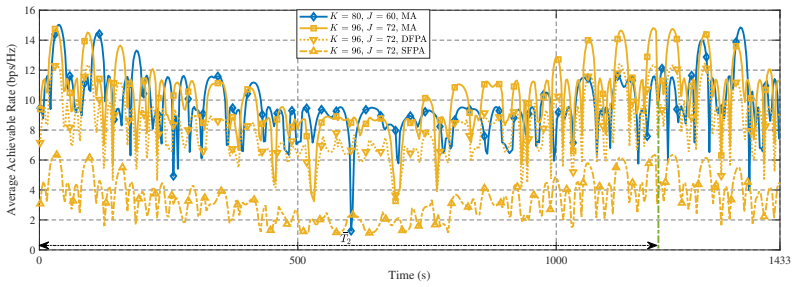
- [§II-C and §IV] The formulation fixes a serving satellite S_jk, but the algorithm and simulations do not specify how this satellite is chosen and no handover/selection variable appears in (P1). Section IV attributes rate gains to the ground station 'connecting to a better service satellite' (Figs. 3, 6, 8–10). This mechanism is not part of the optimization as written. The authors must either introduce a selection variable or state a fixed selection rule and restrict the claims accordingly.
- [§III-D] The convergence proof is insufficient. The statement that 'the objective value is non-decreasing and upper-bounded' does not imply stationarity of the original nonconvex problem (P1), especially because the equivalence of (P2) is entangled with the definitional issue in Eq. (18) and the AWV update error in Eq. (26). A formal argument, or at least a clear statement that only local convergence of the surrogate is claimed, is needed before the algorithm can be said to converge to a stationary point.
minor comments (4)
- [§II-C, Eq. (16)] C3 as written ('m∈M, {n,ñ}∈N, n≠ñ') is not a constraint; it is an index condition and should be part of the statement of C2.
- [§III-A, Eq. (18)] Even apart from the B_m ambiguity, the equality should be written with an explicit max_β on the right-hand side; without it, Eq. (18) is false for arbitrary β.
- [§IV, Fig. 3] The y-axis is labeled 'average sum rate' while the problem maximizes average rate; the terminology should be made consistent.
- [Footnote 1] The LoS-only positioning assumption is stated but its impact on the final fixed-position performance is not quantified; a brief justification of why LoS is sufficient for LEO satellite-ground channels would help.
Circularity Check
No significant circularity: the optimization derivation and simulations are self-contained; the flagged Eq. (18) issue is a correctness concern, not a circularity.
full rationale
This paper is a design-plus-simulation study. It formulates an average-rate maximization problem (P1), applies a Lagrangian dual transformation and a quadratic transformation to obtain (P2), and then derives BCD updates for α, β, w, and c. The simulated MA-versus-FPA comparison is generated entirely from the paper's own system model and algorithm, with no parameter fitted to external data and no prediction back-derived from the results. The self-citations to prior MA work ([32], [33], [63]) motivate the architecture and provide coordinate-system conventions, but the numerical claims do not reduce to those papers' outputs. The linearization lemmas are cited from external work ([67]) and used as mathematical tools, not as conclusions imported from the present authors. The reader-flagged issue with Eq. (18) — that the quadratic-transform identity appears algebraically inconsistent with the definitions of A_m and B_m — is a potential internal correctness defect affecting the equivalence of (P1) and (P2), but it is not a circular step: the algorithm is not defined in terms of its own outputs, and no prediction is equivalent to an input by construction. Accordingly, the circularity score is 0.
Axiom & Free-Parameter Ledger
free parameters (3)
- d_min (minimum inter-antenna spacing) =
0.5 lambda
- antenna movement region A =
3 lambda x 3 lambda
- number of discretization slots M =
500
axioms (6)
- domain assumption Line-of-sight (LoS)-only propagation suffices for APV optimization; post-hoc pilot estimation handles the rest
- domain assumption Satellite beams point vertically downward with the Bessel gain pattern of Eq. (8)
- domain assumption T_bar = T_E / J is an integer multiple of the intra-orbit spacing period T/K
- domain assumption The serving satellite (j,k) is fixed/given in the formulation; selection is not optimized
- standard math The Lagrangian dual and quadratic transformation identities in Section III-A are valid as applied
- domain assumption Accurate instantaneous CSI is available for the time-varying AWVs after positioning
Cite this review
Pith. "Pith review of Joint Antenna Positioning and Beamforming for Movable Antenna Array Aided Ground Station in Low-Earth Orbit Satellite Communication." pith.science (2026). https://pith.science/paper/RSIM2YK3
@misc{pith2026250907511,
  author       = {Pith},
  title        = {Pith review of: Joint Antenna Positioning and Beamforming for Movable Antenna Array Aided Ground Station in Low-Earth Orbit Satellite Communication},
  year         = {2026},
  howpublished = {\url{https://pith.science/paper/RSIM2YK3}},
  note         = {Machine review of arXiv:2509.07511}
}
read the original abstract
This paper proposes a new architecture for the low-earth orbit (LEO) satellite ground station aided by movable antenna (MA) array. Unlike conventional fixed-position antenna (FPA), the MA array can flexibly adjust antenna positions to reconfigure array geometry, for more effectively mitigating interference and improving communication performance in ultra-dense LEO satellite networks. To reduce movement overhead, we configure antenna positions at the antenna initialization stage, which remain unchanged during the whole communication period of the ground station. To this end, an optimization problem is formulated to maximize the average achievable rate of the ground station by jointly optimizing its antenna position vector (APV) and time-varying beamforming weights, i.e., antenna weight vectors (AWVs). To solve the resulting non-convex optimization problem, we adopt the Lagrangian dual transformation and quadratic transformation to reformulate the objective function into a more tractable form. Then, we develop an efficient block coordinate descent-based iterative algorithm that alternately optimizes the APV and AWVs until convergence is reached. Simulation results demonstrate that our proposed MA scheme significantly outperforms traditional FPA by increasing the achievable rate at ground stations under various system setups, thus providing an efficient solution for interference mitigation in future ultra-dense LEO satellite communication networks.
Figures




Reference graph
Works this paper leans on
-
[1]
Aerospace integrate d networks innovation for empowering 6G: A survey and future challenge s,
D. Zhou, M. Sheng, J. Li, and Z. Han, “Aerospace integrate d networks innovation for empowering 6G: A survey and future challenge s,” IEEE Commun. Surveys Tuts. , vol. 25, no. 2, pp. 975–1019, 2023
work page 2023
-
[2]
G. Maiolini Capez, M. A. C´ aceres, R. Armellin, C. P . Brid ges, J. A. Fraire, S. Frey, and R. Garello, “On the use of mega constella tion services in space: Integrating LEO platforms into 6G non-te rrestrial networks,” IEEE J. Sel. Areas Commun. , vol. 42, no. 12, pp. 3490–3504, 2024
work page 2024
-
[3]
X. Qin, T. Ma, Z. Tang, X. Zhang, H. Zhou, and L. Zhao, “Serv ice- Aware resource orchestration in ultra-dense LEO satellite -terrestrial integrated 6G: A service function chain approach,” IEEE Trans. Wireless Commun., vol. 22, no. 9, pp. 6003–6017, 2023
work page 2023
-
[4]
S ervice function chain dynamic scheduling in space-air-ground int egrated net- works,
Z. Jia, Y . Cao, L. He, Q. Wu, Q. Zhu, D. Niyato, and Z. Han, “S ervice function chain dynamic scheduling in space-air-ground int egrated net- works,” IEEE Trans. V eh. Technol. , vol. 74, no. 7, pp. 11 235–11 248, 2025
work page 2025
-
[5]
Online jo int data offloading and power control for space-air-ground integrat ed networks,
L. He, Z. Jia, K. Guo, H. Gan, Z. Han, and C. Y uen, “Online jo int data offloading and power control for space-air-ground integrat ed networks,” IEEE Trans. Wireless Commun. , vol. 23, no. 12, pp. 18 126–18 141, 2024
work page 2024
-
[6]
Satell ite- Terrestrial integrated 6G: An ultra-dense LEO networking m anagement architecture,
T. Ma, B. Qian, X. Qin, X. Liu, H. Zhou, and L. Zhao, “Satell ite- Terrestrial integrated 6G: An ultra-dense LEO networking m anagement architecture,” IEEE Wireless Commun. , vol. 31, no. 1, pp. 62–69, 2024
work page 2024
-
[7]
R. Wang, M. A. Kishk, and M.-S. Alouini, “Ultra reliable l ow latency routing in LEO satellite constellations: A stochastic geom etry approach,” IEEE J. Sel. Areas Commun. , vol. 42, no. 5, pp. 1231–1245, 2024
work page 2024
-
[8]
H. Liu, J. Lai, J. Zhu, L. Gan, and Z. Chang, “Enabling high -throughput routing for LEO satellite broadband networks: A flow-centri c deep reinforcement learning approach,” IEEE Internet Things J. , vol. 11, no. 17, pp. 28 705–28 720, 2024
work page 2024
-
[9]
A survey on random access protocols in direct-access LEO sa tellite- based IoT communication,
T. T. T. Le, N. U. Hassan, X. Chen, M.-S. Alouini, Z. Han, an d C. Y uen, “A survey on random access protocols in direct-access LEO sa tellite- based IoT communication,” IEEE Commun. Surveys Tuts., vol. 27, no. 1, pp. 426–462, 2025
work page 2025
-
[10]
Multiple ac cess interference analysis for multi-satellite joint service,
S. Han, Z. Li, J. Cheng, S. Chen, and L. Xiao, “Multiple ac cess interference analysis for multi-satellite joint service, ” IEEE Trans. V eh. Technol., vol. 74, no. 3, pp. 4235–4246, 2025
work page 2025
-
[11]
A n ovel satellite-based REM construction in cognitive GEO-LEO sat ellite IoT networks,
Q. T. Ngo, B. Jayawickrama, Y . He, and E. Dutkiewicz, “A n ovel satellite-based REM construction in cognitive GEO-LEO sat ellite IoT networks,” IEEE Internet Things J. , vol. 12, no. 6, pp. 7532–7548, 2025
work page 2025
-
[12]
B. Al Homssi, A. Al-Hourani, K. Wang, P . Conder, S. Kande epan, J. Choi, B. Allen, and B. Moores, “Next generation mega satel lite net- works for access equality: Opportunities, challenges, and performance,” IEEE Commun. Mag. , vol. 60, no. 4, pp. 18–24, 2022
work page 2022
-
[13]
A dynam ic beam shut off algorithm for LEO multibeam satellite constellati on network,
S. Liu, J. Lin, L. Xu, X. Gao, L. Liu, and L. Jiang, “A dynam ic beam shut off algorithm for LEO multibeam satellite constellati on network,” IEEE Wireless Commun. Lett. , vol. 9, no. 10, pp. 1730–1733, 2020
work page 2020
-
[14]
Artificial intell igence tech- niques for next-generation massive satellite networks,
B. Al Homssi, K. Dakic, K. Wang, T. Alpcan, B. Allen, R. Bo yce, S. Kandeepan, A. Al-Hourani, and W. Saad, “Artificial intell igence tech- niques for next-generation massive satellite networks,” IEEE Commun. Mag., vol. 62, no. 4, pp. 66–72, 2024
work page 2024
-
[15]
A novel GBSM for LEO satellite-ground communication large- scale channels,
Z. Su, J. Zhang, K. Wang, X. Duan, Y . Cai, L. Ning, L. Liu, a nd B. Ai, “A novel GBSM for LEO satellite-ground communication large- scale channels,” IEEE Internet Things J. , 2024, early access, DOI: 10.1109/JIOT.2024.3515057
-
[16]
Adapti ve routing mechanism for LEO satellite network based on control domain parti- tion,
P . Zhang, Z. Xian, M. Liao, H. Huang, and J. Y ang, “Adapti ve routing mechanism for LEO satellite network based on control domain parti- tion,” IEEE Trans. Green Commun. Netw. , vol. 9, no. 1, pp. 70–82, 2025
work page 2025
-
[17]
X. Zhao, C. Wang, S. Cai, and W. Wang, “Cooperative desig n of dual- layer LEO satellite constellation based on diversified QoS r equirements and seamless multi-coverage,” IEEE Trans. V eh. Technol., vol. 74, no. 1, pp. 925–939, 2025
work page 2025
-
[18]
LEO sat ellite multibeam coverage area division and beamforming method,
K. Y . Zhong, Y . J. Cheng, H. N. Y ang, and B. Zheng, “LEO sat ellite multibeam coverage area division and beamforming method,” IEEE Antennas Wireless Propag. Lett. , vol. 20, no. 11, pp. 2115–2119, 2021
work page 2021
-
[19]
Distributed approach to satellite direct-to-cell connec tivity in 6G non- terrestrial networks,
D. Tuzi, E. F. Aguilar, T. Delamotte, G. Karabulut-Kurt , and A. Knopp, “Distributed approach to satellite direct-to-cell connec tivity in 6G non- terrestrial networks,” IEEE Wireless Commun., vol. 30, no. 6, pp. 28–34, 2023
work page 2023
-
[20]
New bridge to cloud: An ultra-dense LEO assisted green computation offloading ap proach,
Z. Tang, K. Y u, G. Y ang, L. X. Cai, and H. Zhou, “New bridge to cloud: An ultra-dense LEO assisted green computation offloading ap proach,” IEEE Trans. Green Commun. Netw. , vol. 7, no. 2, pp. 552–564, 2023
work page 2023
-
[21]
Re source scheduling for high-capacity multicast service in ultra-d ense LEO satel- lite networks,
T. Ma, B. Qian, X. Qin, X. Zhang, L. X. Cai, and H. Zhou, “Re source scheduling for high-capacity multicast service in ultra-d ense LEO satel- lite networks,” IEEE Trans. V eh. Technol., vol. 73, no. 2, pp. 2468–2481, 2024
work page 2024
-
[22]
Intelligen t multi- objective routing for future ultra-dense LEO satellite net works,
X. Zhou, Y . Weng, B. Mao, J. Liu, and N. Kato, “Intelligen t multi- objective routing for future ultra-dense LEO satellite net works,” IEEE Wireless Commun., vol. 31, no. 5, pp. 102–109, 2024
work page 2024
-
[23]
Fast beam placement for ultra-dense LEO ne tworks,
T. V . Chien, N. M. Quan, T. N. Do, C. Le, T. N. Nguyen, and S. Chatzinotas, “Fast beam placement for ultra-dense LEO ne tworks,” IEEE Wireless Commun. Lett. , vol. 14, no. 3, pp. 621–625, 2025
work page 2025
-
[24]
N. Heydarishahreza, T. Han, and N. Ansari, “Spectrum sh aring and interference management for 6G LEO satellite-terrestrial network in- tegration,” IEEE Commun. Surveys Tuts. , 2024, early access, DOI: 10.1109/COMST.2024.3507019
-
[25]
Handover-aware downlink beamformi ng design for LEO multibeam satellite communications,
X. Chen and Z. Luo, “Handover-aware downlink beamformi ng design for LEO multibeam satellite communications,” IEEE Wireless Commun. Lett., vol. 12, no. 6, pp. 947–951, 2023
work page 2023
-
[26]
M. Wang, R. Wang, R. Ma, W. Kang, G. Liu, and W. Meng, “Reso urce allocation for multi-satellite asynchronous transmissio n in integrated communication and navigation networks,” IEEE Internet Things J., 2025, early access, DOI: 10.1109/JIOT.2025.3526154
-
[27]
Coverage analysis of dynami c coordi- nated beamforming for LEO satellite downlink networks,
D. Kim, J. Park, and N. Lee, “Coverage analysis of dynami c coordi- nated beamforming for LEO satellite downlink networks,” IEEE Trans. Wireless Commun., vol. 23, no. 9, pp. 12 239–12 255, 2024
work page 2024
-
[28]
Movable antennas for wirele ss commu- nication: Opportunities and challenges,
L. Zhu, W. Ma, and R. Zhang, “Movable antennas for wirele ss commu- nication: Opportunities and challenges,” IEEE Commun. Mag. , vol. 62, no. 6, pp. 114–120, 2024
work page 2024
-
[29]
X. Shao and R. Zhang, “6DMA enhanced wireless network wi th flexible antenna position and rotation: Opportunities and challeng es,” IEEE Commun. Mag. , vol. 63, no. 4, pp. 121–128, 2025
work page 2025
-
[30]
A tutorial on movable antennas for wi reless networks,
L. Zhu, W. Ma, W. Mei, Y . Zeng, Q. Wu, B. Ning, Z. Xiao, X. Sh ao, J. Zhang, and R. Zhang, “A tutorial on movable antennas for wi reless networks,” IEEE Commun. Surveys Tuts. , 2025, early access, DOI: 10.1109/COMST.2025.3546373
-
[31]
Historical review of fluid antenn a and movable antenna,
L. Zhu and K.-K. Wong, “Historical review of fluid antenn a and movable antenna,” 2024. [Online]. Available: https://arxiv.org/ abs/2401.02362
Pith/arXiv arXiv 2024
-
[32]
Movable-Antenna array enha nced beamforming: Achieving full array gain with null steering,
L. Zhu, W. Ma, and R. Zhang, “Movable-Antenna array enha nced beamforming: Achieving full array gain with null steering, ” IEEE Commun. Lett. , vol. 27, no. 12, pp. 3340–3344, 2023
work page 2023
-
[33]
Multi-beam forming with mov able- antenna array,
W. Ma, L. Zhu, and R. Zhang, “Multi-beam forming with mov able- antenna array,” IEEE Commun. Lett. , vol. 28, no. 3, pp. 697–701, 2024
2024
-
[34]
Modeling and performance an alysis for movable antenna enabled wireless communications,
L. Zhu, W. Ma, and R. Zhang, “Modeling and performance an alysis for movable antenna enabled wireless communications,” IEEE Trans. Wireless Commun., vol. 23, no. 6, pp. 6234–6250, 2024
2024
-
[35]
Movable-A ntenna position optimization: A graph-based approach,
W. Mei, X. Wei, B. Ning, Z. Chen, and R. Zhang, “Movable-A ntenna position optimization: A graph-based approach,” IEEE Wireless Com- mun. Lett. , vol. 13, no. 7, pp. 1853–1857, 2024
work page 2024
-
[36]
Performance analys is and optimization for movable antenna aided wideband communica tions,
L. Zhu, W. Ma, Z. Xiao, and R. Zhang, “Performance analys is and optimization for movable antenna aided wideband communica tions,” IEEE Trans. Wireless Commun. , vol. 23, no. 12, pp. 18 653–18 668, 2024
2024
-
[37]
MIMO capacity characteriza tion for movable antenna systems,
W. Ma, L. Zhu, and R. Zhang, “MIMO capacity characteriza tion for movable antenna systems,” IEEE Trans. Wireless Commun. , vol. 23, no. 4, pp. 3392–3407, 2024
2024
-
[38]
X. Chen, B. Feng, Y . Wu, D. W. Kwan Ng, and R. Schober, “Joi nt beamforming and antenna movement design for moveable anten na systems based on statistical CSI,” in Proc. IEEE Global Commun. Conf. , Kuala Lumpur, Malaysia, 2023, pp. 4387–4392
work page 2023
-
[39]
Movable-antenna en hanced multiuser communication via antenna position optimizatio n,
L. Zhu, W. Ma, B. Ning, and R. Zhang, “Movable-antenna en hanced multiuser communication via antenna position optimizatio n,” IEEE Trans. Wireless Commun. , vol. 23, no. 7, pp. 7214–7229, 2024
2024
-
[40]
Multiuse r commu- nications with movable-antenna base station: Joint antenn a positioning, receive combining, and power control,
Z. Xiao, X. Pi, L. Zhu, X.-G. Xia, and R. Zhang, “Multiuse r commu- nications with movable-antenna base station: Joint antenn a positioning, receive combining, and power control,” IEEE Trans. Wireless Commun., vol. 23, no. 12, pp. 19 744–19 759, 2024
2024
-
[41]
Y . Wu, D. Xu, D. W. K. Ng, W. Gerstacker, and R. Schober, “M ovable antenna-enhanced multiuser communication: Jointly optim al discrete antenna positioning and beamforming,” in Proc. IEEE Global Commun. Conf., Kuala Lumpur, Malaysia, 2023, pp. 7508–7513
work page 2023
-
[42]
Movable antenna en- abled near-field communications: Channel modeling and perf ormance optimization,
L. Zhu, W. Ma, Z. Xiao, and R. Zhang, “Movable antenna en- abled near-field communications: Channel modeling and perf ormance optimization,” IEEE Trans. Commun. , 2025, early access, DOI: 10.1109/TCOMM.2025.3547783
-
[43]
Fluid antennas-enabled multiuser uplink: A low-complexity grad ient descent for total transmit power minimization,
G. Hu, Q. Wu, K. Xu, J. Ouyang, J. Si, Y . Cai, and N. Al-Dhah ir, “Fluid antennas-enabled multiuser uplink: A low-complexity grad ient descent for total transmit power minimization,” IEEE Commun. Lett. , vol. 28, no. 3, pp. 602–606, 2024
2024
-
[44]
H. Qin, W. Chen, Z. Li, Q. Wu, N. Cheng, and F. Chen, “Anten na positioning and beamforming design for fluid antenna-assis ted multi- user downlink communications,” IEEE Wireless Commun. Lett. , vol. 13, no. 4, pp. 1073–1077, 2024
work page 2024
-
[45]
Flexible precoding for multi-user movable antenna communications,
S. Y ang, W. Lyu, B. Ning, Z. Zhang, and C. Y uen, “Flexible precoding for multi-user movable antenna communications,” IEEE Wireless Com- mun. Lett. , vol. 13, no. 5, pp. 1404–1408, 2024
2024
-
[46]
Fluid antenna system liberating multiuser MIMO for I SAC via deep reinforcement learning,
C. Wang, G. Li, H. Zhang, K.-K. Wong, Z. Li, D. W. K. Ng, and C.-B. Chae, “Fluid antenna system liberating multiuser MIMO for I SAC via deep reinforcement learning,” IEEE Trans. Wireless Commun. , vol. 23, no. 9, pp. 10 879–10 894, 2024
work page 2024
-
[47]
B. Ning, S. Y ang, Y . Wu, P . Wang, W. Mei, C. Y uen, and E. Bjo rnson, “Movable antenna-enhanced wireless communications: Gene ral architec- tures and implementation methods,” IEEE Wireless Commun. , pp. 1–9, 2025
work page 2025
-
[48]
Secure wirel ess communication via movable-antenna array,
G. Hu, Q. Wu, K. Xu, J. Si, and N. Al-Dhahir, “Secure wirel ess communication via movable-antenna array,” IEEE Signal Process. Lett. , vol. 31, pp. 516–520, 2024
work page 2024
-
[49]
En abling secure wireless communications via movable antennas,
Z. Cheng, N. Li, J. Zhu, X. She, C. Ouyang, and P . Chen, “En abling secure wireless communications via movable antennas,” in Proc. IEEE International Conf. Acoust., Speech, Signal Processing , Seoul, Korea, Republic of, 2024, pp. 9186–9190
work page 2024
-
[50]
Secure MIM O communication relying on movable antennas,
J. Tang, C. Pan, Y . Zhang, H. Ren, and K. Wang, “Secure MIM O communication relying on movable antennas,” IEEE Trans. Commun. , 2024, early access, DOI: 10.1109/TCOMM.2024.3465369
-
[51]
W. Liu, X. Zhang, H. Xing, J. Ren, Y . Shen, and S. Cui, “UA V -Enabled wireless networks with movable-antenna array: Flexible be amforming and trajectory design,” IEEE Wireless Commun. Lett. , vol. 14, no. 3, pp. 566–570, 2025
work page 2025
-
[52]
Compressed sensing based ch annel estimation for movable antenna communications,
W. Ma, L. Zhu, and R. Zhang, “Compressed sensing based ch annel estimation for movable antenna communications,” IEEE Commun. Lett. , vol. 27, no. 10, pp. 2747–2751, 2023
2023
-
[53]
Channel estimation for movable antenna communication sys tems: A framework based on compressed sensing,
Z. Xiao, S. Cao, L. Zhu, Y . Liu, B. Ning, X.-G. Xia, and R. Z hang, “Channel estimation for movable antenna communication sys tems: A framework based on compressed sensing,” IEEE Trans. Wireless Com- mun., vol. 23, no. 9, pp. 11 814–11 830, 2024
2024
-
[54]
6D movable antenna base d on user distribution: Modeling and optimization,
X. Shao, Q. Jiang, and R. Zhang, “6D movable antenna base d on user distribution: Modeling and optimization,” IEEE Trans. Wireless Commun., vol. 24, no. 1, pp. 355–370, 2025
2025
-
[55]
6D movable a ntenna en- hanced wireless network via discrete position and rotation optimization,
X. Shao, R. Zhang, Q. Jiang, and R. Schober, “6D movable a ntenna en- hanced wireless network via discrete position and rotation optimization,” IEEE J. Sel. Areas Commun. , vol. 43, no. 3, pp. 674–687, 2025
2025
-
[56]
X. Shao, R. Zhang, Q. Jiang, J. Park, T. Q. S. Quek, and R. S chober, “Distributed channel estimation and optimization for 6D mo vable antenna: Unveiling directional sparsity,” IEEE J. Sel. Topics Signal Process., vol. 19, no. 2, pp. 349–365, 2025
work page 2025
-
[57]
S. Han, J. Wang, C. Li, and E. Hossain, “Principles, appl ications, and challenges of Reconfigurable Intelligent Surface-enab led backscatter communication: A comprehensive survey and outlook,” IEEE Commun. Surveys Tuts., 2024, early access, DOI: 10.1109/COMST.2024.3519788
-
[58]
RIS-Aided wireless communications: Extra degr ees of freedom via rotation and location optimization,
Y . Cheng, W. Peng, C. Huang, G. C. Alexandropoulos, C. Y u en, and M. Debbah, “RIS-Aided wireless communications: Extra degr ees of freedom via rotation and location optimization,” IEEE Trans. Wireless Commun., vol. 21, no. 8, pp. 6656–6671, 2022
work page 2022
-
[59]
In- telligent reflecting surface-aided wireless communicatio n with movable elements,
G. Hu, Q. Wu, D. Xu, K. Xu, J. Si, Y . Cai, and N. Al-Dhahir, “ In- telligent reflecting surface-aided wireless communicatio n with movable elements,” IEEE Wireless Commun. Lett. , vol. 13, no. 4, pp. 1173–1177, 2024
work page 2024
-
[60]
Flexible-Ant enna systems: A pinching-antenna perspective,
Z. Ding, R. Schober, and H. Vincent Poor, “Flexible-Ant enna systems: A pinching-antenna perspective,” IEEE Trans. Commun. , 2025, early access, DOI: 10.1109/TCOMM.2025.3555866
-
[61]
Pinc hing- Antenna systems (PASS): Architecture designs, opportunit ies, and outlook,
Y . Liu, Z. Wang, X. Mu, C. Ouyang, X. Xu, and Z. Ding, “Pinc hing- Antenna systems (PASS): Architecture designs, opportunit ies, and outlook,” 2025. [Online]. Available: https://arxiv.org/ abs/2501.18409
Pith/arXiv arXiv 2025
-
[62]
Resolving the Double Near-Far Problem via Wireless Powered Pinching-Antenna Networks
V . K. Papanikolaou, G. Zhou, B. Kaziu, A. Khalili, P . D. Diamantoulakis, G. K. Karagiannidis, and R. Schober, “Reso lving the double near-far problem via wireless powered pinching- antenna networks,” 2025. [Online]. Available: https://arxiv.org /abs/2505.12403
work page internal anchor Pith review Pith/arXiv arXiv 2025
-
[63]
Dynamic beam c overage for satellite communications aided by movable-antenna arr ay,
L. Zhu, X. Pi, W. Ma, Z. Xiao, and R. Zhang, “Dynamic beam c overage for satellite communications aided by movable-antenna arr ay,” IEEE Trans. Wireless Commun. , vol. 24, no. 3, pp. 1916–1933, 2025
work page 1916
-
[64]
Power-efficient fu ll-duplex satellite communications aided by movable antennas,
L. Lin, J. Ding, Z. Zhou, and B. Jiao, “Power-efficient fu ll-duplex satellite communications aided by movable antennas,” IEEE Wireless Commun. Lett. , vol. 14, no. 3, pp. 656–660, 2025
work page 2025
-
[65]
Movable antenn a-aided interference mitigation for leo-geo spectrum-sharing sys tem,
S. Zuo, W. Jing, Z. Lu, X. Wen, and C. Liu, “Movable antenn a-aided interference mitigation for leo-geo spectrum-sharing sys tem,” in Proc. IEEE Wireless Commun. Netw. Conf. , Milan, Italy, 2025, pp. 1–6
work page 2025
-
[66]
Study on New Radio (NR) to support non-terrestri al networks,
3GPP, “Study on New Radio (NR) to support non-terrestri al networks,” 3GPP Technical Report (TR) 38.811 , Oct. 2020, release 15
work page 2020
-
[67]
Weighted sum-rat e maximiza- tion for movable antenna-enhanced wireless networks,
B. Feng, Y . Wu, X.-G. Xia, and C. Xiao, “Weighted sum-rat e maximiza- tion for movable antenna-enhanced wireless networks,” IEEE Wireless Commun. Lett. , vol. 13, no. 6, pp. 1770–1774, 2024
work page 2024
-
[68]
S hortest path in leo satellite constellation networks: An explicit a nalytic ap- proach,
Q. Chen, L. Y ang, Y . Zhao, Y . Wang, H. Zhou, and X. Chen, “S hortest path in leo satellite constellation networks: An explicit a nalytic ap- proach,” IEEE J. Sel. Areas Commun. , vol. 42, no. 5, pp. 1175–1187, 2024
work page 2024
-
[69]
Analy sis of inter- satellite link paths for leo mega-constellation networks,
Q. Chen, G. Giambene, L. Y ang, C. Fan, and X. Chen, “Analy sis of inter- satellite link paths for leo mega-constellation networks, ” IEEE Trans. V eh. Technol., vol. 70, no. 3, pp. 2743–2755, 2021
work page 2021
This paper was first reviewed by deepseek-v4-flash on August 4, 2026.
discussion (0)
Sign in with ORCID, Apple, or X to comment. Anyone can read and Pith papers without signing in.