Partition function of the Kitaev quantum double model
Pith reviewed 2026-05-18 16:41 UTC · model grok-4.3
The pith
Degeneracies of energy levels in the Kitaev quantum double model follow from S-matrix elements of its anyonic excitations.
A machine-rendered reading of the paper's core claim, the machinery that carries it, and where it could break.
Core claim
We compute the degeneracy of energy levels in the Kitaev quantum double model for any discrete group G on any planar graph forming the skeleton of a closed orientable surface of arbitrary genus. The derivation is based on the fusion rules of the properly identified vertex and plaquette excitations, which are selected among the anyons, i.e., the simple objects of the Drinfeld center Z(Vec_G). These degeneracies are given in terms of the corresponding S-matrix elements and allow one to obtain the exact finite-temperature partition function of the model, valid for any finite-size system.
What carries the argument
Fusion rules of vertex and plaquette excitations identified as simple objects in the Drinfeld center Z(Vec_G), which determine level degeneracies via the associated S-matrix elements.
If this is right
- The exact finite-temperature partition function is obtained for any finite system size on surfaces of any genus.
- Level degeneracies are expressed for arbitrary discrete groups G using only anyon data.
- Thermodynamic observables such as specific heat follow directly from the anyon S-matrix without further approximation.
Where Pith is reading between the lines
- The same degeneracy formulas could be used to compute entanglement spectra or other topological invariants on finite lattices.
- The construction offers a route to study finite-size corrections to topological order in quantum error-correcting codes based on these models.
- Numerical checks on small systems with known groups would test whether the anyon identification holds for every lattice geometry.
Load-bearing premise
The vertex and plaquette excitations on the graph must be correctly identified among the anyons of the Drinfeld center so that their fusion rules directly fix the observed degeneracies.
What would settle it
Exact diagonalization of the Hamiltonian on a small torus for group Z2 or Z3, followed by counting the degeneracy of each energy level and checking whether it matches the value predicted by the corresponding S-matrix element.
Figures




read the original abstract
We compute the degeneracy of energy levels in the Kitaev quantum double model for any discrete group $G$ on any planar graph forming the skeleton of a closed orientable surface of arbitrary genus. The derivation is based on the fusion rules of the properly identified vertex and plaquette excitations, which are selected among the anyons, i.e., the simple objects of the Drinfeld center $\mathcal{Z}(\mathrm{Vec}_G)$. These degeneracies are given in terms of the corresponding $S$-matrix elements and allow one to obtain the exact finite-temperature partition function of the model, valid for any finite-size system.
Editorial analysis
A structured set of objections, weighed in public.
Referee Report
Summary. The manuscript derives the degeneracy of energy levels in the Kitaev quantum double model for arbitrary finite discrete group G, defined on any planar graph that serves as the 1-skeleton of a closed orientable surface of arbitrary genus. Vertex and plaquette excitations are identified with simple objects of the Drinfeld center Z(Vec_G); their fusion rules together with the modular S-matrix elements determine the exact multiplicities of each energy eigenspace. These multiplicities are then assembled into a closed-form expression for the finite-temperature partition function that holds for any finite system size and any topology.
Significance. If the central derivation holds, the result supplies an exact, non-perturbative partition function for an entire family of commuting-projector topological models on general surfaces. This generalizes known special cases (toric-code degeneracy 2^{2g} on genus g, etc.) and permits direct analytic access to finite-size thermodynamic quantities without numerical diagonalization, which is valuable for characterizing topological order at nonzero temperature.
minor comments (2)
- [Abstract] The abstract states that the graph is 'planar' yet the construction is for arbitrary genus; a brief clarifying sentence in the introduction would remove any potential reader confusion about the embedding.
- [Section 4] When the degeneracies are expressed via S-matrix elements, the precise normalization convention (e.g., whether the S-matrix is unitary or modular) should be restated explicitly for readers who may not have the preceding reference at hand.
Simulated Author's Rebuttal
We thank the referee for their careful reading of the manuscript, for the accurate summary of our results, and for the recommendation to accept. The positive assessment is appreciated, and we are pleased that the significance for exact finite-temperature thermodynamics in topological models is recognized.
Circularity Check
No significant circularity detected
full rationale
The paper derives the partition function by identifying vertex and plaquette excitations with simple objects in the Drinfeld center Z(Vec_G), then using their standard fusion rules and S-matrix elements to obtain degeneracies on arbitrary graphs. This identification and the modular data are drawn from established prior literature on Kitaev quantum doubles and anyon theory rather than defined or fitted within the paper itself. The resulting expression groups eigenspaces of the commuting projectors according to these multiplicities and reproduces known special cases such as toric-code ground-state degeneracy. No step reduces by construction to a self-referential definition, a fitted input renamed as prediction, or a load-bearing self-citation chain; the central claim remains independent of the paper's own outputs.
Axiom & Free-Parameter Ledger
axioms (1)
- domain assumption Vertex and plaquette excitations are simple objects of the Drinfeld center Z(Vec_G) whose fusion rules determine the degeneracies
Lean theorems connected to this paper
-
IndisputableMonolith/Foundation/AlexanderDuality.leanalexander_duality_circle_linking unclear?
unclearRelation between the paper passage and the cited Recognition theorem.
We compute the degeneracy of energy levels in the Kitaev quantum double model for any discrete group G on any planar graph forming the skeleton of a closed orientable surface of arbitrary genus... degeneracies are given in terms of the corresponding S-matrix elements
What do these tags mean?
- matches
- The paper's claim is directly supported by a theorem in the formal canon.
- supports
- The theorem supports part of the paper's argument, but the paper may add assumptions or extra steps.
- extends
- The paper goes beyond the formal theorem; the theorem is a base layer rather than the whole result.
- uses
- The paper appears to rely on the theorem as machinery.
- contradicts
- The paper's claim conflicts with a theorem or certificate in the canon.
- unclear
- Pith found a possible connection, but the passage is too broad, indirect, or ambiguous to say the theorem truly supports the claim.
Reference graph
Works this paper leans on
-
[1]
Description ofZ(Vec G) IfGis a group, the category Vec G is defined as follows
Basic facts aboutZ(Vec G) a. Description ofZ(Vec G) IfGis a group, the category Vec G is defined as follows. Its objects are finite-dimensionalG-graded vector spaces (overC) that can be written as direct sums of the form V= L g∈G Vg overC. An arrow fromVtoWis a collection of linear mapsf g :V g →W g. The direct sum of two objects if defined via (V L W) g ...
-
[2]
(C12), whose right-hand side is the same as the right-hand side of Eq
Proofs of counting formulae In the case of the sphere, we start from Eq. (C12), whose right-hand side is the same as the right-hand side of Eq. (C23), thanks to the one-to-one correspondence between gauge orbits inCandG c orbits inF 0,f stated in Sec. C 1 b. So we can identify the left-hand sides of Eqs. (C12) and (C23) and this proves the counting for- m...
-
[3]
Some Results from Representation Theory of Quantum Doubles We present a number of results from the representation theory of quantum doubles. The key reference here is Gould [52]. Refs. [47, 53] are also useful and not too hard to read. Given a groupGwe can construct the quantum dou- ble of the groupD(G). The irreducible representations ofD(G) are the simp...
-
[4]
=δ C1,C2 |G| |C1| ,(D5) where the sum is over anyon types. Here, in order to have a nonzero result,g 1h∗ 1 must be in the same double conjugacy class asg −1 2 h∗
-
[5]
We also must haveg1h1 =h 1g1 andg 2h2 =h 2g2 or the characters vanish. Notice that the value on the right when it is nonzero is exactly that given by Eq. (D4). Note that the equation would read the same if we write the arguments asg 1h∗ rather than h∗g1 in both characters. Fusion of Representations:The anyon types obey fusion relations described by fusion...
-
[6]
Preliminary Material About Geometry In this appendix (and in contrast to the main text), it is more convenient to write the Kitaev model on the dual lattice so it looks more similar to a string-net model [28] ofZ(Vec G) rather than a gauge theory. The equivalence of the direct lattice and dual lattice representation is dis- cussed in chapter 31 of Ref. [2...
-
[7]
Defining the Hilbert Space and Hamiltonian We choose a groupGand assign a group elementg∈G to each oriented edge (we draw an arrow on the edge to indicate the orientation). Reversing the arrow inverts the group element. A basis for our Hilbert space is the set of all labels of all edges. a. Vertex Term The Hamiltonian has a vertex term and a plaquette ter...
-
[8]
Related Group Theory: Rep Basis for a Loop Applying the plaquette ˆPΓnn′ operator to a single loop plaquette Here we consider an edge labeledgin a loop, which we draw as⟲ g=|g⟩and consider applying ˆPΓnn′. Viewing this loop as a plaquette we have ˆP(h) ⟲ g = ⟲ g = ⟲ hg ⟲h (D34) where here we use the graphical notation where we draw a (blue)h-loop and then...
-
[9]
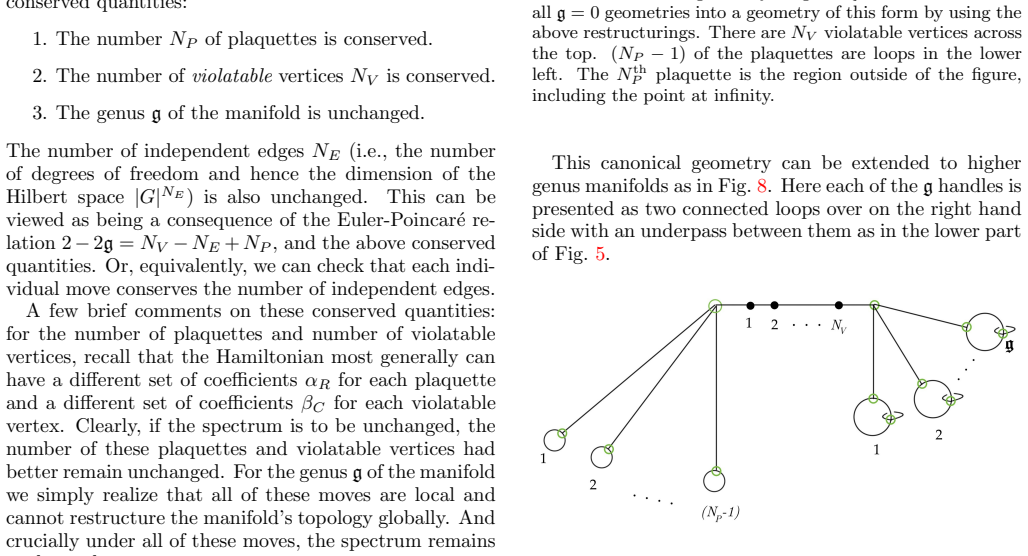
Restructuring Lemmas Our calculation relies on the fact that we can restruc- ture the graph (the geometry) without changing the spec- trum. This may seem obvious, but it is worth being pre- cise about it. 28 Here, we are trying to show that two geometries can be mapped precisely to each other. We start with some easy lemmas (or “moves”), which we can use ...
-
[10]
The numberN P of plaquettes is conserved
-
[11]
The number ofviolatableverticesN V is conserved
-
[12]
The genusgof the manifold is unchanged. The number of independent edgesN E (i.e., the number of degrees of freedom and hence the dimension of the Hilbert space|G| NE) is also unchanged. This can be viewed as being a consequence of the Euler-Poincar´ e re- lation 2−2g=N V −N E +N P , and the above conserved quantities. Or, equivalently, we can check that e...
-
[13]
There are many such simple geometries we might choose, but a good one is of the type shown in Fig
Simple Canonical Geometries Given our restructuring lemmas, it is useful to reduce all geometries to a fixed canonical very simple geometry. There are many such simple geometries we might choose, but a good one is of the type shown in Fig. 7 for genus g= 0. In this figure there areN V violatable vertices across the top row (and no other vertex violations ...
-
[14]
Spectrum on a Sphere We will start by calculating the spectrum given that the genus of our surface isg= 0, i.e., we are considering a sphere. Our geometry will be that of Fig. 7, but here let us label the edges as in Fig. 10. Due to the constraints from the green circles all of the edges labeled withx i must have only the identity labelx i =e, leaving onl...
-
[15]
N P is assigned an irrep (of G) Γi
Each plaquettei= 1. . . N P is assigned an irrep (of G) Γi
-
[16]
Each vertexi= 1. . . N V is assigned a conjugacy classC i. These two steps fully fix the energy of the system. The irreps Γ i occur on the plaquettes here (since we are working on the dual lattice) whereas in the main text these were the “chargeons” which live on the vertices (see Sec. II B 2). Similarly, the conjugacy classes here oc- cur on the vertices...
-
[17]
Each plaquettei= 1. . . N P is assigned an index n∈1. . . d Γi, whered Γi is the dimension of the corresponding irrep Γ i. This is the nontopological index (the energy is indepen- dent of this index and it does not carry anyon charge). For each of the firstN P −1 plaquettes, the wavefunc- tion will be in a superposition ofn ′ values of the states |Γinin′ ...
-
[18]
Consistent with the conjugacy classes, we choose a set ofy’s, which then fixes an orbitωunder conju- gation byh
-
[19]
Choose an irrepqof this orbit ˜Γ(ω) q in Eq. (D66)
-
[20]
(D79) such that Γ (ω,q) Q is conjugate to Γ NP
Once this choice is made, one fixes the irrepQin 35 the decomposition Eq. (D79) such that Γ (ω,q) Q is conjugate to Γ NP . When we sum over all of the orbits in step 4 and then count the fusion multiplicity in steps 5 and 6, we obtain all the fusion channels in the fusion multiplicity equation [Eq. (D65) or (D24)]. In principle, these steps constitute a c...
-
[21]
Higher Genus Let us return to Eq. (D24) and ask how it should gen- eralize to higher genus. Neglecting the nontopological degeneracies, for a system withNcharges in irreps Γ i andMfluxes in conjugacy classesC i on a manifold of genusgwe expect a degeneracy of X λ1,...λg N 1 λ1λ1...λgλg(e,Γ1)(e,Γ2)...(e,ΓN),(C1,Γ0)(C2,Γ0)...(CM ,Γ0) = 1 |G| X g,{ξ},{ξ ′}{k...
-
[22]
J. M. Leinaas and J. Myrheim, On the theory of identical particles, Nuovo Cim. B37, 1 (1977)
work page 1977
-
[23]
Wilczek, Magnetic flux, angular momentum, and statistics, Phys
F. Wilczek, Magnetic flux, angular momentum, and statistics, Phys. Rev. Lett.48, 1144 (1982)
work page 1982
-
[24]
Wilczek, Quantum mechanics of fractional-spin parti- cles, Phys
F. Wilczek, Quantum mechanics of fractional-spin parti- cles, Phys. Rev. Lett.49, 957 (1982)
work page 1982
-
[25]
G. A. Goldin, R. Menikoff, and D. H. Sharp, Comments on ”General theory for quantum statistics in two dimen- sions”, Phys. Rev. Lett.54, 603 (1985)
work page 1985
-
[26]
Wang,Topological Quantum Computation, CBMS Re- gional Conference Series in Mathematics, No
Z. Wang,Topological Quantum Computation, CBMS Re- gional Conference Series in Mathematics, No. 112 (Amer- ican Mathematical Society, Providence, RI, 2010)
work page 2010
-
[27]
M. H. Freedman, A. Kitaev, M. Larsen, and Wang, Topo- logical quantum computation, Bull. Amer. Math. Soc. 40, 31 (2003)
work page 2003
- [28]
-
[29]
D. C. Tsui, H. L. Stormer, and A. C. Gossard, Two- dimensional magnetotransport in the extreme quantum limit, Phys. Rev. Lett.48, 1559 (1982)
work page 1982
-
[30]
H. L. Stormer, T. C. Tsui, and A. C. Gossard, The frac- tional quantum Hall effect, Rev. Mod. Phys.71, S298 (1999)
work page 1999
-
[31]
M. Greiter and F. Wilczek, Fractional statistics, Annu. Rev. Condens. Matter Phys.15, 131 (2024)
work page 2024
- [32]
-
[33]
Kitaev, Fault-tolerant quantum computation by anyons, Ann
A. Kitaev, Fault-tolerant quantum computation by anyons, Ann. Phys. (NY)303, 2 (2003)
work page 2003
- [34]
-
[35]
B. Dou¸ cot and L. B. Ioffe, Physical implementation of protected qubits, Rep. Prog. Phys.75, 072001 (2012)
work page 2012
-
[36]
K. J. Satzingeret al., Realizing topologically ordered states on a quantum processor, Science374, 1237 (2021)
work page 2021
-
[37]
Y. Zhao, Y. Ye, H.-L. Huang, Y. Zhang, D. Wu, H. Guan, Q. Zhu, Z. Wei, T. He, S. Cao, F. Chen, T.-H. Chung, H. Deng, D. Fan, M. Gong, C. Guo, S. Guo, L. Han, N. Li, S. Li, Y. Li, F. Liang, J. Lin, H. Qian, H. Rong, H. Su, L. Sun, S. Wang, Y. Wu, Y. Xu, C. Ying, J. Yu, C. Zha, K. Zhang, Y.-H. Huo, C.-Y. Lu, C.-Z. Peng, X. Zhu, and J.-W. Pan, Realization of...
work page 2022
-
[38]
G. Semeghini, H. Levine, A. Keesling, S. Ebadi, T. T. Wang, D. Bluvstein, R. Verresen, H. Pichler, M. Kali- nowski, R. Samajdar, A. Omran, S. Sachdev, A. Vish- wanath, M. Greiner, V. Vuleti´ c, and M. D. Lukin, Prob- ing topological spin liquids on a programmable quantum simulator, Science374, 1242 (2021)
work page 2021
-
[39]
S. Xu, Z.-Z. Sun, K. Wang, L. Xiang, Z. Bao, Z. Zhu, F. Shen, Z. Song, P. Zhang, W. Ren, X. Zhang, H. Dong, J. Deng, J. Chen, Y. Wu, Z. Tan, Y. Gao, F. Jin, X. Zhu, C. Zhang, N. Wang, Y. Zou, J. Zhong, A. Zhang, W. Li, 39 W. Jiang, L.-W. Yu, Y. Yao, Z. Wang, H. Li, Q. Guo, C. Song, H. Wang, and D.-L. Deng, Digital simulation of projective non-Abelian anyo...
work page 2023
-
[40]
M. Iqbal, N. Tantivasadakarn, R. Verresen, S. L. Camp- bell, J. M. Dreiling, C. Figgatt, J. P. Gaebler, J. Jo- hansen, M. Mills, S. A. Moses, J. M. Pino, A. Ransford, M. Rowe, P. Siegfried, R. P. Stutz, M. Foss-Feig, A. Vish- wanath, and H. Dreyer, Non-Abelian topological order and anyons on a trapped-ion processor, Nature626, 505 (2024)
work page 2024
-
[41]
C. Castelnovo and C. Chamon, Entanglement and topo- logical entropy of the toric code at finite temperature, Phys. Rev. B76, 184442 (2007)
work page 2007
-
[42]
Z. Nussinov and G. Ortiz, Autocorrelations and thermal fragility of anyonic loops in topologically quantum or- dered systems, Phys. Rev. B77, 064302 (2008)
work page 2008
- [43]
-
[44]
S. Iblisdir, D. P´ erez-Garc´ ıa, M. Aguado, and J. Pachos, Scaling law for topologically ordered systems at finite temperature, Phys. Rev. B79, 134303 (2009)
work page 2009
-
[45]
S. Iblisdir, D. P´ erez-Garc´ ıa, M. Aguado, and J. Pachos, Thermal states of anyonic systems, Nucl. Phys. B829, 401 (2010)
work page 2010
-
[46]
O. Landon-Cardinal and D. Poulin, Local topological or- der inhibits thermal stability in 2D, Phys. Rev. Lett.110, 090502 (2013)
work page 2013
-
[47]
B. J. Brown, D. Loss, J. K. Pachos, C. N. Self, and J. R. Wootton, Quantum memories at finite temperature, Rev. Mod. Phys.88, 045005 (2016)
work page 2016
-
[48]
Hastings, Topological order at nonzero temperature, Phys
M. Hastings, Topological order at nonzero temperature, Phys. Rev. Lett.107, 210501 (2011)
work page 2011
-
[49]
M. A. Levin and X.-G. Wen, String-net condensation: A physical mechanism for topological phases, Phys. Rev. B 71, 045110 (2005)
work page 2005
-
[50]
S. H. Simon,Topological Quantum(Oxford University Press, 2023)
work page 2023
- [51]
-
[52]
C.-H. Lin, M. Levin, and F. J. Burnell, Generalized string-net models: A thorough exposition, Phys. Rev. B 103, 195155 (2021)
work page 2021
-
[53]
Vidal, Partition function of the Levin-Wen model, Phys
J. Vidal, Partition function of the Levin-Wen model, Phys. Rev. B105, L041110 (2022)
work page 2022
-
[54]
A. Ritz-Zwilling, J.-N. Fuchs, S. H. Simon, and J. Vidal, Topological and nontopological degeneracies in general- ized string-net models, Phys. Rev. B109, 045130 (2024)
work page 2024
-
[55]
A. Ritz-Zwilling, J.-N. Fuchs, S. H. Simon, and J. Vidal, Finite-temperature properties of string-net models, Phys. Rev. B110, 155147 (2024)
work page 2024
-
[56]
A. Ritz-Zwilling, Ph. D. thesis, Sorbonne Universit´ e Paris, (2024)
work page 2024
-
[57]
Y. Hu, N. Geer, and Y.-S. Wu, Full dyon excitation spec- trum in extended Levin-Wen models, Phys. Rev. B97, 195154 (2018)
work page 2018
- [58]
-
[59]
G. Moore and N. Seiberg, Classical and quantum confor- mal field theory, Commun. Math. Phys.123, 177 (1989)
work page 1989
-
[60]
A. K´ om´ ar and O. Landon-Cardinal, Anyons are not en- ergy eigenspaces of quantum double Hamiltonians, Phys. Rev. B96, 195150 (2017)
work page 2017
-
[61]
Strictly speaking, we are defining a CW-complex
-
[62]
J. Preskill, Lecture Notes for Physics 219:Quantum Com- putation (California Institute of Technology, 2004)
work page 2004
-
[63]
Verlinde, Fusion rules and modular transformations in 2D conformal field theory, Nucl
E. Verlinde, Fusion rules and modular transformations in 2D conformal field theory, Nucl. Phys. B300, 360 (1988)
work page 1988
-
[64]
Y. Hu, Y. Wan, and Y.-S. Wu, Twisted quantum dou- ble model of topological phases in two dimensions, Phys. Rev. B87, 125114 (2013)
work page 2013
-
[65]
Z.-C. Gu, Z. Wang, and X.-G. Wen, Lattice model for fermionic toric code, Phys. Rev. B90, 085140 (2014)
work page 2014
-
[66]
Z. Weinstein, G. Ortiz, and Z. Nussinov, Universality classes of stabilizer code Hamiltonians, Phys. Rev. Lett. 123, 230503 (2019)
work page 2019
-
[67]
B. Dou¸ cot, L. B. Ioffe, and J. Vidal, Discrete non-Abelian gauge theories in Josephson-junction arrays and quantum computation, Phys. Rev. B69, 214501 (2004)
work page 2004
- [68]
-
[69]
P. Etingof, S. Gelaki, D. Nikshych, and V. Ostrik,Tensor categories, Mathematical Surveys and Monographs, Vol. 205 (AMS, 2005)
work page 2005
-
[70]
Sternberg,Group theory and physics(Cambridge Uni- versity Press, 1994)
S. Sternberg,Group theory and physics(Cambridge Uni- versity Press, 1994)
work page 1994
-
[71]
B. Bakalov and A. Kirillov Jr.,Lectures on Tensor cate- gories and Modular Functors, University Lecture Series, Vol. 21 (AMS, 2001)
work page 2001
-
[72]
See the detailed explanation at the very beginning of Sec
As a warning to the reader, note that in this appendix only, the KQD model is presented on the dual lattice. See the detailed explanation at the very beginning of Sec. D 2
-
[73]
Gould, Quantum double finite group algebras and their representations, Bull
M. Gould, Quantum double finite group algebras and their representations, Bull. Aust. Math. Soc.48, 275 (1993)
work page 1993
-
[74]
I. Tsohantjis and M. Gould, Quantum double finite group algebras and link polynomials, Bull. Aust. Math. Soc.49, 177 (1994)
work page 1994
-
[75]
O. Buerschaper and M. Aguado, Mapping Kitaev’s quan- tum double lattice models to Levin and Wen’s string-net models, Phys. Rev. B80, 155136 (2009)
work page 2009
discussion (0)
Sign in with ORCID, Apple, or X to comment. Anyone can read and Pith papers without signing in.