Understanding oxide surface stability: Theoretical insights from silver chromate
Pith reviewed 2026-05-21 22:56 UTC · model grok-4.3
The pith
The coordination of surface chromium-oxygen clusters determines silver chromate surface stability.
A machine-rendered reading of the paper's core claim, the machinery that carries it, and where it could break.
Core claim
The degree of coordination of surface chromium-oxygen clusters plays a decisive role in determining surface stability. The surface Gibbs free energy is evaluated as a function of oxygen and silver chemical potentials, enabling construction of stability trends under non-vacuum environments. Wulff constructions predict morphology evolution as a function of external conditions and identify the atomic structures of the exposed facets in the equilibrium crystal shape.
What carries the argument
The degree of coordination of surface chromium-oxygen clusters, which ranks different surface terminations by their effect on computed surface Gibbs free energy.
If this is right
- Surfaces featuring more fully coordinated chromium-oxygen clusters exhibit lower surface energies and greater stability across ranges of chemical potentials.
- Varying the oxygen and silver chemical potentials causes different facets to become favored, altering the overall equilibrium crystal morphology.
- The identified stable atomic structures on exposed facets provide a basis for linking specific surface orientations to photocatalytic activity in silver chromate.
Where Pith is reading between the lines
- Coordination-based stability trends identified here may extend to related silver-based oxides or other transition-metal chromates under similar conditions.
- The predicted morphology shifts could be checked by preparing crystals in controlled atmospheres and examining facet distributions with microscopy.
- Knowing which facets dominate under given conditions offers a route to engineer nanoparticle shapes that maximize desired surface sites for catalysis.
Load-bearing premise
The first-principles atomistic thermodynamics model correctly computes surface Gibbs free energies from the oxygen and silver chemical potentials under non-vacuum conditions.
What would settle it
An experimental measurement of the dominant surface terminations or equilibrium crystal shape under controlled oxygen and silver chemical potentials that shows different facets than those predicted by the stability ordering and Wulff constructions.
Figures
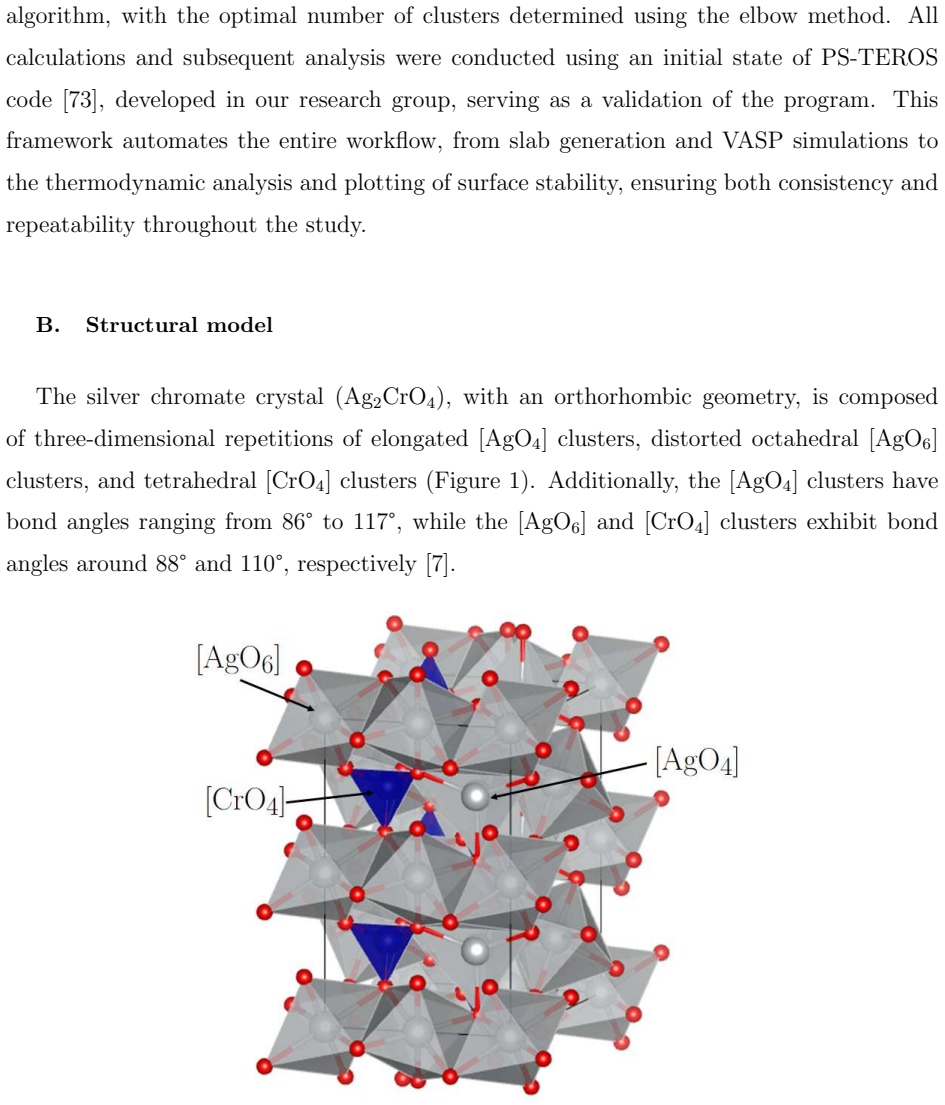


read the original abstract
Silver chromate ($\mathrm{Ag_{2}CrO_{4}}$) has attracted considerable attention in recent years due to its promising photocatalytic performance, which strongly depends on the crystallographic orientation of its exposed surfaces. A detailed understanding of the structural stability of these surfaces under realistic conditions is therefore essential for advancing its applications. In this work, we combine density functional theory (DFT) with first-principles atomistic thermodynamics to systematically investigate the stability of multiple surface orientations and terminations of $\mathrm{Ag_{2}CrO_{4}}$. The surface Gibbs free energy was evaluated as a function of oxygen and silver chemical potentials, enabling the construction of stability trends under non-vacuum environments. Our results reveal that the degree of coordination of surface chromium-oxygen clusters plays a decisive role in determining surface stability. Furthermore, Wulff constructions predict morphology evolution as a function of external conditions, allowing us to identify the atomic structures of the exposed facets in the equilibrium crystal shape. These insights provide a fundamental framework for understanding surface-dependent photocatalytic activity in $\mathrm{Ag_{2}CrO_{4}}$ and related silver-based oxides.
Editorial analysis
A structured set of objections, weighed in public.
Referee Report
Summary. This manuscript applies density functional theory calculations combined with first-principles atomistic thermodynamics to investigate the stability of various surface terminations and orientations of silver chromate (Ag2CrO4). The surface Gibbs free energy is calculated as a function of Ag and O chemical potentials to determine stability under different conditions. The key finding is that the coordination degree of surface Cr-O clusters is the primary determinant of surface stability, with Wulff constructions used to predict the equilibrium morphology and exposed facets.
Significance. If the results hold, this work contributes to the understanding of surface-dependent properties in photocatalytic materials like Ag2CrO4. The chemical potential approach allows for realistic modeling of non-vacuum conditions, and the morphology predictions can inform experimental synthesis of specific facets. The study employs standard computational tools in the field and provides a framework for related silver-based oxides.
major comments (1)
- [Surface stability analysis] The claim that the degree of coordination of surface chromium-oxygen clusters plays a decisive role (abstract) may be influenced by changes in surface stoichiometry. Although the Gibbs free energy formula corrects for composition, the manuscript does not provide an explicit decomposition or fixed-stoichiometry comparison to isolate the coordination effect from overall atom count deviations. This makes the causal attribution to coordination correlative rather than definitively established.
minor comments (2)
- [Abstract] The abstract does not report error bars, convergence checks, or direct experimental comparisons for the stability claims, which would help support the central conclusions.
- [Methods] Additional details on the DFT settings, including the exchange-correlation functional, cutoff energy, and slab models, would improve reproducibility.
Simulated Author's Rebuttal
We thank the referee for their careful reading of our manuscript and for the constructive comment, which helps clarify the interpretation of our results. We address the point below.
read point-by-point responses
-
Referee: The claim that the degree of coordination of surface chromium-oxygen clusters plays a decisive role (abstract) may be influenced by changes in surface stoichiometry. Although the Gibbs free energy formula corrects for composition, the manuscript does not provide an explicit decomposition or fixed-stoichiometry comparison to isolate the coordination effect from overall atom count deviations. This makes the causal attribution to coordination correlative rather than definitively established.
Authors: We appreciate the referee's observation. The surface Gibbs free energy expression does correct for stoichiometric deviations through the Ag and O chemical potential terms, and our comparisons across multiple terminations already show that lower-coordinated Cr-O clusters consistently yield higher energies even when stoichiometry varies. Nevertheless, we agree that an explicit isolation strengthens the causal claim. In the revised manuscript we will add a supplementary analysis that compares surfaces of fixed stoichiometry but differing Cr-O coordination (or, equivalently, decomposes the excess energy into coordination versus composition contributions). This will be presented as a new figure or table to demonstrate that coordination remains the dominant factor. revision: yes
Circularity Check
No significant circularity; standard atomistic thermodynamics applied to DFT results
full rationale
The paper computes surface Gibbs free energies via the standard first-principles atomistic thermodynamics expression γ(μ_Ag, μ_O) = [E_slab − Σ n_i μ_i]/A, treating chemical potentials as independent external variables bounded by bulk stability. Stability trends and the observed correlation with Cr-O coordination degree are direct outputs of these calculations across terminations, not quantities fitted from the same dataset or defined in terms of the target result. No self-citation chains, uniqueness theorems, or ansatzes imported from prior author work are invoked as load-bearing steps in the provided text. The derivation chain remains self-contained and externally falsifiable against independent DFT benchmarks.
Axiom & Free-Parameter Ledger
axioms (2)
- domain assumption Density functional theory yields sufficiently accurate relative surface energies for stability ordering in this oxide system.
- domain assumption First-principles atomistic thermodynamics correctly describes equilibrium surface terminations as a function of external chemical potentials.
Reference graph
Works this paper leans on
-
[1]
(Theoretical) 10.224 7.025 5.653 406.200
-
[2]
(Theoretical) 10.117 7.011 5.618 400.730
-
[3]
(Theoretical) 10.194 7.001 5.634 400.090
-
[4]
(Experimental) 10.066 7.025 5.540 391.830
-
[5]
(Experimental) 10.065 7.0013 5.538 390.900 From the optimized bulk structure, the surface models were c ut out along the (110), (111), (100), (010), (001), (011), and (101) directions based on pr eviously published results in the literature regarding the photocatalytic activities of the material [7]. Symmetric slabs were chosen due to their ease of achiev...
work page 2022
-
[6]
Y. V. B. De Santana, J. E. C. Gomes, L. Matos, G. H. Cruvinel, A. Perrin, C. Perrin, J. Andr` es, J. A. Varela, and E. Longo, Nanomaterials and Nanotechnology 4, 22 (2014), publisher: SAGE Publications Ltd STM
work page 2014
-
[7]
L. F. d. Silva, A. C. Catto, W. Avansi, L. S. Cavalcante, J. Andr´ es, K. Agui r, V. R. Mastelaro, and E. Longo, Nanoscale 6, 4058 (2014), publisher: The Royal Society of Chemistry
work page 2014
-
[8]
F. Soofivand, F. Mohandes, and M. Salavati-Niasari, Materials Research B ulletin 48, 2084 (2013)
work page 2084
-
[9]
B. Arslan Hamat and M. K. Aydinol, Journal of Solid State Chemistry 290, 121571 (2020)
work page 2020
-
[10]
D. Xu, B. Cheng, J. Zhang, W. Wang, J. Yu, and W. Ho, Journal of Materials Chem istry A 3, 20153 (2015), publisher: The Royal Society of Chemistry
work page 2015
-
[11]
a. C. Foggi, M. T. Fabbro, L. P. S. Santos, Y. V. B. de Santana, C. E. Vergani, A. L. M achado, E. Cordoncillo, J. Andr´ es, and E. Longo, Chemical Physics Letters 674, 125 (2017)
work page 2017
- [12]
-
[13]
K. S. Ong, Y. L. Cheow, and S. M. Lee, Journal of Advanced Research 8, 393 (2017), publisher: Elsevier
work page 2017
-
[14]
Dryden, International Journal of Antimicrobial Agents 51, 299 (2018)
M. Dryden, International Journal of Antimicrobial Agents 51, 299 (2018). 29
work page 2018
-
[15]
A. Gouveia, R. Roca, N. Macedo, L. S. Cavalcante, E. Longo, M. A. San-Miguel, A. Al tomare, G. S. da Silva, and J. Andres, Journal of Materials Research and Technology 21, 4023 (2022)
work page 2022
-
[16]
A. F. Gouveia, G. V. Bellucci, L. K. Ribeiro, M. Assis, I. L. V. Rosa, E. Longo, J. Andr´ es, and M. A. San-Miguel, Ecl´ etica Qu ´ ımica47, 80 (2022)
work page 2022
-
[17]
P. F. d. S. Pereira, C. C. De Foggi, A. F. Gouveia, I. M. Pinatti, L. A. Cabr al, E. Guillamon, I. Sorribes, M. A. San-Miguel, C. E. Vergani, A. Z. Sim˜ oes, et al., International Journal of Molecular Sciences 23, 10589 (2022)
work page 2022
-
[18]
P. De Sousa, A. Gouveia, J. Sczancoski, I. Nogueira, E. Longo, M. San-Miguel, an d L. Caval- cante, Journal of Alloys and Compounds 855, 157377 (2021)
work page 2021
-
[19]
R. Alvarez-Roca, A. F. Gouveia, C. C. De Foggi, P. S. Lemos, L. Gracia, L. F. Da Silva, C. E. Vergani, M. San-Miguel, E. Longo, and J. Andres, Inorganic Chemistry 60, 1062 (2020)
work page 2020
-
[20]
V. Teodoro, A. F. Gouveia, T. R. Machado, A. B. Trench, N. Jacomaci, M. Assis, G. E. Marques, M. D. Teodoro, M. A. San-Miguel, J. Andr´ es, et al., Ceramics International 48, 3740 (2022)
work page 2022
- [21]
-
[22]
J. C. Souza, S. C. Lemos, M. Assis, C. H. Fernandes, L. K. Ribeiro, Y. Nune z-de la Rosa, M. D. Teodoro, L. Gracia, J. Andres, L. H. Mascaro, et al., ACS Omega 9, 35537 (2024)
work page 2024
-
[23]
Y. Du, J. Li, X. Ma, and Q. Guo, Vacuum 226, 113323 (2024)
work page 2024
-
[24]
X. Ren, X. Zhang, R. Guo, X. Li, Y. Peng, X. Zhao, and X. Pu, Separation and Purificat ion Technology 270, 118797 (2021)
work page 2021
-
[25]
Y. Deng, L. Tang, G. Zeng, J. Wang, Y. Zhou, J. Wang, J. Tang, Y. Liu, B. Peng, and F. Chen, Journal of Molecular Catalysis A: Chemical 421, 209 (2016)
work page 2016
-
[26]
D. Xu, B. Cheng, S. Cao, and J. Yu, Applied Catalysis B: Environmental 164, 380 (2015)
work page 2015
-
[27]
Y. Liu, H. Yu, M. Cai, and J. Sun, Catalysis Communications 26, 63 (2012)
work page 2012
-
[28]
Y. Nosaka and A. Y. Nosaka, Chemical Reviews 117, 11302 (2017), publisher: American Chemical Society
work page 2017
-
[29]
S. Feizpoor, A. Habibi-Yangjeh, and S. Vadivel, Journal of Photochemi stry and Photobiology A: Chemistry 341, 57 (2017)
work page 2017
-
[30]
J. Luo, X. Zhou, L. Ma, and X. Xu, Applied Surface Science 390, 357 (2016)
work page 2016
- [31]
-
[32]
N. Bayati-Komitaki, S. H. Ganduh, A. H. Alzaidy, and M. Salavati-Niasari, Bi omedicine & Pharmacotherapy 180, 117457 (2024)
work page 2024
-
[33]
M. Dai, Q. Niu, S. Wu, Y. Lin, J. K. Biswas, and C. Yang, Environmental Ch emistry Letters 22, 3059 (2024)
work page 2024
-
[34]
K. N. Shoudho, S. Uddin, M. M. H. Rumon, and M. S. Shakil, ACS Omega 9, 33303 (2024)
work page 2024
-
[35]
F. O. Osazee, K. E. Mokobia, and I. H. Ifijen, Biomedical Materials & Dev ices 2, 614 (2024)
work page 2024
- [36]
-
[37]
J. Wang, B. Wu, X. Zheng, J. Ma, W. Yu, B. Chen, and C. Chu, Environmen tal Science & Technology 58, 10623 (2024)
work page 2024
-
[38]
J. Cao, Q. Wu, X. Liu, X. Zhu, C. Huang, X. Wang, and Y. Song, Journal of Environment al Sciences 151, 200 (2025)
work page 2025
-
[39]
S. Gonz´ alez and X. Jaramillo-Fierro, International Journal of Molecular S ciences 26, 1756 (2025)
work page 2025
-
[40]
K. M. Ta, C. J. Neal, M. Coathup, S. Seal, L. J. Gillie, D. J. Cooke, S. C . Parker, and M. Molinari, The Journal of Physical Chemistry C https://doi.org/10.1021/acs.jp cc.5c03050 (2025)
-
[41]
W.-X. Jiang, J.-G. Han, and H. Guo, Separation and Purification Technology 330, 125309 (2024)
work page 2024
-
[42]
P. Hohenberg and W. Kohn, Physical Review 136, B864 (1964), publisher: American Physical Society
work page 1964
-
[43]
W. Kohn and L. J. Sham, Physical Review 140, A1133 (1965), publisher: American Physical Society
work page 1965
-
[44]
A. F. Gouveia, F. Lipsky, M. A. San-Miguel, E. Longo, and J. Andr´ es, Comput ational Mate- rials Today 1, 100001 (2024)
work page 2024
-
[45]
A. F. Gouveia, L. Gracia, E. Longo, M. A. San-Miguel, and J. Andres, Computation al Mate- rials Science 188, 110217 (2021)
work page 2021
-
[46]
A. F. Gouveia, L. H. S. Lacerda, E. de Oliveira Gomes, L. Gracia, M. Assis, C . C. de Foggi, E. Longo, J. Andr´ es, and M. A. San-Miguel, in Advanced Semiconductors (Springer, 2025) pp. 55–85. 31
work page 2025
-
[47]
D. Santamar ´ ıa-P´ erez, E. Bandiello, D. Errandonea, J. Ruiz-Fuertes, O. Gomis, J. A. Sans, F. J. Manj´ on, P. Rodr ´ ıguez-Hern´ andez, and A. Mu˜ noz, The Journal of Physical Chemistry C 117, 12239 (2013), publisher: American Chemical Society
work page 2013
- [48]
-
[49]
G. S. Silva, L. Gracia, M. T. Fabbro, L. P. Serejo dos Santos, H. Beltr´ an- Mir, E. Cordoncillo, E. Longo, and J. Andr´ es, Inorganic Chemistry55, 8961 (2016), publisher: American Chemical Society
work page 2016
-
[50]
M. T. Fabbro, L. Gracia, G. S. Silva, L. P. S. Santos, J. Andr´ es, E. Cordon cillo, and E. Longo, Journal of Solid State Chemistry 239, 220 (2016)
work page 2016
-
[51]
A. K. Kushwaha, S. Ugur, S. Akbudak, and G. Ugur, Journal of Alloys and Compound s 704, 101 (2017)
work page 2017
- [52]
-
[53]
L. H. d. S. Lacerda, E. Longo, J. Andr´ es, and M. A. San-Miguel, Journal of Solid S tate Chemistry 305, 122670 (2022)
work page 2022
-
[54]
S. K. Meena, N. L. Heda, G. Arora, L. Meena, and B. L. Ahuja, Physica B: Condens ed Matter 560, 236 (2019)
work page 2019
- [55]
-
[56]
J. Rogal and K. Reuter, Experiment, modeling and simulation of gas-su rface interactions for reactive flows in hypersonic flights 14, 2 (2007)
work page 2007
- [57]
- [58]
- [59]
-
[60]
E. Heifets, S. Piskunov, E. A. Kotomin, Y. F. Zhukovskii, and D. E. Ellis, Physical Review B 75, 115417 (2007), publisher: American Physical Society
work page 2007
- [61]
- [62]
-
[63]
B. Liu, J. H. Liu, J. Yang, D. Wang, C. C. Ye, D. Y. Wang, M. Avdeev, S. Shi, J . H. Yang, and W. Q. Zhang https://doi.org/10.1016/j.jpowsour.2019.227693 (2020)
- [64]
- [65]
- [66]
-
[67]
I. Suleiman, N. Assaf, M. M. Al-Rajabi, and Z. Al-Qodah, Physica Scri pta 100, 065911 (2025)
work page 2025
- [68]
-
[69]
M. Poberˇ znik, G. Herrero-Saboya, D. Makovec, D. Lisjak, and L. Martin -Samos, Applied Surface Science 637, 157890 (2023)
work page 2023
-
[70]
G. Kresse and J. Furthm¨ uller, Physical Review B 54, 11169 (1996), publisher: American Physical Society
work page 1996
- [71]
-
[72]
J. P. Perdew, K. Burke, and M. Ernzerhof, Physical Review Lette rs 77, 3865 (1996), publisher: American Physical Society
work page 1996
-
[73]
J. P. Perdew, J. A. Chevary, S. H. Vosko, K. A. Jackson, M. R. Pederson, D. J. Singh, and C. Fiolhais, Physical Review B 46, 6671 (1992), publisher: American Physical Society
work page 1992
-
[74]
P. E. Bl¨ ochl, Physical Review B 50, 17953 (1994), publisher: American Physical Society
work page 1994
-
[75]
H. J. Monkhorst and J. D. Pack, Physical review B 13, 5188 (1976)
work page 1976
-
[76]
R. Tran, Z. Xu, B. Radhakrishnan, D. Winston, W. Sun, K. A. Persson, an d S. P. Ong, Scientific Data 3, 1 (2016)
work page 2016
-
[77]
V. Wang, N. Xu, J.-C. Liu, G. Tang, and W.-T. Geng, Computer Physics Commu nications 267, 108033 (2021)
work page 2021
-
[78]
T. Trevizam Dorini and M. San Miguel, Applied Surface Science 714, https://doi.org/10.1016/j.apsusc.2025.164350 (2025)
-
[79]
C. Kittel and P. McEuen, Introduction to solid state physics (John Wiley & Sons, 2018)
work page 2018
-
[80]
D. A. McQuarrie, Statistical Mechanics (Harper & Row, 1973)
work page 1973
discussion (0)
Sign in with ORCID, Apple, or X to comment. Anyone can read and Pith papers without signing in.