Process-Informed Forecasting of Complex Thermal Dynamics in Pharmaceutical Manufacturing
Pith reviewed 2026-05-21 21:08 UTC · model grok-4.3
The pith
Embedding deterministic production recipes as structural priors yields more accurate and physically consistent temperature forecasts for pharmaceutical lyophilization than pure data-driven models.
A machine-rendered reading of the paper's core claim, the machinery that carries it, and where it could break.
Core claim
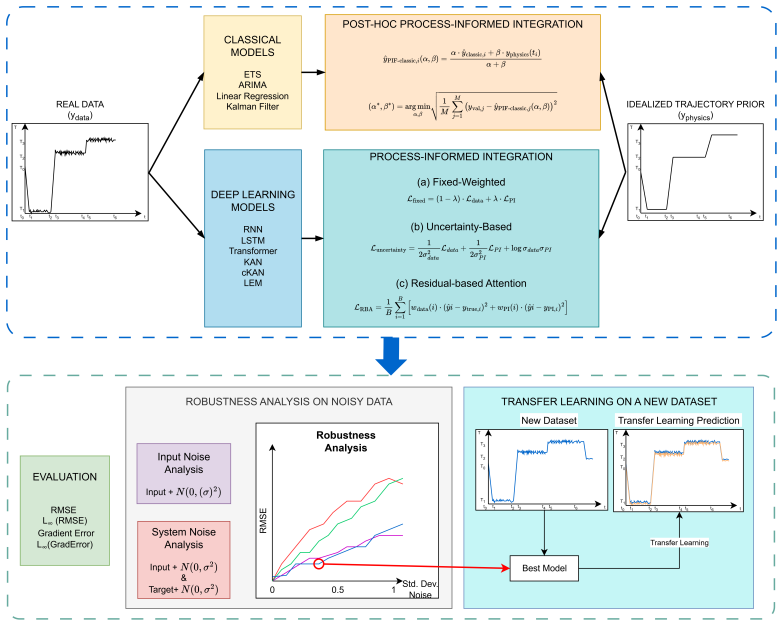
Process-Informed Forecasting models that embed deterministic production recipes as macro-structural priors outperform their data-driven counterparts in accuracy, physical plausibility, and noise resilience for temperature forecasting in pharmaceutical lyophilization, while also generalizing to new processes via transfer learning.
What carries the argument
Process-Informed Forecasting (PIF) models that integrate a process-informed trajectory prior through loss functions (fixed-weight, dynamic uncertainty-based, or Residual-Based Attention).
If this is right
- Forecasts remain usable for monitoring and control in regulated pharmaceutical environments that require physical consistency.
- The same prior-embedding approach supports transfer to new but related manufacturing processes without full retraining.
- Noise resilience allows reliable operation on real sensor streams rather than idealized clean data.
- Hybrid loss designs (uncertainty-weighted or attention-based) can be reused across other time-series tasks that possess known trajectory constraints.
Where Pith is reading between the lines
- Similar recipe-prior methods could apply to other batch manufacturing domains where deterministic process steps are documented but sensor data is noisy or sparse.
- The framework may reduce the volume of labeled data needed for acceptable performance by leveraging the structural prior as a regularizer.
- Extending the prior to include uncertainty in the recipe itself could further improve robustness when production parameters vary slightly between batches.
Load-bearing premise
Deterministic production recipes can be embedded as macro-structural priors that enforce physical consistency without introducing bias or limiting the model's ability to adapt to real process variations.
What would settle it
A controlled experiment on new lyophilization runs where a PIF model either violates a known physical temperature bound or shows lower accuracy and higher sensitivity to added sensor noise than a matched data-only baseline.
Figures


read the original abstract
Accurate time-series forecasting for complex physical systems is the backbone of modern industrial monitoring and control, yet deep learning models often lack the physical consistency required in regulated environments.To bridge this gap, we introduce Process-Informed Forecasting (PIF) models for temperature in pharmaceutical lyophilization, embedding deterministic production recipes as macro-structural priors. We investigate classical methods (e.g., Autoregressive Integrated Moving Average (ARIMA) model) and modern deep learning architectures, including Kolmogorov-Arnold Networks (KANs). We compare three different loss function formulations that integrate a process-informed trajectory prior: a fixed-weight loss, a dynamic uncertainty-based loss, and a Residual-Based Attention (RBA) mechanism. We evaluate all models not only for accuracy and physical consistency but also for robustness to sensor noise. Furthermore, we test the practical generalizability of the best model in a transfer-learning scenario to a new process. Our results show that PIF models outperform their data-driven counterparts in terms of accuracy, physical plausibility and noise resilience, offering a scalable framework for reliable and generalizable forecasting solutions in critical manufacturing.
Editorial analysis
A structured set of objections, weighed in public.
Referee Report
Summary. The manuscript introduces Process-Informed Forecasting (PIF) models for temperature time-series forecasting in pharmaceutical lyophilization by embedding deterministic production recipes as macro-structural priors. It compares ARIMA and deep learning models (including KANs) under three loss formulations—fixed-weight, dynamic uncertainty-based, and Residual-Based Attention (RBA)—and evaluates them on accuracy, physical consistency, sensor-noise resilience, and transfer learning to a new process, claiming outperformance relative to purely data-driven baselines.
Significance. If the empirical results hold under rigorous verification, the work provides a practical hybrid framework that injects domain-specific structural knowledge into forecasting models for regulated manufacturing, potentially improving robustness and reducing data requirements via transfer learning while maintaining adaptability.
major comments (3)
- [Abstract] Abstract: the central claim of outperformance in accuracy, physical plausibility, and noise resilience is stated without any quantitative metrics, error bars, dataset sizes, or exclusion criteria; this absence prevents assessment of effect size and statistical reliability and is load-bearing for the paper's main contribution.
- [§3] §3 (Loss Formulations): the three prior-embedding losses (fixed-weight, dynamic uncertainty, RBA) are presented as enforcing physical consistency without bias, yet the manuscript provides no ablation that isolates the macro-structural recipe prior from the loss-weighting hyperparameter; without this, it is impossible to confirm that reported gains are not artifacts of the tunable weighting factor.
- [Transfer-learning experiment] Transfer-learning section: the skeptic concern that deterministic recipe priors may restrict adaptation to unmodeled variations (sensor drift, batch differences) is not directly tested; the manuscript should report performance under controlled deviations from the nominal recipe to substantiate the generalizability claim.
minor comments (2)
- [Abstract] The abstract lists ARIMA as an example baseline; a brief justification for its inclusion versus other classical time-series methods would improve clarity.
- [Methods] Notation for the recipe trajectory prior should be defined once in a dedicated subsection rather than introduced piecemeal across loss definitions.
Simulated Author's Rebuttal
We thank the referee for the constructive and detailed comments, which have helped us identify areas to strengthen the manuscript. We address each major comment point by point below, indicating the revisions we will implement.
read point-by-point responses
-
Referee: [Abstract] Abstract: the central claim of outperformance in accuracy, physical plausibility, and noise resilience is stated without any quantitative metrics, error bars, dataset sizes, or exclusion criteria; this absence prevents assessment of effect size and statistical reliability and is load-bearing for the paper's main contribution.
Authors: We agree that the abstract would be improved by including quantitative support for the central claims. In the revised manuscript we will add specific metrics (e.g., RMSE and MAE reductions with standard deviations), dataset sizes, and brief mention of statistical comparisons to allow readers to evaluate effect size directly. revision: yes
-
Referee: [§3] §3 (Loss Formulations): the three prior-embedding losses (fixed-weight, dynamic uncertainty, RBA) are presented as enforcing physical consistency without bias, yet the manuscript provides no ablation that isolates the macro-structural recipe prior from the loss-weighting hyperparameter; without this, it is impossible to confirm that reported gains are not artifacts of the tunable weighting factor.
Authors: This observation is correct. The current experiments compare the three loss formulations but do not fully decouple the recipe prior from the weighting hyperparameter. We will add an ablation study in the revised version that fixes the weighting scheme and varies only the presence of the macro-structural prior, thereby isolating its contribution. revision: yes
-
Referee: [Transfer-learning experiment] Transfer-learning section: the skeptic concern that deterministic recipe priors may restrict adaptation to unmodeled variations (sensor drift, batch differences) is not directly tested; the manuscript should report performance under controlled deviations from the nominal recipe to substantiate the generalizability claim.
Authors: We acknowledge that the existing transfer-learning results, while demonstrating adaptation to a new process, do not explicitly probe controlled deviations such as sensor drift or batch-to-batch differences. To address this directly, we will include additional experiments in the revised manuscript that introduce synthetic deviations from the nominal recipe and report the resulting performance. revision: yes
Circularity Check
No significant circularity detected
full rationale
The derivation embeds external deterministic production recipes as macro-structural priors within the three loss formulations (fixed-weight, dynamic uncertainty, and RBA). These priors originate from independent process documentation rather than from any fitted parameters, self-referential equations, or quantities defined by the model itself. Model comparisons, accuracy metrics, physical-consistency checks, noise-resilience tests, and transfer-learning evaluations are performed against data-driven baselines using standard empirical protocols. No step reduces a claimed prediction or uniqueness result to a quantity that was defined or fitted by the same construction inside the paper, and no load-bearing premise rests on a self-citation chain whose validity is presupposed by the present work.
Axiom & Free-Parameter Ledger
free parameters (1)
- loss weighting factor
axioms (1)
- domain assumption Deterministic production recipes provide reliable macro-structural priors for temperature trajectories in lyophilization.
Lean theorems connected to this paper
-
IndisputableMonolith/Foundation/RealityFromDistinction.leanreality_from_one_distinction unclear?
unclearRelation between the paper passage and the cited Recognition theorem.
We formulate an idealized, process-informed trajectory prior ... piecewise linear function that approximates the ideal temperature evolution ... y(t) = ... ramps and holds corresponding to the freezing, primary drying and secondary drying phases.
-
IndisputableMonolith/Cost/FunctionalEquation.leanwashburn_uniqueness_aczel unclear?
unclearRelation between the paper passage and the cited Recognition theorem.
three different loss function formulations that integrate a process-informed trajectory prior: a fixed-weight loss, a dynamic uncertainty-based loss, and a Residual-Based Attention (RBA) mechanism
What do these tags mean?
- matches
- The paper's claim is directly supported by a theorem in the formal canon.
- supports
- The theorem supports part of the paper's argument, but the paper may add assumptions or extra steps.
- extends
- The paper goes beyond the formal theorem; the theorem is a base layer rather than the whole result.
- uses
- The paper appears to rely on the theorem as machinery.
- contradicts
- The paper's claim conflicts with a theorem or certificate in the canon.
- unclear
- Pith found a possible connection, but the passage is too broad, indirect, or ambiguous to say the theorem truly supports the claim.
Reference graph
Works this paper leans on
-
[1]
S. L. Nail, S. Jiang, S. Chongprasert, S. A. Knopp, Fundamentals of Freeze-Drying, Springer US, 2002, pp. 281–360.doi:10.1007/ 978-1-4615-0549-5\_6
work page 2002
-
[2]
R. Rubini, R. Cassandro, M. Caggiano, C. Semeraro, Z. S. Li, M. Das- sisti, The human factor and the resilience of manufacturing processes: a case study of pharmaceutical process toward industry 5.0, in: Interna- tional Symposium on Industrial Engineering and Automation, Springer, 2023, pp. 96–107. 22
work page 2023
-
[3]
R.Rubini, R.Cassandro, C.Semeraro, Z.S.Li, M.Dassisti, Cost-benefit evaluation of digital twin implementation for pharmaceutical lyophiliza- tion plant, in: International Conference on Innovative Intelligent Indus- trial Production and Logistics, Springer, 2023, pp. 398–407
work page 2023
-
[4]
G. E. Box, G. M. Jenkins, G. C. Reinsel, G. M. Ljung, Time series analysis: forecasting and control, John Wiley & Sons, 2015
work page 2015
- [5]
-
[6]
E. S. Gardner Jr, Exponential smoothing: The state of the art, Journal of forecasting 4 (1) (1985) 1–28
work page 1985
-
[7]
C. C. Pegels, Exponential forecasting: Some new variations, Manage- ment Science (1969) 311–315
work page 1969
-
[8]
P. Wang, D. H. Zhang, S. Li, M. W. Wang, B. Chen, Statistical pro- cess control based on kalman filter in manufacturing process, Advanced Materials Research 201 (2011) 986–989
work page 2011
-
[9]
A. L. Korzenowski, M. J. Anzanello, M. S. Portugal, C. Ten Caten, Predictive models with endogenous variables for quality control in cus- tomized scenarios affected by multiple setups, Computers & Industrial Engineering 65 (4) (2013) 729–736
work page 2013
-
[10]
D. Muhr, S. Tripathi, H. Jodlbauer, An adaptive machine learning methodology to determine manufacturing process parameters for each part, Procedia Computer Science 180 (2021) 764–771
work page 2021
-
[11]
A new approach to linear filtering and prediction problems
R. Kalman, A new approach to linear filtering and prediction problems, Journal of Fluids Engineering, Transactions of the ASME 82 (1) (1960) 35 – 45.doi:10.1115/1.3662552
-
[12]
M. Jeffries, E. Lai, J. Hull, Fuzzy flow estimation for ultrasound-based liquid level measurement, Engineering Applications of Artificial Intelli- gence 15 (1) (2002) 31–40
work page 2002
-
[13]
A. D. Sowemimo, M. G. Chorzepa, B. Birgisson, Recurrent neural net- work for quantitative time series predictions of bridge condition ratings, Infrastructures 9 (12) (2024) 221. 23
work page 2024
-
[14]
C. Cui, J. Chen, Industrial process modeling method using arima-acnn- lstm coupling algorithm, in: Journal of Physics: Conference Series, Vol. 2890, IOP Publishing, 2024, p. 012038
work page 2024
-
[15]
H. Oukassi, M. Hasni, S. B. Layeb, Long short-term memory networks for forecasting demand in the case of automotive manufacturing indus- try, in: 2023 IEEE International Conference on Advanced Systems and Emergent Technologies (IC_ASET), IEEE, 2023, pp. 01–06
work page 2023
-
[16]
A. El Filali, E. H. B. Lahmer, S. El Filali, M. Kasbouya, M. A. Ajouary, S. Akantous, Machine learning applications in supply chain manage- ment: A deep learning model using an optimized lstm network for de- mand forecasting., International Journal of Intelligent Engineering & Systems 15 (2) (2022)
work page 2022
-
[17]
L. Han, M. Abdel-Aty, R. Yu, C. Wang, Lstm + transformer real-time crash risk evaluation using traffic flow and risky driving behavior data, IEEE Transactions on Intelligent Transportation Systems 25 (11) (2024) 18383 – 18395.doi:10.1109/TITS.2024.3438616
-
[18]
F. Alsaedi, S. Masoud, Condition-based maintenance for degradation- aware control systems in continuous manufacturing, Machines 13 (2) (2025) 141
work page 2025
-
[19]
H. Abbasimehr, M. Shabani, M. Yousefi, An optimized model using lstm networkfordemandforecasting, Computers&industrialengineering143 (2020) 106435
work page 2020
-
[20]
Y. K. Elalem, S. Maier, R. W. Seifert, A machine learning-based frame- work for forecasting sales of new products with short life cycles using deep neural networks, International Journal of Forecasting 39 (4) (2023) 1874–1894
work page 2023
-
[21]
A. Dutta, K. Nath, Learning via long short-term memory (lstm) network for predicting strains in railway bridge members under train induced vi- bration, in: ICDSMLA 2020: Proceedings of the 2nd International Con- ference on Data Science, Machine Learning and Applications, Springer, 2021, pp. 351–361. 24
work page 2020
-
[22]
A. J. Varghese, A. Bora, M. Xu, G. E. Karniadakis, Transformerg2g: Adaptive time-stepping for learning temporal graph embeddings using transformers, Neural Networks 172 (2024) 106086
work page 2024
-
[23]
A. Zeng, M. Chen, L. Zhang, Q. Xu, Are transformers effective for time series forecasting?, in: Proceedings of the AAAI conference on artificial intelligence, Vol. 37, 2023, pp. 11121–11128
work page 2023
-
[24]
M. Raissi, P. Perdikaris, G. Karniadakis, Physics-informed neural net- works: A deep learning framework for solving forward and inverse problems involving nonlinear partial differential equations, Journal of Computational Physics 378 (2019) 686–707.doi:https://doi.org/ 10.1016/j.jcp.2018.10.045
-
[25]
Z. Liu, Y. Wang, S. Vaidya, F. Ruehle, J. Halverson, M. Soljacic, T. Y. Hou, M. Tegmark, KAN: Kolmogorov–arnold networks, in: The Thir- teenth International Conference on Learning Representations, 2025
work page 2025
- [26]
-
[27]
F. Pourkamali-Anaraki, Kolmogorov-arnold networks in low-data regimes: A comparative study with multilayer perceptrons, arXiv preprint arXiv:2409.10463 (2024)
- [28]
- [29]
- [30]
-
[31]
A. Kendall, Y. Gal, R. Cipolla, Multi-task learning using uncertainty to weigh losses for scene geometry and semantics, in: Proceedings of 25 the IEEE Conference on Computer Vision and Pattern Recognition (CVPR), 2018
work page 2018
-
[32]
S. J. Anagnostopoulos, J. D. Toscano, N. Stergiopulos, G. E. Karni- adakis, Residual-based attention in physics-informed neural networks, Computer Methods in Applied Mechanics and Engineering 421 (2024) 116805
work page 2024
- [33]
-
[34]
D. Kim, K.-J. Park, Y. Eun, S. H. Son, C. Lu, When thermal control meets sensor noise: analysis of noise-induced temperature error, in: 21st IEEE Real-Time and Embedded Technology and Applications Sympo- sium, IEEE, 2015, pp. 98–107. Appendix A. Experimental Setup The framework is implemented in PyTorch and executed on an NVIDIA GPU, leveraging CUDA for c...
discussion (0)
Sign in with ORCID, Apple, or X to comment. Anyone can read and Pith papers without signing in.