The mechanism for creating "dynamical gravastar" black hole mimickers also explains formation of "little red dots"
Pith reviewed 2026-05-21 21:12 UTC · model grok-4.3
The pith
A phase transition creating horizonless black hole mimickers also forms little red dots through latent energy release in highly redshifted regions.
A machine-rendered reading of the paper's core claim, the machinery that carries it, and where it could break.
Core claim
We argue that a high pressure phase transition of relativistic matter to a state with negative energy density, which leads to the formation of horizonless, globally unitary black hole mimickers, also gives rise to the appearance of little red dots. The energy source for the dots is the release of latent energy from the phase transition, and their excess redness is a result of this release taking place in a central region of exponentially small positive g00, and hence very high gravitational redshift.
What carries the argument
High pressure phase transition of relativistic matter to a negative energy density state, which forms horizonless mimickers and releases latent energy in central regions of exponentially small g00.
If this is right
- Little red dots are powered by latent energy released during the phase transition to negative energy density.
- The excess redness of little red dots arises from very high gravitational redshift in the transition region.
- The same mechanism that forms dynamical gravastar black hole mimickers also produces the observed little red dots.
- The abundance of little red dots reflects the rate at which such phase transitions occur in dense early-universe regions.
Where Pith is reading between the lines
- Little red dots could represent an observable early phase in the formation of gravastar-like objects.
- This mechanism predicts possible spatial or temporal correlations between little red dots and other high-redshift compact sources.
- It opens the possibility of using little red dot statistics to constrain the conditions for the phase transition in relativistic matter.
Load-bearing premise
The phase transition occurs in a central region with exponentially small positive g00 and releases latent energy in a manner that quantitatively reproduces the observed properties and abundance of little red dots.
What would settle it
Detection of little red dots whose luminosities, spectra, or number densities cannot be produced by latent energy release combined with high gravitational redshift from an exponentially small g00 region.
Figures


read the original abstract
We argue that a high pressure phase transition of relativistic matter to a state with negative energy density, which leads to the formation of horizonless, globally unitary black hole mimickers, also gives rise to the appearance of ``little red dots''. The energy source for the dots is the release of latent energy from the phase transition, and their excess redness is a result of this release taking place in a central region of exponentially small positive $g_{00}$, and hence very high gravitational redshift.
Editorial analysis
A structured set of objections, weighed in public.
Referee Report
Summary. The manuscript argues that a high-pressure phase transition of relativistic matter to a negative-energy-density state—previously used to construct horizonless, globally unitary dynamical gravastar black hole mimickers—also accounts for the 'little red dots' (LRDs) seen by JWST. The LRD energy source is latent heat released in the transition, while their redness is attributed to the transition occurring in a central region of exponentially small positive g_{00} that produces very high gravitational redshift.
Significance. If the proposed connection can be made quantitative, the work would offer a single microphysical mechanism linking exotic compact-object formation to the unexpected abundance, colors, and luminosities of high-redshift LRDs. It extends the author's earlier gravastar constructions to a new observational domain and supplies a falsifiable link between negative-energy-density matter and early-universe photometry. At present the significance remains prospective because the mapping from phase-transition parameters to JWST observables is not yet derived.
major comments (2)
- [Abstract] Abstract: the claim that the same phase transition 'also gives rise to the appearance of little red dots' is asserted without any derivation or order-of-magnitude estimate of the transition energy scale, the central g_{00} value needed to produce the observed redness, the redshifted effective temperature, or the required cosmological number density of such objects.
- [Full text (central argument)] The argument re-uses the phase-transition and g_{00} behavior introduced in the author's prior gravastar papers; no new calculation is supplied that maps those quantities onto the measured LRD spectral indices, luminosities, or space density, leaving the link qualitative rather than predictive.
minor comments (1)
- The manuscript would be strengthened by the addition of a table or figure that compares predicted redshifted spectra or number densities against published JWST LRD data.
Simulated Author's Rebuttal
We thank the referee for their constructive summary and recommendation. The manuscript proposes a unifying microphysical mechanism linking dynamical gravastars to little red dots; we address the concerns about quantitative support below and will revise the text to include order-of-magnitude estimates while preserving the conceptual focus of the work.
read point-by-point responses
-
Referee: [Abstract] Abstract: the claim that the same phase transition 'also gives rise to the appearance of little red dots' is asserted without any derivation or order-of-magnitude estimate of the transition energy scale, the central g_{00} value needed to produce the observed redness, the redshifted effective temperature, or the required cosmological number density of such objects.
Authors: We agree that the abstract states the connection at a high level. In the revised manuscript we will augment the abstract with a brief clause indicating the relevant scales and add a dedicated paragraph after the introduction that supplies order-of-magnitude estimates drawn from the phase-transition parameters of our earlier gravastar constructions. These will include the latent-energy density sufficient to match observed LRD luminosities, the exponentially small central g_{00} required for the reported redness, the resulting redshifted effective temperature, and a rough cosmological number density consistent with high-redshift formation. revision: yes
-
Referee: [Full text (central argument)] The argument re-uses the phase-transition and g_{00} behavior introduced in the author's prior gravastar papers; no new calculation is supplied that maps those quantities onto the measured LRD spectral indices, luminosities, or space density, leaving the link qualitative rather than predictive.
Authors: The manuscript re-uses the established phase-transition and interior metric from our previous work because the central claim is that those same features naturally account for LRD properties via latent-heat release and extreme gravitational redshift. We acknowledge that a complete predictive mapping to spectral indices would require additional radiative-transfer modeling. In revision we will insert a short section with explicit estimates for luminosity and space density and will state clearly that detailed spectral-index predictions lie beyond the present scope while remaining consistent with the observed redness. revision: partial
Circularity Check
LRD explanation reuses gravastar phase transition and exponentially small g00 without independent derivation of redshift or energy scale
specific steps
-
fitted input called prediction
[Abstract]
"The energy source for the dots is the release of latent energy from the phase transition, and their excess redness is a result of this release taking place in a central region of exponentially small positive g_{00}, and hence very high gravitational redshift."
The exponentially small g00 and latent energy release are inputs defined in the author's prior dynamical gravastar construction to eliminate horizons; here they are invoked unchanged to 'explain' LRD redness and luminosity without deriving the specific g00 scale or energy output needed to match JWST data.
full rationale
The paper's central argument applies the identical high-pressure transition to negative-energy-density matter (previously introduced to produce horizonless mimickers) to LRDs, attributing redness directly to the same central region of exponentially small positive g00. No new equations derive the required g00 value, transition energy, or post-redshift spectrum; the match to observed LRD properties is asserted by reusing the prior construction. This creates partial circularity: the 'prediction' reduces to properties already fixed by the mimicker model. However, the paper remains self-contained in its qualitative analogy and does not claim quantitative fits or uniqueness theorems from self-citations, keeping the score from reaching 8+.
Axiom & Free-Parameter Ledger
axioms (1)
- domain assumption A high-pressure phase transition of relativistic matter to negative energy density exists and produces horizonless unitary objects.
Lean theorems connected to this paper
-
IndisputableMonolith/Foundation/AbsoluteFloorClosure.leanreality_from_one_distinction unclear?
unclearRelation between the paper passage and the cited Recognition theorem.
high pressure phase transition ... to a state with negative energy density ... g00 ... exponentially small positive
-
IndisputableMonolith/Foundation/AlexanderDuality.leanalexander_duality_circle_linking unclear?
unclearRelation between the paper passage and the cited Recognition theorem.
spherically symmetric fluid ... TOV equations
What do these tags mean?
- matches
- The paper's claim is directly supported by a theorem in the formal canon.
- supports
- The theorem supports part of the paper's argument, but the paper may add assumptions or extra steps.
- extends
- The paper goes beyond the formal theorem; the theorem is a base layer rather than the whole result.
- uses
- The paper appears to rely on the theorem as machinery.
- contradicts
- The paper's claim conflicts with a theorem or certificate in the canon.
- unclear
- Pith found a possible connection, but the passage is too broad, indirect, or ambiguous to say the theorem truly supports the claim.
Reference graph
Works this paper leans on
- [1]
-
[2]
X. Lin et al., The Discovery of Little Red Dots in the Local Universe: Signatures of Cool Gas Envelopes, arXiv:2507.10659 (2025)
- [3]
- [4]
-
[5]
de Graaff et al., Astronomy and Astrophysics, 701, A168 (2025)
A. de Graaff et al., Astronomy and Astrophysics, 701, A168 (2025)
work page 2025
-
[6]
J. E. Greene et al., “What you see is what you get: empirically measu red bolometric luminosities of Little Red Dots”, arXiv:2509.05434
-
[7]
Early universe’s ‘little red dots’ m ay be black hole stars
Science Magazine, 389, Issue 6759, 21 July 2025 p. 438, “Early universe’s ‘little red dots’ m ay be black hole stars”
work page 2025
-
[8]
J. R. Oppenheimer and G. M. Volkoff, Phys. Rev. 55, 374 (1938)
work page 1938
-
[9]
Ya. B. Zel’dovich and I. D. Novikov, Stars and Relativity , The University of Chicago Press (1971), pp. 256-257
work page 1971
-
[10]
M. Camenzind, Compact Objects in Astrophysics: White Dwarfs, Neutron Sta rs and Black Holes , Springer (2007), Secs. 4.1-4.2
work page 2007
-
[11]
Weinberg, Lectures on Astrophysics , Cambridge University Press (2020), Sec
S. Weinberg, Lectures on Astrophysics , Cambridge University Press (2020), Sec. 1.1
work page 2020
-
[12]
M. C. Begelman, E. M. Rossi, and P. J. Armitage, Quasi-stars: a ccreting black holes inside massive en- velopes. Monthly Notices of the Royal Astronomical Society, 387( 4), 1649-1659 (2008), arXiv:0711.4078
work page internal anchor Pith review Pith/arXiv arXiv 2008
- [13]
- [14]
- [15]
- [16]
-
[17]
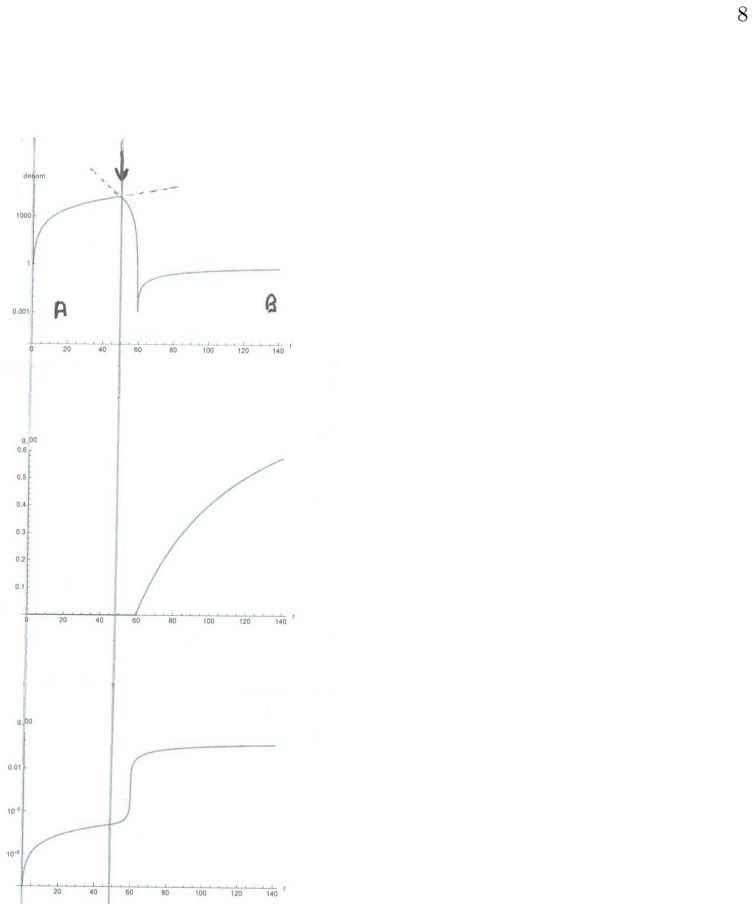
R. Z¨ ollner and B. K¨ ampfer,Astronomy 4 (2), 10 (2025), arXiv:2506.10032. 8 FIG. 1: This figure, taken from [1], was computed with β = 0 . 01, central pressure p(0) = 1, and pjump =
-
[18]
95. In the figure plots of denom = 1 − 2m(r)/r , together with g00(r) on linear and logarithmic scales, are stacked with their horizontal axes aligned. The vertical line at r = 48 . 895, marked by a down-pointing arrow, is where the discontinuity in equations of state at pjump = 0 . 95 appears; to the left of this line, in region A, the equation of state i...
discussion (0)
Sign in with ORCID, Apple, or X to comment. Anyone can read and Pith papers without signing in.