Experimental Results from Early Non-Planar NI-HTS Magnet Prototypes for the Columbia Stellarator eXperiment (CSX)
Pith reviewed 2026-05-18 08:57 UTC · model grok-4.3
The pith
Non-planar HTS magnet prototypes for CSX achieve expected fields and validate key manufacturing steps.
A machine-rendered reading of the paper's core claim, the machinery that carries it, and where it could break.
Core claim
The P1 planar prototype confirmed additive manufacturing and baseline winding, the P2 non-planar version reached expected fields at 30-40 K with up to 4.5 kAt, and the P3 design with dual double-pancakes and 200 turns approaches the 70 kAt target at 20 K, together demonstrating feasible manufacturing, cooling, quench mitigation, and diagnostics for non-planar NI-HTS stellarator coils.
What carries the argument
Sectional 3D-printed aluminum coil frames with gimballed constant-tension winding mechanics and solder potting, which manage strain and enable radial current redistribution in non-planar geometries.
If this is right
- Additive manufacturing and sectional joining produce functional coil frames for non-planar HTS windings.
- Thermal gradients and electrical resistance remain manageable in non-planar geometries down to 20 K.
- Solder potting supplies passive quench mitigation via current redistribution.
- Sub-microhm lap joints support reliable current transfer in the coil assemblies.
Where Pith is reading between the lines
- If the methods scale without new issues, university-scale stellarators could become more practical using compact HTS coils rather than larger conventional systems.
- The winding and frame techniques could be adapted for other fusion devices that require non-planar magnet shapes.
- Intermediate-scale tests between the current prototypes and full CSX coils would help isolate any size-dependent effects before final construction.
Load-bearing premise
That performance measured in small prototypes at modest currents and temperatures will translate directly to full-size coils at target fields without new strain or thermal issues arising at scale.
What would settle it
A full-size non-planar coil energized to the 0.5 T on-axis target in CSX showing unexpected quenching, excess resistance, or deviation from predicted fields.
Figures
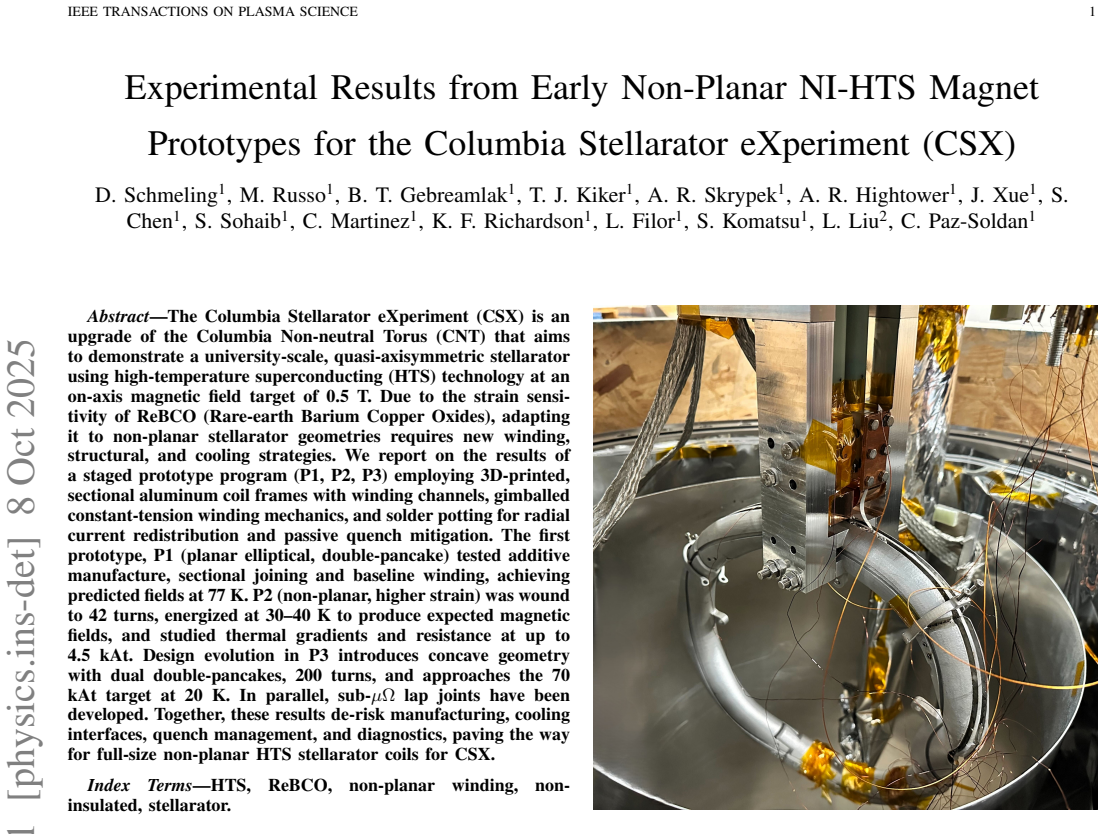


read the original abstract
The Columbia Stellarator eXperiment (CSX) is an upgrade of the Columbia Non-neutral Torus (CNT) that aims to demonstrate a university-scale, quasi-axisymmetric stellarator using high-temperature superconducting (HTS) technology at an on-axis magnetic field target of 0.5 T. Due to the strain sensitivity of ReBCO (Rare-earth Barium Copper Oxides), adapting it to non-planar stellarator geometries requires new winding, structural, and cooling strategies. We report on the results of a staged prototype program (P1, P2, P3) employing 3D-printed, sectional aluminum coil frames with winding channels, gimballed constant-tension winding mechanics, and solder potting for radial current redistribution and passive quench mitigation. The first prototype, P1 (planar elliptical, double-pancake) tested additive manufacture, sectional joining and baseline winding, achieving predicted fields at 77 K. P2 (non-planar, higher strain) was wound to 42 turns, energized at 30-40 K to produce expected magnetic fields, and studied thermal gradients and resistance at up to 4.5 kAt. Design evolution in P3 introduces concave geometry with dual double-pancakes, 200 turns, and approaches the 70 kAt target at 20 K. In parallel, sub-microhm lap joints have been developed. Together, these results de-risk manufacturing, cooling interfaces, quench management, and diagnostics, paving the way for full-size non-planar HTS stellarator coils for CSX.
Editorial analysis
A structured set of objections, weighed in public.
Referee Report
Summary. The manuscript reports experimental results from a staged prototype program (P1–P3) developing non-planar non-insulated high-temperature superconducting (NI-HTS) magnet coils for the Columbia Stellarator eXperiment (CSX), which targets 0.5 T on-axis field. Using 3D-printed sectional aluminum frames, gimballed constant-tension winding, and solder potting, the prototypes achieved magnetic fields consistent with predictions: P1 (planar) at 77 K, P2 (non-planar) at 30–40 K up to 4.5 kAt with 42 turns, and P3 (concave dual double-pancake, 200 turns) approaching 70 kAt at 20 K. Sub-microhm lap joints were also developed. The authors conclude that these results de-risk manufacturing, cooling interfaces, quench management, and diagnostics for full-size non-planar HTS stellarator coils.
Significance. If the results hold, this work is significant for advancing HTS magnet technology in stellarators. It provides concrete experimental validation of practical solutions to ReBCO strain sensitivity in non-planar geometries through additive manufacturing of frames and specialized winding/potting methods. The thermal gradient studies and quench-related observations in P2 add useful data on cooling interfaces and passive mitigation. The staged prototype approach and joint development offer a replicable path for de-risking complex HTS systems at university scale, with potential to accelerate CSX construction and similar compact fusion experiments.
major comments (1)
- [Abstract] Abstract: The central claim that the P1–P3 results de-risk manufacturing, cooling interfaces, quench management, and diagnostics for full-size non-planar HTS coils is not fully supported. P2 reached only 4.5 kAt (versus the 70 kAt target), and the manuscript provides no explicit scaling analysis or discussion of how higher total Lorentz forces, larger thermal gradients across sectional frames, or altered quench propagation in solder-potted windings would be handled at full scale. This extrapolation is load-bearing for the de-risking conclusion.
minor comments (2)
- [Abstract] The abstract would be clearer if it reported the precise achieved current, number of turns, and any quantitative deviation from model predictions for each prototype rather than qualitative statements such as 'achieving predicted fields' or 'approaches the 70 kAt target'.
- Presentation of thermal and resistance data from P2 would benefit from explicit error bars, measurement uncertainties, and direct tabulated comparisons to finite-element models to allow readers to assess agreement quantitatively.
Simulated Author's Rebuttal
We are grateful to the referee for their constructive feedback on our manuscript describing the experimental results from the early non-planar NI-HTS magnet prototypes for CSX. The major comment raises a valid point about the support for our de-risking claims in the abstract. We address this below and have made revisions to the manuscript to strengthen the discussion.
read point-by-point responses
-
Referee: [Abstract] Abstract: The central claim that the P1–P3 results de-risk manufacturing, cooling interfaces, quench management, and diagnostics for full-size non-planar HTS coils is not fully supported. P2 reached only 4.5 kAt (versus the 70 kAt target), and the manuscript provides no explicit scaling analysis or discussion of how higher total Lorentz forces, larger thermal gradients across sectional frames, or altered quench propagation in solder-potted windings would be handled at full scale. This extrapolation is load-bearing for the de-risking conclusion.
Authors: We agree with the referee that the abstract's claim would benefit from additional support. It is correct that P2 was an intermediate step limited to 4.5 kAt, primarily to validate non-planar winding and thermal gradient studies at 30-40 K. However, the program is staged, and P3 has been designed with 200 turns and has approached 70 kAt at 20 K, which is the relevant target for the full-scale coil performance metrics. The de-risking refers to the successful demonstration of 3D-printed sectional frames, gimballed winding, solder potting for quench mitigation, and sub-microhm joints, all of which are directly applicable to full-size coils. Regarding scaling, while the manuscript focuses on experimental results rather than detailed modeling, we acknowledge the absence of an explicit scaling analysis. In the revised version, we will include a brief discussion in the conclusions or a new section outlining how the observed performance scales with current, including considerations for Lorentz forces (which increase quadratically with current) and thermal management, supported by the P3 results and preliminary calculations. This will clarify the path to full-scale implementation without overclaiming. revision: yes
Circularity Check
No circularity: direct experimental measurements with no derivations or fitted predictions
full rationale
This is a straightforward experimental report describing construction and testing of physical prototypes P1–P3. Measured fields, temperatures, and joint resistances are reported as direct outcomes of the hardware at the tested currents and temperatures. No equations, parameter fits, or self-citations are invoked to derive or predict the reported results; the de-risking claim is an interpretive summary of the observed performance rather than a mathematical reduction to prior inputs. The paper is therefore self-contained against external benchmarks of prototype testing.
Axiom & Free-Parameter Ledger
axioms (1)
- domain assumption ReBCO superconductors require specialized winding and structural strategies due to strain sensitivity in non-planar geometries
Reference graph
Works this paper leans on
-
[1]
A. Baillod, E. J. Paul, G. Rawlinson, M. Haque, S. W. Freiberger, and S. Thapa, ‘Integrating novel stellarator single-stage optimization algorithms to design the Columbia stellarator experiment’, Nucl. Fusion, vol. 65, no. 2, p. 026046, Feb. 2025, doi: 10.1088/1741-4326/ada6dd
-
[2]
N. Riva et al., ‘Development of the first non-planar REBCO stellarator coil using VIPER cable’, Supercond. Sci. Technol., vol. 36, no. 10, p. 105001, Oct. 2023, doi: 10.1088/1361-6668/aced9d
-
[3]
C. Paz-Soldan, ‘Non-planar coil winding angle optimization for compatibility with non-insulated high-temperature superconducting magnets’, J. Plasma Phys., vol. 86, no. 5, Oct. 2020, doi: 10.1017/s0022377820001208
-
[4]
P. Huslage et al., ‘Strain optimisation for ReBCO high-temperature superconducting stellarator coils in SIMSOPT’, J. Plasma Phys., vol. 91, no. 2, p. E71, Apr. 2025, doi: 10.1017/S0022377825000224
-
[5]
P. Huslage, D. Kulla, J.-F. Lobsien, T. Schuler, and E. V . Stenson, ‘Winding angle optimization and testing of small-scale, non-planar, high- temperature superconducting stellarator coils’, Supercond. Sci. Technol., vol. 37, no. 8, p. 085010, Aug. 2024, doi: 10.1088/1361-6668/ad5382
-
[6]
J. S. Rogers, G. D. May, C. D. Coats, and P. M. McIntyre, ‘Dy- namics of Current-Sharing Within a REBCO Tape-Stack Cable’, IEEE Trans. Appl. Supercond., vol. 33, no. 5, pp. 1–6, Aug. 2023, doi: 10.1109/TASC.2023.3245999
-
[7]
H. Kobayashi, Y . Nakada, H. Saotome, D. Miyagi, Y . Nagasaki, and M. Tsuda, ‘Numerical Evaluation on Current Behavior of No-Insulation Coils With Parallel HTS Tapes’, IEEE Trans. Appl. Supercond., vol. 33, no. 5, pp. 1–6, Aug. 2023, doi: 10.1109/TASC.2023.3251301
-
[8]
S. Venuturumilli, R. C. Mataira, R. W. Taylor, J. T. Gonzales, and C. W. Bumby, ‘Modeling HTS non-insulated coils: A comparison between finite-element and distributed network models’, AIP Advances, vol. 13, no. 3, p. 035317, Mar. 2023, doi: 10.1063/5.0135291
-
[9]
T. S. Pedersen et al., ‘Construction and Initial Operation of the Columbia Nonneutral Torus’, Fusion Science and Technology, vol. 50, no. 3, pp. 372–381, Oct. 2006, doi: 10.13182/fst06-a1258
-
[10]
P. Huslage et al., ‘A Non-planar ReBCO Test Coil with 3D-printed Aluminum Support Structure for the EPOS Stellarator’, May 13, 2025, arXiv:2505.08488. doi: 10.48550/arXiv.2505.08488
-
[11]
Xue et al., ‘Current sharing in double-sided REBCO tapes’, Su- percond
S. Xue et al., ‘Current sharing in double-sided REBCO tapes’, Su- percond. Sci. Technol., vol. 37, no. 7, p. 075006, Jul. 2024, doi: 10.1088/1361-6668/ad4e76
-
[12]
S. L. Lalitha, ‘Low resistance splices for HTS devices and applications’, Cryogenics, vol. 86, pp. 7–16, Sep. 2017, doi: 10.1016/j.cryogenics.2017.06.003
-
[13]
A. Radovinsky, N. Martovetsky, and S. Kuznetsov, ‘Method of Quench Detection in HTS Magnets’, IEEE Trans. Appl. Supercond., vol. 35, no. 5, pp. 1–5, Aug. 2025, doi: 10.1109/tasc.2024.3520084
-
[14]
A. Watterson et al., ‘Performance Assessment of PIT VIPER Cables Following Long-Duration Solder Exposure During Manufacturing’, IEEE Trans. Appl. Supercond., vol. 35, no. 5, pp. 1–5, Aug. 2025, doi: 10.1109/tasc.2025.3527947
-
[15]
D. Nash et al., ‘Prototyping and Test of the “Canis” HTS Planar Coil Array for Stellarator Field Shaping’, IEEE Trans. Appl. Supercond., vol. 35, no. 7, pp. 1–14, Oct. 2025, doi: 10.1109/TASC.2025.3594533
-
[16]
M. Landreman, B. Medasani, F. Wechsung, A. Giuliani, R. Jorge, and C. Zhu, ‘SIMSOPT: A flexible framework for stellarator optimization’, JOSS, vol. 6, no. 65, p. 3525, Sep. 2021, doi: 10.21105/joss.03525
-
[17]
T. S. Pedersen et al., ‘The Columbia Nonneutral Torus: A New Ex- periment to Confine Nonneutral and Positron-Electron Plasmas in a Stellarator’, Fusion Science and Technology, vol. 46, no. 1, pp. 200–208, Jul. 2004, doi: 10.13182/fst04-a556
-
[18]
Y . Chen et al., ‘HTS Joint Resistance for High-Field Magnets: Experi- ment and Temperature-Dependent Modeling’, J Supercond Nov Magn, vol. 35, no. 5, pp. 1089–1098, May 2022, doi: 10.1007/s10948-022- 06181-0
-
[19]
C. Hu, Y . Lin, Y . Tan, L. Wang, and J. Geng, ‘A quench detection method for parallel co-wound HTS coils based on current redistribution’, Supercond. Sci. Technol., vol. 37, no. 2, p. 025007, Feb. 2024, doi: 10.1088/1361-6668/ad1a45
-
[20]
X. Deng et al., ‘An Experimental and Numerical Study on the Inductance Variation of HTS Magnets’, IEEE Trans. Appl. Supercond., vol. 25, no. 3, pp. 1–5, Jun. 2015, doi: 10.1109/TASC.2014.2377794
discussion (0)
Sign in with ORCID, Apple, or X to comment. Anyone can read and Pith papers without signing in.