Orbital dynamics and precession in magnetized Kerr spacetime
Pith reviewed 2026-05-18 07:19 UTC · model grok-4.3
The pith
A critical magnetic field strength prevents all circular geodesics in magnetized Kerr spacetime.
A machine-rendered reading of the paper's core claim, the machinery that carries it, and where it could break.
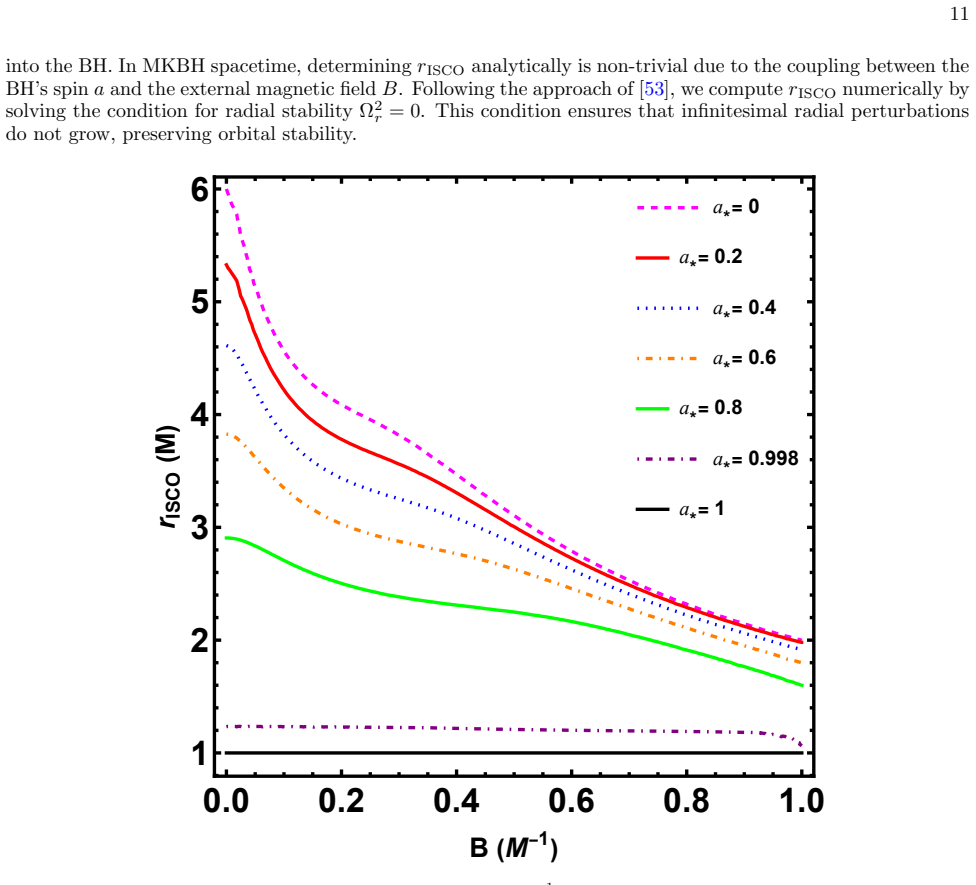
Core claim
In the magnetized Kerr black hole spacetime there exists a critical magnetic field strength above which no circular geodesics, timelike or null, can exist. For subcritical fields the photon circular orbit admits two real roots, the outer defining an outermost stable circular orbit that confines stable motion to a finite radial domain. Exact expressions for orbital, radial and vertical epicyclic frequencies show substantial deviations from Kerr behavior, including a magnetically induced reversal of periastron precession within a finite radial range.
What carries the argument
The magnetized Kerr black hole spacetime, an exact electrovacuum solution that self-consistently incorporates the curvature effects of an external magnetic field.
If this is right
- No circular geodesics exist above the critical magnetic field strength.
- An outermost stable circular orbit confines stable motion between the ISCO and OSCO for subcritical fields.
- Periastron precession reverses within a finite radial range due to magnetic effects.
- Retrograde precession could appear at large radii for astrophysically relevant field strengths.
Where Pith is reading between the lines
- The reversal of precession offers a potential observational signature for large-scale magnetization around black holes.
- The same geometric framework could be applied to model quasi-periodic oscillations in magnetized environments.
- Timing observations of X-ray binaries might reveal magnetic imprints on orbital dynamics at large distances.
Load-bearing premise
The magnetized Kerr black hole is an exact electrovacuum solution of the Einstein-Maxwell equations that self-consistently incorporates the curvature effects of an external magnetic field.
What would settle it
Detection of a circular geodesic at a radius where the local magnetic field exceeds the critical value, or the absence of periastron precession reversal in a subcritical field, would contradict the central claim.
Figures




read the original abstract
We study the orbital structure and precession dynamics of neutral test particles in the magnetized Kerr black hole (MKBH) spacetime-an exact electrovacuum solution of the Einstein-Maxwell equations that self-consistently incorporates the curvature effects of an external magnetic field. This geometry allows a unified treatment of gravitational and magnetic influences across weak to ultra-strong regimes. The analysis reveals a critical magnetic field strength above which no circular geodesics, timelike or null, can exist, establishing an upper magnetic bound for orbital motion. For subcritical fields, the photon circular orbit admits two real roots, the outer of which defines an outermost stable circular orbit (OSCO), complementing the conventional innermost stable circular orbit (ISCO) and confining stable motion within a finite radial domain. Exact expressions for the orbital, radial, and vertical epicyclic frequencies, and their associated precession rates, show substantial deviations from Kerr behavior, including a magnetically induced reversal of periastron precession within a finite radial range. For astrophysically relevant magnetic field strengths, the retrograde precession could be observable at large radii around astrophysical BHs, offering a potential diagnostic of large-scale magnetization. These findings highlight the geometric influence of magnetic curvature on strong-field dynamics, providing a self-consistent framework to interpret quasi-periodic oscillation phenomenology and potential magnetic imprints in precision timing observations of compact objects.
Editorial analysis
A structured set of objections, weighed in public.
Referee Report
Summary. The paper analyzes orbital dynamics and precession of neutral test particles in the magnetized Kerr black hole spacetime, presented as an exact electrovacuum Einstein-Maxwell solution that incorporates external magnetic field curvature effects self-consistently. It reports a critical magnetic field strength above which no circular timelike or null geodesics exist; for subcritical fields the photon orbit admits an outermost stable circular orbit (OSCO) in addition to the ISCO, confining stable orbits to a finite radial domain. Exact expressions are given for orbital, radial, and vertical epicyclic frequencies and associated precession rates, including a magnetically induced reversal of periastron precession within a finite radial interval, with potential observability for astrophysically relevant fields.
Significance. If the central results hold, the work supplies a unified geometric framework for gravitational plus magnetic influences on black-hole orbits across weak-to-ultra-strong regimes, without additional approximations. The exact epicyclic-frequency expressions, the critical-field bound, and the OSCO together with precession reversal constitute a concrete extension of standard Kerr analyses and could furnish falsifiable predictions for QPO phenomenology and precision timing observations of magnetized compact objects.
major comments (1)
- The abstract and introduction assert exact expressions for epicyclic frequencies and a critical magnetic field value, yet the manuscript must supply the explicit line element (or at least the non-zero metric components) and the derivation of the effective potential from the geodesic Lagrangian before these claims can be verified; without those steps the load-bearing result on the critical field remains uncheckable.
Simulated Author's Rebuttal
We thank the referee for the positive evaluation and constructive suggestion. We address the single major comment below and will revise the manuscript accordingly to improve verifiability.
read point-by-point responses
-
Referee: The abstract and introduction assert exact expressions for epicyclic frequencies and a critical magnetic field value, yet the manuscript must supply the explicit line element (or at least the non-zero metric components) and the derivation of the effective potential from the geodesic Lagrangian before these claims can be verified; without those steps the load-bearing result on the critical field remains uncheckable.
Authors: We agree that explicit presentation of the metric and the effective-potential derivation will strengthen the paper. In the revised manuscript we will insert the full line element of the magnetized Kerr spacetime (including all non-zero components) in Section 2 and provide a step-by-step derivation of the effective potential from the geodesic Lagrangian, from which the orbital, radial, and vertical epicyclic frequencies and the critical magnetic-field bound follow directly. These additions will make the central results immediately checkable without altering any of the reported conclusions. revision: yes
Circularity Check
No significant circularity in derivation chain
full rationale
The paper analyzes geodesic motion and epicyclic frequencies directly from the effective potential in the given exact magnetized Kerr electrovacuum metric. The critical magnetic field strength, OSCO existence for subcritical fields, and precession reversal are obtained by solving the radial equation and frequency expressions in this geometry; none reduce to a fitted parameter, self-definition, or prior self-citation that is itself unverified. The metric is treated as an independent input solution of Einstein-Maxwell, and all reported orbital results follow from standard geodesic analysis without renaming or smuggling ansatze. This is a self-contained derivation against the external benchmark of the exact metric.
Axiom & Free-Parameter Ledger
axioms (1)
- domain assumption The magnetized Kerr black hole spacetime is an exact electrovacuum solution of the Einstein-Maxwell equations.
Lean theorems connected to this paper
-
IndisputableMonolith/Foundation/RealityFromDistinction.leanreality_from_one_distinction unclear?
unclearRelation between the paper passage and the cited Recognition theorem.
We study the orbital structure and precession dynamics of neutral test particles in the magnetized Kerr black hole (MKBH) spacetime—an exact electrovacuum solution of the Einstein–Maxwell equations...
-
IndisputableMonolith/Cost/FunctionalEquation.leanwashburn_uniqueness_aczel unclear?
unclearRelation between the paper passage and the cited Recognition theorem.
Vr(r) = ... effective potential ... critical magnetic field strength B_cr ... OSCO ... periastron precession reversal
What do these tags mean?
- matches
- The paper's claim is directly supported by a theorem in the formal canon.
- supports
- The theorem supports part of the paper's argument, but the paper may add assumptions or extra steps.
- extends
- The paper goes beyond the formal theorem; the theorem is a base layer rather than the whole result.
- uses
- The paper appears to rely on the theorem as machinery.
- contradicts
- The paper's claim conflicts with a theorem or certificate in the canon.
- unclear
- Pith found a possible connection, but the passage is too broad, indirect, or ambiguous to say the theorem truly supports the claim.
Forward citations
Cited by 1 Pith paper
-
Distinguishability of magnetic massive black holes from environmental mimics with inspiral gravitational waves
Magnetic field corrections to inspiral waveforms appear at -2 PN and -3 PN orders and mimic power-law environmental gravity but can be distinguished above a transition density of about 10^{-4} kg/m^3 for Bonnor-Melvin...
Reference graph
Works this paper leans on
-
[1]
Starting from the basic formulation, we have derived the potential function governing the equatorial timelike geodesics in the full magnetized Kerr spacetime. The magnetic field introduces a substantial 19 modification, manifesting as a potential barrier that grows withBsimilar to [46]. However, the effect of a∗ is comparatively small on the potential barrier
-
[2]
By determining the radius of CPO, we have identified a critical magnetic field strengthB cr(a∗), beyond which no circular geodesics—timelike or null—can exist
-
[3]
For sub-critical fields (B < B cr), the CPO equation yields two positive roots. We propose a novel identification of the outer root as theoutermost stable circular orbit, providing a physically motivated definition of the OSCO based on the null geodesic structure
-
[4]
We have obtained exact analytical expressions for the fundamental orbital frequencies–Keplerian, radial, and vertical epicyclic–in the MKBH spacetime. For conciseness, we have presented here their series expansions up toO(B 2) term, which are directly relevant for the astrophysical observations of (non- )rotating BHs immersed in magnetic fields. In the sl...
-
[5]
We have derived the exact expressions for the ISCO radius and OSCO radius, which are applicable to any arbitrary values ofa ∗ andB. We have shown that the both radii decrease monotonically with increasing Bfor the whole range ofa ∗: 0≤a ∗ <1. In the extremal BH case (a ∗ →1), the ISCO radius remains fixed at the horizon (r/M→1) for any value ofBdue to the...
-
[6]
The Keplerian frequency Ω ϕ and the nodal plane precession frequency Ω nod exhibit a similar non- monotonic trend. Close to the BH, frame dragging effect due toa ∗ dominates, whereas at larger radii magnetic curvature takes over similar to [9]. In the non-rotating case (a ∗ = 0), nodal plane precession is entirely magnetic in origin, consistent with gravi...
-
[7]
We have reported a reversal to retrograde periastron precession (Ω per <0), a phenomenon absent in the standard Kerr and Schwarzschild spacetime. For the static case, we have identified the condition for this reversal, which defines a critical magnetic field strengthB neg above which the precession is strictly prograde. This behavior generalizes to rotati...
-
[8]
and ngEHT [81] could directly probe these effects near BHs. The presence of an outermost stable circular orbit introduces a qualitatively new restriction on bound motion around MKBH. If, for instance, a neutron star orbits a BH at a radius larger thanr OSCO, the orbit cannot remain stable under perturbations. In such a case, even small deviations would dr...
-
[9]
In this limit, the magnetization functions reduce to unity, Λ e = Λ0 = 1, andA e = (r2 +a 2)2 −a 2∆
Kerr Limit (B= 0) When the magnetic field is switched off, the MKBH spacetime reduces to the standard Kerr spacetime. In this limit, the magnetization functions reduce to unity, Λ e = Λ0 = 1, andA e = (r2 +a 2)2 −a 2∆. Consequently, Eq. (23) simplify to the well-knownV r(r) for equatorial timelike geodesics in the Kerr geometry [45]: Vr(r) B→0 = 1 r4 (r2 ...
-
[10]
In this case,ϖ e|a→0 = 0, Λe|a→0 = 1 + 1 4 B2r2 ≡Λ M, and ∆| a→0 =r 2 −2M r≡∆ Sch
Magnetized Schwarzschild Limit (a= 0) Fora→0, the MKBH metric reduces to the magnetized Schwarzschild solution. In this case,ϖ e|a→0 = 0, Λe|a→0 = 1 + 1 4 B2r2 ≡Λ M, and ∆| a→0 =r 2 −2M r≡∆ Sch. In the Schwarzschild limit we find V+ +V − ∝a= 0, V +V− =− L2∆SchΛ2 M r4 (A3) such that (E−V +)(E−V −) =E 2 − L2∆SchΛ2 M r4 (A4) Substituting into Eq. (23) yields...
-
[11]
Melvin Universe Limit (M→0,a→0) If both the mass and spin vanish, the geometry reduces to the pure Melvin universe, which is static, axisym- metric, and sourced entirely by a magnetic field. Following analogous steps to the magnetized Schwarzschild case, in this limit the effective potential simplifies to [99] Veff = Λ4 ML2 r2 + Λ2 M.(A7) Appendix B: Fund...
-
[12]
K. Akiyama and et al. (Event Horizon Telescope Collaboration), Astrophys. J. Lett.910, L12 (2021)
work page 2021
-
[13]
K. Akiyama and et al. (Event Horizon Telescope Collaboration), Astrophys. J. Lett.910, L13 (2021)
work page 2021
- [14]
-
[15]
M. Del Santo, J. Malzac, R. Belmont, L. Bouchet, and G. De Cesare, Mon. Not. R. Astron. Soc.430, 209 (2013)
work page 2013
-
[16]
C. F. Gammie, S. L. Shapiro, and J. C. McKinney, Astrophys. J.602, 312 (2004)
work page 2004
-
[17]
A. R. Prasanna and C. V. Vishveshwara, Pramana J. Phys.11, 359 (1978)
work page 1978
-
[18]
P. J. Wiita, C. V. Vishveshwara, M. J. Siah, and B. R. Iyer, J. Phys. A: Math. Gen.16, 2077 (1983)
work page 2077
-
[19]
B. R. Iyer, C. V. Vishveshwara, P. J. Wiita, and A. R. Prasanna, Pramana J. Phys.25, 135 (1985)
work page 1985
- [20]
-
[21]
D. V. Galtsov and V. I. Petukhov, Sov. Phys. JETP47, 419 (1978), [Zh. Eksp. Teor. Fiz.74, 801 (1978)]
work page 1978
-
[22]
J. Biˇ c´ ak, V. Karas, and T. Ledvinka, Proc. Int. Astron. Union2, 139 (2006)
work page 2006
-
[23]
R. D. Blandford and R. L. Znajek, Mon. Not. R. Astron. Soc.179, 433 (1977)
work page 1977
- [24]
-
[25]
C. Chakraborty, P. Patil, and G. Akash, Phys. Rev. D109, 064062 (2024)
work page 2024
-
[26]
Y. Hou, Z. Zhang, H. Yan, M. Guo, and B. Chen, Phys. Rev. D106, 064058 (2022)
work page 2022
-
[27]
M. Wang, S. Chen, and J. Jing, Phys. Rev. D104, 084021 (2021)
work page 2021
- [28]
- [29]
-
[30]
Eisenhauer and et al., Astrophys
F. Eisenhauer and et al., Astrophys. J.628, 246 (2005)
work page 2005
-
[31]
S. V. Dhurandhar and D. N. Sharma, J. Phys. A: Math. Gen.16, 99 (1983)
work page 1983
- [32]
-
[33]
E. P. Esteban, Nuovo Cimento B79, 76 (1984)
work page 1984
-
[34]
D. Bini, A. Geralico, and R. T. Jantzen, Phys. Rev. D94, 064066 (2016)
work page 2016
- [35]
-
[36]
B. R. Iyer and C. V. Vishveshwara, Phys. Rev. D48, 5706 (1993)
work page 1993
- [37]
-
[38]
M. A. Abramowicz and W. Klu´ zniak, Astron. Astrophys.374, L19 (2001)
work page 2001
- [39]
-
[40]
F. J. Ernst, J. Math. Phys.17, 54 (1976)
work page 1976
-
[41]
W. J. Wild, R. M. Kerns, and W. F. Drish, Phys. Rev. D23, 829 (1981)
work page 1981
-
[42]
A. N. Aliev and D. V. Galtsov, Astrophys. Space Sci.155, 181 (1989)
work page 1989
-
[43]
A. N. Aliev and D. V. Galtsov, Astrophys. Space Sci.135, 81 (1987)
work page 1987
-
[44]
S. Shaymatov, B. Narzilloev, A. Abdujabbarov, and C. Bambi, Phys. Rev. D103, 124066 (2021)
work page 2021
-
[45]
A. N. Aliev and D. V. Gal’tsov, Astrophys. Space Sci.143, 301 (1988)
work page 1988
-
[46]
W. A. Hiscock, J. Math. Phys.22, 1828 (1981)
work page 1981
-
[47]
G. W. Gibbons, A. H. Mujtaba, and C. N. Pope, Classical and Quantum Gravity30, 125008 (2013)
work page 2013
-
[48]
M. A. Melvin, Physics letters8, 65 (1964)
work page 1964
-
[49]
M. A. Melvin, Phys. Rev.139, B225 (1965)
work page 1965
-
[50]
Straumann, General Relativity, 2nd ed
N. Straumann, General Relativity, 2nd ed. (Springer, 2013)
work page 2013
-
[51]
K. J. J. Taylor and A. Ritz, Class. Quant. Grav. 10.1088/1361-6382/ae0be3 (2025)
- [52]
- [53]
-
[54]
V. P. Frolov and A. Zelnikov, Introduction to Black Hole Physics (Oxford University Press, 2011)
work page 2011
-
[55]
V. P. Frolov and I. D. Novikov,Black Hole Physics: Basic Concepts and New Developments, Fundamental Theories of Physics (Springer Dordrecht, 1998)
work page 1998
-
[56]
V. Ferrari, L. Gualtieri, and P. Pani,General Relativity and its Applications: Black Holes, Compact Stars and Gravitational Waves (CRC Press, 2020)
work page 2020
- [57]
-
[58]
J. M. Bardeen, W. H. Press, and S. A. Teukolsky, Astrophys. J.178, 347 (1972). 24
work page 1972
-
[59]
S. L. Shapiro and S. A. Teukolsky,Black Holes, White Dwarfs, and Neutron Stars: The Physics of Compact Objects (Wiley-VCH, 1983)
work page 1983
- [60]
-
[61]
N. Dadhich, C. Hoenselaers, and C. V. Vishveshwara, J. Phys. A: Math. Gen.12, 215 (1979)
work page 1979
-
[62]
A. N. Aliev and D. V. Gal’tsov, Sov. Phys. Usp.32, 75 (1989)
work page 1989
-
[63]
C. Chakraborty, P. Kocherlakota, M. Patil, S. Bhattacharyya, P. S. Joshi, and A. Kr´ olak, Phys. Rev. D95, 084024 (2017)
work page 2017
-
[64]
D. D. Doneva, S. S. Yazadjiev, N. Stergioulas, K. D. Kokkotas, and T. M. Athanasiadis, Phys. Rev. D90, 044004 (2014)
work page 2014
-
[65]
R. M. Wald, Phys. Rev. D10, 1680 (1974)
work page 1974
-
[66]
A. R. King, J. P. Lasota, and W. Kundt, Phys. Rev. D12, 3037 (1975)
work page 1975
-
[67]
J. Biˇ c´ ak and V. Janiˇ s, Mon. Not. R. Astron. Soc.212, 899 (1985)
work page 1985
-
[68]
W. B. Bonnor, Proc. Phys. Soc.76, 891 (1960)
work page 1960
- [69]
- [70]
- [71]
-
[72]
J. A. Orosz, J. E. McClintock, J. P. Aufdenberg, R. A. Remillard, M. J. Reid, R. Narayan, and L. Gou, Astrophys. J.742, 84 (2011)
work page 2011
- [73]
-
[74]
T. M. Belloni and L. Stella, Space Sci. Rev.183, 43 (2014)
work page 2014
-
[75]
T. M. Belloni, A. Sanna, and M. M´ endez, Mon. Not. R. Astron. Soc.426, 1701 (2012)
work page 2012
- [76]
-
[77]
S. E. Motta, T. Mu˜ noz-Darias, A. Sanna, R. Fender, T. Belloni, and L. Stella, Mon. Not. R. Astron. Soc. Lett. 439, L65 (2014)
work page 2014
-
[78]
S. E. Motta, T. M. Belloni, L. Stella, T. Mu˜ noz-Darias, and R. Fender, Mon. Not. R. Astron. Soc.437, 2554 (2014)
work page 2014
- [79]
-
[80]
K. J. Taylor and A. Ritz, Class. Quantum Grav.42, 165013 (2025)
work page 2025
discussion (0)
Sign in with ORCID, Apple, or X to comment. Anyone can read and Pith papers without signing in.