REVIEW 3 major objections 4 minor 1 cited by
How to Build an Empirical Speed Distribution for Dark Matter in the Solar Neighborhood
T0 review · 3 major / 4 minor · reviewed 2026-08-04 · deepseek-v4-flash
Pith's one-line read Local dark-matter speeds can be reconstructed empirically from observed stars: a Maxwellian background plus dispersion-boosted merger debris matches simulated galaxies and shifts the Milky Way's peak 11 km/s slower.
desk verdict Solid, honest method paper for reconstructing the local DM speed distribution from stellar kinematics; the Milky Way application is a TNG50-calibrated extrapolation that deserves review but needs external validation. read the letter →
The pith
A machine-rendered reading of the paper's core claim, the machinery that carries it, and where it could break.
The reading
What carries the argument
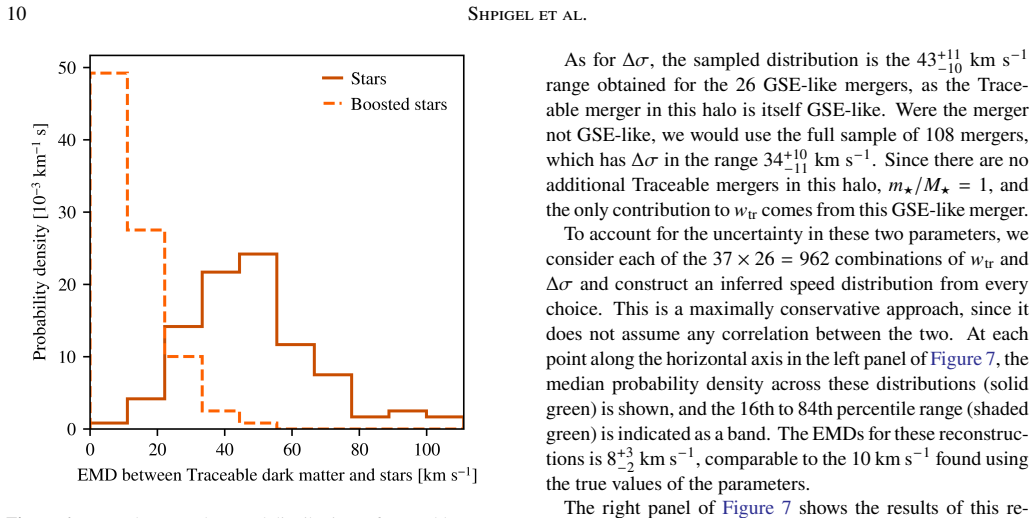
The load-bearing construction is the two-component formula f_tot(v) = (1 - w_tr) SHM(v|v0) + w_tr Σ (m_*/M_*) f_b(v). The first term is a Maxwell–Boltzmann 'Standard Halo Model' with v0 set by the circular speed at 8 kpc, covering old and dark-accreted dark matter. The second term is a kernel-density estimate built from the observed velocities of stars from each massive merger, after each velocity component is shifted by the boost v_i^b = (Δσ + σ_i^★)/σ_i^★ (v_i^★ − ⟨v_i^★⟩) + ⟨v_i^★⟩, with Δσ ≈ 30 km/s the mean difference between dark-matter and stellar velocity dispersions. The construction is validated with the Earth Mover's Distance between the true and reconstructed speed distributions,
What would settle it
Compute the same stellar–dark-matter velocity-dispersion offset for recent massive mergers in high-resolution Milky Way-mass simulations that use different baryonic feedback and a different halo-tracking algorithm; if the offset is not near 30 km/s, or if the Earth Mover's Distance between boosted stars and dark matter exceeds ~20 km/s, the one-parameter boost is not portable. A second check is to redo the Milky Way reconstruction with alternative selections of the last major merger's stars; the 11 km/s peak shift should not move by more than a few km/s.
Extended reading notes
Core claim
The central discovery is that the total local dark-matter speed distribution splits cleanly into two pieces. The 'Untraceable' piece—old accreted dark matter plus recent dark accretion—is Maxwell–Boltzmann with a scale set by the mass enclosed at the solar radius. The 'Traceable' piece from recent massive mergers can be modeled from the observed velocities of the merger's stars, provided the stellar velocity dispersion is boosted by an empirical factor of about 30 km/s. The boost works because stars are stripped later and land deeper in the potential well, while dark matter is stripped earlier and retains higher orbital speeds. The authors verify the reconstruction on 98 simulated Milky Way-
Load-bearing premise
The load-bearing premise is that the velocity-dispersion boost and the traceable dark-matter fraction measured in simulated Milky Way analogues transfer to our own Galaxy; if the stellar-to-dark-matter offset in the Milky Way differs, the reconstructed peak shift and tail suppression change.
Editorial extensions
If this is right
- Direct detection experiments can replace the pure Maxwellian assumption with this empirical mixture, changing predicted recoil spectra near threshold and at high recoil energy.
- The Milky Way's last major merger shifts the local speed-distribution mode 11 km/s lower and suppresses the fastest portion of the tail by about 20%, altering sensitivity projections for low- and high-mass dark matter.
- Dark matter that cannot be traced by stars—early accretion and dark accretion—can safely be left as a Maxwellian, removing a major uncertainty in empirical models of the local dark matter.
- The reconstructed Milky Way speed distributions are released for public use, so detector analyses can adopt them without re-running galaxy formation simulations.
Reading between the lines
- If the offset between dark-matter and stellar velocity dispersions depends on galaxy assembly history or baryonic feedback, the ~30 km/s boost is best treated as a prior from this simulation set; a multi-simulation calibration would tell whether the Milky Way value is stable.
- The same two-component strategy could be extended beyond the solar neighborhood once future wide-field spectroscopic surveys provide clean samples of accreted stars for more merger events.
- Because the stellar debris from massive mergers carries nonzero azimuthal velocity, the full dark-matter velocity distribution is likely not isotropic even where the speed distribution looks Maxwellian—an opportunity for directional detectors.
- The predicted ~20% suppression of the high-speed tail is the part of the distribution that high-recoil-energy searches probe; experiments with different thresholds should see opposite-signed rate shifts if this reconstruction is right.
Editorial analysis
A structured set of objections, weighed in public.
Referee Report
Summary. The paper proposes an empirical procedure for reconstructing the local dark-matter speed distribution in the solar neighborhood. Using 98 Milky Way analogues from TNG50, it separates the DM into three components: 'Old Untraceable' DM accreted before z=3, 'Young Untraceable' DM from later diffuse/low-mass accretion, and 'Traceable' DM from massive recent mergers. The first two are modeled jointly by a Maxwell–Boltzmann (SHM) distribution; the Traceable component is modeled from the stellar debris of the same merger after applying a velocity-dispersion boost. The full reconstruction is the weighted sum of these pieces (Eq. 7). The method is validated in TNG50 with Earth Mover's Distance metrics, showing median EMDs of 10–11 km/s against the exact simulated distributions. The paper then applies the procedure to the Milky Way using Gaia GSE stellar tracers, finding that the GSE contribution shifts the mode of the local speed distribution by 11 km/s and suppresses the high-speed tail by about 20%.
Significance. If the method holds up, this is a valuable step toward an observationally grounded local DM speed distribution for direct-detection analyses. The paper's strengths are its large, homogeneous sample of 98 MW analogues; the explicit treatment of dark accretion as distinct from luminous mergers; the systematic parameter-robustness tests in Appendices A–C; and the public release of the inferred MW speed distributions. The three-way decomposition is physically well motivated, and the finding that the untraceable background is Maxwellian even when young dark-accretion is included is a useful result. The application to the GSE is timely and connects to active literature. However, the validation is in-sample, the improvement over the SHM is modest in EMD terms (11 vs 14 km/s), and the Milky Way application relies on TNG50-calibrated parameters that may not transfer to the MW's specific assembly history.
major comments (3)
- [§3.3, Eq. (7), Fig. 7] The central validation is in-sample: the distributions for Δσ and w_tr used in Eq. (7) are computed from the same 98 TNG50 halos against which the reconstruction is tested in Fig. 7. The EMDs of 10–11 km/s therefore measure self-consistency of the calibration, not out-of-sample predictive skill. Since the paper advertises a reconstruction procedure, I ask for an explicit out-of-sample test: e.g., calibrate on half the analogues and apply to the other half, or calibrate Δσ on the GSE-like mergers and apply it to non-GSE mergers (and vice versa). Appendix A tests tagging parameters but does not address this circularity.
- [§4, Fig. 8] The Milky Way result — the 11 km/s mode shift and the ~20% high-speed-tail suppression — is controlled by Δσ = 43^{+11}_{-10} km/s and w_tr = 18^{+15}_{-5}%, both taken from TNG50. Section 5 explicitly states that FIRE-2 finds a tighter stellar–DM correlation and smaller offsets, and Appendix B attributes the TNG50 offset to earlier assembly and deeper potentials. Since 81% of the analogues are within 16 Mpc of a Virgo-mass cluster (Sec. 2.1) while the MW is not, the TNG50-calibrated boost is an extrapolation. The shaded bands in Fig. 8 reflect only internal TNG50 scatter, not this code/systematic uncertainty. Please quantify the MW speed distribution for a range of Δσ and w_tr spanning the FIRE-2 expectations (including Δσ = 0), and report the resulting spread in the mode shift, 95th percentile, and tail suppression.
- [§3, EMD metric; Fig. 7] The EMD is the only validation metric used in the TNG50 tests, and the paper itself notes that EMD is 'not very sensitive to changes at the high-speed tail' (Sec. 3). However, the abstract and conclusions highlight the high-speed tail suppression as a key consequence. The reported median EMD improvement over the SHM (11 vs 14 km/s) is modest and does not directly test whether the reconstruction captures the tail. I recommend adding a tail-sensitive statistic (e.g., the 95th percentile speed, the fraction of DM above 400 or 500 km/s, or a rate-weighted integral) to the TNG50 validation in Fig. 7, and reporting it alongside the EMD.
minor comments (4)
- [§2.2 / Appendix A] The classification into Old/Young/Traceable depends on the z_acc = 3 threshold and the 2 Gyr/70% tagging choices; Appendix A notes that w_tr varies with these choices. Please add a sentence in the main text reminding the reader that w_tr is defined relative to this operational classification.
- [Fig. 7, left panel] The sentence 'The SHM alone (not shown here)' is confusing because the caption and the figure appear to include black SHM curves in other panels; specify that the left panel omits the SHM-only curve for clarity.
- [§5] The conclusion quotes a 'median speed of 180 km/s' for the GSE stars, while Section 4 quotes a mode of 90 km/s. These are different statistics; please use consistent terminology to avoid apparent contradiction.
- [Eq. (5)] The notation v^i_b and Δσ could be defined more explicitly: state that Δσ is a single scalar applied equally to all three spherical components, and that the directionally averaged definition in Eq. (6) is used.
Circularity Check
Reconstruction accuracy partly reflects TNG50-calibrated inputs: the dispersion boost removes the stellar-DM offset by construction, and the traceable fraction is sampled from the same halos used as the benchmark.
-
self definitional
[Section 3.2, Eqs. (5)-(6), Figure 6]
"we implement a boost to the stellar velocities to increase the observed dispersion while maintaining a fixed mean. The resulting boosted velocities, v_b, better trace the DM speed distribution. For each Traceable merger, we define a one-parameter boosted stellar velocity as follows: v^b_i = (Δσ+σ^★_i)/σ^★_i (v^★_i−\bar v^★_i)+\bar v^★_i, with Δσ = (1/3) Σ_i (σ^DM_i − σ^★_i)"
By Eqs. (5)-(6), the boosted stellar dispersion in each component is σ^b_i = σ^★_i + Δσ = σ^DM_i, because Δσ is the direction-averaged difference between DM and stellar dispersions. Thus the dominant velocity-dispersion offset is removed by definition, not by an independent prediction. The subsequent claim that the boosted stars 'serve as better tracers' (EMD reduced from 47 to 10 km/s) therefore tests only the shape and mean of the stellar distribution, with the first-order broadening enforced by construction.
-
fitted input called prediction
[Section 3.3, Eq. (7), Figure 7]
"From the left panel of Figure 1, it is clear that w_tr is sensitive to the number of Traceable mergers... Therefore, the probability distribution for w_tr used in this reconstruction is equal to the distribution observed in the simulation conditioned on the number of Traceable mergers... For each MW analogue, this gives a range of EMDs corresponding to the distance between the exact speed distribution and the f_tot(v) model."
The mixture weight w_tr in Eq. (7) is not predicted from stellar kinematics; it is sampled from the distribution of Traceable DM fractions in the same TNG50 halos whose exact DM speed distribution is used as the benchmark. The reported agreement (median EMD 11 km/s) therefore partly reflects an in-sample calibration of the weighting parameter rather than an out-of-sample reconstruction of the Traceable contribution. The stellar tracer component is real, but its normalization is taken from the target population being reconstructed.
full rationale
The paper is not definitionally circular: the Maxwell-Boltzmann background is parameterized independently, and the stellar speed shape after the boost is not forced to equal the DM speed distribution point-by-point. However, two load-bearing ingredients are calibrated from the same TNG50 sample against which the method is validated. First, Δσ is defined as the average DM-star dispersion difference, so Eq. (5) sets the boosted stellar dispersion equal to the DM dispersion by construction; the large EMD reduction in Figure 6 is therefore not an independent test of the width of the tracer distribution. Second, w_tr is sampled from the Traceable fractions of the very halos used as the exact benchmark in Figure 7, making the quoted EMD an in-sample consistency check rather than a prediction. The Milky Way application is an extrapolation rather than circularity, but it inherits these TNG50-calibrated inputs; the paper itself notes that FIRE-2 simulations find tighter stellar-DM correlations and smaller offsets, underscoring that the transfer is assumption-laden. No load-bearing self-citation or uniqueness-theorem circularity is present.
Assumptions & free parameters
free parameters (3)
- Dispersion boost Δσ =
34(+10/−11) km/s; 43(+11/−10) km/s for GSE-like mergers
- Traceable DM fraction w_tr =
18(+15/−5)% for single-Traceable-merger halos
- GSE stellar eccentricity cut =
e > 0.7
assumptions (3)
- domain assumption Old virialized DM plus diffuse/dark accretion follows a Maxwell-Boltzmann (SHM) speed distribution
- domain assumption TNG50 is representative of MW-like galaxy formation and merger histories
- domain assumption The stellar-to-DM velocity-dispersion offset (stars stripped later, DM stripped earlier) is universal and applies to the Milky Way
Cite this review
Pith. "Pith review of How to Build an Empirical Speed Distribution for Dark Matter in the Solar Neighborhood." pith.science (2026). https://pith.science/paper/57IPWNIU
@misc{pith2026251021914,
  author       = {Pith},
  title        = {Pith review of: How to Build an Empirical Speed Distribution for Dark Matter in the Solar Neighborhood},
  year         = {2026},
  howpublished = {\url{https://pith.science/paper/57IPWNIU}},
  note         = {Machine review of arXiv:2510.21914}
}
read the original abstract
The dark matter flux in a direct detection experiment depends on its local speed distribution. This distribution has been inferred from simulations of Milky Way-like galaxies, but such models serve only as proxies, given that no simulation directly captures the detailed evolution of our own Galaxy. This motivates alternative approaches that obtain this distribution directly from observations. In this work, we utilize 98 Milky Way analogues from the TNG50 simulation to develop and validate a procedure for inferring the dark matter speed distribution using the kinematics of nearby stars. We find that the dark matter that originated from old mergers, plus that from recent nonluminous accretions, is well described by a Maxwell-Boltzmann speed distribution centered at the local standard-of-rest velocity. Meanwhile, recently accreted dark matter from massive mergers has speeds that can be traced from the associated stellar debris of these events. The stellar populations systematically underestimate the velocity dispersion of their dark matter counterparts, but a simple kinematic boost brings the two into good alignment. Using the TNG50 host galaxies, we demonstrate that combining these two contributions provides an accurate reconstruction of the local dark matter speeds. As an application of the procedure to our own Galaxy, we utilize stellar kinematic data from Gaia to quantify how the dark matter remnants from the Milky Way's last major merger impact its speed distribution in the solar neighborhood.
Figures


Figures from the paper (5 more)




Forward citations
Cited by 1 Pith paper
-
Ubiquitous Corotation of Dark Matter Halos: Implications for Direct Detection
Dark matter in simulated Milky Way analogues preferentially corotates with the baryonic disk, suppressing predicted direct-detection rates for light WIMPs, reducing directional modulation, and producing a 21% astrophy...
Reference graph
Works this paper leans on
-
[1]
thebibliography [1] 20pt to REFERENCES 6pt =0pt -12pt 10pt plus 3pt =0pt =0pt =1pt plus 1pt =0pt =0pt -12pt =13pt plus 1pt =20pt =13pt plus 1pt \@M =10000 =-1.0em =0pt =0pt 0pt =0pt =1.0em @enumiv\@empty 10000 10000 `\.\@m \@noitemerr \@latex@warning Empty `thebibliography' environment \@ifnextchar \@reference \@latexerr Missing key on reference command E...
arXiv 2021
-
[3]
Baxter, D., Bloch, I. M., Bodnia, E., et al. 2021, Eur. Phys. J. C, 81, 907, 10.1140/epjc/s10052-021-09655-y
-
[4]
Belokurov, V., Erkal, D., Evans, N. W., Koposov, S. E., & Deason, A. J. 2018, MNRAS, 478, 611, 10.1093/mnras/sty982
-
[5]
Benisty, D., Vasiliev, E., Evans, N. W., et al. 2022, Astrophys. J., 928, L5, 10.3847/2041-8213/ac5c42
-
[7]
Bland-Hawthorn , J., & Gerhard, O. 2016, Annu. Rev. Astron. Astrophys., 54, 529, 10.1146/annurev-astro-081915-023441
-
[8]
Boardman, N., Zasowski, G., Newman, J. A., et al. 2020, MNRAS, 498, 4943, 10.1093/mnras/staa2731
-
[9]
Bonaca, A., Conroy, C., Cargile, P. A., et al. 2020, Astrophys. J., 897, L18, 10.3847/2041-8213/ab9caa
-
[10]
Bovy, J. 2015, Astrophys. J. Suppl. Ser., 216, 29, 10.1088/0067-0049/216/2/29
Show all 117 references
-
[11]
2013, Astrophys
Bovy, J., & Rix, H.-W. 2013, Astrophys. J., 779, 115, 10.1088/0004-637X/779/2/115
2013 doi
-
[12]
2017, Int
Bozorgnia, N., & Bertone, G. 2017, Int. J. Mod. Phys. A, 32, 1730016, 10.1142/S0217751X17300162
2017 doi
-
[13]
G., et al
Bozorgnia, N., Fattahi, A., Cerde \ n o, D. G., et al. 2019, J. Cosmol. Astropart. Phys., 2019, 045, 10.1088/1475-7516/2019/06/045
2019 doi
-
[14]
S., et al
Bozorgnia, N., Fattahi, A., Frenk, C. S., et al. 2020, J. Cosmol. Astropart. Phys., 2020, 036, 10.1088/1475-7516/2020/07/036
2020 doi
-
[15]
Bozorgnia, N., Calore, F., Schaller, M., et al. 2016, J. Cosmol. Astropart. Phys., 2016, 024, 10.1088/1475-7516/2016/05/024
2016 doi
-
[16]
O., Wechsler, R
Buch, D., Nadler, E. O., Wechsler, R. H., & Mao, Y.-Y. 2024, Astrophys. J., 971, 79, 10.3847/1538-4357/ad554c
2024 doi
-
[17]
V., Dutton, A
Butsky, I., Macci \`o , A. V., Dutton, A. A., et al. 2016, MNRAS, 462, 663, 10.1093/mnras/stw1688
2016 doi
-
[18]
J., Fattahi, A., Callingham, T
Carrillo, A., Deason, A. J., Fattahi, A., Callingham, T. M., & Grand, R. J. J. 2024, MNRAS, 527, 2165, 10.1093/mnras/stad3274
2024 doi
-
[19]
J., et al
Cautun, M., Ben \'i tez-Llambay , A., Deason, A. J., et al. 2020, MNRAS, 494, 4291, 10.1093/mnras/staa1017
2020 doi
-
[20]
P., Conroy, C., et al
Chandra, V., Naidu, R. P., Conroy, C., et al. 2023, Astrophys. J., 951, 26, 10.3847/1538-4357/accf13
2023 doi
-
[21]
S., & White, S
Davis, M., Efstathiou, G., Frenk, C. S., & White, S. D. M. 1985, Astrophys. J., 292, 371, 10.1086/163168
1985 doi
-
[22]
J., & Belokurov, V
Deason, A. J., & Belokurov, V. 2024, New Astronomy Reviews, 99, 101706, 10.1016/j.newar.2024.101706
2024
-
[23]
J., Belokurov, V., Koposov, S
Deason, A. J., Belokurov, V., Koposov, S. E., & Lancaster, L. 2018, Astrophys. J., 862, L1, 10.3847/2041-8213/aad0ee
2018 doi
-
[24]
2014, Advances in High Energy Physics, 2014, 1, 10.1155/2014/604914
Del Nobile, E. 2014, Advances in High Energy Physics, 2014, 1, 10.1155/2014/604914
2014 doi
-
[25]
2008, Nature, 454, 735, 10.1038/nature07153
Diemand, J., Kuhlen, M., Madau, P., et al. 2008, Nature, 454, 735, 10.1038/nature07153
2008 doi
-
[27]
K., Freese, K., & Spergel, D
Drukier, A. K., Freese, K., & Spergel, D. N. 1986, Phys. Rev. D, 33, 3495, 10.1103/PhysRevD.33.3495
1986 doi
-
[28]
W., O'Hare, C
Evans, N. W., O'Hare, C. A. J., & McCabe, C. 2019, Phys. Rev. D, 99, 023012, 10.1103/PhysRevD.99.023012
2019 doi
-
[29]
J., et al
Fattahi, A., Belokurov, V., Deason, A. J., et al. 2019, MNRAS, 484, 4471, 10.1093/mnras/stz159
2019 doi
-
[30]
K., Sahlholdt, C
Feuillet, D. K., Sahlholdt, C. L., Feltzing, S., & Casagrande, L. 2021, MNRAS, 508, 1489, 10.1093/mnras/stab2614
2021 doi
-
[31]
2006, MNRAS, 372, 1149, 10.1111/j.1365-2966.2006.10911.x
Flynn, C., Holmberg, J., Portinari, L., Fuchs, B., & Jahrei , H. 2006, MNRAS, 372, 1149, 10.1111/j.1365-2966.2006.10911.x
2006
- [32]
-
[33]
2025 b , Astrophys
Folsom, D., Lisanti, M., Necib, L., et al. 2025 b , Astrophys. J., 983, 119, 10.3847/1538-4357/adbe31
2025 doi
-
[34]
2013, Reviews of Modern Physics, 85, 1561, 10.1103/RevModPhys.85.1561
Freese, K., Lisanti, M., & Savage, C. 2013, Reviews of Modern Physics, 85, 1561, 10.1103/RevModPhys.85.1561
2013 doi
-
[35]
L., et al
Funakoshi, N., Kawata, D., Sanders, J. L., et al. 2025, MNRAS, 543, 2275, 10.1093/mnras/staf1632
2025 doi
-
[36]
Gaia Collaboration , Brown, A. G. A., Vallenari, A., et al. 2018, A&A, 616, A1, 10.1051/0004-6361/201833051
2018 doi
-
[37]
J., Brook, C
Gallart, C., Bernard, E. J., Brook, C. B., et al. 2019, Nat. Astron., 3, 932, 10.1038/s41550-019-0829-5
2019 doi
-
[38]
Grand, R. J. J., G \'o mez, F. A., Marinacci, F., et al. 2017, MNRAS, 467, 179, 10.1093/mnras/stx071
2017 doi
-
[39]
Grand, R. J. J., Bustamante, S., G \'o mez, F. A., et al. 2018, MNRAS, 474, 3629, 10.1093/mnras/stx3025
2018 doi
-
[40]
2021, A&A, 647, A59, 10.1051/0004-6361/202040208
GRAVITY Collaboration , Abuter, R., Amorim, A., et al. 2021, A&A, 647, A59, 10.1051/0004-6361/202040208
2021 doi
-
[41]
2024, A&A, 692, A242, 10.1051/0004-6361/202452274
GRAVITY Collaboration , Abd El Dayem, K., Abuter, R., et al. 2024, A&A, 692, A242, 10.1051/0004-6361/202452274
2024 doi
-
[42]
Green, A. M. 2010, J. Cosmol. Astropart. Phys., 2010, 034, 10.1088/1475-7516/2010/10/034
2010 doi
-
[43]
---. 2017, J. Phys. G: Nucl. Phys., 44, 084001, 10.1088/1361-6471/aa7819
2017 doi
-
[44]
2011, Astrophys
Guedes, J., Callegari, S., Madau, P., & Mayer, L. 2011, Astrophys. J., 742, 76, 10.1088/0004-637X/742/2/76
2011 doi
-
[45]
Hammer, F., Puech, M., Chemin, L., Flores, H., & Lehnert, M. D. 2007, Astrophys. J., 662, 322, 10.1086/516727
2007 doi
-
[46]
H., Moore, B., Zemp, M., & Stadel, J
Hansen, S. H., Moore, B., Zemp, M., & Stadel, J. 2006, J. Cosmol. Astropart. Phys., 2006, 014, 10.1088/1475-7516/2006/01/014
2006 doi
-
[47]
2020, Annu
Helmi, A. 2020, Annu. Rev. Astron. Astrophys., 58, 205, 10.1146/annurev-astro-032620-021917
2020 doi
-
[48]
H., et al
Helmi, A., Babusiaux, C., Koppelman, H. H., et al. 2018, Nature, 563, 85, 10.1038/s41586-018-0625-x
2018 doi
-
[49]
2019, The Messenger, 175, 23, 10.18727/0722-6691/5120
Helmi, A., Irwin, M., Deason, A., et al. 2019, The Messenger, 175, 23, 10.18727/0722-6691/5120
2019 doi
-
[50]
2018, Phys
Herzog-Arbeitman , J., Lisanti, M., Madau, P., & Necib, L. 2018, Phys. Rev. Lett., 120, 041102, 10.1103/PhysRevLett.120.041102
2018 doi
-
[51]
F., Wetzel, A., Kere s , D., et al
Hopkins, P. F., Wetzel, A., Kere s , D., et al. 2018, MNRAS, 480, 800, 10.1093/mnras/sty1690
2018 doi
-
[52]
Hryczuk, A., Karukes, E., Roszkowski, L., & Talia, M. 2020, J. High Energy Phys., 2020, 81, 10.1007/JHEP07(2020)081
2020 doi
- [53]
-
[54]
A., Gilmore, G., & Irwin, M
Ibata, R. A., Gilmore, G., & Irwin, M. J. 1994, Nature, 370, 194, 10.1038/370194a0
1994 doi
-
[55]
2021, MNRAS, 502, 5686, 10.1093/mnras/stab005
Iorio, G., & Belokurov, V. 2021, MNRAS, 502, 5686, 10.1093/mnras/stab005
2021 doi
-
[56]
M., Tyson, J
Ivezi \'c , Z ., Kahn, S. M., Tyson, J. A., et al. 2019, Astrophys. J., 873, 111, 10.3847/1538-4357/ab042c
2019 doi
-
[57]
C., Dalton, G
Jin, S., Trager, S. C., Dalton, G. B., et al. 2024, MNRAS, 530, 2688, 10.1093/mnras/stad557
2024 doi
-
[58]
D., Conroy, C., Naidu, R
Johnson, B. D., Conroy, C., Naidu, R. P., et al. 2020, Astrophys. J., 900, 103, 10.3847/1538-4357/abab08
2020 doi
-
[59]
W., Feuillet, D
Johnson, J. W., Feuillet, D. K., Bonaca, A., & de Brito Silva , D. 2025, preprint, arXiv, 10.48550/arXiv.2510.08688
2025 doi
-
[60]
1996, Physics Reports, 267, 195, 10.1016/0370-1573(95)00058-5
Jungman, G., Kamionkowski, M., & Griest, K. 1996, Physics Reports, 267, 195, 10.1016/0370-1573(95)00058-5
1996 doi
-
[61]
R., Sharma, S., Lewis, G
Kafle, P. R., Sharma, S., Lewis, G. F., Robotham, A. S. G., & Driver, S. P. 2018, MNRAS, 475, 4043, 10.1093/mnras/sty082
2018 doi
-
[62]
Karachentsev, I. D. 2005, AJ, 129, 178, 10.1086/426368
2005 doi
-
[63]
Kelso, C., Savage, C., Valluri, M., et al. 2016, J. Cosmol. Astropart. Phys., 2016, 071, 10.1088/1475-7516/2016/08/071
2016 doi
-
[64]
A., Trujillo-Gomez , S., & Primack, J
Klypin, A. A., Trujillo-Gomez , S., & Primack, J. 2011, Astrophys. J., 740, 102, 10.1088/0004-637X/740/2/102
2011 doi
-
[65]
Kuhlen, M., Weiner, N., Diemand, J., et al. 2010, J. Cosmol. Astropart. Phys., 2010, 030, 10.1088/1475-7516/2010/02/030
2010 doi
-
[66]
E., Belokurov, V., Evans, N
Lancaster, L., Koposov, S. E., Belokurov, V., Evans, N. W., & Deason, A. J. 2019, MNRAS, 486, 378, 10.1093/mnras/stz853
2019 doi
-
[67]
Lane, J. M. M., Bovy, J., & Mackereth, J. T. 2022, MNRAS, 510, 5119, 10.1093/mnras/stab3755
2022 doi
-
[68]
E., Duffy, A
Lawrence, G. E., Duffy, A. R., Blake, C. A., & Hopkins, P. F. 2023, MNRAS, 524, 2606, 10.1093/mnras/stac2447
2023 doi
-
[69]
Lee, A. J. 2023, Astrophys. J., 956, 15, 10.3847/1538-4357/acee69
2023 doi
-
[70]
G., Busch, M
Li, S., Riess, A. G., Busch, M. P., et al. 2021, Astrophys. J., 920, 84, 10.3847/1538-4357/ac1597
2021 doi
-
[71]
C., & Newman, J
Licquia, T. C., & Newman, J. A. 2015, Astrophys. J., 806, 96, 10.1088/0004-637X/806/1/96
2015 doi
- [72]
-
[73]
C., Newman, J
Licquia, T. C., Newman, J. A., & Bershady, M. A. 2016, Astrophys. J., 833, 220, 10.3847/1538-4357/833/2/220
2016 doi
-
[74]
S., Nezri, E., Athanassoula, E., & Teyssier, R
Ling, F. S., Nezri, E., Athanassoula, E., & Teyssier, R. 2010, J. Cosmol. Astropart. Phys., 2010, 012, 10.1088/1475-7516/2010/02/012
2010 doi
- [75]
-
[76]
Lisanti, M., & Spergel, D. N. 2012, Physics of the Dark Universe, 1, 155, 10.1016/j.dark.2012.10.007
2012 doi
-
[77]
N., & Madau, P
Lisanti, M., Spergel, D. N., & Madau, P. 2015, Astrophys. J., 807, 14, 10.1088/0004-637X/807/1/14
2015 doi
-
[78]
T., & Bovy, J
Mackereth, J. T., & Bovy, J. 2018, PASP, 130, 114501, 10.1088/1538-3873/aadcdd
2018 doi
-
[79]
C., Schaller, M., et al
McAlpine, S., Helly, J. C., Schaller, M., et al. 2022, MNRAS, 512, 5823, 10.1093/mnras/stac295
2022 doi
-
[81]
2017, MNRAS, 465, 76, 10.1093/mnras/stw2759
---. 2017, MNRAS, 465, 76, 10.1093/mnras/stw2759
2017 doi
-
[82]
T., Miglio, A., et al
Montalb \'a n, J., Mackereth, J. T., Miglio, A., et al. 2021, Nat. Astron., 5, 640, 10.1038/s41550-021-01347-7
2021 doi
-
[83]
C., Evans, N
Myeong, G. C., Evans, N. W., Belokurov, V., Sanders, J. L., & Koposov, S. E. 2018, Astrophys. J., 856, L26, 10.3847/2041-8213/aab613
2018 doi
-
[84]
P., Conroy, C., Bonaca, A., et al
Naidu, R. P., Conroy, C., Bonaca, A., et al. 2020, Astrophys. J., 901, 48, 10.3847/1538-4357/abaef4
2020 doi
- [85]
-
[86]
2019 a , Astrophys
Necib, L., Lisanti, M., & Belokurov, V. 2019 a , Astrophys. J., 874, 3, 10.3847/1538-4357/ab095b
2019 doi
-
[87]
2019 b , Astrophys
Necib, L., Lisanti, M., Garrison-Kimmel , S., et al. 2019 b , Astrophys. J., 883, 27, 10.3847/1538-4357/ab3afc
2019 doi
-
[88]
2020, Astrophys
Necib, L., Ostdiek, B., Lisanti, M., et al. 2020, Astrophys. J., 903, 25, 10.3847/1538-4357/abb814
2020 doi
-
[89]
2019 a , MNRAS, 490, 3234, 10.1093/mnras/stz2306
Nelson, D., Pillepich, A., Springel, V., et al. 2019 a , MNRAS, 490, 3234, 10.1093/mnras/stz2306
2019 doi
-
[90]
2019 b , Comput
Nelson, D., Springel, V., Pillepich, A., et al. 2019 b , Comput. Astrophys. Cosmol., 6, 2, 10.1186/s40668-019-0028-x
2019 doi
-
[91]
Nu \ n ez-Casti \ n eyra , A., Nezri, E., Mollitor, P., Devriendt, J., & Teyssier, R. 2023, J. Cosmol. Astropart. Phys., 2023, 012, 10.1088/1475-7516/2023/05/012
2023 doi
-
[92]
O'Hare, C. A. J., Evans, N. W., McCabe, C., Myeong, G., & Belokurov, V. 2020, Phys. Rev. D, 101, 023006, 10.1103/PhysRevD.101.023006
2020 doi
-
[93]
2020, A&A, 636, A75, 10.1051/0004-6361/201936866
Ostdiek, B., Necib, L., Cohen, T., et al. 2020, A&A, 636, A75, 10.1051/0004-6361/201936866
2020 doi
-
[94]
2017, MNRAS, 468, 3428, 10.1093/mnras/stx698
Patel, E., Besla, G., & Mandel, K. 2017, MNRAS, 468, 3428, 10.1093/mnras/stx698
2017 doi
-
[95]
2014, Astrophys
Pillepich, A., Kuhlen, M., Guedes, J., & Madau, P. 2014, Astrophys. J., 784, 161, 10.1088/0004-637X/784/2/161
2014 doi
-
[96]
2019, MNRAS, 490, 3196, 10.1093/mnras/stz2338
Pillepich, A., Nelson, D., Springel, V., et al. 2019, MNRAS, 490, 3196, 10.1093/mnras/stz2338
2019 doi
-
[97]
Planck Collaboration , Ade, P. A. R., Aghanim, N., et al. 2016, A&A, 594, A13, 10.1051/0004-6361/201525830
2016 doi
-
[98]
S., Boxer, B., et al
Poole-McKenzie , R., Font, A. S., Boxer, B., et al. 2020, J. Cosmol. Astropart. Phys., 2020, 016, 10.1088/1475-7516/2020/11/016
2020 doi
-
[99]
2012, Astrophys
Rashkov, V., Madau, P., Kuhlen, M., & Diemand, J. 2012, Astrophys. J., 745, 142, 10.1088/0004-637X/745/2/142
2012 doi
-
[100]
J., & Brunthaler, A
Reid, M. J., & Brunthaler, A. 2004, Astrophys. J., 616, 872, 10.1086/424960
2004 doi
-
[101]
P., Agertz, O., Starkenburg, T
Rey, M. P., Agertz, O., Starkenburg, T. K., et al. 2023, MNRAS, 521, 995, 10.1093/mnras/stad513
2023 doi
-
[102]
2012, MNRAS, 426, 128, 10.1111/j.1365-2966.2012.21698.x
Sanders, J. 2012, MNRAS, 426, 128, 10.1111/j.1365-2966.2012.21698.x
2012
-
[103]
Sawala, T., Teeriaho, M., & Johansson, P. H. 2023, MNRAS, 521, 4863, 10.1093/mnras/stad883
2023 doi
-
[104]
S., Fattahi, A., et al
Sawala, T., Frenk, C. S., Fattahi, A., et al. 2015, MNRAS, 448, 2941, 10.1093/mnras/stu2753
2015 doi
-
[105]
D., Buckley, M
Sloane, J. D., Buckley, M. R., Brooks, A. M., & Governato, F. 2016, Astrophys. J., 831, 93, 10.3847/0004-637X/831/1/93
2016 doi
-
[106]
2010, Annu
Springel, V. 2010, Annu. Rev. Astron. Astrophys., 48, 391, 10.1146/annurev-astro-081309-130914
2010 doi
-
[107]
Springel, V., White, S. D. M., Tormen, G., & Kauffmann, G. 2001, MNRAS, 328, 726, 10.1046/j.1365-8711.2001.04912.x
2001
-
[108]
2008, MNRAS, 391, 1685, 10.1111/j.1365-2966.2008.14066.x
Springel, V., Wang, J., Vogelsberger, M., et al. 2008, MNRAS, 391, 1685, 10.1111/j.1365-2966.2008.14066.x
2008
-
[109]
G., Bullock, J
Staudt, P. G., Bullock, J. S., Boylan-Kolchin , M., et al. 2024, J. Cosmol. Astropart. Phys., 2024, 022, 10.1088/1475-7516/2024/08/022
2024 doi
-
[110]
B., White, S
Tissera, P. B., White, S. D. M., Pedrosa, S., & Scannapieco, C. 2010, MNRAS, 406, 922, 10.1111/j.1365-2966.2010.16777.x
2010
-
[111]
2025, MNRAS, 540, 3493, 10.1093/mnras/staf604
Tsukui, T., Wisnioski, E., Bland-Hawthorn , J., & Freeman, K. 2025, MNRAS, 540, 3493, 10.1093/mnras/staf604
2025 doi
-
[112]
2023, Phys
Villanueva-Domingo , P., Villaescusa-Navarro , F., Genel, S., et al. 2023, Phys. Rev. D, 107, 103003, 10.1103/PhysRevD.107.103003
2023 doi
-
[113]
Vogelsberger, M., White, S. D. M., Helmi, A., & Springel, V. 2008, MNRAS, 385, 236, 10.1111/j.1365-2966.2007.12746.x
2008
-
[114]
2013, MNRAS, 430, 1722, 10.1093/mnras/sts712
Vogelsberger, M., & Zavala, J. 2013, MNRAS, 430, 1722, 10.1093/mnras/sts712
2013 doi
-
[115]
2009, MNRAS, 395, 797, 10.1111/j.1365-2966.2009.14630.x
Vogelsberger, M., Helmi, A., Springel, V., et al. 2009, MNRAS, 395, 797, 10.1111/j.1365-2966.2009.14630.x
2009
-
[116]
F., Frenk, C
Wang, J., Navarro, J. F., Frenk, C. S., et al. 2011, MNRAS, 413, 1373, 10.1111/j.1365-2966.2011.18220.x
2011
-
[117]
R., Hopkins, P
Wetzel, A. R., Hopkins, P. F., Kim, J.-h., et al. 2016, Astrophys. J., 827, L23, 10.3847/2041-8205/827/2/L23
2016 doi
-
[118]
White, S. D. M., & Rees, M. J. 1978, MNRAS, 183, 341, 10.1093/mnras/183.3.341
1978 doi
-
[119]
L., Gottl \"o ber, S., & Mamon, G
Wojtak, R., okas, E. L., Gottl \"o ber, S., & Mamon, G. A. 2005, MNRAS, 361, L1, 10.1111/j.1745-3933.2005.00054.x
2005
-
[120]
in prep., preprint
Zhang, X., Thoyas, A., Necib, L., & Wetzel, A. in prep., preprint
-
[121]
2024, Astrophys
Zhu, H., Guo, R., Shen, J., et al. 2024, Astrophys. J., 974, 167, 10.3847/1538-4357/ad6b17
2024 doi
Reviewed August 4, 2026 · model on record in the stance chip above.
Discussion (0). Continue with ORCID to comment.