REVIEW 4 major objections 4 minor 13 cited by
The chirp-mass distribution of binary black holes shows three peaks spaced by a factor of about 1.9, evidence the author interprets as hierarchical mergers shaping the population.
Reviewed by Pith at T0; open to challenge. T0 means a machine referee read the full paper against a public rubric. the ladder, T0–T4 →
T0 review · deepseek-v4-flash
2026-08-04 07:25 UTC pith:6EC2VX24
load-bearing objection A careful but incremental GWTC-4 population analysis whose central claim of three factor-of-two chirp-mass peaks leans on an unpublished, self-cited significance method and a flexible mixture model. the 4 major comments →
Population of Binary Black Holes Inferred from One Hundred and Fifty Gravitational Wave Signals
The pith
A machine-rendered reading of the paper's core claim, the machinery that carries it, and where it could break.
Core claim
The paper claims that the chirp-mass distribution of binary black holes, inferred with the Vamana mixture model, exhibits four distinct peaks, with the first three exceeding 99% confidence. The first peak spans a chirp mass of about 6–10 solar masses; the second and third are near 14 and 27 solar masses. The peaks are separated by approximately a factor of 1.9, consistent with the roughly 5% mass loss expected when a merger remnant is retained and merges again. The primary and secondary masses correlate uniquely to produce a strong chirp-mass peak at 14 solar masses without a comparably strong peak in the individual component masses. In addition, black holes in binaries with high effective s
What carries the argument
The central tool is Vamana, a mixture-model framework that fits the joint distribution of primary mass, secondary mass, aligned spins, and redshift evolution using ten multivariate Gaussian components. A key feature is a covariance term between the primary and secondary masses, which lets the model reproduce the chirp-mass distribution accurately—important because chirp mass is the best-measured mass parameter. The supporting identity is the hierarchical-merger ladder: a first-generation black hole of mass m leaves a remnant of roughly 1.9m (about 5% of mass is radiated as gravitational waves), so successive generations produce peaks spaced by a factor of about 1.9. A secondary analysis infe
Load-bearing premise
The load-bearing premise is that the three chirp-mass peaks at 8, 14, and 27 solar masses are real features of the population and not artifacts of the flexible 10-component Gaussian mixture model or of the chosen priors on peak locations.
What would settle it
A decisive test would be to re-run the analysis with a non-parametric method that does not assume Gaussian components, or to wait for the full O4 catalog: if the peaks at 14 and 27 solar masses disappear or shift so that their spacing is no longer consistent with a common factor of about 1.9, the hierarchical interpretation loses its foundation. Similarly, if high-spin binaries' component masses (measured with improved spin precision) no longer cluster at the chirp-mass peaks, the claimed alignment would fail.
If this is right
- If the peaks are real, the binary black hole mass distribution is not a smooth continuum but carries discrete structure, implying distinct formation channels or repeated merger generations.
- The factor-of-1.9 spacing gives a quantitative prediction: future detections should continue to populate peaks at multiples of the base mass, and the 10–12 solar-mass chirp-mass gap should be partially filled by intergenerational mergers, as already seen in events like GW241110.
- The mass distribution alone can be used to test hierarchical merger scenarios, even where current spin measurements remain imprecise.
- The correlation between primary and secondary masses near the 14 solar-mass peak implies specific pairing rules that formation models must reproduce.
- Once the remaining O4 data roughly double the catalog, the statistical significance of the peaks can be tested decisively.
Where Pith is reading between the lines
- If confirmed, the chirp-mass ladder could serve as a cosmic mass ruler, cross-checked against independent black-hole mass measurements from astrometric surveys to validate the generation interpretation.
- A testable extension: if hierarchical mergers are responsible, the high-spin subpopulation's merger rate should rise with redshift faster than the low-spin population, since repeated mergers require dense environments that were more common earlier.
- The fact that the clearest structure appears in chirp mass—the most precisely measured parameter—suggests that future generation studies should prioritize chirp-mass distributions, which may reveal structure that is smeared out in primary-mass analyses.
Editorial analysis
A structured set of objections, weighed in public.
Referee Report
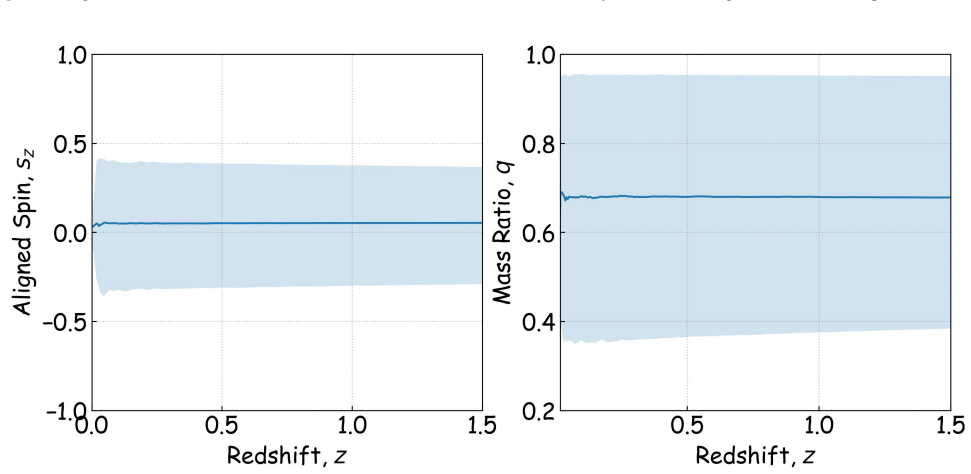
Summary. The paper applies the Vamana mixture-model framework—ten multivariate Gaussian components for primary/secondary masses with an m1–m2 covariance term, Gaussian aligned-spin components, and a redshift power law—to 153 LVK binary black hole observations from GWTC-4 and some later events. It reports a low-mass overdensity and three peaks in the chirp-mass distribution near 8, 14, and 27 Msun, spaced by approximately a factor 1.9. The paper claims over 99% confidence in the second and third peaks based on the author's earlier method papers, and interprets the peaks plus the component masses of high-spin binaries as evidence for hierarchical mergers. It also reports mass-ratio, aligned-spin, and redshift-evolution distributions.
Significance. If the three-peak chirp-mass structure and the factor-of-two spacing are robust, this is a significant result for BBH formation astrophysics and would add to the case that hierarchical mergers shape a large part of the observed mass distribution. The paper uses a larger catalog than previous analyses, explicitly models an m1–m2 correlation, and makes data products and plotting scripts publicly available. The independent mass selection of the high-spin subset provides a useful internal cross-check. However, the central statistical significance claim rests on a method described only by citation, the flexible mixture model is not tested against simpler alternatives, and the high-spin subpopulation analysis is not selection-corrected. The result is therefore promising but not yet established at the level claimed.
major comments (4)
- [§3.1, Fig. 1] The statement 'over 99% confidence in the two peaks around 14 Msun and 26 Msun' is the paper's principal quantitative claim, but it is supported only by 'methodologies from Tiwari (2024) and Tiwari (2025)' with no description of the peak-confidence procedure in this manuscript. In particular, there is no null-model comparison (e.g., a smooth power-law or reduced-component mixture), no posterior-predictive check, and no demonstration that the 10-component covariance mixture cannot produce spurious diagonal ridges. Because the 14-Msun chirp peak is claimed to arise from an m1–m2 correlation (§3.2.1) rather than from marginal peaks, a robustness test against a diagonal-covariance model or a lower-component model is essential. As written, the >99% confidence is not independently assessable.
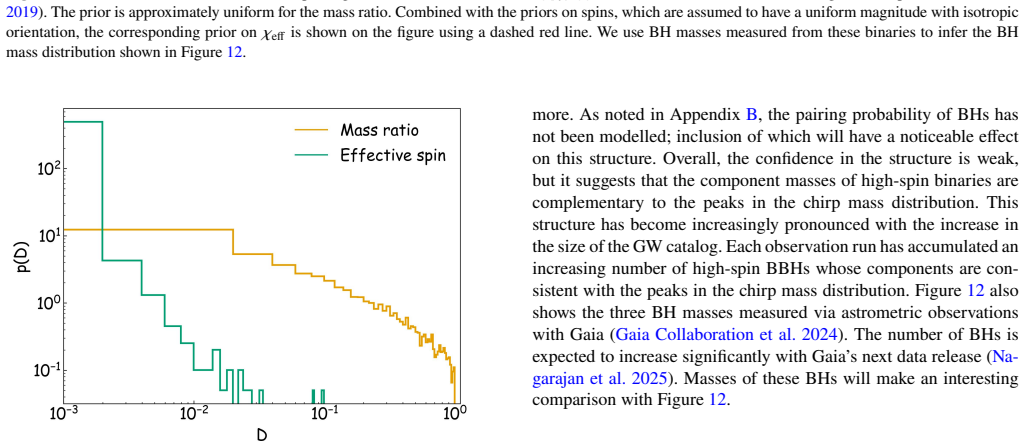
- [§4.1, Appendix B] The inference of the BH mass distribution from high-spin binaries explicitly states 'The inferred distribution has not been corrected for the selection effect' and fixes the mass-ratio distribution and redshift evolution to the standard PE prior. This makes the comparison with the chirp-mass peaks in Fig. 12 a raw data-overdensity comparison, not a population-level measurement. Since the |χ_eff|>0.2 selection depends on spin and mass (selection is effective-spin dependent and mass-dependent through SNR), the absence of a selection correction can shift peak locations and heights. The claim in §5 that this offers 'direct evidence in support of hierarchical scenarios' therefore goes beyond what the current analysis can support. I request a selection-corrected version (using the LVK sensitivity estimate) or, at minimum, a quantitative test of how much selection changes the peak locations.
- [§3.1 / Fig. 1] The figure caption says 'four distinct peaks, with the first three exceeding a 99% confidence level,' while the abstract and conclusion describe 'three peaks.' This discrepancy must be resolved; either the fourth peak is being ignored or the claim is misstated. Additionally, the only prior-sensitivity statement concerns the first-peak rate fraction (66% vs. 78% in the footnote). The stability of the second and third peak significances under the alternative mass-location prior p(μ) ∝ 1/μ is not reported. Because the mixture model has 10 components with free weights and covariance, prior sensitivity is a central concern for the multi-peak claim, not a footnote.
- [§4] The 'factor of 1.9' ladder is asserted from the fitted peak positions, but no statistical test is given for why the spacing is better than arbitrary or why a hierarchical model is preferred over a smooth multi-component mass distribution. The peaks are outputs of the fit; the hierarchical interpretation is applied post hoc. A concrete assessment—e.g., comparing the evidence for a model with peaks constrained at 1.9 spacing versus free peak locations, or quantifying how well the 1.9 ladder matches the posterior peak distribution—is needed before the statement 'offer direct evidence' can be accepted.
minor comments (4)
- [§2 vs. Appendix A] The selection criteria differ between §2 ('mean secondary mass greater than 3 Msun') and Appendix A ('only observations with a mean chirp mass greater than 5 Msun'). Please state whether both criteria were applied and reconcile the text.
- [§3.1] The text says the first peak 'contributes approximately 66%' to the merger rate, but the footnote gives 78% under an alternative prior. Please quote the full range in the main text or otherwise prominently caveat the value.
- [§4.1] The claim that GW241110_124123 'fills the 10–12 Msun chirp mass gap' should be reconciled with the gap quoted in §3.1 (8.9–11.7 Msun). Also clarify whether this event (and GW241011_233834) are used in the Fig. 1 inference despite not being part of GWTC-4.0.
- [Appendix B, Eq. B1] The summands in terms (i)–(iv) have ambiguous indices: the subscript i is used for both the mixture component and an observation index. Use distinct labels for component index, observation index, and posterior-sample index, and define p_PE consistently.
Circularity Check
Peak-significance claim rests on undeveloped self-citation, and the hierarchical-merger 'predictions' at 16.2 and 30.7 M_sun are rescaled versions of the same fitted chirp-mass peaks, making the support for the central claim partially circular.
specific steps
-
self citation load bearing
[Sec. 3.1 (Marginalised Distributions in One Dimension)]
"Using methodologies from Tiwari (2024) and Tiwari (2025), we estimate over 99% confidence in the two peaks around 14 M_sun and 26 M_sun (see Roy et al. (2025) for a detailed study of this peak)."
The paper's central quantitative claim—over 99% confidence in the 14 and 26 M_sun chirp-mass peaks—is not derived or described in this paper; it is imported from two prior papers by the same author. The current Vamana model is updated (primary/secondary masses instead of chirp mass and mass ratio), but the confidence methodology is not reproduced, so the significance claim reduces to the author's own earlier assertion. This is load-bearing because the factor-of-two peak ladder and the hierarchical interpretation depend on these peaks being significant.
-
fitted input called prediction
[Sec. 4.1 (High-Spin Binary Black Holes)]
"The first peak in chirp mass is located around 7.5 M_sun. The component mass for a comparable mass binary corresponding to this value is 7.5×2^0.2 = 8.5 M_sun. Consequently, the BHs involved in intra- and inter-generation mergers will have masses distributed around 8.5 M_sun×1.9=16.2 M_sun and 8.5 M_sun×1.9^2=30.7 M_sun."
The 'predicted' hierarchical-merger masses (16.2 and 30.7 M_sun) are obtained by scaling the observed first chirp-mass peak by the same factor ~1.9 that already separates the fitted chirp-mass peaks (~7.5, ~14, ~27 M_sun). In equal-mass conversion, 16.2 M_sun corresponds exactly to the 14 M_sun chirp peak and 30.7 M_sun to the 27 M_sun peak. The high-spin binaries then compared against these values are drawn from the same 153-event catalog used to infer the chirp-mass peaks, so the subsequent 'alignment' is a within-sample consistency check, not an independent prediction; the expected positions were read off the same data.
full rationale
The underlying population inference with Vamana is a self-contained Bayesian analysis of LVK data, and the peak locations are posterior outputs rather than inputs. However, the paper's headline support for hierarchical mergers is weakened by two circular elements. First, the over-99% confidence in the 14 and 26 M_sun chirp-mass peaks is justified only by citing the author's own earlier works (Tiwari 2024, 2025), with no description or independent reproduction of the method; this is a load-bearing self-citation. Second, the expected high-spin component masses (16.2 and 30.7 M_sun) are not independent hierarchical-merger predictions: they are the observed first chirp peak rescaled by the same 1.9 factor that already separates the fitted chirp peaks, and the high-spin events are part of the same sample from which those peaks were inferred. The paper is candid about limitations—the high-spin selection is 'not the most robust criterion,' the high-spin mass distribution is not selection-corrected, and 'the confidence in the structure is weak'—and this honesty reduces the severity. Because the central claim still has independent content in the data-driven inference and the spin-selected subset is not completely redundant, this is partial circularity rather than a full reduction.
Axiom & Free-Parameter Ledger
free parameters (6)
- Gaussian component means for m1 and m2 (10 components) =
posterior; peaks near 8.5/16.2/30.7 Msun in high-spin subset; full-population chirp peaks near 8/14/27 Msun
- Gaussian component widths sigma_m1, sigma_m2 =
posterior; prior range 0.05*mu/sqrt(N) to 0.185*mu/sqrt(N)
- m1-m2 covariance C per component =
posterior; uniform +/-0.5*sigma1*sigma2
- Spin hyperparameters mu_chi, sigma_chi =
low-spin |chi|<0.4 and high-spin 0.4<|chi|<0.9 components
- Redshift power-law index kappa_p and local rate R0 =
kappa=0.4-4.7 at 90% credibility; R0=14.0+4.8/-5.9 Gpc^-3 yr^-1
- Mixture weights w_i =
Dirichlet(1/N) prior
axioms (5)
- domain assumption Hierarchical Bayesian likelihood with LVK sensitivity estimates correctly maps observed events to the underlying population.
- domain assumption The 153 selected events (FAR<=1/yr, mean m2>3 Msun, excluding GW190814 and NS-BH candidates) are a representative sample after selection correction.
- domain assumption The BBH mass/spin distribution is well approximated by 10 multivariate Gaussians plus a power-law redshift evolution.
- ad hoc to paper Peak spacing near 1.9 indicates hierarchical mergers, assuming ~5% gravitational-wave mass loss and remnant retention/re-merger.
- ad hoc to paper For the high-spin subpopulation, fixing mass-ratio and redshift priors and ignoring selection effects does not bias the component-mass peak comparison.
read the original abstract
The LIGO-Virgo-KAGRA collaborations have reported gravitational wave signals from more than 150 binary black holes in the fourth catalog (GWTC-4). Here, we investigate the population properties of these binary black holes using the mixture-model framework Vamana. We present one-dimensional distributions of masses and spins, explore their correlations, and examine their evolution with redshift. These features may reflect astrophysical processes associated with binary black hole formation channels, although most remain poorly constrained. A notable feature is a peak near $10M_\odot$ in the primary mass and $8M_\odot$ in the chirp mass. Additionally, the primary and secondary masses correlate uniquely, producing pronounced peaks in the chirp mass around $14M_\odot$ and $27M_\odot$. The three peaks are roughly separated by a factor of two. A simple explanation for such well-placed peaks is a hierarchical merger scenario, in which the first peak arises from mergers of black holes of stellar origin, and higher-mass peaks arise from repeated mergers of black holes from lower-mass peaks. Although most binaries do not exhibit the high spins and characteristic mass ratios expected from hierarchical mergers, those that do are associated with the peaks observed in the chirp mass distribution.
Figures




Forward citations
Cited by 13 Pith papers
-
Population Properties of Binary Black Holes with Eccentricity
First joint population inference on binary black hole eccentricity from GWTC-4 bounds the eccentric branching ratio below 5% at 90% confidence, with results consistent with quasi-circular models but highly model-dependent.
-
Secondary-Mass Features improve Spectral-Siren $H_0$ Constraints
A new model emphasizing secondary mass features and pairing transitions improves spectral siren H0 constraints by ~30% using 142 GW events from GWTC-4.0.
-
Mind the peak: improving cosmological constraints from GWTC-4.0 spectral sirens using semiparametric mass models
A data-driven Bspline model for the binary black hole mass distribution from 137 GW events resolves three peaks and improves H0 precision by 12-21% over parametric alternatives.
-
Assessing the waveform systematics from parameter estimation to population inference with eccentricity
Eccentric waveform-model differences, small per event, accumulate across the GWTC-4 catalog and alter inferred redshift evolution and effective-spin population distributions.
-
Uncovering Hierarchical Sub-Population of Binary Black Holes
A flexible six-component fit to 259 LIGO/Virgo/KAGRA black-hole mergers finds a roughly geometric sequence of mass peaks but no aligned-spin signal except in the lowest-mass component.
-
Second-Generation Mass Peak in the Gravitational-Wave Population as a Probe of Globular Clusters
Dynamical formation in globular clusters produces a robust second black-hole mass peak at ~70 solar masses from second-generation mergers when the first-generation spectrum is truncated by pair-instability supernovae.
-
Pushing spectral siren cosmology into the third-generation era: a blinded mock data challenge
Three public spectral-siren pipelines agree on blinded Einstein Telescope mock catalogs and scale to ~10^5 events, forecasting ~2.4% precision on H(z) at z≈1.5.
-
Signatures of a subpopulation of hierarchical mergers in the GWTC-4 gravitational-wave dataset
GWTC-4 data show a transition to nearly all hierarchical mergers above 46 solar masses, with the hierarchical rate peaking at 15.7 solar masses, indicating mass-dependent substructure in black hole spins.
-
Signatures of a subpopulation of hierarchical mergers in the GWTC-4 gravitational-wave dataset
Using a joint effective-spin and precession-spin model on 155 gravitational-wave events, the authors infer that the hierarchical (second-generation) merger fraction rises sharply above ~46 M_sun and peaks again near 1...
-
The Chirp-Mass Ladder: A New Rung Emerges
GWTC-5 chirp-mass peaks form a ~1.9-spaced ladder with a new ~19 M⊙ rung matching predicted 2G+3G mergers, unifying prior 1G+2G spin-transition groups under one hierarchical scenario.
-
Population-level correlations in Bayesian statistics: an illustrative model for gravitational-wave astronomy
An idealized Gaussian model demonstrates that single-event correlations inflate uncertainties in population correlations and that catalog-wide correlated biases can be misread as population correlations.
-
The Chirp-Mass Ladder: A New Rung Emerges
The chirp-mass distribution of GW-detected binary black holes shows a ladder of peaks doubling in mass, with a new intermediate peak at 19 solar masses confirming a prior prediction from the hierarchical merger model.
-
Emergent structure in the binary black hole mass distribution and implications for population-based cosmology
B-spline agnostic reconstruction of binary black hole masses from GWTC-4.0 reveals multiple features and a logarithmic hierarchy that impacts Hubble constant measurements, with a low-mass subpopulation isolation metho...
Reference graph
Works this paper leans on
-
[1]
Aasi J., Abbott B. P., Abbott R., Abbott T., et al., 2015, @doi [Classical and Quantum Gravity] 10.1088/0264-9381/32/7/074001 , https://ui.adsabs.harvard.edu/\\#abs/2015CQGra..32g4001L 32, 074001
-
[2]
Abbott B. P., et al., 2016, @doi [ ] 10.1103/PhysRevLett.116.241103 , https://ui.adsabs.harvard.edu/abs/2016PhRvL.116x1103A 116, 241103
-
[3]
Abbott R., Abbott T. D., Abraham S., et al., 2019, @doi [Physical Review X] 10.1103/PhysRevX.9.031040 , https://ui.adsabs.harvard.edu/abs/2019PhRvX...9c1040A 9, 031040
-
[4]
Abbott R., et al., 2020, @doi [ ] 10.1103/PhysRevD.102.043015 , https://ui.adsabs.harvard.edu/abs/2020PhRvD.102d3015A 102, 043015
-
[5]
Abbott R., Abbott T. D., Abraham S., et al., 2021, @doi [Physical Review X] 10.1103/PhysRevX.11.021053 , https://ui.adsabs.harvard.edu/abs/2021PhRvX..11b1053A 11, 021053
-
[6]
Abbott R., Abbott T. D., Acernese F., et al., 2023a, @doi [Physical Review X] 10.1103/PhysRevX.13.011048 , https://ui.adsabs.harvard.edu/abs/2023PhRvX..13a1048A 13, 011048
-
[7]
Abbott R., Abbott T. D., Acernese F., et al., 2023b, @doi [Physical Review X] 10.1103/PhysRevX.13.041039 , https://ui.adsabs.harvard.edu/abs/2023PhRvX..13d1039A 13, 041039
-
[8]
Abbott R., Abbott T. D., Acernese F., et al., 2024, @doi [ ] 10.1103/PhysRevD.109.022001 , https://ui.adsabs.harvard.edu/abs/2024PhRvD.109b2001A 109, 022001
-
[9]
Acernese F., et al., 2015, @doi [Classical and Quantum Gravity] 10.1088/0264-9381/32/2/024001 , https://ui.adsabs.harvard.edu/abs/2015CQGra..32b4001A 32, 024001
-
[10]
Adamcewicz C., Lasky P. D., Thrane E., 2023, @doi [ ] 10.3847/1538-4357/acf763 , https://ui.adsabs.harvard.edu/abs/2023ApJ...958...13A 958, 13
-
[11]
Adamcewicz C., Galaudage S., Lasky P. D., Thrane E., 2024, @doi [ ] 10.3847/2041-8213/ad2df2 , https://ui.adsabs.harvard.edu/abs/2024ApJ...964L...6A 964, L6
-
[12]
Ade P. A. R., Aghanim N., Arnaud M., et al., 2016, @doi [ ] 10.1051/0004-6361/201525830 , https://ui.adsabs.harvard.edu/abs/2016A&A...594A..13P 594, A13
-
[13]
Afroz S., Mukherjee S., 2025a, @doi [arXiv e-prints] 10.48550/arXiv.2505.22739 , https://ui.adsabs.harvard.edu/abs/2025arXiv250522739A p. arXiv:2505.22739
-
[14]
Afroz S., Mukherjee S., 2025b, @doi [arXiv e-prints] 10.48550/arXiv.2509.09123 , https://ui.adsabs.harvard.edu/abs/2025arXiv250909123A p. arXiv:2509.09123
-
[15]
Ajith P., et al., 2011, @doi [ ] 10.1103/PhysRevLett.106.241101 , https://ui.adsabs.harvard.edu/abs/2011PhRvL.106x1101A 106, 241101
-
[16]
Akutsu T., et al., 2021, @doi [Progress of Theoretical and Experimental Physics] 10.1093/ptep/ptaa125 , https://ui.adsabs.harvard.edu/abs/2021PTEP.2021eA101A 2021, 05A101
-
[17]
Antonini F., Gieles M., Gualandris A., 2019, @doi [ ] 10.1093/mnras/stz1149 , https://ui.adsabs.harvard.edu/abs/2019MNRAS.486.5008A 486, 5008
-
[18]
Antonini F., Romero-Shaw I. M., Callister T., 2024, @doi [arXiv e-prints] 10.48550/arXiv.2406.19044 , https://ui.adsabs.harvard.edu/abs/2024arXiv240619044A p. arXiv:2406.19044
-
[19]
Antonini F., Romero-Shaw I., Callister T., Dosopoulou F., Chattopadhyay D., Gieles M., Mapelli M., 2025a, @doi [arXiv e-prints] 10.48550/arXiv.2509.04637 , https://ui.adsabs.harvard.edu/abs/2025arXiv250904637A p. arXiv:2509.04637
-
[20]
Antonini F., Callister T., Dosopoulou F., Romero-Shaw I. M., Chattopadhyay D., 2025b, @doi [ ] 10.1103/nxnr-pdyx , https://ui.adsabs.harvard.edu/abs/2025PhRvD.112f3040A 112, 063040
-
[21]
Ashton G., et al., 2019, @doi [The Astrophysical Journal Supplement Series] 10.3847/1538-4365/ab06fc , https://ui.adsabs.harvard.edu/abs/2019ApJS..241...27A 241, 27
-
[22]
Astropy Collaboration Astropy Project Contributors 2022, @doi [ ] 10.3847/1538-4357/ac7c74 , https://ui.adsabs.harvard.edu/abs/2022ApJ...935..167A 935, 167
-
[23]
Baibhav V., Kalogera V., 2024, @doi [arXiv e-prints] 10.48550/arXiv.2412.03461 , https://ui.adsabs.harvard.edu/abs/2024arXiv241203461B p. arXiv:2412.03461
-
[24]
Baibhav V., Doctor Z., Kalogera V., 2023, @doi [ ] 10.3847/1538-4357/acbf4c , https://ui.adsabs.harvard.edu/abs/2023ApJ...946...50B 946, 50
-
[25]
Baird E., Fairhurst S., Hannam M., 2013, Phys. Rev. D, 87, 024035
2013
-
[26]
Banagiri S., Callister T. A., Doctor Z., Kalogera V., 2025, @doi [arXiv e-prints] 10.48550/arXiv.2501.06712 , https://ui.adsabs.harvard.edu/abs/2025arXiv250106712B p. arXiv:2501.06712
-
[27]
Banerjee S., 2021, @doi [ ] 10.1093/mnras/staa2392 , https://ui.adsabs.harvard.edu/abs/2021MNRAS.500.3002B 500, 3002
-
[28]
Barausse E., Morozova V., Rezzolla L., 2012, @doi [ ] 10.1088/0004-637X/758/1/63 , https://ui.adsabs.harvard.edu/abs/2012ApJ...758...63B 758, 63
-
[29]
Bavera S. S., et al., 2020, @doi [ ] 10.1051/0004-6361/201936204 , https://ui.adsabs.harvard.edu/abs/2020A&A...635A..97B 635, A97
-
[30]
Belczynski K., et al., 2020, @doi [ ] 10.1051/0004-6361/201936528 , https://ui.adsabs.harvard.edu/abs/2020A&A...636A.104B 636, A104
-
[31]
Biscoveanu S., 2025, @doi [arXiv e-prints] 10.48550/arXiv.2502.04278 , https://ui.adsabs.harvard.edu/abs/2025arXiv250204278B p. arXiv:2502.04278
-
[32]
Biscoveanu S., Callister T. A., Haster C.-J., Ng K. K. Y., Vitale S., Farr W. M., 2022, @doi [ ] 10.3847/2041-8213/ac71a8 , https://ui.adsabs.harvard.edu/abs/2022ApJ...932L..19B 932, L19
-
[33]
Callister T. A., Farr W. M., 2024, @doi [Physical Review X] 10.1103/PhysRevX.14.021005 , https://ui.adsabs.harvard.edu/abs/2024PhRvX..14b1005C 14, 021005
-
[34]
Callister T. A., Haster C.-J., Ng K. K. Y., Vitale S., Farr W. M., 2021, @doi [ ] 10.3847/2041-8213/ac2ccc , https://ui.adsabs.harvard.edu/abs/2021ApJ...922L...5C 922, L5
-
[35]
Chattopadhyay D., Stegmann J., Antonini F., Barber J., Romero-Shaw I. M., 2023, @doi [ ] 10.1093/mnras/stad3048 , https://ui.adsabs.harvard.edu/abs/2023MNRAS.526.4908C 526, 4908
-
[36]
Cutler C., Flanagan E. E., 1994, @doi [Phys. Rev. D] 10.1103/PhysRevD.49.2658 , 49, 2658
-
[37]
Damour T., 2001, @doi [ ] 10.1103/PhysRevD.64.124013 , https://ui.adsabs.harvard.edu/abs/2001PhRvD..64l4013D 64, 124013
-
[38]
Doctor Z., Wysocki D., O'Shaughnessy R., Holz D. E., Farr B., 2020, @doi [ ] 10.3847/1538-4357/ab7fac , https://ui.adsabs.harvard.edu/abs/2020ApJ...893...35D 893, 35
-
[39]
Edelman B., Farr B., Doctor Z., 2023, @doi [ ] 10.3847/1538-4357/acb5ed , https://ui.adsabs.harvard.edu/abs/2023ApJ...946...16E 946, 16
-
[40]
El-Badry K., et al., 2023a, @doi [ ] 10.1093/mnras/stac3140 , https://ui.adsabs.harvard.edu/abs/2023MNRAS.518.1057E 518, 1057
-
[41]
El-Badry K., et al., 2023b, @doi [ ] 10.1093/mnras/stad799 , https://ui.adsabs.harvard.edu/abs/2023MNRAS.521.4323E 521, 4323
-
[42]
Farah A., Fishbach M., Essick R., Holz D. E., Galaudage S., 2022, @doi [ ] 10.3847/1538-4357/ac5f03 , https://ui.adsabs.harvard.edu/abs/2022ApJ...931..108F 931, 108
-
[43]
M., Edelman B., Zevin M., Fishbach M., Mar \' a Ezquiaga J., Farr B., Holz D
Farah A. M., Edelman B., Zevin M., Fishbach M., Mar \' a Ezquiaga J., Farr B., Holz D. E., 2023, @doi [ ] 10.3847/1538-4357/aced02 , https://ui.adsabs.harvard.edu/abs/2023ApJ...955..107F 955, 107
-
[44]
Farr W. M., Stevenson S., Miller M. C., Mand el I., Farr B., Vecchio A., 2017, @doi [ ] 10.1038/nature23453 , https://ui.adsabs.harvard.edu/abs/2017Natur.548..426F 548, 426
-
[45]
Fishbach M., Holz D. E., Farr W. M., 2018, @doi [Astrophys. J. Lett.] 10.3847/2041-8213/aad800 , https://ui.adsabs.harvard.edu/abs/2018ApJ...863L..41F 863, L41
-
[46]
Fishbach M., Essick R., Holz D. E., 2020, @doi [ ] 10.3847/2041-8213/aba7b6 , https://ui.adsabs.harvard.edu/abs/2020ApJ...899L...8F 899, L8
-
[47]
Fowler W. A., Hoyle F., 1964, @doi [ ] 10.1086/190103 , https://ui.adsabs.harvard.edu/abs/1964ApJS....9..201F 9, 201
doi:10.1086/190103 1964
-
[48]
Fragione G., Rasio F. A., 2023, @doi [ ] 10.3847/1538-4357/acd9c9 , https://ui.adsabs.harvard.edu/abs/2023ApJ...951..129F 951, 129
-
[49]
Gaia Collaboration et al., 2024, @doi [ ] 10.1051/0004-6361/202449763 , https://ui.adsabs.harvard.edu/abs/2024A&A...686L...2G 686, L2
-
[50]
Galaudage S., Talbot C., Nagar T., Jain D., Thrane E., Mandel I., 2021, @doi [ ] 10.3847/2041-8213/ac2f3c , https://ui.adsabs.harvard.edu/abs/2021ApJ...921L..15G 921, L15
-
[51]
Gennari V., Mastrogiovanni S., Tamanini N., Marsat S., Pierra G., 2025, @doi [ ] 10.1103/ftw9-7xd5 , https://ui.adsabs.harvard.edu/abs/2025PhRvD.111l3046G 111, 123046
-
[52]
Gerosa D., Fishbach M., 2021, @doi [Nature Astronomy] 10.1038/s41550-021-01398-w , https://ui.adsabs.harvard.edu/abs/2021NatAs...5..749G 5, 749
-
[53]
Ghodla S., Eldridge J. J., 2024, @doi [ ] 10.1093/mnras/stae2198 , https://ui.adsabs.harvard.edu/abs/2024MNRAS.534.1868G 534, 1868
-
[54]
Godfrey J., Edelman B., Farr B., 2023, arXiv e-prints, https://ui.adsabs.harvard.edu/abs/2023arXiv230401288G p. arXiv:2304.01288
Pith/arXiv arXiv 2023
-
[55]
Golomb J., Talbot C., 2023, @doi [ ] 10.1103/PhysRevD.108.103009 , https://ui.adsabs.harvard.edu/abs/2023PhRvD.108j3009G 108, 103009
-
[56]
Golomb J., Isi M., Farr W., 2023, @doi [arXiv e-prints] 10.48550/arXiv.2312.03973 , https://ui.adsabs.harvard.edu/abs/2023arXiv231203973G p. arXiv:2312.03973
-
[57]
Guttman N., Payne E., Lasky P. D., Thrane E., 2025, @doi [arXiv e-prints] 10.48550/arXiv.2509.09876 , https://ui.adsabs.harvard.edu/abs/2025arXiv250909876G p. arXiv:2509.09876
-
[58]
R., et al., 2020, @doi [Nature] 10.1038/s41586-020-2649-2 , 585, 357
Harris C. R., et al., 2020, @doi [Nature] 10.1038/s41586-020-2649-2 , 585, 357
-
[59]
Heinzel J., Mould M., \'A lvarez-L \'o pez S., Vitale S., 2024a, @doi [arXiv e-prints] 10.48550/arXiv.2406.16813 , https://ui.adsabs.harvard.edu/abs/2024arXiv240616813H p. arXiv:2406.16813
-
[60]
Heinzel J., Mould M., Vitale S., 2024b, @doi [arXiv e-prints] 10.48550/arXiv.2406.16844 , https://ui.adsabs.harvard.edu/abs/2024arXiv240616844H p. arXiv:2406.16844
-
[61]
Heinzel J., Vitale S., Biscoveanu S., 2024c, @doi [ ] 10.1103/PhysRevD.109.103006 , https://ui.adsabs.harvard.edu/abs/2024PhRvD.109j3006H 109, 103006
-
[62]
Ho M.-F., Perkins S. E., Bird S., Dawson W. A., Golovich N., Lu J. R., McGill P., 2024, @doi [ ] 10.1103/PhysRevD.110.063031 , https://ui.adsabs.harvard.edu/abs/2024PhRvD.110f3031H 110, 063031
-
[63]
Hoy C., Fairhurst S., Mandel I., 2025, @doi [ ] 10.1103/PhysRevD.111.023037 , https://ui.adsabs.harvard.edu/abs/2025PhRvD.111b3037H 111, 023037
-
[64]
D., 2007, @doi [Computing in Science & Engineering] 10.1109/MCSE.2007.55 , 9, 90
Hunter J. D., 2007, @doi [Computing in Science & Engineering] 10.1109/MCSE.2007.55 , 9, 90
-
[65]
Hussain A., Isi M., Zimmerman A., 2024, @doi [arXiv e-prints] 10.48550/arXiv.2411.02252 , https://ui.adsabs.harvard.edu/abs/2024arXiv241102252H p. arXiv:2411.02252
-
[66]
Kinugawa T., Nakamura T., Nakano H., 2024, @doi [ ] 10.1093/mnras/stae1460 , https://ui.adsabs.harvard.edu/abs/2024MNRAS.531.4725K 531, 4725
-
[67]
Koloniari A. E., Koursoumpa E. C., Nousi P., Lampropoulos P., Passalis N., Tefas A., Stergioulas N., 2025, @doi [Mach. Learn. Sci. Tech.] 10.1088/2632-2153/adb5ed , 6, 015054
-
[68]
Kumar P., Dent T., 2024, @doi [Phys. Rev. D] 10.1103/PhysRevD.110.043036 , 110, 043036
-
[69]
LIGO Scientific Collaboration Virgo Collaboration 2019, @doi [Astrophys. J. Lett.] 10.3847/2041-8213/ab3800 , https://ui.adsabs.harvard.edu/abs/2019ApJ...882L..24A 882, L24
-
[70]
LIGO Scientific Collaboration VIRGO Collaboration Kagra Collaboration 2023, @doi [ ] 10.3847/1538-4365/acdc9f , https://ui.adsabs.harvard.edu/abs/2023ApJS..267...29A 267, 29
-
[71]
LIGO Scientific Collaboration VIRGO Collaboration Kagra Collaboration 2025, @doi [ ] 10.3847/2041-8213/ae0d54 , 993, L21
-
[72]
Li Y.-J., Wang Y.-Z., Han M.-Z., Tang S.-P., Yuan Q., Fan Y.-Z., Wei D.-M., 2021, @doi [ ] 10.3847/1538-4357/ac0971 , https://ui.adsabs.harvard.edu/abs/2021ApJ...917...33L 917, 33
-
[73]
Li Y.-J., Wang Y.-Z., Tang S.-P., Fan Y.-Z., 2024, @doi [ ] 10.1103/PhysRevLett.133.051401 , https://ui.adsabs.harvard.edu/abs/2024PhRvL.133e1401L 133, 051401
-
[74]
J., 2004, AIP Conf
Loredo T. J., 2004, AIP Conf. Proc., 735
2004
-
[75]
Lousto C. O., Campanelli M., Zlochower Y., Nakano H., 2010, @doi [Classical and Quantum Gravity] 10.1088/0264-9381/27/11/114006 , https://ui.adsabs.harvard.edu/abs/2010CQGra..27k4006L 27, 114006
-
[76]
Mahapatra P., Chattopadhyay D., Gupta A., Favata M., Sathyaprakash B. S., Arun K. G., 2025, @doi [ ] 10.1103/PhysRevD.111.023013 , https://ui.adsabs.harvard.edu/abs/2025PhRvD.111b3013M 111, 023013
-
[77]
Mandel I., Broekgaarden F. S., 2022, @doi [Living Reviews in Relativity] 10.1007/s41114-021-00034-3 , https://ui.adsabs.harvard.edu/abs/2022LRR....25....1M 25, 1
-
[78]
Mandel I., Farr W. M., Gair J. R., 2019, @doi [Mon. Not. R. Astron. Soc.] 10.1093/mnras/stz896 , https://ui.adsabs.harvard.edu/abs/2019MNRAS.486.1086M 486, 1086
-
[79]
Mapelli M., et al., 2021, @doi [ ] 10.1093/mnras/stab1334 , https://ui.adsabs.harvard.edu/abs/2021MNRAS.505..339M 505, 339
-
[80]
Mapelli M., Bouffanais Y., Santoliquido F., Arca Sedda M., Artale M. C., 2022, @doi [ ] 10.1093/mnras/stac422 , https://ui.adsabs.harvard.edu/abs/2022MNRAS.511.5797M 511, 5797
discussion (0)
Sign in with ORCID, Apple, or X to comment. Anyone can read and Pith papers without signing in.