Dissecting the superradiant phase transition in the anisotropic Rabi model: Pattern competition and cavity-QED simulation
Pith reviewed 2026-05-18 01:47 UTC · model grok-4.3
The pith
The superradiant phase transition in the anisotropic Rabi model arises from competition between three patterns found by expanding the Hamiltonian.
A machine-rendered reading of the paper's core claim, the machinery that carries it, and where it could break.
Core claim
By expanding the anisotropic Rabi model Hamiltonian in operator space, three patterns are obtained. The superradiant phase transition arises from the competition between these patterns. In the equivalent parametrically-driven Jaynes-Cummings model, the excitation energy of the normal and superradiant phases vanishes at the critical point, and the photon number becomes infinite beyond the critical point.
What carries the argument
Three patterns obtained from the operator-space expansion of the anisotropic Rabi Hamiltonian, whose competition sets the location of the superradiant phase transition, together with the parametrically-driven Jaynes-Cummings model that simulates the dynamics in a squeezed-light frame.
If this is right
- The excitation energy of both normal and superradiant phases vanishes at the critical point.
- The photon number diverges beyond the critical point.
- The system undergoes a superradiant phase transition driven by pattern competition.
- The driven Jaynes-Cummings model serves as a practical cavity-QED simulator for the anisotropic Rabi dynamics.
Where Pith is reading between the lines
- Cavity-QED experiments with parametric driving could directly test the pattern-competition mechanism without requiring extreme ultrastrong couplings.
- The same expansion technique might reveal analogous pattern competitions in related spin-boson models with anisotropic interactions.
- Divergence of the photon number could be probed by monitoring cavity output intensity near the critical point in a driven setup.
Load-bearing premise
The parametrically-driven Jaynes-Cummings model can reproduce the dynamics of an ultrastrong-coupling anisotropic Rabi model in a squeezed-light frame.
What would settle it
If measurements in the driven Jaynes-Cummings system show that the excitation energy remains finite at the predicted critical coupling or that the photon number stays finite beyond it, the claimed superradiant phase transition would not hold.
Figures



read the original abstract
In this manuscript, we analyze the mechanism of the superradiant phase transition in the anisotropic Rabi model under the classical oscillator limit using the pattern picture. By expanding the anisotropic Rabi model Hamiltonian in operator space, we obtained three patterns, and we find that the phase transition arises from the competition between patterns. The difficulty in achieving the classical oscillator limit motivates our investigation into the quantum phase transition within a parametrically-driven Jaynes-Cummings model. This parametrically-driven Jaynes-Cummings model can reproduce the dynamics of an ultrastrong-coupling anisotropic Rabi model in a squeezed-light frame. According to the eigenenergies and eigenstates of the normal and superradiant phases of this equivalent anisotropic Rabi model, we find that the excitation energy of the normal phase and the superradiant phase vanishes at the critical point. The photon number becomes infinite beyond the critical point. These results indicate that the system undergoes a superradiant phase transition at the critical point.
Editorial analysis
A structured set of objections, weighed in public.
Referee Report
Summary. The manuscript analyzes the superradiant phase transition in the anisotropic Rabi model in the classical oscillator limit via a pattern picture obtained by expanding the Hamiltonian in operator space, yielding three patterns whose competition is claimed to drive the transition. Motivated by difficulties in the classical limit, the authors introduce a parametrically-driven Jaynes-Cummings model asserted to reproduce the dynamics of the ultrastrong-coupling anisotropic Rabi model in a squeezed-light frame. Eigenenergy and eigenstate analysis of the normal and superradiant phases in this equivalent model shows vanishing excitation energies at criticality and diverging photon number beyond it, indicating a superradiant phase transition.
Significance. If the asserted equivalence is shown to be exact for ground-state properties and to preserve both the critical point and the three-pattern decomposition, the work would supply a concrete mechanistic account of the superradiant transition through pattern competition together with a cavity-QED route to simulate the anisotropic Rabi model. The pattern-based decomposition itself could serve as a useful diagnostic tool for related light-matter phase transitions.
major comments (3)
- [Pattern expansion in the classical-oscillator-limit section] The operator-space expansion that produces the three patterns and the subsequent demonstration that their competition causes the excitation energy to vanish are load-bearing for the central mechanistic claim. The manuscript states that three patterns are obtained and that the transition arises from competition, yet supplies neither the explicit operator forms of the patterns nor a quantitative accounting of how their interplay produces the vanishing energy at criticality.
- [Equivalence and motivation section] The claim that the parametrically-driven Jaynes-Cummings model reproduces the dynamics of the ultrastrong-coupling anisotropic Rabi model in the squeezed-light frame is asserted without an explicit unitary transformation, effective Hamiltonian, or error bound. Because the reported vanishing of excitation energies and divergence of photon number rest on this mapping, it must be shown that the equivalence preserves the location of the critical point and the identity of the competing patterns for ground-state observables, not merely for time evolution.
- [Eigenenergy and eigenstate analysis of normal and superradiant phases] The statement that the excitation energy of both the normal and superradiant phases vanishes at the critical point, together with the divergence of the photon number beyond it, is presented as confirmation of the superradiant transition. To connect these results back to the pattern-competition mechanism, the manuscript should supply the explicit critical-point parameter values and indicate how the three patterns appear in the eigenstates on either side of criticality.
minor comments (2)
- [Abstract] The abstract refers to 'three patterns' without a concise characterization; adding a single sentence that identifies them would improve readability.
- [Notation throughout] Notation for the anisotropy parameter and the parametric drive strength should be checked for consistency between the Rabi-model and driven-Jaynes-Cummings sections.
Simulated Author's Rebuttal
We thank the referee for the careful reading and constructive feedback on our manuscript. We value the identification of areas where additional detail will strengthen the presentation of the pattern-competition mechanism and the model equivalence. We address each major comment below and will incorporate the requested clarifications and derivations in the revised version.
read point-by-point responses
-
Referee: [Pattern expansion in the classical-oscillator-limit section] The operator-space expansion that produces the three patterns and the subsequent demonstration that their competition causes the excitation energy to vanish are load-bearing for the central mechanistic claim. The manuscript states that three patterns are obtained and that the transition arises from competition, yet supplies neither the explicit operator forms of the patterns nor a quantitative accounting of how their interplay produces the vanishing energy at criticality.
Authors: We agree that the explicit operator forms and a quantitative accounting of their competition are necessary to fully substantiate the mechanistic claim. In the revised manuscript we will add the explicit operator expressions for the three patterns obtained from the expansion of the anisotropic Rabi Hamiltonian in the classical-oscillator limit. We will also include a quantitative analysis showing the individual and combined contributions of each pattern to the excitation energy, demonstrating how their competition drives the energy to zero at criticality. revision: yes
-
Referee: [Equivalence and motivation section] The claim that the parametrically-driven Jaynes-Cummings model reproduces the dynamics of the ultrastrong-coupling anisotropic Rabi model in the squeezed-light frame is asserted without an explicit unitary transformation, effective Hamiltonian, or error bound. Because the reported vanishing of excitation energies and divergence of photon number rest on this mapping, it must be shown that the equivalence preserves the location of the critical point and the identity of the competing patterns for ground-state observables, not merely for time evolution.
Authors: We acknowledge that a more explicit derivation of the mapping is required. In the revision we will present the explicit unitary transformation connecting the ultrastrong-coupling anisotropic Rabi model to the parametrically-driven Jaynes-Cummings model in the squeezed-light frame, together with the resulting effective Hamiltonian and an estimate of the approximation error. We will further verify that the mapping preserves the critical-point location and the three-pattern decomposition for ground-state observables. revision: yes
-
Referee: [Eigenenergy and eigenstate analysis of normal and superradiant phases] The statement that the excitation energy of both the normal and superradiant phases vanishes at the critical point, together with the divergence of the photon number beyond it, is presented as confirmation of the superradiant transition. To connect these results back to the pattern-competition mechanism, the manuscript should supply the explicit critical-point parameter values and indicate how the three patterns appear in the eigenstates on either side of criticality.
Authors: We agree that explicit connection of the eigenenergy results to the pattern mechanism will improve clarity. In the revised manuscript we will report the specific critical-point parameter values at which the excitation energies of both phases vanish. We will also examine the eigenstates on either side of criticality and describe how the three competing patterns are manifested in their structure. revision: yes
Circularity Check
Equivalence to driven Jaynes-Cummings model asserted for dynamics but not shown to preserve ground-state critical properties exactly
specific steps
-
other
[abstract]
"This parametrically-driven Jaynes-Cummings model can reproduce the dynamics of an ultrastrong-coupling anisotropic Rabi model in a squeezed-light frame. According to the eigenenergies and eigenstates of the normal and superradiant phases of this equivalent anisotropic Rabi model, we find that the excitation energy of the normal phase and the superradiant phase vanishes at the critical point. The photon number becomes infinite beyond the critical point."
The phase-transition signatures (vanishing excitation energy, diverging photon number) are reported for the 'equivalent' model, yet the text supplies no explicit unitary transformation or error bound demonstrating that the critical point and pattern identities survive the squeezed-frame mapping. The reproduction claim therefore functions as an unverified bridge rather than an independent derivation.
full rationale
The derivation begins with an explicit operator-space expansion of the anisotropic Rabi Hamiltonian in the classical-oscillator limit to obtain three patterns whose competition is stated to produce the superradiant transition. The parametrically-driven Jaynes-Cummings model is then introduced as an equivalent representation in a squeezed-light frame. No equation in the supplied text reduces the location of the critical point, the vanishing of excitation energy, or the divergence of photon number to a fitted parameter or to the pattern-competition ansatz itself. The equivalence is presented as a reproduction of dynamics rather than a self-definitional mapping, and no self-citation chain is invoked to justify uniqueness. This yields only minor circularity risk from the unbenchmarked equivalence claim.
Axiom & Free-Parameter Ledger
axioms (2)
- domain assumption The classical oscillator limit is a valid regime for analyzing the anisotropic Rabi model Hamiltonian.
- domain assumption A unitary transformation to a squeezed-light frame maps the parametrically-driven Jaynes-Cummings dynamics onto those of the ultrastrong anisotropic Rabi model.
Reference graph
Works this paper leans on
-
[1]
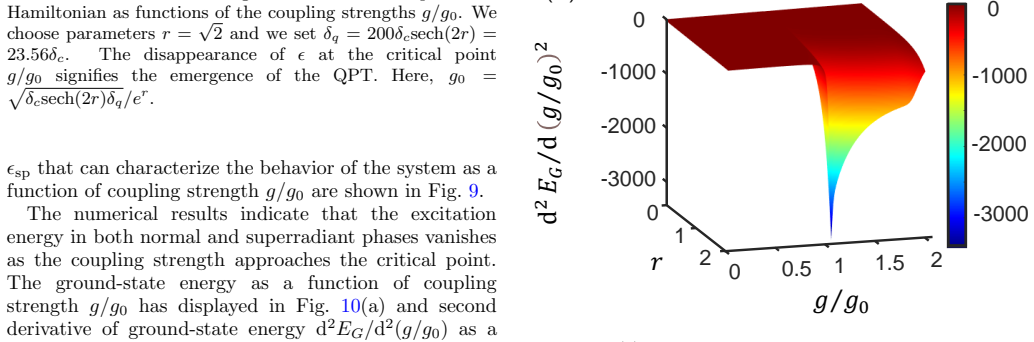
The excitation energiesϵ np and 8 0.2 0.6 1 1.4 1.8 0 0.04 0.08 0.12 𝜀 Τ𝑔 𝑔0 FIG. 9. Excitation energies of the anisotropic Rabi Hamiltonian as functions of the coupling strengthsg/g 0. We choose parametersr= √ 2 and we setδ q = 200δ csech(2r) = 23.56δc. The disappearance ofϵat the critical point g/g0 signifies the emergence of the QPT. Here,g 0 =p δcsech...
work page 2000
-
[2]
L. D. Landau, On the theory of phase transitions. I., Phys. Z. Sowjet.11, 26 (1937)
work page 1937
-
[3]
Carr,Understanding Quantum Phase Transitions (CRC Press, 2010) p
L. Carr,Understanding Quantum Phase Transitions (CRC Press, 2010) p. 756
work page 2010
- [4]
-
[5]
L.-T. Shen, Z.-B. Yang, H.-Z. Wu, and S.-B. Zheng, Quantum phase transition and quench dynamics in the anisotropic Rabi model, Phys. Rev. A95, 013819 (2017)
work page 2017
-
[6]
M.-J. Hwang and M. B. Plenio, Quantum phase transition in the finite Jaynes-cummings lattice systems, Phys. Rev. Lett.117, 123602 (2016)
work page 2016
-
[7]
R.-H. Zheng, W. Ning, Y.-H. Chen, J.-H. L¨ u, L.-T. Shen, K. Xu, Y.-R. Zhang, D. Xu, H. Li, Y. Xia, F. Wu, Z.- B. Yang, A. Miranowicz, N. Lambert, D. Zheng, H. Fan, F. Nori, and S.-B. Zheng, Observation of a superradiant phase transition with emergent cat states, Phys. Rev. Lett.131, 113601 (2023)
work page 2023
- [8]
-
[9]
Y. Kleeorin and Y. Meir, Quantum phase transition in a realistic double-quantum-dot system, Sci. Rep.8, 10539 (2018)
work page 2018
-
[10]
F. J. Gonz´ alez, A. Norambuena, and R. Coto, Dynamical quantum phase transition in diamond: Applications in quantum metrology, Phys. Rev. B106, 014313 (2022)
work page 2022
-
[11]
Y. Zhang, B.-B. Mao, D. Xu, Y.-Y. Zhang, W.-L. You, M. Liu, and H.-G. Luo, Quantum phase transitions and critical behaviors in the two-mode three-level quantum rabi model, J. Phys. A: Math. Theor.53, 315302 (2020)
work page 2020
-
[12]
C. J. Zhu, L. L. Ping, Y. P. Yang, and G. S. Agarwal, Squeezed light induced symmetry breaking superradiant phase transition, Phys. Rev. Lett.124, 073602 (2020)
work page 2020
-
[13]
C. Emary and T. Brandes, Chaos and the quantum phase transition in the Dicke model, Phys. Rev. E67, 066203 (2003)
work page 2003
- [14]
-
[16]
V. M. Bastidas, C. Emary, B. Regler, and T. Brandes, Nonequilibrium quantum phase transitions in the Dicke model, Phys. Rev. Lett.108, 043003 (2012)
work page 2012
-
[17]
D. Tolkunov and D. Solenov, Quantum phase transition in the multimode Dicke model, Phys. Rev. B75, 024402 (2007)
work page 2007
-
[18]
D. Nagy, G. K´ onya, G. Szirmai, and P. Domokos, Dicke- model phase transition in the quantum motion of a Bose- Einstein Condensate in an Optical Cavity, Phys. Rev. Lett.104, 130401 (2010)
work page 2010
-
[19]
C. M. Bowden and C. C. Sung, First- and second-order phase transitions in the Dicke model: Relation to optical bistability, Phys. Rev. A19, 2392 (1979)
work page 1979
-
[20]
L. Bakemeier, A. Alvermann, and H. Fehske, Quantum phase transition in the Dicke model with critical and noncritical entanglement, Phys. Rev. A85, 043821 (2012)
work page 2012
-
[21]
N. Lambert, C. Emary, and T. Brandes, Entanglement and the phase transition in single-mode superradiance, Phys. Rev. Lett.92, 073602 (2004)
work page 2004
-
[22]
K. Hepp and E. H. Lieb, On the superradiant phase transition for molecules in a quantized radiation field: the Dicke maser model, Ann. Phys.76, 360 (1973)
work page 1973
-
[23]
Y. K. Wang and F. T. Hioe, Phase transition in the Dicke model of superradiance, Phys. Rev. A7, 831 (1973)
work page 1973
-
[24]
M. O. Scully, Single photon subradiance: Quantum control of spontaneous emission and ultrafast readout, Phys. Rev. Lett.115, 243602 (2015)
work page 2015
-
[25]
N. Shammahet al., Open quantum systems with local and collective incoherent processes: Efficient numerical 10 simulations using permutational invariance, Phys. Rev. A98, 063815 (2018)
work page 2018
-
[26]
C. Emary and T. Brandes, Quantum chaos triggered by precursors of a quantum phase transition: The Dicke model, Phys. Rev. Lett.90, 044101 (2003)
work page 2003
-
[27]
R. Puebla, M.-J. Hwang, and M. B. Plenio, Excited-state quantum phase transition in the Rabi model, Phys. Rev. A94, 023835 (2016)
work page 2016
-
[28]
J. Liu, M. Zhao, Y.-T. Yang, and H.-G. Luo, Using nonclassical states to explore the superradiant phase transition in the quantum Rabi model, Phys. Rev. A109, 023721 (2024)
work page 2024
-
[29]
M. Cai, Z. Liu, W. Zhao, Y. Wu, Q. Mei, Y. Jiang, L. He, X. Zhang, Z. Zhou, and L. Duan, Observation of a quantum phase transition in the quantum rabi model with a single trapped ion, Nat. Commun.12, 1126 (2021)
work page 2021
-
[30]
Zhenget al., Observation of a superradiant phase transition with emergent cat states, Phys
R.-H. Zhenget al., Observation of a superradiant phase transition with emergent cat states, Phys. Rev. Lett.131, 113601 (2023)
work page 2023
-
[31]
Z.-J. Yinget al., Quantum phase transition and spontaneous symmetry breaking in a nonlinear quantum rabi model, J. Phys. A: Math. Theor.51, 315302 (2018)
work page 2018
-
[32]
L.-T. Shen, J.-W. Yang, Z.-R. Zhong, and Z.-B. Yang, Quantum phase transition and quench dynamics in the two-mode Rabi model, Phys. Rev. A104, 063703 (2021)
work page 2021
-
[33]
Ashhab, Superradiance transition in a system with a single qubit and a single oscillator, Phys
S. Ashhab, Superradiance transition in a system with a single qubit and a single oscillator, Phys. Rev. A87, 013826 (2013)
work page 2013
-
[34]
X. Chen, Z. Wu, M. Jiang,et al., Experimental quantum simulation of superradiant phase transition beyond no- go theorem via antisqueezing, Nat. Commun.12, 6281 (2021)
work page 2021
-
[35]
Q.-T. Xie, S. Cui, J.-P. Cao, L. Amico, and H. Fan, Anisotropic Rabi model, Phys. Rev. X4, 021046 (2014)
work page 2014
-
[36]
G. Zhang and H. Zhu, Analytical solution for the anisotropic rabi model: Effects of counter-rotating terms, Sci. Rep.5, 8756 (2015)
work page 2015
-
[37]
P. Nataf and C. Ciuti, No-go theorem for superradiant quantum phase transitions in cavity qed and counter- example in circuit qed, Nat. Commun.1, 72 (2010)
work page 2010
- [38]
-
[39]
D. Lamberto, G. Orlando, and S. Sawasta, Superradiant quantum phase transition in open systems: System- bath interaction at the critical point, Phys. Rev. A100, 063815 (2024)
work page 2024
-
[40]
K. Rza˙ zewski, K. W´ odkiewicz, and W. Zakowicz, Phase transitions, two-level atoms, and the a²term, Phys. Rev. Lett35, 432 (1975)
work page 1975
-
[41]
B. W. Shore and P. L. Knight, The Jaynes-Cummings model, J. Mod. Opt.40, 1195–1238 (1993)
work page 1993
-
[42]
J.-F. Huang, J.-Q. Liao, and L.-M. Kuang, Ultrastrong Jaynes-Cummings model, Phys. Rev. A101, 043835 (2020)
work page 2020
-
[43]
W. Qin, A. Miranowicz, P.-B. Li, X.-Y. L¨ u, J. You, and F. Nori, Exponentially enhanced light-matter interaction, cooperativities, and steady-state entanglement using parametric amplification, Phys. Rev. Lett.120(2018)
work page 2018
- [44]
-
[45]
Y.-H. Chen, W. Qin, X. Wang, A. Miranowicz, and F. Nori, Shortcuts to adiabaticity for the quantum Rabi model: Efficient generation of giant entangled cat states via parametric amplification, Phys. Rev. Lett.126, 023602 (2021)
work page 2021
- [46]
-
[47]
Y.-T. Yang and H.-G. Luo, Dissecting superradiant phase transition in the quantum Rabi model, Chin. Phys. Lett. 41, 120501 (2024)
work page 2024
-
[48]
X. Wang and H.-R. Li, Chiral quantum network with giant atoms, Quant. Sci. Tech.7, 035007 (2022)
work page 2022
-
[49]
Y.-H. Chen, Y. Qiu, A. Miranowicz, N. Lambert, W. Qin, R. Stassi, Y. Xia, S.-B. Zheng, and F. Nori, Sudden change of the photon output field marks phase transitions in the quantum rabi model, Commun. Phys.7, 5 (2024)
work page 2024
-
[50]
W. Shao, C. Wu, and X.-L. Feng, Generalized James’ effective hamiltonian method, Phys. Rev. A95, 032124 (2017)
work page 2017
discussion (0)
Sign in with ORCID, Apple, or X to comment. Anyone can read and Pith papers without signing in.