Many-body interferometry with semiconductor spins
Pith reviewed 2026-05-18 01:06 UTC · model grok-4.3
The pith
A semiconductor quantum dot array enables full energy spectrum reconstruction of eight interacting spins, showing a localization-to-chaos crossover.
A machine-rendered reading of the paper's core claim, the machinery that carries it, and where it could break.
Core claim
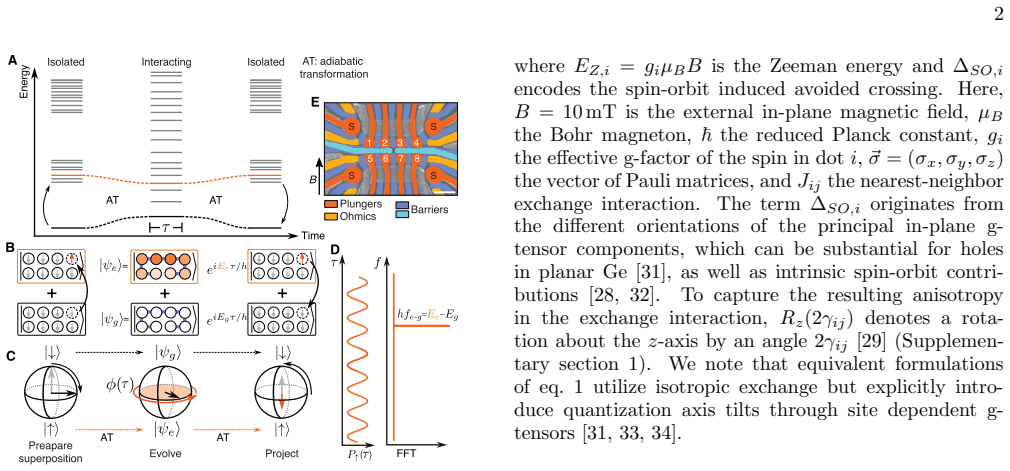
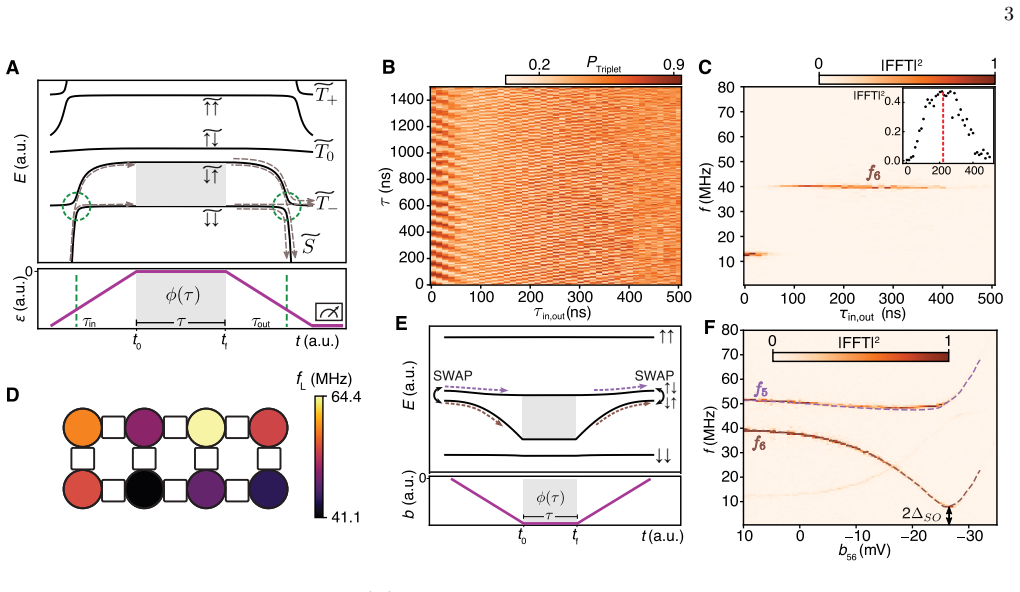
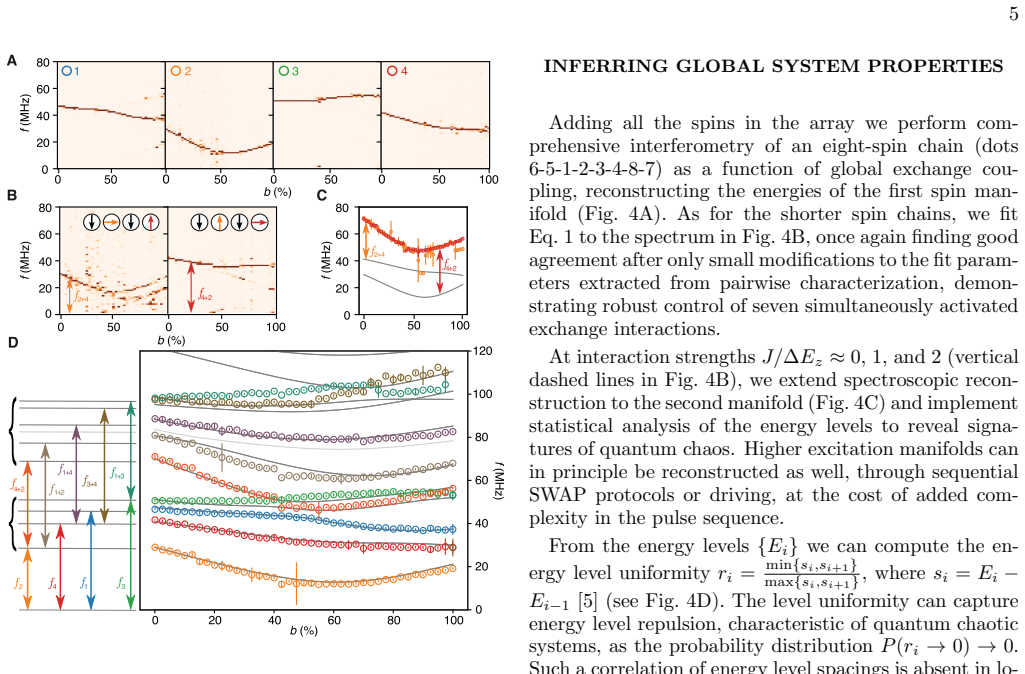
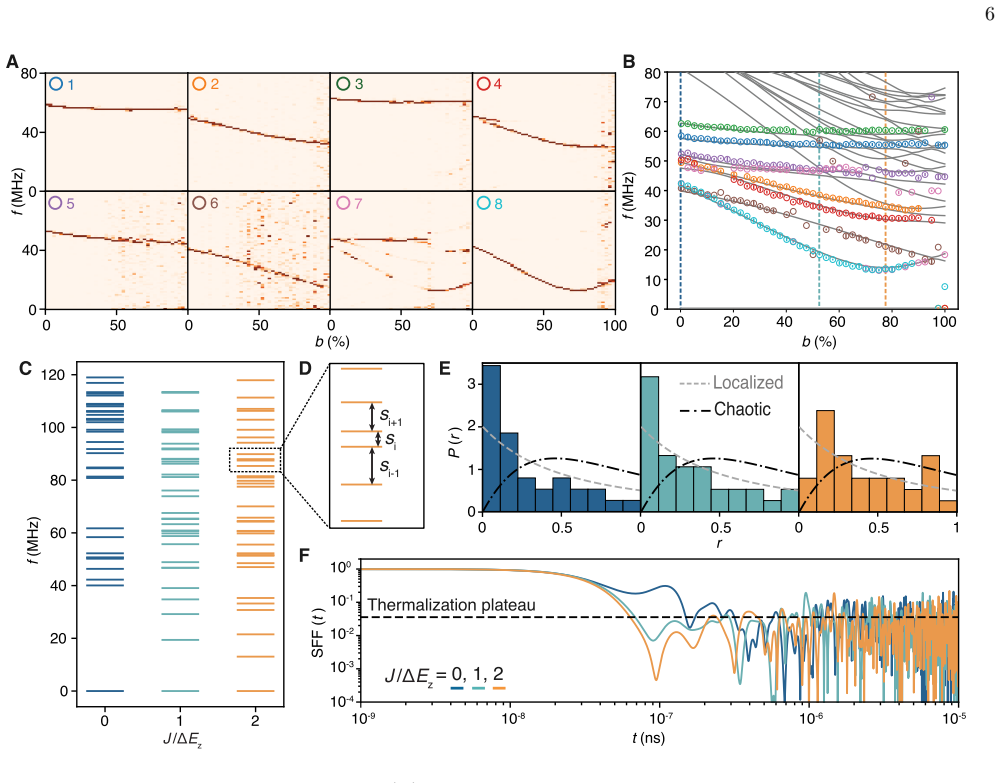
Using a 2x4 array of gate-defined germanium quantum dots, the authors perform spectroscopy on up to eight interacting spins by means of Ramsey interferometry and adiabatic mapping of many-body eigenstates to single-spin eigenstates. This enables complete energy spectrum reconstruction. As the interaction strength exceeds magnetic disorder, signatures of the crossover from a localized to a chaotic phase are observed.
What carries the argument
The adiabatic mapping protocol that converts many-body eigenstates into single-spin eigenstates for readout after Ramsey evolution.
Load-bearing premise
The adiabatic mapping protocol accurately transfers many-body eigenstates onto single-spin eigenstates without significant leakage or diabatic transitions that would distort the reconstructed spectrum.
What would settle it
If experiments with increased interaction strength do not show the predicted changes in energy level statistics or correlations indicating chaos, such as level repulsion, the claim of observing the crossover would be falsified.
Figures
read the original abstract
Quantum simulators enable studies of many-body phenomena which are intractable with classical hardware. Spins in devices based on semiconductor quantum dots promise precise electrical control and scalability advantages, but accessing many-body phenomena has so far been restricted by challenges in nanofabrication and simultaneous control of multiple interactions. Here, we perform spectroscopy of up to eight interacting spins using a 2x4 array of gate-defined germanium quantum dots. The spectroscopy protocol is based on Ramsey interferometry and adiabatic mapping of many-body eigenstates to single-spin eigenstates, enabling a complete energy spectrum reconstruction. As the interaction strength exceeds magnetic disorder, we observe signatures of the crossover from localization to a chaotic phase marking a step towards the observation of many-body phenomena in quantum dot systems.
Editorial analysis
A structured set of objections, weighed in public.
Referee Report
Summary. The manuscript reports spectroscopy of up to eight interacting spins in a 2x4 array of gate-defined germanium quantum dots. The protocol combines Ramsey interferometry with adiabatic mapping of many-body eigenstates onto single-spin eigenstates to reconstruct the full energy spectrum. As exchange interaction J exceeds magnetic disorder, the authors report spectral signatures of a crossover from localization to a chaotic phase.
Significance. If the adiabatic mapping remains faithful and the spectral features are robust, the work constitutes a concrete experimental step toward many-body quantum simulation in electrically tunable semiconductor platforms. The demonstration of tunable localization-to-chaos crossover in an eight-spin device is a notable advance over prior few-spin studies in quantum dots.
major comments (2)
- [Methods (adiabatic mapping and Ramsey protocol)] The adiabatic mapping protocol is central to the spectrum reconstruction that underpins the localization-to-chaos claim, yet the manuscript provides no explicit fidelity benchmarks, Landau-Zener estimates, or time-dependent simulations for the 8-spin case at the ramp times and interaction strengths used. Without these, residual diabatic leakage cannot be ruled out as a source of apparent level broadening or mixing.
- [Results (spectral reconstruction and crossover analysis)] The reported crossover signatures rest on the reconstructed spectra, but the text does not detail post-selection criteria, calibration stability, or quantitative error bars on the extracted level statistics. This omission leaves open whether the observed broadening is robust against experimental choices.
minor comments (2)
- [Figure captions] Figure captions should explicitly state the number of experimental repetitions and the fitting procedure used to extract the many-body energies.
- [Notation and definitions] Notation for the disorder strength and interaction parameter J should be defined consistently in the main text and supplementary material.
Simulated Author's Rebuttal
We thank the referee for the positive assessment of our work and for the constructive comments, which help clarify the presentation of our methods and results. We address each major comment below and will incorporate revisions to strengthen the manuscript.
read point-by-point responses
-
Referee: [Methods (adiabatic mapping and Ramsey protocol)] The adiabatic mapping protocol is central to the spectrum reconstruction that underpins the localization-to-chaos claim, yet the manuscript provides no explicit fidelity benchmarks, Landau-Zener estimates, or time-dependent simulations for the 8-spin case at the ramp times and interaction strengths used. Without these, residual diabatic leakage cannot be ruled out as a source of apparent level broadening or mixing.
Authors: We agree that explicit validation of the adiabatic mapping is important for the 8-spin case. Although supporting estimates were performed during analysis, they were omitted from the original submission for brevity. In the revised manuscript we will add Landau-Zener transition probability calculations for the relevant ramp times and interaction strengths, together with time-dependent simulations of the full 8-spin Hamiltonian to quantify residual diabatic leakage and confirm that it does not account for the observed spectral features. revision: yes
-
Referee: [Results (spectral reconstruction and crossover analysis)] The reported crossover signatures rest on the reconstructed spectra, but the text does not detail post-selection criteria, calibration stability, or quantitative error bars on the extracted level statistics. This omission leaves open whether the observed broadening is robust against experimental choices.
Authors: We acknowledge that additional details on data processing are needed. The revised version will include a clear description of the post-selection criteria applied to the Ramsey data, a summary of calibration stability across the measurement runs, and quantitative error bars or uncertainty estimates on the extracted level spacings and statistics used to identify the localization-to-chaos crossover. revision: yes
Circularity Check
No circularity: experimental spectrum reconstruction rests on measured data
full rationale
The paper is an experimental work that performs spectroscopy on up to eight spins in a germanium quantum-dot array using Ramsey interferometry combined with adiabatic mapping to reconstruct the many-body energy spectrum. The central claim of observing a localization-to-chaos crossover when interaction exceeds magnetic disorder is drawn directly from the measured spectra rather than from any theoretical derivation, prediction, or first-principles calculation that reduces to its own inputs by construction. No self-definitional steps, fitted inputs renamed as predictions, or load-bearing self-citations appear in the protocol description or results. The reconstruction method is presented as a measurement technique whose validity is assessed against the experimental outcomes themselves, making the work self-contained against external benchmarks with no reduction of claimed results to tautological inputs.
Axiom & Free-Parameter Ledger
Lean theorems connected to this paper
-
IndisputableMonolith/Foundation/DimensionForcing.leanreality_from_one_distinction / 8-tick period forcing unclear?
unclearRelation between the paper passage and the cited Recognition theorem.
We perform spectroscopy of up to eight interacting spins using a 2x4 array... adiabatic mapping of many-body eigenstates to single-spin eigenstates... crossover from localization to a chaotic phase
What do these tags mean?
- matches
- The paper's claim is directly supported by a theorem in the formal canon.
- supports
- The theorem supports part of the paper's argument, but the paper may add assumptions or extra steps.
- extends
- The paper goes beyond the formal theorem; the theorem is a base layer rather than the whole result.
- uses
- The paper appears to rely on the theorem as machinery.
- contradicts
- The paper's claim conflicts with a theorem or certificate in the canon.
- unclear
- Pith found a possible connection, but the passage is too broad, indirect, or ambiguous to say the theorem truly supports the claim.
Forward citations
Cited by 2 Pith papers
-
Randomised measurements of a disorder-induced entanglement transition in a neutral atom quantum processor
A randomised measurement protocol enables observation of a disorder-induced entanglement transition from chaotic to localised dynamics in a neutral atom quantum processor.
-
Tailoring Germanium Heterostructures for Quantum Devices with Machine Learning
Localized strained silicon spikes in unstrained Ge channels, optimized via multi-objective Bayesian optimization, enhance spin-orbit interaction by up to three orders of magnitude and improve quantum-dot spin qubit qu...
Reference graph
Works this paper leans on
-
[1]
Keimer, B., Kivelson, S. A., Norman, M. R., Uchida, S. & Zaanen, J. From quantum matter to high-temperature superconductivity in copper oxides.Nature518, 179–186 (2015)
work page 2015
-
[2]
Spin liquids in frustrated magnets.Nature 464, 199–208 (2010)
Balents, L. Spin liquids in frustrated magnets.Nature 464, 199–208 (2010)
work page 2010
-
[3]
Bloch, I., Dalibard, J. & Nascimb` ene, S. Quantum simu- lations with ultracold quantum gases.Nature Physics8, 267–276 (2012)
work page 2012
-
[4]
Browaeys, A. & Lahaye, T. Many-body physics with individually controlled rydberg atoms.Nature Physics 16, 132–142 (2020)
work page 2020
-
[5]
Roushan, P.et al.Spectroscopic signatures of localiza- tion with interacting photons in superconducting qubits. Science358, 1175–1179 (2017)
work page 2017
-
[6]
Andersen, T. I.et al.Thermalization and criticality on an analogue–digital quantum simulator.Nature638, 79–85 (2025)
work page 2025
- [7]
-
[8]
Senko, C.et al.Coherent imaging spectroscopy of a quantum many-body spin system.Science345, 430–433 (2014)
work page 2014
-
[9]
Barthelemy, P. & Vandersypen, L. M. K. Quantum dot systems: a versatile platform for quantum simulations. Annalen der Physik525, 808–826 (2013)
work page 2013
-
[10]
Hensgens, T.et al.Quantum simulation of a fermi–hubbard model using a semiconductor quantum dot array.Nature548, 70–73 (2017)
work page 2017
-
[11]
P.et al.Nagaoka ferromagnetism observed in a quantum dot plaquette.Nature579, 528–533 (2020)
Dehollain, J. P.et al.Nagaoka ferromagnetism observed in a quantum dot plaquette.Nature579, 528–533 (2020)
work page 2020
-
[12]
Kiczynski, M.et al.Engineering topological states in atom-based semiconductor quantum dots.Nature606, 694–699 (2022)
work page 2022
-
[13]
Wang, X.et al.Experimental realization of an extended fermi-hubbard model using a 2d lattice of dopant-based quantum dots.Nature Communications13(2022)
work page 2022
-
[14]
Hsiao, T.-K.et al.Exciton transport in a germanium quantum dot ladder.Physical Review X14, 011048 (2024)
work page 2024
- [15]
-
[16]
Burkard, G., Ladd, T. D., Pan, A., Nichol, J. M. & Petta, J. R. Semiconductor spin qubits.Reviews of Modern Physics95, 025003 (2023)
work page 2023
-
[17]
van Diepen, C.et al.Quantum simulation of antifer- romagnetic heisenberg chain with gate-defined quantum dots.Physical Review X11, 041025 (2021). 8
work page 2021
-
[18]
Qiao, H.et al.Coherent multispin exchange coupling in a quantum-dot spin chain.Physical Review X10, 031006 (2020)
work page 2020
-
[19]
Wang, C.-A.et al.Probing resonating valence bonds on a programmable germanium quantum simulator.npj Quantum Information9(2023)
work page 2023
-
[20]
Cova-Fari˜ na, P.et al.Site-resolved magnon and triplon dynamics on a programmable quantum dot spin ladder (2025). 2506.08663
-
[21]
Avishai, Y., Richert, J. & Berkovits, R. Level statistics in a heisenberg chain with random magnetic field.Physical Review B66, 052416 (2002)
work page 2002
- [22]
-
[23]
Roberts, G.et al.Manybody interferometry of quantum fluids.Science Advances10(2024)
work page 2024
-
[24]
W.et al.Quantum annealing with manu- factured spins.Nature473, 194–198 (2011)
Johnson, M. W.et al.Quantum annealing with manu- factured spins.Nature473, 194–198 (2011)
work page 2011
-
[25]
Veldhorst, M.et al.A two-qubit logic gate in silicon. Nature526, 410–414 (2015)
work page 2015
-
[26]
M.et al.Resonantly driven cnot gate for elec- tron spins.Science359, 439–442 (2018)
Zajac, D. M.et al.Resonantly driven cnot gate for elec- tron spins.Science359, 439–442 (2018)
work page 2018
-
[27]
Zhang, X.et al.Universal control of four singlet–triplet qubits.Nature Nanotechnology20, 209–215 (2024)
work page 2024
-
[28]
Saez-Mollejo, J.et al.Exchange anisotropies in microwave-driven singlet-triplet qubits.Nature Commu- nications16(2025)
work page 2025
- [29]
-
[30]
Chou, Y.-Z. & Sarma, S. D. Spin ladder quantum sim- ulators from spin-orbit-coupled quantum dot spin qubits (2025). 2508.08358
-
[31]
Hendrickx, N. W.et al.Sweet-spot operation of a germa- nium hole spin qubit with highly anisotropic noise sensi- tivity.Nature Materials23, 920–927 (2024)
work page 2024
-
[32]
Geyer, S.et al.Anisotropic exchange interaction of two hole-spin qubits.Nature Physics20, 1152–1157 (2024)
work page 2024
-
[33]
Qvist, J. H. & Danon, J. Anisotropic g -tensors in hole quantum dots: Role of transverse confinement direction. Physical Review B105, 075303 (2022)
work page 2022
-
[34]
Wang, C.-A.et al.Operating semiconductor quantum processors with hopping spins.Science385, 447–452 (2024)
work page 2024
-
[35]
Jurcevic, P.et al.Spectroscopy of interacting quasiparti- cles in trapped ions.Physical Review Letters115, 100501 (2015)
work page 2015
- [36]
-
[37]
Abadillo-Uriel, J. C., Rodr´ ıguez-Mena, E. A., Martinez, B. & Niquet, Y.-M. Hole-spin driving by strain-induced spin-orbit interactions.Physical Review Letters131, 097002 (2023)
work page 2023
- [38]
-
[39]
Ivakhnenko, O. V., Shevchenko, S. N. & Nori, F. Nonadi- abatic landau–zener–st¨ uckelberg–majorana transitions, dynamics, and interference.Physics Reports995, 1–89 (2023)
work page 2023
-
[40]
G.et al.Identifying and mitigating errors in hole spin qubit readout (2025)
Kelly, E. G.et al.Identifying and mitigating errors in hole spin qubit readout (2025). 2504.06898
-
[41]
Non-adiabatic crossing of energy levels.Pro- ceedings of the Royal Society of London
Zener, C. Non-adiabatic crossing of energy levels.Pro- ceedings of the Royal Society of London. Series A, Con- taining Papers of a Mathematical and Physical Character 137, 696–702 (1932)
work page 1932
-
[42]
Landau, L. D. Zur theorie der energie¨ ubertragung. ii. Physics of the Soviet Union2, 46–51 (1932)
work page 1932
-
[43]
Matsoukas-Roubeas, A. S., Prosen, T. & Campo, A. d. Quantum chaos and coherence: Random parametric quantum channels.Quantum8, 1446 (2024)
work page 2024
-
[44]
Hauke, P., Katzgraber, H. G., Lechner, W., Nishimori, H. & Oliver, W. D. Perspectives of quantum annealing: methods and implementations.Reports on Progress in Physics83, 054401 (2020)
work page 2020
-
[45]
Shekhtman, L., Entin-Wohlman, O. & Aharony, A. Moriya’s anisotropic superexchange interaction, frustra- tion, and dzyaloshinsky’s weak ferromagnetism.Physical Review Letters69, 836–839 (1992)
work page 1992
-
[46]
Derzhko & Moina. Statistical mechanics of one- dimensional s=1/2 anisotropic xy model in transverse field with dzyaloshinskii-moriya interaction.Condensed Matter Physics3 (1994)
work page 1994
-
[47]
Oshikawa, M., Yamanaka, M. & Affleck, I. Magnetization plateaus in spin chains: “haldane gap” for half-integer spins.Physical Review Letters78, 1984–1987 (1997)
work page 1984
-
[48]
Seidler, I.et al.Spatial uniformity of g-tensor and spin- orbit interaction in germanium hole spin qubits (2025). 2510.03125
-
[49]
Prange, R. E. The spectral form factor is not self- averaging.Physical Review Letters78, 2280–2283 (1997)
work page 1997
-
[50]
Statistics of the random matrix spectral form factor,
Altland, A., Divi, F., Micklitz, T., Pappalardi, S. & Rezaei, M. Statistics of the random matrix spectral form factor (2025). 2503.21386
-
[51]
K.et al.Proposal for many-body quantum chaos detection.Physical Review Research7, 013181 (2025)
Das, A. K.et al.Proposal for many-body quantum chaos detection.Physical Review Research7, 013181 (2025)
work page 2025
-
[52]
Prakash, A., Pixley, J. H. & Kulkarni, M. Universal spec- tral form factor for many-body localization.Physical Re- view Research3, l012019 (2021)
work page 2021
-
[53]
Spectral form factors and late time quantum chaos.Physical Review D98, 086026 (2018)
Liu, J. Spectral form factors and late time quantum chaos.Physical Review D98, 086026 (2018)
work page 2018
-
[54]
Winer, M. & Swingle, B. Hydrodynamic theory of the connected spectral form factor.Physical Review X12, 021009 (2022)
work page 2022
-
[55]
Jirovec, D.et al.Mitigation of exchange crosstalk in dense quantum dot arrays.Physical Review Applied24 (2025)
work page 2025
-
[56]
Martins, F.et al.Noise suppression using symmetric exchange gates in spin qubits.Physical Review Letters 116, 116801 (2016)
work page 2016
-
[57]
Physical Review Letters116, 110402 (2016)
Reed, M.et al.Reduced sensitivity to charge noise in semiconductor spin qubits via symmetric operation. Physical Review Letters116, 110402 (2016)
work page 2016
-
[58]
Nurizzo, M.et al.Complete readout of two-electron spin states in a double quantum dot.PRX Quantum4, 010329 (2023)
work page 2023
-
[59]
Communications Materials3(2022)
Petit, L.et al.Design and integration of single-qubit rotations and two-qubit gates in silicon above one kelvin. Communications Materials3(2022)
work page 2022
-
[60]
E.et al.Pauli blockade in silicon quantum dots with spin-orbit control.PRX Quantum2, 010303 (2021)
Seedhouse, A. E.et al.Pauli blockade in silicon quantum dots with spin-orbit control.PRX Quantum2, 010303 (2021). 9
work page 2021
-
[61]
Meinersen, C. V., Bosco, S. & Rimbach-Russ, M. Quan- tum geometric protocols for fast high-fidelity adiabatic state transfer (2024). 2409.03084. 1 Supplemental Materials: Manybody interferometry with spins in Germanium
-
[62]
Each dotQ i is characterized by an energyϵ i, a Zeeman splittingE Z,i, and the charging energyU i
8-SPIN CHAIN HAMIL TONIAN We model a linear chain of QDs in a Ge/SiGe heterostructure using a generalized Fermi-Hubbard Hamiltonian in the qubit frame [28, 29, 32] HFH = X i,σ ϵiˆni,σ − X i̸=j tijc† i ˆSij rotcj + X i Uiˆni,↑ˆni,↓ + X i EZ,i(ˆni,↑ −ˆni,↓),(2) where the transmission matrix ˆSij rot is given by ˆSij rot = exp h −iγ ij(⃗ nso,ij ·⃗ σ) i .(3) ...
-
[63]
SIGNA TURES OF LOCALIZA TION AND QUANTUM CHAOS In the following, we introduce the observables to discern localized from quantum chaotic systems and the specific form they take for the system in this work. A. Universality class Having derived both the theoretical HamiltonianH eff and its corresponding fitted HamiltonianH fit, we now turn to determining the...
-
[64]
Early time behavior The early time behavior is characterized by an exponential decay, which only depends on the coarse-grained density of statesρ(E) of each ensemble (more specifically, it depends on the Fourier transform ˜ρ(t)). For early times, one 5 FIG. S2. Eigenvalue statistics for a reduced spectrum: averaged spectral form factor (left), energy spac...
-
[65]
Eigenvalue repulsion from spectral form factor We can compute the averaged spectral form factor using the measure over the GUE SFF(t) = 1 d2 Z dµ(H) tr e−iHt tr eiHt dµ(H) =dHexp − d 2 tr H2 ,(30) whered= 2 L. We can write the integral over the Hermitian matrixHas an integral over eigenvalues by adjusting the measure dH=dU dΛ ∆ 2 Λ with ∆2 Λ = Y i<j (λi −...
-
[66]
Note on degeneracies for spectral analyses To analyze and conclude the correct spectral behavior (for both the gap ratio and the SFF), one needs to account for the underlying symmetries in the physical systems and subsequently work in a corresponding (irreducible) symmetry block. If one does not remove these symmetries, any spectral analysis will wrongly ...
-
[67]
SETUP All experiments are carried out in an Oxford Triton dilution refrigerator at a base temperature of 13 mK. The sample is mounted on a custom built printed circuit board (PCB) with a total of 100 DC, 28 microwave (up to 2 GHz, and 2 RF-reflectometry lines. The microwave lines are connected to their corresponding DC lines via bias tees with a cutoff fr...
-
[68]
S5 depicts the pulses on detuning and barriers for a typical experiment involving all eight spins
INITIALIZA TION AND READOUT PULSES Fig. S5 depicts the pulses on detuning and barriers for a typical experiment involving all eight spins. In this particular case we initialize the state|↓ 1,→ 2,↓ 3,↑ 4,↓ 5,↓ 6,↓ 7,↓ 8⟩. The graph is separated in parts which are explained in the following. After each part, marked by the gray dashed vertical lines, we also...
-
[69]
SW AP CALIBRA TION As described in the main text, Landau-Zener passages selectively initialize the lowest g-factor spin in each dot pair in either spin down (slow ramp), a superposition state (fast ramp) or a spin up state (intermediate speed ramp. To prepare the higher g-factor spin in spin-up or superposition states, we implement SWAP operations through...
-
[70]
We refer to the Larmor frequencies of the spins as the frequencies we measure when allJs are ≈0
LARMOR FREQUENCIES We utilize the pulse schemes in Fig- 2A together with local SWAPs to map out the Larmor frequencies of the 8 spins in our system. We refer to the Larmor frequencies of the spins as the frequencies we measure when allJs are ≈0. We record oscillations for up to 1µs with a sampling rate of 500 MS/s, i.e. we record a point every 2 ns. After...
-
[71]
EXCHANGE AND∆ SO EXTRACTION In order to extract the relevant experimental parameters to simulate the eight-spin system, we perform interferom- etry experiments in two-spin subspaces. In this situation, the energy levels are well known and extensively studied for singlet-triplet qubits. For each pair of spinsijwe first measure the frequency of both spins a...
-
[72]
ADDITIONAL SPIN CHAINS We report other measured spin chains in Fig. S13. Specifically, we show data for a chain formed by dots 2-1-5-6 (Fig. S13A), chain 3-4-8-7 (Fig. S13C), and another instance of the full eight-spin chain (Fig. S13E). The gray lines represent the modeled frequencies. Figures S13B, D, and F report the effective exchanges applied as extr...
-
[73]
DISCUSSION ON ADIABA TIC RAMPS FIG. S14. FFT of oscillations for the 8-spin chain reported in Fig. 4 measured at different ramp timesτ ramp initializing and reading-out dot 7 and 8 respectively. The data where normalized at the maximum signal among all the spectra in order to compare the FFT intensities. To ensure adiabatic ramps to the interacting regime...
-
[74]
S16.AFrequencies as extracted from model Hamiltonian with experimentally fitted parameters (Fig
SIMULA TED SPECTRAL FORM F ACTOR 0 5 10 15 20 25 30 35 Energy Level index 7.5 5.0 2.5 0.0 2.5 5.0 7.5 Exp-Theo (MHz) J/E Z = 0 J/E Z = 1 J/E Z = 2 J/E Z = 0 J/E Z = 1 J/E Z = 2 0 5 10 15 20 25 30 35 Energy Level index 0 2 4 6 8 10 12 14Error (%) A B C D EZJ/=0, 1, 2 EZJ/ 0 1 2 0 20 40 60 80 100 120f (MHz) 10 9 10 8 10 7 10 6 10 5 Time (t) 10 4 10 3 10 2 1...
discussion (0)
Sign in with ORCID, Apple, or X to comment. Anyone can read and Pith papers without signing in.