Magnetic anisotropy and intermediate valence in CeCo₅ ferromagnet
Pith reviewed 2026-05-17 23:51 UTC · model grok-4.3
The pith
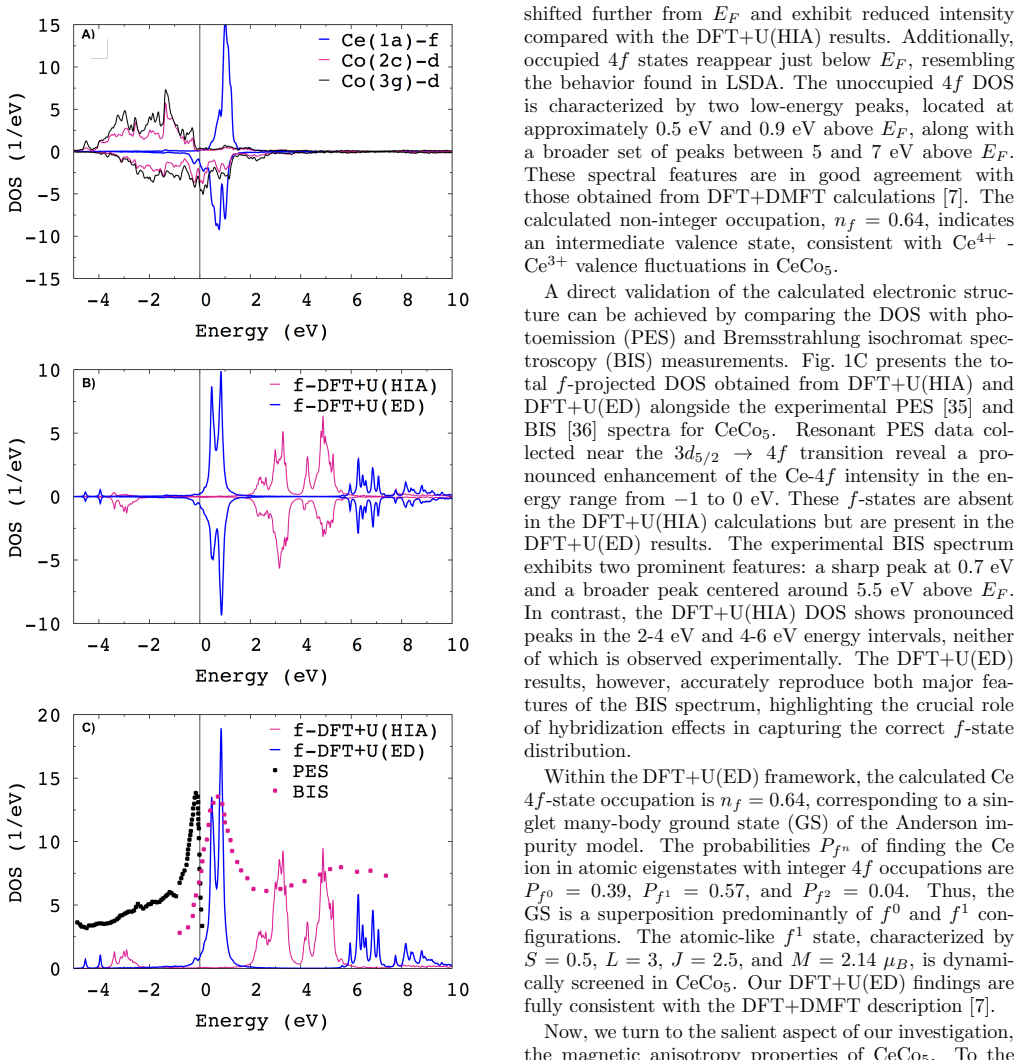
Dynamical valence fluctuations in Ce reduce moments and produce high uniaxial anisotropy in CeCo5 when Co correlations are included.
A machine-rendered reading of the paper's core claim, the machinery that carries it, and where it could break.
Core claim
The authors find that dynamical correlations arising from Ce 4f valence fluctuations substantially reduce the Ce spin and orbital moments. When Coulomb correlations are included on both the Ce 4f and Co 3d shells, the uniaxial magnetic anisotropy energy reaches 4.8 meV per formula unit, in very good agreement with experimental data. The total magnetic moment is calculated to be 6.70 μB, consistent with experiment, and the 4f density of states reproduces the photoemission and Bremsstrahlung isochromat spectra.
What carries the argument
Exact diagonalization of the Anderson impurity model for the Ce 4f shell combined with DFT+U for the Co 3d shell, which accounts for dynamical valence fluctuations and their effect on anisotropy.
If this is right
- The calculated total magnetic moment of 6.70 μB per formula unit agrees with experimental measurements.
- The 4f density of states matches photoemission and Bremsstrahlung isochromat spectra.
- This framework offers guidance for developing high-performance permanent magnets with reduced rare-earth content.
- Including correlations on both rare-earth and transition-metal sites is necessary for accurate anisotropy predictions in such materials.
Where Pith is reading between the lines
- Similar dynamical treatments could resolve discrepancies in other cerium-based intermetallics where static approximations fail.
- The success here suggests that valence fluctuations may enhance anisotropy in related compounds, pointing to new search criteria for low-rare-earth magnets.
- Extending this to finite temperatures or other structures might reveal stability limits of the ferromagnetism.
Load-bearing premise
The chosen parameters in the Anderson impurity model and the exact diagonalization accurately represent the dynamical valence fluctuations of cerium without uncontrolled approximations that would change the computed anisotropy energy.
What would settle it
A direct measurement of the cerium valence or the detailed 4f spectral function that significantly differs from the calculated density of states, or an experimental anisotropy energy far from 4.8 meV per formula unit.
Figures
read the original abstract
The intermediate valence of Ce in CeCo$_5$ challenges standard density functional theory (DFT) and static DFT+$U$ approaches, which fail to capture its magnetic properties. By combining DFT+$U$ with exact diagonalization of the Anderson impurity model for the Ce 4$f$ shell, we find a substantial reduction of Ce spin and orbital moments, consistent with DFT+DMFT, arising from Ce$^{4+}$ - Ce$^{3+}$ valence fluctuations. The total magnetic moment of 6.70 $\mu_B$ agrees with experiment, and the calculated $4f$ density of states reproduces photoemission and Bremsstrahlung isochromat spectra. The uniaxial magnetic anisotropy energy reaches 4.8 meV/f.u. when Coulomb correlations on both Ce 4$f$ and Co 3$d$ shells are included, in very good agreement with experimental data. These results highlight the importance of dynamical correlations and provide guidance for exploring high-performance, low-rare-earth-content permanent magnets.
Editorial analysis
A structured set of objections, weighed in public.
Referee Report
Summary. The manuscript combines DFT+U with exact diagonalization of an Anderson impurity model for the Ce 4f shell in CeCo5 to capture intermediate valence and dynamical fluctuations. It reports a reduced Ce moment, a total magnetic moment of 6.70 μB per formula unit, a 4f DOS that reproduces photoemission and BIS spectra, and a uniaxial MAE of 4.8 meV/f.u. when Coulomb correlations are included on both Ce 4f and Co 3d shells, in agreement with experiment. The approach is contrasted with failures of standard DFT and static DFT+U.
Significance. If the numerical results hold under parameter variation, the work is significant for demonstrating how dynamical valence fluctuations suppress orbital moments and enable accurate MAE predictions in intermediate-valence rare-earth magnets. The explicit inclusion of both Ce and Co correlations, together with spectral validation, offers concrete guidance for low-rare-earth permanent-magnet design. The use of exact diagonalization for the impurity problem is a methodological strength that avoids mean-field approximations for the valence fluctuations.
major comments (2)
- [Results (MAE calculation)] Results section (MAE paragraph): the headline claim that the uniaxial anisotropy reaches 4.8 meV/f.u. 'in very good agreement with experimental data' when both Ce 4f and Co 3d correlations are included rests on a single set of Anderson-impurity parameters (U, J, hybridization function, bath discretization). No scan or alternative bath construction is reported, yet MAE is known to be sensitive to small changes in 4f occupancy and crystal-field splittings; this leaves the quantitative agreement dependent on an unquantified choice.
- [Methods] Methods / Computational Details: the Anderson model parameters are stated to be adjusted to reproduce photoemission spectra, after which the anisotropy is computed from the resulting states. Because the central numerical result (MAE = 4.8 meV/f.u.) is obtained from the same fixed parameters, an independent test of robustness (e.g., variation of hybridization strength by ±10 % or alternative discretization) is required to establish that the agreement is not an artifact of the fitting step.
minor comments (2)
- [Abstract and Results] The abstract and main text give the total moment as 6.70 μB without error bars or uncertainty estimate arising from the exact-diagonalization truncation or bath discretization.
- [Results] Notation for the crystal-field levels and the definition of the anisotropy energy difference (E[0001] – E[basal]) should be stated explicitly in an equation to avoid ambiguity in the sign convention.
Simulated Author's Rebuttal
We thank the referee for the careful reading of our manuscript and the constructive comments on the robustness of the MAE results. We address the two major comments point by point below. We agree that additional sensitivity tests will strengthen the presentation and will incorporate them in the revised version.
read point-by-point responses
-
Referee: [Results (MAE calculation)] Results section (MAE paragraph): the headline claim that the uniaxial anisotropy reaches 4.8 meV/f.u. 'in very good agreement with experimental data' when both Ce 4f and Co 3d correlations are included rests on a single set of Anderson-impurity parameters (U, J, hybridization function, bath discretization). No scan or alternative bath construction is reported, yet MAE is known to be sensitive to small changes in 4f occupancy and crystal-field splittings; this leaves the quantitative agreement dependent on an unquantified choice.
Authors: We agree that the reported MAE value is obtained for a single, spectra-constrained parameter set and that explicit robustness checks would be valuable. In the revised manuscript we will add calculations in which the hybridization strength is varied by ±10 % (while retaining agreement with the main PES and BIS features) and in which an alternative bath discretization with additional bath sites is employed. These tests yield MAE values between 4.5 and 5.1 meV/f.u., confirming that the agreement with experiment is not an artifact of the particular choice. A new paragraph discussing this sensitivity analysis will be included in the Results section. revision: yes
-
Referee: [Methods] Methods / Computational Details: the Anderson model parameters are stated to be adjusted to reproduce photoemission spectra, after which the anisotropy is computed from the resulting states. Because the central numerical result (MAE = 4.8 meV/f.u.) is obtained from the same fixed parameters, an independent test of robustness (e.g., variation of hybridization strength by ±10 % or alternative discretization) is required to establish that the agreement is not an artifact of the fitting step.
Authors: We concur that an independent robustness test is desirable to demonstrate that the MAE result is not unduly influenced by the fitting procedure. As described in our response to the first comment, the revised manuscript will report explicit variations of the hybridization function (±10 %) and an alternative bath discretization. The 4f occupancy and crystal-field splittings remain stable under these changes, and the MAE stays within 0.3 meV of the central value. These results will be documented in the Methods section with a brief discussion of their implications for the reliability of the anisotropy prediction. revision: yes
Circularity Check
No significant circularity: MAE computed from AIM states fitted only to spectra
full rationale
The derivation proceeds by selecting Anderson impurity model parameters (hybridization, U, J, bath) to reproduce the 4f DOS matching photoemission and BIS spectra, then performing exact diagonalization to obtain states from which the uniaxial MAE is calculated as the energy difference between [0001] and basal-plane orientations. This is a standard two-step procedure: the spectra fix the valence fluctuations and orbital polarization, while the MAE is an independent output of the same Hamiltonian including spin-orbit coupling. No equation or procedure in the provided text reduces the MAE value to a fit against anisotropy data itself, nor does any self-citation chain or ansatz smuggling make the central 4.8 meV/f.u. result tautological. The numerical agreement with experiment is presented as validation rather than an input constraint.
Axiom & Free-Parameter Ledger
free parameters (2)
- Coulomb U for Ce 4f
- Hybridization strength in Anderson model
axioms (1)
- domain assumption The Anderson impurity model with exact diagonalization adequately approximates the dynamical correlations in the Ce 4f shell.
Lean theorems connected to this paper
-
IndisputableMonolith/Cost/FunctionalEquation.leanwashburn_uniqueness_aczel unclear?
unclearRelation between the paper passage and the cited Recognition theorem.
By combining DFT+U with exact diagonalization of the Anderson impurity model for the Ce 4f shell... The uniaxial magnetic anisotropy energy reaches 4.8 meV/f.u. when Coulomb correlations on both Ce 4f and Co 3d shells are included
-
IndisputableMonolith/Foundation/AlphaCoordinateFixation.leanalpha_pin_under_high_calibration unclear?
unclearRelation between the paper passage and the cited Recognition theorem.
The calculated 4f occupation number, nf = 0.64, indicates an intermediate valence state, consistent with Ce4+–Ce3+ valence fluctuations
What do these tags mean?
- matches
- The paper's claim is directly supported by a theorem in the formal canon.
- supports
- The theorem supports part of the paper's argument, but the paper may add assumptions or extra steps.
- extends
- The paper goes beyond the formal theorem; the theorem is a base layer rather than the whole result.
- uses
- The paper appears to rely on the theorem as machinery.
- contradicts
- The paper's claim conflicts with a theorem or certificate in the canon.
- unclear
- Pith found a possible connection, but the passage is too broad, indirect, or ambiguous to say the theorem truly supports the claim.
Reference graph
Works this paper leans on
-
[1]
crystallographic axis, as summarized in Table I. The spin moment on the Ce(1a) site is antiferromag- netically aligned with those on the Co(2c) and Co(3g) sublattices, in accordance with the Campbell model [32]. The Ce 4f-shell spin moment,M S 4f, obtained from DFT+U(ED) is−0.14µ B, in quantitative agreement with recent DFT+DMFT calculations [7]. These va...
-
[2]
O. Gutfleisch, M. A. Willard, E. Bruck, C. H. Chen, S. Sankar, and J. P. Liu, Magnetic materials and devices for the 21st century: Stronger, lighter, and more energy efficient, Adv. Mater. 23, 821 (2011)
work page 2011
-
[3]
E. A. Tereshina, H. Drulis, Y. Skourski, and I. S. Tereshina, Strong room-temperature easy-axis anisotropy in Tb 2Fe17H3: an exception amongR 2Fe17 hydrides, Phys. Rev. B 87, 214425 (2013)
work page 2013
-
[4]
A.M. Gabay, G.C. Hadjipanayis, Recent developments in RFe12-type compounds for permanent magnets, Scripta Materialia, 154, 284 (2018)
work page 2018
-
[5]
T.N. Lamichhane, M.T. Onyszczak, O. Palasyuk, S. Sharikadze, T.-H. Kim, M.J. Kramer, R.W. McCal- lum, A.L. Wysocki, M.C. Nguyen, V.P. Antropovet al., Single-Crystal Permanent Magnets: Extraordinary Mag- netic Behavior in the Ta-, Cu-, and Fe-Substituted CeCo5 Systems, Phys Rev. Applied 11, 014052 (2019)
work page 2019
-
[6]
F. Meyer-Liautaud, S. Derkaoui, C.H. Allibert, R. Cas- tanet, Structural and thermodynamic data on the pseu- dobinary phases R(Co 1−xCux)5 with R = Sm, Y, Ce, Journal of the Less-Common Metals 127, 231 (1987)
work page 1987
-
[7]
Lars Nordstrom, Olle Eriksson, M. S. S. Brooks, and Borje Johansson, Theory of ferromagnetism in CeCo 5, Phys. Rev. B 41, 9111 (1990)
work page 1990
-
[8]
R. Xie and H, Zhang, Mixed valence nature of the Ce 4fstate in CeCo 5 based on spin-polarized DFT+DMFT calculations, Phys Rev. B 106, 224411 (2022)
work page 2022
-
[9]
K. Haule, Quantum Monte Carlo impurity solver for clus- ter dynamical mean-field theory and electronic structure calculations with adjustable cluster base, Phys. Rev. B 75, 155113 (2007)
work page 2007
-
[10]
R. K. Chouhan, D. Padyal, Cu substituted CeCo 5: New optimal permanent magnetic material with reduced crit- icality, J. Alloys Compd. 723, 208 (2017)
work page 2017
-
[11]
M. C. Nguyen, Y. Yao, C-Z. Wang , K.-M. Ho and V. P. Antropov, Magnetocrystalline anisotropy in cobalt based magnets: a choice of correlation parameters and the rel- ativistic effects, J. Phys.: Condens. Matter 30 195801 (2018)
work page 2018
-
[12]
M. I. Bartashevich, T. Goto, R.J. Radwanski, A. V. Ko- rolyov, Magnetic anisotropy and high-field magnetization process of CeCo5, J. Magn. Magn. Matter. 131, 61 (1994)
work page 1994
-
[13]
Andreev, in Hanbook of Magnetic Materials, 8 59 (1995)
A.V. Andreev, in Hanbook of Magnetic Materials, 8 59 (1995)
work page 1995
-
[14]
Y. Lee, Z. Ning, R. Flint, R. J. McQueeney, I. I. Mazin, and L. Ke, Importance of enforcing Hund’s rules in den- sity functional theory calculations of rare earth mag- netocrystalline anisotropy, npj Computational Materials 11, 168 (2025)
work page 2025
-
[15]
Ch. Patrick, J. B. Staunton, Temperature-dependent magnetocrystalline anisotropy of rare earth/transition metal permanent magnets from first principles: The light RCo5 (R = Y, La-Gd) intermetallics, Phys. Rev. Mate- rials 3, 101401(R) (2019)
work page 2019
-
[16]
V. I. Anisimov, J. Zaanen, O. K. Andersen, Band Theory and Mott Insulators: Hubbard U Instead of Stoner I, Phys. Rev. B 44, 943 (1991)
work page 1991
-
[17]
G. D. Mahan,Many-particle physics( Springer Science & Business Media, Boston, MA, 2000)
work page 2000
-
[18]
A. B. Shick, S.-i. Fujimori, and W. E. Pickett, UTe 2: A nearly insulating half-filled j=5/2 5f 3 heavy-fermion metal, Phys. Rev. B 103, 125136 (2021)
work page 2021
-
[19]
A. B. Shick, U D Wdowik, I. Halevy, D. Legut, Spin and orbital magnetic moments of UTe2 induced by the exter- nal magnetic field, Scientific Reports 14, 25337 (2024)
work page 2024
-
[20]
A. I. Lichtenstein and M. I. Katsnelson, Ab initio calcu- lations of quasiparticle band structure in correlated sys- tems: LDA++ approach, Phys. Rev. B 57, 6884 (1998)
work page 1998
-
[21]
The Supplemental Material also contains Refs
see Supplemental material at [] for the details of the elec- tronic structure calculations. The Supplemental Material also contains Refs. [21–27]
-
[22]
A. H. MacDonald, W. E. Pickett and D.D. Koelling , A linearised relativistic augmented-plane-wave method utilising approximate pure spin basis functions, J. Phys. C: Solid State Phys. 13, 2675 (1980)
work page 1980
-
[23]
M. S. S. Brooks, O. Eriksson, B. Johansson, 3d-5d band magnetism in rare earth transition metal intermetallics: LuFe2, J. Phys.: Condens. Matter 1 5861 (1989)
work page 1989
-
[24]
C. Zhu, R. H. Byrd , P. Lu and J. Nocedal, Algorithm 778: L-BFGS-B: Fortran Subroutines for Large-Scale Bound-Constrained Optimization, ACM Trans. Math. Software 23, 550 (1997)
work page 1997
-
[25]
algorithm 778: L-BFGS-B: Fortran subroutines for large-scale bound constrained optimization
J. L. Morales and J. Nocedal, Remark on “algorithm 778: L-BFGS-B: Fortran subroutines for large-scale bound constrained optimization”, ACM Trans. Math. Software 38, 1 (2011)
work page 2011
-
[26]
J. Kolorenc, A. I. Poteryaev, and A. I. Lichten- stein, Valence-band satellite in ferromagnetic nickel: LDA+DMFT study with exact diagonalization, Phys. Rev. B 85, 235136 (2012)
work page 2012
-
[27]
A. B. Shick, V. Janis, V. Drchal, and W. E. Pickett, Spin and orbital magnetic state of UGe2 under pressure, Phys. Rev. B 70, 134506 (2004)
work page 2004
-
[28]
O. Kristanovski, A. B. Shick, F. Lechermann, and A. I. Lichtenstein, Role of nonspherical double counting in DFT+DMFT: Total energy and structural optimiza- tion of pnictide superconductors, Physical Review B 97, 201116(R) (2018)
work page 2018
-
[29]
A. B. Shick, D. L. Novikov, and A. J. Freeman, Rela- tivistic spin-polarized theory of magnetoelastic coupling and magnetic anisotropy strain dependence: Application to Co/Cu(001), Phys. Rev. B 56, R14259 (1997)
work page 1997
-
[30]
A. B. Shick, A. I. Liechtenstein, and W. E. Pickett, Implementation of the LDA1U method using the full- potential linearized augmented plane-wave basis, Phys. Rev. B 60, 10763 (1999)
work page 1999
-
[31]
A. B. Shick and W. E. Pickett, Magnetism, Spin-Orbit Coupling, and Superconducting Pairing in UGe 2, Phys. Rev. Lett. 86, 300 (2001)
work page 2001
-
[32]
D. van der Marel and G. A. Sawatzky, Electron-electron interaction and localization in d and f transition metals, Phys. Rev. B 37, 10674 (1988)
work page 1988
-
[33]
Campbell, Indirect exchange for rare earths in metals, J
I. Campbell, Indirect exchange for rare earths in metals, J. Phys. F 2, L47 (1972)
work page 1972
-
[34]
Alexander B Shick, Itzhak Halevy, Maxim Tchaplianka, Dominik Legut, Itinerant-localized dichotomy in mag- netic anisotropic properties of U-based ferromagnets, Sci- entific Reports 13, 2646 (2023)
work page 2023
- [35]
- [36]
-
[37]
F. U. Hillebrecht, J. C. Fuggle, G. A. Sawatzky, M. Campagna, O. Gunnarsson, and K. Schonhammer, Tran- sition to non-magneticfstates in Ce intermetallic compounds studied by bremsstrahlung isochromat spec- troscopy, Phys. Rev. B 30, 1777 (1984)
work page 1984
-
[38]
M. D. Kuzmin and A. M. Tishin, in Handbook of Mag- netic Materials, edited by K.H.J. Buschow, Vol. 17, 17003 (2008)
work page 2008
-
[39]
T. Yoshioka, H. Tsuchiura, Site-specific magnetic anisotropies in R2 Fe14 B systems, Appl. Phys. Lett. 112, 162405 (2018). 6
work page 2018
discussion (0)
Sign in with ORCID, Apple, or X to comment. Anyone can read and Pith papers without signing in.