Two Constraint Compilation Methods for Lifted Planning
Pith reviewed 2026-05-17 22:38 UTC · model grok-4.3
The pith
Two new methods compile constraints for lifted planning without grounding
A machine-rendered reading of the paper's core claim, the machinery that carries it, and where it could break.
Core claim
The paper establishes two constraint compilation methods for lifted planning that eliminate the need for grounding when handling qualitative state-trajectory constraints in PDDL, with proofs of correctness and analysis of time complexity, demonstrated to yield succinct specifications competitive in practice.
What carries the argument
Lifted compilation rules that transform constraints into equivalent problem structures without instantiating objects or actions.
If this is right
- The compiled problems are orders of magnitude more succinct than those from grounding-based compilers.
- The methods support efficient planning on domains from the latest International Planning Competition.
- Worst-case time complexities of the compilers are outlined to show suitability for large-scale problems.
Where Pith is reading between the lines
- These compilation techniques may apply to other fragments of planning languages with similar constraints.
- They suggest potential for hybrid lifted and grounded approaches in future planners.
- The succinctness could lead to reduced memory requirements during search in large object domains.
Load-bearing premise
The qualitative state-trajectory constraints belong to a fragment of PDDL whose semantics can be preserved exactly by the lifted compilation rules without additional grounding or approximation steps.
What would settle it
Running the compiled lifted problem and the original constrained problem through a planner and finding inconsistent solutions or unsolvability would falsify the claim that the compilation preserves the problem semantics.
Figures

read the original abstract
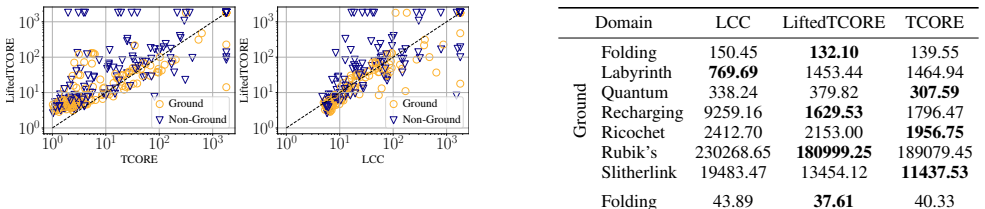
We study planning in a fragment of PDDL with qualitative state-trajectory constraints, capturing safety requirements, task ordering conditions, and intermediate sub-goals commonly found in real-world problems. A prominent approach to tackle such problems is to compile their constraints away, leading to a problem that is supported by state-of-the-art planners. Unfortunately, existing compilers do not scale on problems with a large number of objects and high-arity actions, as they necessitate grounding the problem before compilation. To address this issue, we propose two methods for compiling away constraints without grounding, making them suitable for large-scale planning problems. We prove the correctness of our compilers and outline their worst-case time complexity. Moreover, we present a reproducible empirical evaluation on the domains used in the latest International Planning Competition. Our results demonstrate that our methods are efficient and produce planning specifications that are orders of magnitude more succinct than the ones produced by compilers that ground the domain, while remaining competitive when used for planning with a state-of-the-art planner.
Editorial analysis
A structured set of objections, weighed in public.
Referee Report
Summary. The paper studies planning in a fragment of PDDL with qualitative state-trajectory constraints. It proposes two methods for compiling away these constraints without grounding, proves the correctness of the compilers, outlines their worst-case time complexity, and presents a reproducible empirical evaluation on IPC domains showing that the compiled problems are orders of magnitude more succinct than grounded alternatives while remaining competitive with a state-of-the-art planner.
Significance. If the correctness proofs hold, the work would be significant for scaling constraint-aware planning to large problems with many objects and high-arity actions, addressing a key limitation of prior grounding-based compilers. The explicit proofs of correctness together with the reproducible evaluation on standard IPC benchmarks are strengths that support independent verification and increase confidence in the practical claims.
major comments (1)
- The correctness argument for the lifted compilers must explicitly demonstrate exact semantic preservation for constraints involving universal quantification, ordering conditions, or safety properties over high-arity actions and large object sets; without this, the claim that solutions of the compiled problem correspond exactly to those of the original (without over- or under-constraining the reachable states) remains load-bearing and unverified for the most challenging cases.
minor comments (1)
- The abstract and introduction would benefit from a brief concrete example of a qualitative state-trajectory constraint to illustrate the fragment before the compilation rules are presented.
Simulated Author's Rebuttal
We thank the referee for their careful reading of the manuscript, the positive assessment of its significance for scaling constraint-aware planning, and the recognition of the reproducible evaluation on IPC domains. We address the major comment below.
read point-by-point responses
-
Referee: The correctness argument for the lifted compilers must explicitly demonstrate exact semantic preservation for constraints involving universal quantification, ordering conditions, or safety properties over high-arity actions and large object sets; without this, the claim that solutions of the compiled problem correspond exactly to those of the original (without over- or under-constraining the reachable states) remains load-bearing and unverified for the most challenging cases.
Authors: We thank the referee for highlighting the need for explicit demonstration in these cases. The correctness proofs in the manuscript are stated generally for the full fragment of qualitative state-trajectory constraints in PDDL, which includes universal quantification, ordering conditions, and safety properties. Because the two compilation methods operate entirely at the lifted level, semantic equivalence is established by showing that every constraint-satisfying trajectory in the original problem maps to a valid plan in the compiled problem (and vice versa) without requiring instantiation of objects or actions. This argument is independent of object-set size and action arity. To strengthen the presentation and directly address the concern, we will add a new subsection in the revised version that provides an explicit case analysis for universal quantifiers, ordering constraints, and safety properties over high-arity actions, including a proof sketch confirming that the reachable-state sets remain identical. revision: yes
Circularity Check
No circularity: new lifted compilation procedures with independent correctness proof
full rationale
The paper introduces two novel lifted compilation methods for qualitative state-trajectory constraints in a PDDL fragment, claims to prove their correctness directly from the defined rewriting rules, and reports worst-case complexity plus empirical results on IPC domains. No load-bearing step reduces a claimed result to a fitted parameter, self-citation chain, or definitional renaming; the central contribution consists of algorithmic procedures whose semantic preservation is asserted via explicit proof rather than by construction from the input data or prior self-referential results.
Axiom & Free-Parameter Ledger
axioms (1)
- standard math Standard PDDL planning semantics and the definition of qualitative state-trajectory constraints
Lean theorems connected to this paper
-
IndisputableMonolith/Cost/FunctionalEquation.leanwashburn_uniqueness_aczel unclear?
unclearRelation between the paper passage and the cited Recognition theorem.
We propose two methods for compiling away constraints without grounding... LiftedTCORE employs a lifted variant of the regression operator... LCC compiles away constraints without grounding and without the use of a regression operator.
-
IndisputableMonolith/Foundation/ArithmeticFromLogic.leanLogicNat ≃ Nat recovery unclear?
unclearRelation between the paper passage and the cited Recognition theorem.
We prove the correctness of our compilers and outline their worst-case time complexity.
What do these tags mean?
- matches
- The paper's claim is directly supported by a theorem in the formal canon.
- supports
- The theorem supports part of the paper's argument, but the paper may add assumptions or extra steps.
- extends
- The paper goes beyond the formal theorem; the theorem is a base layer rather than the whole result.
- uses
- The paper appears to rely on the theorem as machinery.
- contradicts
- The paper's claim conflicts with a theorem or certificate in the canon.
- unclear
- Pith found a possible connection, but the passage is too broad, indirect, or ambiguous to say the theorem truly supports the claim.
Reference graph
Works this paper leans on
-
[1]
Pure-Past Linear Temporal and Dynamic Logic on Finite Traces. InIJCAI, 4959–4965. Edelkamp, S. 2006. On the Compilation of Plan Constraints and Preferences. InICAPS, 374–377. Fiser, D. 2023. Operator Pruning Using Lifted Mutex Groups via Compilation on Lifted Level. InICAPS. Gerevini, A.; Haslum, P.; Long, D.; Saetti, A.; and Di- mopoulos, Y . 2009. Deter...
work page 2006
-
[2]
Computing Infinite Plans for LTL Goals Using a Clas- sical Planner. InIJCAI, 2003–2008. Percassi, F.; and Gerevini, A. E. 2019. On Compiling Away PDDL3 Soft Trajectory Constraints without Using Automata. InICAPS, 320–328. Pnueli, A. 1977. The Temporal Logic of Programs. In FOCS, 46–57. IEEE Computer Society. Richter, S.; and Westphal, M. 2010. The LAMA Pl...
work page 2003
-
[3]
A Virtual Reality Mission Planner for Mars Rovers. SMC-IT, 142–146. Shaik, I.; and van de Pol, J. 2023. Optimal Layout Synthesis for Quantum Circuits as Classical Planning. InICCAD, 1–9. Speck, D.; Mattm ¨uller, R.; and Nebel, B. 2020. Symbolic Top-k Planning. InAAAI, 9967–9974. Steinmetz, M.; Hoffmann, J.; Kovtunova, A.; and Borg- wardt, S. 2022. Classic...
work page 2023
-
[5]
Suppose thatπis solution forΠ, but it is not a solution for Π ′
The effects ofa i inA ′ that are different from the ones ofa i inAaffect only monitoring atoms, i.e.,hold c and seenϕ, and thus, for each formulaϕwithout monitoring atoms, we haves i |=ϕiffs ′ i |=ϕ. Suppose thatπis solution forΠ, but it is not a solution for Π ′. Sinceπis not a solution for problemΠ ′, andΠ ′ does not have constraints, then one of the fo...
work page 1982
-
[6]
Actiona i has strictly more restrictive preconditions in A′ than inA, i.e.,Pre ′(ai )|=Pre(a i )
-
[7]
Suppose thatπis solution forΠ, butπ ′ is not a solution forΠ ′
The effects ofa i inA ′ that are different from the ones of ai inAaffect only monitoring atoms, i.e.,hold c,seen ϕ andprevent ϕ atoms, and thus, for each formulaϕwith- out monitoring atoms, we haves i |=ϕiffs ′ i |=ϕ. Suppose thatπis solution forΠ, butπ ′ is not a solution forΠ ′. Sinceπ ′ is not a solution for problemΠ ′, andΠ ′ does not have constraints...
work page 2021
discussion (0)
Sign in with ORCID, Apple, or X to comment. Anyone can read and Pith papers without signing in.