Entanglement Phase Transition in Chaotic non-Hermitian Systems
Pith reviewed 2026-05-17 22:12 UTC · model grok-4.3
The pith
In chaotic non-Hermitian spin chains, steady-state entanglement entropy switches from volume-law to area-law scaling as dissipation rate increases.
A machine-rendered reading of the paper's core claim, the machinery that carries it, and where it could break.
Core claim
In a class of chaotic non-Hermitian spin chains whose spin-spin coupling terms commute with the non-Hermitian contributions, increasing the dissipation rate induces a gapless-to-gapped transition in the complex spectrum and drives the steady-state entanglement entropy from volume-law to area-law scaling, with non-monotonic gap behavior and entanglement enhancement inside the volume-law phase both arising from level crossings between the maximal imaginary level and other spectral levels.
What carries the argument
The complex energy spectrum, whose gap exhibits oscillations before the gapped phase, together with non-unitary time evolution to a steady state whose entanglement scaling is extracted from the density matrix.
If this is right
- Both representative models display the same dissipation-driven entanglement transition once their transverse fields exceed model-specific thresholds.
- Level crossings in the complex spectrum produce the observed non-monotonic gap oscillations and the counterintuitive entanglement increase with dissipation inside the volume-law regime.
- The steady-state entanglement is controlled by the imaginary part of the leading eigenvalue and its crossings with nearby levels.
- The transition occurs specifically in systems where spin-spin couplings commute with the non-Hermitian terms.
Where Pith is reading between the lines
- Non-Hermitian dissipation could serve as a tunable knob for preparing states with controlled entanglement in open many-body systems.
- The observed transition may share mechanisms with measurement-induced entanglement transitions in monitored quantum circuits.
- Similar scaling changes could appear in higher-dimensional or disordered non-Hermitian lattices if the commuting condition is preserved.
Load-bearing premise
The chosen models remain representative of generic chaotic non-Hermitian systems and the simulated dynamics reach true steady states without transient or finite-size effects dominating the observed scaling.
What would settle it
Direct numerical simulation of larger system sizes showing that the volume-to-area entanglement scaling transition disappears or shifts when dissipation rate is increased while holding all other parameters fixed.
Figures




read the original abstract
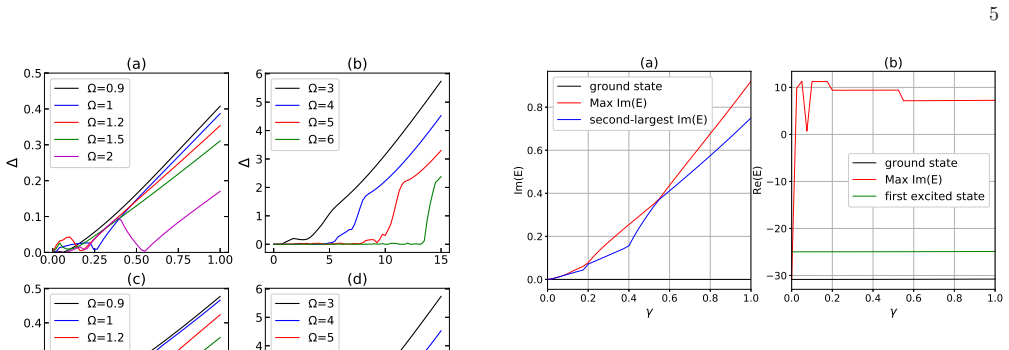
We study an entanglement phase transition in a class of chaotic non-Hermitian spin chains whose spin-spin coupling terms commute with the non-Hermitian contributions. Two representative models are investigated: the transverse-field Ising model with a complex longitudinal field and the non-Hermitian XX model with a transverse field. By analyzing their complex spectra, we find that both models undergo a dissipation-induced gapless-gapped phase transition when the transverse field exceeds a model-dependent threshold. Interestingly, the complex gap does not vary monotonically with the dissipation rate; instead, it exhibits pronounced oscillations before entering the gapped phase. By simulating their non-unitary dynamics, we show that the steady-state entanglement entropy undergoes a transition from volume-law to area-law scaling as the dissipation rate increases. Moreover, several unexpected features emerge within the volume-law regime: a larger complex gap or dissipation rate may lead to a more entangled steady state. We trace these unusual behaviors of the complex gap and the steady-state entanglement to level crossings between the maximal imaginary level and other spectral levels. Our work uncovers an exotic entanglement transition in chaotic non-Hermitian many-body systems.
Editorial analysis
A structured set of objections, weighed in public.
Referee Report
Summary. The manuscript studies entanglement phase transitions in chaotic non-Hermitian spin chains, specifically the transverse-field Ising model with complex longitudinal field and the non-Hermitian XX model with transverse field. Analysis of complex spectra reveals a dissipation-induced gapless-to-gapped transition above a model-dependent transverse-field threshold, with the complex gap exhibiting non-monotonic oscillations. Non-unitary dynamics simulations show the steady-state entanglement entropy transitioning from volume-law to area-law scaling as the dissipation rate increases, with counterintuitive features in the volume-law regime traced to level crossings involving the maximal-imaginary eigenvalue.
Significance. If the numerical evidence holds, the work is significant for identifying an exotic dissipation-driven entanglement transition in non-Hermitian chaotic many-body systems and for linking spectral level crossings to unusual entanglement behavior. The concrete demonstration of volume-to-area scaling change and the non-monotonic gap oscillations provide falsifiable predictions that could stimulate further studies in dissipative quantum dynamics.
major comments (2)
- [Numerical simulations of non-unitary dynamics] In the section on non-unitary dynamics simulations, the identification of steady-state entanglement entropy assumes relaxation to the right eigenvector of the dominant eigenvalue. When the complex gap oscillates or remains small (as reported before the gapped phase), the relaxation time diverges as 1/gap; without explicit convergence checks versus simulation time or gap magnitude, the measured scaling may capture transients rather than the true steady state.
- [Entanglement entropy scaling] The reported volume-law to area-law transition in entanglement entropy is observed in finite-size spin chains accessible to exact diagonalization. To establish a genuine phase transition, the manuscript should include finite-size scaling analysis or data collapse (e.g., S/L versus dissipation rate for multiple L) rather than raw scaling for fixed small L, as finite-size effects can mimic the distinction between S ~ L and S ~ const without thermodynamic-limit extrapolation.
minor comments (2)
- [Spectral analysis] Clarify the precise definition of the 'complex gap' (e.g., the difference in imaginary parts between the two largest eigenvalues) and how it is computed from the spectrum in each model.
- [Dynamics simulations] Specify the initial states used for the non-unitary time evolution and test whether the steady-state entanglement is independent of the choice of initial state or boundary conditions.
Simulated Author's Rebuttal
We thank the referee for their careful reading of our manuscript and for the constructive comments, which have helped us improve the presentation and strengthen the claims. We address each major comment point by point below.
read point-by-point responses
-
Referee: In the section on non-unitary dynamics simulations, the identification of steady-state entanglement entropy assumes relaxation to the right eigenvector of the dominant eigenvalue. When the complex gap oscillates or remains small (as reported before the gapped phase), the relaxation time diverges as 1/gap; without explicit convergence checks versus simulation time or gap magnitude, the measured scaling may capture transients rather than the true steady state.
Authors: We thank the referee for this important observation on the relaxation dynamics. In the original simulations, the evolution time was chosen to be several times larger than the inverse gap for each parameter set, and the entanglement entropy was monitored until it visibly saturated. To make this explicit, we have added convergence checks in the revised manuscript: for representative points in both the volume-law and area-law regimes, we plot the entanglement entropy versus simulation time and confirm that it plateaus well before the final time used. We have also verified that the dynamically obtained steady-state values agree with those computed directly from the right eigenvector of the dominant eigenvalue wherever the gap permits reliable extraction. revision: yes
-
Referee: The reported volume-law to area-law transition in entanglement entropy is observed in finite-size spin chains accessible to exact diagonalization. To establish a genuine phase transition, the manuscript should include finite-size scaling analysis or data collapse (e.g., S/L versus dissipation rate for multiple L) rather than raw scaling for fixed small L, as finite-size effects can mimic the distinction between S ~ L and S ~ const without thermodynamic-limit extrapolation.
Authors: We agree that a finite-size scaling analysis is necessary to substantiate the phase transition claim in the thermodynamic limit. The original manuscript presented raw entanglement scaling for system sizes up to L=12. In the revised version we have added a finite-size scaling study: we plot S/L versus dissipation rate for several values of L and observe that the curves develop a sharper crossing near the reported critical dissipation strength as L increases. This data collapse supports the existence of a volume-to-area transition in the large-L limit and has been included as a new figure with accompanying discussion. revision: yes
Circularity Check
No circularity: claims rest on direct numerical simulation of spectra and dynamics
full rationale
The paper reports spectral analysis and non-unitary time evolution on two concrete spin-chain models. The volume-to-area-law transition in steady-state entanglement is presented as an observed numerical outcome from those simulations, not as a quantity defined in terms of itself or obtained by fitting a parameter that is then relabeled as a prediction. No load-bearing self-citations, uniqueness theorems imported from prior author work, or ansatzes smuggled via citation appear in the provided text. The derivation chain is therefore self-contained empirical computation rather than a reduction to the paper's own inputs.
Axiom & Free-Parameter Ledger
free parameters (2)
- transverse-field threshold
- dissipation rate
axioms (2)
- domain assumption The non-Hermitian contributions commute with the spin-spin coupling terms.
- domain assumption Steady-state entanglement entropy is reached within the simulated evolution time.
Lean theorems connected to this paper
-
IndisputableMonolith/Cost/FunctionalEquation.leanwashburn_uniqueness_aczel unclear?
unclearRelation between the paper passage and the cited Recognition theorem.
By simulating their non-unitary dynamics, we show that the steady-state entanglement entropy undergoes a transition from volume-law to area-law scaling as the dissipation rate increases.
-
IndisputableMonolith/Foundation/AlexanderDuality.leanalexander_duality_circle_linking unclear?
unclearRelation between the paper passage and the cited Recognition theorem.
the complex gap does not vary monotonically with the dissipation rate; instead, it exhibits pronounced oscillations before entering the gapped phase
What do these tags mean?
- matches
- The paper's claim is directly supported by a theorem in the formal canon.
- supports
- The theorem supports part of the paper's argument, but the paper may add assumptions or extra steps.
- extends
- The paper goes beyond the formal theorem; the theorem is a base layer rather than the whole result.
- uses
- The paper appears to rely on the theorem as machinery.
- contradicts
- The paper's claim conflicts with a theorem or certificate in the canon.
- unclear
- Pith found a possible connection, but the passage is too broad, indirect, or ambiguous to say the theorem truly supports the claim.
Reference graph
Works this paper leans on
-
[1]
Thus, it is difficult to get analytical results about its spectrum and entanglement phase transition
are finite, the system is chaotic. Thus, it is difficult to get analytical results about its spectrum and entanglement phase transition. Therefore, we employ the numerical approach introduced in Sec. 2 to address this problem
-
[2]
complex gap We have calculated the gap of the imaginary part of the eigenvalues of the total Hamiltonian Ht withγ for N=10 (Fig. 3(a)-(b)), and for N=12 (Fig. 3(c)-(d)). Fig. 3(a) and (c) are taken for modest transverse field Ω ∈ [0. 9, 2], while Fig. 3(b) and (d) are illustrating the gap for Ω on the range [3 , 6]. We can see that as Ω = 0 . 9, a gap- les...
-
[3]
The gap with the dissipation rate for N = {8, 10, 12, 14} are il- lustrated in Fig
entanglement phase transition Before studying the entanglement scaling in size, we first compare the gap for various chain lengths. The gap with the dissipation rate for N = {8, 10, 12, 14} are il- lustrated in Fig. 5(a, c) with Ω = 0 . 9, 2, respectively. We can see that the critical point between gapless and gapped phase varies with the system size, whic...
-
[4]
Y. Li, X. Chen, and M. P. A. Fisher, Quantum Zeno effect and the many-body entanglement transition, Phys. Rev. B 98, 205136 (2018)
work page 2018
-
[5]
Y. Li, X. Chen, and M. P. A. Fisher, Measurement- driven entanglement transition in hybrid quantum cir- cuits, Physical Review B 100, 134306 (2019)
work page 2019
-
[6]
B. Skinner, J. Ruhman, and A. Nahum, Measurement- induced phase transitions in the dynamics of entangle- ment, Phys. Rev. X 9, 031009 (2019)
work page 2019
-
[7]
S. Choi, Y. Bao, X.-L. Qi and E. Altman, Quantum er- ror correction in scrambling dynamics and measurement- induced phase transition, Phys. Rev. Lett. 125, 030505 (2020)
work page 2020
-
[8]
M. J. Gullans and D. A. Huse, Dynamical purifica- tion phase transition induced by quantum measurements, Phys. Rev. X 10, 041020 (2020)
work page 2020
-
[9]
M. J. Gullans and D. A. Huse, Scalable Probes of Measurement-Induced Criticality, Physical Review Let- ters 125, 070606 (2020)
work page 2020
-
[10]
Y. Bao, S. Choi, and E. Altman, Theory of the phase transition in random unitary circuits with measurements, Phys. Rev. B 101, 104301 (2020)
work page 2020
-
[11]
C.-M. Jian, Y.-Z. You, R. Vasseur, and A. W. W. Ludwig, Measurement-induced criticality in random quantum cir- cuits, Phys. Rev. B 101, 104302 (2020)
work page 2020
-
[12]
X. Cao, A. Tilloy, and A. De Luca, Entanglement in a fermion chain under continuous monitoring, SciPost Phys. 7, 024 (2019)
work page 2019
-
[13]
M. Buchhold, Y. Minoguchi, A. Altland, and S. Diehl, Ef- fective theory for the measurement-induced phase tran- sition of dirac fermions, Phys. Rev. X 11, 041004 (2021)
work page 2021
-
[14]
O. Alberton, M. Buchhold, and S. Diehl, Entanglement transition in a monitored free-fermion chain: From ex- tended criticality to area law, Phys. Rev. Lett. 126, 170602 (2021)
work page 2021
- [15]
-
[16]
T. M¨ uller, S. Diehl, and M. Buchhold, Measurement- induced dark state phase transitions in long-ranged fermion systems, Phys. Rev. Lett. 128, 010605 (2022)
work page 2022
-
[17]
Q. Yang, Y. Zuo, and D. E. Liu, Keldysh nonlinear sigma model for a free-fermion gas under continuous measure- ments. Phys. Rev. Res. 5, 033174 (2023)
work page 2023
-
[18]
M. Szyniszewski, O. Lunt, and A. Pal, Disordered moni- tored free fermions, Phys. Rev. B 108, 165126 (2023)
work page 2023
- [19]
-
[20]
I. Poboiko, P. P¨ opperl, I. V. Gornyi, and A. D. Mirlin, Theory of free fermions under random projective mea- surements, Phys. Rev. X 13, 041046 (2023)
work page 2023
- [21]
-
[22]
M. Fava, L. Piroli, T. Swann, D. Bernard, and A. Nahum, Nonlinear sigma models for monitored dynamics of free fermions, Phys. Rev. X 13, 041045 (2023)
work page 2023
-
[23]
Merritt, Entanglement transitions with free fermio ns, Phys
J. Merritt, Entanglement transitions with free fermio ns, Phys. Rev. B 107, 064303 (2023)
work page 2023
-
[24]
I. Poboiko, I. V. Gornyi, and A. D. Mirlin, Measurement- induced phase transition for free fermions above one di- mension, Phys. Rev. Lett. 132, 110403 (2024)
work page 2024
-
[25]
R. D. Soares, Y. Le Gal, and M. Schir` o, Entanglement transition due to particle losses in a monitored fermionic chain, Physical Review B 111, 064313 (2025)
work page 2025
-
[26]
E. Starchl, M. H. Fischer, and L. M. Sieberer, Gener- alized Zeno Effect and Entanglement Dynamics Induced by Fermion Counting, PRX Quantum 6, 030302 (2025)
work page 2025
-
[27]
A. Delmonte, Z. Li, G. Passarelli, E. Y. Song, D. Bar- berena, A. M. Rey, and R. Fazio, Measurement-induced phase transitions in monitored infinite-range interacting systems, Physical Review Research 7, 023082 (2025)
work page 2025
-
[28]
D. Barberena and M. P. A. Fisher, Postselection in lat- tice bosons undergoing continuous measurements, Phys- ical Review B 111, 184313 (2025)
work page 2025
-
[29]
Z. Li, A. Delmonte, and R. Fazio, Emergent determin- istic entanglement dynamics in monitored infinite-range bosonic systems, Physical Review B 112, 104315 (2025)
work page 2025
- [30]
-
[31]
A. Lavasani, Z.-X. Luo, and S. Vijay, Monitored quantum dynamics and the Kitaev spin liquid, Phys. Rev. B 108, 115135 (2023)
work page 2023
-
[32]
K. Klocke, and M. Buchhold, Majorana loop models for measurement-only quantum circuits, Phys. Rev. X 13, 041028 (2023)
work page 2023
- [33]
-
[34]
S. Gopalakrishnan and M. J. Gullans, Phys. Rev. Lett. 126, 170503 (2021)
work page 2021
-
[35]
S.-K. Jian, Z.-C. Yang, Z. Bi, and X. Chen, Yang-Lee edge singularity triggered entanglement transition, Phys . Rev. B 104, L161107 (2021)
work page 2021
-
[36]
X. Turkeshi, A. Biella, R. Fazio, M. Dalmonte, and M. Schir´ o, Measurement-induced entanglement transitions in the quantum ising chain: From infinite to zero clicks, Phys. Rev. B 103, 224210 (2021)
work page 2021
-
[37]
X. Turkeshi and M. Schir´ o, Entanglement and correlation spreading in non-Hermitian spin chains, Phys. Rev. B 107, L020403 (2023)
work page 2023
- [38]
-
[39]
Malakar, et al., Measurement-induced entanglement transition in chaotic quantum Ising chain, Phys
M. Malakar, et al., Measurement-induced entanglement transition in chaotic quantum Ising chain, Phys. Rev. B 110, 134316 (2024)
work page 2024
-
[40]
B. Xing, X. Turkeshi, M. Schir´ o, R. Fazio, and D. Poletti, Phys. Rev. B 109, L060302 (2024)
work page 2024
-
[41]
R. D. Soares and M. Schir´ o, Non-unitary quantum many- 8 body dynamics using the Faber polynomial method, Sci- Post Phys. 17, 128 (2024)
work page 2024
-
[42]
D. C. Liu, and M. T. Batchelor, Characterizing phase transitions and criticality in non-Hermitian extensions o f the XY model. Phys. Rev. B 112, 014422 (2025)
work page 2025
-
[43]
Y. Zhou, W. Xia, L. Li, and W. Li, Diagnosing quan- tum many-body chaos in non-Hermitian quantum spin chain via Krylov complexity, Physical Review Research 7, 033281 (2025)
work page 2025
-
[44]
W.-Y. Zhang, M.-Y. Mao, Q.-M. Hu, X. Zhao, G. Sun, and W.-L. You, Yang-Lee edge singularity and quantum criticality in non-Hermitian PXP model, Physical Review B 112, 155135 (2025)
work page 2025
discussion (0)
Sign in with ORCID, Apple, or X to comment. Anyone can read and Pith papers without signing in.