An International Agreement to Prevent the Premature Creation of Artificial Superintelligence
Pith reviewed 2026-05-17 21:38 UTC · model grok-4.3
The pith
An agreement led by the United States and China would cap AI training scale and ban dangerous research to avoid creating artificial superintelligence too soon.
A machine-rendered reading of the paper's core claim, the machinery that carries it, and where it could break.
Core claim
The proposal is that a coalition agreement restricting AI training runs below certain computing thresholds, verified by monitoring chip inventories and usage, together with legal bans on research that advances superintelligence or undermines verification, would be technically sufficient to prevent premature ASI if put in place now.
What carries the argument
The international agreement framework that sets FLOP-based limits on training scale and enforces them through AI chip tracking plus multi-layered checks on prohibited research.
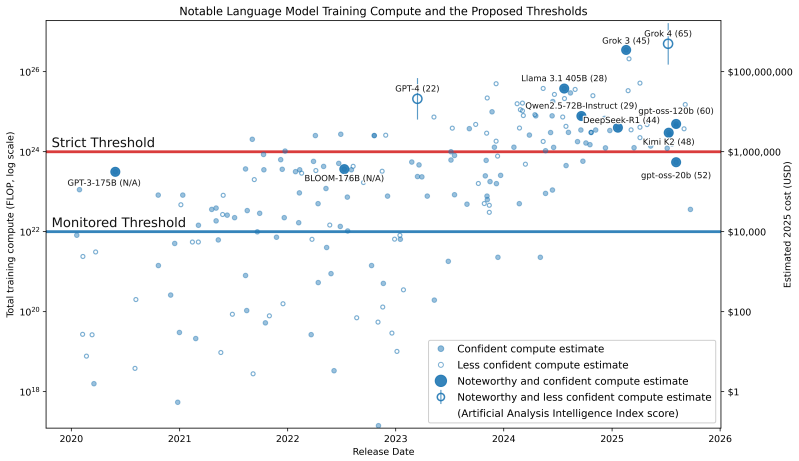
If this is right
- Dangerous AI capabilities advancement would stop while current safe applications remain available.
- Verification of chip use would enforce compliance even without full trust between participants.
- The agreement would reduce risks of misaligned systems, geopolitical instability, and misuse by malicious actors.
- Advancements in AI methods could eventually weaken the agreement's ability to hold.
Where Pith is reading between the lines
- Similar verification-based pauses might apply to other technologies that carry extinction-level risks.
- Improvements in remote monitoring tools could make the limits harder to evade over time.
- The agreement could serve as a template for coordinating on other high-stakes AI governance questions.
Load-bearing premise
Major powers that distrust each other can still reliably detect and stop secret large-scale AI training runs using only chip tracking and usage verification.
What would settle it
Evidence that a nation has completed a very large AI training run without any detectable increase in tracked chip activity or reported usage.
Figures
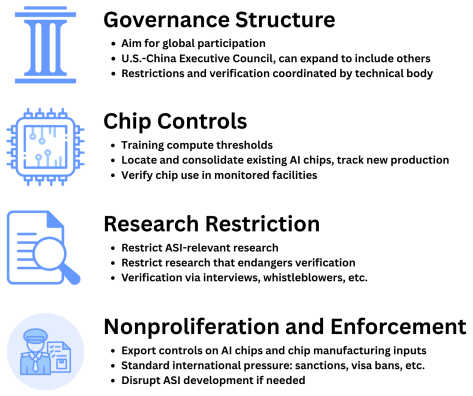
read the original abstract
Many experts argue that premature development of artificial superintelligence (ASI) poses catastrophic risks, including the risk of human extinction from misaligned ASI, geopolitical instability, and misuse by malicious actors. This report proposes an international agreement to prevent the premature development of ASI until AI development can proceed without these risks. The agreement halts dangerous AI capabilities advancement while preserving access to current, safe AI applications. The proposed framework centers on a coalition led by the United States and China that would restrict the scale of AI training and dangerous AI research. Due to the lack of trust between parties, verification is a key part of the agreement. Limits on the scale of AI training are operationalized by FLOP thresholds and verified through the tracking of AI chips and verification of chip use. Dangerous AI research--that which advances toward artificial superintelligence or endangers the agreement's verifiability--is stopped via legal prohibitions and multifaceted verification. We believe the proposal would be technically sufficient to forestall the development of ASI if implemented today, but advancements in AI capabilities or development methods could hurt its efficacy. Additionally, there does not yet exist the political will to put such an agreement in place. Despite these challenges, we hope this agreement can provide direction for AI governance research and policy.
Editorial analysis
A structured set of objections, weighed in public.
Referee Report
Summary. The manuscript proposes an international agreement, led by the United States and China, to prevent premature development of artificial superintelligence (ASI). The framework imposes FLOP-based limits on AI training scale, enforces them via AI chip tracking and verification of chip use, and prohibits dangerous AI research (defined as that advancing toward ASI or undermining verifiability) through legal prohibitions combined with multifaceted verification. The authors claim the proposal would be technically sufficient to forestall ASI if implemented today, while acknowledging insufficient current political will and potential future erosion of efficacy from capability or methodological advances.
Significance. If the verification components can be made robust against adversarial conditions, the proposal supplies a coherent high-level policy architecture for compute governance that explicitly addresses low-trust environments and seeks to preserve beneficial AI applications. It contributes to the AI governance literature by centering coalition enforcement and verifiability as first-order design constraints rather than afterthoughts.
major comments (2)
- [Abstract and verification framework description] Abstract and the section describing the verification framework: the central claim that the proposal 'would be technically sufficient to forestall the development of ASI if implemented today' rests on the feasibility of detecting and preventing covert large-scale training runs. The manuscript provides no analysis of false-positive rates, remote attestation protocols, on-site audit procedures, or evasion-resistant methods (e.g., against distributed or obfuscated compute), leaving the operational viability of chip tracking and multifaceted verification unexamined.
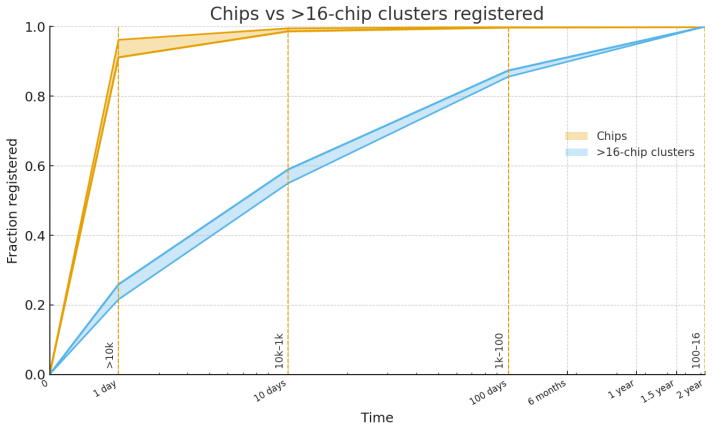
- [Coalition formation and maintenance] Section on coalition formation and maintenance: the proposal presupposes that a US-China-led coalition can be formed and sustained despite acknowledged mutual distrust, yet offers no concrete mechanisms or confidence intervals for how verification data would be shared or disputes adjudicated under conditions of strategic competition. This assumption is load-bearing for the enforceability of both FLOP thresholds and research prohibitions.
minor comments (2)
- [Abstract] The abstract states that 'advancements in AI capabilities or development methods could hurt its efficacy' without identifying candidate advancements (e.g., efficient training algorithms or new hardware paradigms), which would help readers assess the robustness claim.
- [Operationalization of training limits] Notation for 'FLOP thresholds' is introduced without an explicit definition or reference to a standard benchmark (e.g., whether it refers to total training compute or peak utilization), which could be clarified in the operationalization section.
Simulated Author's Rebuttal
We thank the referee for their positive assessment of the manuscript's contributions to the AI governance literature and for the constructive comments on verification and coalition dynamics. We respond to each major comment below, indicating where we will revise the manuscript to address the points raised.
read point-by-point responses
-
Referee: Abstract and the section describing the verification framework: the central claim that the proposal 'would be technically sufficient to forestall the development of ASI if implemented today' rests on the feasibility of detecting and preventing covert large-scale training runs. The manuscript provides no analysis of false-positive rates, remote attestation protocols, on-site audit procedures, or evasion-resistant methods (e.g., against distributed or obfuscated compute), leaving the operational viability of chip tracking and multifaceted verification unexamined.
Authors: We agree that the manuscript lacks a detailed technical examination of verification feasibility, including false-positive rates, specific attestation protocols, audit procedures, and resistance to evasion tactics such as distributed or obfuscated compute. The proposal is a high-level policy framework rather than an implementation study, and the sufficiency claim assumes that verification methods can be made operational with existing or near-future technology. We will revise the abstract and verification framework section to qualify this claim by stating that technical sufficiency is contingent on developing robust verification, and we will add a concise discussion of key challenges such as potential evasion methods and the need for further work on remote attestation and on-site audits. This will make the limitations explicit while retaining the overall architecture. revision: yes
-
Referee: Section on coalition formation and maintenance: the proposal presupposes that a US-China-led coalition can be formed and sustained despite acknowledged mutual distrust, yet offers no concrete mechanisms or confidence intervals for how verification data would be shared or disputes adjudicated under conditions of strategic competition. This assumption is load-bearing for the enforceability of both FLOP thresholds and research prohibitions.
Authors: The manuscript already notes the absence of current political will and the difficulties arising from strategic competition and distrust. It does not, however, supply concrete mechanisms for verification data sharing or dispute adjudication, as these elements would be determined through diplomatic negotiation and fall outside the scope of a conceptual proposal. We will expand the relevant section to outline illustrative approaches, such as cryptographic techniques to enable low-trust data sharing and the potential role of neutral international bodies for adjudication. We will not introduce confidence intervals, as the proposal is qualitative. This addition will clarify the load-bearing assumptions without claiming to resolve them in full detail. revision: partial
Circularity Check
No significant circularity: forward-looking policy proposal without derivations or self-referential claims
full rationale
This is a policy proposal document advocating an international agreement to limit AI training scale via FLOP thresholds, chip tracking, and research prohibitions. It contains no equations, fitted parameters, derivations, or load-bearing self-citations that reduce claims to inputs by construction. Central assertions such as technical sufficiency are explicitly framed as author beliefs rather than results derived from the authors' prior work or internal definitions. The document is self-contained as a normative governance proposal and does not exhibit any of the enumerated circularity patterns.
Axiom & Free-Parameter Ledger
axioms (3)
- domain assumption Tracking and verifying AI chip usage can reliably detect and prevent unauthorized large-scale training runs
- ad hoc to paper A US-China led coalition can be formed and maintained despite acknowledged lack of trust
- domain assumption Dangerous AI research can be defined with sufficient clarity to allow legal prohibition without blocking safe applications
Lean theorems connected to this paper
-
IndisputableMonolith/Cost/FunctionalEquation.leanwashburn_uniqueness_aczel unclear?
unclearRelation between the paper passage and the cited Recognition theorem.
Limits on the scale of AI training are operationalized by FLOP thresholds and verified through the tracking of AI chips and verification of chip use.
-
IndisputableMonolith/Foundation/RealityFromDistinction.leanreality_from_one_distinction unclear?
unclearRelation between the paper passage and the cited Recognition theorem.
The agreement halts dangerous AI capabilities advancement while preserving access to current, safe AI applications.
What do these tags mean?
- matches
- The paper's claim is directly supported by a theorem in the formal canon.
- supports
- The theorem supports part of the paper's argument, but the paper may add assumptions or extra steps.
- extends
- The paper goes beyond the formal theorem; the theorem is a base layer rather than the whole result.
- uses
- The paper appears to rely on the theorem as machinery.
- contradicts
- The paper's claim conflicts with a theorem or certificate in the canon.
- unclear
- Pith found a possible connection, but the passage is too broad, indirect, or ambiguous to say the theorem truly supports the claim.
Forward citations
Cited by 2 Pith papers
-
Detecting Hidden ML Training With Zero-Overhead Telemetry
A classifier using NVML telemetry identifies ML training workloads at 98.2% accuracy and retains 43-87% accuracy against the strongest tested adversarial evasions across 9 GPUs and 5 iteration rounds.
-
Does Distributed Training Undermine Compute Governance?
Distributed training may enable evasion of cluster-based compute governance for frontier AI, requiring new detection approaches such as chip tracking and cluster thresholds.
Reference graph
Works this paper leans on
-
[1]
Accessed: 2025-10-10. Brian David Ehrhart, Dusty Marie Brooks, Alice Baca Muna, and Chris Bensdotter LaFleur. Evalua- tion of risk acceptance criteria for transporting hazardous materials. 2020. Epoch AI. Ai benchmarking hub, 11 2024. URL https://epoch.ai/benchmarks/. Accessed: 2025-10-10. Epoch AI. Data on ai models, 07 2025. URL https://epoch.ai/data/ai...
-
[2]
Artificial intelligence (AI)means a computational system that performs tasks requiring cognition, planning, learning, or taking actions in physical, social or cyber domains. This includes systems that perform tasks under varying and unpredictable conditions, or that can learn from experience and improve performance
-
[3]
Artificial superintelligence (ASI)is operationally defined as any AI with sufficiently superhuman cognitive performance that it could plan and successfully execute the destruction of humanity. (a) For the purposes of this Agreement, AI development which is not explicitly authorized by the Coalition Technical Body (Article III) and is in violation of the l...
-
[4]
Dangerous AI activitiesare those activities which substantially increase the risk of an artificial superintelligence being created, and are not limited to the final step of developing an ASI but also include precursor steps as laid out in this Agreement. The full scope of dangerous AI activities is concretized by Articles IV through IX and may be elaborat...
-
[5]
Floating-point operations (FLOP)is the computational measure used to quantify the scale of training and post-training, based on the number of mathematical operations done. FLOP shall be counted as either the equivalent operations to the half-precision floating-point (FP16) format or the total operations (in the format used), whichever is higher
-
[6]
Training runmeans any computational process that optimizes an AI’s parameters (specifi- cations of the propagation of information through a neural network, e.g., weights and biases) using gradient-based or other search/learning methods, including pre-training, fine-tuning, reinforcement learning, large-scale hyperparameter searches that update parameters,...
-
[7]
Pre-trainingmeans the training run by which an AI’s parameters are initially optimized using large-scale datasets to learn generalizable patterns or representations prior to any task- or domain-specific adaptation. It includes supervised, unsupervised, self-supervised, and reinforcement-based optimization when performed before such adaptation
-
[8]
Post-trainingmeans a training run executed after a model’s pre-training. In addition, any training performed on an AI created before this Agreement entered into force is considered post-training
-
[9]
Strict Thresholdis the amount of training computation (measured in FLOP) above which training runs are prohibited. It is set at10 24 FLOP. 4The Convention on Prohibitions or Restrictions on the Use of Certain Conventional Weapons Which May Be Deemed to Be Excessively Injurious or to Have Indiscriminate Effects, commonly called the CCW, entered into force ...
work page 1983
-
[10]
Strict Post-training Thresholdis the amount of training computation (measured in FLOP) above which post-training runs (e.g., of models trained before the agreement) are prohibited. It is set at10 23 FLOP
-
[11]
Monitored Thresholdis the amount of training computation (measured in FLOP) above which training runs are subject to monitoring by the international authority. It is set at 1022 FLOP
-
[12]
Advanced computer chipsare integrated circuits fabricated on processes at least as ad- vanced as the 28 nanometer process node
-
[13]
This includes GPUs, TPUs, NPUs, and other AI accelerators
AI chipsmean specialized integrated circuits designed primarily for AI computations, including but not limited to training and inference operations for machine learning models [this would need to be defined more precisely in an Annex]. This includes GPUs, TPUs, NPUs, and other AI accelerators. This may also include hardware that was not originally designe...
-
[14]
This includes AI chips, as well as networking equipment, power supplies, and cooling equipment
AI hardwaremeans all computer hardware for training and running AIs. This includes AI chips, as well as networking equipment, power supplies, and cooling equipment
-
[15]
AI chip manufacturing equipmentmeans equipment used to fabricate, test, assemble, or package AI chips, including but not limited to lithography, deposition, etch, metrology, test, and advanced-packaging equipment [a more complete list would need to be defined in an Annex]
-
[16]
H100-equivalentmeans the unit of computing capacity (FLOP per second) equal to one NVIDIA H100 SXM accelerator, 990 TFLOP/s in FP16, or a Total Processing Performance (TPP) of 15,840, where TPP is calculated as TPP = 2 × non-sparse MacTOPS × (bit length of the multiply input)
-
[17]
Covered chip cluster (CCC)means any set of AI chips or networked cluster with aggregate effective computing capacity greater than 16 H100-equivalents. A networked cluster refers to chips that either are physically co-located, have inter-node aggregate bandwidth — defined as the sum of bandwidth between distinct hosts/chassis — greater than 25 Gbit/s, or a...
-
[18]
National Technical Means (NTM)includes satellite, aerial, cyber, signals, imagery (in- cluding thermal), and other remote-sensing capabilities employed by Parties for verification consistent with this Agreement
-
[19]
Chip-use verificationmeans methods that provide insight into what activities are being run on particular computer chips in order to differentiate acceptable and prohibited activities
-
[20]
Methods used to create frontier modelsrefers to the broad set of methods used in AI development. It includes but is not limited to AI architectures, optimizers, tokenizer methods, data curation, data generation, parallelism strategies, training algorithms (e.g., RL algorithms) and other training methods. This includes post-training but does not include me...
-
[21]
Training runs above the Monitored Threshold may only use techniques on this list
AI Technique Whitelistmeans the list of approved AI methods and techniques maintained by the Coalition Technical Body. Training runs above the Monitored Threshold may only use techniques on this list. Notes on Article II On Definitions of AIThe definition of AI used here (adapted from Senator Chuck Grassley’s AI Whistleblower Protection Act) is possibly t...
-
[22]
Parties to this Agreement constitute the coalition. The coalition shall implement this Agreement and its provisions, including those for international verification of compliance with it, and shall provide a forum for consultation and cooperation among Parties
-
[23]
The organs of the coalition are the Executive Council and the Coalition Technical Body (CTB)
-
[24]
Executive Council (a) The Executive Council initially consists of the United States of America and the People’s Republic of China. (b) The Executive Council: approves challenge inspections; appoints the Director-General; provides oversight of the CTB and exercises veto power over its recommendations; determines overall policy and adopts the budget. (c) De...
-
[25]
(b) The Director-General is appointed by the Executive Council for a four-year term, renewable once
Coalition Technical Body (CTB) and Director-General (a) The Director-General of the CTB is its head and chief administrative officer. (b) The Director-General is appointed by the Executive Council for a four-year term, renewable once. The Executive Council can recall the Director-General. (c) The CTB coordinates the activities of the Parties required by t...
-
[26]
The coalition’s regular budget is funded by assessed contributions of members of the Executive Council, with the assessment scale determined by the Executive Council. Precedent for Article IIIThe Intermediate-Range Nuclear Forces (INF) Treaty and Strategic Arms Reduction Treaties (START I, START II, and New START), place responsibility for implementation ...
-
[27]
Each Party agrees to ban and prohibit AI training above the following thresholds: Any training run exceeding the Strict Threshold or any post-training run exceeding the Strict Post- training Threshold. Each Party agrees to not conduct training runs above these thresholds, and to not permit any entity within its jurisdiction to conduct training runs above ...
-
[28]
This applies for training runs conducted by the Party or any entity within its jurisdiction
Each Party shall report any training run above the Monitored Threshold to the CTB, prior to initiation. This applies for training runs conducted by the Party or any entity within its jurisdiction. (a) This report must include, but is not limited to, all training code, all training data, and an estimate of the total FLOP to be used. The Party must provide ...
-
[29]
Each Party, and entities within its jurisdiction, may conduct training runs of less FLOP than the Monitored Threshold without oversight or approval from the CTB. 23
-
[30]
The CTB may authorize specific carveouts for activities such as safety evaluations, self- driving vehicles, medical technology, and other activities deemed safe by the Director- General, subject to the Executive Council’s veto power under Article III. These carveouts may allow for training runs larger than the Strict Threshold with CTB oversight, or a pre...
-
[31]
The CTB creates and maintains an AI Technique Whitelist specifying allowed AI methods and techniques. The CTB may modify this Whitelist in accordance with Article III. Training runs above the Monitored Threshold may only employ techniques on this Whitelist. Precedent for Article IVWhile the numerical values for thresholds specified in our agreement can an...
work page 1974
-
[32]
Each Party ensures that within their jurisdiction, all covered chip clusters (CCCs), as defined in Article II (i.e., a set of chips with capacity greater than 16 H100-equivalents) [note that 16 H100s collectively cost around $500,000 in 2025 and these are rarely owned by individuals], are located in facilities declared to the CTB, and that these AI chips ...
work page 2025
-
[33]
Unmonitored AI chips that are not part of a CCC (i.e., that have capacity less than 16 H100-equivalents) may remain outside of CTB-declared facilities, provided that such stock- piles are not aggregated or networked to meet the CCC definition, are not rotated among sites to defeat monitoring, and are not used for prohibited training. Parties will make rea...
-
[34]
Within 120 days of the Agreement entering into force, each Party locates, inventories, and consolidates all CCCs into facilities declared to the CTB. Parties do not disaggregate, conceal, or otherwise reassign chips to evade this requirement or to cause a set of chips which would have been classified as a CCC to no longer be classified as a CCC
-
[35]
The CTB may require chain-of-custody records for transfers
Parties to the Agreement monitor the domestic consolidation process, coordinated by the CTB, including through on-site inspections, document and inventory verification, accompa- niment of domestic authorities during transfers and inspection, and information sharing with Parties under Article X. The CTB may require chain-of-custody records for transfers. P...
-
[36]
Within 120 days of the Agreement entering into force, Parties submit to the CTB a register of their CCCs. The register must include the location, type, quantity, serial or other unique 25 identifiers where available, and associated interconnects of all AI chips in the CCCs. Each Party provides the CTB with an updated and accurate register no later than ev...
-
[37]
The CTB must approve any transfer before it proceeds
Parties provide the CTB with advance notice of any planned transfer of AI chips, whether domestic or international, no less than 14 days before the planned transfer. The CTB must approve any transfer before it proceeds. Inspectors are afforded the opportunity to observe the transfer. For international transfers, both the sending and receiving Parties coor...
-
[38]
avoid co-locating AI chips with non-ancillary non-AI computer hardware in these declared facilities
Broken, defective, surplus, or otherwise decommissioned AI chips continue to be treated as functional chips, until the CTB coordinates certification of their destruction. Parties do not destroy AI chips without oversight. Destruction or rendering permanently inoperable is conducted under oversight using CTB-approved methods and recorded in a destruction c...
work page 1922
-
[39]
The CTB will coordinate monitoring of AI chip production facilities and key inputs to chip production. This monitoring will ensure that all newly produced AI chips are immediately tracked and monitored until they are installed in declared CCCs and that unmonitored supply chains are not established. (a) The CTB will coordinate monitoring of AI chip product...
-
[40]
For facilities where tracking and monitoring is not feasible or implemented, production of AI chips will be halted. Production of AI chips may continue when the CTB declares that acceptable tracking and monitoring measures have been implemented
-
[41]
If a monitored chip production facility is decommissioned or repurposed, the CTB will coordinate oversight of that process, and, if done satisfactorily, this ends the monitoring requirement
-
[42]
No Party sells or transfers AI chips or AI chip manufacturing equipment except as authorized and tracked by the CTB. (a) Sale or transfer of AI chips within or between Parties to the Agreement has a presump- tion of approval and is tracked by the CTB. (b) Sale or transfer of AI chip manufacturing equipment within or between Parties to the Agreement does n...
-
[43]
No Party sells or transfers non-AI advanced computer chips or non-AI advanced computer chip manufacturing equipment to non-Party States or entities outside a Party State except as authorized and tracked by the CTB. 29
-
[44]
Sale or transfer of non-AI advanced computer chips or non-AI advanced computer chip manufacturing equipment within or between Parties to the Agreement is not restricted under this Article
-
[45]
relevant hardware would need to be further described in an Annex,
To prevent accumulation of excess chip production capacity that could enable rapid breakout from the Agreement, the Executive Council may impose limits on total annual production of AI chips. Such limits aim to allow replacement of aging chips and modest expansion for approved applications while preventing stockpiling that would reduce the time required f...
work page 1987
-
[46]
Parties accept continuous on-site verification of total chip usage at declared CCCs. The methods used for verification will be determined and updated by the CTB, in accordance with the process described in Article III. These methods may include, but are not limited to: (a) In-person inspectors (b) Tamper-proof cameras (c) Measurements of power, thermal, a...
-
[47]
The aim of this verification is to ensure chips are not being used for prohibited activities, such as large-scale AI training described in Article IV
-
[48]
In cases where the CTB assesses that current verification methods cannot provide sufficient assurance that the AI hardware is not being used for prohibited activities, AI hardware must be powered off, and its non-operation continually verified by in-person inspectors or other CTB-approved verification mechanisms
-
[49]
The CTB may impose various restrictions on how chips can operate in order to ensure proper verification. These restrictions may include but are not limited to: 31 (a) Restrictions on the bandwidth and latency between different chips, or between chips and their data center network, in order to distinguish permitted inference from prohibited training. (b) R...
-
[50]
The CTB will coordinate differentiated verification approaches for different CCCs based on their likelihood of being used for AI activities and their sensitivity as relevant to national security. (a) More sensitive facilities might have more technical/automated verification methods, less extensive physical access for foreign inspectors, and enhanced secur...
-
[51]
The CTB will lead research and engineering to develop better technologies for chip use monitoring and verification. Parties will support these efforts [more details would be provided in an Annex]. Precedent for Article VIIIn our discussion of precedent for Article VI, we described the continu- ous monitoring of former intermediate-ranged missile productio...
work page 1977
-
[52]
For the purpose of preventing the development of artificial superintelligence, this Agreement restricts only research that would materially advance toward ASI or undermine verification of compliance with this Agreement. This includes research in the field of machine learning and research in other artificial intelligence paradigms. Research focused on spec...
-
[53]
Application-specific AI research and development that does not advance general cognitive capabilities is permitted and encouraged. This includes research in domains such as medical diagnostics, drug discovery, materials science, climate modeling, robotics for specific tasks, and other specialized applications
-
[54]
The CTB’s Research Controls division classifies all Restricted Research activities as either Controlled or Banned. (a) Each Party monitors any Controlled Research activities within its jurisdiction, and takes measures to ensure that all Controlled Research is monitored and made available to the Research Controls division for review and monitoring purposes...
-
[55]
Parties to the Agreement must not assist, encourage, or share Banned Research, including by funding, procuring, hosting, supervising, teaching, publishing, providing controlled tools or chips, or facilitating collaboration
-
[56]
Each Party provides a representative to the CTB’s Research Controls division (established in Article III). This division has these responsibilities: (a) Interpret and clarify the categories of Restricted Research, and respond to questions as to the boundaries of Restricted Research, in response to new information, and in response to requests from research...
work page 1946
-
[57]
Each Party creates or empowers a domestic agency with the following responsibilities: (a) Maintain awareness of and relationships with domestic researchers and organizations working on areas adjacent to Restricted Research, in order to communicate the cate- gories of Restricted Research established in Article VIII. (b) Impose penalties to deter domestic r...
-
[58]
maintain awareness of and relationships with domestic researchers and organizations
To aid in the international verification of research bans, the Research Controls division will develop and implement verification mechanisms. (a) These mechanisms could include but are not limited to: 36 i. Interviews of researchers who have previously worked in Restricted Research topics, or are presently working in adjacent areas, conducted by the U.S. ...
work page 1994
-
[59]
with a giant dollar amount of compute
A key source of information for the coalition is the independent information gathering efforts of Parties. As such, the Information Consolidation division (Article III) will be ready to receive this information. This division coordinates verification and monitoring activities conducted by Parties. Parties conduct monitoring, inspections, and verification ...
work page 2025
-
[60]
A key source of information for the coalition are individuals who provide evidence of dangerous AI activities to the coalition. These individuals are subject to whistleblower protections. (a) This Article establishes protections, incentives, and assistance for individuals ("Covered Whistleblowers") who, in good faith, provide the coalition or a Party with...
-
[61]
(a) Parties may request a challenge inspection
Challenge inspections of suspected sites may be conducted upon credible information about dangerous AI activities. (a) Parties may request a challenge inspection. The Executive Council, either by request or because of the analysis provided by the Information Consolidation division, will consider the information at hand in order to request additional infor...
-
[62]
U.S. and PRC Independent Verification Efforts (a) The U.S. and PRC each operate an independent verification effort to assess compliance with this Agreement. These verification efforts build upon the pre-existing capabilities of each member’s intelligence community and supplement the work of the Coalition Technical Body. (b) The Coalition Technical Body pr...
work page 1987
-
[63]
Any Party ("Concerned Party") may raise concerns regarding the implementation of this Agreement, including concerns about ambiguous situations or possible non-compliance by another Party ("Requested Party"). This includes misuse of Protective Actions (Article XII). (a) The Concerned Party notifies the Requested Party of their concern, while also sharing t...
-
[64]
This may include the Concerned Party requesting a challenge inspection in accordance with Article X
If the issue is not resolved, the Concerned Party may request that the Executive Council assist in adjudicating and clarifying the concern. This may include the Concerned Party requesting a challenge inspection in accordance with Article X. (a) The Executive Council provides appropriate information in its possession relevant to such a concern. (b) The Exe...
-
[65]
as soon as possible, but in any case not later than 10 days after the request
If the Executive Council determines there was a violation of the Agreement, it can take actions to prevent dangerous AI activities or reprimand the Requested Party. These actions may include: (a) Require additional monitoring or restrictions on AI activities (b) Require relinquishment of AI hardware (c) Call for sanctions (d) Recommend Parties take Protec...
-
[66]
Recognizing that the development of ASI or other Dangerous AI Activities, as laid out in Articles IV through IX, would pose a threat to global security and to the life of all people, it may be necessary for Parties to this Agreement to take drastic actions to prevent such development. The Parties recognize that development of artificial superintelligence ...
-
[67]
To prevent the development or deployment of ASI, this Article authorizes tailored Protective Actions. Where there is credible evidence that a State or other actor (whether a Party or a non-Party) is conducting or imminently intends to conduct activities aimed at developing or deploying ASI in violation of Article I, Article IV , Article V , Article VI, Ar...
-
[68]
Protective Actions may include measures such as cyber operations to sabotage AI develop- ment, interdiction or seizure of covered chip clusters, military actions to disable or destroy AI hardware, and physical disablement of specific facilities or assets directly enabling AI development
-
[69]
Parties minimize collateral harm, including to civilians and essential services, wherever practical, subject to mission requirements
-
[70]
Permanent occupation or annexation of territory is prohibited
Protective Actions are strictly limited to preventing ASI development or deployment and are not used as a pretext for territorial acquisition, regime change, resource extraction, or broader military objectives. Permanent occupation or annexation of territory is prohibited. Action will cease upon verification by the coalition that the threat no longer exists
-
[71]
Each Protective Action is accompanied, at initiation or as soon as security permits, by a public Protective Action Statement that: (a) Explains the protective purpose of the action; (b) Identifies the specific AI-enabling activities and assets targeted; (c) States the conditions for cessation; (d) Commits to cease operations once those conditions are met. 43
-
[72]
Protective Actions terminate without delay upon any of the following: (a) Coalition certification that the relevant activities have ceased. (b) Verified surrender or destruction of covered chip clusters or ASI -enabling assets, potentially including the establishment of sufficient safeguards to prevent Restricted Research activities. (c) A determination b...
-
[73]
Parties do not regard measured Protective Actions taken by another Party under this Article as provocative acts, and do not undertake reprisals or sanctions on that basis. Parties agree that Protective Actions meeting the above requirements are not construed as an act of aggression or justification for the use of force
-
[74]
The Executive Council reviews each Protective Action for compliance with this Article. If the Executive Council finds that an action was not necessary, proportionate, or properly targeted, actions may be taken under Article XI, paragraph 3. Precedent for Article XIIThe idea that nation-states can take protective actions for their own security is a reality...
work page 2015
-
[75]
For AI models created via declared training or post -training within the limits of Article IV , the CTB may require evaluations and other tests. These tests will inform whether the thresholds set in Article IV , Article V , Article VII, and Article VIII need to be revised. The methods used for reviews will be determined by the CTB and may be updated
-
[76]
Evaluations are conducted at CTB facilities or monitored CCCs, by CTB officials. Officials from Parties to the Agreement may be informed which tests are conducted, and the CTB may provide a summary of the test results. Parties will not gain access to AI models they did not train, except when granted access by the model owner, and the CTB will take steps t...
-
[77]
The CTB may share detailed information with Parties or the public, if the Director-General deems that this may be necessary to reduce the chance of human extinction from advanced AI. Precedent for Article XIIIPrecedents for tests with oversight are shared with precedents around chip use verification discussed under Article VII, with the missile telemetry ...
-
[78]
The Executive Council may revise this Agreement as necessary to ensure its purposes are achieved. "Amendments" are considered revisions to the main body and Articles of the Agreement. Under Article III, the CTB may change specific definitions and implementation methods, such as those relevant to Article IV , Article V , Article VI, Article VII, Article VI...
-
[79]
The Executive Council may propose amendments to all Parties to the Agreement. The Exec- utive Council shall circulate proposed amendments to all State Parties with an explanation of the rationale and expected effects
-
[80]
The Executive Council will consider such recom- mendations but is not obligated to adopt them
Parties to the Agreement may submit recommendations for amendments to the Executive Council through the Director-General. The Executive Council will consider such recom- mendations but is not obligated to adopt them
discussion (0)
Sign in with ORCID, Apple, or X to comment. Anyone can read and Pith papers without signing in.