A Quantum Spectral Method for Non-Periodic Boundary Value Problems
Pith reviewed 2026-05-17 22:05 UTC · model grok-4.3
The pith
A quantum spectral method solves non-periodic boundary value problems with polylogarithmic complexity using Fourier and sine transforms.
A machine-rendered reading of the paper's core claim, the machinery that carries it, and where it could break.
Core claim
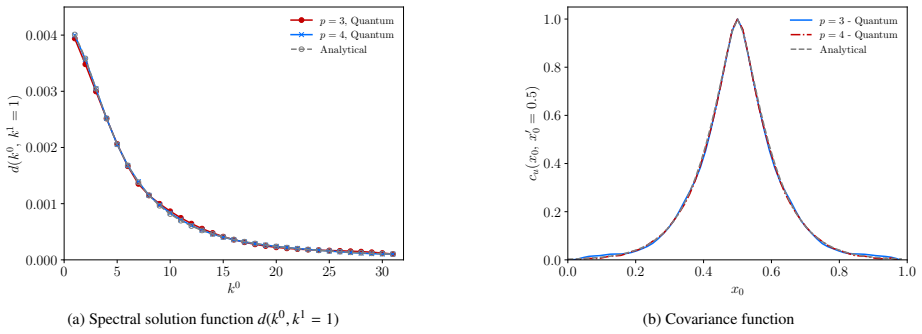
We propose a quantum spectral method with polylogarithmic complexity for solving non-periodic boundary value problems with arbitrary Dirichlet boundary conditions. The method approximates the diagonal solution operator with a polynomial in Fourier space, encodes it quantumly, uses the quantum Fourier transform for space mappings, and defines the quantum sine transform through domain reflection for zero boundaries, with decomposition for non-zero cases. Numerical evidence on a Dirichlet-Poisson problem and a fractional stochastic PDE confirms the approach.
What carries the argument
The quantum sine transform obtained by pre- and post-multiplying the quantum Fourier transform with the reflection matrix to impose zero Dirichlet boundary conditions, combined with polynomial approximation of the solution operator.
If this is right
- The method achieves polylogarithmic computational complexity for non-periodic problems similar to periodic ones.
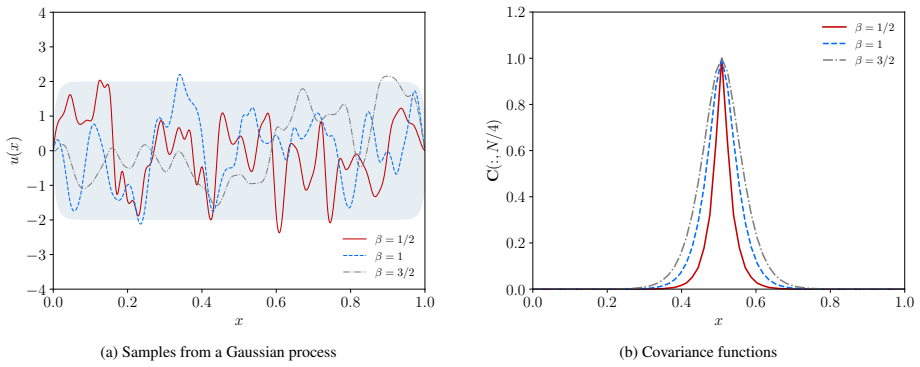
- It applies to both simple Poisson equations and more complex fractional stochastic PDEs for spatial random fields.
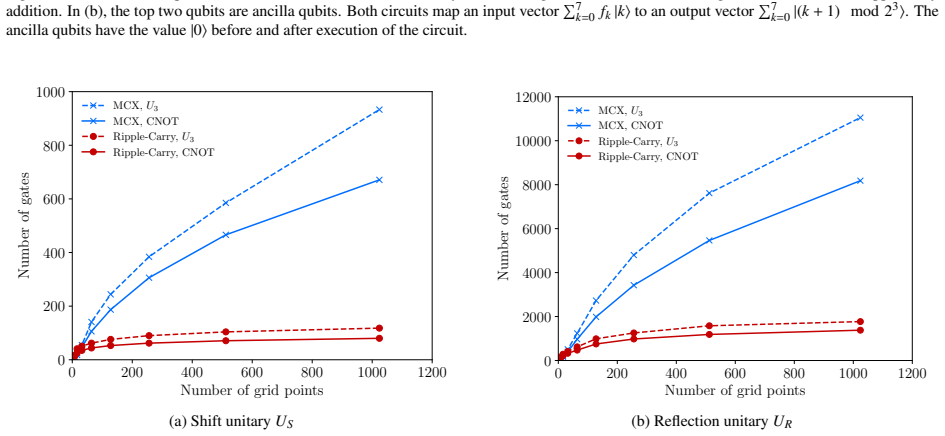
- The circuit implementation allows quantum encoding of the polynomial approximation while maintaining accuracy.
- Domain reflection enables exact enforcement of Dirichlet conditions without additional overhead in the quantum setting.
Where Pith is reading between the lines
- If extended, the reflection technique could adapt to Neumann or mixed boundary conditions by choosing appropriate symmetries.
- Such methods might integrate with other quantum linear system solvers to tackle even broader classes of PDEs.
- Testing on real quantum hardware for moderate sizes could reveal practical overheads not seen in simulations.
Load-bearing premise
A low-degree polynomial approximation to the diagonal solution operator in Fourier space can be quantum-encoded with gate cost that remains polylogarithmic while preserving the accuracy needed for the target PDE.
What would settle it
Implementing the quantum circuit for the Dirichlet-Poisson problem and measuring the number of gates required as the grid size N increases to verify scaling as O((log N)^c) rather than polynomial in N.
Figures







read the original abstract
Quantum computing holds the promise of solving computational mechanics problems in polylogarithmic time, meaning computational time scales as $\mathscr{O}((\log N)^c)$, where $N$ is the problem size and $c$ a constant. We propose a quantum spectral method with polylogarithmic complexity for solving non-periodic boundary value problems with arbitrary Dirichlet boundary conditions. Our method extends the recently proposed approach by Liu et al. (2025), in which periodic problems are discretised using truncated Fourier series. In such spectral methods, the discretisation of boundary value problems with constant coefficients leads to a set of algebraic equations in the Fourier space. We implement the respective diagonal solution operator by first approximating it with a polynomial and then quantum encoding the polynomial. The mapping between the physical and Fourier spaces is accomplished using the quantum Fourier transform (QFT). To impose zero Dirichlet boundary conditions, we double the domain size and reflect all physical fields antisymmetrically. The respective reflection matrix defines the quantum sine transform (QST) by pre- and post-multiplying with the QFT. For non-zero Dirichlet boundary conditions, the solution is decomposed into a boundary-conforming and a homogeneous part. The homogenous part is determined by solving a problem with a suitably modified forcing vector. We illustrate the basic approach with a Dirichlet-Poisson problem and demonstrate its generality by applying it to a fractional stochastic PDE for modelling spatial random fields. We discuss the circuit implementation of the proposed approach and provide numerical evidence confirming its polylogarithmic complexity.
Editorial analysis
A structured set of objections, weighed in public.
Referee Report
Summary. The manuscript proposes a quantum spectral method for non-periodic boundary value problems with arbitrary Dirichlet conditions. It extends the periodic Fourier spectral solver of Liu et al. by doubling the domain and using antisymmetric reflection to construct a quantum sine transform (QST) for zero boundary conditions, and by decomposing the solution into a boundary-conforming part plus a homogeneous problem with modified forcing for nonzero boundaries. The diagonal solution operator in Fourier space is approximated by a polynomial that is then quantum-encoded and applied via QFT/QST mappings. Numerical results for a Dirichlet-Poisson problem and a fractional stochastic PDE are presented as evidence of polylogarithmic complexity.
Significance. If the polylogarithmic scaling can be placed on a rigorous footing with explicit degree bounds and end-to-end gate counts, the extension from periodic to non-periodic domains would be a useful incremental advance for quantum PDE solvers. The numerical demonstration on both a standard Poisson problem and a fractional SPDE is a concrete strength that shows the method is not limited to the simplest case.
major comments (2)
- [Abstract / circuit implementation discussion] Abstract and circuit-implementation discussion: the headline claim of polylogarithmic complexity rests on the polynomial approximation to the diagonal Fourier multiplier (e.g., multiplication by 1/|k|^2 or fractional powers) having degree d that remains polylog(N,1/ε) after accounting for the antisymmetric reflection matrix, the QST construction, and the modified forcing in the nonzero-BC decomposition. No explicit degree bounds, approximation-error analysis, or circuit-depth theorem that incorporates these additional operators is supplied; numerical evidence alone does not establish the asymptotic regime.
- [Method description] Method description: the condition number of the composite operator (reflection + polynomial encoding + boundary decomposition) is not analyzed, yet any N-dependent growth would immediately destroy the claimed polylog scaling. This quantity is load-bearing for the central complexity statement.
minor comments (2)
- The manuscript would benefit from an explicit statement of the smoothness assumptions required on the solution and forcing to guarantee that the polynomial degree remains controlled.
- A direct comparison table against a classical spectral solver (or at least against the periodic baseline of Liu et al.) on the same test problems would clarify the practical overhead introduced by the quantum encoding and reflection steps.
Simulated Author's Rebuttal
We thank the referee for the constructive report and for recognizing the concrete numerical demonstrations on both the Poisson problem and the fractional SPDE. We address the two major comments point by point below, indicating the revisions we intend to incorporate.
read point-by-point responses
-
Referee: Abstract and circuit-implementation discussion: the headline claim of polylogarithmic complexity rests on the polynomial approximation to the diagonal Fourier multiplier (e.g., multiplication by 1/|k|^2 or fractional powers) having degree d that remains polylog(N,1/ε) after accounting for the antisymmetric reflection matrix, the QST construction, and the modified forcing in the nonzero-BC decomposition. No explicit degree bounds, approximation-error analysis, or circuit-depth theorem that incorporates these additional operators is supplied; numerical evidence alone does not establish the asymptotic regime.
Authors: We agree that the current manuscript does not contain explicit degree bounds or a complete error-propagation analysis that folds the reflection matrix and QST into the polynomial approximation. The polylogarithmic claim is based on the fact that the core building blocks (QFT, QST constructed from QFT, and quantum polynomial evaluation) each admit polylog-depth implementations, while the multiplier (1/|k|^2 or fractional powers) admits a polynomial approximation of degree polylog(N,1/ε) by standard approximation theory for analytic functions on the discrete spectrum. The additional operators are unitary or isometric and therefore do not asymptotically increase the required degree. Nevertheless, a self-contained theorem combining all pieces is absent. We will revise the abstract to state that the method exhibits numerically observed polylogarithmic scaling and expand the circuit-implementation section with a sketch of degree selection and error accumulation. revision: partial
-
Referee: Method description: the condition number of the composite operator (reflection + polynomial encoding + boundary decomposition) is not analyzed, yet any N-dependent growth would immediately destroy the claimed polylog scaling. This quantity is load-bearing for the central complexity statement.
Authors: The antisymmetric reflection is an isometry on the doubled domain, the QST is unitary by construction, and the polynomial approximates the inverse Fourier multiplier whose eigenvalues remain bounded away from zero independently of N (after removal of the zero mode for the Poisson problem). The nonzero-boundary decomposition modifies only the right-hand side and leaves the linear operator unchanged. Hence the composite operator inherits a condition number that is independent of N or grows at most polylogarithmically. We did not, however, supply a dedicated paragraph deriving this bound. In the revised manuscript we will add a short remark in the method section that extracts the condition-number bound directly from the spectral properties of the multiplier and the unitarity of the transforms. revision: yes
Circularity Check
No significant circularity; independent constructions for non-periodic extensions
full rationale
The paper extends the periodic solver from the cited Liu et al. (2025) work by adding an antisymmetric reflection matrix to obtain the quantum sine transform (QST) and a solution decomposition into boundary-conforming plus homogeneous parts for arbitrary Dirichlet conditions. These steps are explicitly constructed from standard Fourier techniques and do not reduce by definition or fitting to the target PDE solution or to quantities computed inside the present paper. The polynomial approximation to the diagonal Fourier-space operator is introduced as a standard enabling step for quantum encoding, without any indication that its coefficients or degree are derived from or fitted to the output of the method itself. The overall polylogarithmic complexity claim therefore rests on the properties of QFT/QST mappings and the approximation error bounds rather than on any self-referential loop.
Axiom & Free-Parameter Ledger
axioms (2)
- standard math Quantum Fourier transform implements the discrete Fourier transform with polylog gate cost
- domain assumption A low-degree polynomial can approximate the diagonal solution operator to sufficient accuracy
Reference graph
Works this paper leans on
-
[1]
B. Liu, M. Ortiz, F. Cirak, Towards quantum computational mechanics, Computer Methods in Applied Mechanics and Engineering 432 (2024) 117403:1–117403:29
work page 2024
-
[2]
D. E. Deutsch, Quantum computational networks, Proceedings of the Royal Society of London. A. Mathematical and Physical Sciences 425 (1989) 73–90
work page 1989
-
[3]
A. Barenco, C. H. Bennett, R. Cleve, D. P. DiVincenzo, N. Margolus, P. Shor, T. Sleator, J. A. Smolin, H. Weinfurter, Elementary gates for quantum computation, Physical Review A 52 (1995) 3457–3467
work page 1995
-
[4]
M. M ¨ott¨onen, J. J. Vartiainen, V . Bergholm, M. M. Salomaa, Transformation of quantum states using uniformly controlled rotations, Quantum Information & Computation 5 (2005) 467–473
work page 2005
-
[5]
X. Sun, G. Tian, S. Yang, P. Yuan, S. Zhang, Asymptotically optimal circuit depth for quantum state preparation and general unitary synthesis, IEEE Transactions on Computer-Aided Design of Integrated Circuits and Systems 42 (2023) 3301–3314
work page 2023
-
[6]
M. Rosenkranz, E. Brunner, G. Marin-Sanchez, N. Fitzpatrick, S. Dilkes, Y . Tang, Y . Kikuchi, M. Benedetti, Quantum state preparation for multivariate functions, Quantum 9 (2025) 1703
work page 2025
-
[7]
J. M. Martyn, Z. M. Rossi, A. K. Tan, I. L. Chuang, Grand unification of quantum algorithms, PRX Quantum 2 (4) (2021) 040203:1– 040203:40
work page 2021
-
[8]
A. W. Harrow, A. Hassidim, S. Lloyd, Quantum algorithm for linear systems of equations, Physical Review Letters 103 (2009) 150502
work page 2009
- [9]
- [10]
- [11]
-
[12]
L. Lapworth, Evaluation of block encoding for sparse matrix inversion using QSVT, arXiv preprint arXiv:2402.17529 (2024)
-
[13]
C. S ¨underhauf, E. Campbell, J. Camps, Block-encoding structured matrices for data input in quantum computing, Quantum 8 (2024) 1226
work page 2024
-
[14]
L. N. Trefethen, Spectral methods in MATLAB, SIAM, 2000
work page 2000
- [15]
-
[16]
H. Moulinec, P. Suquet, A numerical method for computing the overall response of nonlinear composites with complex microstructure, Computer Methods in Applied Mechanics and Engineering 157 (1998) 69–94
work page 1998
-
[17]
M. Schneider, A review of nonlinear FFT-based computational homogenization methods, Acta Mechanica 232 (2021) 2051–2100
work page 2021
-
[18]
C. Gierden, J. Kochmann, J. Waimann, B. Svendsen, S. Reese, A review of FE-FFT-based two-scale methods for computational modeling of microstructure evolution and macroscopic material behavior, Archives of Computational Methods in Engineering 29 (2022) 4115–4135
work page 2022
- [19]
-
[20]
Y . Cao, A. Papageorgiou, I. Petras, J. Traub, S. Kais, Quantum algorithm and circuit design solving the Poisson equation, New Journal of Physics 15 (2013) 013021:1–013021:30
work page 2013
-
[21]
M. Lubasch, Y . Kikuchi, L. Wright, C. M. Keever, Quantum circuits for partial differential equations in Fourier space, arXiv preprint arXiv:2505.16895 (2025)
-
[22]
A. M. Childs, J.-P. Liu, A. Ostrander, High-precision quantum algorithms for partial differential equations, Quantum 5 (2021) 574
work page 2021
- [23]
-
[24]
Strang, Introduction to Applied Mathematics, 1986
G. Strang, Introduction to Applied Mathematics, 1986
work page 1986
-
[25]
F. Lindgren, H. Rue, J. Lindstr ¨om, An explicit link between Gaussian fields and Gaussian Markov random fields: the stochastic partial differential equation approach, Journal of the Royal Statistical Society: Series B (Statistical Methodology) 73 (2011) 423–498
work page 2011
-
[26]
F. Lindgren, D. Bolin, H. Rue, The SPDE approach for Gaussian and non-Gaussian fields: 10 years and still running, Spatial Statistics (2022) 100599
work page 2022
-
[27]
K. J. Koh, F. Cirak, Stochastic PDE representation of random fields for large-scale Gaussian process regression and statistical finite element analysis, Computer Methods in Applied Mechanics and Engineering 417 (2023) 116358:1–116358:41
work page 2023
-
[28]
I. Ben-Yelun, A. O. Yuksel, F. Cirak, Robust topology optimisation of lattice structures with spatially correlated uncertainties, Structural and Multidisciplinary Optimization 67 (2024) 16:1–16:19
work page 2024
-
[29]
S. Woerner, D. J. Egger, Quantum risk analysis, npj Quantum Information 5 (2019) 1–15
work page 2019
-
[30]
M. V . Wickerhauser, Adapted wavelet analysis: from theory to software, IEEE Press, 1994
work page 1994
-
[31]
Strang, The discrete cosine transform, SIAM Review 41 (1999) 135–147
G. Strang, The discrete cosine transform, SIAM Review 41 (1999) 135–147
work page 1999
-
[32]
A. Klappenecker, M. Rotteler, Discrete cosine transforms on quantum computers, in: ISPA 2001, 464–468, 2001
work page 2001
-
[33]
S. Wang, X. Li, W. J. B. Lee, S. Deb, E. Lim, A. Chattopadhyay, A comprehensive study of quantum arithmetic circuits, Philosophical Transactions A 383 (2025) 20230392:1–20230392:37
work page 2025
-
[34]
M. A. Nielsen, I. L. Chuang, Quantum Computation and Quantum Information, Cambridge University Press, 10th anniversary edn., 2010
work page 2010
-
[35]
P. Kaye, R. Laflamme, M. Mosca, An Introduction to Quantum Computing, Oxford University Press, 2006
work page 2006
-
[36]
E. G. Rieffel, W. H. Polak, Quantum Computing: A Gentle Introduction, MIT Press, 2011
work page 2011
-
[37]
T. G. Draper, Addition on a quantum computer, arXiv preprint quant-ph/0008033 (2000)
work page internal anchor Pith review Pith/arXiv arXiv 2000
-
[38]
M. A. Schalkers, M. M ¨oller, Efficient and fail-safe quantum algorithm for the transport equation, Journal of Computational Physics 502 (2024) 112816:1–112816:25
work page 2024
-
[39]
A. Javadi-Abhari, M. Treinish, K. Krsulich, C. J. Wood, J. Lishman, J. Gacon, S. Martiel, P. D. Nation, L. S. Bishop, A. W. Cross, B. R. Johnson, J. M. Gambetta, Quantum computing with Qiskit, arXiv preprint arXiv:2405.08810 (2024). 27
work page internal anchor Pith review Pith/arXiv arXiv 2024
-
[40]
S. Sivarajah, S. Dilkes, A. Cowtan, W. Simmons, A. Edgington, R. Duncan,t|ket⟩: A Retargetable Compiler for NISQ Devices, arXiv preprint arXiv:2003.10611 (2020)
-
[41]
Y . Nam, Y . Su, D. Maslov, Approximate quantum Fourier transform with O (n log (n)) T gates, NPJ Quantum Information 6 (2020) 26
work page 2020
- [42]
- [43]
- [44]
-
[45]
L. Risthaus, M. Schneider, FFT-based computational micromechanics with Dirichlet boundary conditions on the rotated staggered grid, International Journal for Numerical Methods in Engineering 125 (2024) e7569:1–e7569:31
work page 2024
-
[46]
J. Paux, L. Morin, L. G ´el´ebart, A. M. A. Sanoko, A discrete sine–cosine based method for the elasticity of heterogeneous materials with arbitrary boundary conditions, Computer Methods in Applied Mechanics and Engineering 433 (2025) 117488:1–117488:22
work page 2025
- [47]
discussion (0)
Sign in with ORCID, Apple, or X to comment. Anyone can read and Pith papers without signing in.