Brute-force positivization of J₁-J₂ model ground states
Pith reviewed 2026-05-17 06:19 UTC · model grok-4.3
The pith
Single-qubit transformations can make the ground states of the one-dimensional J1-J2 model sign-free in the strong-frustration regime.
A machine-rendered reading of the paper's core claim, the machinery that carries it, and where it could break.
Core claim
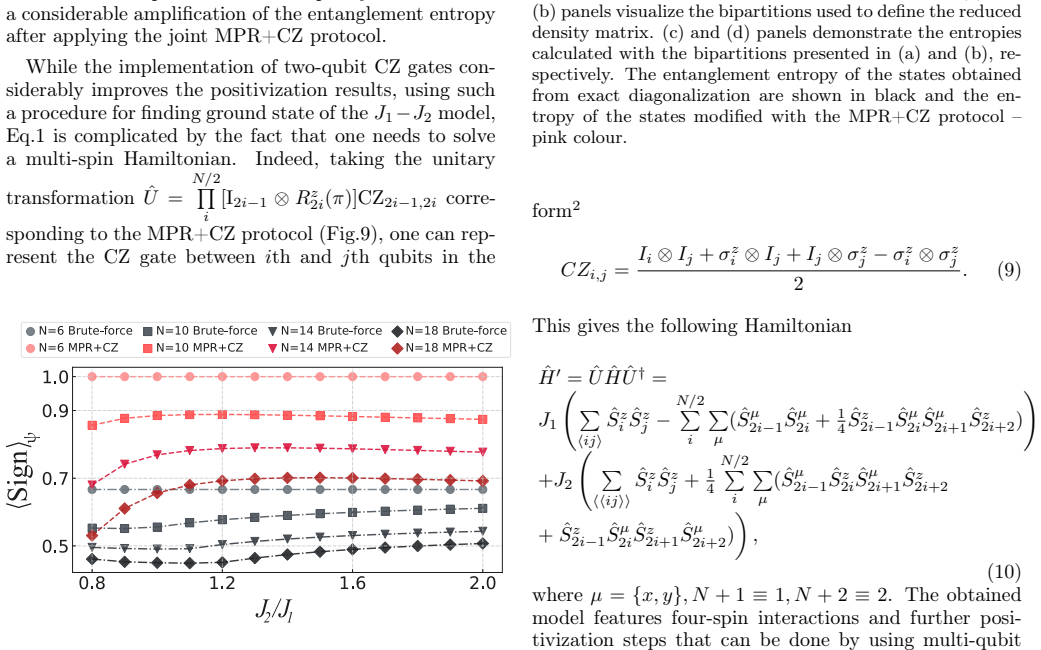
Utilizing a brute force approach based on a set of single-qubit transformations we evaluate protocols enabling positivization of the one-dimensional J1-J2 model ground states in the regime of strong frustration. Based on the obtained positivization results, we show the difference between the cases of periodic and open boundary conditions, and also establish the dependence of the sign structure on parity of the simulated spin chains.
What carries the argument
Brute-force enumeration of single-qubit transformations applied to each site to locate a basis in which all ground-state amplitudes are non-negative.
If this is right
- Positivization succeeds with only local single-qubit operations for the strongly frustrated J1-J2 chain.
- Open and periodic boundary conditions require distinct sets of transformations.
- The sign pattern of the positivized state depends on whether the chain length is even or odd.
- The method avoids any need for multi-qubit or non-local operations.
Where Pith is reading between the lines
- If single-qubit rotations suffice here, the same local search might positivize ground states of other one-dimensional frustrated models.
- States obtained this way could serve as sign-problem-free inputs for variational or quantum Monte Carlo methods.
- The observed parity dependence may reflect a hidden symmetry that could be exploited in larger systems.
Load-bearing premise
That a brute-force enumeration of single-qubit transformations is sufficient to achieve positivization for the ground states in the strong-frustration regime without requiring multi-qubit or non-local operations.
What would settle it
A concrete ground-state vector for a chosen chain length and boundary condition in which no combination of single-qubit rotations produces strictly non-negative coefficients.
Figures


read the original abstract
Exploring sign structures of quantum wave functions attracts considerable attention due to the potential for advances in modeling complex phases of matter. This stimulates developing different optimization procedures for imitating and manipulating sign structures of quantum states. In this work, utilizing a brute force approach based on a set of single-qubit transformations we evaluate protocols enabling positivization of the one-dimensional $J_1 -J_2$ model ground states in the regime of strong frustration. Based on the obtained positivization results, we show the difference between the cases of periodic and open boundary conditions, and also establish the dependence of the sign structure on parity of the simulated spin chains.
Editorial analysis
A structured set of objections, weighed in public.
Referee Report
Summary. The manuscript presents a brute-force numerical protocol that enumerates products of single-qubit unitaries (rotations and phase flips) to drive all coefficients of the exact ground state of the one-dimensional J1-J2 Heisenberg model non-negative in the strongly frustrated regime. It reports that successful positivization and the underlying sign pattern differ between periodic and open boundary conditions and further depend on the parity of the chain length.
Significance. If the single-qubit ansatz reliably positivizes the ground states, the work would supply concrete, falsifiable information about the locality of the sign structure in a canonical frustrated spin chain, which is relevant to variational Monte Carlo, tensor-network representations, and quantum simulation. The boundary-condition and parity distinctions constitute specific, testable claims that could guide subsequent analytic or numerical studies of sign patterns.
major comments (2)
- [§3 (Method)] §3 (Method): The protocol is restricted to independent single-qubit transformations. At J2/J1 ≈ 0.5 the Marshall sign rule is violated and the ground-state sign pattern is known to be non-local; the manuscript does not demonstrate that the enumerated single-qubit set is complete or that residual negative coefficients remain zero after the transformation for the system sizes examined.
- [§4 (Results)] §4 (Results): No quantitative diagnostics are supplied—e.g., the fraction of negative coefficients before/after transformation, Hilbert-space dimensions, success rates across multiple J2/J1 values, or direct comparison with exact diagonalization for small chains. Without these data the reported differences between periodic and open boundaries cannot be evaluated.
minor comments (2)
- [Methods] The explicit matrix representations of the single-qubit gates employed in the enumeration should be stated once in the methods section for reproducibility.
- [Figures] Figure captions should include the precise value of J2/J1, the range of chain lengths, and whether the data correspond to the ground state or a low-lying excited state.
Simulated Author's Rebuttal
We thank the referee for their careful reading and constructive comments. We address the major points below and clarify the scope and limitations of our brute-force single-qubit positivization approach while incorporating additional quantitative support in the revision.
read point-by-point responses
-
Referee: [§3 (Method)] The protocol is restricted to independent single-qubit transformations. At J2/J1 ≈ 0.5 the Marshall sign rule is violated and the ground-state sign pattern is known to be non-local; the manuscript does not demonstrate that the enumerated single-qubit set is complete or that residual negative coefficients remain zero after the transformation for the system sizes examined.
Authors: We agree that the single-qubit ansatz is a restricted class and does not capture potentially non-local sign structures that may appear at larger sizes. Within this ansatz, however, the enumeration is exhaustive for the accessible system sizes (N ≤ 12). For every ground state examined we explicitly verified that the optimal product of single-qubit unitaries yields strictly non-negative coefficients; no residual negatives remain. We will add an explicit statement of this verification together with a clear caveat that the ansatz is not claimed to be complete for arbitrary system sizes or to prove locality of the sign structure. revision: partial
-
Referee: [§4 (Results)] No quantitative diagnostics are supplied—e.g., the fraction of negative coefficients before/after transformation, Hilbert-space dimensions, success rates across multiple J2/J1 values, or direct comparison with exact diagonalization for small chains. Without these data the reported differences between periodic and open boundaries cannot be evaluated.
Authors: We accept that the original manuscript lacks these quantitative benchmarks. In the revised version we will include (i) tables reporting the fraction of negative coefficients before and after the optimal transformation, (ii) the Hilbert-space dimensions for each chain length, (iii) success rates for positivization over a grid of J2/J1 values around 0.5, and (iv) direct comparisons with exact-diagonalization results for the smallest chains to substantiate the reported boundary-condition and parity dependence. revision: yes
Circularity Check
No circularity: direct brute-force numerical search over single-qubit transformations
full rationale
The paper presents a computational protocol that enumerates products of single-qubit unitaries and applies them to the exact ground-state wavefunction of the J1-J2 chain, checking whether all coefficients become non-negative. This procedure is self-contained: the input is the numerically obtained ground state (from exact diagonalization or similar), the search is exhaustive within the stated single-qubit ansatz, and the reported differences between periodic/open boundaries and even/odd parity are direct empirical outputs of that enumeration. No derivation chain, fitted parameter renamed as prediction, or self-citation load-bearing step is present; the central claims follow immediately from the numerical results without reducing to the inputs by construction.
Axiom & Free-Parameter Ledger
axioms (1)
- domain assumption The J1-J2 Hamiltonian with given coupling ratio accurately captures the low-energy physics of the spin chain.
Lean theorems connected to this paper
-
IndisputableMonolith/Cost/FunctionalEquation.leanwashburn_uniqueness_aczel unclear?
unclearRelation between the paper passage and the cited Recognition theorem.
utilizing a brute force approach based on a set of single-qubit transformations we evaluate protocols enabling positivization of the one-dimensional J1−J2 model ground states in the regime of strong frustration
-
IndisputableMonolith/Foundation/ArithmeticFromLogic.leanLogicNat recovery and embed_strictMono unclear?
unclearRelation between the paper passage and the cited Recognition theorem.
the Marshall-Peierls rule … odd and even schemes … MPR+CZ protocol
What do these tags mean?
- matches
- The paper's claim is directly supported by a theorem in the formal canon.
- supports
- The theorem supports part of the paper's argument, but the paper may add assumptions or extra steps.
- extends
- The paper goes beyond the formal theorem; the theorem is a base layer rather than the whole result.
- uses
- The paper appears to rely on the theorem as machinery.
- contradicts
- The paper's claim conflicts with a theorem or certificate in the canon.
- unclear
- Pith found a possible connection, but the passage is too broad, indirect, or ambiguous to say the theorem truly supports the claim.
Reference graph
Works this paper leans on
-
[1]
T. Grover and M. P. A. Fisher, Entanglement and the sign structure of quantum states, Phys. Rev. A 92, 042308 (2015)
work page 2015
-
[2]
O. M. Sotnikov, I. A. Iakovlev, E. O. Kiktenko, A. K. Fedorov, V. V. Mazurenko, Achieving the volume-law entropy regime with random-sign Dicke states, Phys. Rev. A 110, 062416 (2024)
work page 2024
-
[3]
M. A. Nielsen and I. L. Chuang, Quantum Computation and Quantum Information (Cambridge University Press, Cambridge, 2000)
work page 2000
- [4]
-
[5]
G. Carleo and M. Troyer, M. Solving the quantum many-body problem with artificial neural networks, Science 355, 602-606 (2017)
work page 2017
-
[6]
S. R. Clark, Unifying neural-network quantum states and correlator product states via tensor networks, J. Phys. A: Math. Theor. 51, 135301 (2018)
work page 2018
-
[7]
O. M. Sotnikov, I. A. Iakovlev, E. O. Kiktenko, M. I. Katsnelson, A. K. Fedorov, and V. V. Mazurenko, Emergence of global receptive fields capturing multipartite quantum correlations, Phys. Rev. B 112, 054425 (2025)
work page 2025
-
[8]
Xun Gao and Lu-Ming Duan, Efficient representation of quantum many-body states with deep neural networks, Nat. Commun. 8, 662 (2017)
work page 2017
-
[9]
T. Westerhout, N. Astrakhantsev, K. S. Tikhonov, M. I. Katsnelson1, and A. A. Bagrov, Generalization properties of neural network approximations to frustrated magnet ground states, Nat. Commun. 11, 1593 (2020)
work page 2020
-
[10]
K. Choo, T. Neupert, and G. Carleo, Two-dimensional frustrated J1-J2 model studied with neural network quantum states, Phys. Rev. B 100, 125124 (2019)
work page 2019
-
[11]
A. Chen, K. Choo, N. Astrakhantsev and T. Neupert, Neural network evolution strategy for solving quantum sign structures, Phys. Rev. Res. 4, L022026 (2022)
work page 2022
-
[12]
X. Ou, T. Huang, V. Ozolins, Improving neural network performance for solving quantum sign structure, Phys. Rev. B 112, 165122 (2025)
work page 2025
-
[13]
A. Szab\'o, C. Castelnovo, Neural network wave functions and the sign problem, Phys. Rev. Res. 2, 033075 (2020)
work page 2020
-
[14]
T. Westerhout, M. I. Katsnelson, and A. A. Bagrov, Many-body quantum sign structures as non-glassy Ising models, Commun. Phys. 6, 275 (2023)
work page 2023
-
[15]
W. Marshall and R. E. Peierls, Antiferromagnetism, Proc. R. Soc. London A 232, 48 (1955)
work page 1955
-
[16]
Torlai, Augmenting Quantum Mechanics with Artificial Intelligence, (2018)
G. Torlai, Augmenting Quantum Mechanics with Artificial Intelligence, (2018)
work page 2018
-
[17]
L. L. Viteritti, F. Ferrari, F. Becca, Accuracy of Restricted Boltzmann Machines for the one-dimensional J1-J2 Heisenberg model, SciPost Phys. 12, 166 (2022)
work page 2022
- [18]
-
[19]
Westerhout, Lattice-symmetries: A package for working with quantum many-body bases, J
T. Westerhout, Lattice-symmetries: A package for working with quantum many-body bases, J. Open Source Softw. 6, 3537 (2021)
work page 2021
-
[20]
C.K. Majumdar, D.K. Ghosh, On Next-Nearest-Neighbor Interaction in Linear Chain. I, J. Math. Phys. 10, 1388 (1969)
work page 1969
-
[21]
C.K. Majumdar, D.K. Ghosh, On Next-Nearest-Neighbor Interaction in Linear Chain. II, J. Math. Phys. 10, 1399 (1969)
work page 1969
-
[22]
T. Tonegawa and I. Harada, Ground-state properties of the one-dimensional isotropic spin-1/2 Heisenberg antiferromagnet with competing interactions, J. Phys. Soc. Jpn. 56, 2153 (1987)
work page 1987
-
[23]
S. Chen, L. Wang, Shi-Jian Gu, Y. Wang, Fidelity and Quantum phase transition for the Heisenberg chain with the next-nearest-neighbor interaction, Phys. Rev. E 76, 061108 (2007)
work page 2007
-
[24]
S. R. White, I. Affleck, Dimerization and incommensurate spiral spin correlations in the zigzag spin chain: Analogies to the Kondo lattice, Phys. Rev. B 54, 9862 (1996)
work page 1996
-
[25]
L. L. Viteritti, R. Rende, and F. Becca, Transformer variational wave functions for frustrated quantum spin systems, Phys. Rev. Lett. 130, 236401 (2023)
work page 2023
-
[26]
Eggert, Numerical evidence for multiplicative logarithmic corrections from marginal operators, Phys
S. Eggert, Numerical evidence for multiplicative logarithmic corrections from marginal operators, Phys. Rev. B 54, R9612 (1996)
work page 1996
-
[27]
A. Sandvik, Computational studies of quantum spin systems, AIP Conference Proceedings 1297(1), 135 (2010)
work page 2010
-
[28]
O. M. Sotnikov, E. A. Stepanov, M. I. Katsnelson, F. Mila, and V. V. Mazurenko, Emergence of Classical Magnetic Order from Anderson Towers: Quantum Darwinism in Action, Phys. Rev. X 13, 041027 (2023)
work page 2023
-
[29]
V.S. Okatev, O.M. Sotnikov, V.V. Mazurenko, Exploring entanglement in finite-size quantum systems with degenerate ground state, Phys. Rev. B 111, 054443 (2025)
work page 2025
discussion (0)
Sign in with ORCID, Apple, or X to comment. Anyone can read and Pith papers without signing in.