Robust Nonlinear Transform Coding: A Framework for Generalizable Joint Source-Channel Coding
Pith reviewed 2026-05-17 05:58 UTC · model grok-4.3
The pith
Robust nonlinear transform coding enables generalizable digital JSCC by modeling latent uncertainty with a Gaussian proxy to adapt quantization and transmission without channel-specific retraining.
A machine-rendered reading of the paper's core claim, the machinery that carries it, and where it could break.
Core claim
Robust-NTC couples variational latent modeling with channel-adaptive transmission by explicitly modeling element-wise latent distributions via a variational objective that employs a Gaussian proxy for quantization and channel noise; this lets the encoder-decoder capture latent uncertainty without channel-specific training and supports rate-distortion optimization that selects quantizers and bit depths according to observed channel conditions, all within a unified resource allocation scheme for OFDM that jointly tunes quantization, bits, modulation, and power to meet distortion targets while minimizing latency.
What carries the argument
The variational objective with Gaussian proxy for quantization and channel noise, which captures element-wise latent uncertainty and drives adaptive quantizer and bit-depth selection based on online channel statistics.
If this is right
- The encoder-decoder pair can be trained once and then deployed across a range of channel conditions without retraining.
- Rate-distortion optimization becomes possible at transmission time by selecting per-element quantizers and bit depths using learned latent statistics.
- A single resource allocation routine can jointly set quantization, bit loading, modulation order, and power to cut latency while respecting learned distortion bounds in OFDM.
- Simulation results indicate higher rate-distortion efficiency and more consistent reconstruction quality than both conventional separated coding and prior digital JSCC methods.
Where Pith is reading between the lines
- The same variational proxy and adaptive allocation logic could be tested in other multicarrier or single-carrier wireless systems to check whether the channel-agnostic property holds beyond OFDM.
- Because training no longer needs to embed specific channel realizations, the framework might lower the data-collection burden for learning-based JSCC in environments where channel statistics change over time.
- Hardware experiments could measure actual end-to-end latency gains when the joint optimization of quantization, bits, modulation, and power is implemented on real-time platforms.
Load-bearing premise
That a Gaussian approximation for quantization and channel noise inside the variational objective is accurate enough to represent latent uncertainty and permit reliable element-wise adaptation without any channel-specific training.
What would settle it
A direct comparison showing that reconstruction fidelity drops sharply or rate-distortion performance becomes unstable when the actual noise statistics deviate from the Gaussian proxy, for example under strong non-Gaussian interference or rapid channel fluctuations not captured by the online adaptation.
Figures


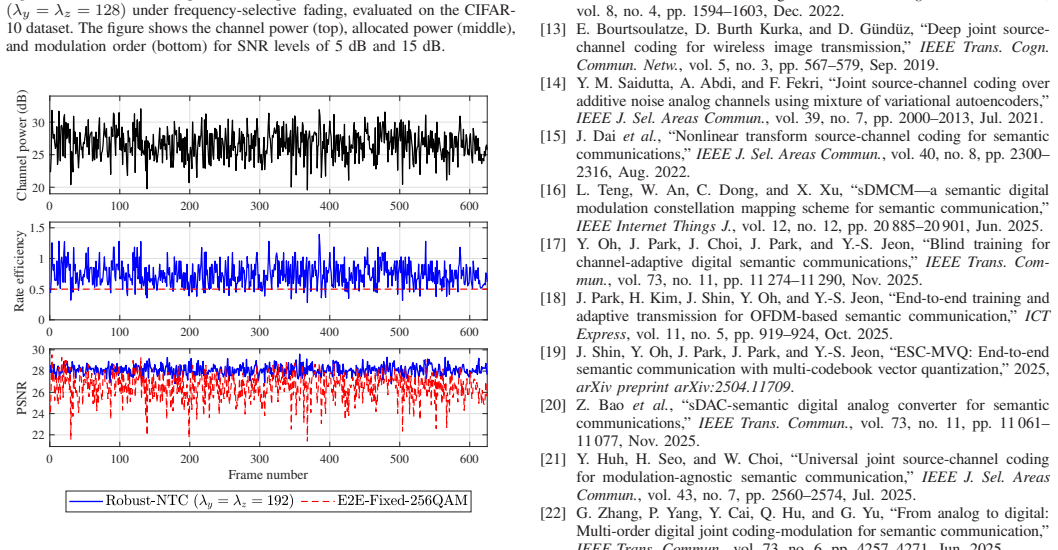
read the original abstract
This paper proposes robust nonlinear transform coding (Robust-NTC), a generalizable digital joint source-channel coding (JSCC) framework that couples variational latent modeling with channel-adaptive transmission. Unlike learning-based JSCC methods that implicitly absorb channel variations, Robust-NTC explicitly models element-wise latent distributions via a variational objective with a Gaussian proxy for quantization and channel noise, allowing encoder-decoder to capture latent uncertainty without channel-specific training. Using the learned statistics, Robust-NTC also facilitates rate-distortion optimization to adaptively select element-wise quantizers and bit depths according to online channel conditions. To support practical deployment, Robust-NTC is integrated into an orthogonal frequency-division multiplexing (OFDM) system, where a unified resource allocation framework jointly optimizes latent quantization, bit allocation, modulation order, and power allocation to minimize transmission latency while guaranteeing learned distortion targets. Simulation results demonstrate that for practical OFDM systems, Robust-NTC achieves superior rate-distortion efficiency and stable reconstruction fidelity compared to both a conventional separated coding scheme and digital JSCC baselines across various channel conditions.
Editorial analysis
A structured set of objections, weighed in public.
Referee Report
Summary. The paper proposes Robust Nonlinear Transform Coding (Robust-NTC), a digital JSCC framework that couples variational latent modeling with a Gaussian proxy for quantization and channel noise. This enables element-wise modeling of latent uncertainty, adaptive selection of quantizers and bit depths from learned statistics without channel-specific retraining, and integration into an OFDM system via a unified resource allocator that jointly optimizes quantization, bit allocation, modulation order, and power allocation to minimize latency subject to learned distortion targets. Simulations are reported to demonstrate superior rate-distortion efficiency and stable reconstruction fidelity relative to separated source-channel coding and other digital JSCC baselines across channel conditions.
Significance. A framework that achieves channel-adaptive JSCC performance without per-channel retraining would be valuable for practical OFDM deployments where conditions vary. The explicit variational modeling and unified allocator represent a structured alternative to implicit learning-based JSCC, provided the Gaussian proxy remains sufficiently accurate for the adaptation step.
major comments (1)
- [§3 (variational objective) and OFDM resource allocation section] The Gaussian proxy for combined quantization and channel noise (used to derive per-element latent uncertainty and feed the rate-distortion optimizer) is load-bearing for the central claim of generalizability without channel-specific training. In §3 (variational objective) and the OFDM integration section, the paper should provide either a derivation showing when the post-demodulation noise remains approximately Gaussian or empirical validation (e.g., Kolmogorov-Smirnov tests or KL divergence between proxy and measured residuals) under frequency-selective fading, residual ICI, and the specific modulation orders employed. Without this, the reported superiority in rate-distortion curves may not generalize beyond the simulated conditions.
minor comments (2)
- Clarify the exact channel models, SNR ranges, fading parameters, and number of Monte Carlo trials used in the simulations; the abstract's reference to 'various channel conditions' is too vague for reproducibility.
- [OFDM integration section] The description of the unified resource allocator would benefit from an explicit statement of the optimization problem (objective and constraints) and the solver employed.
Simulated Author's Rebuttal
We thank the referee for the constructive comments on our manuscript. We respond to the major comment as follows.
read point-by-point responses
-
Referee: [§3 (variational objective) and OFDM resource allocation section] The Gaussian proxy for combined quantization and channel noise (used to derive per-element latent uncertainty and feed the rate-distortion optimizer) is load-bearing for the central claim of generalizability without channel-specific training. In §3 (variational objective) and the OFDM integration section, the paper should provide either a derivation showing when the post-demodulation noise remains approximately Gaussian or empirical validation (e.g., Kolmogorov-Smirnov tests or KL divergence between proxy and measured residuals) under frequency-selective fading, residual ICI, and the specific modulation orders employed. Without this, the reported superiority in rate-distortion curves may not generalize beyond the simulated conditions.
Authors: We thank the referee for this important observation. The Gaussian proxy is indeed central to enabling channel-adaptive behavior without retraining. In the current manuscript, we rely on this approximation to model the effective noise in the latent space for the variational objective. Although we have not provided an explicit derivation or empirical validation in the original submission, our simulation results across multiple channel conditions support its practical utility. In the revised manuscript, we will add a derivation in §3 under the assumption of perfect channel equalization and cyclic prefix mitigating ICI, showing that the post-demodulation noise can be approximated as Gaussian for the considered modulations. Additionally, we will include empirical results in a new figure or appendix demonstrating the KL divergence and KS test statistics between the proxy and observed residuals for frequency-selective fading channels. revision: yes
Circularity Check
No significant circularity; derivation chain is self-contained
full rationale
The paper's claimed derivation proceeds from a variational latent model using an explicit Gaussian proxy for quantization and channel noise (a standard modeling assumption), through learned per-element statistics that enable online quantizer/bit-depth selection, to a unified OFDM resource allocator minimizing latency subject to distortion targets. None of these steps reduce by the paper's own equations to quantities defined solely in terms of the paper's fitted outputs or prior self-citations; the performance claims rest on external simulation comparisons against separated coding and digital JSCC baselines rather than any internal redefinition or forced prediction. The framework therefore remains independent of its own results.
Axiom & Free-Parameter Ledger
axioms (1)
- domain assumption Gaussian proxy sufficiently models quantization and channel noise effects in the variational objective
Lean theorems connected to this paper
-
IndisputableMonolith/Cost/FunctionalEquation.leanwashburn_uniqueness_aczel unclear?
unclearRelation between the paper passage and the cited Recognition theorem.
a variational objective with a Gaussian proxy for quantization and channel noise, allowing encoder-decoder to capture latent uncertainty without channel-specific training
-
IndisputableMonolith/Foundation/RealityFromDistinction.leanreality_from_one_distinction unclear?
unclearRelation between the paper passage and the cited Recognition theorem.
distortion-matching strategy exploits the learned statistics to determine, for each latent element, the optimal quantizer and bit depth
What do these tags mean?
- matches
- The paper's claim is directly supported by a theorem in the formal canon.
- supports
- The theorem supports part of the paper's argument, but the paper may add assumptions or extra steps.
- extends
- The paper goes beyond the formal theorem; the theorem is a base layer rather than the whole result.
- uses
- The paper appears to rely on the theorem as machinery.
- contradicts
- The paper's claim conflicts with a theorem or certificate in the canon.
- unclear
- Pith found a possible connection, but the passage is too broad, indirect, or ambiguous to say the theorem truly supports the claim.
Reference graph
Works this paper leans on
-
[1]
R. G. Gallager, Information Theory and Reliable Communication . New Y ork, NY , USA: Springer, 1968
work page 1968
-
[2]
A mathematical theory of communication,
C. E. Shannon, “A mathematical theory of communication, ” Bell Syst. Tech. J., vol. 27, no. 3, pp. 379–423, Jul. 1948
work page 1948
-
[3]
Channel coding r ate in the finite blocklength regime,
Y . Polyanskiy, H. V . Poor, and S. V erdu, “Channel coding r ate in the finite blocklength regime,” IEEE Trans. Inf. Theory , vol. 56, no. 5, pp. 2307–2359, May 2010
work page 2010
-
[4]
End-to-end optimized image compression,
J. Ball´ e, V . Laparra, and E. P . Simoncelli, “End-to-end optimized image compression,” in Proc. Int. Conf. Learn. Represent. (ICLR) , Apr. 2017, pp. 1–27
work page 2017
-
[5]
J. Ball´ e et al. , “Nonlinear transform coding,” IEEE J. Sel. Topics Signal Process., vol. 15, no. 2, pp. 339–353, Feb. 2021
work page 2021
-
[6]
V ariational image compression with a scale hyperprior,
J. Ball´ e, D. Minnen, S. Singh, S. J. Hwang, and N. Johnsto n, “V ariational image compression with a scale hyperprior,” in Proc. Int. Conf. Learn. Represent. (ICLR) , May 2018, pp. 1–10
work page 2018
-
[7]
Analog joint sou rce-channel coding using non-linear curves and MMSE decoding,
Y . Hu, J. Garcia-Frias, and M. Lamarca, “Analog joint sou rce-channel coding using non-linear curves and MMSE decoding,” IEEE Trans. Commun., vol. 59, no. 11, pp. 3016–3026, Nov. 2011
work page 2011
-
[8]
On zero- delay source-channel coding,
E. Akyol, K. B. Viswanatha, K. Rose, and T. A. Ramstad, “On zero- delay source-channel coding,” IEEE Trans. Inf. Theory , vol. 60, no. 12, pp. 7473–7489, Dec. 2014
work page 2014
-
[9]
Quantizing for noisy channe ls,
A. Kurtenbach and P . Wintz, “Quantizing for noisy channe ls,” IEEE Trans. Commun. Techn., , vol. 17, no. 2, pp. 291–302, Apr. 1969
work page 1969
-
[10]
Optimal quantizer d esign for noisy channels: An approach to combined source-channel coding,
N. Farvardin and V . V aishampayan, “Optimal quantizer d esign for noisy channels: An approach to combined source-channel coding,” IEEE Trans. Inf. Theory , vol. 33, no. 6, pp. 827–838, Nov. 1987
work page 1987
-
[11]
OFDM-bas ed digital semantic communication with importance awareness ,
C. Liu, C. Guo, Y . Y ang, W. Ni, and T. Q. S. Quek, “OFDM-bas ed digital semantic communication with importance awareness ,” IEEE Trans. Commun., vol. 72, no. 10, pp. 6301–6315, Oct. 2024
work page 2024
-
[12]
Semantic coding for t ext transmission: An iterative design,
S. Y ao, K. Niu, S. Wang, and J. Dai, “Semantic coding for t ext transmission: An iterative design,” IEEE Trans. Cogn. Commun. Netw. , vol. 8, no. 4, pp. 1594–1603, Dec. 2022
work page 2022
-
[13]
Dee p joint source- channel coding for wireless image transmission,
E. Bourtsoulatze, D. Burth Kurka, and D. G¨ und¨ uz, “Dee p joint source- channel coding for wireless image transmission,” IEEE Trans. Cogn. Commun. Netw., vol. 5, no. 3, pp. 567–579, Sep. 2019
work page 2019
-
[14]
Y . M. Saidutta, A. Abdi, and F. Fekri, “Joint source-cha nnel coding over additive noise analog channels using mixture of variationa l autoencoders,” IEEE J. Sel. Areas Commun. , vol. 39, no. 7, pp. 2000–2013, Jul. 2021
work page 2000
-
[15]
Nonlinear transform source-channel coding for semantic communications,
J. Dai et al. , “Nonlinear transform source-channel coding for semantic communications,” IEEE J. Sel. Areas Commun. , vol. 40, no. 8, pp. 2300– 2316, Aug. 2022
work page 2022
-
[16]
sDMCM—a semantic digi tal modulation constellation mapping scheme for semantic comm unication,
L. Teng, W. An, C. Dong, and X. Xu, “sDMCM—a semantic digi tal modulation constellation mapping scheme for semantic comm unication,” IEEE Internet Things J. , vol. 12, no. 12, pp. 20 885–20 901, Jun. 2025
work page 2025
-
[17]
Blind tr aining for channel-adaptive digital semantic communications,
Y . Oh, J. Park, J. Choi, J. Park, and Y .-S. Jeon, “Blind tr aining for channel-adaptive digital semantic communications,” IEEE Trans. Com- mun., vol. 73, no. 11, pp. 11 274–11 290, Nov. 2025
work page 2025
-
[18]
End-to-e nd training and adaptive transmission for OFDM-based semantic communicat ion,
J. Park, H. Kim, J. Shin, Y . Oh, and Y .-S. Jeon, “End-to-e nd training and adaptive transmission for OFDM-based semantic communicat ion,” ICT Express, vol. 11, no. 5, pp. 919–924, Oct. 2025
work page 2025
-
[19]
ESC-MVQ : End-to-end semantic communication with multi-codebook vector quanti zation,
J. Shin, Y . Oh, J. Park, J. Park, and Y .-S. Jeon, “ESC-MVQ : End-to-end semantic communication with multi-codebook vector quanti zation,” 2025, arXiv preprint arXiv:2504.11709
-
[20]
sDAC-semantic digital analog converter for semantic communications,
Z. Bao et al. , “sDAC-semantic digital analog converter for semantic communications,” IEEE Trans. Commun. , vol. 73, no. 11, pp. 11 061– 11 077, Nov. 2025
work page 2025
-
[21]
Universal joint source-cha nnel coding for modulation-agnostic semantic communication,
Y . Huh, H. Seo, and W. Choi, “Universal joint source-cha nnel coding for modulation-agnostic semantic communication,” IEEE J. Sel. Areas Commun., vol. 43, no. 7, pp. 2560–2574, Jul. 2025
work page 2025
-
[22]
From analog to digital: Multi-order digital joint coding-modulation for semantic communication,
G. Zhang, P . Y ang, Y . Cai, Q. Hu, and G. Y u, “From analog to digital: Multi-order digital joint coding-modulation for semantic communication,” IEEE Trans. Commun. , vol. 73, no. 6, pp. 4257–4271, Jun. 2025
work page 2025
-
[23]
Study on channel model for frequencies from 0.5 t o 100 GHz, version 18.0.0,
3GPP, “Study on channel model for frequencies from 0.5 t o 100 GHz, version 18.0.0,” 3GPP , Sophia Antipolis, France, 3GPP Rep. (TR) 38.901, Apr. 2024, available: http://www.3gpp.org/DynaReport/3 8901.htm
work page 2024
-
[24]
Auto-Encoding Variational Bayes
D. P . Kingma and M. Welling, “Auto-encoding variationa l bayes,” 2013, arXiv preprint arXiv:1312.6114
work page internal anchor Pith review Pith/arXiv arXiv 2013
-
[25]
On the general BER expression of one- and two-dimensional amplitude modulations,
K. Cho and D. Y oon, “On the general BER expression of one- and two-dimensional amplitude modulations,” IEEE Trans. Commun., vol. 50, no. 7, pp. 1074–1080, Jul. 2002
work page 2002
-
[26]
Discrete optimization via marginal analysis,
B. Fox, “Discrete optimization via marginal analysis, ” Manage. Sci. , vol. 13, no. 3, pp. 210–216, Nov. 1966
work page 1966
-
[27]
Estimating or Propagating Gradients Through Stochastic Neurons for Conditional Computation
Y . Bengio, N. L´ eonard, and A. Courville, “Estimating o r propagating gradients through stochastic neurons for conditional comp utation,” 2013, arXiv preprint arXiv:1308.3432
work page internal anchor Pith review Pith/arXiv arXiv 2013
-
[28]
Swin transformer: Hierarchical vision transformer usin g shifted windows,
Z. Liu et al. , “Swin transformer: Hierarchical vision transformer usin g shifted windows,” in Proc. IEEE/CVF Int. Conf. Comput. Vis. (ICCV) , Oct. 2021, pp. 10 012–10 022
work page 2021
discussion (0)
Sign in with ORCID, Apple, or X to comment. Anyone can read and Pith papers without signing in.