Infrared absorption spectroscopy of a single polyatomic molecular ion
Pith reviewed 2026-05-17 05:31 UTC · model grok-4.3
The pith
Single-photon recoil from a co-trapped atomic ion reveals the absorption spectrum of one molecular ion.
A machine-rendered reading of the paper's core claim, the machinery that carries it, and where it could break.
Core claim
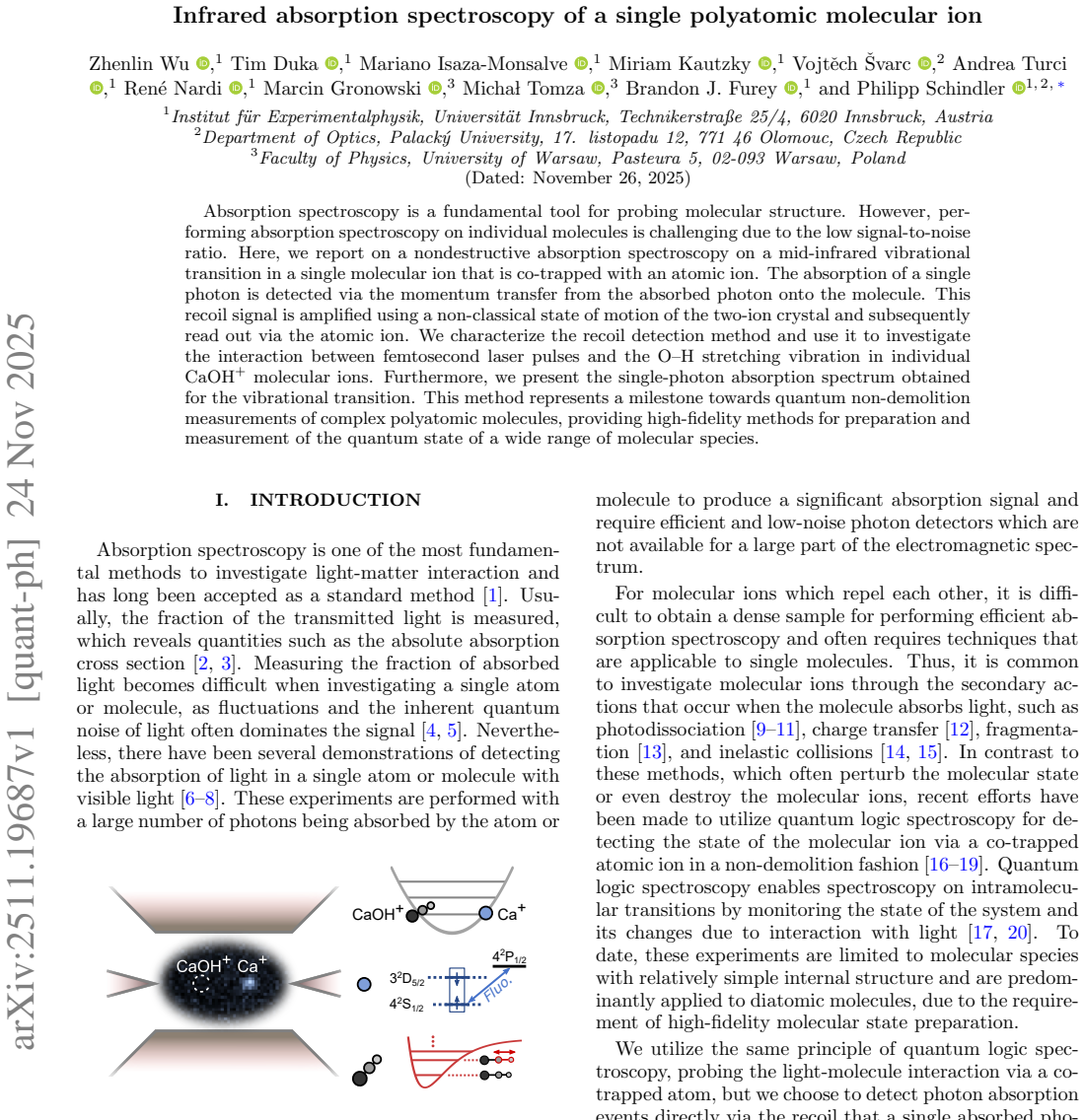
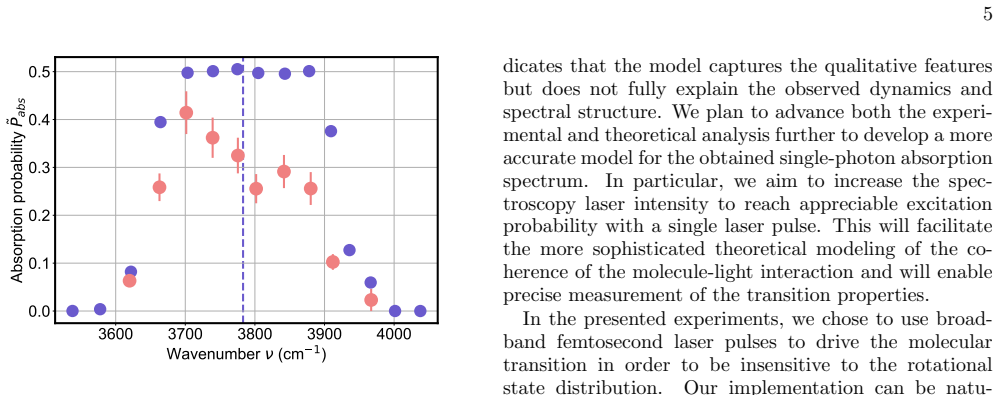
We report on a nondestructive absorption spectroscopy on a mid-infrared vibrational transition in a single molecular ion that is co-trapped with an atomic ion. The absorption of a single photon is detected via the momentum transfer from the absorbed photon onto the molecule. This recoil signal is amplified using a non-classical state of motion of the two-ion crystal and subsequently read out via the atomic ion. We characterize the recoil detection method and use it to investigate the interaction between femtosecond laser pulses and the O-H stretching vibration in individual CaOH+ molecular ions, and present the single-photon absorption spectrum obtained for the vibrational transition.
What carries the argument
Recoil detection via momentum transfer amplified by non-classical motional state in the two-ion crystal, read out through the atomic ion.
If this is right
- This enables high-fidelity preparation and measurement of the quantum state of molecular ions.
- It provides methods for quantum non-demolition measurements of complex polyatomic molecules.
- The technique can be applied to a wide range of molecular species for spectroscopy.
- It allows study of laser-molecule interactions at the single photon level without post-selection or destruction.
Where Pith is reading between the lines
- This method could extend to real-time monitoring of molecular quantum states during chemical processes.
- Connecting to quantum computing, vibrational states in molecules might serve as long-lived qubits if this readout is reliable.
- A testable extension would be to measure other transitions or use different molecular ions to confirm the method's versatility.
Load-bearing premise
The assumption that the recoil kick from absorbing one photon can be reliably distinguished from noise by amplifying it with a non-classical shared motion state between the molecular and atomic ions.
What would settle it
If repeated measurements on the same ion show no distinct absorption peaks at the expected frequencies or if the ion is lost or its state degraded after spectroscopy, the nondestructive single-photon detection claim would be falsified.
Figures


read the original abstract
Absorption spectroscopy is a fundamental tool for probing molecular structure. However, performing absorption spectroscopy on individual molecules is challenging due to the low signal-to-noise ratio. Here, we report on a nondestructive absorption spectroscopy on a mid-infrared vibrational transition in a single molecular ion that is co-trapped with an atomic ion. The absorption of a single photon is detected via the momentum transfer from the absorbed photon onto the molecule. This recoil signal is amplified using a non-classical state of motion of the two-ion crystal and subsequently read out via the atomic ion. We characterize the recoil detection method and use it to investigate the interaction between femtosecond laser pulses and the O-H stretching vibration in individual CaOH+ molecular ions. Furthermore, we present the single-photon absorption spectrum obtained for the vibrational transition. This method represents a milestone towards quantum non-demolition measurements of complex polyatomic molecules, providing high-fidelity methods for preparation and measurement of the quantum state of a wide range of molecular species.
Editorial analysis
A structured set of objections, weighed in public.
Referee Report
Summary. The manuscript reports a nondestructive absorption spectroscopy technique for a single polyatomic molecular ion (CaOH+) co-trapped with an atomic ion. Single-photon absorption on a mid-infrared vibrational transition is detected via recoil momentum transfer to the molecule; this signal is amplified by a non-classical motional state of the two-ion crystal and read out through the atomic ion. The authors characterize the recoil detection method and apply it to obtain the absorption spectrum of the O-H stretch using femtosecond pulses.
Significance. If the central experimental result holds, the work constitutes a notable advance toward quantum non-demolition measurements on complex molecules. It demonstrates a practical route to high-fidelity state preparation and readout for molecular ions without destruction, combining established ion-trapping and motional-control techniques with infrared spectroscopy. Credit is due for the experimental realization on CaOH+ and the explicit characterization of the recoil-amplification protocol.
major comments (2)
- [§4] §4 (Recoil detection characterization): the quantitative enhancement factor achieved by the non-classical motional state is not stated numerically, nor is a direct comparison to a classical thermal state provided; without these numbers it is difficult to assess whether the reported spectrum is truly free of post-selection or noise artifacts as claimed.
- [§5] §5 (Absorption spectrum): the presented spectrum lacks error bars, a stated signal-to-noise ratio, or a control trace with the molecular ion removed; these omissions make it hard to confirm that the observed features arise exclusively from single-photon recoil on the O-H transition.
minor comments (3)
- [Abstract] The abstract would benefit from one or two key quantitative results (e.g., observed linewidth or detection fidelity) to allow readers to gauge the method’s performance at a glance.
- [Figures] Figure captions should explicitly state the integration time per data point and the number of experimental repetitions used to construct the spectrum.
- [§3] Notation for the two-ion motional modes (e.g., center-of-mass vs. stretch) is introduced without a brief reminder of the definitions; a short parenthetical in the text would improve clarity.
Simulated Author's Rebuttal
We thank the referee for their positive assessment of our work and for the constructive comments, which will help improve the clarity and rigor of the presentation. We address each major comment below.
read point-by-point responses
-
Referee: [§4] §4 (Recoil detection characterization): the quantitative enhancement factor achieved by the non-classical motional state is not stated numerically, nor is a direct comparison to a classical thermal state provided; without these numbers it is difficult to assess whether the reported spectrum is truly free of post-selection or noise artifacts as claimed.
Authors: We thank the referee for this observation. We have revised Section 4 to explicitly report the numerical enhancement factor achieved by the non-classical motional state relative to the classical case. We have also added a direct comparison of the recoil signal obtained with the non-classical state to that expected for a classical thermal state with equivalent mean energy, which demonstrates the amplification and confirms that the reported spectrum is not affected by post-selection or noise artifacts. revision: yes
-
Referee: [§5] §5 (Absorption spectrum): the presented spectrum lacks error bars, a stated signal-to-noise ratio, or a control trace with the molecular ion removed; these omissions make it hard to confirm that the observed features arise exclusively from single-photon recoil on the O-H transition.
Authors: We agree that these elements would strengthen the evidence. In the revised manuscript we have added error bars to the data points in the absorption spectrum, stated the signal-to-noise ratio of the observed features, and included a control trace recorded with the molecular ion removed from the trap. The control trace shows a flat background with no absorption features, confirming that the spectrum arises from single-photon recoil on the O-H transition. revision: yes
Circularity Check
No significant circularity: experimental demonstration only
full rationale
The manuscript describes an experimental technique for nondestructive single-photon absorption spectroscopy on a co-trapped molecular ion, relying on recoil momentum transfer amplified by a non-classical motional state of the ion crystal and read out via the atomic ion. No derivation chain, first-principles predictions, fitted parameters renamed as predictions, or self-referential equations appear in the provided abstract or claimed results. The central output is an empirical absorption spectrum for the O-H stretch in CaOH+, obtained after characterizing the recoil detection method. This is a self-contained experimental report whose validity rests on laboratory measurements rather than any reduction of outputs to inputs by construction. No load-bearing self-citations or ansatzes are invoked in the summary material.
Axiom & Free-Parameter Ledger
axioms (1)
- standard math Standard quantum mechanics of light-matter interaction and ion trapping
Lean theorems connected to this paper
-
IndisputableMonolith/Cost/FunctionalEquation.leanwashburn_uniqueness_aczel unclear?
unclearRelation between the paper passage and the cited Recognition theorem.
The recoil signal is amplified using a non-classical state of motion of the two-ion crystal... cat state Ψcat = 1/√2(|+⟩|α⟩ + |−⟩|−α⟩)... S(ηm) = sin(4ηm|α|)
What do these tags mean?
- matches
- The paper's claim is directly supported by a theorem in the formal canon.
- supports
- The theorem supports part of the paper's argument, but the paper may add assumptions or extra steps.
- extends
- The paper goes beyond the formal theorem; the theorem is a base layer rather than the whole result.
- uses
- The paper appears to rely on the theorem as machinery.
- contradicts
- The paper's claim conflicts with a theorem or certificate in the canon.
- unclear
- Pith found a possible connection, but the passage is too broad, indirect, or ambiguous to say the theorem truly supports the claim.
Reference graph
Works this paper leans on
-
[1]
J. M. Hollas,Modern Spectroscopy(John Wiley & Sons, 2004)
work page 2004
- [2]
-
[3]
C. N. Banwell and E. M. McCash,Fundamentals of Molecular Spectroscopy(Indian Edition, 2017)
work page 2017
- [4]
-
[5]
R. Whittaker, C. Erven, A. Neville, M. Berry, J. L. O’Brien, H. Cable, and J. C. F. Matthews, Absorption spectroscopy at the ultimate quantum limit from single- photon states, New J. Phys.19, 023013 (2017)
work page 2017
-
[6]
D. J. Wineland, W. M. Itano, and J. C. Bergquist, Ab- sorption spectroscopy at the limit: Detection of a single atom, Opt. Lett.12, 389 (1987)
work page 1987
-
[7]
M. Celebrano, P. Kukura, A. Renn, and V. Sandoghdar, Single-molecule imaging by optical absorption, Nat. Pho- ton.5, 95 (2011)
work page 2011
-
[8]
E. W. Streed, A. Jechow, B. G. Norton, and D. Kielpin- ski, Absorption imaging of a single atom, Nat. Commun. 3, 933 (2012)
work page 2012
-
[9]
M. Okumura, L. I. Yeh, and Y. T. Lee, The vibrational predissociation spectroscopy of hydrogen cluster ions, J. Chem. Phys.83, 3705 (1985)
work page 1985
-
[10]
J. C. J. Koelemeij, B. Roth, A. Wicht, I. Ernsting, and S. Schiller, Vibrational Spectroscopy of HD + with 2-ppb Accuracy, Phys. Rev. Lett.98, 173002 (2007)
work page 2007
-
[11]
H. Loh, K. C. Cossel, M. C. Grau, K.-K. Ni, E. R. Meyer, J. L. Bohn, J. Ye, and E. A. Cornell, Precision Spec- troscopy of Polarized Molecules in an Ion Trap, Science 342, 1220 (2013)
work page 2013
-
[12]
M. Germann, X. Tong, and S. Willitsch, Observation of electric-dipole-forbidden infrared transitions in cold molecular ions, Nat. Phys.10, 820 (2014)
work page 2014
-
[13]
P. C. Schmid, O. Asvany, T. Salomon, S. Thorwirth, and S. Schlemmer, Leak-Out Spectroscopy, A Univer- sal Method of Action Spectroscopy in Cold Ion Traps, 9 J. Phys. Chem. A126, 8111 (2022)
work page 2022
- [14]
- [15]
-
[16]
F. Wolf, Y. Wan, J. C. Heip, F. Gebert, C. Shi, and P. O. Schmidt, Non-destructive state detection for quan- tum logic spectroscopy of molecular ions, Nature530, 457 (2016)
work page 2016
- [17]
-
[18]
C.-w. Chou, C. Kurz, D. B. Hume, P. N. Plessow, D. R. Leibrandt, and D. Leibfried, Preparation and coherent manipulation of pure quantum states of a single molecu- lar ion, Nature545, 203 (2017)
work page 2017
-
[19]
D. Holzapfel, F. Schmid, N. Schwegler, O. Stadler, M. Stadler, A. Ferk, J. P. Home, and D. Kienzler, Quan- tum Control of a Single H + 2 Molecular Ion, Phys. Rev. X 15, 031009 (2025)
work page 2025
-
[20]
C. W. Chou, A. L. Collopy, C. Kurz, Y. Lin, M. E. Hard- ing, P. N. Plessow, T. Fortier, S. Diddams, D. Leibfried, and D. R. Leibrandt, Frequency-comb spectroscopy on pure quantum states of a single molecular ion, Science 367, 1458 (2020)
work page 2020
- [21]
-
[22]
Y. Wan, F. Gebert, J. B. W¨ ubbena, N. Scharnhorst, S. Amairi, I. D. Leroux, B. Hemmerling, N. L¨ orch, K. Hammerer, and P. O. Schmidt, Precision spectroscopy by photon-recoil signal amplification, Nat. Commun.5, 3096 (2014)
work page 2014
-
[23]
D. Wineland, C. Monroe, W. Itano, D. Leibfried, B. King, and D. Meekhof, Experimental issues in coher- ent quantum-state manipulation of trapped atomic ions, J. Res. Natl. Inst. Stand. Technol.103, 259 (1998)
work page 1998
-
[24]
J. P. Home, Quantum science and metrology with mixed- species ion chains, Adv. At. Mol. Opt. Phys.62, 231 (2013)
work page 2013
- [25]
- [26]
- [27]
-
[28]
Z. Wu, S. Walser, V. Podlesnic, M. Isaza-Monsalve, E. Mattivi, G. Mu, R. Nardi, P. Gniewek, M. Tomza, B. J. Furey, and P. Schindler, Photodissociation spectra of single trapped CaOH+ molecular ions, J. Chem. Phys. 161, 044304 (2024)
work page 2024
-
[29]
Y. Liu, J. Schmidt, Z. Liu, D. R. Leibrandt, D. Leibfried, and C.-w. Chou, Quantum state tracking and control of a single molecular ion in a thermal environment, Science 385, 790 (2024)
work page 2024
-
[30]
Schindler, Ultrafast infrared spectroscopy with single molecular ions, New J
P. Schindler, Ultrafast infrared spectroscopy with single molecular ions, New J. Phys.21, 083025 (2019)
work page 2019
-
[31]
V. B. Braginsky, Y. I. Vorontsov, and K. S. Thorne, Quantum Nondemolition Measurements, Science209, 547 (1980)
work page 1980
-
[32]
D. B. Hume, T. Rosenband, and D. J. Wineland, High-Fidelity Adaptive Qubit Detection through Repeti- tive Quantum Nondemolition Measurements, Phys. Rev. Lett.99, 120502 (2007)
work page 2007
-
[33]
H.-Y. Lo, D. Kienzler, L. de Clercq, M. Marinelli, V. Neg- nevitsky, B. C. Keitch, and J. P. Home, Spin–motion en- tanglement and state diagnosis with squeezed oscillator wavepackets, Nature521, 336 (2015)
work page 2015
-
[34]
S. C. Burd, R. Srinivas, J. J. Bollinger, A. C. Wilson, D. J. Wineland, D. Leibfried, D. H. Slichter, and D. T. C. Allcock, Quantum amplification of mechanical oscillator motion, Science364, 1163 (2019)
work page 2019
-
[35]
L. J. Bond, C. H. Valahu, A. Shankar, T. R. Tan, and A. Safavi-Naini, Optimal Displacement Sensing with Spin-Dependent Squeezed States (2025)
work page 2025
-
[36]
A. Shlykov, M. Roguski, and S. Willitsch, Optimized Strategies for the Quantum-State Preparation of Single Trapped Nitrogen Molecular Ions, Adv. Quantum Tech- nol.8, 2300268 (2025)
work page 2025
-
[37]
H. J. Kim, F. Schmid, D. Holzapfel, and D. Kienzler, State-Selective Ionization and Trapping of Single H+ 2 Ions with (2+1) Multiphoton Ionization (2025)
work page 2025
-
[38]
D. Leibfried, R. Blatt, C. Monroe, and D. Wineland, Quantum dynamics of single trapped ions, Rev. Mod. Phys.75, 281 (2003)
work page 2003
-
[39]
E. Tiesinga, C. J. Williams, and P. S. Julienne, Photoas- sociative spectroscopy of highly excited vibrational lev- els of alkali-metal dimers: Green-function approach for eigenvalue solvers, Phys. Rev. A57, 4257 (1998)
work page 1998
-
[40]
J. Bloino, A VPT2 Route to Near-Infrared Spectroscopy: The Role of Mechanical and Electrical Anharmonicity, J. Phys. Chem. A119, 5269 (2015)
work page 2015
-
[41]
J. G. Hill and K. A. Peterson, Gaussian basis sets for use in correlated molecular calculations. XI. Pseudopotential-based and all-electron relativistic basis sets for alkali metal (K–Fr) and alkaline earth (Ca–Ra) elements, J. Chem. Phys.147, 244106 (2017)
work page 2017
-
[42]
K. A. Peterson and T. H. Dunning Jr, Accurate cor- relation consistent basis sets for molecular core–valence correlation effects: The second row atoms Al–Ar, and the first row atoms B–Ne revisited, J. Chem. Phys.117, 10548 (2002)
work page 2002
-
[43]
R. A. Kendall, T. H. Dunning Jr, and R. J. Harrison, Electron affinities of the first-row atoms revisited. Sys- tematic basis sets and wave functions, J. Chem. Phys. 96, 6796 (1992)
work page 1992
-
[44]
I. S. Lim, H. Stoll, and P. Schwerdtfeger, Relativis- tic small-core energy-consistent pseudopotentials for the alkaline-earth elements from Ca to Ra, J. Chem. Phys. 124, 034107 (2006)
work page 2006
-
[45]
J. F. Stanton, Why CCSD(T) works: A different per- spective, Chem. Phys. Lett.281, 130 (1997)
work page 1997
-
[46]
J. Noga and R. J. Bartlett, The full CCSDT model for molecular electronic structure, J. Chem. Phys.86, 7041 (1987)
work page 1987
-
[47]
A. Halkier, T. Helgaker, P. Jørgensen, W. Klopper, and 10 J. Olsen, Basis-set convergence of the energy in molecular Hartree–Fock calculations, Chem. Phys. Lett.302, 437 (1999)
work page 1999
-
[48]
T. Helgaker, W. Klopper, H. Koch, and J. Noga, Basis- set convergence of correlated calculations on water, J. Chem. Phys.106, 9639 (1997)
work page 1997
-
[49]
D. A. Matthews, L. Cheng, M. E. Harding, F. Lipparini, S. Stopkowicz, T.-C. Jagau, P. G. Szalay, J. Gauss, and J. F. Stanton, Coupled-cluster techniques for compu- tational chemistry: The CFOUR program package, J. Chem. Phys.152, 214108 (2020)
work page 2020
discussion (0)
Sign in with ORCID, Apple, or X to comment. Anyone can read and Pith papers without signing in.