Adaptable Route to Fast Coherent State Transport via Bang-Bang-Bang Protocols
Pith reviewed 2026-05-17 05:38 UTC · model grok-4.3
The pith
A bang-bang-bang protocol with forward and backward trap potentials transports coherent states faster than forward-only methods and approaches the quantum speed limit.
A machine-rendered reading of the paper's core claim, the machinery that carries it, and where it could break.
Core claim
The paper establishes that a bang-bang-bang protocol utilizing a combination of forward- and backward-moving trap potentials expedites the coherent state transport, approaching the quantum speed limit under a harmonic trap potential and surpassing the performance of forward-moving-only potential protocols. It further showcases the advantage of applying squeezed coherent state evolution under a deeper potential followed by a weaker one, where a design of symmetric squeezing potential transports promotes an even shorter timescale for genuine state preparation.
What carries the argument
The bang-bang-bang (BBB) protocol that alternates forward- and backward-moving harmonic trap potentials to shape the state trajectory.
If this is right
- The protocol approaches the quantum speed limit more closely than forward-moving-only methods for coherent state transport.
- Squeezed coherent states evolved under deeper then weaker potentials enable shorter timescales for state preparation.
- The methods outperform conventional forward-moving-only approaches in speed while maintaining coherence.
- These protocols open new routes for rapid state transport and preparation in quantum control tasks.
Where Pith is reading between the lines
- The protocol could be tested in systems with fast tunable traps such as optical tweezers to check how close real implementations come to the ideal switching limit.
- Similar backward-potential segments might combine with other quantum control methods like shortcuts to adiabaticity for hybrid speed gains.
- The squeezed-state variant suggests potential extensions to non-harmonic traps or multi-mode systems where variable depth can be engineered.
Load-bearing premise
The trap potentials can be switched instantaneously between forward and backward moving configurations without introducing significant errors, decoherence, or deviations from the ideal harmonic model.
What would settle it
An experiment that measures the shortest achievable transport time and final fidelity for an atom in a harmonic trap while rapidly reversing the potential direction, compared against the forward-only case.
Figures


read the original abstract
Fast coherent state transport is essential to quantum computation and quantum information processing. While an adiabatic transport of atomic qubits guarantees a high fidelity of the state preparation, it requires a long timescale that defies efficient quantum operations. Here, we propose an adaptable and fast bang-bang-bang (BBB) protocol, utilizing a combination of forwardand backward-moving trap potentials, to expedite the coherent state transport. This protocol approaches the quantum speed limit under a harmonic trap potential, surpassing the performance by the forward-moving-only potential protocols. We further showcase the advantage of applying squeezed coherent state evolution under a deeper potential followed by a weaker one, where a design of symmetric squeezing potential transports promotes an even shorter timescale for genuine state preparation. Our protocols outperform conventional forward-moving-only methods, providing new insights and opportunities for rapid state transport and preparation, ultimately advancing the capabilities of quantum control and quantum operations.
Editorial analysis
A structured set of objections, weighed in public.
Referee Report
Summary. The manuscript proposes a bang-bang-bang (BBB) protocol for rapid coherent-state transport in a harmonic trap. By alternating between forward- and backward-moving trap potentials, the protocol is claimed to approach the quantum speed limit and to outperform forward-moving-only protocols. A second variant using symmetric squeezing potentials applied to squeezed coherent states is shown to yield even shorter transport times.
Significance. If the reported performance holds under the stated idealizations, the work supplies a concrete, adaptable route to near-optimal coherent-state transport that could reduce gate times in trapped-ion or neutral-atom quantum processors. The explicit use of backward-moving potentials to cancel excess kinetic energy is a useful addition to the existing catalog of time-optimal control protocols.
major comments (1)
- [Protocol description and numerical results] Protocol description and numerical results sections: the central claim that the BBB protocol approaches the quantum speed limit rests on the assumption of instantaneous, error-free switching between forward- and backward-moving harmonic potentials. No analysis of finite switching duration, transient non-harmonic terms, or decoherence during the switch is presented; therefore the reported proximity to the QSL and the performance gain over forward-only protocols are obtained only under this idealization.
minor comments (2)
- [Abstract] The abstract introduces the acronym BBB without a brief parenthetical definition or reference to prior bang-bang literature.
- [Figures] Figure captions should explicitly state the trap frequency, initial displacement, and target fidelity used in each panel so that the plots can be reproduced from the text alone.
Simulated Author's Rebuttal
We thank the referee for the positive assessment of our work's significance and for the constructive comment. We respond to the major comment below.
read point-by-point responses
-
Referee: Protocol description and numerical results sections: the central claim that the BBB protocol approaches the quantum speed limit rests on the assumption of instantaneous, error-free switching between forward- and backward-moving harmonic potentials. No analysis of finite switching duration, transient non-harmonic terms, or decoherence during the switch is presented; therefore the reported proximity to the QSL and the performance gain over forward-only protocols are obtained only under this idealization.
Authors: We agree that the reported performance and proximity to the quantum speed limit are obtained under the idealization of instantaneous, error-free switching. This assumption is standard for establishing fundamental bounds in bang-bang control and is stated in the protocol description. The manuscript does not analyze finite switching times, transients, or decoherence, as its scope is the ideal-case performance. In the revised version we will add a short paragraph in the discussion section explicitly listing this idealization and noting that experimental implementations would require smooth switching functions or additional error analysis. revision: yes
Circularity Check
No circularity detected; protocol is a proposed construction under ideal assumptions
full rationale
The paper proposes a bang-bang-bang protocol for fast coherent state transport by combining forward- and backward-moving harmonic trap potentials. The central claims concern performance approaching the quantum speed limit and outperforming forward-only protocols. These rest on the explicit modeling choice of instantaneous switching in a perfect harmonic trap, which is an input assumption rather than a derived result. No equations or steps in the provided text reduce a prediction or first-principles claim to a fitted parameter, self-definition, or self-citation chain. The derivation chain is self-contained as a constructive protocol design, with no load-bearing self-citations or renamings of known results presented as novel derivations. This is the expected non-finding for a methods paper.
Axiom & Free-Parameter Ledger
axioms (1)
- domain assumption The system is accurately modeled by a time-dependent harmonic oscillator potential that can be abruptly switched in direction and depth.
Reference graph
Works this paper leans on
-
[1]
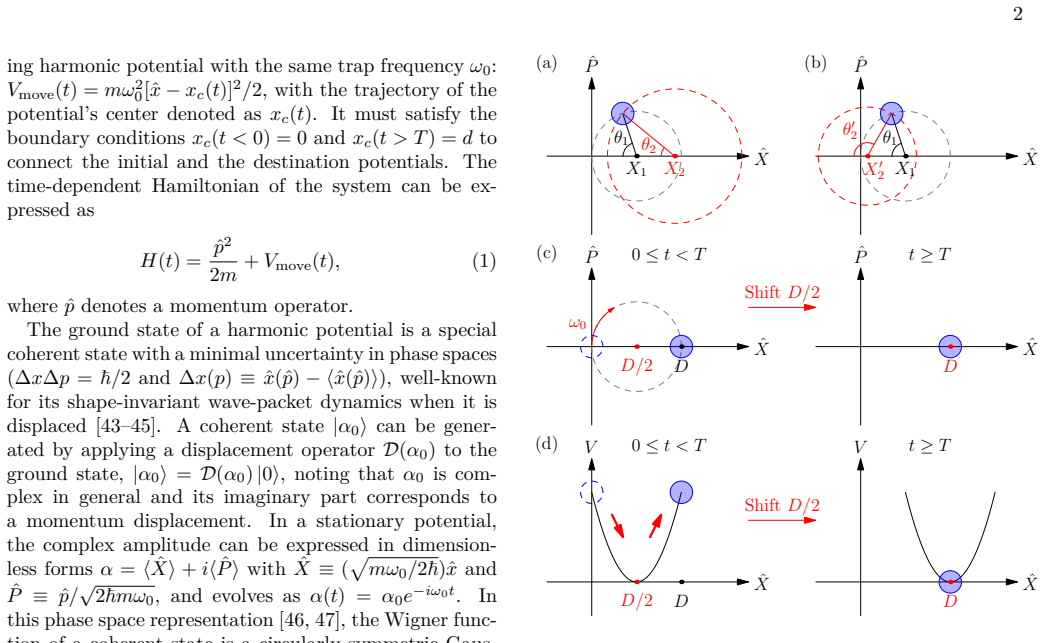
This illustrates the key finding that θ2 < θ 1 < θ ′ 2, demonstrating that forward movements inhibit while back- ward movements accelerate the angular evolution toward π. (c) Phase-space evolution and (d) the corresponding potential trajectory for the standard BB protocol, which demonstrate the forward-moving speed limit τfor = π/ω0. Dashed (filled) circl...
-
[2]
M. A. Nielsen and I. L. Chuang. Quantum Computation and Quantum Information, Cambridge University Press (2000)
work page 2000
-
[3]
J. I. Cirac and P. Zoller, Quantum Computations with Cold Trapped Ions, Phys. Rev. Lett. 74, 4091 (1995)
work page 1995
-
[4]
D. Kielpinski, C. Monroe and D. Wineland, Architecture for a large-scale ion-trap quantum computer, Nature 417, 709–711 (2002)
work page 2002
-
[5]
D. Leibfried, R. Blatt, C. Monroe, and D. Wineland, Quantum dynamics of single trapped ions, Rev. Mod. Phys. 75, 281 (2003). 6
work page 2003
-
[6]
H. Häffner, C. Roos, and R. Blatt, Quantum computing with trapped ions, Phys. Rep. 469, 155 (2008)
work page 2008
-
[7]
J. P. Home, D. Hanneke, J. D. Jost, J. M. Amini, D. Leibfried, and D. J. Wineland, Complete Methods Set for Scalable Ion Trap Quantum Information Processing, Sci- ence 325, 1227 (2009)
work page 2009
-
[8]
H.-Y. Lo, D. Kienzler, L. de Clercq, M. Marinelli, V. Neg- nevitsky, B. C. Keitch, and J. P. Home, Spin–motion en- tanglement and state diagnosis with squeezed oscillator wavepackets, Nature 521, 336 (2015)
work page 2015
-
[9]
D. Bluvstein, H. Levine, G. Semeghini, T. T. Wang, S. Ebadi, M. Kalinowski, A. Keesling, N. Maskara, H. Pichler et al., A quantum processor based on coherent transport of entangled atom arrays, Nature 604, 451 (2022)
work page 2022
-
[10]
T. M. Graham, Y. Song, J. Scott, C. Poole, L. Phuttitarn, K. Jooya, P. Eichler, X. Jiang, A. Marra et al., Multi-qubit entanglement and algorithms on a neutral-atom quantum computer, Nature 604, 457 (2022)
work page 2022
-
[11]
S. Jandura and G. Pupillo, Time-Optimal Two- and Three-Qubit Gates for Rydberg Atoms, Quantum 6, 712 (2022)
work page 2022
-
[12]
S. A. Moses, C. H. Baldwin, M. S. Allman, R. Ancona, L. Ascarrunz, C. Barnes, J. Bartolotta, B. Bjork, P. Blan- chard et al., A Race-Track Trapped-Ion Quantum Proces- sor, Phys. Rev. X 13, 041052 (2023)
work page 2023
-
[13]
S. J. Evered, D. Bluvstein, M. Kalinowski, S. Ebadi, T. Manovitz, H. Zhou, S. H. Li, A. A. Geim, T. T. Wang et al., High-fidelity parallel entangling gates on a neutral- atom quantum computer, Nature 622, 268 (2023)
work page 2023
-
[14]
T. H. Chang, T. N. Wang, H. H. Jen, and Y.-C. Chen, High-fidelity Rydberg controlled-Z gates with optimized pulses, New J. phys. 25, 123007 (2023)
work page 2023
-
[15]
D. Bluvstein, S. J. Evered, A. A. Geim, S. H. Li, H. Zhou, T. Manovitz, S. Ebadi, M. Cain, M. Kalinowski et al., Logical quantum processor based on reconfigurable atom arrays, Nature 626, 58 (2024)
work page 2024
-
[16]
H. J. Manetsch, G.Nomura, E. Bataille, X. Lv, K. H. Leung, and M. Endres, A tweezer array with 6,100 highly coherent atomic qubits, Nature 647, 60 (2025)
work page 2025
-
[17]
D. J. Wineland, C. Monroe, W. M. Itano, D. Leibfried, B. E. King, and D. M. Meekhof, J. Res, Experimental Is- sues in Coherent Quantum-State Manipulation of Trapped Atomic Ions, Natl. Inst. Stand. Technol. 103, 259 (1998)
work page 1998
-
[18]
A. S. Parkins and H. J. Kimble, Quantum state transfer between motion and light, J. Opt. B: Quantum Semiclas- sical Opt. 1, 496 (1999)
work page 1999
-
[19]
M. A. Rowe et al, Transport of quantum states and sepa- ration of ions in a dual RF ion trap. Quant. Inform. Com- put 2, 257–271 (2002)
work page 2002
-
[20]
R. Reichle, D. Leibfried, R.B. Blakestad, J. Britton, J.D. Jost, E. Knill, C. Langer, R. Ozeri, S. Seidelin, D.J. Wineland, Transport dynamics of single ions in segmented microstructured Paul trap arrays, Fortschr. Phys. 54, 666 (2006)
work page 2006
-
[21]
Bowler, et al, Coherent diabatic ion transport and separation in a multizone trap array
R. Bowler, et al, Coherent diabatic ion transport and separation in a multizone trap array. Phys. Rev. Lett. 109, 080502 (2012)
work page 2012
-
[22]
D. Guéry-Odelin, A. Ruschhaupt, A. Kiely, E. Tor- rontegui, S. Martínez-Garaot, and J. G. Muga, Short- cuts to adiabaticity: Concepts, methods, and applications, Rev. Mod. Phys. 91, 045001 (2019)
work page 2019
-
[23]
X. Chen, A. Ruschhaupt, S. Schmidt, A. del Campo, D. Guéry-Odelin, and J. G. Muga, Fast Optimal Frictionless Atom Cooling in Harmonic Traps: Shortcut to Adiabatic- ity, Phys. Rev. Lett. 104, 063002 (2010)
work page 2010
-
[24]
S. An, D. Lv, A. del Campo, and K. Kim, Shortcuts to adiabaticity by counterdiabatic driving for trapped- ion displacement in phase space, Nat. Commun. 7, 12999 (2016)
work page 2016
-
[25]
P. Kaufmann, T. F. Gloger, D. Kaufmann, M.Johanning, and C. Wunderlich, High-Fidelity Preservation of Quan- tum Information During Trapped-Ion Transport, Phys. Rev. Lett. 120, 010501 (2018)
work page 2018
-
[26]
J. R. Finžgar, S. Notarnicola , M. Cain , M. D. Lukin, and D. Sels, Counterdiabatic Driving with Performance Guarantees, Phys. Rev. Lett. 135, 180602 (2025)
work page 2025
- [27]
-
[28]
X. Chen, E. Torrontegui, D. Stefanatos, J.-S. Li, and J. G. Muga, Optimal trajectories for efficient atomic trans- port without final excitation, Phys. Rev. A 84, 043415, (2011)
work page 2011
-
[29]
E. Torrontegui, S. Ibáñez, X. Chen, A. Ruschhaupt, D. Guéry-Odelin, and J. G. Muga, Fast Atomic Transport without Vibrational Heating, Phys. Rev. A 83, 013415 (2011)
work page 2011
-
[30]
Y. Ding, T.-Y. Huang, K. Paul, M. Hao, and X. Chen, Smooth bang-bang shortcuts to adiabaticity for atomic transport in a moving harmonic trap, Phys. Rev. A 101, 063410, (2020)
work page 2020
-
[31]
M. R. Lam, N. Peter, T.n Groh, W.g Alt, C. Robens, D. Meschede, A. Negretti, S. Montangero, T. Calarco et al., Demonstration of Quantum Brachistochrones be- tween Distant States of an Atom, Phys. Rev. X 11, 011035 (2021)
work page 2021
- [32]
-
[33]
G. S. Agarwal, Brownian Motion of a Quantum Oscilla- tor, Phys. Rev. A 4, 739 (1971)
work page 1971
-
[34]
D. J. Daniel and G. J. Milburn, Destruction of quantum coherence in a nonlinear oscillator via attenuation and am- plification, Phys. Rev. A 39, 4628 (1989)
work page 1989
-
[35]
D. J. Wineland, C. Monroe, W. M. Itano, D. Leibfried, B. E. King, D. M. Meekhof, Experimental Issues in Coherent Quantum-State Manipulation of Trapped Atomic Ions, J. Res. Natl. Inst. Stand. Technol. 103, 259 (1998)
work page 1998
- [36]
-
[37]
D. J. Wineland, C. Monroe, D. M. Meekhof, B. E. King, D. Leibfried, W. M. Itano, J. C. Bergquist, D. Berkeland, J. J. Bollinger and J. Miller, Quantum state manipulation of trapped atomic ions, Proc. Roy. Soc. A 454, 1969 (1998)
work page 1969
- [38]
-
[39]
J. J. Morton, et al, Bang-bang control of fullerene qubits using ultrafast phase gates. Nat. Phys. 2, 40–43 (2006)
work page 2006
-
[40]
S. Damodarakurup, M. Lucamarini, G. Di Giuseppe, D. Vitali and P. Tombesi, Experimental inhibition of deco- herence on flying qubits via ‘bang-bang’ control. Phys. Rev. Lett. 103, 040502 (2009)
work page 2009
- [41]
- [42]
-
[43]
D. F. Walls, Squeezed states of light, Nature 306, 141 (1983)
work page 1983
-
[44]
E. C. G. Sudarshan, Equivalence of Semiclassical and Quantum Mechanical Descriptions of Statistical Light Beams, Phys. Rev. Lett. 10, 277 (1963)
work page 1963
-
[45]
R. J. Glauber, Coherent and Incoherent States of the Radiation Field, Phys. Rev. 131, 2766 (1963)
work page 1963
- [46]
-
[47]
Wigner, On the Quantum Correction for Thermody- namic Equilibrium, Phys
E. Wigner, On the Quantum Correction for Thermody- namic Equilibrium, Phys. Rev. 40, 749 (1932)
work page 1932
-
[48]
M. O. Scully and M. S. Zubairy. Quantum Optics, Cam- bridge University Press (1997)
work page 1997
-
[49]
J. Beugnon, C. Tuchendler, H. Marion, A. Gaëtan, Y. Miroshnychenko, Y. R. P. Sortais, A. M. Lance, M. P. A. Jones, G. Messin et al., Two-dimensional transport and transfer of a single atomic qubit in optical tweezers, Nat. Phys. 3, 696 (2007)
work page 2007
-
[50]
See supplemental material for details of the evolution of a coherent state under a series of potential shifts, the quan- tum speed limit, and the calculation of the orientation angle for the squeezed coherent state
- [53]
-
[54]
A. M. Kaufman, B. J. Lester, and C. A. Regal, Cool- ing a Single Atom in an Optical Tweezer to Its Quantum Ground State, Phys. Rev. X 2, 041014 (2012)
work page 2012
-
[55]
D. Barredo, S. de Léséleuc, V. Lienhard, T. Lahaye, and A. Browaeys, An atom-by-atom assembler of defect- free arbitrary two-dimensional atomic arrays, Science 354, 1021 (2016)
work page 2016
-
[56]
D. Barredo, V. Lienhard, S. de Léséleuc, T. Lahaye, and A. Browaeys, Synthetic three-dimensional atomic struc- tures assembled atom by atom, Nature 561, 79 (2018)
work page 2018
-
[57]
M. O. Brown, T. Thiele, C. Kiehl, T.-W. Hsu, and C. A. Regal, Gray-Molasses Optical-Tweezer Loading: Control- ling Collisions for Scaling Atom-Array Assembly, Phys. Rev. X 9, 011057 (2019)
work page 2019
- [58]
- [59]
-
[60]
T. Dordević, P. Samutpraphoot, P. L. Ocola, H. Bernien, B. Grinkemeyer, I. Dimitrova, V. Vuletić, and M. D. Lukin, Entanglement transport and a nanophotonic in- terface for atoms in optical tweezers, Science 373, 1511 (2021)
work page 2021
- [61]
-
[62]
H. A. Fürst, M. H. Goerz, U. G. Poschinger, M. Murphy, S. Montangero, T. Calarco, F. Schmidt-Kaler, K. Singer, and C. P. Koch, Controlling the transport of an ion: Clas- sical and quantum mechanical solutions, New J. Phys. 16, 075007 (2014)
work page 2014
-
[63]
X.-M. Zhang, Z.-W. Cui, X. Wang, and M.-H. Yung, Au- tomatic spin-chain learning to explore the quantum speed limit, Phys. Rev. A 97, 052333 (2018)
work page 2018
- [64]
-
[65]
O. Morandi, S. Nicoletti, V. Gavryusev, and L.Fallani, Optimal control in phase space applied to minimal-time transfer of thermal atoms in optical traps, Phys. Rev. A 111, 063312 (2025)
work page 2025
- [66]
-
[67]
A. Serafini, A. Retzker and M. B. Plenio, Manipulating the quantum information of the radial modes of trapped ions: linear phononics, entanglement generation, quantum state transmission and non-locality tests. New. J. Phys. 11, 023007 (2009). SUPPLEMENTARY INFORMATION: AN ADAPTABLE ROUTE TO F AST COHERENT STATE TRANSPORT VIA BANG–BANG–BANG PROTOCOLS Coher...
work page 2009
-
[68]
These occur at angles α and β where the derivative d/dϕ [|⃗ v(ϕ)|2]|ϕ=α,β = 0
(22) The semi-major and semi-minor axes correspond to the extrema of the distance |⃗ v(ϕ)|. These occur at angles α and β where the derivative d/dϕ [|⃗ v(ϕ)|2]|ϕ=α,β = 0. This calculation yields the condition for the extrema angles tan(2α) = 2⃗ a′ 1 · ⃗b′ 1 |⃗ a′ 1|2 − |⃗b′ 1|2 . (23) 12 Substituting the two resulting angles into Eq. ( 22) gives the new s...
-
[69]
L. Mandelstam and I. Tamm, The Uncertainty Relation between Energy and Time in Non-Relativistic Quantum Mechanics, J. Phys. (Moscow) 9, 249 (1945)
work page 1945
-
[70]
N. Margolus and L. B. Levitin, The maximum speed of dynamical evolution, Physica (Amsterdam) 120D, 188 (1998)
work page 1998
discussion (0)
Sign in with ORCID, Apple, or X to comment. Anyone can read and Pith papers without signing in.