Learning to Orchestrate Agents in Natural Language with the Conductor
Pith reviewed 2026-05-17 01:31 UTC · model grok-4.3
The pith
A 7B Conductor model trained with reinforcement learning can orchestrate multiple LLMs to outperform any single model on reasoning tasks.
A machine-rendered reading of the paper's core claim, the machinery that carries it, and where it could break.
Core claim
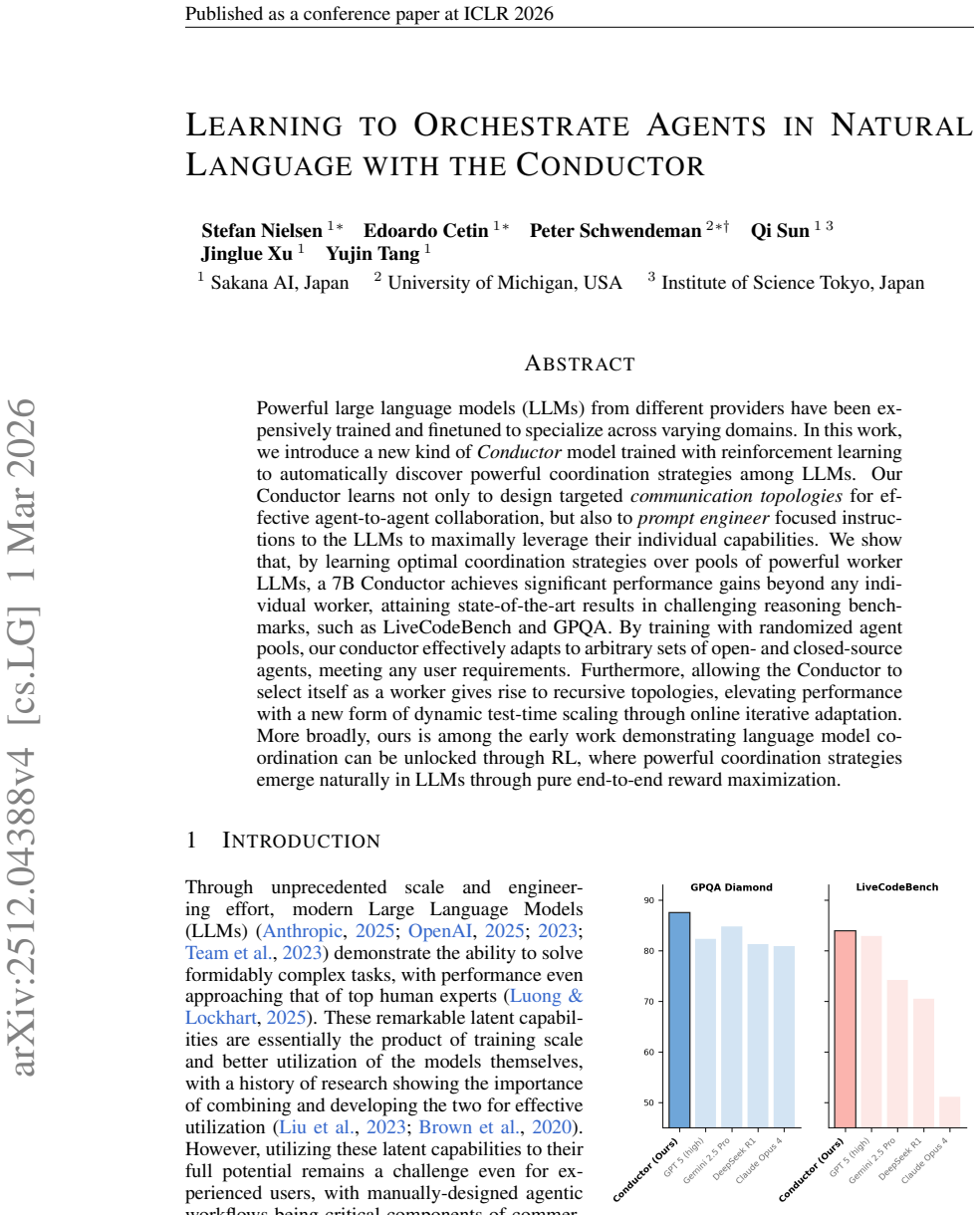
By training a Conductor with reinforcement learning to automatically discover coordination strategies, including communication topologies and focused prompts for worker LLMs, a 7B model achieves performance gains beyond any individual worker and attains state-of-the-art results on benchmarks such as LiveCodeBench and GPQA. Training with randomized agent pools enables adaptation to arbitrary sets of agents, and allowing self-selection creates recursive topologies for dynamic test-time scaling.
What carries the argument
The Conductor, a model trained via reinforcement learning to design agent communication topologies and engineer prompts for optimal collaboration among worker LLMs.
If this is right
- Significant performance gains on challenging reasoning benchmarks beyond single worker models.
- State-of-the-art results on LiveCodeBench and GPQA.
- Adaptation to arbitrary pools of open- and closed-source agents.
- Support for recursive topologies through self-selection, enabling online iterative adaptation.
Where Pith is reading between the lines
- Coordination learned this way might scale better than increasing the size of individual models alone.
- Users could dynamically choose worker sets based on cost or capability without retraining the orchestrator.
- Recursive self-inclusion suggests a path to test-time compute scaling without fixed architectures.
Load-bearing premise
The performance improvements come primarily from the learned coordination and prompting strategies rather than from the particular choice of worker models or other unmentioned factors.
What would settle it
Measuring performance when the Conductor uses random or fixed coordination strategies instead of learned ones; if gains disappear, the claim holds.
Figures





read the original abstract
Powerful large language models (LLMs) from different providers have been expensively trained and finetuned to specialize across varying domains. In this work, we introduce a new kind of Conductor model trained with reinforcement learning to automatically discover powerful coordination strategies among LLMs. Our Conductor learns not only to design targeted communication topologies for effective agent-to-agent collaboration, but also to prompt engineer focused instructions to the LLMs to maximally leverage their individual capabilities. We show that, by learning optimal coordination strategies over pools of powerful worker LLMs, a 7B Conductor achieves significant performance gains beyond any individual worker, attaining state-of-the-art results in challenging reasoning benchmarks, such as LiveCodeBench and GPQA. By training with randomized agent pools, our conductor effectively adapts to arbitrary sets of open- and closed-source agents, meeting any user requirements. Furthermore, allowing the Conductor to select itself as a worker gives rise to recursive topologies, elevating performance with a new form of dynamic test-time scaling through online iterative adaptation. More broadly, ours is among the early work demonstrating language model coordination can be unlocked through RL, where powerful coordination strategies emerge naturally in LLMs through pure end-to-end reward maximization.
Editorial analysis
A structured set of objections, weighed in public.
Referee Report
Summary. The manuscript introduces a Conductor model trained with reinforcement learning to discover coordination strategies among pools of worker LLMs. The Conductor learns communication topologies and targeted prompts to orchestrate agents, with a 7B model claimed to outperform any individual worker and reach state-of-the-art results on LiveCodeBench and GPQA. Additional claims include adaptation to arbitrary open- and closed-source agent sets via randomized pools during training and performance gains from recursive topologies enabled by self-selection as a worker.
Significance. If the central performance claims hold after proper controls, the work would be significant for multi-agent LLM systems. It provides an early demonstration that end-to-end RL on coordination can yield emergent strategies that leverage existing specialized models, potentially offering a path to dynamic test-time scaling without retraining individual workers.
major comments (2)
- [Experimental Evaluation] The central claim that learned coordination strategies produce gains beyond any individual worker (and SOTA results) is load-bearing, yet the evaluation lacks matched baselines that apply the identical worker pool under non-learned strategies such as fixed round-robin, static prompt templates, or best-single-model oracle selection. Without these controls, gains cannot be isolated from the choice of worker models or the reward function that scores final-answer correctness.
- [Method] The description of the RL training process and reward function requires explicit detail on how final-answer correctness is scored and whether the number of workers queried per step or recursion self-selection rules are fixed or learned; these choices directly affect whether the reported improvements can be attributed to discovered topologies rather than implementation specifics.
minor comments (2)
- [Abstract] The abstract states that pools are randomized at training time but does not clarify whether test-time evaluations maintain the same randomization protocol or use fixed pools; adding this distinction would improve reproducibility.
- [Method] Notation for communication topologies and prompt-engineering actions could be formalized with a short diagram or pseudocode to clarify how the Conductor outputs are translated into agent interactions.
Simulated Author's Rebuttal
We thank the referee for the constructive and detailed feedback. We address each major comment below and have revised the manuscript accordingly to strengthen the evaluation and clarify the methodology.
read point-by-point responses
-
Referee: [Experimental Evaluation] The central claim that learned coordination strategies produce gains beyond any individual worker (and SOTA results) is load-bearing, yet the evaluation lacks matched baselines that apply the identical worker pool under non-learned strategies such as fixed round-robin, static prompt templates, or best-single-model oracle selection. Without these controls, gains cannot be isolated from the choice of worker models or the reward function that scores final-answer correctness.
Authors: We agree that matched baselines using the identical worker pool are necessary to isolate the effect of learned coordination. In the revised manuscript we have added experiments that apply fixed round-robin scheduling and static prompt templates to the same randomized pools. We also include an explicit best-single-model oracle baseline. These new results are reported in an expanded experimental section and confirm that the performance gains arise from the discovered topologies and prompts rather than from worker choice or reward design alone. revision: yes
-
Referee: [Method] The description of the RL training process and reward function requires explicit detail on how final-answer correctness is scored and whether the number of workers queried per step or recursion self-selection rules are fixed or learned; these choices directly affect whether the reported improvements can be attributed to discovered topologies rather than implementation specifics.
Authors: We have expanded the Methods section and added an appendix with pseudocode. Final-answer correctness is scored with task-specific metrics (exact match on GPQA, pass@1 on LiveCodeBench). The number of workers queried per step and the decision to include the Conductor itself for recursion are both outputs of the learned policy rather than fixed hyperparameters. These details are now stated explicitly so that the contribution of the discovered topologies can be clearly attributed. revision: yes
Circularity Check
No circularity: empirical RL training of Conductor is self-contained
full rationale
The paper describes a standard reinforcement learning setup in which a 7B Conductor is trained end-to-end to maximize a reward based on final answer correctness while selecting communication topologies and prompts over randomized pools of worker LLMs. The reported gains on LiveCodeBench and GPQA are presented as empirical outcomes of this optimization, with additional features such as self-selection for recursion described as emergent behaviors. No equations, definitions, or self-citations are shown that reduce the central performance claim to a fitted parameter or to the input data by construction. The derivation therefore rests on observable training dynamics and benchmark evaluation rather than on any definitional equivalence or load-bearing self-reference.
Axiom & Free-Parameter Ledger
invented entities (1)
-
Conductor model
no independent evidence
Forward citations
Cited by 1 Pith paper
-
LEMON: Learning Executable Multi-Agent Orchestration via Counterfactual Reinforcement Learning
LEMON trains an LLM orchestrator with counterfactual-augmented GRPO to produce deployable multi-agent specifications that reach state-of-the-art results on six reasoning and coding benchmarks.
Reference graph
Works this paper leans on
-
[1]
For the semi-OOD setting, we balance in-distribution and OOD, taking one example from MATH500, one example from LiveCodeBench, one example from Countdown, and one example from Medreason. F EXAMPLECONDUCTORCOMPLETIONS We present in this section additional examples of Conductor completions, exemplifying the Conduc- tor’s capability as an agentic workflow co...
work page 2026
-
[2]
and an example of the Conductor calling an additional agent to check through the past reasoning traces and revise the obtained response (Figure 22). F.1 CONDUCTORCATEGORIZATION We present in this subsection categorization for some of the most frequent orchestration modes we tended to observe throughout Conductor training and evaluation. We note that these...
work page 2026
-
[3]
Provide ONLY the final result without explanations, equations, or steps
-
[4]
For equations with a single solution, provide just the value (e.g., ’5’ not ’x=5’) ... 3B Conductor Here’s the approach: model id = [0, 1, 2] subtasks = [”Solve the problem step by step and provide the final value ofz 2002 without ex- planations, equations, or steps in<idea>tags. Use standard LaTeX notation for the final result. ”, ”Verify the proposed so...
work page 2002
-
[5]
Model 0 directly tackles solving the recurrence relation and providing the final value
-
[6]
Model 1 verifies the result by applying the function repeatedly to confirm it converges as expected
-
[7]
Model 2 ensures the accuracy of the solution and formats it according to the guidelines. 27 Published as a conference paper at ICLR 2026 Figure 16:In-distribution few-shot examples.The two few-shot examples provided are taken from MATH500 and MMLU. EXAMPLE 1: Question: Subject: Physics. A converging lens is placed 30.0 cm to the right of a diverging lens ...
work page 2026
-
[8]
We need to calculate how much Susan pays for her 4 discounted tickets (Model 1). 2. We need to calculate how much Pam pays for her 5 discounted tickets (Model 2). 3. We need to determine the difference in cost between Pam’s and Susan’s tickets (Model 3). model id = [1, 2, 3] subtasks = [”Calculate the cost of 4 tickets at a 25% discount. ”, ”Calculate the...
work page 2026
-
[9]
The first model (Model 6) should understand the problem statement and define the objectives
-
[10]
The second model (Model 4) should analyze the given graph and its edges to understand the structure. 3. The third model (Model 5) should determine the strategy to find the minimum cost spanning tree. 4. The fourth model (Model 3) will implement the strategy in a Python function. 5. The final model (Model 2) will validate the implemented solution, ensuring...
work page 2026
-
[11]
First, we’ll directly attempt to solve the problem. 2. Next, we’ll check and refine the solution if necessary. 3. Finally, we’ll provide the most accurate and detailed solution, following all the given instructions. model id = [0, 1, 2] subtasks = [”Transform the string s into t in exactly k operations and provide the number of ways to do so. Show your wo...
work page 2026
-
[12]
First, we’ll directly attempt to solve the problem. 2. Next, we’ll check and refine the solution if necessary. 3. Finally, we’ll provide the most accurate and detailed solution, following all the given instructions. model id = [0, 1, 2] subtasks = [”Take the string and devise an algorithm for counting adjacent occurrences of a given letter. Show your work...
work page 2026
discussion (0)
Sign in with ORCID, Apple, or X to comment. Anyone can read and Pith papers without signing in.