RapidUn: Influence-Driven Parameter Reweighting for Efficient Large Language Model Unlearning
Pith reviewed 2026-05-21 17:25 UTC · model grok-4.3
The pith
RapidUn enables efficient LLM unlearning by reweighting parameters according to per-sample influence estimates.
A machine-rendered reading of the paper's core claim, the machinery that carries it, and where it could break.
Core claim
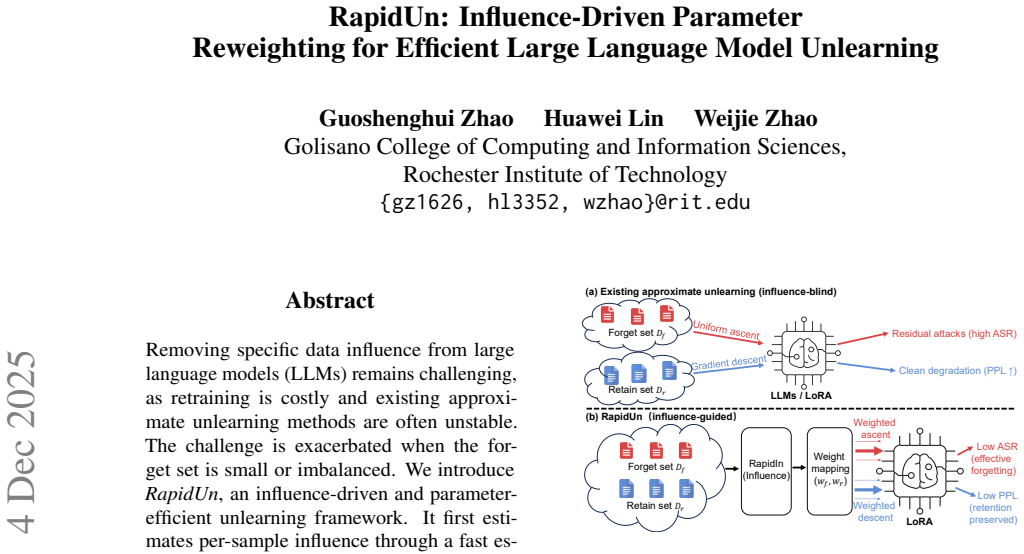
RapidUn is an influence-driven and parameter-efficient unlearning framework. It first estimates per-sample influence through a fast estimation module, then maps these scores into adaptive update weights that guide selective parameter updates -- forgetting harmful behavior while retaining general knowledge.
What carries the argument
The fast influence estimation module and its mapping to adaptive update weights, which directs selective updates to parameters based on each sample's computed influence.
If this is right
- Up to 100 times higher efficiency compared to full retraining for unlearning tasks.
- Consistent outperformance over Fisher, GA, and LoReUn methods on both in-distribution and out-of-distribution forgetting.
- Applicability to models such as Mistral-7B and Llama-3-8B with datasets like Dolly-15k and Alpaca-57k.
Where Pith is reading between the lines
- If the influence estimates are reliable, this method could generalize to unlearning in other AI domains like vision models.
- The adaptive weights might offer a way to interpret which parameters are most affected by specific data points.
- Future work could test the method on even larger models or more complex forget sets to validate scalability.
Load-bearing premise
The fast influence estimation accurately reflects the true effect of each sample on the model parameters and behavior.
What would settle it
Running the unlearning with the influence scores replaced by random values and observing if performance degrades to match or fall below baseline methods would test the necessity of the influence-driven weighting.
Figures


read the original abstract
Removing specific data influence from large language models (LLMs) remains challenging, as retraining is costly and existing approximate unlearning methods are often unstable. The challenge is exacerbated when the forget set is small or imbalanced. We introduce RapidUn, an influence-driven and parameter-efficient unlearning framework. It first estimates per-sample influence through a fast estimation module, then maps these scores into adaptive update weights that guide selective parameter updates -- forgetting harmful behavior while retaining general knowledge. On Mistral-7B and Llama-3-8B across Dolly-15k and Alpaca-57k, RapidUn achieves up to 100 times higher efficiency than full retraining and consistently outperforms Fisher, GA, and LoReUn on both in-distribution and out-of-distribution forgetting. These results establish influence-guided parameter reweighting as a scalable and interpretable paradigm for LLM unlearning.
Editorial analysis
A structured set of objections, weighed in public.
Referee Report
Summary. The paper proposes RapidUn, an influence-driven parameter reweighting framework for efficient LLM unlearning. It estimates per-sample influence scores via a fast estimation module and maps them to adaptive update weights to guide selective parameter updates, aiming to forget specific data while retaining general capabilities. Experiments on Mistral-7B and Llama-3-8B with Dolly-15k and Alpaca-57k report up to 100x efficiency gains over full retraining and consistent outperformance versus Fisher, GA, and LoReUn on both in-distribution forgetting and out-of-distribution retention.
Significance. If the fast influence module reliably approximates true per-sample effects, the method could advance practical unlearning for large models by avoiding costly retraining while providing an interpretable reweighting mechanism. The reported efficiency and cross-model results on standard benchmarks indicate potential for scalable applications, though this hinges on unvalidated assumptions about the estimation accuracy.
major comments (2)
- [§3] §3 (Fast Influence Estimation Module): The central mapping from estimated scores to adaptive update weights assumes the fast module accurately proxies true influence on model parameters and behavior, but no correlation, ablation, or comparison to exact baselines (full gradients, leave-one-out retraining, or Hessian-based ground truth) is reported for Mistral-7B or Llama-3-8B on the forget sets.
- [§4] §4 (Experiments): Claims of consistent outperformance and 100x efficiency lack reported error bars, statistical significance tests, details on random seeds, number of runs, or controls for small/imbalanced forget sets, making it difficult to confirm the results are robust rather than sensitive to particular splits or initializations.
minor comments (1)
- [§3.1] The description of how influence scores are normalized or thresholded before mapping to weights could include a small concrete example for clarity.
Simulated Author's Rebuttal
We appreciate the referee's detailed feedback on our manuscript. We have carefully considered the major comments regarding the validation of our fast influence estimation module and the statistical robustness of our experimental results. Below, we provide point-by-point responses and indicate the revisions we plan to make in the next version of the paper.
read point-by-point responses
-
Referee: [§3] §3 (Fast Influence Estimation Module): The central mapping from estimated scores to adaptive update weights assumes the fast module accurately proxies true influence on model parameters and behavior, but no correlation, ablation, or comparison to exact baselines (full gradients, leave-one-out retraining, or Hessian-based ground truth) is reported for Mistral-7B or Llama-3-8B on the forget sets.
Authors: We thank the referee for highlighting this important point. Computing exact influence measures such as full gradients or Hessian-based methods for 7B and 8B parameter models on datasets like Dolly-15k is computationally prohibitive, often requiring orders of magnitude more resources than the unlearning process itself. Our fast estimation module builds on established approximations from influence function literature to enable practical application. To address this, we will revise Section 3 to include a more detailed explanation of the module's design rationale, its assumptions, and limitations. This constitutes a partial revision as full-scale exact validations remain infeasible. revision: partial
-
Referee: [§4] §4 (Experiments): Claims of consistent outperformance and 100x efficiency lack reported error bars, statistical significance tests, details on random seeds, number of runs, or controls for small/imbalanced forget sets, making it difficult to confirm the results are robust rather than sensitive to particular splits or initializations.
Authors: We agree that additional statistical reporting would strengthen the presentation of our results. The experiments were conducted using a fixed random seed for reproducibility across the reported runs, but we acknowledge the value of multiple runs and error bars. In the revised manuscript, we will update Section 4 to report results averaged over multiple random seeds (e.g., 3-5 runs) with standard deviations as error bars where computational resources permit. We will also specify the seeds used, include statistical significance tests (such as paired t-tests) comparing RapidUn to baselines, and add discussion on handling small or imbalanced forget sets, including any controls like balanced sampling or subset-specific metrics. This will be incorporated as a full revision. revision: yes
- We cannot provide direct comparisons to exact baselines like Hessian-based ground truth or leave-one-out retraining for the full-scale Mistral-7B and Llama-3-8B models due to prohibitive computational costs.
Circularity Check
No significant circularity in derivation chain
full rationale
The paper presents RapidUn as an empirical unlearning framework that estimates per-sample influence via a fast module and maps scores to adaptive weights for selective updates. Claims of efficiency (up to 100x vs retraining) and outperformance vs Fisher/GA/LoReUn are supported by direct comparisons on Mistral-7B and Llama-3-8B using Dolly-15k and Alpaca-57k. No steps reduce outputs to inputs by construction, no fitted parameters are relabeled as predictions, and no load-bearing self-citations or uniqueness theorems are invoked. The central method remains independent of its own results and relies on external benchmarks.
Axiom & Free-Parameter Ledger
axioms (1)
- domain assumption Per-sample influence can be estimated rapidly without full Hessian or retraining computations
Lean theorems connected to this paper
-
IndisputableMonolith/Cost/FunctionalEquation.leanwashburn_uniqueness_aczel unclear?
unclearRelation between the paper passage and the cited Recognition theorem.
RapidIn estimates per-sample influence via token-wise gradient alignment eI(i→j) and maps to adaptive weights via RobustScale and clipping for weighted ascent/descent
What do these tags mean?
- matches
- The paper's claim is directly supported by a theorem in the formal canon.
- supports
- The theorem supports part of the paper's argument, but the paper may add assumptions or extra steps.
- extends
- The paper goes beyond the formal theorem; the theorem is a base layer rather than the whole result.
- uses
- The paper appears to rely on the theorem as machinery.
- contradicts
- The paper's claim conflicts with a theorem or certificate in the canon.
- unclear
- Pith found a possible connection, but the passage is too broad, indirect, or ambiguous to say the theorem truly supports the claim.
Reference graph
Works this paper leans on
-
[1]
BitFit: Simple parameter-efficient fine-tuning for transformer-based masked language-models. In Proceedings of the 60th Annual Meeting of the As- sociation for Computational Linguistics (Volume 2: Short Papers), pages 1–9. Association for Computa- tional Linguistics. Kshira Bhaila, Juin-Hwey Hsieh, Mingqing Liu, Nikos Karampatziakis, and Jan Prins. 2025. ...
work page 2025
-
[2]
IEEE. Tom B. Brown, Benjamin Mann, Nick Ryder, Melanie Subbiah, Jared Kaplan, Prafulla Dhariwal, and 1 oth- ers. 2020. Language models are few-shot learners. In Advances in Neural Information Processing Systems 33 (NeurIPS), pages 1877–1901. Yinzhi Cao and Junfeng Yang. 2015. Towards making systems forget with machine unlearning. In2015 IEEE Symposium on ...
-
[3]
Huawei Lin, Jikai Long, Zhaozhuo Xu, and Weijie Zhao
Association for Computational Linguistics. Huawei Lin, Jikai Long, Zhaozhuo Xu, and Weijie Zhao
-
[4]
Token-wise influential training data retrieval for large language models. InProceedings of the 62nd Annual Meeting of the Association for Compu- tational Linguistics (ACL), pages 841–860. Hao Liu, Derek Tam, and 1 others. 2022. Few- shot parameter-efficient fine-tuning is better and cheaper than in-context learning.arXiv preprint arXiv:2205.05638. Sijia L...
-
[5]
Language models are unsupervised multitask learners.OpenAI Technical Re- port. Available at https://cdn.openai.com/ better-language-models/language_models_ are_unsupervised_multitask_learners.pdf. Colin Raffel, Noam Shazeer, Adam Roberts, Kather- ine Lee, Sharan Narang, Michael Matena, Yanqi Zhou, Wei Li, and Peter J. Liu. 2020. Exploring the limits of tr...
-
[6]
Concealed data poisoning attacks on NLP models.arXiv preprint arXiv:2010.12563. Haoming Xu, Ningyuan Zhao, Liming Yang, Sendong Zhao, Shumin Deng, Mengru Wang, Bryan Hooi, Nay Oo, Huajun Chen, and Ningyu Zhang. 2025a. Relearn: Unlearning via learning for large language models. InProceedings of the 63rd Annual Meet- ing of the Association for Computational...
discussion (0)
Sign in with ORCID, Apple, or X to comment. Anyone can read and Pith papers without signing in.