Identifying bound states in the continuum by their boundary sensitivity
Pith reviewed 2026-05-17 01:54 UTC · model grok-4.3
The pith
Bound states in the continuum stay stable when external boundaries change, unlike radiating modes.
A machine-rendered reading of the paper's core claim, the machinery that carries it, and where it could break.
Core claim
Bound states in the continuum are identified by varying the external boundary conditions that close the computational domain; only the BIC frequencies produce peaks that remain fixed across the family of histograms, while all other quasi-normal modes shift or disappear.
What carries the argument
Spectral histograms formed by sweeping external boundary conditions; stable peaks mark the BICs because they alone are insensitive to the exterior region.
If this is right
- Numerical searches for BICs no longer require explicit computation of the imaginary part of the eigenvalue.
- The same boundary-variation test applies to both periodic guided-wave systems and finite resonators.
- The method supplies an independent check that can be compared directly with perfectly-matched-layer calculations.
- Integral reciprocity relations derived in the paper confirm that only non-radiating solutions remain invariant under exterior changes.
Where Pith is reading between the lines
- The histogram technique could be applied to any linear wave system whose radiation is controlled by an artificial outer boundary.
- It offers a way to screen candidate BIC frequencies before expensive high-accuracy decay-rate calculations are performed.
Load-bearing premise
Bound states in the continuum are completely insensitive to the region outside the physical structure while every other mode feels that region.
What would settle it
A mode flagged as a BIC by the histogram test would be shown false if a full open-domain simulation found it to radiate energy at a measurable rate.
Figures


read the original abstract
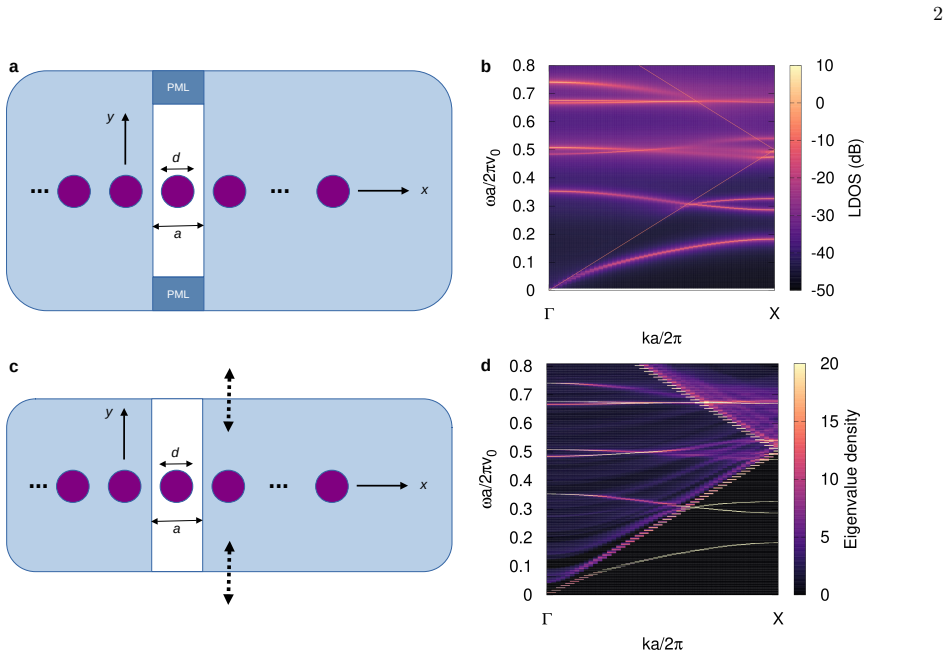
We introduce a method for effectively identifying bound states in the continuum (BICs) - notably without computing the imaginary part of the eigenvalues - thereby simplifying the modeling and potentially reducing computation time. In real, open, physical systems, wave decay must be taken into account. This phenomenon is captured by complex-valued solutions of the harmonic wave equation, the so-called quasi-normal modes (QNMs). BICs, however, constitute a limiting class of solutions that do not radiate energy to infinity and are therefore, by their very nature, insensitive to the region surrounding the physical structure. Building on this observation, we identify BICs by varying the external boundary conditions that close the computational domain; the resulting behavior is displayed in the form of spectral histograms. We demonstrate the effectiveness of this procedure by comparing it with conventional QNM analysis employing perfectly matched layers. Two representative examples are considered: a periodic system of permeable inclusions supporting guided Rayleigh-Bloch waves, and a whispering-gallery resonator constructed from this configuration. Finally, we provide a mathematical explanation for the method's validity by deriving integral reciprocity statements.
Editorial analysis
A structured set of objections, weighed in public.
Referee Report
Summary. The paper introduces a method to identify bound states in the continuum (BICs) in open wave systems by varying external boundary conditions that close the computational domain and inspecting the resulting spectral histograms for stable features. This exploits the non-radiating character of BICs, which renders them insensitive to the surrounding region. The approach is demonstrated on two geometries—a periodic array of permeable inclusions supporting Rayleigh-Bloch waves and a whispering-gallery resonator derived from the same configuration—via comparison with conventional perfectly matched layer (PML) quasi-normal mode (QNM) computations. A theoretical justification is supplied through derived integral reciprocity statements.
Significance. If the central claim holds, the method could simplify BIC detection in numerical modeling by circumventing explicit computation of complex eigenvalues or the setup of absorbing layers, offering potential savings in computation time for open systems in electromagnetics and acoustics. The reciprocity-based argument provides a physical and mathematical rationale grounded in the wave equation, and the two concrete examples illustrate applicability to both periodic and localized resonator geometries.
major comments (2)
- [§3] §3 (Rayleigh-Bloch example): the spectral histograms are shown without quantitative measures such as the range of boundary-condition variations tested, the number of modes tracked, or any error analysis on peak stability; this leaves open whether discretization-induced imaginary parts or evanescent tails could produce similar clustering for high-Q QNMs, undermining the uniqueness claim relative to PML results.
- [§4] §4 (reciprocity derivation): the integral statements are derived under the assumption of exact satisfaction of the lossless wave equation with no truncation; the manuscript does not address how finite-element or finite-difference discretization errors propagate into the histogram features, which is load-bearing for the assertion that only true BICs remain stable.
minor comments (2)
- Figure captions in the numerical sections should explicitly state the boundary-condition parametrization (e.g., the functional form and range of the external closure) to allow readers to reproduce the histogram construction.
- Notation for the external boundary operator is introduced without a dedicated equation number; cross-referencing it to the reciprocity integrals would improve clarity.
Simulated Author's Rebuttal
We thank the referee for the careful reading and constructive comments. We address the major points below and will incorporate clarifications and additional quantitative details to strengthen the manuscript.
read point-by-point responses
-
Referee: §3 (Rayleigh-Bloch example): the spectral histograms are shown without quantitative measures such as the range of boundary-condition variations tested, the number of modes tracked, or any error analysis on peak stability; this leaves open whether discretization-induced imaginary parts or evanescent tails could produce similar clustering for high-Q QNMs, undermining the uniqueness claim relative to PML results.
Authors: We agree that explicit quantitative measures were not provided and will add them in revision. The revised manuscript will report the specific range of boundary-condition variations (phase shifts sampled over a dense grid spanning multiple periods), the number of modes tracked per histogram, and an error analysis quantifying peak stability (e.g., frequency shifts below 0.1% across the tested variations). Our existing PML comparisons already demonstrate that only the BIC features remain fixed while high-Q modes shift appreciably; we will add a short discussion explaining why discretization-induced imaginary parts and evanescent tails do not produce false clustering at the resolutions employed, supported by the observed agreement with the independent PML computations. revision: yes
-
Referee: §4 (reciprocity derivation): the integral statements are derived under the assumption of exact satisfaction of the lossless wave equation with no truncation; the manuscript does not address how finite-element or finite-difference discretization errors propagate into the histogram features, which is load-bearing for the assertion that only true BICs remain stable.
Authors: The reciprocity statements are derived in the continuous setting, as is conventional for such integral identities. In the revised manuscript we will add a dedicated paragraph on numerical implementation, noting that the discrete solutions converge to the continuous ones for sufficiently resolved meshes. Mesh-convergence studies already performed for both examples confirm that the stable histogram features correspond to the BICs identified by PML and are insensitive to further refinement, while non-BIC modes continue to shift. We will explicitly state that, within the convergence regime used, discretization errors do not generate spurious stable peaks that could be misidentified as BICs. revision: yes
Circularity Check
No significant circularity; derivation relies on physical definition of BICs and standard reciprocity without reduction to inputs.
full rationale
The paper identifies BICs via their boundary insensitivity, a direct consequence of the non-radiating property in the definition of BICs, and supports this with derived integral reciprocity statements that follow from the wave equation without assuming the target identification result. No steps reduce by construction to fitted parameters, self-citations, or renamed ansatzes; the method is compared externally to PML-based QNM analysis. The derivation chain remains self-contained and independent of the claimed outputs.
Axiom & Free-Parameter Ledger
axioms (1)
- domain assumption Solutions of the harmonic wave equation in open domains are quasi-normal modes with complex frequencies that capture radiation losses.
Reference graph
Works this paper leans on
-
[1]
shown in Fig. 1b is obtained by solving the acoustic Helmholtz equation when the unit cell is surrounded by a perfectly matched layer (PML), as depicted in Fig. 1a. Three BICs are observed at the Γ point and another BIC forka/(2π) = 0.172 – see Ref. [21] for more details. Instead of considering the resolvent band structure, we next compute the classical b...
-
[2]
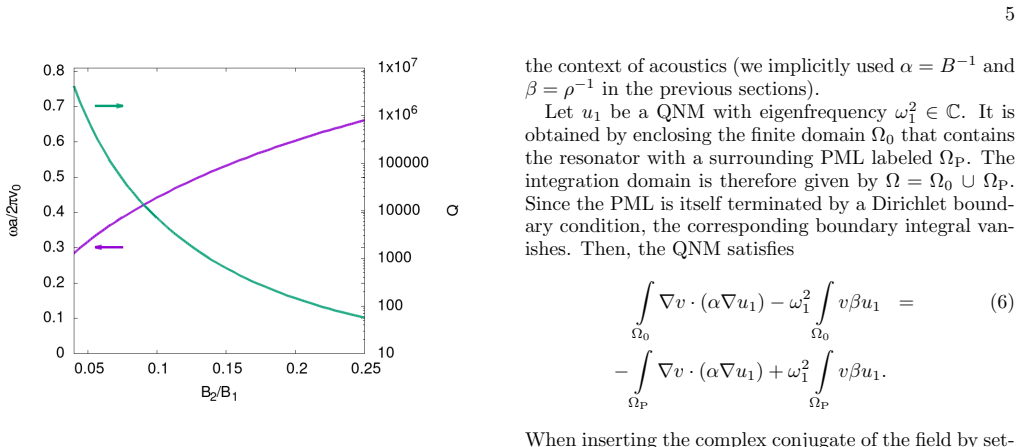
In this case, the NM’s eigen- frequency corresponds to a BIC – a QNM of infinite qual- ity factor – and thus coincides with the QNM frequency, which is consequently real-valued. As a result, a straight- forward criterion for determining whether a QNM con- stitutes a BIC is I ∂Ω u1 (α∇u1)·n= 0,(12) that is, the requirement that the QNM satisfy the Neu- man...
-
[3]
When combining Eq. (11) with Eq. (9) forv=u ∗ 2 we obtain γ= 1 2 ℑ H ∂Ω u1 (α∇u1)·n R Ω0 u1βu1 R Ω0 u∗ 2βu2 R Ω0 ∇u∗ 2 ·(α∇u 2) .(13) The choice of the test functionv=u ∗ 2 is made so that the integrals definingω 2 2 are real and positive but remains otherwise arbitrary. V. CONCLUSION In summary, we have presented a conceptually sim- p...
-
[4]
E. M. Purcell, Spontaneous emission probabilities at ra- dio frequencies, Phys. Rev.69, 681 (1946)
work page 1946
-
[5]
C. Sauvan, J.-P. Hugonin, I. Maksymov, and P. Lalanne, Theory of the spontaneous optical emission of nanosize photonic and plasmon resonators, Phys. Rev. Lett.110, 237401 (2013)
work page 2013
-
[6]
M. B. Doost, W. Langbein, and E. A. Muljarov, Resonant-state expansion applied to three-dimensional open optical systems, Phys. Rev. A90, 013834 (2014)
work page 2014
-
[7]
A. Colombi, D. Colquitt, P. Roux, S. Guenneau, and R. V. Craster, A seismic metamaterial: The resonant metawedge, Scientific Reports6, 1 (2016)
work page 2016
-
[8]
S. Benchabane, R. Salut, O. Gaiffe, V. Soumann, M. Ad- douche, V. Laude, and A. Khelif, Surface-wave coupling to single phononic subwavelength resonators, Phys. Rev. Appl.8, 034016 (2017)
work page 2017
- [9]
-
[10]
M. K. Schmidt, L. Helt, C. G. Poulton, and M. Steel, Elastic Purcell effect, Physical Review Letters121, 064301 (2018)
work page 2018
-
[11]
V. Laude and M. E. Korotyaeva, Stochastic excitation method for calculating the resolvent band structure of periodic media and waveguides, Phys. Rev. B97, 224110 (2018)
work page 2018
- [12]
-
[13]
S. Benchabane, A. Jallouli, L. Raguin, O. Gaiffe, J. Chatellier, V. Soumann, J.-M. Cote, R. Salut, and A. Khelif, Nonlinear coupling of phononic resonators in- duced by surface acoustic waves, Phys. Rev. Appl.16, 054024 (2021)
work page 2021
-
[14]
A.-W. El-Sayed and S. Hughes, Quasinormal-mode the- ory of elastic Purcell factors and Fano resonances of op- tomechanical beams, Physical Review Research2, 043290 (2020)
work page 2020
- [15]
- [16]
-
[17]
T. Wu, M. Gurioli, and P. Lalanne, Nanoscale light con- finement: the Q’s and V’s, ACS photonics8, 1522 (2021)
work page 2021
-
[18]
V. Laude and Y.-F. Wang, Quasinormal mode represen- tation of radiating resonators in open phononic systems, Physical Review B107, 144301 (2023)
work page 2023
-
[19]
F. H. Stillinger and D. R. Herrick, Bound states in the continuum, Physical Review A11, 446 (1975)
work page 1975
-
[20]
C. W. Hsu, B. Zhen, A. D. Stone, J. D. Joannopoulos, and M. Soljaˇ ci´ c, Bound states in the continuum, Nature Reviews Materials1, 1 (2016)
work page 2016
-
[21]
W. Wang, Y. K. Srivastava, T. C. Tan, Z. Wang, and R. Singh, Brillouin zone folding driven bound states in the continuum, Nature Communications14, 2811 (2023)
work page 2023
-
[22]
C. M. Linton and P. McIver, Embedded trapped modes in water waves and acoustics, Wave motion45, 16 (2007)
work page 2007
-
[23]
G. J. Chaplain, S. C. Hawkins, M. A. Peter, L. G. Ben- netts, and T. A. Starkey, Acoustic lattice resonances and generalised Rayleigh–Bloch waves, Communications Physics8, 37 (2025)
work page 2025
-
[24]
V. Laude, Complex dispersion relation of rayleigh-bloch waves trapped by slow inclusions, Physical Review B 111, L220101 (2025)
work page 2025
-
[25]
B. Maling and R. V. Craster, Whispering Bloch modes, Proceedings of the Royal Society A: Mathematical, Phys- ical and Engineering Sciences472, 20160103 (2016)
work page 2016
-
[26]
M. Mart´ ı-Sabat´ e, B. Djafari-Rouhani, and D. Torrent, Bound states in the continuum in circular clusters of scat- terers, Physical Review Research5, 013131 (2023)
work page 2023
-
[27]
M. Mart´ ı-Sabat´ e, J. Li, B. Djafari-Rouhani, S. A. Cum- mer, and D. Torrent, Observation of two-dimensional acoustic bound states in the continuum, Communications Physics7, 122 (2024)
work page 2024
-
[28]
Hecht, New development in FreeFem++, J
F. Hecht, New development in FreeFem++, J. Numer. Math.20, 251 (2012)
work page 2012
discussion (0)
Sign in with ORCID, Apple, or X to comment. Anyone can read and Pith papers without signing in.