REVIEW 2 major objections 4 minor 110 references
Reviving $Z^\prime$ Portal Dark Matter with Conversion Mechanism
T0 review · 2 major / 4 minor · reviewed 2026-08-03 · deepseek-v4-flash
Pith's one-line read The paper claims that in a gauged U(1)_{B-L} model with two nearly degenerate dark fermions, the conversion mechanism can set the correct dark-matter relic density while keeping the Z' coupling so small that the model evades collider, direc
desk verdict A competent, useful map of GeV–TeV U(1)_{B-L} Z' portal DM with conversion, but two unaddressed issues (kinetic mixing, Z' bath equilibrium at tiny g') keep the 'favored' windows from being fully settled. read the letter →
The pith
A machine-rendered reading of the paper's core claim, the machinery that carries it, and where it could break.
The reading
What carries the argument
The central object is the mass-mixing term δm χ̄₁χ₂ between a U(1)_{B-L}-neutral and a U(1)_{B-L}-charged dark fermion, which produces the small mixing angle θ in the mass eigenstates. This angle suppresses the effective gauge coupling of the dark-matter state χ₁ to Z' (by sin²θ) while keeping the partner χ₂ strongly coupled (by cos²θ), so that conversion reactions involving χ₂ control the abundance of χ₁ without requiring a large coupling to Standard-Model fermions.
What would settle it
A measurement of non-zero kinetic mixing ε ≳ 10^-4 between B-L and hypercharge (e.g. via precision electroweak data or a direct measurement of the Z' couplings to electrons) would generate a Z-Z' mixing that enhances the spin-independent DM-nucleon cross section far above the predicted 10^-50-10^-52 cm² range, ruling out the small-θ conversion windows.
Extended reading notes
Core claim
In the U(1)_{B-L} Z' model with two Dirac dark fermions χ₁ and χ₂ of nearly equal mass, a small mass-mixing angle θ suppresses the coupling of the dark-matter candidate χ₁ to the Z' (proportional to sin²θ) while leaving the heavier partner χ₂ strongly coupled. The relic density of χ₁ is then set not by χ₁χ₁ annihilation but by inelastic conversion reactions χ₂χᵢ → χ₁χⱼ. The paper demonstrates that in both the resonance regime (m_Z' ≈ 2m_χ₂) and the secluded regime (m_Z' < m_χ₂), the conversion mechanism yields the observed relic abundance with gauge couplings below current limits, making the scenario testable at future colliders, indirect-detection, and CMB experiments.
Load-bearing premise
The paper assumes there is no kinetic mixing between the U(1)_{B-L} gauge boson and the Standard-Model hypercharge gauge boson; if such mixing is non-negligible, the DM-nucleon scattering and the collider limits become much stronger and the 'favored' conversion regions may disappear.
Editorial extensions
If this is right
- The correct thermal relic density can be obtained with Z' couplings g' as small as 10^-8-10^-3, far below the values needed in conventional Z' portal dark matter.
- Spin-independent direct detection is suppressed by sin⁴θ, so most benchmark points predict cross sections below 10^-50 cm² and escape current and near-future experiments.
- In the resonance scenario, the conversion phase survives current collider bounds and could be probed by future colliders at g' ≈ 10^-5-10^-3, while the coannihilation region is instead accessible to future CMB measurements.
- In the secluded scenario, conversion is the most promising phase: it can be seen in indirect-detection experiments at g' ≈ 10^-8-10^-5 and, at even smaller couplings, in CMB observations, whereas coannihilation is almost entirely excluded.
- The model predicts long-lived dark partners χ₂ at small θ and g', giving distinctive displaced-vertex or missing-energy signatures that complement the search for the Z' itself.
Reading between the lines
- The viability of the small-θ conversion windows relies on the absence of kinetic mixing between U(1)_{B-L} and hypercharge; if even a small mixing parameter ε is present, the Z' would mix with the Standard-Model Z, enhancing the DM-nucleon scattering cross section and strengthening collider bounds, potentially closing the 'favored' regions. Adding ε and recomputing σ_SI would quantify this.
- Because the relic density in the secluded scenario is largely independent of g', a natural extension would allow an arbitrarily light Z' acting as a dark-radiation component; the model could then be constrained or discovered by future CMB spectral-distortion or ΔN_eff measurements at couplings below 10^-10.
- The same small mixing angle that suppresses direct detection also suppresses the Z'χ₁χ₂ vertex; a dedicated study of mono-photon signals at lepton colliders could target the conversion parameter space with θ ~ 10^-3-10^-2, complementing the CMB and indirect-detection probes envisioned in the paper.
Editorial analysis
A structured set of objections, weighed in public.
Referee Report
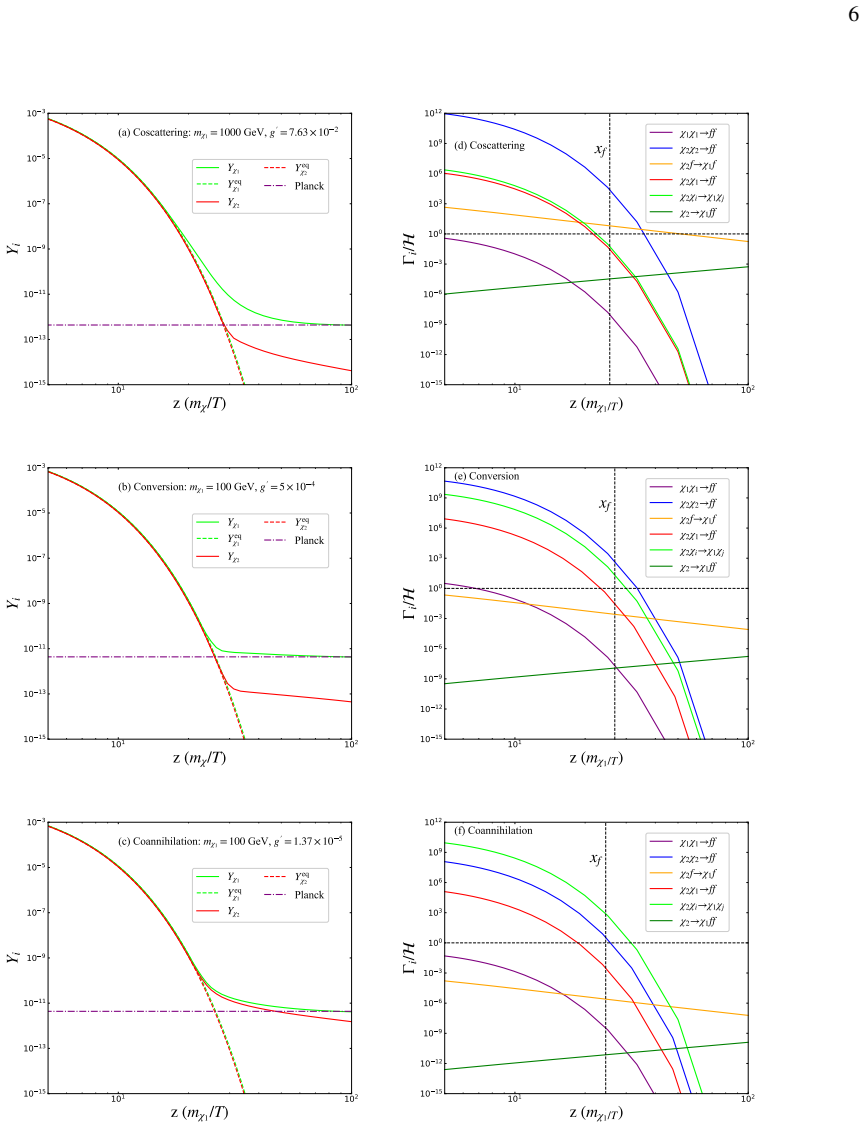
Summary. The paper proposes a U(1)_B-L Z' portal model with two nearly degenerate vector-like dark fermions, chi_1 and chi_2, whose mass mixing induces a small effective coupling of the lighter state chi_1 to the Z'. The authors compute the thermal relic density using micrOMEGAs for two mass regimes: the Z' resonance scenario (r_Z' = m_Z'/m_chi2 = 2) and the secluded scenario (r_Z' < 1). They classify the dominant production mechanisms as coscattering, conversion, and coannihilation, using thermal-rate criteria from Ref. [58]. After imposing collider, direct-detection, indirect-detection, BBN, and CMB constraints, the paper claims that the conversion mechanism is favored in both scenarios, leaving viable parameter windows at small g' (roughly 10^-5--10^-3 in resonance and 10^-8--10^-5 in secluded), with masses from GeV to TeV. The central claim is that conversion solves the tension between relic density and the stringent experimental bounds that affect conventional Z' portal DM.
Significance. If the result holds, the paper identifies new, experimentally promising parameter space for Z' portal DM, particularly in the secluded regime where conversion can be probed by future CMB and indirect-detection experiments. The study is systematic: it uses standard Boltzmann equations, a widely accepted external code (micrOMEGAs), applies a broad set of current and projected constraints, and explicitly shows freeze-out conditions for chi_1. The phase classification and the comparison of resonance versus secluded scenarios are useful and clearly presented. However, the central viability claim depends on two model assumptions that are not adequately justified or tested: the absence of kinetic mixing and the thermal equilibrium of the Z' bath at very small g'. These are not mere presentation issues; they directly affect the relic-density calculation and the derived constraints in the most interesting parameter windows.
major comments (2)
- [Sec. IV, Eqs. (15)-(17)] The secluded-scenario calculation assumes that the Z' is part of the thermal bath with equilibrium abundance Y_zeta^eq, including the massive-Z' expression in Eq. (17). This requires the Z' to maintain chemical equilibrium with the SM bath. For the conversion windows highlighted in Sec. IV E (e.g., g' below O(1e-8)), this is not satisfied. For example, with m_Z' ~ 10 GeV and T ~ m_chi/20 ~ 1 GeV, the Z' production rate from SM fermions is roughly g'^2 T/(16 pi) ~ 2e-18 GeV for g'=1e-8, comparable to H ~ 1.4e-18 GeV; for g' below a few times 1e-9 it is smaller than H. At larger m_Z' the threshold is even higher. The paper never checks Gamma_Z' > H for its benchmarks and never evolves Y_Z' separately. The conversion/coscattering terms with Z' in Eqs. (15)-(16) therefore give unreliable relic densities in exactly the small-g' region where the paper claims CMB/indirect-detection promise. The
- [Sec. II, Eq. (2)] The Lagrangian in Eq. (2) contains only the direct coupling g' Q_f Z'_mu bar f gamma^mu f and no kinetic-mixing term epsilon F_Y^mu nu F'_mu nu with hypercharge. In U(1)_B-L extensions, such kinetic mixing is generically allowed and is loop-induced even if set to zero at tree level. A non-negligible epsilon would mix the Z' with the SM Z/gamma, contributing to spin-independent DM-nucleon scattering in addition to Eq. (9) and modifying the collider bounds used in Figs. 2 and 7. Since the viability of conversion relies on very small g' and strongly suppressed direct detection, even epsilon ~ 10^-4 could dominate the scattering rate at g' = 1e-8. The paper never states or justifies the assumption epsilon=0. This is a load-bearing model gap. The authors should add a discussion of kinetic mixing, estimate the loop-induced size, and show that the derived constraints and viable windows are robu
minor comments (4)
- [Sec. III A, Eqs. (4)-(5)] The text states that the three-body decay chi_2 -> chi_1 f bar f 'has an ignored contribution', but the Boltzmann equations (4)-(5) explicitly include the Gamma_chi2->chi1 f bar f term. Please clarify whether this process is included or neglected; the current wording is contradictory.
- [Sec. III A] The authors acknowledge an O(10%) distinction from not solving the full unintegrated Boltzmann equations. This is reasonable, but since the phase boundaries in Figs. 1, 2, 6, and 7 are based on thermal-rate proxies from Ref. [58], it would be helpful to state explicitly how much the benchmark lines and the conversion/coannihilation phase boundaries could shift under a full treatment.
- [Sec. IV E] In the discussion of the very small g' limit, the paper requires g' > 1e-10 to avoid BBN constraints on the Z' lifetime. The text could also note that in the range 1e-10 < g' < ~1e-8, the Z' may not be in thermal equilibrium with the SM bath, connecting to the major comment above.
- [General] The notation in the figures is often compressed and some labels overlap (e.g., Figs. 1 and 6 with multiple rate curves on a single panel). The phase lines are central to the paper; larger panels or a table of benchmark parameters would improve readability.
Circularity Check
No significant circularity: relic density is solved from coupled Boltzmann equations, benchmark lines are fitted to the observed Omega h^2, and phase labels are diagnostic classifications rather than self-defined predictions.
full rationale
The paper's derivation chain is self-contained in the relevant sense. The relic density is obtained by numerically solving the coupled Boltzmann equations (4)-(5) in the resonance scenario and (15)-(16) in the secluded scenario, with thermal averages computed by micrOMEGAs. The benchmark lines are fitted to the externally measured value Omega_chi1 h^2 = 0.12, which is a standard fitting procedure, not a prediction claimed as independent. The phenomenological statements (collider, direct detection, indirect detection, BBN, CMB) are externally imposed constraints applied after the relic-density calculation, so they do not reduce to an input of the derivation. The classification into coscattering, conversion, and coannihilation is explicitly defined in Section III A by comparing thermal rates; it is a diagnostic used to label regions, not a result that is defined in terms of the conclusion. The central claim that 'conversion is favored' summarizes which fitted benchmark curves remain allowed by external constraints, and the relevant cross sections follow from the Lagrangian in Eq. (2) rather than from the conclusion. The self-citations [50] and [68] are present, but they are used as model motivation and as one of many references for inelastic-conversion cosmology; the scalar-portal suppression is introduced as an explicit parameter assumption (m_phi >> m_chi1,2), not as an unverified uniqueness or ansatz smuggled in solely by citation. Potential physical caveats, such as the neglected kinetic mixing with hypercharge and the assumption that the Z' stays in equilibrium in the very-small-g' secluded region, are model-validity or correctness concerns rather than circular reductions: no equation in the paper is defined in terms of the result it is used to predict, and no fitted parameter is renamed as a prediction.
Assumptions & free parameters
free parameters (6)
- m_chi1 (dark matter mass) =
scanned; benchmark values imply m_chi1 up to ~5000 GeV
- Delta_chi = (m_chi2 - m_chi1)/m_chi1 =
benchmarks 0.01, 0.04, 0.08; range 1e-3-0.1
- r_Z' = m_Z'/m_chi2 =
2 (resonance), 0.75 default, 0.3-0.95 varied
- g' (B-L gauge coupling) =
benchmark lines ~1e-8 to 0.86, varies
- g_chi = Q_chi2 g' =
benchmarks 0.2, 0.3, 0.5, 1
- theta (dark fermion mixing angle) =
5e-5 to 5e-3 (resonance), 0.003 to 0.1 (secluded)
assumptions (5)
- domain assumption U(1)_{B-L} is anomaly-free with three right-handed neutrinos; their mass is set at the seesaw scale and they decouple from DM.
- ad hoc to paper Scalar portal (Yukawa coupling y phi \bar{chi~}_1 chi~_2) is negligible because m_phi >> m_chi1,2.
- ad hoc to paper No kinetic mixing between U(1)_{B-L} and hypercharge.
- domain assumption Standard radiation-dominated cosmology with equilibrium thermodynamics; chi1 remains in kinetic equilibrium during freeze-out.
- domain assumption The coscattering/conversion/coannihilation phase criteria of Ref. [58] are valid proxies for the relic-density production mechanism.
invented entities (4)
-
chi~_1 (mass eigenstate chi1)
-
chi~_2 (mass eigenstate chi2)
-
phi (dark scalar with B-L charge -Q_chi2)
-
Z' gauge boson of U(1)_{B-L}
Cite this review
Pith. "Pith review of Reviving $Z^\prime$ Portal Dark Matter with Conversion Mechanism." pith.science (2026). https://pith.science/paper/N5LTOD2U
@misc{pith2026251208515,
  author       = {Pith},
  title        = {Pith review of: Reviving $Z^\prime$ Portal Dark Matter with Conversion Mechanism},
  year         = {2026},
  howpublished = {\url{https://pith.science/paper/N5LTOD2U}},
  note         = {Machine review of arXiv:2512.08515}
}
abstract
In many new physics models with extended gauge symmetry, the new gauge boson $Z'$ could mediate the interactions between the dark matter and standard model particles. For the conventional $Z^\prime$ portal dark matter, the collider and the direct detection constraints typically pose a significant challenge. To address this pressing issue, we present in this paper a new benchmark model based on the gauged $U(1)_{B-L}$ symmetry, which introduces a Dirac dark fermion $\tilde{\chi}_1$ and a heavier partner $\tilde{\chi}_2$ with zero and nonzero $U(1)_{B-L}$ charge, respectively. Including the mass term $\delta m \bar{\tilde{\chi}}_1\tilde{\chi}_2$ results in the dark fermions $\chi_1$ and $\chi_2$ in the mass eigenstate, where the lighter one $\chi_1$ is regarded as the dark matter candidate. Various intriguing processes for the relic density arise with the compressed mass spectrum $m_{\chi_1}\simeq m_{\chi_2}$, such as the coscattering $\chi_2f\to\chi_1f$, the conversion $\chi_2\chi_i\to\chi_1\chi_j$, and the coannihilation $\chi_1\chi_2\to f\bar{f}$ processes. Suppressed by the small mixing angle $\theta$ between the dark fermions, the small effective gauge coupling of dark matter $\chi_1$ to the gauge boson $Z'$ is one distinct feature of this model, rendering phenomenology in many aspects more promising. In this paper, we investigate the production of dark matter through new mechanisms within the frameworks of resonance and secluded scenarios. The impacts of phenomenological constraints from collider, dark matter, and cosmology are also taken into account. We report that the conversion mechanism is both favored by the resonance and secluded scenarios under current constraints.
Figures


Figures from the paper (7 more)


Reference graph
Works this paper leans on
-
[58]
R. T. D’Agnolo, D. Pappadopulo, J. T. Ruderman and P. J. Wang, Phys. Rev. Lett.124, no.15, 151801 (2020) [arXiv:1906.09269 [hep-ph]]
arXiv 2020
-
[1]
G. Bertone, D. Hooper and J. Silk, Phys. Rept.405, 279-390 (2005) [arXiv:hep-ph/0404175 [hep-ph]]
arXiv 2005
- [2]
-
[3]
A. De Simone and T. Jacques, Eur. Phys. J. C76, no.7, 367 (2016) [arXiv:1603.08002 [hep-ph]]
arXiv 2016
- [4]
- [5]
- [6]
-
[7]
M. Escudero, N. Rius and V . Sanz, Eur. Phys. J. C77, no.6, 397 (2017) [arXiv:1607.02373 [hep-ph]]
arXiv 2017
Show all 110 references
-
[8]
Coito, C
L. Coito, C. Faubel, J. Herrero-Garc ´ıa, A. Santamaria and A. Titov, JHEP08, 085 (2022) [arXiv:2203.01946 [hep-ph]]
2022 arXiv
-
[9]
S. P. Li and X. J. Xu, JCAP06, 047 (2023) [arXiv:2212.09109 [hep-ph]]
2023 arXiv
- [10]
-
[11]
March-Russell, S
J. March-Russell, S. M. West, D. Cumberbatch and D. Hooper, JHEP07, 058 (2008) [arXiv:0801.3440 [hep- ph]]
2008 arXiv
-
[12]
Okada and O
N. Okada and O. Seto, Phys. Rev. D82, 023507 (2010) [arXiv:1002.2525 [hep-ph]]
2010 arXiv
-
[13]
Djouadi, O
A. Djouadi, O. Lebedev, Y . Mambrini and J. Quevillon, Phys. Lett. B709, 65-69 (2012) [arXiv:1112.3299 [hep-ph]]
2012 arXiv
-
[14]
J. M. Cline, K. Kainulainen, P. Scott and C. Weniger, Phys. Rev. D88, 055025 (2013) [erratum: Phys. Rev. D 92, no.3, 039906 (2015)] [arXiv:1306.4710 [hep-ph]]. 29
2013 arXiv
-
[15]
Arcadi, A
G. Arcadi, A. Djouadi and M. Raidal, Phys. Rept.842, 1-180 (2020) [arXiv:1903.03616 [hep-ph]]
2020 arXiv
-
[16]
Alves, S
A. Alves, S. Profumo and F. S. Queiroz, JHEP04, 063 (2014) [arXiv:1312.5281 [hep-ph]]
2014 arXiv
-
[17]
D’Eramo, B
F. D’Eramo, B. J. Kavanagh and P. Panci, JHEP08, 111 (2016) [arXiv:1605.04917 [hep-ph]]
2016 arXiv
-
[18]
Okada, Adv
S. Okada, Adv. High Energy Phys.2018, 5340935 (2018) [arXiv:1803.06793 [hep-ph]]
2018 arXiv
-
[19]
Blanco, M
C. Blanco, M. Escudero, D. Hooper and S. J. Witte, JCAP11, 024 (2019) [arXiv:1907.05893 [hep-ph]]
2019 arXiv
-
[20]
P. J. Fitzpatrick, H. Liu, T. R. Slatyer and Y . D. Tsai, Phys. Rev. D106, no.8, 083517 (2022) [arXiv:2011.01240 [hep-ph]]
2022 arXiv
-
[21]
R. N. Mohapatra and R. E. Marshak, Phys. Rev. Lett.44, 1316-1319 (1980) [erratum: Phys. Rev. Lett.44, 1643 (1980)]
1980
-
[22]
Minkowski, Phys
P. Minkowski, Phys. Lett. B67, 421-428 (1977)
1977
-
[23]
R. N. Mohapatra and G. Senjanovic, Phys. Rev. Lett.44, 912 (1980)
1980
-
[24]
Schechter and J
J. Schechter and J. W. F. Valle, Phys. Rev. D22, 2227 (1980)
1980
-
[25]
Schechter and J
J. Schechter and J. W. F. Valle, Phys. Rev. D25, 774 (1982)
1982
-
[26]
Fukugita and T
M. Fukugita and T. Yanagida, Phys. Lett. B174, 45-47 (1986)
1986
-
[27]
Davidson, E
S. Davidson, E. Nardi and Y . Nir, Phys. Rept.466, 105-177 (2008) [arXiv:0802.2962 [hep-ph]]
2008 arXiv
-
[28]
S. Iso, N. Okada and Y . Orikasa, Phys. Rev. D83, 093011 (2011) [arXiv:1011.4769 [hep-ph]]
2011 arXiv
-
[29]
P. S. B. Dev, R. N. Mohapatra and Y . Zhang, JHEP03, 122 (2018) [arXiv:1711.07634 [hep-ph]]
2018 arXiv
-
[30]
Das and Y
A. Das and Y . Orikasa, Phys. Lett. B864, 139395 (2025) [arXiv:2407.05644 [hep-ph]]
2025 arXiv
-
[31]
Okada and Y
N. Okada and Y . Orikasa, Phys. Rev. D85, 115006 (2012) [arXiv:1202.1405 [hep-ph]]
2012 arXiv
-
[32]
Basak and T
T. Basak and T. Mondal, Phys. Rev. D89, 063527 (2014) [arXiv:1308.0023 [hep-ph]]
2014 arXiv
-
[33]
Escudero, N
M. Escudero, N. Rius and V . Sanz, JHEP02, 045 (2017) [arXiv:1606.01258 [hep-ph]]
2017 arXiv
-
[34]
A. Das, S. Goswami, K. N. Vishnudath and T. Nomura, Phys. Rev. D101, no.5, 055026 (2020) [arXiv:1905.00201 [hep-ph]]
2020 arXiv
-
[35]
A. Liu, F. L. Shao, Z. L. Han, Y . Jin and H. Li, JHEP10, 019 (2024) [arXiv:2407.19730 [hep-ph]]
2024 arXiv
-
[36]
Abdallah, H
J. Abdallah, H. Araujo, A. Arbey, A. Ashkenazi, A. Belyaev, J. Berger, C. Boehm, A. Boveia, A. Brennan and J. Brooke,et al.Phys. Dark Univ.9-10, 8-23 (2015) [arXiv:1506.03116 [hep-ph]]
2015 arXiv
-
[37]
Klasen, F
M. Klasen, F. Lyonnet and F. S. Queiroz, Eur. Phys. J. C77, no.5, 348 (2017) [arXiv:1607.06468 [hep-ph]]
2017 arXiv
-
[38]
Agneset al.[DarkSide-50], Eur
P. Agneset al.[DarkSide-50], Eur. Phys. J. C83, 322 (2023) [arXiv:2302.01830 [hep-ex]]
2023 arXiv
-
[39]
Boet al.[PandaX], Phys
Z. Boet al.[PandaX], Phys. Rev. Lett.134, no.1, 011805 (2025) [arXiv:2408.00664 [hep-ex]]
2025 arXiv
-
[40]
Aalberset al.[LZ], Phys
J. Aalberset al.[LZ], Phys. Rev. Lett.135, no.1, 011802 (2025) [arXiv:2410.17036 [hep-ex]]
2025 arXiv
-
[41]
J. P. Leeset al.[BaBar], Phys. Rev. Lett.113, no.20, 201801 (2014) [arXiv:1406.2980 [hep-ex]]
2014 arXiv
-
[42]
J. P. Leeset al.[BaBar], Phys. Rev. Lett.119, no.13, 131804 (2017) [arXiv:1702.03327 [hep-ex]]
2017 arXiv
-
[43]
Aaijet al.[LHCb], Phys
R. Aaijet al.[LHCb], Phys. Rev. Lett.120, no.6, 061801 (2018) [arXiv:1710.02867 [hep-ex]]
2018 arXiv
-
[44]
Aaijet al.[LHCb], Phys
R. Aaijet al.[LHCb], Phys. Rev. Lett.124, no.4, 041801 (2020) [arXiv:1910.06926 [hep-ex]]
2020
-
[45]
Aadet al.[ATLAS], Phys
G. Aadet al.[ATLAS], Phys. Lett. B796, 68-87 (2019) [arXiv:1903.06248 [hep-ex]]
2019 arXiv
-
[46]
N. Nath, N. Okada, S. Okada, D. Raut and Q. Shafi, Eur. Phys. J. C82, no.10, 864 (2022) [arXiv:2112.08960 [hep-ph]]. 30
2022 arXiv
-
[47]
R. N. Mohapatra and N. Okada, Phys. Rev. D102, no.3, 035028 (2020) [arXiv:1908.11325 [hep-ph]]
2020 arXiv
-
[48]
Tucker-Smith and N
D. Tucker-Smith and N. Weiner, Phys. Rev. D64, 043502 (2001) [arXiv:hep-ph/0101138 [hep-ph]]
2001 arXiv
-
[49]
Filimonova, S
A. Filimonova, S. Junius, L. Lopez Honorez and S. Westhoff, JHEP06, 048 (2022) [arXiv:2201.08409 [hep- ph]]
2022 arXiv
-
[50]
J. J. Zhang, Z. L. Han, A. Liu and F. L. Shao, Nucl. Phys. B1014, 116864 (2025) [arXiv:2411.06744 [hep-ph]]
2025 arXiv
-
[51]
Griest and D
K. Griest and D. Seckel, Phys. Rev. D43, 3191-3203 (1991)
1991
-
[52]
R. T. D’Agnolo, D. Pappadopulo and J. T. Ruderman, Phys. Rev. Lett.119, no.6, 061102 (2017) [arXiv:1705.08450 [hep-ph]]
2017 arXiv
-
[53]
Garny, J
M. Garny, J. Heisig, B. L ¨ulf and S. V ogl, Phys. Rev. D96, no.10, 103521 (2017) [arXiv:1705.09292 [hep-ph]]
2017 arXiv
-
[54]
Garny, J
M. Garny, J. Heisig, M. Hufnagel and B. L ¨ulf, Phys. Rev. D97, no.7, 075002 (2018) [arXiv:1802.00814 [hep-ph]]
2018 arXiv
-
[55]
R. T. D’Agnolo, C. Mondino, J. T. Ruderman and P. J. Wang, JHEP08, 079 (2018) [arXiv:1803.02901 [hep- ph]]
2018 arXiv
-
[56]
H. C. Cheng, L. Li and R. Zheng, JHEP09, 098 (2018) [arXiv:1805.12139 [hep-ph]]
2018 arXiv
-
[57]
Junius, L
S. Junius, L. Lopez-Honorez and A. Mariotti, JHEP07, 136 (2019) [arXiv:1904.07513 [hep-ph]]
2019 arXiv
-
[59]
T. N. Maity and T. S. Ray, Phys. Rev. D101, no.10, 103013 (2020) [arXiv:1908.10343 [hep-ph]]
2020 arXiv
-
[60]
Br ¨ummer, JHEP01, 113 (2020) [arXiv:1910.01549 [hep-ph]]
F. Br ¨ummer, JHEP01, 113 (2020) [arXiv:1910.01549 [hep-ph]]
2020 arXiv
-
[61]
Heeck, J
J. Heeck, J. Heisig and A. Thapa, Phys. Rev. D107, no.1, 015028 (2023) [arXiv:2211.13013 [hep-ph]]
2023 arXiv
-
[62]
Heisig, Phys
J. Heisig, Phys. Rev. Lett.133, no.19, 19 (2024) [arXiv:2404.12428 [hep-ph]]
2024 arXiv
-
[63]
Heisig, A
J. Heisig, A. Lessa and L. M. D. Ramos, Phys. Rev. D110, no.1, 1 (2024) [arXiv:2404.16086 [hep-ph]]
2024 arXiv
-
[64]
D ´ıaz S´aez, J
B. D ´ıaz S´aez, J. Lahiri and K. M¨ohling, JCAP10, 001 (2024) [arXiv:2404.19057 [hep-ph]]
2024 arXiv
-
[65]
D ´ıaz S´aez, Phys
B. D ´ıaz S´aez, Phys. Dark Univ.48, 101852 (2025) [arXiv:2405.06113 [hep-ph]]
2025 arXiv
-
[66]
P. K. Paul, S. K. Sahoo and N. Sahu, JCAP10, 053 (2025) [arXiv:2412.02607 [hep-ph]]
2025
-
[67]
Chatterjee and A
S. Chatterjee and A. Hryczuk, JHEP07, 279 (2025) [arXiv:2502.08725 [hep-ph]]
2025 arXiv
-
[68]
A. Liu, Z. L. Han, F. Huang, F. L. Shao and W. Wang, [arXiv:2510.13231 [hep-ph]]
-
[69]
P. K. Paul, S. K. Sahoo and N. Sahu, [arXiv:2511.14571 [hep-ph]]
-
[70]
Alguero, G
G. Alguero, G. Belanger, S. Kraml and A. Pukhov, SciPost Phys.13, 124 (2022) [arXiv:2207.10536 [hep-ph]]
2022 arXiv
-
[71]
Alguero, G
G. Alguero, G. Belanger, F. Boudjema, S. Chakraborti, A. Goudelis, S. Kraml, A. Mjallal and A. Pukhov, Comput. Phys. Commun.299, 109133 (2024) [arXiv:2312.14894 [hep-ph]]
2024 arXiv
-
[72]
Y . D. Tsai, P. deNiverville and M. X. Liu, Phys. Rev. Lett.126, no.18, 181801 (2021) [arXiv:1908.07525 [hep-ph]]
2021 arXiv
-
[73]
Aghanimet al.[Planck], Astron
N. Aghanimet al.[Planck], Astron. Astrophys.641, A6 (2020) [erratum: Astron. Astrophys.652, C4 (2021)] [arXiv:1807.06209 [astro-ph.CO]]
2020 arXiv
-
[74]
S. K.A., A. Das, G. Lambiase, T. Nomura and Y . Orikasa, Eur. Phys. J. C84, no.11, 1224 (2024) [arXiv:2308.14483 [hep-ph]]. 31
2024 arXiv
-
[75]
Schaelet al.[ALEPH, DELPHI, L3, OPAL and LEP Electroweak], Phys
S. Schaelet al.[ALEPH, DELPHI, L3, OPAL and LEP Electroweak], Phys. Rept.532, 119-244 (2013) [arXiv:1302.3415 [hep-ex]]
2013 arXiv
-
[76]
A. M. Sirunyanet al.[CMS], JHEP07, 208 (2021) [arXiv:2103.02708 [hep-ex]]
2021 arXiv
-
[77]
Ferber, C
T. Ferber, C. Garcia-Cely and K. Schmidt-Hoberg, Phys. Lett. B833, 137373 (2022) [arXiv:2202.03452 [hep- ph]]
2022 arXiv
-
[78]
M. J. Dolan, T. Ferber, C. Hearty, F. Kahlhoefer and K. Schmidt-Hoberg, JHEP12, 094 (2017) [erratum: JHEP 03, 190 (2021)] [arXiv:1709.00009 [hep-ph]]
2017 arXiv
-
[79]
Karliner, M
M. Karliner, M. Low, J. L. Rosner and L. T. Wang, Phys. Rev. D92, no.3, 035010 (2015) [arXiv:1503.07209 [hep-ph]]
2015 arXiv
-
[80]
Agneset al.[Global Argon Dark Matter], Phys
P. Agneset al.[Global Argon Dark Matter], Phys. Rev. D107, no.11, 112006 (2023) [arXiv:2209.01177 [physics.ins-det]]
2023 arXiv
-
[81]
Agneseet al.[SuperCDMS], Phys
R. Agneseet al.[SuperCDMS], Phys. Rev. D95, no.8, 082002 (2017) [arXiv:1610.00006 [physics.ins-det]]
2017 arXiv
-
[82]
D. S. Akeribet al.[LZ], [arXiv:1509.02910 [physics.ins-det]]
-
[83]
Y . F. Lianget al.[CDEX], [arXiv:2510.07800 [hep-ex]]
-
[84]
Cirelli, N
M. Cirelli, N. Fornengo, J. Koechler, E. Pinetti and B. M. Roach, JCAP07, 026 (2023) [erratum: JCAP08, E02 (2025)] [arXiv:2303.08854 [hep-ph]]
2023 arXiv
-
[85]
Lopez-Honorez, O
L. Lopez-Honorez, O. Mena, S. Palomares-Ruiz and A. C. Vincent, JCAP07, 046 (2013) [arXiv:1303.5094 [astro-ph.CO]]
2013 arXiv
-
[86]
T. R. Slatyer, Phys. Rev. D93, no.2, 023527 (2016) [arXiv:1506.03811 [hep-ph]]
2016 arXiv
-
[87]
R. K. Leane, T. R. Slatyer, J. F. Beacom and K. C. Y . Ng, Phys. Rev. D98, no.2, 023016 (2018) [arXiv:1805.10305 [hep-ph]]
2018 arXiv
-
[88]
Dutta, A
K. Dutta, A. Ghosh, A. Kar and B. Mukhopadhyaya, JCAP08, 071 (2023) [arXiv:2212.09795 [hep-ph]]
2023 arXiv
-
[89]
Aguilaret al.[AMS], Phys
M. Aguilaret al.[AMS], Phys. Rev. Lett.113, 121102 (2014)
2014
-
[90]
Aguilaret al.[AMS], Phys
M. Aguilaret al.[AMS], Phys. Rev. Lett.122, no.4, 041102 (2019)
2019
-
[91]
Albertet al.[Fermi-LAT and DES], Astrophys
A. Albertet al.[Fermi-LAT and DES], Astrophys. J.834, no.2, 110 (2017) [arXiv:1611.03184 [astro-ph.HE]]
2017 arXiv
-
[92]
Abdallahet al.[H.E.S.S.], Phys
H. Abdallahet al.[H.E.S.S.], Phys. Rev. Lett.117, no.11, 111301 (2016) [arXiv:1607.08142 [astro-ph.HE]]
2016 arXiv
-
[93]
Abdallaet al.[H.E.S.S.], Phys
H. Abdallaet al.[H.E.S.S.], Phys. Rev. Lett.129, no.11, 111101 (2022) [arXiv:2207.10471 [astro-ph.HE]]
2022
-
[94]
Caputoet al.[AMEGO], [arXiv:1907.07558 [astro-ph.IM]]
R. Caputoet al.[AMEGO], [arXiv:1907.07558 [astro-ph.IM]]
1907 arXiv
-
[95]
C. A. Kierans [AMEGO Team], Proc. SPIE Int. Soc. Opt. Eng.11444, 1144431 (2020) [arXiv:2101.03105 [astro-ph.IM]]
2020 arXiv
-
[96]
Caputo, M
R. Caputo, M. Ajello, C. A. Kierans, J. S. Perkins, J. L. Racusin, L. Baldini, M. G. Baring, E. Bissaldi, E. Burns and N. Cannady,et al.J. Astron. Telesc. Instrum. Syst.8, no.4, 044003 (2022) [arXiv:2208.04990 [astro-ph.IM]]
2022 arXiv
-
[97]
De Angeliset al.[e-ASTROGAM], Exper
A. De Angeliset al.[e-ASTROGAM], Exper. Astron.44, no.1, 25-82 (2017) [arXiv:1611.02232 [astro- ph.HE]]
2017 arXiv
-
[98]
De Angeliset al.[e-ASTROGAM], JHEAp19, 1-106 (2018) [arXiv:1711.01265 [astro-ph.HE]]
A. De Angeliset al.[e-ASTROGAM], JHEAp19, 1-106 (2018) [arXiv:1711.01265 [astro-ph.HE]]
2018 arXiv
-
[99]
Dzhatdoev and E
T. Dzhatdoev and E. Podlesnyi, Astropart. Phys.112, 1-7 (2019) [arXiv:1902.01491 [astro-ph.HE]]. 32
2019 arXiv
-
[100]
Cirelli and A
M. Cirelli and A. Kar, SciPost Phys.19, 080 (2025) [arXiv:2503.04907 [hep-ph]]
2025
-
[101]
Berlin and F
A. Berlin and F. Kling, Phys. Rev. D99, no.1, 015021 (2019) [arXiv:1810.01879 [hep-ph]]
2019 arXiv
-
[102]
Hayrapetyanet al.[CMS], Phys
A. Hayrapetyanet al.[CMS], Phys. Rev. Lett.132, no.4, 041802 (2024) [arXiv:2305.11649 [hep-ex]]
2024 arXiv
-
[103]
Liu and J
W. Liu and J. Sun, Phys. Rev. D111, no.11, 115022 (2025) [arXiv:2503.21083 [hep-ph]]
2025 arXiv
-
[104]
Kawasaki, K
M. Kawasaki, K. Kohri, T. Moroi and Y . Takaesu, Phys. Rev. D97, no.2, 023502 (2018) [arXiv:1709.01211 [hep-ph]]
2018 arXiv
-
[105]
Same as the resonance scenario, they are represented in Figure 10 by the gray region and orange dashed lines, respectively
on the delayed decay ofχ 2 →χ 1e+e−. Same as the resonance scenario, they are represented in Figure 10 by the gray region and orange dashed lines, respectively. In this scenario, we note that the conversion becomes independent ofg ′ at the minimumm χ1, which exceeds 1 GeV in a...
2024
-
[106]
Lucca, N
M. Lucca, N. Sch ¨oneberg, D. C. Hooper, J. Lesgourgues and J. Chluba, JCAP02, 026 (2020) [arXiv:1910.04619 [astro-ph.CO]]
2020 arXiv
-
[107]
Hambye, M
T. Hambye, M. Hufnagel and M. Lucca, JCAP05, no.05, 033 (2022) [arXiv:2112.09137 [hep-ph]]
2022 arXiv
-
[108]
A. Liu, F. L. Shao, Z. L. Han, Y . Jin and H. Li, Phys. Rev. D108, no.11, 115028 (2023) [arXiv:2212.10043 [hep-ph]]
2023 arXiv
-
[109]
Pospelov, A
M. Pospelov, A. Ritz and M. B. V oloshin, Phys. Lett. B662, 53-61 (2008) [arXiv:0711.4866 [hep-ph]]
2008 arXiv
-
[110]
Profumo, F
S. Profumo, F. S. Queiroz, J. Silk and C. Siqueira, JCAP03, 010 (2018) [arXiv:1711.03133 [hep-ph]]
2018 arXiv
Reviewed August 3, 2026 · model on record in the stance chip above.
Discussion (0). Sign in to comment.