Improved Physics-Driven Neural Network to Solve Inverse Scattering Problems
Pith reviewed 2026-05-16 23:48 UTC · model grok-4.3
The pith
An improved physics-driven neural network with GLOW activation reconstructs electromagnetic scatterers more accurately and efficiently.
A machine-rendered reading of the paper's core claim, the machinery that carries it, and where it could break.
Core claim
The IPDNN framework uses a new GLOW activation function and a dynamic subregion strategy together with transfer learning to combine the physical constraints of iterative solvers with the speed of neural networks, yielding superior accuracy and lower computational cost in reconstructing scatterers from scattered electromagnetic fields.
What carries the argument
The GLOW activation function, which suppresses oscillations while localizing Gaussian windows to stabilize the physics-driven network training, paired with the dynamic scatter subregion strategy that adaptively identifies and refines relevant computational domains.
If this is right
- Enables real-time inference for inverse scattering while retaining physical consistency.
- Reduces overall computational cost by focusing resources only on active subregions.
- Extends applicability to practical scenarios through transfer learning without retraining from scratch.
- Improves robustness against noise compared with prior neural and iterative methods.
Where Pith is reading between the lines
- The lightweight architecture may support deployment on embedded hardware for field-deployable imaging systems.
- Similar activation and domain-adaptation ideas could transfer to acoustic or optical inverse problems.
- Further gains might come from hybridizing the network with additional wave-equation constraints.
Load-bearing premise
The GLOW activation and dynamic subregion strategy will generalize to complex unseen real-world scattering cases without introducing instability or missed detections.
What would settle it
A set of experimental measurements from a complex noisy scattering target outside the training distribution where the network either misses a scatterer or fails to converge.
Figures




read the original abstract
This paper presents an improved physics-driven neural network (IPDNN) framework for solving electromagnetic inverse scattering problems (ISPs). A new Gaussian-localized oscillation-suppressing window (GLOW) activation function is introduced to stabilize convergence and enable a lightweight yet accurate network architecture. A dynamic scatter subregion identification strategy is further developed to adaptively refine the computational domain, preventing missed detections and reducing computational cost. Moreover, transfer learning is incorporated to extend the solver's applicability to practical scenarios, integrating the physical interpretability of iterative algorithms with the real-time inference capability of neural networks. Numerical simulations and experimental results demonstrate that the proposed solver achieves superior reconstruction accuracy, robustness, and efficiency compared with existing state-of-the-art methods.
Editorial analysis
A structured set of objections, weighed in public.
Referee Report
Summary. This paper presents an improved physics-driven neural network (IPDNN) framework for electromagnetic inverse scattering problems. It introduces a new Gaussian-localized oscillation-suppressing window (GLOW) activation function to stabilize convergence in a lightweight architecture, a dynamic scatter subregion identification strategy to adaptively refine the computational domain and avoid missed detections, and transfer learning to extend applicability to practical scenarios. The central claim, supported by numerical simulations and experiments, is that the solver achieves superior reconstruction accuracy, robustness, and efficiency compared to existing state-of-the-art methods.
Significance. If the central claims hold, the work could meaningfully advance real-time electromagnetic imaging by integrating the physical consistency of iterative solvers with the speed of neural inference. The GLOW activation and dynamic subregion approach, if shown to generalize, would offer concrete tools for reducing computational cost while maintaining accuracy in inverse scattering applications such as microwave imaging.
major comments (2)
- [Abstract] Abstract: the claim of 'superior reconstruction accuracy, robustness, and efficiency' is asserted without any quantitative metrics (e.g., RMSE, SSIM, runtime comparisons), error bars, specific baseline implementations, or ablation results, preventing assessment of whether the improvements are load-bearing or marginal.
- [Method (dynamic subregion strategy)] Dynamic subregion identification strategy (described in the method section): the adaptive refinement relies on decision thresholds and refinement criteria tuned on the training distribution; no experiments demonstrate stability under distribution shift (different scatterer counts, contrasts, or noise statistics). Under-segmentation would supply an incomplete domain to the network and directly falsify the robustness component of the headline claim.
minor comments (2)
- [Method] The explicit mathematical definition and hyper-parameters of the GLOW activation function should be stated as an equation rather than described only in prose.
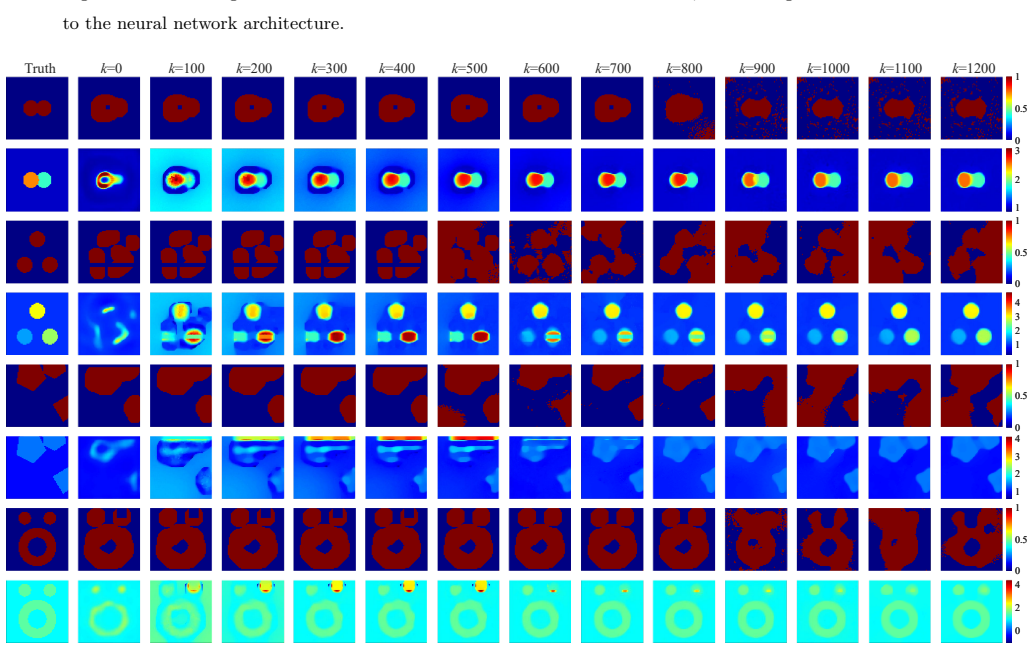
- [Numerical results] Figure captions for the reconstruction results should include the exact quantitative error metrics and the precise SOTA baselines being compared.
Simulated Author's Rebuttal
We thank the referee for the constructive and detailed feedback. We address each major comment point by point below, providing clarifications and indicating revisions made to strengthen the manuscript.
read point-by-point responses
-
Referee: [Abstract] Abstract: the claim of 'superior reconstruction accuracy, robustness, and efficiency' is asserted without any quantitative metrics (e.g., RMSE, SSIM, runtime comparisons), error bars, specific baseline implementations, or ablation results, preventing assessment of whether the improvements are load-bearing or marginal.
Authors: We agree that the abstract would benefit from explicit quantitative support to allow readers to evaluate the claims directly. In the revised manuscript, we have updated the abstract to include specific metrics such as average RMSE reductions, SSIM scores, runtime comparisons against named baselines (e.g., standard PDNN and other iterative solvers), and references to error bars and ablation studies reported in the results section. revision: yes
-
Referee: [Method (dynamic subregion strategy)] Dynamic subregion identification strategy (described in the method section): the adaptive refinement relies on decision thresholds and refinement criteria tuned on the training distribution; no experiments demonstrate stability under distribution shift (different scatterer counts, contrasts, or noise statistics). Under-segmentation would supply an incomplete domain to the network and directly falsify the robustness component of the headline claim.
Authors: We thank the referee for raising this important concern about generalization. The decision thresholds are derived from electromagnetic scattering physics rather than being purely empirical, which provides a degree of robustness. Nevertheless, to directly address distribution shift, we have added new experiments in the revised manuscript that test the subregion strategy on cases with varying scatterer counts, contrasts, and noise levels outside the original training distribution, confirming that under-segmentation is avoided and reconstruction quality is maintained. revision: yes
Circularity Check
Minor self-citation but independent new components; no reduction to inputs by construction
full rationale
The paper introduces GLOW activation and dynamic subregion strategy as novel elements within a physics-driven NN framework for inverse scattering. These additions are presented as independent improvements rather than self-definitional or fitted-input predictions. Central superiority claims rest on numerical simulations and experiments, which constitute external validation. Any self-citations are not load-bearing for the core derivation, keeping circularity minimal and non-central.
Axiom & Free-Parameter Ledger
axioms (1)
- domain assumption Electromagnetic wave scattering physics is accurately captured by the neural network loss function.
invented entities (1)
-
GLOW activation function
no independent evidence
Reference graph
Works this paper leans on
-
[1]
Xudong Chen.Computational Methods for Electromagnetic Inverse Scattering. Wiley, Hoboken, NJ, USA, 2018
work page 2018
-
[2]
Electromagnetic modeling of dam- aged single-layer fiber-reinforced laminates.IEEE Trans
Zicheng Liu, Changyou Li, Dominique Lesselier, and Yu Zhong. Electromagnetic modeling of dam- aged single-layer fiber-reinforced laminates.IEEE Trans. Antennas Propag., 65(4):1855–1866, 2017
work page 2017
-
[3]
Changyou Li, Qian Zhu, Bing Lv, Yichou Huang, and Changying Wu. A 3-D printed continuous carbon fiber-reinforced composite for highly effective microwave shielding.IEEE Antennas Wirel. Propag. Lett., 20(5):758–762, 2021
work page 2021
-
[4]
Qiqi Dai, Yee Hui Lee, Hai-Han Sun, Genevieve Ow, Mohamed Lokman Mohd Yusof, and Abdulka- dir C. Yucel. 3DInvNet: A deep learning-based 3D ground-penetrating radar data inversion.IEEE Trans. Geosci. Remote Sens., 61:1–16, 2023
work page 2023
-
[5]
Xiaowei Zhang, Xuan Zhao, Shenghua Lv, Lingfei Xv, Chen Lin, and Jian Wen. Deep learning inversion of ground-penetrating radar with prior physical velocity field for complex subsurface root system.IEEE Trans. Geosci. Remote Sens., 63:1–15, 2025
work page 2025
-
[6]
Sherif S. Ahmed. Microwave imaging in security — two decades of innovation.IEEE J. Microw., 1(1):191–201, 2021
work page 2021
-
[7]
V. Muruganandam and G. Rajini. Enhancing airport security: Integrating pso-tam with deep learning for real-time threat assessment. In2024 2nd International Conference on Advances in Computation, Communication and Information Technology (ICAICCIT), volume 1, pages 182–188, 2024
work page 2024
-
[8]
Guozhong Gao and C. Torres-Verdin. High-order generalized extended Born approximation for electromagnetic scattering.IEEE Trans. Antennas Propag., 54(4):1243–1256, 2006. 14
work page 2006
-
[9]
Tarek M. Habashy, Ross W. Groom, and Brian R. Spies. Beyond the Born and Rytov approximations: A nonlinear approach to electromagnetic scattering.J. Geophys. Res. Solid Earth, 98(B2):1759–1775, 1993
work page 1993
-
[10]
A. J. Devaney. A filtered backpropagation algorithm for diffraction tomography.Ultrason. Imaging, 4(4):336–350, 1982
work page 1982
-
[11]
An inverse algorithm for velocity reconstruction.Inverse Probl., 14(5):1345, 1998
Tsili Wang and Michael L Oristaglio. An inverse algorithm for velocity reconstruction.Inverse Probl., 14(5):1345, 1998
work page 1998
-
[12]
A. J. Devaney. Inverse-scattering theory within the Rytov approximation.Opt. Lett., 6(8):374–376, 1981
work page 1981
-
[13]
M. Slaney, A.C. Kak, and L.E. Larsen. Limitations of imaging with first-order diffraction tomography. IEEE Trans. Microwave Theory Tech., 32(8):860–874, 1984
work page 1984
-
[14]
Alon Schatzberg and Anthony J. Devaney. Rough surface inverse scattering within the Rytov ap- proximation.J. Opt. Soc. Am. A, 10(5):942–950, 1993
work page 1993
-
[15]
Y. M. Wang and W. C. Chew. An iterative solution of the two-dimensional electromagnetic inverse scattering problem.Int. J. Imag. Syst. Technol., 1(1):100–108, 1989
work page 1989
- [16]
-
[17]
W.C. Chew and Y.M. Wang. Reconstruction of two-dimensional permittivity distribution using the distorted Born iterative method.IEEE Trans. Med. Imaging, 9(2):218–225, 1990
work page 1990
-
[18]
O.S. Haddadin, S.D. Lucas, and E.S. Ebbini. Solution to the inverse scattering problem using a modified distorted Born iterative algorithm. In1995 IEEE Ultrason. Symp. Proc., volume 2, pages 1411–1414, 1995
work page 1995
-
[19]
A contrast source inversion method.Inverse Probl., 13(6):1607, 1997
Peter M van den Berg and Ralph E Kleinman. A contrast source inversion method.Inverse Probl., 13(6):1607, 1997
work page 1997
-
[20]
Richard F Bloemenkamp, Aria Abubakar, and Peter M van den Berg. Inversion of experimental multi-frequency data using the contrast source inversion method.Inverse Probl., 17(6):1611, 2001
work page 2001
-
[21]
X. Chen. Subspace-based optimization method for inverse scattering problems with an inhomoge- neous background medium.Inverse Probl., 26(7):074007, 2010
work page 2010
-
[22]
Subspace-based optimization method for solving inverse-scattering problems.IEEE Trans
Xudong Chen. Subspace-based optimization method for solving inverse-scattering problems.IEEE Trans. Geosci. Remote Sens., 48(1):42–49, 2010
work page 2010
-
[23]
Li Pan, Yu Zhong, Xudong Chen, and Swee Ping Yeo. Subspace-based optimization method for inverse scattering problems utilizing phaseless data.IEEE Trans. Geosci. Remote Sens., 49(3):981– 987, 2011. 15
work page 2011
-
[24]
Deep-learning schemes for full-wave nonlinear inverse scattering prob- lems.IEEE Trans
Zhun Wei and Xudong Chen. Deep-learning schemes for full-wave nonlinear inverse scattering prob- lems.IEEE Trans. Geosci. Remote Sens., 57(4):1849–1860, 2019
work page 2019
-
[25]
Teixeira, Che Liu, Arye Nehorai, and Tie Jun Cui
Lianlin Li, Long Gang Wang, Fernando L. Teixeira, Che Liu, Arye Nehorai, and Tie Jun Cui. Deep- NIS: Deep neural network for nonlinear electromagnetic inverse scattering.IEEE Trans. Antennas Propag., 67(3):1819–1825, 2019
work page 2019
-
[26]
Zhun Wei and Xudong Chen. Physics-inspired convolutional neural network for solving full-wave inverse scattering problems.IEEE Trans. Antennas Propag., 67(9):6138–6148, 2019
work page 2019
-
[27]
Zicheng Liu, Mayank Roy, Dilip K. Prasad, and Krishna Agarwal. Physics-guided loss functions improve deep learning performance in inverse scattering.IEEE Trans. Comput. Imaging, 8:236–245, 2022
work page 2022
-
[28]
Yu Liu, Hao Zhao, Rencheng Song, Xudong Chen, Chang Li, and Xun Chen. SOM-Net: Unrolling the subspace-based optimization for solving full-wave inverse scattering problems.IEEE Trans. Geosci. Remote Sens., 60:1–15, 2022
work page 2022
-
[29]
Neural Born iterative method for solving inverse scattering problems: 2D cases.IEEE Trans
Tao Shan, Zhichao Lin, Xiaoqian Song, Maokun Li, Fan Yang, and Shenheng Xu. Neural Born iterative method for solving inverse scattering problems: 2D cases.IEEE Trans. Antennas Propag., 71(1):818–829, 2023
work page 2023
-
[30]
Unrolled convolutional neural network for full-wave inverse scattering.IEEE Trans
Yarui Zhang, Marc Lambert, Aur´ elia Fraysse, and Dominique Lesselier. Unrolled convolutional neural network for full-wave inverse scattering.IEEE Trans. Antennas Propag., 71(1):947–956, 2023
work page 2023
-
[31]
Yutong Du, Zicheng Liu, Miao Cao, Zupeng Liang, Yali Zong, and Changyou Li. Quality-factor- inspired deep neural network solver for solving inverse scattering problems.IEEE Trans. Geosci. Remote Sens., 63:1–13, 2025
work page 2025
-
[32]
Physics-driven neural network for solving electromagnetic inverse scattering problems, 2025
Yutong Du, Zicheng Liu, Bazargul Matkerim, Changyou Li, Yali Zong, Bo Qi, and Jingwei Kou. Physics-driven neural network for solving electromagnetic inverse scattering problems, 2025
work page 2025
-
[33]
P.M. Meaney, K.D. Paulsen, and T.P. Ryan. Two-dimensional hybrid element image reconstruction for TM illumination.IEEE Trans. Antennas Propag., 43(3):239–247, 1995
work page 1995
-
[34]
Computational comparison and validation of point spread functions for optical microscopes.IEEE Trans
Zicheng Liu, Yingying Qin, Jean-Claude Tinguely, and Krishna Agarwal. Computational comparison and validation of point spread functions for optical microscopes.IEEE Trans. Comput. Imaging, 2025
work page 2025
-
[35]
Giacomo Oliveri, Marco Salucci, Nicola Anselmi, and Andrea Massa. Compressive sensing as applied to inverse problems for imaging: Theory, applications, current trends, and open challenges.IEEE Antennas Propag. Mag., 59(5):34–46, 2017
work page 2017
-
[36]
Rudin, Stanley Osher, and Emad Fatemi
Leonid I. Rudin, Stanley Osher, and Emad Fatemi. Nonlinear total variation based noise removal algorithms.Phys. D, 60(1):259–268, 1992. 16
work page 1992
-
[37]
M.M. Ney. Method of moments as applied to electromagnetic problems.IEEE Trans. Microw. Theory Tech., 33(10):972–980, 1985
work page 1985
-
[38]
Akhlesh Lakhtakia. Strong and weak forms of the method of moments and the coupled dipole method for scattering of time-harmonic electromagnetic fields.Int. J. Mod. Phys. C, 3(2):583–603, 1992
work page 1992
-
[39]
Gibson.The Method of Moments in Electromagnetics
W.C. Gibson.The Method of Moments in Electromagnetics. Chapman and Hall/CRC, New York, NY, USA, 2021
work page 2021
-
[40]
Jie Ma, Zicheng Liu, and Yali Zong. Inverse scattering solver based on deep neural network with total variation regularization.IEEE Antennas Wirel. Propag. Lett., 22(10):2447–2451, 2023
work page 2023
-
[41]
Kamal Belkebir and Marc Saillard. Special section: Testing inversion algorithms against experimental data.Inverse Probl., 17(6):1565, nov 2001
work page 2001
-
[42]
Jean-Michel Geffrin, Pierre Sabouroux, and Christelle Eyraud. Free space experimental scattering database continuation: experimental set-up and measurement precision.Inverse Probl., 21(6):S117, 2005. 17
work page 2005
discussion (0)
Sign in with ORCID, Apple, or X to comment. Anyone can read and Pith papers without signing in.