Infusing Experimental Reality into Complex Many-Body Hamiltonians: The Observable-Constrained Variational Framework (OCVF)
Pith reviewed 2026-05-16 23:52 UTC · model grok-4.3
The pith
A variational framework corrects theoretical Hamiltonians with neural terms to match experimental observables and predict accurate phase transitions in BaTiO3.
A machine-rendered reading of the paper's core claim, the machinery that carries it, and where it could break.
Core claim
The central claim is that the Observable-Constrained Variational Framework extends the Constrained-Ensemble Variational Method by training a neural network correction ΔH_θ so the combined Hamiltonian matches experimental observables across temperatures, allowing accurate prediction of BaTiO3's full phase transition sequence with the reported accuracy improvements.
What carries the argument
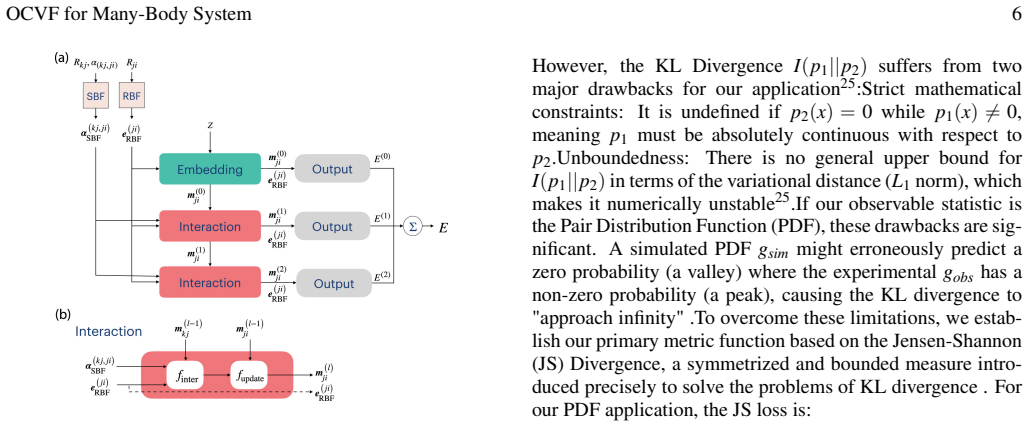
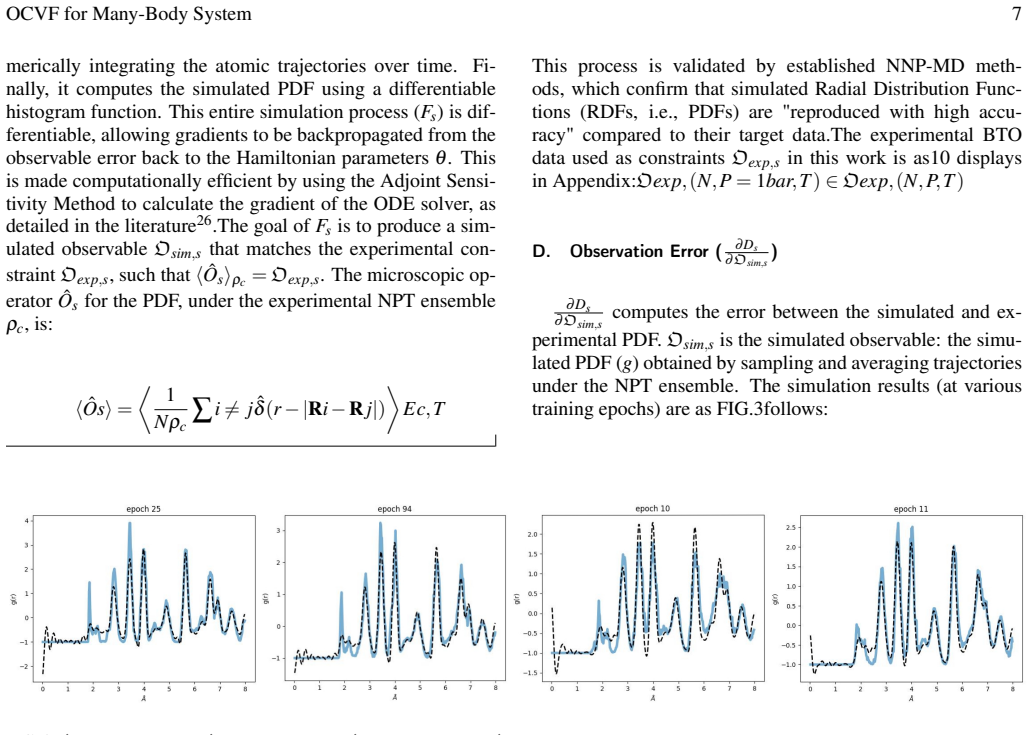
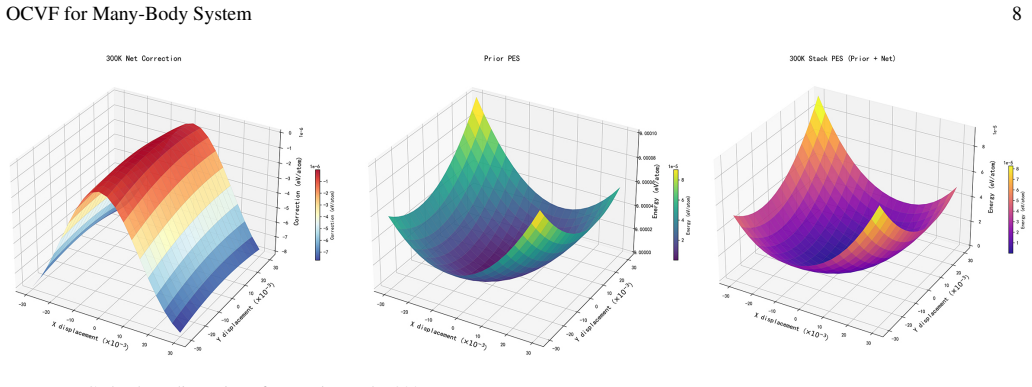
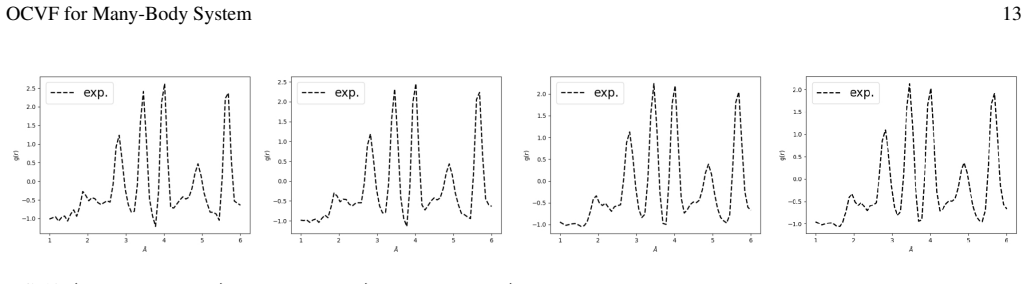
The Observable-Constrained Variational Framework (OCVF) is a top-down correction method that uses a neural network to learn the functional correction ΔH_θ enforcing match to experimental observables like pair-distribution functions.
If this is right
- The augmented Hamiltonian predicts the full temperature-driven phase transition sequence in BaTiO3 accurately.
- Cubic-tetragonal transition temperature accuracy rises by 95.8 percent relative to the uncorrected model.
- Orthorhombic-rhombohedral transition temperature accuracy rises by 36.1 percent.
- Lattice-structure accuracy in the rhombohedral phase rises by 55.6 percent.
Where Pith is reading between the lines
- The same constrained-correction approach could be tested on other perovskites where both DFT and experimental PDF data exist.
- If the neural correction remains stable under modest changes in training temperature windows, it may indicate that missing physics is being captured rather than memorized.
- One could check whether the learned correction functional transfers to different observables such as dielectric constants or elastic moduli.
Load-bearing premise
The neural network correction ΔH_θ trained on experimental PDF data generalizes to new phases and temperatures without overfitting or unphysical artifacts.
What would settle it
Applying the corrected model to independent experimental data for BaTiO3 phase transitions and finding no improvement in accuracy would falsify the claim.
Figures
read the original abstract
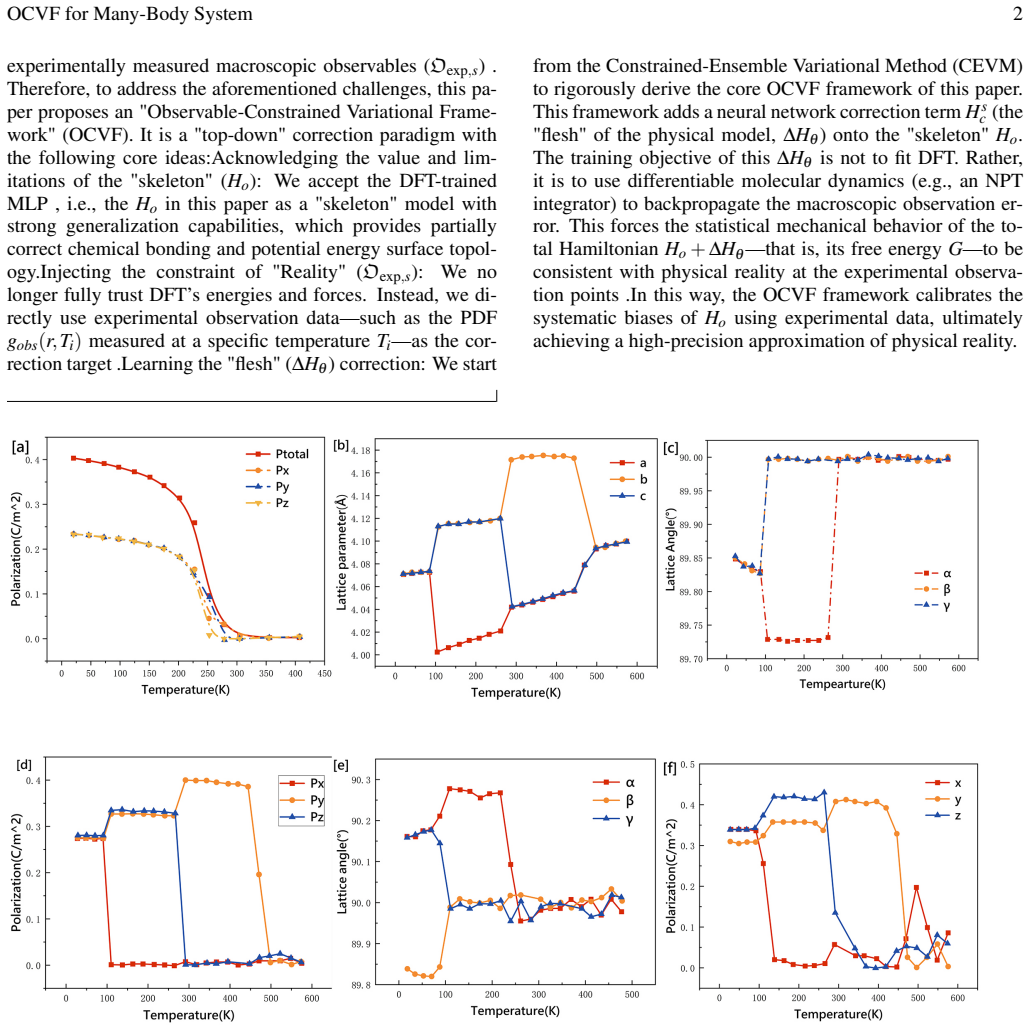
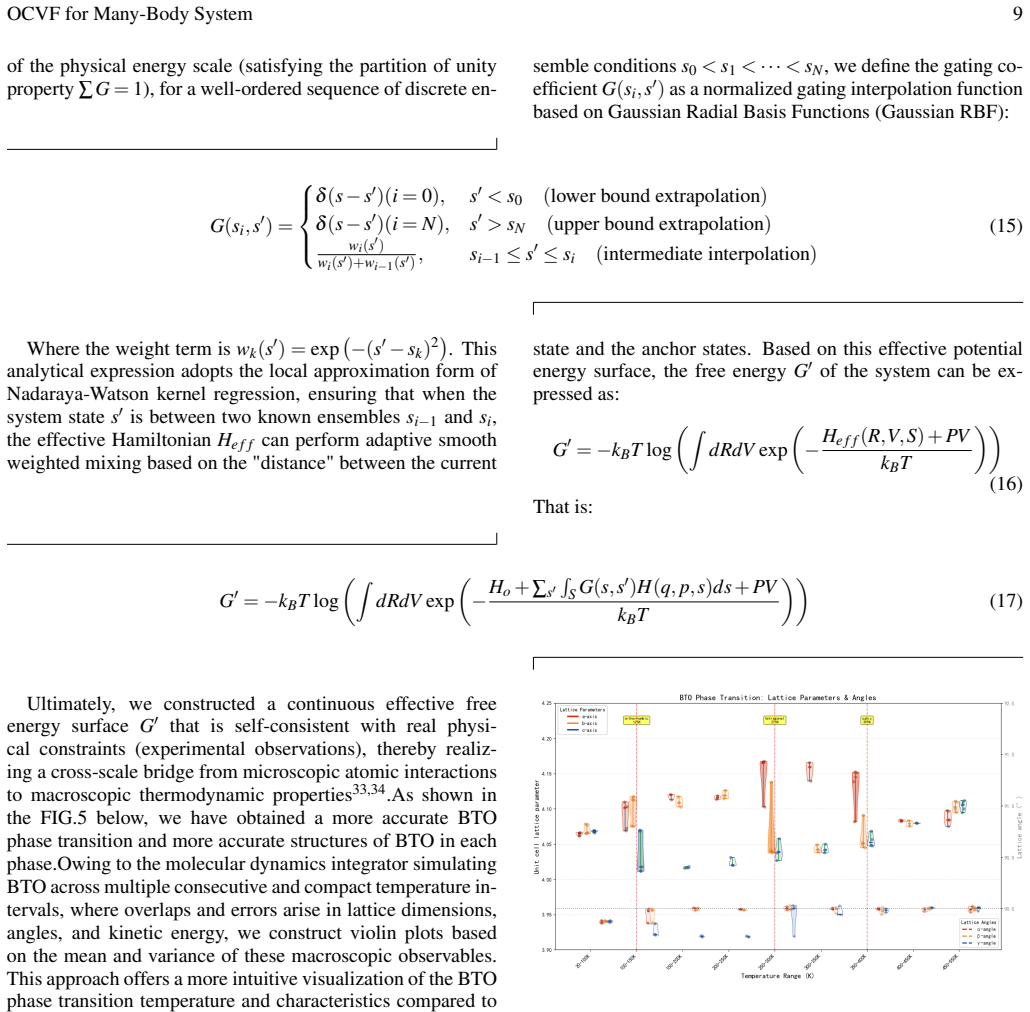
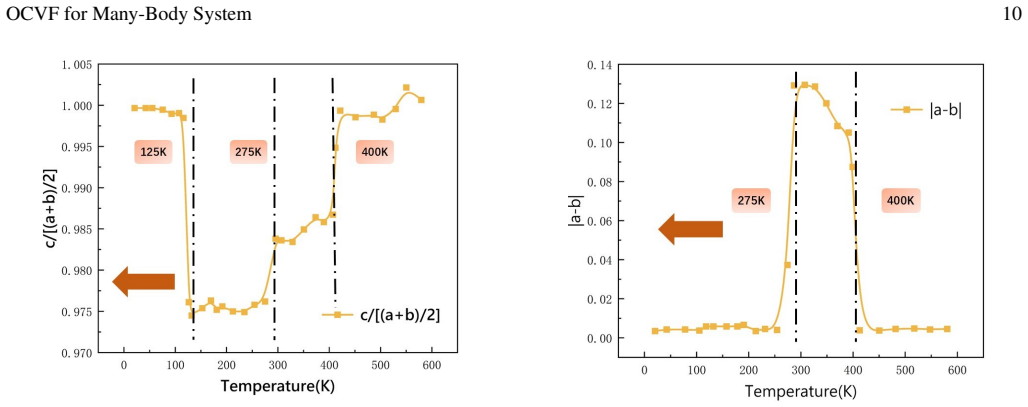
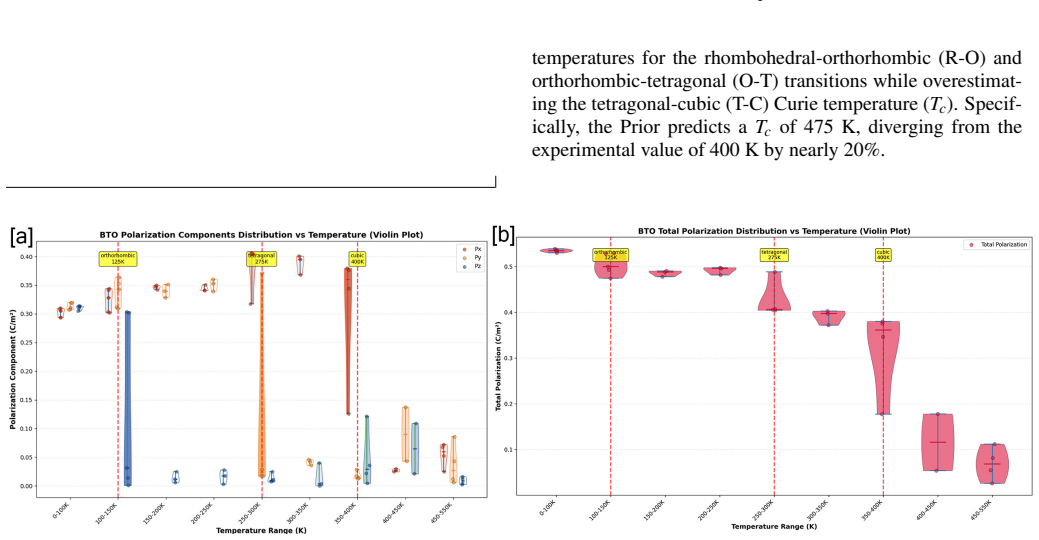
Deep learning potentials for complex many-body systems often face challenges of insufficient accuracy and a lack of physical realism. This paper proposes an "Observable-Constrained Variational Framework" (OCVF), a general top-down correction paradigm designed to infuse physical realism into theoretical "skeleton" models (H_o) by imposing constraints from macroscopic experimental observables (\mathfrak{O}_{\text{exp},s}). We theoretically derive OCVF as a numerically tractable extension of the "Constrained-Ensemble Variational Method" (CEVM), wherein a neural network (\Delta H_\theta) learns the correction functional required to match the experimental data. We apply OCVF to BaTiO3 (BTO) to validate the framework: a neural network potential trained on DFT data serves as H_o, and experimental PDF data at various temperatures are used as constraints (\mathfrak{O}{\text{exp},s}). The final model, H_o + \Delta H_\theta, successfully predicts the complete phase transition sequence accurately (s', s \neq s'). Compared to the prior model, the accuracy of the Cubic-Tetragonal (C-T) phase transition temperature is improved by 95.8\% , and the Orthorhombic-Rhombohedral (O-R) T_c accuracy is improved by 36.1\%. Furthermore, the lattice structure accuracy in the Rhombohedral (R) phase is improved by 55.6\%, validating the efficacy of the OCVF framework in calibrating theoretical models via observational constraints.
Editorial analysis
A structured set of objections, weighed in public.
Referee Report
Summary. The paper introduces the Observable-Constrained Variational Framework (OCVF) as a top-down correction to skeleton many-body Hamiltonians H_o. A neural-network term ΔH_θ is variationally optimized to enforce agreement with experimental observables (PDF data at selected temperatures) while preserving the underlying physics; the corrected Hamiltonian is then used to predict the full sequence of phase transitions in BaTiO3, yielding reported accuracy gains of 95.8 % for the cubic-tetragonal transition temperature, 36.1 % for the orthorhombic-rhombohedral transition temperature, and 55.6 % for the rhombohedral lattice parameters relative to the uncorrected model.
Significance. If the neural correction can be shown to remain physical and transferable outside the temperatures at which the PDF constraints were imposed, OCVF would supply a practical route for calibrating machine-learned potentials against macroscopic observables, improving predictive reliability for materials with multiple structural phase transitions.
major comments (2)
- [Abstract and §4] Abstract and §4 (application to BaTiO3): the quantitative claims of 95.8 % and 36.1 % improvement in transition temperatures and 55.6 % improvement in R-phase lattice accuracy are presented without any statement that the experimental PDF data at the relevant temperatures were excluded from the training set of ΔH_θ; absent such held-out validation or independent experimental benchmarks, the reported gains cannot be distinguished from a direct fit to the validation metric.
- [§3] §3 (theoretical derivation of OCVF): the extension of CEVM to a neural correction ΔH_θ is asserted to be numerically tractable, yet no explicit description is given of how the constraints are imposed during optimization (e.g., Lagrange multipliers, penalty terms, or projection) or of any regularization that would guarantee the correction remains physical at temperatures s' ≠ s.
minor comments (2)
- [Notation] The notation for the experimental observables (mathfrak{O}_{exp,s}) is introduced in the abstract but never given an explicit functional form; a short equation or table defining the PDF observable would aid reproducibility.
- [Figures] Figure captions and axis labels in the phase-diagram plots should explicitly state whether error bars are present and whether the plotted transition temperatures are obtained from free-energy crossings or from order-parameter jumps.
Simulated Author's Rebuttal
We thank the referee for the constructive comments, which highlight important points for improving the clarity of our presentation of the OCVF framework. We address each major comment below and will revise the manuscript accordingly.
read point-by-point responses
-
Referee: [Abstract and §4] Abstract and §4 (application to BaTiO3): the quantitative claims of 95.8 % and 36.1 % improvement in transition temperatures and 55.6 % improvement in R-phase lattice accuracy are presented without any statement that the experimental PDF data at the relevant temperatures were excluded from the training set of ΔH_θ; absent such held-out validation or independent experimental benchmarks, the reported gains cannot be distinguished from a direct fit to the validation metric.
Authors: We agree that the abstract and Section 4 should explicitly state that the experimental PDF data at the temperatures corresponding to the predicted phase transitions were excluded from the training set of ΔH_θ. Although the manuscript indicates predictions for s' ≠ s, this was not made unambiguous. In the revised manuscript we will add clear statements in both the abstract and Section 4 specifying the distinct temperature sets used for training versus evaluation, thereby confirming the held-out nature of the reported accuracy gains. revision: yes
-
Referee: [§3] §3 (theoretical derivation of OCVF): the extension of CEVM to a neural correction ΔH_θ is asserted to be numerically tractable, yet no explicit description is given of how the constraints are imposed during optimization (e.g., Lagrange multipliers, penalty terms, or projection) or of any regularization that would guarantee the correction remains physical at temperatures s' ≠ s.
Authors: We agree that Section 3 would benefit from explicit implementation details. In the revised manuscript we will expand the derivation to describe the optimization procedure, in which observable constraints are enforced through a tunable penalty term added to the variational objective (rather than Lagrange multipliers or projection). We will also detail the regularization employed, including L2 weight decay on the neural-network parameters and a smoothness prior on ΔH_θ, chosen to promote physical behavior and transferability to temperatures s' ≠ s outside the training set. revision: yes
Circularity Check
No significant circularity detected in derivation or claims
full rationale
The paper derives OCVF theoretically as a numerically tractable extension of CEVM, then applies it by training a neural correction ΔH_θ on experimental PDF observables at temperatures s to correct the DFT-based skeleton H_o. The central claims concern emergent predictions of the full phase-transition sequence and specific Tc values at distinct temperatures s' ≠ s, with quantitative accuracy gains reported relative to the uncorrected model. Because the phase-transition temperatures and lattice parameters are not the direct fitting targets but derived properties of the corrected Hamiltonian, and the text explicitly distinguishes training constraints from validation at different s, the reported results do not reduce by construction to the inputs. No self-definitional equations, fitted-input-renamed-as-prediction, or load-bearing self-citations are exhibited in the provided text.
Axiom & Free-Parameter Ledger
free parameters (1)
- neural-network parameters θ
axioms (1)
- domain assumption The correction to the skeleton Hamiltonian can be represented as an additive neural-network functional that remains variationally tractable.
invented entities (1)
-
ΔH_θ correction functional
no independent evidence
Lean theorems connected to this paper
-
IndisputableMonolith/Cost/FunctionalEquation.leanwashburn_uniqueness_aczel unclear?
unclearRelation between the paper passage and the cited Recognition theorem.
We theoretically derive OCVF as a numerically tractable extension of the Constrained-Ensemble Variational Method (CEVM), wherein a neural network (ΔH_θ) learns the correction functional required to match the experimental data.
-
IndisputableMonolith/Foundation/RealityFromDistinction.leanreality_from_one_distinction unclear?
unclearRelation between the paper passage and the cited Recognition theorem.
The final model, H_o + ΔH_θ, successfully predicts the complete phase transition sequence accurately... accuracy of the Cubic-Tetragonal (C-T) phase transition temperature is improved by 95.8%.
What do these tags mean?
- matches
- The paper's claim is directly supported by a theorem in the formal canon.
- supports
- The theorem supports part of the paper's argument, but the paper may add assumptions or extra steps.
- extends
- The paper goes beyond the formal theorem; the theorem is a base layer rather than the whole result.
- uses
- The paper appears to rely on the theorem as machinery.
- contradicts
- The paper's claim conflicts with a theorem or certificate in the canon.
- unclear
- Pith found a possible connection, but the passage is too broad, indirect, or ambiguous to say the theorem truly supports the claim.
Reference graph
Works this paper leans on
-
[1]
It must reproduce all experimental observations: ⟨ ˆOs⟩ρc =O exp,s,∀s. OCVF for Many-Body System 4
-
[2]
The corrected ensembleρ c should be "as close as pos- sible" to our most credible theoretical priorρ o. To satisfy these conditions, we apply the principle of Mini- mum Relative Entropy (Kullback-Leibler divergence). This principle posits that the least biased distributionρ c agreeing with new constraints is the one minimizing the information- theoretic "...
-
[3]
The "Rigid" vs. "Flexible" Ansatz Beyond its analytical intractability, the CEVM solution ∆H({λs})presents a fundamental physical limitation. It op- erates on a "rigid" ansatz, which assumes that the true cor- rection functional (H−H o) can be perfectly expressed as a linear combination of the few microscopic operators ˆOs that we chose to observe (e.g., ...
-
[4]
Literature Context of OCVF This OCVF framework represents a "top-down" correc- tion paradigm. It is distinct from "bottom-up" approaches, OCVF for Many-Body System 5 such as variational force-matching, where the observable Oexp,s is typically the DFT-calculated force/energy itself 16. Our method also differs from other emerging top-down techniques, such a...
-
[5]
Deconstruction of the Gradient Chain Rule ∂D s/∂O sim,s: The "Observational Gradient", representing the error signal between the simulated PDF (g sim) and the experimental PDF (gobs);∂Fs/∂H c: The "Physical Gradient", representing the sensitivity of the final averaged observable (PDF) to infinitesimal changes in the potential energy surface. This is the m...
-
[6]
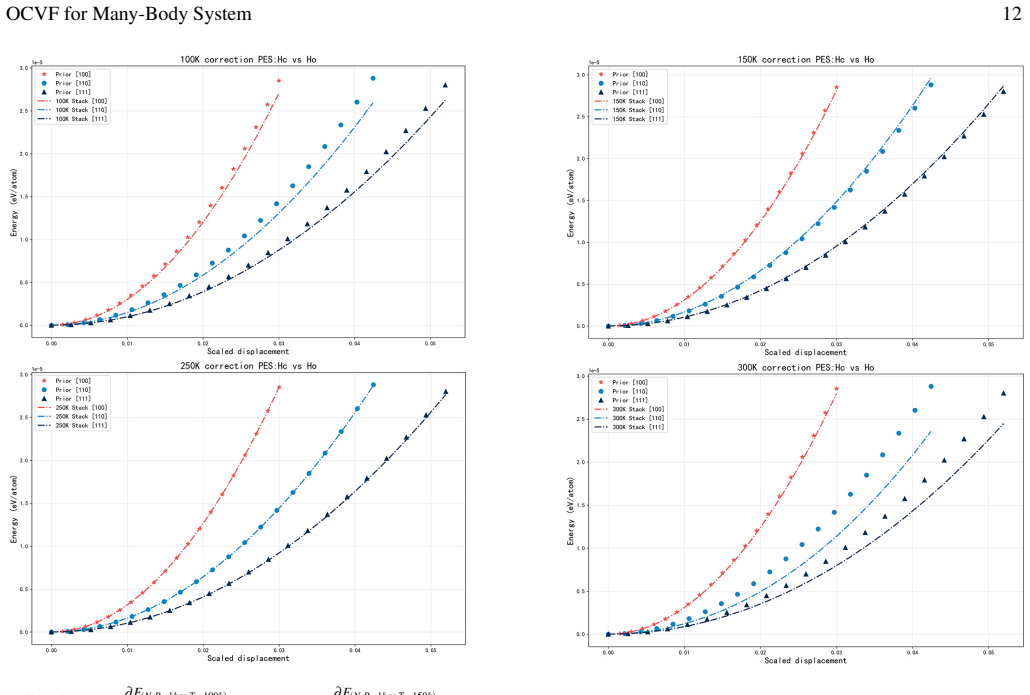
[110] [111] Temperature (K) Max (eV/atom) RMS (eV/atom) Max (eV/atom) RMS (eV/atom) Max (eV/atom) RMS (eV/atom) 100−1.47×10 −6 6.79×10 −7 −2.87×10 −6 1.32×10 −6 −1.79×10 −6 8.21×10 −7 150−3.76×10 −7 1.75×10 −7 0 3.52×10 −7 0 2.86×10 −7 250 0 4.00×10 −9 −7.90×10 −8 3.87×10 −8 −3.68×10 −7 1.73×10 −7 300−5.48×10 −7 2.56×10 −7 −5.23×10 −6 2.65×10 −6 −3.56×10 ...
discussion (0)
Sign in with ORCID, Apple, or X to comment. Anyone can read and Pith papers without signing in.