Real-Time Polarization Control for Satellite QKD with Liquid-Crystal Beacon Stabilization
Pith reviewed 2026-05-16 23:06 UTC · model grok-4.3
The pith
Liquid-crystal retarders guided by a classical beacon enable real-time polarization compensation for satellite quantum key distribution.
A machine-rendered reading of the paper's core claim, the machinery that carries it, and where it could break.
Core claim
Liquid-crystal variable retarders, operated as a polarimeter and steered by measurements on a co-propagating classical beacon, allow continuous identification and compensation of polarization transformations experienced by quantum photons, achieving sufficient accuracy for entanglement-based QKD with only moderate impact on the quantum-bit error rate.
What carries the argument
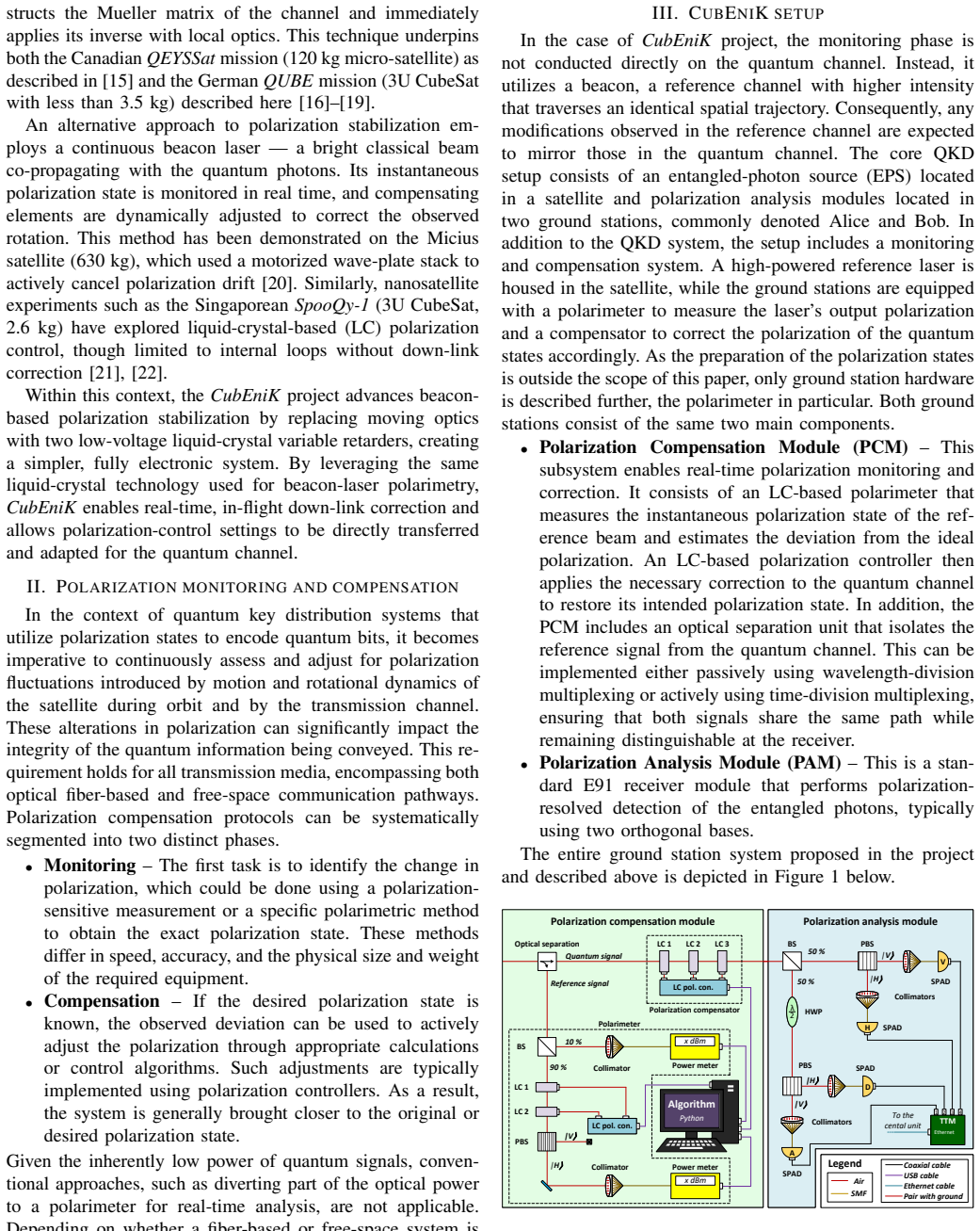
Liquid-crystal variable retarders configured as an LC-based polarimeter that reconstructs Stokes parameters from a classical beacon to drive real-time polarization compensation.
If this is right
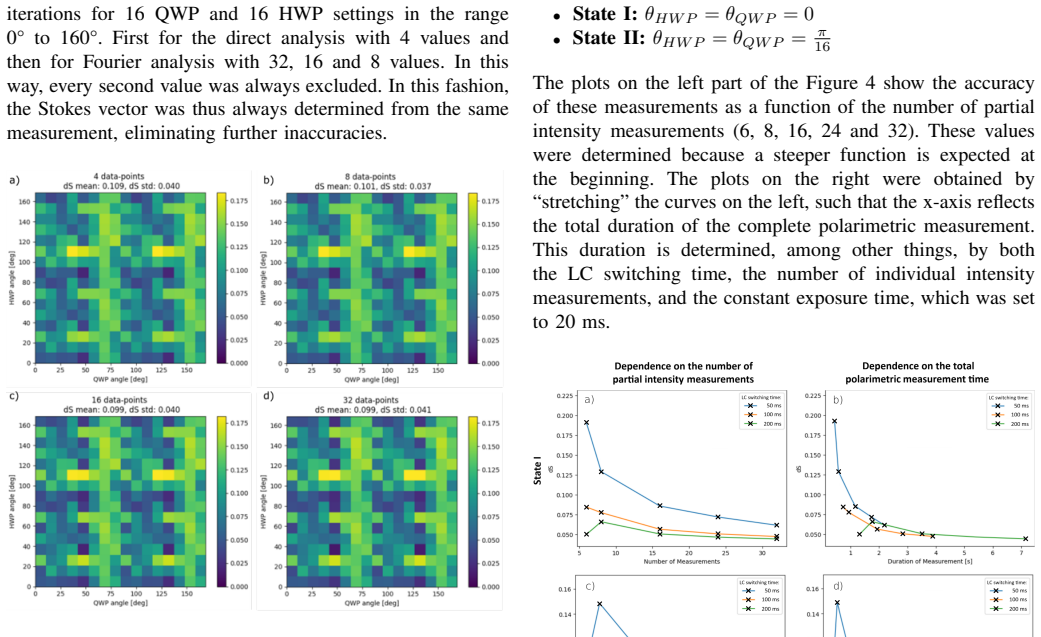
- Accurate Stokes-parameter estimation is possible with a limited number of measurements, giving a usable speed-precision trade-off.
- Liquid-crystal switching dynamics must be tuned to operating conditions that support continuous real-time performance.
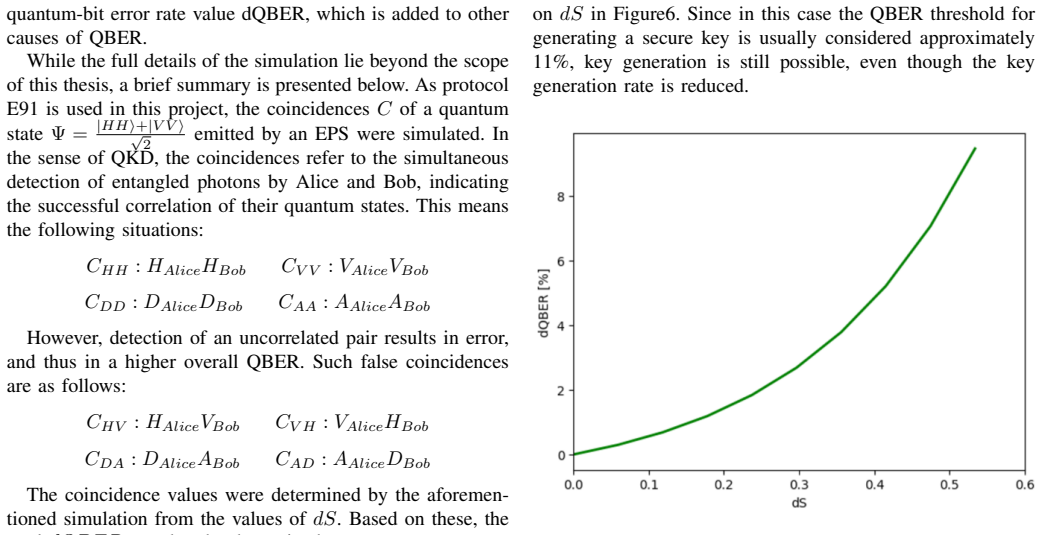
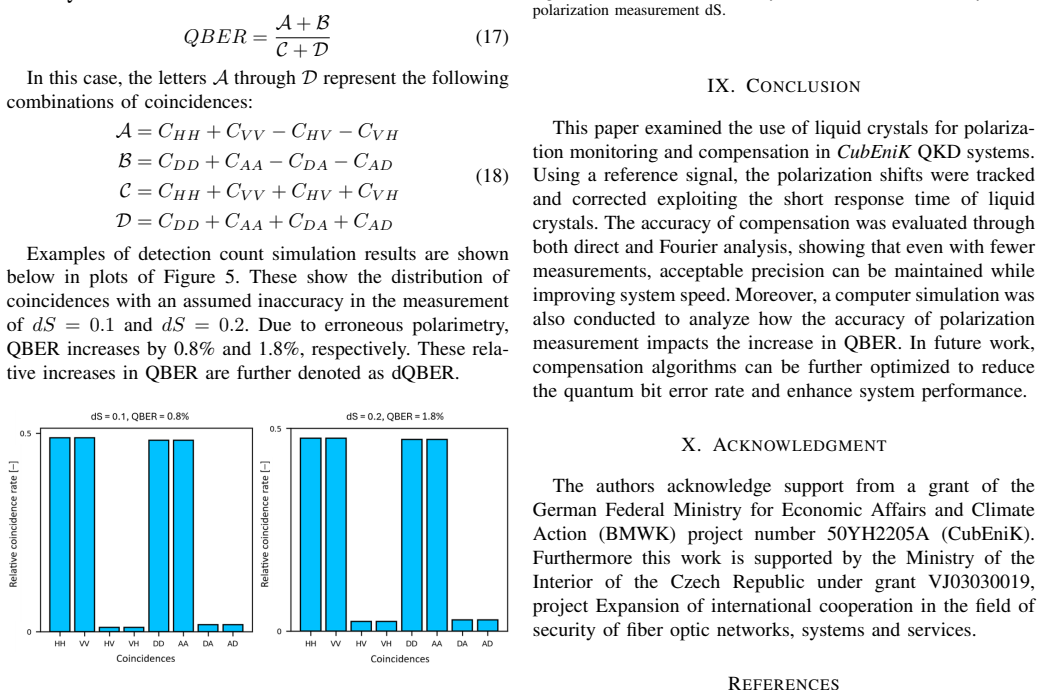
- Simulations indicate that the resulting QBER increase remains compatible with secure key distribution in an entanglement-based protocol.
- The compact LC architecture reduces hardware demands compared with conventional polarization controllers on satellite platforms.
Where Pith is reading between the lines
- If the beacon-to-quantum matching holds under real orbital conditions, the same LC approach could stabilize polarization in other free-space quantum channels.
- Field trials on an actual satellite would directly test whether switching speed and stability survive launch vibrations and thermal cycling.
- Integration with existing QKD terminals could lower mass and power budgets by replacing bulk-optic compensators.
Load-bearing premise
The classical beacon experiences exactly the same polarization transformations as the quantum photons, and the liquid-crystal devices switch fast enough and stably enough for uninterrupted real-time tracking.
What would settle it
A side-by-side measurement in which the polarization state reconstructed from the beacon differs measurably from the actual state of the quantum photons, or a continuous test in which the resulting QBER exceeds the threshold for secure key extraction.
Figures
read the original abstract
Polarization instability is a critical challenge for polarization-entangled satellite quantum key distribution (QKD), where atmospheric effects and platform motion continuously distort photon polarization. To maintain entanglement fidelity, these transformations must be accurately identified and compensated prior to detection. In this work, a compact and fast polarization-compensation approach based on liquid-crystal (LC) variable retarders is presented, using a co-propagating classical reference signal (beacon) for real-time polarization tracking. An LC-based polarimeter is implemented, and its performance is evaluated using both direct and Fourier-based Stokes parameter reconstruction. Experimental results indicate that accurate polarization estimation can be achieved with a limited number of measurements, enabling a favorable trade-off between speed and precision. The impact of liquid-crystal switching dynamics is also analyzed, highlighting the importance of selecting appropriate operating conditions for real-time applications. In addition, the effect of polarimetric inaccuracies on QKD performance is assessed through simulations of an entanglement-based protocol. The results show that only a moderate increase in quantum-bit error rate is introduced, while remaining compatible with secure key distribution. These findings demonstrate that LC-based polarization control represents an efficient and practical solution for real-time compensation in satellite QKD systems.
Editorial analysis
A structured set of objections, weighed in public.
Referee Report
Summary. The manuscript presents a liquid-crystal (LC) variable retarder based system for real-time polarization compensation in satellite quantum key distribution (QKD) using a co-propagating classical beacon signal. It describes the implementation of an LC-based polarimeter evaluated with both direct and Fourier-based Stokes parameter reconstruction methods. Experimental results on polarization estimation accuracy and LC switching dynamics are provided, along with simulations assessing the impact on quantum bit error rate (QBER) in an entanglement-based QKD protocol, concluding that the approach introduces only moderate QBER increase while remaining suitable for secure key distribution.
Significance. If the results hold, this work demonstrates a compact and practical LC-based solution for addressing polarization instability in satellite QKD, a key barrier to entanglement fidelity. The experimental evaluation of polarimeter accuracy combined with switching dynamics analysis and direct QKD simulations provides concrete support for feasibility, strengthening the case for real-time compensation using standard components. This could aid deployment of polarization-entangled satellite links by offering a favorable speed-precision trade-off.
major comments (1)
- [Experimental Evaluation] Experimental Evaluation section: the claim of accurate polarization estimation with a limited number of measurements lacks reported error bars, exact measurement counts, and any discussion of potential post-selection, which is load-bearing for assessing the speed-precision trade-off and the moderate QBER impact conclusion.
minor comments (2)
- [Abstract] Abstract: the phrase 'Fourier-based Stokes parameter reconstruction' is introduced without a brief definition or citation, reducing accessibility for readers outside the immediate subfield.
- [Figures] Figure captions: experimental figures would benefit from explicit inclusion of operating wavelength, LC retarder model, and beacon power levels to allow reproduction of the reported accuracy.
Simulated Author's Rebuttal
We thank the referee for their positive assessment of the work and for the constructive comment, which we address below. We will revise the manuscript accordingly to strengthen the experimental evaluation section.
read point-by-point responses
-
Referee: [Experimental Evaluation] Experimental Evaluation section: the claim of accurate polarization estimation with a limited number of measurements lacks reported error bars, exact measurement counts, and any discussion of potential post-selection, which is load-bearing for assessing the speed-precision trade-off and the moderate QBER impact conclusion.
Authors: We agree that the Experimental Evaluation section would benefit from greater statistical detail. In the revised manuscript we will add error bars to all polarization estimation accuracy plots, explicitly state the number of independent measurements (and repetitions) used for both the direct and Fourier-based Stokes reconstructions, and include a short paragraph confirming that no post-selection was performed on the data. These additions will make the speed-precision trade-off and the resulting QBER impact fully quantifiable. revision: yes
Circularity Check
No significant circularity detected
full rationale
The paper presents an experimental implementation of an LC-based polarimeter for satellite QKD polarization compensation, with performance evaluated via direct Stokes measurements and Fourier-based reconstruction, plus analysis of switching dynamics and QBER simulations. No derivation chain reduces by construction to its inputs; there are no self-definitional equations, fitted parameters relabeled as predictions, or load-bearing self-citations that substitute for independent validation. The co-propagating beacon assumption is standard and externally verifiable, and all central claims rest on reported measurements and standard protocol simulations without internal reduction to tautology.
Axiom & Free-Parameter Ledger
axioms (1)
- domain assumption Classical beacon experiences the same polarization transformation as the quantum signal
Reference graph
Works this paper leans on
-
[1]
Commission and european space agency sign euroqci implementation agreement, Jan 2025
European Commission. Commission and european space agency sign euroqci implementation agreement, Jan 2025
work page 2025
-
[2]
Eagle-1 — europe’s first space-based quantum key distribution system, Nov 2024
European Space Agency. Eagle-1 — europe’s first space-based quantum key distribution system, Nov 2024
work page 2024
-
[3]
Satellite-Relayed Intercontinental Quantum Network
Sheng-Kai Liao, Wen-Qi Cai, Johannes Handsteiner, Bo Liu, Juan Yin, Liang Zhang, Dominik Rauch, Matthias Fink, Ji-Gang Ren, Wei-Yue Liu, Yang Li, Qi Shen, Yuan Cao, Feng-Zhi Li, Jian-Feng Wang, Yong- Mei Huang, Lei Deng, Tao Xi, Lu Ma, Tai Hu, Li Li, Nai-Le Liu, Franz Koidl, Peiyuan Wang, Yu-Ao Chen, Xiang-Bin Wang, Michael Steindorfer, Georg Kirchner, Ch...
work page 2018
-
[4]
Mi- cius quantum experiments in space
Chao-Yang Lu, Yuan Cao, Cheng-Zhi Peng, and Jian-Wei Pan. Mi- cius quantum experiments in space. Reviews of Modern Physics , 94(3):035001, 2022
work page 2022
-
[5]
Peide Zhang, David Lowndes, Milan Stefko, Daniel Oi, and John Rarity. Modelling and experimental testing of an optical synchronisation beacon designed for high-loss satellite quantum communication. IET Quantum Communication, 5(1):52–65, 2024
work page 2024
-
[6]
Ian J. O’Neill. SEAQUE Arrives at Space Station Aboard NASA’s SpaceX CRS-31, 2024
work page 2024
-
[7]
Security of trusted repeater quantum key distribution networks
Louis Salvail, Momtchil Peev, Eleni Diamanti, Romain All ´eaume, Norbert L ¨utkenhaus, and Thomas L ¨anger. Security of trusted repeater quantum key distribution networks. Journal of Computer Security , 18(1):61–87, 2010
work page 2010
-
[8]
Satellite-to-ground quantum key distribution
Sheng-Kai Liao, Wen-Qi Cai, Wei-Yue Liu, Liang Zhang, Yang Li, Ji- Gang Ren, Juan Yin, Qi Shen, Yuan Cao, Zheng-Ping Li, Feng-Zhi Li, Xia-Wei Chen, Li-Hua Sun, Jian-Jun Jia, Jin-Cai Wu, Xiao-Jun Jiang, Jian-Feng Wang, Yong-Mei Huang, Qiang Wang, Yi-Lin Zhou, Lei Deng, Tao Xi, Lu Ma, Tai Hu, Qiang Zhang, Yu-Ao Chen, Nai-Le Liu, Xiang-Bin Wang, Zhen-Cai Zhu...
work page 2017
-
[9]
Bruno Huttner, Romain All ´eaume, Eleni Diamanti, Florian Fr ¨owis, Philippe Grangier, Hannes H ¨ubel, Vicente Mart ´ın, Andreas Poppe, James A. Slater, Timothy P. Spiller, Wolfgang Tittel, Beno ˆıt Tranier, Adrian Wonfor, and Hugo Zbinden. Author correction: Long-range qkd without trusted nodes is not possible with current technology. npj Quantum Informa...
work page 2022
-
[10]
Morozov, Anatolii Divochiy, Zhen Zhou, Guangcan Guo, and Zheng-Fu Han
Shuang Wang, Zhen Yin, Dejun He, Weijian Chen, Rui Wang, Peng Ye, Yuchen Zhou, Guoyang Fan-Yuan, Feihu Wang, Wei Chen, Yulin Zhu, Pavel V . Morozov, Anatolii Divochiy, Zhen Zhou, Guangcan Guo, and Zheng-Fu Han. Twin-field quantum key distribution over 830-km fibre. Nature Photonics, 16(2):154–161, 2022
work page 2022
-
[11]
Micius quantum experiments in space
Chao-Yang Lu, Yuan Cao, Cheng-Zhi Peng, and Jian-Wei Pan. Micius quantum experiments in space. Reviews of Modern Physics, 94(3), 2022
work page 2022
-
[12]
Entanglement- based secure quantum cryptography over 1,120 kilometres
Juan Yin, Yuan Li, Sheng-Kai Liao, Min Yang, Yuan Cao, Liang Zhang, Ji-Gang Ren, Wen-Qi Cai, Wei-Yue Liu, Sheng-Kai Li, Rong Shu, Yong- Mei Huang, Lei Deng, Li Li, Qiang Zhang, Nai-Le Liu, Yu-Ao Chen, Chao-Yang Lu, Xiang-Bin Wang, and Jian-Wei Pan. Entanglement- based secure quantum cryptography over 1,120 kilometres. Nature, 582(7813):501–505, 2020
work page 2020
-
[13]
Satellite- relayed intercontinental quantum network
Sheng-Kai Liao, Wen-Qi Cai, Johannes Handsteiner, Bo Liu, Juan Yin, Liang Zhang, Dominik Rauch, Matthias Fink, Ji-Gang Ren, Wei-Yue Liu, Li Yang, Qi Shen, Yuan Cao, Feng-Zhi Li, Jian-Feng Wang, Yong- Mei Huang, Lei Deng, Xi Tao, Lu Ma, and Jian-Wei Pan. Satellite- relayed intercontinental quantum network. Physical Review Letters , 120(3):030501, 2018
work page 2018
-
[14]
Omar Amer, Vishal Garg, and Walter O. Krawec. An introduction to practical quantum key distribution. IEEE Aerospace and Electronic Systems Magazine, 36(3):30–55, 2021
work page 2021
-
[15]
Higgins, Hugh Podmore, and Thomas Jennewein
Youn Seok Lee, Kimia Mohammadi, Lindsay Babcock, Brendon L. Higgins, Hugh Podmore, and Thomas Jennewein. Robotized polarization characterization platform for free-space quantum communication optics. Review of Scientific Instruments , 93(3):033101, March 2022. Published 1 March 2022; arXiv:2109.01984
-
[16]
QKD Hardware on Small Satellites
Peter Freiwang. QKD Hardware on Small Satellites . Doctoral disser- tation, Faculty of Physics, Ludwig–Maximilians–Universit ¨at M ¨unchen, Munich, Germany, April 2023. Oral defence: 28 Apr 2023
work page 2023
-
[17]
Qube – towards quantum key distribution with small satellites
Lukas Knips, Michael Auer, Adomas Baliuka, ¨Omer Bayraktar, Peter Freiwang, Matthias Gr¨unefeld, Roland Haber, Norbert Lemke, Christoph Marquardt, Florian Moll, Jonas Pudelko, Benjamin R ¨odiger, Klaus Schilling, Christopher Schmidt, and Harald Weinfurter. Qube – towards quantum key distribution with small satellites. In Quantum 2.0 Confer- ence and Exhib...
work page 2022
-
[18]
QUBE – a cubesat for quantum key distribution experiments
Roland Haber, Daniel Garbe, and Klaus Schilling. QUBE – a cubesat for quantum key distribution experiments. In Proceedings of the 32 nd Annual AIAA/USU Conference on Small Satellites , pages 1–8, Logan, Utah, USA, August 2018. Paper SSC18–III–05
work page 2018
-
[19]
Global quantum key encryption: German nano-satellite qube launches into space, Aug 2024
Telematik Zentrum der Universit ¨at W ¨urzburg (TZW). Global quantum key encryption: German nano-satellite qube launches into space, Aug 2024
work page 2024
-
[20]
Satellite-based entanglement distribution over 1200 kilometers
Juan Yin, Yuan Cao, Yu-Huai Li, Sheng-Kai Liao, Liang Zhang, Ji- Gang Ren, Wen-Qi Cai, Wei-Yue Liu, Hui Dai, Bo Li, Guang-Bing Lu, Qi-Ming Gong, Yu Xu, Shuang-Lin Li, Feng-Zhi Li, Ya-Yun Yin, Zi- Qing Jiang, Ming Li, Jian-Jun Jia, Ge Ren, Dong He, Yi-Lin Zhou, Xiao-Xiang Zhang, Na Wang, Xiang Chang, Zhen-Cai Zhu, Na-Le Liu, Yu-Ao Chen, Chao-Yang Lu, Rong ...
work page 2017
-
[21]
Wildfeuer, Douglas Griffin, Daniel K
Tom Vergoossen, Aitor Villar, Alexander Lohrmann, Huai Ying Lim, Divya Shankar, Robert Bedington, Christoph F. Wildfeuer, Douglas Griffin, Daniel K. L. Oi, Xueliang Bai, Chithrabhanu Perumangatt, Tan- virul Islam, Ayesha Reezwana, Subash Sachidananda, Zhongkan Tang, Kadir Durak, Rakhitha Chandrasekara, and Alexander Ling. Spooqy-1: The first nano-satellit...
work page 2020
- [22]
-
[23]
Linear algebra for mueller calculus
Andrea Aiello and Piet Woerdman. Linear algebra for mueller calculus. arXiv, 1:1–68, 2006
work page 2006
-
[24]
Measuring the Stokes polarization parameters
Beth Schaefer, Edward Collett, Robert Smyth, Daniel Barrett, and Beth Fraher. Measuring the Stokes polarization parameters. American Journal of Physics, 75(2):163–168, 2007
work page 2007
-
[25]
J. Dong et al. Polarimeters from bulky optics to integrated optics: A review. Optik, 208:163186, 2020
work page 2020
-
[26]
Nicholas P. Schnoor, Ryan C. Niemeier, Aaron L. Woods, and Jeremy D. Rogers. Calibration of liquid crystal variable retarders using a common- path interferometer and fit of a closed-form expression for the retardance curve. Applied Optics, 59(34):10673–10679, 2020
work page 2020
-
[27]
Jawad Khadim Judy. Review in fourier series. Journal of Al-Qadisiyah for Computer Science and Mathematics , 16(3):99–106, 2024
work page 2024
discussion (0)
Sign in with ORCID, Apple, or X to comment. Anyone can read and Pith papers without signing in.