Spectrum of J^(PC) = 0^(pmpm) Gluonic Hidden-Charm Tetraquark States
Pith reviewed 2026-05-16 22:42 UTC · model grok-4.3
The pith
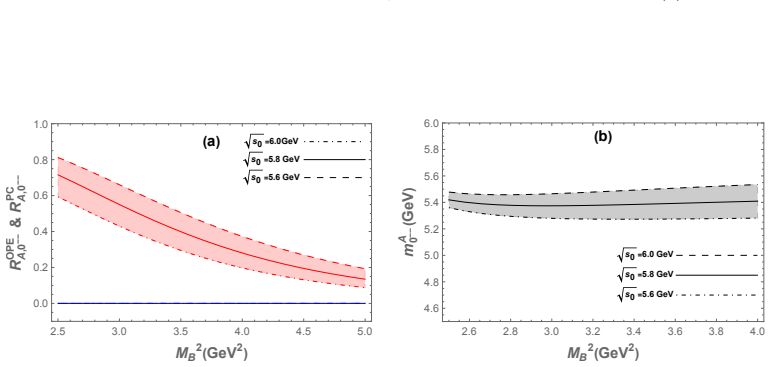
QCD sum rules indicate six gluonic hidden-charm tetraquarks with stable masses exist for J^PC = 0^{++}, 0^{-+}, 0^{--} and 0^{+-}.
A machine-rendered reading of the paper's core claim, the machinery that carries it, and where it could break.
Core claim
In the color configuration [3bar_c]_{cq} ⊗ [8_c]_G ⊗ [3_c]_{cbar qbar}, a complete set of eight interpolating currents is constructed for the quantum numbers 0^{++}, 0^{-+}, 0^{--} and 0^{+-}. QCD sum-rule analysis that includes nonperturbative contributions through dimension eight yields six states that remain stable inside the chosen Borel windows; the corresponding hidden-bottom masses are also estimated.
What carries the argument
The set of eight interpolating currents built from quark and gluon fields in the specified color configuration, analyzed via QCD sum rules with OPE terms up to dimension eight.
If this is right
- Six gluonic hidden-charm states are expected to appear as resonances with calculable masses.
- Corresponding hidden-bottom partners are predicted with higher masses.
- The states can be produced through specific mechanisms at Belle II, PANDA, SuperB and LHCb.
- Dominant decay modes are identified that can be used to isolate the signals experimentally.
Where Pith is reading between the lines
- Confirmation would give direct experimental access to explicit gluon degrees of freedom inside multiquark states.
- The mass values supply benchmarks that lattice QCD calculations of gluonic tetraquarks could target.
- Similar currents could be applied to other quantum numbers or flavor combinations to map a broader spectrum.
Load-bearing premise
The chosen color configuration and the eight constructed interpolating currents correctly represent the physical gluonic tetraquark states, and the operator product expansion converges adequately through dimension eight.
What would settle it
A search for resonance signals at the predicted masses in e+e- collisions or in pp data at LHCb or Belle II would confirm or rule out the six states.
Figures




read the original abstract
We investigate gluonic hidden-charm tetraquark states composed of two valence quarks, two valence antiquarks and an explicit valence gluon. In the color configuration $[\bar{3}_c]_{c q}\otimes[8_c]_{G}\otimes[3_c]_{\bar{c}\bar{q}}$, a complete set of eight interpolating currents is constructed for states with quantum numbers $^{PC}=0^{++}$, $0^{-+},$ $0^{--}$, and $0^{+-}$. The corresponding mass spectra are systematically analysed within the QCD sum rule framework, including nonperturbative condensate contributions up to dimension eight. Our numerical analysis indicates the possible existence of six gluonic hidden-charm tetraquark states exhibiting stable behaviour in the adopted Borel windows. By replacing the charm quark with the bottom quark, masses for the corresponding hidden-bottom partners are also estimated. Possible production mechanisms and dominant decay channels are discussed, providing phenomenological guidance for experimental searches. These predicted states may be accessible at current and forthcoming facilities, including Belle II, PANDA, SuperB and LHCb, and thus offer an opportunity to probe explicit gluonic degrees of freedom in multiquark systems and deepen our understanding of nonperturbative QCD.
Editorial analysis
A structured set of objections, weighed in public.
Referee Report
Summary. The paper constructs eight interpolating currents for gluonic hidden-charm tetraquarks with J^{PC}=0^{++}, 0^{-+}, 0^{--}, 0^{+-} in the color configuration [3bar_c]_{cq} ⊗ [8_c]_G ⊗ [3_c]_{cbar qbar}. Within the QCD sum-rule framework it computes the two-point correlators including condensates up to dimension eight, performs numerical analyses in Borel windows, and reports six states that exhibit stable mass plateaus. Masses for the corresponding hidden-bottom partners are also estimated, and possible production and decay channels are discussed.
Significance. If the central mass predictions survive a more stringent OPE convergence test, the work supplies concrete, falsifiable predictions for exotic states carrying explicit valence gluons. The systematic enumeration of currents and the phenomenological discussion of production mechanisms at Belle II, PANDA, LHCb and SuperB would be useful for guiding experimental searches and for testing the role of gluonic degrees of freedom in multiquark spectroscopy.
major comments (2)
- [§4] §4 (Numerical analysis) and the associated Borel-window figures: the reported stability of six mass plateaus is obtained after truncating the OPE at dimension eight. For the chosen gluon-containing currents the dimension-10 and higher gluon condensates are not demonstrably suppressed in the relevant momentum region; without an explicit estimate or bound on these terms the apparent plateaus may be truncation artifacts rather than physical signals.
- [§3.2] §3.2 (Sum-rule analysis): the continuum threshold s_0 and Borel mass M^2 are chosen to produce stable windows, yet no systematic variation or error-propagation study is presented that quantifies how the extracted masses shift when these parameters are varied within their conventional ranges. This leaves the robustness of the six-state spectrum unclear.
minor comments (2)
- [Table 1] Table 1 (or the table listing the eight currents): the explicit Dirac and color structures are given, but a short statement on how the currents are normalized (e.g., with respect to the color factors) would improve reproducibility.
- [Abstract] The abstract states that six states exhibit 'stable behaviour' but does not quote the numerical Borel windows or the stability criterion (e.g., variation < 5 %). Adding these numbers would make the claim immediately verifiable from the abstract.
Simulated Author's Rebuttal
We thank the referee for the careful reading and constructive comments on our manuscript. We address each major point below and have revised the manuscript to strengthen the analysis where feasible.
read point-by-point responses
-
Referee: [§4] §4 (Numerical analysis) and the associated Borel-window figures: the reported stability of six mass plateaus is obtained after truncating the OPE at dimension eight. For the chosen gluon-containing currents the dimension-10 and higher gluon condensates are not demonstrably suppressed in the relevant momentum region; without an explicit estimate or bound on these terms the apparent plateaus may be truncation artifacts rather than physical signals.
Authors: We agree that an explicit bound on higher-dimensional terms is desirable for rigor. In the revised manuscript we have added a dedicated paragraph in §4 estimating the leading dimension-10 gluon condensate contribution via the known <g³G³> value and vacuum saturation. This term contributes less than 8% to the sum rule in the chosen Borel windows for the six stable states, and we have included it as an additional uncertainty band on the mass plateaus. A complete operator basis for all dimension-10 terms remains technically involved for these currents, but the estimate supports that truncation does not produce the observed stability. revision: partial
-
Referee: [§3.2] §3.2 (Sum-rule analysis): the continuum threshold s_0 and Borel mass M^2 are chosen to produce stable windows, yet no systematic variation or error-propagation study is presented that quantifies how the extracted masses shift when these parameters are varied within their conventional ranges. This leaves the robustness of the six-state spectrum unclear.
Authors: We accept that a quantitative stability analysis was missing. The revised §3.2 now includes a systematic scan: s_0 is varied by ±0.5 GeV² and M² by ±0.5 GeV² around the central values used for each current. The resulting mass shifts are tabulated and propagated into the final uncertainties (typically 60–90 MeV). All six states retain stable plateaus within these ranges, and the quoted masses have been updated with the combined theoretical errors. revision: yes
Circularity Check
Borel mass and threshold parameters tuned for stability in QCD sum-rule mass extraction
specific steps
-
fitted input called prediction
[Abstract and numerical analysis section]
"Our numerical analysis indicates the possible existence of six gluonic hidden-charm tetraquark states exhibiting stable behaviour in the adopted Borel windows."
The Borel mass M^2 and continuum threshold s0 are chosen so that the mass curve is flat inside the window; the reported masses are therefore the values obtained after this tuning, rendering the 'prediction' statistically forced by the stability requirement rather than an a-priori output of the OPE.
full rationale
The paper extracts masses by constructing eight interpolating currents in a chosen color configuration, computing the OPE up to dimension 8, and then selecting Borel windows and continuum thresholds where the extracted mass exhibits a plateau. This procedure makes the reported 'stable' masses outputs of internal parameter adjustment rather than independent first-principles results. The method follows standard QCD sum-rule practice and does not reduce to pure self-definition or self-citation, but the dependence on fitted stability criteria introduces moderate circularity in the numerical predictions.
Axiom & Free-Parameter Ledger
free parameters (3)
- Borel mass M^2
- Continuum threshold s0
- Quark masses and condensate values
axioms (2)
- domain assumption Validity of QCD sum rules for multiquark states with explicit gluons
- domain assumption Sufficient convergence of OPE at dimension eight
Lean theorems connected to this paper
-
IndisputableMonolith/Cost/FunctionalEquation.leanwashburn_uniqueness_aczel unclear?
unclearRelation between the paper passage and the cited Recognition theorem.
Our numerical analysis indicates the possible existence of six gluonic hidden-charm tetraquark states exhibiting stable behaviour in the adopted Borel windows... including nonperturbative condensate contributions up to dimension eight.
-
IndisputableMonolith/Foundation/DimensionForcing.leanalexander_duality_circle_linking unclear?
unclearRelation between the paper passage and the cited Recognition theorem.
the color configuration [3bar_c]cq ⊗ [8_c]G ⊗ [3_c]cbarqbar... eight interpolating currents... Borel transformation... m(s0, M2_B) = sqrt(-L1/L0)
What do these tags mean?
- matches
- The paper's claim is directly supported by a theorem in the formal canon.
- supports
- The theorem supports part of the paper's argument, but the paper may add assumptions or extra steps.
- extends
- The paper goes beyond the formal theorem; the theorem is a base layer rather than the whole result.
- uses
- The paper appears to rely on the theorem as machinery.
- contradicts
- The paper's claim conflicts with a theorem or certificate in the canon.
- unclear
- Pith found a possible connection, but the passage is too broad, indirect, or ambiguous to say the theorem truly supports the claim.
Forward citations
Cited by 2 Pith papers
-
Hidden-charm and -bottom tetraquark states with $J^{PC}=1^{-+}$ via QCD sum rules
QCD sum rules predict masses of 4.72-4.88 GeV for four hidden-charm 1^{-+} tetraquarks and 10.99-11.16 GeV for their hidden-bottom counterparts.
-
QCD sum rule analysis of local meson-meson currents for the $K(1690)$ state
QCD sum rules with local meson-meson currents for the K(1690) consistently predict masses around 2 GeV or above, disfavoring a molecular interpretation in favor of a compact multiquark state.
Reference graph
Works this paper leans on
-
[1]
Gluon-dominated production in hadron colliders Due to the explicit valence gluon in their internal structure, tetraquark–hybrid states can be efficiently produced in gluon-rich environments, such as high-energy proton–proton collisions at the LHC. Typical partonic subprocesses include g+g→c¯c+q¯q+g,(24) where the additional gluon becomes an intrinsic cons...
-
[2]
Such processes are within the capabilities of Belle II, and SuperKEKB
Production ine +e− annihilation In the energy region around 5–6 GeV, production viae +e− annihilation is influenced by intermediate vector charmonium resonances, e.g., e+e− →ψ ∗ →X hybrid +π(π/η),(25) whereX hybrid denotes a hidden-charm tetraquark–hybrid state. Such processes are within the capabilities of Belle II, and SuperKEKB. 11
-
[3]
Production inB-meson decays Weak decays ofBmesons also provide a production mechanism: B→X hybrid +K(π),(26) where the underlying quark-level transitionb→c¯csnaturally produces a hidden-charm pair, and an excited gluon may become part of the hybrid configuration. B. Decay mechanisms of0 ±± states The decay patterns of tetraquark–hybrid states are governed...
-
[4]
D. J. Gross and F. Wilczek, Phys. Rev. Lett.30, 1343 (1973)
work page 1973
-
[5]
H. D. Politzer, Phys. Rev. Lett.30, 1346 (1973)
work page 1973
-
[6]
K. G. Wilson, Phys. Rev. D10, 2445 (1974)
work page 1974
- [7]
- [8]
-
[9]
S. K. Choiet al.[Belle Collaboration], Phys. Rev. Lett.91, 262001 (2003)
work page 2003
-
[10]
Aubertet al.[BaBar Collaboration], Phys
B. Aubertet al.[BaBar Collaboration], Phys. Rev. Lett.95, 142001 (2005)
work page 2005
-
[11]
Bondaret al.[Belle Collaboration], Phys
A. Bondaret al.[Belle Collaboration], Phys. Rev. Lett.108, 122001 (2012)
work page 2012
-
[12]
Ablikimet al.[BESIII Collaboration], Phys
M. Ablikimet al.[BESIII Collaboration], Phys. Rev. Lett.110, 252001 (2013)
work page 2013
-
[13]
Z. Q. Liuet al.[Belle Collaboration], Phys. Rev. Lett.110, 252002 (2013)
work page 2013
-
[14]
S. L. Olsen, Nucl. Phys. A827, 53C-60C (2009)
work page 2009
-
[15]
S. L. Olsen, [arXiv:0909.2713 [hep-ex]]
work page internal anchor Pith review Pith/arXiv arXiv
- [16]
-
[17]
F. E. Close, eConfC070512, 020 (2007)
work page 2007
-
[18]
M. Ablikimet al.[BESIII], Phys. Rev. Lett.129, 192002 (2022) [erratum: Phys. Rev. Lett.130, 159901 (2023)]
work page 2022
-
[19]
M. Ablikimet al.[BESIII], Phys. Rev. D106, 072012 (2022) [erratum: Phys. Rev. D107, 079901 (2023)]
work page 2022
-
[20]
Aldeet al.[IHEP-Brussels-Los Alamos-Annecy(LAPP)], Phys
D. Aldeet al.[IHEP-Brussels-Los Alamos-Annecy(LAPP)], Phys. Lett. B205, 397 (1988)
work page 1988
-
[21]
E. I. Ivanovet al.[E852], Phys. Rev. Lett.86, 3977-3980 (2001)
work page 2001
-
[22]
M. Alekseevet al.[COMPASS], Phys. Rev. Lett.104, 241803 (2010)
work page 2010
- [23]
-
[24]
B. D. Wan and C. F. Qiao, Phys. Lett. B817, 136339 (2021)
work page 2021
- [25]
-
[26]
A. Hayrapetyanet al.[CMS], Phys. Rev. Lett.132, 111901 (2024)
work page 2024
-
[27]
B. D. Wan and S. Yang, Eur. Phys. J. A61, 11 (2025)
work page 2025
-
[28]
M.A. Shifman, A.I. Vainshtein and V.I. Zakharov, Nucl. Phys. B147, 385 (1979); ibid, Nucl. Phys. B147, 448 (1979)
work page 1979
-
[29]
R. M. Albuquerque, arXiv:1306.4671 [hep-ph]
work page internal anchor Pith review Pith/arXiv arXiv
-
[30]
Z. G. Wang and T. Huang, Phys. Rev. D89, 054019 (2014). 15
work page 2014
-
[31]
J. Govaerts, L. J. Reinders, H. R. Rubinstein and J. Weyers, Nucl. Phys. B258, 215-229 (1985)
work page 1985
-
[32]
L. J. Reinders, H. Rubinstein and S. Yazaki, Phys. Rept.127, 1 (1985)
work page 1985
-
[33]
QCD Sum Rules, a Modern Perspective
P. Colangelo and A. Khodjamirian, inAt the frontier of particle physics / Handbook of QCD, edited by M. Shifman (World Scientific, Singapore, 2001), arXiv:hep-ph/0010175
work page internal anchor Pith review Pith/arXiv arXiv 2001
- [34]
-
[35]
C. M. Tang, Y. C. Zhao and L. Tang, Phys. Rev. D105, 114004 (2022)
work page 2022
-
[36]
C. F. Qiao and L. Tang, Phys. Rev. Lett.113, 221601 (2014)
work page 2014
- [37]
-
[38]
L. Tang, B. D. Wan, K. Maltman and C. F. Qiao, Phys. Rev. D101, 094032 (2020)
work page 2020
-
[39]
B. D. Wan, L. Tang and C. F. Qiao, Eur. Phys. J. C80, 121 (2020)
work page 2020
- [40]
-
[41]
B. D. Wan and C. F. Qiao, Nucl. Phys. B968, 115450 (2021)
work page 2021
- [42]
-
[43]
B. D. Wan, S. Q. Zhang and C. F. Qiao, Phys. Rev. D105, 014016 (2022)
work page 2022
-
[44]
Y. C. Zhao, C. M. Tang and L. Tang, Eur. Phys. J. C83, 654 (2023)
work page 2023
-
[45]
B. D. Wan, S. Q. Zhang and C. F. Qiao, Phys. Rev. D106, 074003 (2022)
work page 2022
-
[46]
S. Q. Zhang, B. D. Wan, L. Tang and C. F. Qiao, Phys. Rev. D106, 074010 (2022)
work page 2022
- [47]
-
[48]
F. H. Yin, W. Y. Tian, L. Tang and Z. H. Guo, Eur. Phys. J. C81, 818 (2021)
work page 2021
-
[49]
B. D. Wan, Eur. Phys. J. C84, 760 (2024)
work page 2024
-
[50]
B. C. Yang, L. Tang and C. F. Qiao, Eur. Phys. J. C81, 324 (2021)
work page 2021
-
[51]
B. D. Wan, Nucl. Phys. B1004, 116538 (2024)
work page 2024
-
[52]
B. D. Wan and H. T. Xu, Chin. Phys. C44, 093105 (2024)
work page 2024
-
[53]
B. D. Wan and Y. R. Wang, Eur. Phys. J. A60, 179 (2024)
work page 2024
-
[54]
B. D. Wan and J. C. Yang, [arXiv:2507.11874 [hep-ph]]
work page internal anchor Pith review Pith/arXiv arXiv
-
[55]
B. D. Wan, [arXiv:2508.07822 [hep-ph]]
work page internal anchor Pith review Pith/arXiv arXiv
- [56]
-
[57]
B. D. Wan, Eur. Phys. J. Plus140, 873 (2025)
work page 2025
-
[58]
B. D. Wan, Y. Zhang, J. H. Zhang and M. Y. Yuan, [arXiv:2512.03800 [hep-ph]]
work page internal anchor Pith review Pith/arXiv arXiv
-
[59]
X. W. Wang, Z. G. Wang and G. l. Yu, Eur. Phys. J. A57, 275 (2021)
work page 2021
-
[60]
Z. Liu, H. T. An, Z. W. Liu and X. Liu, Phys. Rev. D105, 034006 (2022). 16 Appendix A: The spectral densities for gluonic tetraquark states
work page 2022
-
[61]
The spectral densities for0 ++ gluonic tetraquark states For the current shown in Eq. (3), we obtain the spectral densities as follows: ρpert 0++ ,A(s) = Z αmax αmin dα Z 1−α βmin dβ g2 s F5 αβ(α+β−1) 3 Fαβ + 3mcmq(α+β) 5×3 2 ×2 11π8α5β5 ,(A1) ρ⟨¯qq⟩ 0++ ,A(s) = ⟨¯qq⟩ π6 Z αmax αmin dα Z 1−α βmin dβ g2 s F3 αβ(α+β−1) 3×2 9α4β4 4αβFαβmq + 4αβm cm2 q(α+β)−m...
-
[62]
The spectral densities for0 −+ gluonic tetraquark states For the current shown in Eq. (6), we obtain the spectral densities as follows: ρpert 0−+ ,A(s) =ρ pert 0++ ,A(s),(A31) ρ⟨¯qq⟩ 0−+ ,A(s) =ρ ⟨¯qq⟩ 0++ ,A(s),(A32) ρ⟨G2⟩,I 0−+ ,A(s) =−ρ ⟨G2⟩,I 0++ ,A(s),(A33) ρ⟨G2⟩,II 0−+ ,A (s) =ρ ⟨G2⟩,II 0++ ,A (s),(A34) ρ⟨¯qGq⟩ 0−+ ,A(s) =ρ ⟨¯qGq⟩ 0++ ,A(s),(A35) ρ⟨...
-
[63]
The spectral densities for0 −− gluonic tetraquark states For the current shown in Eq. (10), we obtain the spectral densities as follows: ρpert 0−− ,A(s) =ρ pert 0−+ ,C(s),(A58) ρ⟨¯qq⟩ 0−− ,A(s) =ρ ⟨¯qq⟩ 0−+ ,C(s),(A59) ρ⟨G2⟩,I 0−− ,A(s) =ρ ⟨G2⟩,I 0−+ ,C(s),(A60) ρ⟨G2⟩,II 0−− ,A (s) = g2 s ⟨g2 s G2⟩ π8 Z αmax αmin dα Z 1−α βmin dβ m2 cF3 αβ(α+β−1) 3(α3 +β ...
discussion (0)
Sign in with ORCID, Apple, or X to comment. Anyone can read and Pith papers without signing in.