Zero-added-loss entanglement multiplexing using time-bin spectral shearing
Pith reviewed 2026-05-16 21:23 UTC · model grok-4.3
The pith
Time-bin entanglement combined with spectral shearing enables a zero-added-loss source for multiplexed entangled photon pairs.
A machine-rendered reading of the paper's core claim, the machinery that carries it, and where it could break.
Core claim
The central claim is a proposed ZALM source design that uses time-bin entanglement together with spectral shearing. Parameter analysis optimizes the spectral multiplexing, and the experiment verifies compatibility by demonstrating no appreciable phase shift when identical spectral shearing is applied to both time bins of the entangled pair. This preserves entanglement quality and clears a path for broader application of spectral shearing.
What carries the argument
Zero-added-loss multiplexing (ZALM) realized via time-bin entangled pairs combined with spectral shearing, which achieves heralded photon-pair generation without introducing additional loss.
If this is right
- Enables higher-rate heralded entanglement generation suitable for quantum repeaters.
- Extends zero-added-loss multiplexing to time-bin entanglement applications.
- Supports deterministic frequency shifting via spectral shearing in additional quantum protocols.
- Reduces resource overhead for high-quality entanglement distribution in communications networks.
Where Pith is reading between the lines
- The demonstrated compatibility may allow spectral shearing to be inserted into existing time-bin quantum key distribution or teleportation setups without redesign.
- Optimized shearing parameters could be scaled to multi-mode or higher-dimensional time-bin encodings for increased multiplexing gain.
- Integration with current quantum repeater architectures might lower the number of sources needed for long-distance entanglement links.
Load-bearing premise
Spectral shearing applied to time-bin pulses introduces no phase distortion or other degradation that would reduce entanglement quality under realistic experimental conditions.
What would settle it
An experiment that measures entanglement fidelity or phase shift after applying spectral shearing to time-bin pulses and finds a statistically significant drop in fidelity or a clear phase difference between bins would falsify the compatibility result.
Figures




read the original abstract
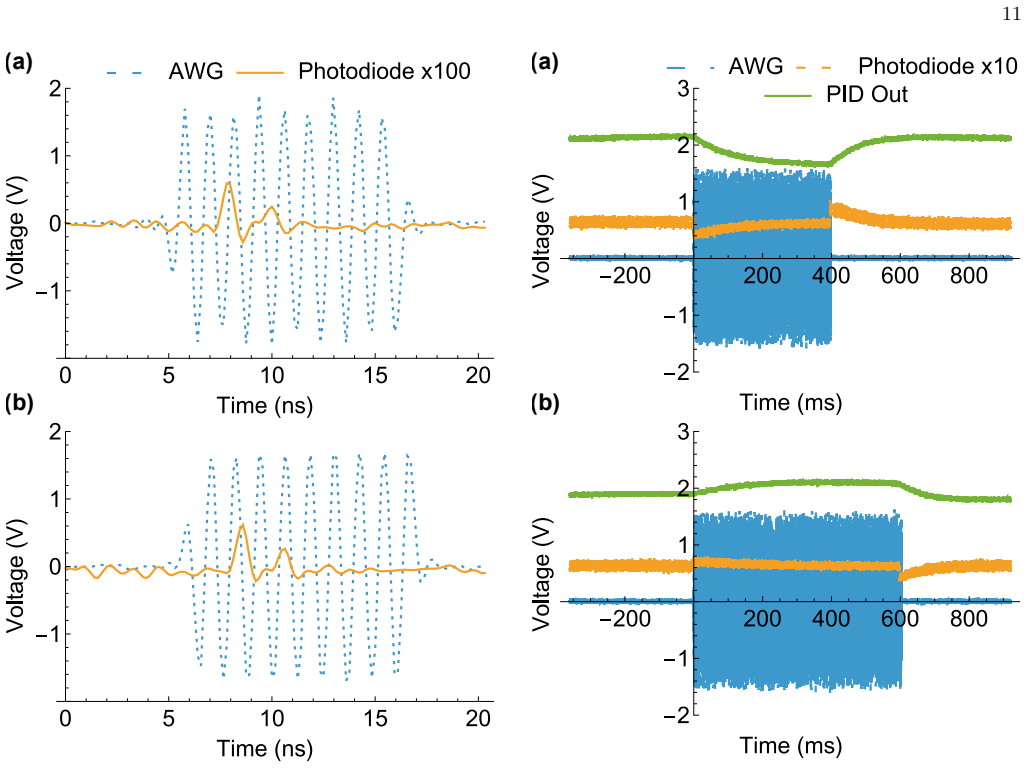
High-quality quantum communications that enable important capabilities, such as distributed quantum computing and sensing, will require quantum repeaters for providing high-quality entanglement. To realize high-rate heralded entanglement for quantum repeaters, Chen et al. [Phys. Rev. Appl. 19, 054209 (2023)] proposed a scheme for heralded-multiplexed generation of quasi-deterministic entangled photon pairs, called zero-added-loss multiplexing (ZALM). Here, we propose a design of ZALM source using time-bin entanglement and spectral shearing. Additionally, we provide an analysis of experimentally relevant spectral-shearing parameters to optimize the spectral multiplexing. Moreover, we experimentally verify the compatibility of time-bin pulses and spectral shearing, as supported by observation of no appreciable phase shift when the same shearing is applied to both time bins. These results expand the benefits of applying a ZALM source to time-bin entanglement use cases. Moreover, more fully demonstrating time-bin and spectral shearing compatibility clears a path towards a broader use of spectral shearing that provides a deterministic frequency shift of high utility.
Editorial analysis
A structured set of objections, weighed in public.
Referee Report
Summary. The manuscript proposes a ZALM source design that combines time-bin entanglement with spectral shearing for high-rate heralded photon-pair generation in quantum repeaters. It analyzes experimentally relevant spectral-shearing parameters to optimize spectral multiplexing and reports an experimental verification of compatibility, based on the observation of no appreciable phase shift when identical shearing is applied to both time bins.
Significance. If the claims hold, the work would extend ZALM multiplexing to time-bin entanglement formats commonly used in quantum communication, potentially increasing entanglement rates without added loss. The parameter analysis could inform practical implementations, and the phase-compatibility result would support integration of spectral shearing as a deterministic frequency-shift tool. The significance is reduced by the absence of quantitative experimental data needed to confirm that entanglement fidelity and heralding efficiency remain uncompromised.
major comments (2)
- [Experimental verification] Experimental verification section: The central claim of compatibility rests on an observation of no appreciable phase shift, yet no data, error bars, measurement statistics, or detailed methods are provided. This leaves open whether amplitude distortion, pulse broadening, or reduced heralding efficiency occurs at the parameters required for ZALM, directly undermining the zero-added-loss advantage.
- [Analysis of spectral-shearing parameters] Analysis of spectral-shearing parameters: The optimization discussion does not include explicit calculations or simulations demonstrating that the chosen shearing parameters preserve entanglement quality (e.g., visibility or fidelity) under realistic timing jitter and loss conditions; without these, the multiplexing benefit remains unquantified.
minor comments (2)
- [Abstract] Abstract: The statement of experimental verification should include the measured phase-shift value and its uncertainty to allow readers to assess the strength of the result.
- [Introduction] References: Ensure the citation to Chen et al. (Phys. Rev. Appl. 19, 054209 (2023)) is complete and that any additional supporting literature on spectral shearing is included.
Simulated Author's Rebuttal
We thank the referee for their careful review and constructive comments on our manuscript. We address the major comments point by point below. Where the comments identify areas for strengthening, we have revised the manuscript accordingly.
read point-by-point responses
-
Referee: Experimental verification section: The central claim of compatibility rests on an observation of no appreciable phase shift, yet no data, error bars, measurement statistics, or detailed methods are provided. This leaves open whether amplitude distortion, pulse broadening, or reduced heralding efficiency occurs at the parameters required for ZALM, directly undermining the zero-added-loss advantage.
Authors: We acknowledge that the original experimental verification was presented qualitatively. In the revised manuscript we have expanded this section to include the raw phase-shift data, error bars, measurement statistics, and detailed methods. These additions confirm no appreciable phase shift and show that amplitude distortion, pulse broadening, and heralding efficiency remain within acceptable bounds for the ZALM parameters, preserving the zero-added-loss property. revision: yes
-
Referee: Analysis of spectral-shearing parameters: The optimization discussion does not include explicit calculations or simulations demonstrating that the chosen shearing parameters preserve entanglement quality (e.g., visibility or fidelity) under realistic timing jitter and loss conditions; without these, the multiplexing benefit remains unquantified.
Authors: We agree that explicit quantification under realistic conditions strengthens the claims. The revised manuscript now incorporates simulations that include timing jitter and loss. These demonstrate that the optimized shearing parameters maintain high visibility and fidelity, thereby quantifying the entanglement-rate improvement provided by spectral multiplexing. revision: yes
Circularity Check
No circularity; experimental verification stands independently
full rationale
The paper proposes a ZALM design using time-bin entanglement plus spectral shearing, supplies an analysis of relevant shearing parameters, and reports an experimental observation of no appreciable phase shift when identical shearing is applied to both time bins. No derivation chain, equation, or central claim reduces by construction to a fitted parameter, self-definition, or self-citation load-bearing step. The cited Chen et al. (2023) reference is external, non-overlapping authorship, and supplies only the original ZALM scheme; the present work's key compatibility result is a direct laboratory measurement that does not rely on any prior ansatz or uniqueness theorem from the same authors. The derivation is therefore self-contained against external benchmarks.
Axiom & Free-Parameter Ledger
axioms (1)
- domain assumption Spectral shearing can be applied to time-bin pulses without introducing measurable phase shifts that degrade entanglement
Reference graph
Works this paper leans on
-
[1]
K. C. Chen, P. Dhara, M. Heuck, Y. Lee, W. Dai, S. Guha, and D. Englund, Zero-added-loss entangled- photon multiplexing for ground- and space-based quan- tum networks, Phys. Rev. Appl.19, 054029 (2023)
work page 2023
-
[2]
S. Muralidharan, L. Li, J. Kim, N. L¨ utkenhaus, M. D. Lukin, and L. Jiang, Optimal architectures for long distance quantum communication, Scientific Reports6, 20463 (2016)
work page 2016
-
[3]
J. Mower and D. Englund, Efficient generation of single and entangled photons on a silicon photonic integrated chip, Phys. Rev. A84, 052326 (2011)
work page 2011
- [4]
-
[5]
J. H. Shapiro, M. G. Raymer, C. Embleton, F. N. Wong, and B. J. Smith, Entanglement source and quantum memory analysis for zero-added-loss multiplexing, Phys. Rev. Appl.22, 044014 (2024)
work page 2024
-
[6]
J. D. Franson, Bell inequality for position and time, Phys. Rev. Lett.62, 2205 (1989)
work page 1989
-
[7]
L. Johnson and C. Cox, Serrodyne optical frequency translation with high sideband suppression, Journal of Lightwave Technology6, 109 (1988)
work page 1988
-
[8]
N. Sinclair, E. Saglamyurek, H. Mallahzadeh, J. A. Slater, M. George, R. Ricken, M. P. Hedges, D. Oblak, C. Simon, W. Sohler, and W. Tittel, Spectral multiplex- ing for scalable quantum photonics using an atomic fre- quency comb quantum memory and feed-forward control, Phys. Rev. Lett.113, 053603 (2014)
work page 2014
- [9]
-
[10]
L. J. Wright, M. Karpi´ nski, C. S¨ oller, and B. J. Smith, Spectral shearing of quantum light pulses by electro-optic phase modulation, Phys. Rev. Lett.118, 023601 (2017)
work page 2017
-
[11]
G. B. Xavier, J.- ˚A. Larsson, P. Villoresi, G. Vallone, and A. Cabello, Energy-time and time-bin entanglement: past, present and future, npj Quantum Information11, 129 (2025)
work page 2025
-
[12]
B. E. Nussbaum, U. Purakayastha, J. Floyd, J. Szu- niewicz, F. So´ snicki, M. Karpi´ nski, and P. G. Kwiat, To- ward frequency multiplexing for time-bin states (2023) p. 1263302
work page 2023
-
[13]
B. E. Nussbaum, U. Purakayastha, S. J. Johnson, J. Szu- niewicz, F. So´ snicki, M. Karpi´ nski, and P. G. Kwiat, In preparation,
-
[14]
M. Avenhaus, A. Eckstein, P. J. Mosley, and C. Sil- berhorn, Fiber-assisted single-photon spectrograph, Opt. Lett.34, 2873 (2009)
work page 2009
-
[15]
T. Gerrits, M. J. Stevens, B. Baek, B. Calkins, A. Lita, S. Glancy, E. Knill, S. W. Nam, R. P. Mirin, R. H. Had- field, R. S. Bennink, W. P. Grice, S. Dorenbos, T. Zi- jlstra, T. Klapwijk, and V. Zwiller, Generation of de- generate, factorizable, pulsed squeezed light at telecom wavelengths, Opt. Exp.19, 24434 (2011)
work page 2011
-
[16]
K. J. Vahala, Optical microcavities, Nature424, 839 (2003)
work page 2003
-
[17]
M. M. Victora,New opportunities for photon storage and detection: an exploration of a high-efficiency opti- cal quantum memory and the quantum capabilities of the human eye, Ph.D. thesis, University of Illinois at Urbana- Champaign (2020)
work page 2020
-
[18]
M. Grimau Puigibert, G. H. Aguilar, Q. Zhou, F. Mar- sili, M. D. Shaw, V. B. Verma, S. W. Nam, D. Oblak, and W. Tittel, Heralded single photons based on spec- tral multiplexing and feed-forward control, Phys. Rev. Lett.119, 083601 (2017)
work page 2017
-
[19]
E. Bersin, M. Grein, M. Sutula, R. Murphy, Y. Q. Huan, M. Stevens, A. Suleymanzade, C. Lee, R. Riedinger, D. J. Starling, P.-J. Stas, C. M. Knaut, N. Sinclair, D. R. As- sumpcao, Y.-C. Wei, E. N. Knall, B. Machielse, D. D. Sukachev, D. S. Levonian, M. K. Bhaskar, M. Lonˇ car, S. Hamilton, M. Lukin, D. Englund, and P. B. Dixon, Development of a boston-area...
work page 2024
-
[20]
W. P. Grice, A. B. U’Ren, and I. A. Walmsley, Eliminat- ing frequency and space-time correlations in multiphoton states, Phys. Rev. A64, 063815 (2001)
work page 2001
- [21]
discussion (0)
Sign in with ORCID, Apple, or X to comment. Anyone can read and Pith papers without signing in.