REVIEW 4 major objections 4 minor 42 references
Symmetry Matters: Auditing and Symmetrizing 3D Generative Models
T0 review · 4 major / 4 minor · reviewed 2026-08-03 · deepseek-v4-flash
Pith's one-line read This paper shows that training point-cloud diffusion models on mirrored half-objects, then reflecting the generated half back, reduces the mirror-symmetry error of generated shapes from roughly 0.02–0.17 to 0.004–0.008 across three ShapeNet
desk verdict The symmetry gains are hardwired into the reconstruction rule, so the headline numbers don't measure learned behavior—but the audit of existing generators and the FPD results give the paper something to work with. read the letter →
The pith
A machine-rendered reading of the paper's core claim, the machinery that carries it, and where it could break.
The reading
What carries the argument
The central mechanism is the half-object transformation: each point cloud is split at the plane x=0, the left half is reflected to the right side, and the two are concatenated, yielding a 'right-half' cloud with the same 15K point count as the original. The generative model is trained on these half-clouds, and at inference the sampled half is reflected across x=0 and merged to form the full shape. The paper's symmetry metric is a mirror-Chamfer distance: the Chamfer distance between a shape and its reflection across the x=0 plane, computed via a Householder reflection. This metric both exposes the symmetry gap and quantifies the intervention's effect.
What would settle it
Train the same half-object pipeline on a class where shapes have a consistent but off-axis symmetry plane (or where symmetry is weak), or estimate the symmetry plane per object during evaluation; if the mirror-CD improvement disappears or the generated halves are judged implausible, the effect is an artifact of the x=0 assumption rather than a learned structural prior.
Extended reading notes
Core claim
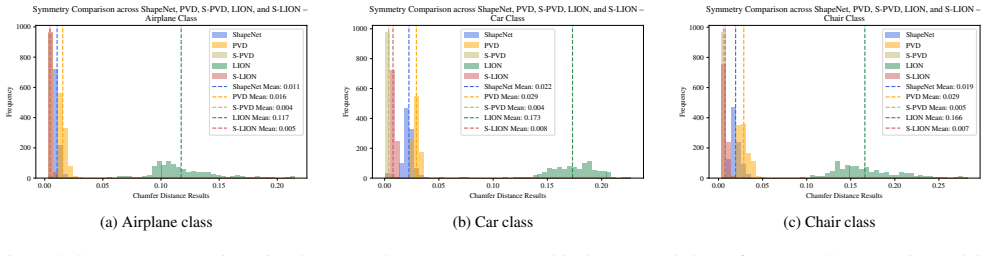
The paper's central claim is that the persistent asymmetry in generated 3D shapes is not inherent to diffusion-based generation but a consequence of the model never being forced to respect the reflection prior. Auditing PVD, LION, XCube, and SLIDE 3D with a mirror-Chamfer protocol shows mean symmetry errors of 0.016–0.39, far above ShapeNet's 0.011–0.021. Training PVD and LION on a half-object dataset, where every point cloud is a right-half with the left half mirrored onto it, and then reconstructing full objects by reflecting generated halves, reduces the mirror error to 0.004–0.008—below the real-data baseline—while FPD improves in most cells. The cost is a modest degradation in 1-NNA and
Load-bearing premise
The approach assumes every object in the training set has its true reflection symmetry plane exactly at x=0, and that the half-object dataset therefore represents a natural partial geometry; if real objects' symmetry axes deviate from that plane, the half-objects are artificial and the reported symmetry improvement is imposed by the protocol rather than learned.
Editorial extensions
If this is right
- If correct, the approach shows that reflection symmetry can be instilled into any point-cloud generator by changing only the training data, not the architecture or loss.
- Standard fidelity metrics (1-NNA, CD, EMD) miss structural properties; mirror-CD audits reveal failures those metrics hide, so benchmarks should report symmetry alongside the usual scores.
- The FPD gains suggest that enforcing symmetry also moves the generated distribution closer to the real-feature distribution, making symmetry a practical proxy for realism.
- The reliance on a fixed x=0 plane limits the method to classes with a dominant global reflection axis; extending it to per-object estimated symmetry planes would widen its scope.
- The observed drop in 1-NNA and CD/EMD indicates a trade-off between local accuracy and global regularity, so the intervention is not a free lunch for all downstream uses.
Reading between the lines
- A large part of the symmetry gain is mechanical: the reconstruction step reflects the generated half, so any generated half yields a mirror-symmetric full shape. The substantive claim is therefore about the quality of the half-object distribution, which the FPD gains support, but a direct comparison of generated halves to real halves would make this explicit.
- The method's success hints that data-centric augmentation with structural priors can regularize generative models more broadly; analogous half-object splits for rotational or translational symmetries could be tested on categories with those properties.
- Applying the same half-object protocol to XCube and SLIDE 3D—as the authors propose—would reveal whether the benefit transfers across architectures that operate on voxel hierarchies or sparse latent points, not just point-diffusion models.
- Because the half-object construction discards one side of each object, the improved FPD could reflect reduced intra-class variance rather than the symmetry prior per se; ablating with randomly chosen half-planes would isolate the symmetry-specific effect.
Editorial analysis
A structured set of objections, weighed in public.
Referee Report
Summary. The paper audits reflection symmetry in three ShapeNet classes for four point-cloud/3D generative models (PVD, LION, XCube, SLIDE 3D) using a Chamfer-distance-based symmetry score, and proposes a data-centric intervention: train PVD and LION on half-objects (one side mirrored onto the other) and reconstruct full shapes by reflecting the generated half across the x=0 plane. The authors report large reductions in mirror-CD (e.g., airplane PVD 0.016 to 0.004, LION 0.117 to 0.005), improvements in FPD in all reported cells, and a trade-off in 1-NNA/CD/EMD, which they acknowledge. The central claim is that training on half-objects teaches the model a symmetry prior and yields more symmetric, plausible shapes.
Significance. The proposed symmetrization is simple, architecture-agnostic, and the FPD gains in Table 2 are notable if reproducible. The paper is also transparent about the CD/EMD/1-NNA degradation. However, the main quantitative evidence for symmetry improvement is confounded: for the symmetrized models, the symmetry metric is essentially satisfied by construction, not by learned behavior. The FPD results are independent of that artifact, but FPD is not a symmetry metric. The manuscript therefore currently does not support its strongest claim, although the underlying idea and the non-circular parts of the evaluation could be salvaged with a substantial rewrite.
major comments (4)
- [§5.3 and §4.1] The headline symmetry gains are a construction artifact. Section 5.3 defines Xtilde_full = Xtilde_+ ∪ Xtilde_−, where Xtilde_− is the reflection of Xtilde_+. Section 4.1 measures symmetry as CD(S1, reflect(S1)). For any generated half Xtilde_+, reflect(Xtilde_full) = reflect(Xtilde_+) ∪ Xtilde_+ = Xtilde_full, so CD(Xtilde_full, reflect(Xtilde_full)) is identically zero (up to FPS tie-breaking and rescaling). Consequently the reported reductions in Fig. 5 and Sec. 6.4 are restatements of the reconstruction rule and cannot measure what the model learned; a null model generating random halves would yield the same mirror-CD. Please re-evaluate symmetry of the generated halves before reflection, compare against a random-half baseline, and either remove or reframe the mirror-CD comparisons for symmetrized models.
- [Abstract vs. full text] The abstract states that the paper analyzes 'symmetry dynamics during training' and that 'mechanism-inspired diagnostic tests were conducted at the sampling and latent-representation levels.' No such experiments or results appear in the manuscript. These promised analyses are exactly what would be needed to support the claim that the model internalizes a symmetry prior, rather than that the reconstruction rule imposes it. Please either include the missing experiments or revise the abstract and the related claims.
- [§6.4, Tables 1–2] All quantitative comparisons are reported as point estimates with no error bars, confidence intervals, or significance tests over generated samples or training seeds. For the baseline-vs-symmetrized comparisons, some differences are large, but the FPD improvements are the only non-circular evidence in favor of the method, and without uncertainty estimates it is unclear whether the differences are stable. Please report variance over multiple generated sets (e.g., bootstrap or multiple sampling runs) and, ideally, over training runs.
- [§5.1 and §7] The method assumes every object is reflectionally symmetric about x=0, but Sec. 4.2 reports non-zero mirror-CD means for ShapeNet (0.011 for airplane, 0.021 for car, 0.019 for chair), so the assumption is only approximate. For objects with a different symmetry plane, the half-object construction pairs two halves that are not true mirrors, and the reconstruction forcibly symmetrizes an asymmetric object. The Discussion acknowledges this as a limitation, but the current evaluation does not quantify how much of the 1-NNA/EMD degradation is due to this imposed symmetry, as opposed to the generative model itself. Please report results on the subset of objects whose measured symmetry error is low, and discuss the effect of the x=0 assumption more concretely.
minor comments (4)
- [§5.3] The normalization formula 'Xtilde_full = Xtilde_full·σ−μ' is notationally unclear and dimensionally inconsistent; if this is a standardization step, please write it as (X−μ)/σ or the intended equivalent and define σ and μ.
- [Table 2] The row 'Reference (Lower bound)' labels the FPD of the validation set as a lower bound, but FPD is not a bound in the mathematical sense; it is the reference value. Please reword.
- [§4.3.2] The sentence 'LION achieves lower Chamfer Distances in the airplane class, with a mean of 0.117' is ambiguous: it is lower than the car and chair means, but not lower than ShapeNet's mean. Please clarify.
- [General] No code, hyperparameters, or data-preparation details beyond the textual description are provided. A reproducibility appendix with the half-object construction script and training configurations would strengthen the paper.
Circularity Check
Headline symmetry gains are construction artifacts: reconstructed shapes are assembled as H ∪ reflect(H), so mirror-CD is ≈0 by construction and cannot measure learned symmetry.
-
self definitional
[Section 4.1 (Symmetry Measurement Protocol) + Section 5.3 (Generation) + Section 6.4 (Results)]
"we compute the Chamfer Distance (CD) between the original point cloud S1 and its reflected counterpart S2 ... We apply a reflection across the symmetry plane x=0, obtaining the mirrored half X̃_−. The full shape is obtained by concatenating both halves: X̃_f ull = X̃_+ ∪ X̃_−."
Reflect(X̃_full) = reflect(X̃_+ ∪ X̃_−) = X̃_− ∪ X̃_+ = X̃_full exactly as sets (up to FPS tie-breaking and normalization). The Section 4.1 symmetry score is CD(S, reflect(S)), so for every reconstructed sample it is ≈0 regardless of what the diffusion model learned. The reported drops (0.016→0.004, 0.117→0.005, etc.) are a restatement of the reconstruction rule, not evidence of learned symmetry. A null model emitting arbitrary half-clouds would produce the same mirror-CD distribution. The symmetry metric therefore cannot distinguish 'the model learned symmetry' from 'the evaluation function is the reconstruction function.'
full rationale
The central quantitative claim is that S-PVD and S-LION improve symmetry, as measured by the Section 4.1 mirror-CD. But Section 5.3 defines the reconstructed full shape as X̃_full = X̃_+ ∪ X̃_−, where X̃_− is the reflection of X̃_+; hence reflect(X̃_full) = X̃_full (up to FPS tie-breaking), making CD(X̃_full, reflect(X̃_full)) ≈ 0 for every sample by construction. The symmetry gains reported in Figure 5 and the associated text are therefore not measurements of learned symmetry, but consequences of the deterministic mirroring step. The FPD results and the 1-NNA/EMD tradeoffs are independent and not circular, but they do not support the central symmetry claim. No load-bearing self-citation chain appears; the self-citation [1] is used only for the Chamfer Distance definition. Because the headline symmetry effect is forced by the reconstruction definition while some ancillary evaluations remain meaningful, the score is 7.
Assumptions & free parameters
free parameters (1)
- symmetry plane x=0 for all objects =
x=0 after the standard ShapeNet canonical alignment
assumptions (4)
- domain assumption ShapeNet objects are reflectionally symmetric about the canonical plane x=0 (Section 5.1: 'Each object X is assumed to be reflectionally symmetric with respect to the plane x=0')
- domain assumption Chamfer Distance to the mirrored cloud is a valid measure of reflection symmetry (Section 4.1)
- domain assumption Pretrained model checkpoints and ShapeNet splits follow the standard PointFlow benchmark protocol (Sections 4.3, 6.1)
- domain assumption FPD on PointNet features is a valid proxy for perceptual realism, with near-zero reference FPD as a lower bound (Table 2 caption)
Cite this review
Pith. "Pith review of Symmetry Matters: Auditing and Symmetrizing 3D Generative Models." pith.science (2026). https://pith.science/paper/4HAS74NF
@misc{pith2026251218953,
  author       = {Pith},
  title        = {Pith review of: Symmetry Matters: Auditing and Symmetrizing 3D Generative Models},
  year         = {2026},
  howpublished = {\url{https://pith.science/paper/4HAS74NF}},
  note         = {Machine review of arXiv:2512.18953}
}
read the original abstract
Symmetry is a strong prior present in many object categories, yet standard benchmarks for 3D generative models rarely report whether this prior is preserved. We study symmetry preservation in unconditional point cloud generation. We first audit the symmetry of generated shapes by several 3D generative models and compute a normalized symmetry score based on the Chamfer Distance (CD). We show that although current 3D generative models achieve competitive results under standard evaluation, they reveal a persistent symmetry gap when a symmetry-aware evaluation protocol is applied. To test whether this gap is merely inherited from the training data, we evaluate these models over a mirrored-objects dataset derived from ShapeNet and analyze symmetry dynamics during training. Mechanism-inspired diagnostic tests were conducted at the sampling and latent-representation levels to further show that reflection symmetry is not reliably encoded in the learned generative process. Finally, to address this gap, we propose a data-centric symmetry-based intervention: training generative models on a half-objects dataset and reconstructing full objects by reflection during sampling. Across multiple backbones, this intervention substantially improves geometric consistency and visual plausibility while remaining competitive under standard metrics. These findings suggest that symmetry-aware evaluation is needed alongside standard benchmarks, and future 3D generative models should incorporate this prior explicitly, either during training or sampling.
Figures


Figures from the paper (2 more)

Reference graph
Works this paper leans on
-
[1]
A dataset-free approach for self-supervised learning of 3D re- flectional symmetries, 2025
Isaac Aguirre, Ivan Sipiran, and Gabriel Monta ˜nana. A dataset-free approach for self-supervised learning of 3D re- flectional symmetries, 2025. 4
2025
-
[2]
Turner, Eric Nalisnick, and Jos´e Miguel Hern´andez-Lobato
James Urquhart Allingham, Bruno Kacper Mlodozeniec, Shreyas Padhy, Javier Antoran, David Krueger, Richard E. Turner, Eric Nalisnick, and Jos´e Miguel Hern´andez-Lobato. A Generative Model of Symmetry Transformations. In The Thirty-eighth Annual Conference on Neural Information Processing Systems, 2024. 2, 3, 8
2024
-
[3]
Chang, Thomas Funkhouser, Leonidas Guibas, Pat Hanrahan, Qixing Huang, Zimo Li, Silvio Savarese, Mano- lis Savva, Shuran Song, Hao Su, Jianxiong Xiao, Li Yi, and Fisher Yu
Angel X. Chang, Thomas Funkhouser, Leonidas Guibas, Pat Hanrahan, Qixing Huang, Zimo Li, Silvio Savarese, Mano- lis Savva, Shuran Song, Hao Su, Jianxiong Xiao, Li Yi, and Fisher Yu. ShapeNet: An Information-Rich 3D Model Repository, 2015. 4, 6, 7
2015
-
[4]
Qi Charles, Hao Su, Mo Kaichun, and Leonidas J
R. Qi Charles, Hao Su, Mo Kaichun, and Leonidas J. Guibas. Pointnet: Deep learning on point sets for 3d classification and segmentation. In2017 IEEE Conference on Computer Vision and Pattern Recognition (CVPR), pages 77–85, 2017. 7
2017
-
[5]
AutoSweep: Recovering 3D Ed- itable Objects from a Single Photograph.IEEE Transactions on Visualization and Computer Graphics, 26(3):1466–1475,
Xin Chen, Yuwei Li, Xi Luo, Tianjia Shao, Jingyi Yu, Kun Zhou, and Youyi Zheng. AutoSweep: Recovering 3D Ed- itable Objects from a Single Photograph.IEEE Transactions on Visualization and Computer Graphics, 26(3):1466–1475,
-
[6]
Diop, Thierno Fall, Alioune Mbengue, and Mo- hamed Daoudi
El Hadji S. Diop, Thierno Fall, Alioune Mbengue, and Mo- hamed Daoudi. Geometric Generative Models based on Mor- phological Equivariant PDEs and GANs, 2024. 8
2024
-
[7]
A Point Set Generation Network for 3D Object Reconstruction from a Single Image
Haoqiang Fan, Hao Su, and Leonidas Guibas. A Point Set Generation Network for 3D Object Reconstruction from a Single Image. In2017 IEEE Conference on Computer Vision and Pattern Recognition (CVPR), pages 2463–2471, Hon- olulu, HI, 2017. IEEE. 4
2017
-
[8]
GET3D: A Generative Model of High Quality 3D Textured Shapes Learned from Images, 2022
Jun Gao, Tianchang Shen, Zian Wang, Wenzheng Chen, Kangxue Yin, Daiqing Li, Or Litany, Zan Gojcic, and Sanja Fidler. GET3D: A Generative Model of High Quality 3D Textured Shapes Learned from Images, 2022. 3
2022
Show all 42 references
-
[9]
Robust Symmetry Detection via Riemannian Langevin Dynamics
Jihyeon Je, Jiayi Liu, Guandao Yang, Boyang Deng, Shengqu Cai, Gordon Wetzstein, Or Litany, and Leonidas Guibas. Robust Symmetry Detection via Riemannian Langevin Dynamics. InSIGGRAPH Asia 2024 Conference Papers, pages 1–11, Tokyo Japan, 2024. ACM. 2, 3
2024
-
[10]
A fast and efficient 3D reflection symmetry detector based on neural networks.Multimedia Tools and Applications, 78(24):35471–35492, 2019
Penglei Ji and Xinguo Liu. A fast and efficient 3D reflection symmetry detector based on neural networks.Multimedia Tools and Applications, 78(24):35471–35492, 2019. 2
2019
-
[11]
Andersson, Abhijith S
Filip Ekstr ¨om Kelvinius, Oskar B. Andersson, Abhijith S. Parackal, Dong Qian, Rickard Armiento, and Fredrik Lind- sten. WyckoffDiff - A Generative Diffusion Model for Crys- tal Symmetry, 2025. 1, 3
2025
-
[12]
SymmCD: Symmetry- Preserving Crystal Generation with Diffusion Models
Daniel Levy, Siba Smarak Panigrahi, S ´ekou-Oumar Kaba, Qiang Zhu, Kin Long Kelvin Lee, Mikhail Galkin, Santi- ago Miret, and Siamak Ravanbakhsh. SymmCD: Symmetry- Preserving Crystal Generation with Diffusion Models. In The Thirteenth International Conference on Learning Rep- ...
2024
-
[13]
Learning Part Generation and Assembly for Structure-Aware Shape Synthesis.Pro- ceedings of the AAAI Conference on Artificial Intelligence, 34(07):11362–11369, 2020
Jun Li, Chengjie Niu, and Kai Xu. Learning Part Generation and Assembly for Structure-Aware Shape Synthesis.Pro- ceedings of the AAAI Conference on Artificial Intelligence, 34(07):11362–11369, 2020. 1
2020
-
[14]
An Adjustable Farthest Point Sampling Method for Approximately-sorted Point Cloud Data
Jingtao Li, Jian Zhou, Yan Xiong, Xing Chen, and Chaitali Chakrabarti. An Adjustable Farthest Point Sampling Method for Approximately-sorted Point Cloud Data. In2022 IEEE Workshop on Signal Processing Systems (SiPS), pages 1–6,
-
[15]
Xiang Li, Zixuan Huang, Anh Thai, and James M. Rehg. Symmetry Strikes Back: From Single-Image Symmetry De- tection to 3D Generation, 2024. 1, 3
2024
-
[16]
Stephen D. Liang. Symmetry Is All You Need: Image Gen- eration Using Pre-trained Deep Diffusion Probabilistic Mod- els. InICLR 2025 Workshop on Deep Generative Model in Machine Learning: Theory, Principle and Efficacy, 2025. 3
2025
-
[17]
Point- V oxel CNN for Efficient 3D Deep Learning
Zhijian Liu, Haotian Tang, Yujun Lin, and Song Han. Point- V oxel CNN for Efficient 3D Deep Learning. InAdvances in Neural Information Processing Systems. Curran Associates, Inc., 2019. 5
2019
-
[18]
Structure Preserving Diffusion Models, 2025
Haoye Lu, Spencer Szabados, and Yaoliang Yu. Structure Preserving Diffusion Models, 2025. 1, 3, 6, 8
2025
-
[19]
Diffusion Probabilistic Models for 3D Point Cloud Generation
Shitong Luo and Wei Hu. Diffusion Probabilistic Models for 3D Point Cloud Generation. In2021 IEEE/CVF Conference on Computer Vision and Pattern Recognition (CVPR), pages 2836–2844, Nashville, TN, USA, 2021. IEEE. 4, 6
2021
-
[20]
SLIDE: Controllable Mesh Genera- tion Through Sparse Latent Point Diffusion Models
Zhaoyang Lyu, Jinyi Wang, Yuwei An, Ya Zhang, Dahua Lin, and Bo Dai. SLIDE: Controllable Mesh Genera- tion Through Sparse Latent Point Diffusion Models. In 2023 IEEE/CVF Conference on Computer Vision and Pat- tern Recognition (CVPR), pages 271–280, Vancouver, BC, Canada, 2023....
2023
-
[21]
Symmetry and Uncertainty-Aware Object SLAM for 6DoF Object Pose Estimation
Nathaniel Merrill, Yuliang Guo, Xingxing Zuo, Xinyu Huang, Stefan Leutenegger, Xi Peng, Liu Ren, and Guoquan Huang. Symmetry and Uncertainty-Aware Object SLAM for 6DoF Object Pose Estimation. In2022 IEEE/CVF Confer- ence on Computer Vision and Pattern Recognition (CVPR), pages...
2022
-
[22]
Mitra, Leonidas J
Niloy J. Mitra, Leonidas J. Guibas, and Mark Pauly. Sym- metrization.ACM Trans. Graph., 26(3):63–es, 2007. 2
2007
-
[23]
Mitra, Mark Pauly, Michael Wand, and Duygu Cey- lan
Niloy J. Mitra, Mark Pauly, Michael Wand, and Duygu Cey- lan. Symmetry in 3D Geometry: Extraction and Applica- tions.Computer Graphics Forum, 32(6):1–23, 2013. 1, 2, 3, 8
2013
-
[24]
A symmetry-aware alignment method for photogrammetric 3D models.ISPRS Journal of Photogrammetry and Remote Sensing, 204:184–208, 2023
Wenyuan Niu, Xianfeng Huang, Hanyu Xiang, Xuan Wang, Sentao Ji, and Fan Zhang. A symmetry-aware alignment method for photogrammetric 3D models.ISPRS Journal of Photogrammetry and Remote Sensing, 204:184–208, 2023. 3
2023
-
[25]
XCube: Large-Scale 3D Generative Modeling using Sparse V oxel Hierarchies
Xuanchi Ren, Jiahui Huang, Xiaohui Zeng, Ken Museth, Sanja Fidler, and Francis Williams. XCube: Large-Scale 3D Generative Modeling using Sparse V oxel Hierarchies. In Proceedings of the IEEE/CVF Conference on Computer Vi- sion and Pattern Recognition, pages 4209–4219, 2024. 1,...
2024
-
[26]
TIGER: Time-Varying Denoising Model for 3D Point Cloud Generation with Diffusion Process
Zhiyuan Ren, Minchul Kim, Feng Liu, and Xiaoming Liu. TIGER: Time-Varying Denoising Model for 3D Point Cloud Generation with Diffusion Process. In2024 IEEE/CVF Conference on Computer Vision and Pattern Recognition (CVPR), pages 9462–9471, Seattle, W A, USA, 2024. IEEE. 1, 4, 6
2024
-
[27]
Completing 3D ob- ject shape from one depth image
Jason Rock, Tanmay Gupta, Justin Thorsen, JunYoung Gwak, Daeyun Shin, and Derek Hoiem. Completing 3D ob- ject shape from one depth image. In2015 IEEE Conference on Computer Vision and Pattern Recognition (CVPR), pages 2484–2493, Boston, MA, USA, 2015. IEEE. 1, 3
2015
-
[28]
tree- gan: 3d point cloud generative adversarial network based on tree structured graph convolutions
Dongwook Shu, Sung Woo Park, and Junseok Kwon. tree- gan: 3d point cloud generative adversarial network based on tree structured graph convolutions. In2019 IEEE/CVF International Conference on Computer Vision (ICCV), page 3858–3867, 2019. 7
2019
-
[29]
Symmetry Detection and Analysis of Chinese Paifang Using 3D Point Clouds.Symmetry, 13(11):2011,
Yeran Sun. Symmetry Detection and Analysis of Chinese Paifang Using 3D Point Clouds.Symmetry, 13(11):2011,
2011
-
[30]
Behind the Looking-Glass: A Review on Human Symmetry Perception.Symmetry, 2(3): 1510–1543, 2010
Matthias Sebastian Treder. Behind the Looking-Glass: A Review on Human Symmetry Perception.Symmetry, 2(3): 1510–1543, 2010. 1
2010
-
[31]
Qi, He Wang, and Leonidas J
Shubham Tulsiani, Or Litany, Charles R. Qi, He Wang, and Leonidas J. Guibas. Object-Centric Multi-View Aggrega- tion, 2020. 2
2020
-
[32]
Unsupervised Learning of Probably Symmetric Deformable 3D Objects From Images in the Wild
Shangzhe Wu, Christian Rupprecht, and Andrea Vedaldi. Unsupervised Learning of Probably Symmetric Deformable 3D Objects From Images in the Wild. InProceedings of the IEEE/CVF Conference on Computer Vision and Pattern Recognition, pages 1–10, 2020. 1, 3
2020
-
[33]
Partial intrinsic reflec- tional symmetry of 3D shapes
Kai Xu, Hao Zhang, Andrea Tagliasacchi, Ligang Liu, Guo Li, Min Meng, and Yueshan Xiong. Partial intrinsic reflec- tional symmetry of 3D shapes. InACM SIGGRAPH Asia 2009 Papers, pages 1–10, New York, NY , USA, 2009. Asso- ciation for Computing Machinery. 2, 8
2009
-
[34]
A survey of deep learning-based 3D shape generation.Computational Visual Media, 9(3):407–442, 2023
Qun-Ce Xu, Tai-Jiang Mu, and Yong-Liang Yang. A survey of deep learning-based 3D shape generation.Computational Visual Media, 9(3):407–442, 2023. 4
2023
-
[35]
Lady- bird: Quasi-Monte Carlo Sampling for Deep Implicit Field Based 3D Reconstruction with Symmetry
Yifan Xu, Tianqi Fan, Yi Yuan, and Gurprit Singh. Lady- bird: Quasi-Monte Carlo Sampling for Deep Implicit Field Based 3D Reconstruction with Symmetry. InComputer Vi- sion – ECCV 2020, pages 248–263. Springer International Publishing, Cham, 2020. 1, 2
2020
-
[36]
PointFlow: 3D Point Cloud Generation With Continuous Normalizing Flows
Guandao Yang, Xun Huang, Zekun Hao, Ming-Yu Liu, Serge Belongie, and Bharath Hariharan. PointFlow: 3D Point Cloud Generation With Continuous Normalizing Flows. In 2019 IEEE/CVF International Conference on Computer Vi- sion (ICCV), pages 4540–4549, Seoul, Korea (South), 2019. I...
2019
-
[37]
SYM3D: Learning Symmetric Triplanes for Better 3D-Awareness of GANs, 2024
Jing Yang, Kyle Fogarty, Fangcheng Zhong, and Cengiz Oztireli. SYM3D: Learning Symmetric Triplanes for Better 3D-Awareness of GANs, 2024. 1, 3
2024
-
[38]
LION: Latent Point Diffusion Models for 3D Shape Generation.Advances in Neural Information Processing Systems, 35:10021–10039,
Xiaohui Zeng, Arash Vahdat, Francis Williams, Zan Gojcic, Or Litany, Sanja Fidler, and Karsten Kreis. LION: Latent Point Diffusion Models for 3D Shape Generation.Advances in Neural Information Processing Systems, 35:10021–10039,
-
[39]
Barron, Yun-Ta Tsai, Rohit Pandey, Xiuming Zhang, Ren Ng, and David E
Xuaner (Cecilia) Zhang, Jonathan T. Barron, Yun-Ta Tsai, Rohit Pandey, Xiuming Zhang, Ren Ng, and David E. Ja- cobs. Portrait shadow manipulation.ACM Transactions on Graphics, 39(4), 2020. 2
2020
-
[40]
Learning Symmetry-Aware Geometry Correspondences for 6D Object Pose Estimation
Heng Zhao, Shenxing Wei, Dahu Shi, Wenming Tan, Zheyang Li, Ye Ren, Xing Wei, Yi Yang, and Shiliang Pu. Learning Symmetry-Aware Geometry Correspondences for 6D Object Pose Estimation. In2023 IEEE/CVF In- ternational Conference on Computer Vision (ICCV), pages 13999–14008, Pari...
2023
-
[41]
3D Shape Gener- ation and Completion through Point-V oxel Diffusion
Linqi Zhou, Yilun Du, and Jiajun Wu. 3D Shape Gener- ation and Completion through Point-V oxel Diffusion. In 2021 IEEE/CVF International Conference on Computer Vi- sion (ICCV), pages 5806–5815, 2021. 1, 4, 5, 6, 7, 8
2021
-
[42]
NeRD: Neural 3D Reflection Symmetry Detector
Yichao Zhou, Shichen Liu, and Yi Ma. NeRD: Neural 3D Reflection Symmetry Detector. In2021 IEEE/CVF Confer- ence on Computer Vision and Pattern Recognition (CVPR), pages 15935–15944, Nashville, TN, USA, 2021. IEEE. 3 10
2021
Reviewed August 3, 2026 · model on record in the stance chip above.
Discussion (0). Sign in to comment.