Gauge-Invariant Phase Mapping to Intensity Lobes of Structured Light via Closed-Loop Atomic Dark States
Pith reviewed 2026-05-16 19:03 UTC · model grok-4.3
The pith
Gauge-invariant loop phases from closed-loop atoms appear as bright-dark lobes in Laguerre-Gaussian beam intensities.
A machine-rendered reading of the paper's core claim, the machinery that carries it, and where it could break.
Core claim
The gauge-invariant loop phase in a three-level closed-loop atomic system imprints as bright-dark lobes in Laguerre Gaussian probe beam intensity patterns. In the weak probe limit, the output intensity includes Beer-Lambert absorption, a scattering term and loop phase dependent interference term with optical depth controlling visibility. These systems enable mapping of arbitrary phases via interference rotation and offer a platform to measure Berry phase. Berry phase emerge as a geometric holonomy acquired by the dark states during adiabatic traversal of LG phase defined in a toroidal parameter space. Manifesting as fringe shifts which are absent in open systems, experimental realization is
What carries the argument
Gauge-invariant loop phase in a three-level closed-loop atomic system, which imprints via an interference term onto the intensity pattern of a Laguerre-Gaussian probe beam.
Load-bearing premise
The weak probe limit holds so that dark states adiabatically acquire the loop phase as geometric holonomy while traversing the Laguerre-Gaussian phase structure in toroidal parameter space.
What would settle it
If the predicted bright-dark lobes fail to exhibit fringe shifts that scale with the loop phase and vanish when the atomic loop is opened, while the visibility does not track optical depth, the mapping would be falsified.
Figures
read the original abstract
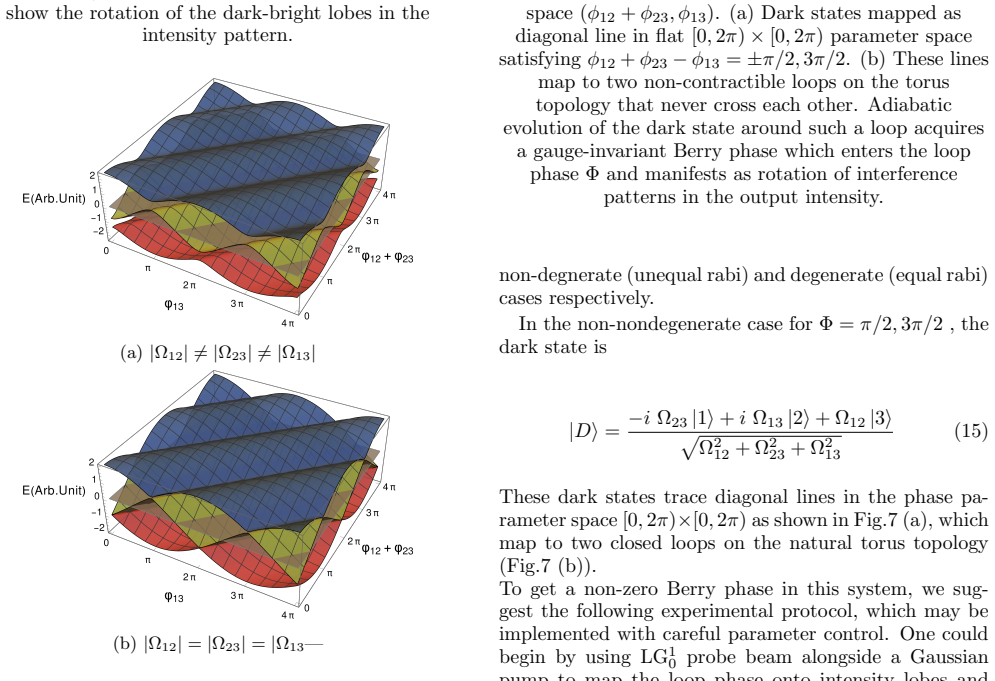
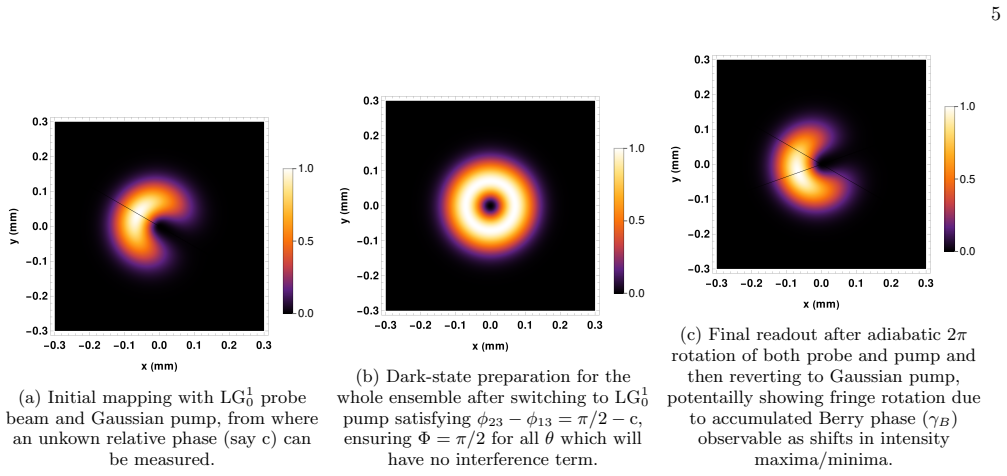
We present an analytical model showing how the gauge-invariant loop phase in a three-level closed-loop atomic system imprints as bright-dark lobes in Laguerre Gaussian probe beam intensity patterns. In the weak probe limit, the output intensity in such systems include Beer-Lambert absorption, a scattering term and loop phase dependent interference term with optical depth controlling visibility. These systems enable mapping of arbitrary phases via interference rotation and offer a platform to measure Berry phase. Berry phase emerge as a geometric holonomy acquired by the dark states during adiabatic traversal of LG phase defined in a toroidal parameter space. Manifesting as fringe shifts which are absent in open systems, experimental realization using cold atoms or solid state platforms appears feasible, positioning structured light in closed-loop systems as ideal testbeds for geometric phases in quantum optics.
Editorial analysis
A structured set of objections, weighed in public.
Referee Report
Summary. The paper claims that the gauge-invariant loop phase in a three-level closed-loop atomic system imprints as bright-dark lobes in Laguerre-Gaussian probe beam intensity patterns. In the weak probe limit, the output intensity consists of Beer-Lambert absorption, a scattering term, and a loop-phase-dependent interference term, with optical depth controlling visibility. This enables mapping of arbitrary phases via interference rotation and provides a platform to measure Berry phase, which emerges as geometric holonomy acquired by dark states during adiabatic traversal of the LG phase in a toroidal parameter space. Experimental realization with cold atoms or solid-state platforms is suggested.
Significance. If the central claim holds, the work provides an analytical framework for mapping geometric phases to intensity structures in atomic systems using structured light. Strengths include the parameter-free derivation from the closed-loop system and the explicit connection to Berry phase holonomy, offering a falsifiable prediction for fringe shifts absent in open systems. This could serve as a testbed for quantum optics experiments, though its impact depends on validation against full propagation effects.
major comments (1)
- [Output intensity model (abstract and main derivation)] The model posits that the output intensity includes Beer-Lambert absorption, a scattering term, and loop phase dependent interference term. However, since the LG probe has spatially varying local intensity, the atomic response creates a position-dependent susceptibility. This leads to diffraction, Gouy-phase shifts, and transverse energy redistribution during propagation, especially if the medium thickness approaches the Rayleigh range. The simple additive model does not guarantee that the bright-dark lobe contrast and fringe rotation persist; a paraxial propagation equation or numerical Maxwell-Bloch simulation is required to substantiate the claims.
minor comments (2)
- [Notation and definitions] The toroidal parameter space for the LG phase should be defined more explicitly, perhaps with a figure or coordinate description, to clarify how the adiabatic traversal leads to the holonomy.
- [References] Ensure citations to prior work on closed-loop EIT systems and structured light phase imprinting are included for context.
Simulated Author's Rebuttal
We thank the referee for their careful reading of the manuscript and for identifying an important point regarding the validity of the output intensity model. We address the major comment below.
read point-by-point responses
-
Referee: [Output intensity model (abstract and main derivation)] The model posits that the output intensity includes Beer-Lambert absorption, a scattering term, and loop phase dependent interference term. However, since the LG probe has spatially varying local intensity, the atomic response creates a position-dependent susceptibility. This leads to diffraction, Gouy-phase shifts, and transverse energy redistribution during propagation, especially if the medium thickness approaches the Rayleigh range. The simple additive model does not guarantee that the bright-dark lobe contrast and fringe rotation persist; a paraxial propagation equation or numerical Maxwell-Bloch simulation is required to substantiate the claims.
Authors: We appreciate the referee highlighting this limitation of the analytical model. The derivation in the manuscript is performed strictly in the weak-probe, optically thin medium limit, where the local atomic polarization is computed from the steady-state density-matrix solution and the output intensity is obtained by a first-order integration along the propagation direction. In this regime the medium length is assumed much smaller than the Rayleigh range of the Laguerre-Gaussian beam, rendering diffraction, Gouy-phase accumulation, and transverse energy flow negligible to leading order. The position-dependent susceptibility therefore imprints the loop-phase interference term directly onto the transmitted intensity pattern. We agree that the simple additive expression does not automatically guarantee persistence of the lobe contrast for thicker samples. To address the concern we will revise the manuscript by (i) explicitly stating the thin-medium approximation and its validity condition (L ≪ z_R), (ii) adding a short paragraph discussing when propagation effects become relevant, and (iii) noting that full paraxial or Maxwell-Bloch simulations would be required outside this regime. These changes will be made without altering the central analytical result. revision: partial
Circularity Check
Analytical derivation from closed-loop atomic equations remains self-contained with no reduction to fitted inputs or self-citations
full rationale
The paper presents an analytical model derived from the three-level closed-loop atomic system under the weak-probe limit, expressing output intensity via Beer-Lambert absorption, scattering, and interference terms controlled by optical depth. No equations or claims reduce by construction to prior fitted parameters, self-referential definitions, or load-bearing self-citations; the Berry phase is obtained as geometric holonomy from adiabatic traversal in the defined parameter space, independent of the target intensity lobes. The derivation chain is therefore self-contained against standard atomic physics and paraxial optics assumptions without circular steps.
Axiom & Free-Parameter Ledger
axioms (2)
- domain assumption Weak probe limit approximation
- domain assumption Adiabatic traversal of LG phase in toroidal parameter space
Lean theorems connected to this paper
-
IndisputableMonolith/Cost/FunctionalEquation.leanwashburn_uniqueness_aczel unclear?
unclearRelation between the paper passage and the cited Recognition theorem.
The output intensity ... Beer-Lambert absorption, a scattering term and loop phase dependent interference term with optical depth controlling visibility. ... I(r,z,Φ)=Ω13²(r)e^{-2βz}−2Ω13(r)Ω23(r)Ω12/γ12 e^{-βz}(1−e^{-βz})sin(Φ)+Ω23²(r)Ω12²/γ12²(1−e^{-βz})²
-
IndisputableMonolith/Foundation/AlexanderDuality.leanalexander_duality_circle_linking unclear?
unclearRelation between the paper passage and the cited Recognition theorem.
Berry phase emerge as a geometric holonomy acquired by the dark states during adiabatic traversal of LG phase defined in a toroidal parameter space.
What do these tags mean?
- matches
- The paper's claim is directly supported by a theorem in the formal canon.
- supports
- The theorem supports part of the paper's argument, but the paper may add assumptions or extra steps.
- extends
- The paper goes beyond the formal theorem; the theorem is a base layer rather than the whole result.
- uses
- The paper appears to rely on the theorem as machinery.
- contradicts
- The paper's claim conflicts with a theorem or certificate in the canon.
- unclear
- Pith found a possible connection, but the passage is too broad, indirect, or ambiguous to say the theorem truly supports the claim.
Reference graph
Works this paper leans on
- [1]
-
[2]
H. Rubinsztein-Dunlop, A. Forbes, M. V. Berry, M. R. Dennis, D. L. Andrews, M. Mansuripur, C. Denz, C. Alp- mann, P. Banzer, T. Bauer,et al., Roadmap on struc- tured light, Journal of Optics19, 013001 (2016)
work page 2016
- [3]
-
[4]
P. S. Badavath, V. Raskatla, T. P. Chakravarthy, and V. Kumar, Speckle-based structured light shift-keying for non-line-of-sight optical communication, Applied Optics 62, G53 (2023)
work page 2023
-
[5]
Y. Yang, Y.-X. Ren, M. Chen, Y. Arita, and C. Rosales- Guzm´ an, Optical trapping with structured light: a re- view, Advanced Photonics3, 034001 (2021)
work page 2021
-
[6]
A. Forbes and I. Nape, Quantum mechanics with pat- terns of light: progress in high dimensional and mul- tidimensional entanglement with structured light, AVS Quantum Science1(2019)
work page 2019
- [7]
-
[8]
A. E. Willner, Oam light for communications, Optics and Photonics News32, 34 (2021)
work page 2021
-
[9]
P. Li, B. Wang, and X. Zhang, High-dimensional encod- ing based on classical nonseparability, Optics express24, 15143 (2016)
work page 2016
-
[10]
E. Korsunsky, N. Leinfellner, A. Huss, S. Baluschev, and L. Windholz, Phase-dependent electromagnetically in- duced transparency, Physical Review A59, 2302 (1999)
work page 1999
-
[11]
A. Joshi, Phase-dependent electromagnetically induced transparency and its dispersion properties in a four-level quantum well system, Physical Review B—Condensed Matter and Materials Physics79, 115315 (2009)
work page 2009
-
[12]
H. Li, V. A. Sautenkov, Y. V. Rostovtsev, G. R. Welch, P. R. Hemmer, and M. O. Scully, Electromagnetically induced transparency controlled by a microwave field, Physical Review A—Atomic, Molecular, and Optical Physics80, 023820 (2009)
work page 2009
-
[13]
W. Maichen, R. Gaggl, E. Korsunsky, and L. Wind- holz, Observation of phase-dependent coherent popula- tion trapping in optically closed atomic systems, Euro- physics Letters31, 189 (1995)
work page 1995
-
[14]
M. ´Curˇ ci´ c, T. Khalifa, B. Zlatkovi´ c, I. Radojiˇ ci´ c, A. Krm- pot, D. Arsenovi´ c, B. Jelenkovi´ c, and M. Gharavipour, Four-wave mixing in potassium vapor with an off- resonant double-λsystem, Physical Review A97, 063851 (2018)
work page 2018
- [15]
- [16]
-
[17]
N. Radwell, T. W. Clark, B. Piccirillo, S. M. Barnett, and S. Franke-Arnold, Spatially dependent electromag- netically induced transparency, Physical Review Letters 114, 123603 (2015)
work page 2015
-
[18]
H. R. Hamedi, V. Kudriaˇ sov, J. Ruseckas, and G. Juzeli¯ unas, Azimuthal modulation of electromagneti- cally induced transparency using structured light, Optics Express26, 28249 (2018)
work page 2018
-
[19]
Rahmatullah, M. Abbas, Ziauddin, and S. Qamar, Spa- tially structured transparency and transfer of optical vor- tices via four-wave mixing in a quantum-dot nanostruc- ture, Physical Review A101, 023821 (2020)
work page 2020
-
[20]
C. Meng, T. Shui, and W.-X. Yang, Coherent transfer of optical vortices via backward four-wave mixing in a double-λatomic system, Physical Review A107, 053712 (2023)
work page 2023
- [21]
- [22]
-
[23]
O. N. Verma and N. Kant, All-optical generation of struc- tured light beams via microwave-field-controlled electro- magnetically induced transparency, Physical Review A 110, 013701 (2024)
work page 2024
-
[24]
J. A. Thachil, C. R. Patel, O. N. Verma, and A. Kumar, Self-healing of orbital angular momentum in bright twin light beams generated via four-wave mixing, Physical Re- view A110, 053520 (2024)
work page 2024
-
[25]
M. V. Berry, Quantal phase factors accompanying adia- batic changes, Proceedings of the Royal Society of Lon- don. A. Mathematical and Physical Sciences392, 45 (1984)
work page 1984
discussion (0)
Sign in with ORCID, Apple, or X to comment. Anyone can read and Pith papers without signing in.