ROBOPOL: Social Robotics Meets Vehicular Communications for Cooperative Automated Driving
Pith reviewed 2026-05-16 19:00 UTC · model grok-4.3
The pith
Social robots can moderate between autonomous vehicles and pedestrians in mixed traffic scenarios.
A machine-rendered reading of the paper's core claim, the machinery that carries it, and where it could break.
Core claim
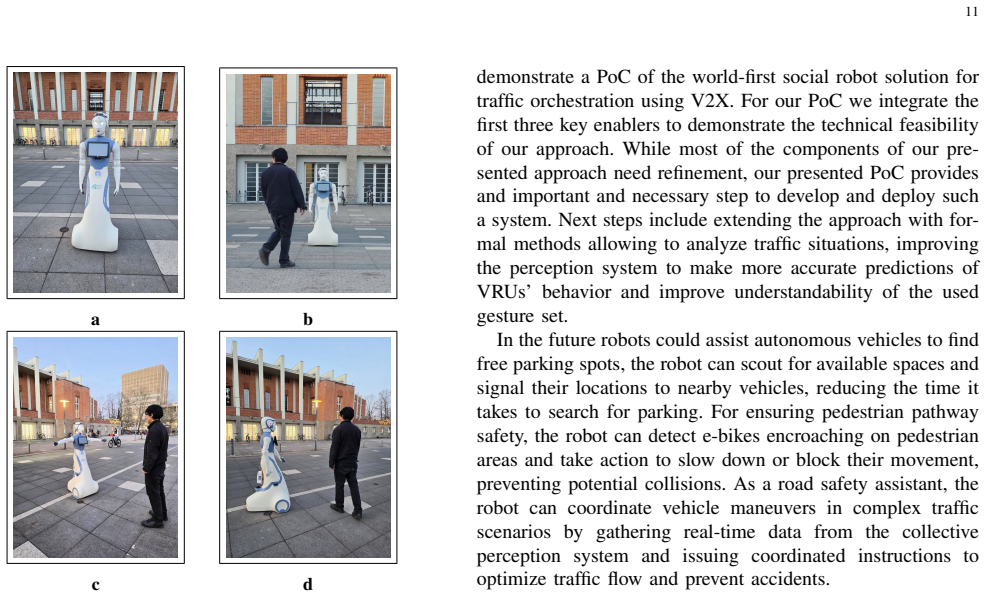
We propose social robots as moderators between autonomous vehicles and vulnerable road users. This paper presents a first proof-of-concept integration of a social robot advising pedestrians in crossing scenarios involving a cooperative automated vehicle. We also discuss key enablers required for designing a robot policeman in a generic use case of cooperative intersection management. Our work provides a vision of the role of social robotics in future Cooperative Intelligent Transport Systems.
What carries the argument
The robot policeman, a social robot that advises pedestrians and integrates with vehicular communication systems to manage cooperative intersections.
Load-bearing premise
That social robots can effectively communicate with and influence pedestrian behavior in dynamic real-world traffic scenarios while integrating seamlessly with vehicular communication systems.
What would settle it
A real-world test where the social robot fails to change pedestrian crossing behavior or where the communication with the vehicle breaks down leading to unsafe situations.
Figures



read the original abstract
On the way toward full autonomy, sharing roads between automated and autonomous vehicles in so-called mixed traffic is unavoidable. Moreover, even if all vehicles on the road were autonomous, pedestrians would still cross streets. We propose social robots as moderators between autonomous vehicles and vulnerable road users. This paper presents a first proof-of-concept integration of a social robot advising pedestrians in crossing scenarios involving a cooperative automated vehicle. We also discuss key enablers required for designing "robot policeman" in a generic use case of cooperative intersection management. Our work provides a vision of the role of social robotics in future Cooperative Intelligent Transport Systems.
Editorial analysis
A structured set of objections, weighed in public.
Referee Report
Summary. The manuscript proposes social robots as moderators between autonomous vehicles and vulnerable road users in mixed traffic. It presents a first proof-of-concept integration of a social robot advising pedestrians in crossing scenarios involving a cooperative automated vehicle, and discusses key enablers for designing a 'robot policeman' in a generic cooperative intersection management use case within Cooperative Intelligent Transport Systems.
Significance. If the proposed integration architecture can be realized with reliable real-time performance, the work could meaningfully extend social robotics into safety-critical traffic applications by providing a novel human-facing interface layer between V2X-enabled vehicles and pedestrians.
major comments (2)
- [Abstract] Abstract: the claim of presenting a 'first proof-of-concept integration' is not supported by any reported measurements of V2X-to-robot message latency, pedestrian compliance rate changes, or comparison against baseline signage, leaving the moderator role unsubstantiated.
- [Use-case discussion] Use-case discussion: the generic cooperative intersection scenario does not address or quantify the timing constraints required for the robot to receive vehicle state data and issue crossing advice before pedestrians enter the roadway, which is load-bearing for the claimed feasibility.
minor comments (1)
- The manuscript would benefit from an explicit statement early on that the contribution is primarily architectural and visionary rather than empirical, to set reader expectations.
Simulated Author's Rebuttal
We thank the referee for the constructive comments, which help clarify the scope of our proof-of-concept work. We agree that the abstract overstates the empirical nature of the integration and that timing constraints require explicit discussion. Both points will be addressed through targeted revisions to the abstract and use-case section.
read point-by-point responses
-
Referee: [Abstract] Abstract: the claim of presenting a 'first proof-of-concept integration' is not supported by any reported measurements of V2X-to-robot message latency, pedestrian compliance rate changes, or comparison against baseline signage, leaving the moderator role unsubstantiated.
Authors: We agree that the current abstract phrasing implies a stronger empirical validation than the manuscript delivers. The proof-of-concept consists of an architectural integration and simulated demonstration of the robot receiving V2X data and issuing advice, without quantitative measurements of latency, compliance rates, or baseline comparisons. We will revise the abstract to state that the work presents a conceptual proof-of-concept of the integration architecture and a discussion of key enablers, explicitly noting the absence of empirical performance data on the moderator role. revision: yes
-
Referee: [Use-case discussion] Use-case discussion: the generic cooperative intersection scenario does not address or quantify the timing constraints required for the robot to receive vehicle state data and issue crossing advice before pedestrians enter the roadway, which is load-bearing for the claimed feasibility.
Authors: We acknowledge that the generic use-case discussion lacks explicit quantification of timing constraints. We will expand this section to include a timing analysis based on standard V2X latencies (e.g., CAM/DENM messages under 100 ms) and typical social-robot response times, outlining the end-to-end budget needed for the robot to issue safe crossing advice prior to pedestrian entry. This addition will strengthen the feasibility argument without requiring new experiments. revision: yes
Circularity Check
Conceptual architecture proposal with no derivations or self-referential reductions
full rationale
The paper advances a vision for social robots moderating interactions between cooperative automated vehicles and pedestrians, presenting an architectural sketch and generic use-case discussion. No equations, fitted parameters, predictive models, or derivation chains appear in the provided text. The central claim rests on descriptive integration rather than any result that reduces to its own inputs by construction. Self-citations, if present, support background context only and do not carry load-bearing uniqueness theorems or ansatzes for the proposed moderator role. This is a standard non-circular conceptual contribution.
Axiom & Free-Parameter Ledger
invented entities (1)
-
social robot moderator or 'robot policeman'
no independent evidence
Lean theorems connected to this paper
-
IndisputableMonolith/Foundation/RealityFromDistinctionreality_from_one_distinction unclear?
unclearRelation between the paper passage and the cited Recognition theorem.
We propose social robots as moderators between autonomous vehicles and vulnerable road users... first proof-of-concept integration of a social robot advising pedestrians in crossing scenarios involving a cooperative automated vehicle.
-
IndisputableMonolith/Cost/FunctionalEquationwashburn_uniqueness_aczel unclear?
unclearRelation between the paper passage and the cited Recognition theorem.
The main technical enablers... advanced perception, vehicular communications, social human-robot interaction, formal specification.
What do these tags mean?
- matches
- The paper's claim is directly supported by a theorem in the formal canon.
- supports
- The theorem supports part of the paper's argument, but the paper may add assumptions or extra steps.
- extends
- The paper goes beyond the formal theorem; the theorem is a base layer rather than the whole result.
- uses
- The paper appears to rely on the theorem as machinery.
- contradicts
- The paper's claim conflicts with a theorem or certificate in the canon.
- unclear
- Pith found a possible connection, but the passage is too broad, indirect, or ambiguous to say the theorem truly supports the claim.
Forward citations
Cited by 1 Pith paper
-
Multi-Robot Coordination in V2X Environments
New robot-specific V2X services enable decentralized coordination between robots and vehicles, demonstrated in a real-world pedestrian assistance scenario and simulations.
Reference graph
Works this paper leans on
-
[1]
W. Yue, C. Li, P. Duan, and F. R. Yu, “Revolution on wheels: A survey on the positive and negative impacts of connected and automated vehicles in era of mixed autonomy,”IEEE Internet of Things Journal, vol. 10, no. 24, pp. 21 820–21 835, 2023
work page 2023
-
[2]
A survey on cooperative architectures and maneuvers for connected and automated vehicles,
B. H ¨afner, V . Bajpai, J. Ott, and G. A. Schmitt, “A survey on cooperative architectures and maneuvers for connected and automated vehicles,” IEEE Communications Surveys & Tutorials, vol. 24, no. 1, pp. 380– 403, 2022
work page 2022
-
[3]
M. Bied, B. Bruno, and A. Vinel, “Autonomous vehicles as social agents: Vehicle to pedestrian communication from v2x, ehmi and hri perspectives,” in2024 20th International Conference on Wireless and Mobile Computing, Networking and Communications (WiMob). IEEE, 2024, pp. 86–91
work page 2024
-
[4]
Experiencing social robots for traffic guidance using virtual reality videos,
M. Schrapel, M. Bied, B. Bruno, and A. Vinel, “Experiencing social robots for traffic guidance using virtual reality videos,” inMensch und Computer 2024 - Workshopband. Gesellschaft f ¨ur Informatik e.V ., 2024
work page 2024
-
[5]
Protection of vulnerable road users using hybrid vehicular networks,
O. A. Molina, E. Ronel ¨ov, K. Boustedt, J. Blidkvist, and A. Vinel, “Protection of vulnerable road users using hybrid vehicular networks,” in2022 IEEE International Conference on Vehicular Electronics and Safety (ICVES), 2022, pp. 1–6
work page 2022
-
[6]
Analysis and evaluation of information redundancy mitigation for v2x collective perception,
Q. Delooz, A. Willecke, K. Garlichs, A.-C. Hagau, L. Wolf, A. Vinel, and A. Festag, “Analysis and evaluation of information redundancy mitigation for v2x collective perception,”IEEE Access, vol. 10, pp. 47 076–47 093, 2022
work page 2022
-
[7]
Safearcross: Augmented reality collision warnings and virtual traffic lights for pedestrian safety,
A. Cl ´erigo, M. Schrapel, P. Teixeira, P. Rito, S. Sargento, and A. Vinel, “Safearcross: Augmented reality collision warnings and virtual traffic lights for pedestrian safety,” inProceedings of the 16th International Conference on Automotive User Interfaces and Interactive Vehicular Applications, ser. AutomotiveUI ’24. New York, NY , USA: Association for...
-
[8]
Controlling traffic with humanoid social robot,
F. Ghaffar, “Controlling traffic with humanoid social robot,” 2022. [Online]. Available: https://arxiv.org/abs/2204.04240
-
[9]
S. C. Kumaran, A. Oberlender, A. Grishko, B. Megidish, and H. Erel, “To cross or not-to-cross: A robotic object for mediating interactions between autonomous vehicles and pedestrians,” in2023 32nd IEEE In- ternational Conference on Robot and Human Interactive Communication (RO-MAN), 2023, pp. 285–292
work page 2023
-
[10]
Traffic light and moving object detection for a guide-dog robot,
Q. Chen, Y . Chen, J. Zhu, G. De Luca, M. Zhang, and Y . Guo, “Traffic light and moving object detection for a guide-dog robot,”The Journal of Engineering, vol. 2020, no. 13, pp. 675–678, 2020
work page 2020
-
[11]
Study on evaluating applicability of road traffic safety moderator robot,
Y . W. Lee, “Study on evaluating applicability of road traffic safety moderator robot,”Advanced Science and Technology Letters, vol. 100, pp. 39–42, 2015. 12
work page 2015
-
[12]
Three Strate- gies for Autonomous Car-to-Pedestrian Communication: A Survival Guide,
N. Mirnig, N. Perterer, G. Stollnberger, and M. Tscheligi, “Three Strate- gies for Autonomous Car-to-Pedestrian Communication: A Survival Guide,” inComp. ACM/IEEE Int. Conf. Human-Robot Interaction (HRI). New York, NY , USA: ACM, 03 2017, pp. 209–210
work page 2017
-
[13]
K. Holl ¨ander, A. Colley, C. Mai, J. H ¨akkil¨a, F. Alt, and B. Pfleging, “Investigating the influence of external car displays on pedestrians’ crossing behavior in virtual reality,” inProc. 21st Int. Conf. Hum.-Comp. Interact. Mob. Devices Serv. (MobileHCI). New York, NY , USA: ACM, 2019
work page 2019
-
[14]
Towards a smart robot model for traffic signal management in developing countries,
A. Najjar, H. Prakash, I. Tchappi, J. E. Ndamlabin Mboula, and Y . Mualla, “Towards a smart robot model for traffic signal management in developing countries,” inProceedings of the 10th International Conference on Human-Agent Interaction, 2022, pp. 333–336
work page 2022
-
[15]
L. Gong, C. Gong, Z. Ma, L. Zhao, Z. Wang, X. Li, X. Jing, H. Yang, and C. Liu, “Real-time human-in-the-loop remote control for a life- size traffic police robot with multiple augmented reality aided display terminals,” in2017 2nd International conference on advanced robotics and mechatronics (ICARM). IEEE, 2017, pp. 420–425
work page 2017
-
[16]
A. P. Dani, I. Salehi, G. Rotithor, D. Trombetta, and H. Ravichandar, “Human-in-the-Loop Robot Control for Human-Robot Collaboration: Human Intention Estimation and Safe Trajectory Tracking Control for Collaborative Tasks,”IEEE Control Systems Magazine, vol. 40, no. 6, pp. 29–56, Dec. 2020, conference Name: IEEE Control Systems Magazine. [Online]. Availab...
-
[17]
C. Bartneck, T. Belpaeme, F. Eyssel, T. Kanda, M. Keijsers, and S. ˇSabanovi´c,Human-robot interaction: An introduction. Cambridge University Press, 2024
work page 2024
-
[18]
A meta-analysis on the effectiveness of anthropomorphism in human-robot interaction,
E. Roesler, D. Manzey, and L. Onnasch, “A meta-analysis on the effectiveness of anthropomorphism in human-robot interaction,”Science Robotics, vol. 6, no. 58, p. eabj5425, 2021
work page 2021
-
[19]
A. Gholamhosseinian and J. Seitz, “A comprehensive survey on coop- erative intersection management for heterogeneous connected vehicles,” IEEE Access, vol. 10, pp. 7937–7972, 2022
work page 2022
-
[20]
R. Siegwart, I. R. Nourbakhsh, and D. Scaramuzza,Introduction to Autonomous Mobile Robots, 2nd ed. The MIT Press, 2011
work page 2011
-
[21]
Pedestrian models for autonomous driving part i: Low-level models, from sensing to tracking,
F. Camara, N. Bellotto, S. Cos ¸ar, D. Nathanael, M. Althoff, J. Wu, J. Ruenz, A. Dietrich, and C. W. Fox, “Pedestrian models for autonomous driving part i: Low-level models, from sensing to tracking,”IEEE Transactions on Intelligent Transportation Systems, vol. 22, pp. 6131–6151, 2020. [Online]. Available: https: //api.semanticscholar.org/CorpusID:211506828
work page 2020
-
[22]
Roadside infrastructure support for urban automated driving,
M. Pechinger, G. Schr ¨oer, K. Bogenberger, and C. Markgraf, “Roadside infrastructure support for urban automated driving,”IEEE Transactions on Intelligent Transportation Systems, vol. 24, no. 10, pp. 10 643–10 652, 2023
work page 2023
-
[23]
Simulation-based performance optimization of v2x collective perception by adaptive object filtering,
Q. Delooz, A. Festag, A. Vinel, and S. C. Lobo, “Simulation-based performance optimization of v2x collective perception by adaptive object filtering,” in2023 IEEE Intelligent Vehicles Symposium (IV), 2023, pp. 1–8
work page 2023
-
[24]
Throughput and waiting-time analysis of an unsignalized t-intersection,
H. Van den Bossche, D. Fiems, and H. Bruneel, “Throughput and waiting-time analysis of an unsignalized t-intersection,”21ste European Conference on Operational Research EURO XXI, 2006
work page 2006
-
[25]
Pollaczek contour integrals for the fixed-cycle traffic-light queue,
M. A. A. Boon, G. J. E. M. Janssen, J. S. H. van Leeuwaarden, and R. W. Timmerman, “Pollaczek contour integrals for the fixed-cycle traffic-light queue,”Queueing Systems, vol. 91, no. 1–2, pp. 89–111, 2019
work page 2019
-
[26]
The fixed-cycle traffic-light queue with multiple lanes and temporary blockages,
R. W. Timmerman and M. A. A. Boon, “The fixed-cycle traffic-light queue with multiple lanes and temporary blockages,”Transportmetrica A-Transport Science, vol. 20, no. 1, p. 36, 2024
work page 2024
-
[27]
Q. Yang and J. Zhang, “Modelling the queues of connected and au- tonomous vehicles at signal-free intersections considering the correlated vehicle arrivals,”Journal of Computational Science, vol. 82, 2024
work page 2024
-
[28]
F. Macedo, P. Milheiro-Oliveira, A. Pacheco, and M. L. Sim ˜oes, “Application of a particular class of Markov chains in the assessment of semi-actuated signalized intersections,” inAnalytical and Stochastic Modelling Techniques and Applications: LNCS vol. 10378. Springer, 2017, pp. 138–151
work page 2017
-
[29]
H. Moradi, S. Sasaninejad, S. Wittevrongel, and J. Walraevens, “Pro- posal of an integrated platoon-based round-robin algorithm with priori- ties for intersections with mixed traffic flows,”IET Intelligent Transport Systems, vol. 15, no. 9, pp. 1106–1118, 2021
work page 2021
-
[30]
An MDP decomposition approach for traffic control at isolated signalized intersections,
R. Haijema and J. van der Wal, “An MDP decomposition approach for traffic control at isolated signalized intersections,”Probability in the Engineering and Informational Sciences, vol. 22, no. 4, pp. 587–602, 2008
work page 2008
-
[31]
Dynamic control of traffic lights,
R. Haijema, E. M. Hendrix, and J. van der Wal, “Dynamic control of traffic lights,”Markov Decision Processes in Practice, pp. 371–386, 2017
work page 2017
-
[32]
T. A. Haddad, D. Hedjazi, and S. Aouag, “A deep reinforcement learning-based cooperative approach for multi-intersection traffic signal control,”Engineering Applications of Artificial Intelligence, vol. 114, 2022
work page 2022
-
[33]
Y . Shi, Y . Liu, Y . Qi, and Q. Han, “A control method with reinforcement learning for urban un-signalized intersection in hybrid traffic environ- ment,”Sensors, vol. 22, no. 3, 2022
work page 2022
-
[34]
Deep rein- forcement learning for intersection signal control considering pedestrian behavior,
G. Han, Q. Zheng, L. Liao, P. Tang, Z. Li, and Y . Zhu, “Deep rein- forcement learning for intersection signal control considering pedestrian behavior,”Electronics, vol. 11, no. 21, 2022
work page 2022
-
[35]
Queueing-theoretic approaches for dynamic scheduling: A survey,
D. Terekhov, D. Down, and J. Beck, “Queueing-theoretic approaches for dynamic scheduling: A survey,”Surveys in Operations Research and Management Science, vol. 19, pp. 105–129, 2014
work page 2014
-
[36]
S. Asmussen and P. W. Glynn,Stochastic Simulation: Algorithms and Analysis, ser. Stochastic Modelling and Applied Probability. Springer, 2007, vol. 57
work page 2007
-
[37]
K. Baker and D. Trietsch,Principles of Sequencing and Scheduling. John Wiley & Sons, 2009
work page 2009
-
[38]
N. Kalra and S. M. Paddock,Driving to Safety: How Many Miles of Driving Would It Take to Demonstrate Autonomous Vehicle Reliability? Santa Monica, CA: RAND Corporation, 2016
work page 2016
-
[39]
Cooperative intersection management: A survey,
L. Chen and C. Englund, “Cooperative intersection management: A survey,”IEEE Trans. on Int. Transportation Systems, vol. 17, no. 2, pp. 570–586, 2016
work page 2016
-
[40]
K. E. Bekris, K. I. Tsianos, and L. E. Kavraki, “A decentralized planner that guarantees the safety of communicating vehicles with complex dynamics that replan online,” inIEEE/RSJ Int. Conf. on Intelligent Robots and Systems, Proc.IEEE, 2007, pp. 3784–3790
work page 2007
-
[41]
An abstract model for proving safety of autonomous urban traffic,
M. Schwammberger, “An abstract model for proving safety of autonomous urban traffic,”Theoretical Computer Science, vol. 744, pp. 143–169, 2018. [Online]. Available: https://doi.org/10.1016/j.tcs.2018. 05.028
-
[42]
A temporal logic for multilevel reasoning about hardware,
B. Moszkowski, “A temporal logic for multilevel reasoning about hardware,”Computer, vol. 18, no. 2, pp. 10–19, 1985
work page 1985
-
[43]
G. V . Alves, L. Dennis, and M. Fisher, “A double-level model checking approach for an agent-based autonomous vehicle and road junction regulations,”Journal of Sensor and Actuator Networks, vol. 10, no. 3,
-
[44]
Available: https://www.mdpi.com/2224-2708/10/3/41
[Online]. Available: https://www.mdpi.com/2224-2708/10/3/41
-
[45]
Extending urban multi-lane spatial logic to formalise road junction rules,
M. Schwammberger and G. V . Alves, “Extending urban multi-lane spatial logic to formalise road junction rules,” inProceedings Third Workshop on Formal Methods for Autonomous Systems, FMAS 2021, Virtual, October 21-22, 2021, ser. EPTCS, M. Farrell and M. Luckcuck, Eds., vol. 348, 2021, pp. 1–19. [Online]. Available: https://doi.org/10.4204/EPTCS.348.1
-
[46]
It’s safe to play while driving: From a spatial traffic logic towards traffic games,
M. Schwammberger and Q. Hamarneh, “It’s safe to play while driving: From a spatial traffic logic towards traffic games,” inBridging the Gap Between AI and Reality, B. Steffen, Ed. Cham: Springer Nature Switzerland, 2025, pp. 277–290
work page 2025
-
[47]
T. A. Henzinger, B. Horowitz, and R. Majumdar, “Rectangular hybrid games,” inCONCUR ’99: Concurrency Theory, 10th International Con- ference, Eindhoven, The Netherlands, August 24-27, 1999, Proceedings, ser. Lecture Notes in Computer Science, J. C. M. Baeten and S. Mauw, Eds., vol. 1664. Springer, 1999, pp. 320–335
work page 1999
-
[48]
S. Chamideh, W. T ¨arneberg, and M. Kihl, “A safe and robust au- tonomous intersection management system using a hierarchical control strategy and v2i communication,”IEEE Systems Journal, vol. 17, no. 1, pp. 50–61, 2023
work page 2023
-
[49]
D. S. Syrdal, K. Dautenhahn, K. L. Koay, and M. L. Walters, “The negative attitudes towards robots scale and reactions to robot behaviour in a live human-robot interaction study,” inProceedings of the 23rd convention of the society for the study of artificial intelligence and simulation of behaviour. AISB, 2009, pp. 109–115. [Online]. Available: https://a...
work page 2009
-
[50]
C. Bartneck, D. Kuli ´c, E. Croft, and S. Zoghbi, “Measurement in- struments for the anthropomorphism, animacy, likeability, perceived intelligence, and perceived safety of robots,”International journal of social robotics, vol. 1, pp. 71–81, 2009
work page 2009
-
[51]
S. P. Saunderson and G. Nejat, “Persuasive robots should avoid authority: The effects of formal and real authority on persuasion in human-robot interaction,” vol. 6, no. 58, p. eabd5186. [Online]. Available: https://www.science.org/doi/10.1126/scirobotics.abd5186
-
[52]
Overtrust of robots in emergency evacuation scenarios,
P. Robinette, W. Li, R. Allen, A. M. Howard, and A. R. Wagner, “Overtrust of robots in emergency evacuation scenarios,” in2016 11th ACM/IEEE International Conference on Human- Robot Interaction (HRI). IEEE, pp. 101–108. [Online]. Available: http://ieeexplore.ieee.org/document/7451740/ 13 Manuel Biedis a postdoctoral researcher at the Karlsruhe Institute o...
discussion (0)
Sign in with ORCID, Apple, or X to comment. Anyone can read and Pith papers without signing in.