The second Hochschild cohomology and deformations of Brauer graph algebras
Pith reviewed 2026-05-16 15:33 UTC · model grok-4.3
The pith
Bipartite Brauer graph algebras with trivial grading have an explicit second Hochschild cohomology that interprets deformations geometrically through surface models.
A machine-rendered reading of the paper's core claim, the machinery that carries it, and where it could break.
Core claim
We give an explicit description about the second Hochschild cohomology groups of bipartite Brauer graph algebras with trivial grading. Based on this, we provide geometric interpretations of deformations associated to some standard cocycles in terms of the surface models of Brauer graph algebras.
What carries the argument
The surface models of Brauer graph algebras, which translate cocycles in the second Hochschild cohomology into concrete changes of edges, faces, and relations on the surface.
If this is right
- Deformations of the algebra correspond to modifications of the surface model that preserve the bipartite structure.
- Standard cocycles generate a basis whose geometric effects can be read off directly from the surface.
- The trivial grading condition ensures that the cohomology calculation remains combinatorial and avoids higher-degree complications.
- Any deformation classified by these cocycles yields a new algebra whose quiver and relations are visible on the deformed surface.
Where Pith is reading between the lines
- The geometric picture may extend to counting deformation parameters for families of Brauer graph algebras indexed by surfaces of fixed genus.
- One could test whether the same surface-model correspondence holds after base change to fields of positive characteristic.
- The explicit cohomology might supply a combinatorial criterion for rigidity of these algebras under deformation.
Load-bearing premise
The algebras must be bipartite and equipped with the trivial grading, and the surface models must remain compatible with the cocycle deformations.
What would settle it
Compute the dimension of the second Hochschild cohomology for a specific small bipartite Brauer graph algebra and check whether it equals the number of independent geometric deformations visible in its surface model; mismatch would falsify the claimed explicit description and interpretations.
Figures


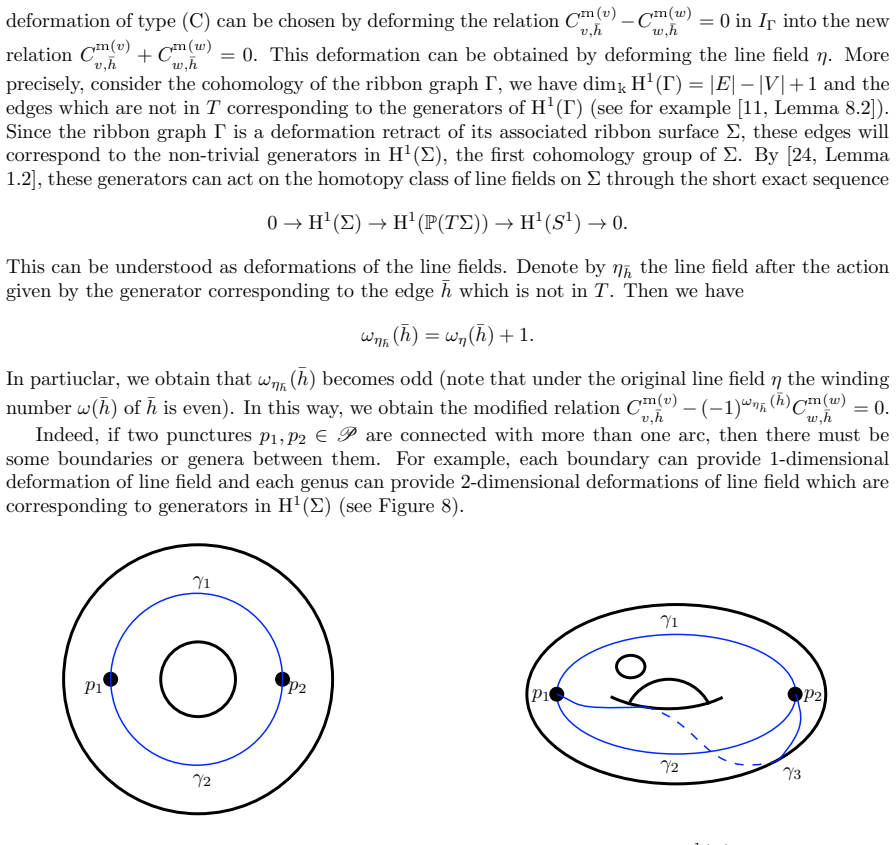


read the original abstract
In this paper, we give an explicit description about the second Hochschild cohomology groups of bipartite Brauer graph algebras with trivial grading. Based on this, we provide geometric interpretations of deformations associated to some standard cocycles in terms of the surface models of Brauer graph algebras.
Editorial analysis
A structured set of objections, weighed in public.
Referee Report
Summary. The manuscript claims to give an explicit description of the second Hochschild cohomology groups of bipartite Brauer graph algebras equipped with the trivial grading. It then uses this description to provide geometric interpretations of deformations associated to some standard cocycles, expressed in terms of modifications to the surface models of the algebras.
Significance. If the explicit HH^2 description is accurate and the geometric correspondences hold, the work would strengthen the connection between homological invariants and geometric models for a concrete class of algebras, aiding deformation theory and representation-theoretic studies of Brauer graph algebras.
major comments (2)
- [§4] §4 (geometric interpretations): the claim that standard cocycles correspond to concrete surface operations (e.g., handle addition or edge-multiplicity changes) is asserted without an explicit verification that the deformed multiplication table reproduces the algebra associated to the modified surface model. This check is load-bearing for the geometric interpretation to hold for the full set of cocycles.
- [Theorem 3.1] Theorem 3.1 (explicit HH^2 basis): the dimension formula and basis elements are stated for the trivial grading, but the derivation omits the step-by-step verification that the listed cocycles satisfy the cocycle condition and that no additional relations arise from the bipartiteness assumption.
minor comments (2)
- [§2] Notation for the surface models in §2 is introduced without a reference diagram or explicit definition of the trivial grading action on the edges; a small illustrative figure would improve readability.
- [Introduction] The abstract and introduction use the phrase 'some standard cocycles' without listing them or cross-referencing the precise cocycles treated in §4.
Simulated Author's Rebuttal
We thank the referee for the careful reading and constructive comments on our manuscript. We address each major comment below and will revise the manuscript to strengthen the presentation.
read point-by-point responses
-
Referee: [§4] §4 (geometric interpretations): the claim that standard cocycles correspond to concrete surface operations (e.g., handle addition or edge-multiplicity changes) is asserted without an explicit verification that the deformed multiplication table reproduces the algebra associated to the modified surface model. This check is load-bearing for the geometric interpretation to hold for the full set of cocycles.
Authors: We agree that explicit verification is required to make the geometric correspondences rigorous. In the revised version we will add, for each standard cocycle, a direct computation of the deformed multiplication on the basis of the original algebra and show that the resulting structure constants match those of the Brauer graph algebra associated to the modified surface (including the updated quiver, relations, and grading). These checks will be presented in an expanded subsection of §4. revision: yes
-
Referee: [Theorem 3.1] Theorem 3.1 (explicit HH^2 basis): the dimension formula and basis elements are stated for the trivial grading, but the derivation omits the step-by-step verification that the listed cocycles satisfy the cocycle condition and that no additional relations arise from the bipartiteness assumption.
Authors: We accept that the proof of Theorem 3.1 would be clearer with explicit verification steps. We will expand the argument to include: (i) direct substitution of each listed cocycle into the Hochschild coboundary operator to confirm δ²(φ)=0, and (ii) an explicit check that the bipartiteness condition on the underlying graph does not impose further linear dependencies among the cocycles beyond those already used to construct the basis. The revised proof will appear in §3 immediately after the statement of the theorem. revision: yes
Circularity Check
No significant circularity; explicit HH^2 computation rests on standard homological algebra
full rationale
The paper's central result is an explicit description of the second Hochschild cohomology for bipartite Brauer graph algebras under trivial grading, followed by geometric interpretations of deformations. No load-bearing step reduces by definition, by fitting a parameter then renaming it a prediction, or by a self-citation chain that is itself unverified. The derivation chain relies on direct cocycle calculations and surface-model compatibility checks that are presented as independent verifications rather than tautological re-labelings. Self-citations, if present, are not invoked to force uniqueness or smuggle an ansatz; the geometric correspondence is asserted after the cohomology computation and does not presuppose its own conclusion.
Axiom & Free-Parameter Ledger
Lean theorems connected to this paper
-
IndisputableMonolith/Foundation/AlexanderDuality.leanalexander_duality_circle_linking unclear?
unclearRelation between the paper passage and the cited Recognition theorem.
We give an explicit description about the second Hochschild cohomology groups of bipartite Brauer graph algebras with trivial grading... geometric interpretations of deformations... in terms of the surface models
-
IndisputableMonolith/Cost/FunctionalEquation.leanwashburn_uniqueness_aczel unclear?
unclearRelation between the paper passage and the cited Recognition theorem.
dim HH²(B_Γ) = 2 + Σ(m(v)−1) + |E|−|V| + |S_{2-cyc}|
What do these tags mean?
- matches
- The paper's claim is directly supported by a theorem in the formal canon.
- supports
- The theorem supports part of the paper's argument, but the paper may add assumptions or extra steps.
- extends
- The paper goes beyond the formal theorem; the theorem is a base layer rather than the whole result.
- uses
- The paper appears to rely on the theorem as machinery.
- contradicts
- The paper's claim conflicts with a theorem or certificate in the canon.
- unclear
- Pith found a possible connection, but the passage is too broad, indirect, or ambiguous to say the theorem truly supports the claim.
Reference graph
Works this paper leans on
-
[1]
M. Antipov, A. Zvonareva. On stably biserial algebras and the Auslander–Reiten conjecture for special biserial algebras.Journal of Mathematical Sciences240.4(2019) 375–394. 47
work page 2019
-
[2]
M. Antipov, A. Zvonareva. Brauer graph algebras are closed under derived equivalence.Mathema- tische Zeitschrift301(2022) 1963-1981
work page 2022
-
[3]
Deformations of path algebras of quivers with relations
S. Barmeier, Z. Wang. Deformations of path algebras of quivers with relations. arXiv: 2002.10001v5 [math.QA] (2023)
-
[4]
S. Barmeier, S. Schroll, Z. Wang. Partially wrapped Fukaya categories of orbifold surfaces. arXiv:2407.16358 [math.SG] (2024)
-
[5]
S. Barmeier, S. Schroll, Z. Wang. Deformations of partially wrapped Fukaya categories of surfaces. arXiv:2512.16354 [math.SG] (2025)
-
[6]
G.M. Bergman. The diamond lemma for ring theory.Advances in Mathematics29(1978) 178-218
work page 1978
-
[7]
C. Bessenrodt, T. Holm. Weighted locally gentle quiver and Cartan matrices.Journal of Pure and Applied Algebra212(1) (2008) 204-221
work page 2008
-
[8]
Bondy, U.S.R Murty.Graph Theory
J.A. Bondy, U.S.R Murty.Graph Theory. New York: Springer, 2008
work page 2008
- [9]
- [10]
-
[11]
I. Dewan. Graph homology and cohomology. Preprint, available athttps://alistairsavage. ca/pubs/Dewan-Graph_Homology.pdf(2016)
work page 2016
-
[12]
P. Gabriel. Finite representation type is open. In: Proceedings of the International Conference Ot- tawa 1974. Ottawa, Carleton Mathematics Lecture Notes9, 132-155, Carleton University, Ottawa (1974)
work page 1974
-
[13]
M. Gerstenhaber. On the deformation of rings and algebras.Annals of Mathematics79(1964) 59-103
work page 1964
-
[14]
E.L. Green. Noncommutative Gr¨ obner bases, and projective resolutions.Progress in Mathematics 173(1999) 29-60
work page 1999
- [15]
- [16]
- [17]
- [18]
-
[19]
T. Holm. Hochschild cohomology of Brauer tree algebras.Communications in Algebra26.11 (1998) 3625–3646
work page 1998
- [20]
- [21]
-
[22]
B. Keller. Derived invariance of higher structures on the Hochschild complex. Preprint, available athttp://webusers.imj-prg.fr/ ~bernhard.keller/publ/dih.pdf(2003)
work page 2003
-
[23]
M. Kontsevich, Y. Soibelman. Notes onA ∞-algebras,A ∞ categories and non-commutative geom- etry. In:Homological Mirror Symmetry, Lecture Notes in Phys., pp. 153-219, Springer, 2009
work page 2009
- [24]
-
[25]
J. Liu, Z. Wang.A ∞-deformations of zigzag algebras via Ginzburg dg algebras.Journal of Algebra, 677(2025) 360-371
work page 2025
-
[26]
Y. Liu, B. Xing. Generalized parallel paths method for computing the first Hochschild cohomology group with applications to Brauer graph algebras.Journal of Algebra and its Applications, advance online publication:https://doi.org/10.1142/S021949882650297X(2025)
-
[27]
M. M¨ uller, M.J. Redondo, F. Rossi Bertone, P. Suarez. Maurer-Cartan equation for gentle alge- bras.Communications in Algebra(2025) 1-24
work page 2025
- [28]
-
[29]
S. Schroll, Trivial extensions of gentle algebras and Brauer graph algebras.Journal of Algebra 444(2015), 183-200
work page 2015
-
[30]
S. Schroll. Brauer graph algebras. In:Homological Methods, Representation Theory, and Cluster Algebras, pp. 177-223, Springer, 2018. 49
work page 2018
discussion (0)
Sign in with ORCID, Apple, or X to comment. Anyone can read and Pith papers without signing in.