pith. sign in

math.RA

Rings and Algebras

Non-commutative rings and algebras, non-associative algebras, universal algebra and lattice theory, linear algebra, semigroups

5
math.RA 2026-05-19 2 theorems

2-generated Monster type axial algebras fully classified

by Clara Franchi, Mario Mainardis +2 more

The Classification of the 2-generated Primitive Axial Algebras of Monster Type

Case analysis on parameters, subalgebras, axets and dimensions completes the list with explicit bases and products

abstract click to expand
Axial algebras of Monster type are a class of commutative algebras generated by special idempotents called axes. Some motivating examples of these algebras are the Griess algebra and the Norton-Sakuma algebras, relating to the Monster simple group. A long standing open problem is to classify the 2-generated axial algebras of Monster type. A huge milestone was accomplished by Yabe leading, with additional cases completed by Franchi, Mainardis, and McInroy, to the classification in the symmetric case. In this paper, we complete the classification. To do so, we split the proof into multiple cases: dealing with certain parameters, subalgebras, axets, and axial dimensions. Furthermore, we provide a basis, multiplication and information of the algebras in the classification; consolidating existing results on these algebras into one place.
0
2
math.RA 2026-05-15 3 theorems

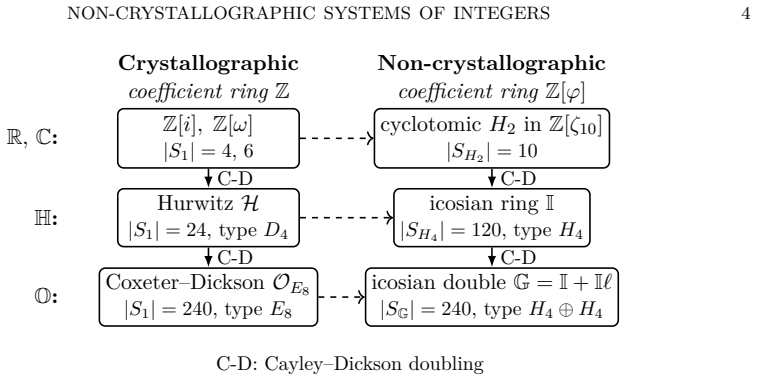
Octonion order from icosian doubling carries 240-element H4 shell

by Daniele Corradetti

Non-crystallographic systems of integers over composition algebras

The resulting self-dual rank-8 Zφ-order has genuinely octonionic multiplication and no norm-integral overorder or isotropic gluings.

Figure from the paper full image
abstract click to expand
In this work we revisit classical systems of integers inside the real normed division algebras from the point of view of finite norm shells and root systems. Building on the icosian framework of Moody--Patera and on the integral root-system viewpoint of Chen--Moody--Patera and of Johnson, we isolate the precise axiomatic ingredients of the non-crystallographic analogue: an order over the golden ring \(\Zphi\) together with a distinguished finite root shell whose Cartan coefficients lie in \(\Zphi\). We show that the usual Gaussian, Eisenstein, Hamilton, Hurwitz and Coxeter--Dickson examples are recovered by separating the order, its units, and its distinguished finite shells; once the lattice requirement is replaced by a finite root-shell requirement, the golden integer ring becomes the natural coefficient ring for the non-crystallographic cases \(H_2\) and \(H_4\). We then construct a weak golden octonion order by Cayley--Dickson doubling of the icosian ring; the resulting free rank-\(8\) \(\Zphi\)-order has a \(240\)-element finite shell of type \(H_4\oplus H_4\) and its multiplication is genuinely octonionic. Finally, we prove (i) that this weak double is self-dual with respect to the polar norm pairing, hence has no strict norm-integral overorder, and (ii) that the first trace-integral discriminant tower over it contains no octonion-stable nonzero isotropic gluing.
1 0
1
math.RA 2026-05-13 2 theorems

Evolution algebras from expanders meet Alon-Boppana bound

by Piero Giacomelli

Expander Evolution Algebras

The Cheeger constant of the graph sets connectivity and forces the optimal eigenvalue gap for the evolution operator over C.

abstract click to expand
We introduce \emph{expander evolution algebras} (EEAs), a class of nonassociative algebras defined over an arbitrary field $\K$ in which the underlying undirected loopless graph of the algebra -- in the sense of Kowalski -- is an expander graph in the classical sense of Cheeger. Starting from the formal graph definition of Kowalski and the algebraic framework of Tian, we establish a dictionary between combinatorial expansion and algebraic structure: the Cheeger constant of the associated graph governs connectivity, the subalgebra lattice, the growth of the evolution sequence, and -- over $\R$ and $\C$ -- the spectral gap of the evolution operator. Over a general field $\K$ we prove that EEAs are always connected and simple (as evolution algebras), carry no proper large evolution subalgebras, and that every generator of a \emph{symmetric} EEA is algebraically persistent. Over $\C$ we obtain the sharp Alon--Boppana lower bound for the second eigenvalue of the evolution operator, leading to the definition of \emph{Ramanujan evolution algebras} as optimal expanders. We also construct families of EEAs from Cayley graphs of finite groups. We close with open problems.
0

browse all of math.RA → full archive · search · sub-categories