Non-crystallographic systems of integers over composition algebras
Pith reviewed 2026-05-15 02:32 UTC · model grok-4.3
The pith
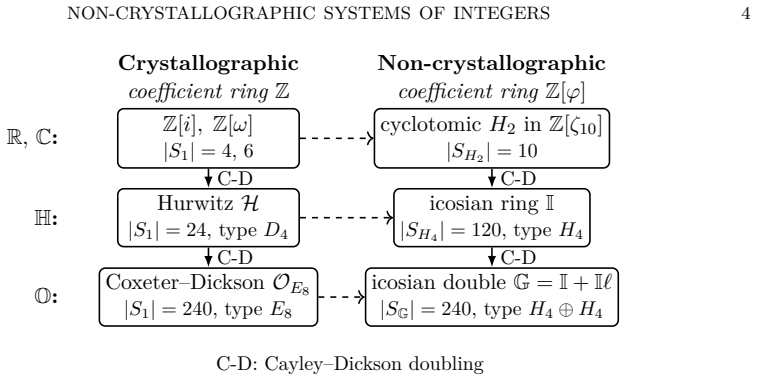
A weak golden octonion order arises from Cayley-Dickson doubling of the icosian ring, carrying a 240-element H4⊕H4 shell and remaining self-dual under the polar norm.
A machine-rendered reading of the paper's core claim, the machinery that carries it, and where it could break.
Core claim
We construct a weak golden octonion order by Cayley-Dickson doubling of the icosian ring; the resulting free rank-8 Zφ-order has a 240-element finite shell of type H4⊕H4 and its multiplication is genuinely octonionic. We prove (i) that this weak double is self-dual with respect to the polar norm pairing, hence has no strict norm-integral overorder, and (ii) that the first trace-integral discriminant tower over it contains no octonion-stable nonzero isotropic gluing.
What carries the argument
The weak golden octonion order obtained by Cayley-Dickson doubling of the icosian ring, which supplies the finite H4⊕H4 root shell and carries the self-dual polar-norm structure.
If this is right
- The golden ring Zφ becomes the natural coefficient ring for non-crystallographic H2 and H4 systems once the lattice requirement is replaced by a finite root-shell requirement.
- The constructed order admits no strict norm-integral overorder because it is already self-dual under the polar norm pairing.
- The first trace-integral discriminant tower over the order contains no octonion-stable nonzero isotropic gluing.
- Classical crystallographic examples are recovered uniformly by separating the order, its units and its distinguished finite shells.
Where Pith is reading between the lines
- Such orders may supply algebraic models for octonionic symmetries in aperiodic structures such as quasicrystals.
- The self-duality property could extend to other Cayley-Dickson constructions over non-crystallographic rings and yield a lattice of maximal orders.
- Explicit basis calculations on the doubled order may produce new multiplication identities or norm formulas specific to golden-integer octonions.
Load-bearing premise
Cayley-Dickson doubling of the icosian ring preserves genuinely octonionic multiplication while producing exactly the claimed 240-element H4⊕H4 shell and satisfying self-duality and the absence of isotropic gluings without further hidden constraints.
What would settle it
Explicit computation of the multiplication table on the eight basis elements of the doubled order, followed by verification that the 240 shell vectors satisfy the H4⊕H4 Cartan relations with coefficients in Zφ and that the first trace-integral discriminant contains no octonion-stable isotropic gluing.
Figures


read the original abstract
In this work we revisit classical systems of integers inside the real normed division algebras from the point of view of finite norm shells and root systems. Building on the icosian framework of Moody--Patera and on the integral root-system viewpoint of Chen--Moody--Patera and of Johnson, we isolate the precise axiomatic ingredients of the non-crystallographic analogue: an order over the golden ring \(\Zphi\) together with a distinguished finite root shell whose Cartan coefficients lie in \(\Zphi\). We show that the usual Gaussian, Eisenstein, Hamilton, Hurwitz and Coxeter--Dickson examples are recovered by separating the order, its units, and its distinguished finite shells; once the lattice requirement is replaced by a finite root-shell requirement, the golden integer ring becomes the natural coefficient ring for the non-crystallographic cases \(H_2\) and \(H_4\). We then construct a weak golden octonion order by Cayley--Dickson doubling of the icosian ring; the resulting free rank-\(8\) \(\Zphi\)-order has a \(240\)-element finite shell of type \(H_4\oplus H_4\) and its multiplication is genuinely octonionic. Finally, we prove (i) that this weak double is self-dual with respect to the polar norm pairing, hence has no strict norm-integral overorder, and (ii) that the first trace-integral discriminant tower over it contains no octonion-stable nonzero isotropic gluing.
Editorial analysis
A structured set of objections, weighed in public.
Referee Report
Summary. The manuscript revisits integer systems in real normed division algebras via finite norm shells and root systems over the golden ring Z[φ]. It recovers classical Gaussian, Eisenstein, Hamilton, Hurwitz and Coxeter-Dickson examples by separating orders, units and shells, then constructs a weak golden octonion order by Cayley-Dickson doubling of the icosian ring. The resulting free rank-8 Z[φ]-order is asserted to possess a 240-element finite shell of type H4⊕H4 with genuinely octonionic multiplication. Two proofs are given: (i) self-duality with respect to the polar norm pairing (hence no strict norm-integral overorder), and (ii) absence of octonion-stable nonzero isotropic gluings in the first trace-integral discriminant tower.
Significance. If the central construction and proofs hold, the work supplies a new maximal example of a non-crystallographic integral structure in the octonions, extending the H4 framework of Moody-Patera and Chen-Moody-Patera to rank 8. The separation of order, units and root shell, together with the explicit doubling construction and the two targeted proofs, would strengthen the axiomatic treatment of non-crystallographic systems and could inform further study of root systems and orders in composition algebras.
major comments (2)
- [Main construction (Cayley-Dickson doubling of the icosian ring)] Construction via Cayley-Dickson doubling: the manuscript asserts that doubling the icosian ring yields a free rank-8 Z[φ]-order whose distinguished shell consists of precisely 240 elements of type H4⊕H4 and whose multiplication satisfies the octonion composition law while remaining non-associative. Explicit verification that the doubling map sends the proposed shell into itself (up to the order) and preserves exact cardinality and non-associativity is required; without it, both self-duality and the discriminant-tower claim rest on an unverified generative step.
- [Proof of self-duality with respect to the polar norm pairing] Proof of self-duality (i): the polar norm pairing must be shown to make the order equal to its dual, with an explicit computation confirming that no strict norm-integral overorder exists. The argument should include the precise definition of the polar form and the verification that the dual coincides with the order itself.
minor comments (2)
- [Notation and terminology] Notation: the golden ring is written Zphi in the abstract; adopt a consistent LaTeX form such as ℤ[φ] or ℤ_φ throughout the text and in all statements.
- [Introduction and background] References: ensure that the citations to Moody-Patera, Chen-Moody-Patera and Johnson are placed at the first appearance of the relevant root-system or icosian constructions rather than only in the introduction.
Simulated Author's Rebuttal
We thank the referee for the careful reading and for identifying points where additional explicit verification would strengthen the presentation. We address each major comment below and will revise the manuscript accordingly.
read point-by-point responses
-
Referee: Construction via Cayley-Dickson doubling: the manuscript asserts that doubling the icosian ring yields a free rank-8 Z[φ]-order whose distinguished shell consists of precisely 240 elements of type H4⊕H4 and whose multiplication satisfies the octonion composition law while remaining non-associative. Explicit verification that the doubling map sends the proposed shell into itself (up to the order) and preserves exact cardinality and non-associativity is required; without it, both self-duality and the discriminant-tower claim rest on an unverified generative step.
Authors: We agree that the doubling construction benefits from a fully explicit verification step. In the revised manuscript we will insert a dedicated subsection that computes the image of the icosian 120-element shell under the Cayley-Dickson doubling map, confirms that the resulting set lies inside the proposed rank-8 order, verifies that the cardinality remains exactly 240, and checks that the multiplication remains non-associative while satisfying the octonion norm identity. This computation will be placed immediately after the definition of the doubling and before the self-duality argument, thereby removing any ambiguity in the generative step. revision: yes
-
Referee: Proof of self-duality (i): the polar norm pairing must be shown to make the order equal to its dual, with an explicit computation confirming that no strict norm-integral overorder exists. The argument should include the precise definition of the polar form and the verification that the dual coincides with the order itself.
Authors: We will expand the self-duality proof to begin with the precise definition of the polar norm pairing on the rank-8 order (the standard bilinear form induced by the octonion norm, restricted to the Z[φ]-module). We will then give an explicit basis computation showing that the dual module with respect to this pairing is identical to the order itself, and we will verify that no strictly larger norm-integral overorder exists by checking that any element satisfying the integrality condition with respect to the polar form already lies in the order. These explicit matrix calculations will be added to the revised text. revision: yes
Circularity Check
No circularity detected; new construction with independent proofs
full rationale
The paper's central derivation consists of an explicit new construction of the weak golden octonion order obtained by Cayley-Dickson doubling of the icosian ring, followed by direct proofs that the resulting rank-8 Z[φ]-order is self-dual under the polar norm pairing and that its first trace-integral discriminant tower contains no octonion-stable nonzero isotropic gluing. These steps are presented as fresh applications of the doubling formula to a cited external object (the icosian ring from Moody-Patera), with the shell cardinality, root-system type, and multiplication properties asserted to follow from the construction itself rather than from any fitted parameter, self-definition, or load-bearing self-citation chain. No equation or claim in the provided text reduces the target results to the inputs by construction, so the derivation remains self-contained.
Axiom & Free-Parameter Ledger
axioms (2)
- standard math Standard axioms of real normed division algebras and the Cayley-Dickson doubling construction
- domain assumption Existence and root-shell properties of the icosian ring over Z[φ]
invented entities (1)
-
weak golden octonion order
no independent evidence
Lean theorems connected to this paper
-
IndisputableMonolith/Constants.leanphi_golden_ratio echoes?
echoesECHOES: this paper passage has the same mathematical shape or conceptual pattern as the Recognition theorem, but is not a direct formal dependency.
We then construct a weak golden octonion order by Cayley–Dickson doubling of the icosian ring; the resulting free rank-8 Z[φ]-order has a 240-element finite shell of type H4⊕H4
-
IndisputableMonolith/Cost/FunctionalEquation.leanwashburn_uniqueness_aczel echoes?
echoesECHOES: this paper passage has the same mathematical shape or conceptual pattern as the Recognition theorem, but is not a direct formal dependency.
the icosian double G0 = I + Iℓ ... G#0 = G0 ... first trace-integral discriminant tower ... no octonion-stable nonzero isotropic gluing
-
IndisputableMonolith/Foundation/AlexanderDuality.leanalexander_duality_circle_linking echoes?
echoesECHOES: this paper passage has the same mathematical shape or conceptual pattern as the Recognition theorem, but is not a direct formal dependency.
H4 ... 120 roots ... SG = (SH4 ⊕ 0) ∪ (0 ⊕ SH4 ℓ) ... 240 elements
What do these tags mean?
- matches
- The paper's claim is directly supported by a theorem in the formal canon.
- supports
- The theorem supports part of the paper's argument, but the paper may add assumptions or extra steps.
- extends
- The paper goes beyond the formal theorem; the theorem is a base layer rather than the whole result.
- uses
- The paper appears to rely on the theorem as machinery.
- contradicts
- The paper's claim conflicts with a theorem or certificate in the canon.
- unclear
- Pith found a possible connection, but the passage is too broad, indirect, or ambiguous to say the theorem truly supports the claim.
Forward citations
Cited by 1 Pith paper
-
Integral Planes and Unit-Norm Polytopes
Defines integral planes O² with norm sum quadratic form over crystallographic and non-crystallographic orders, recovers root systems including E8⊕E8 and H4⊕H4, proves no indecomposable rank-8 golden octonion order exi...
Reference graph
Works this paper leans on
-
[1]
A Guide to Mathematical Quasicrystals
M. Baake, A guide to mathematical quasicrystals, in Quasicrystals, eds. J. B. Luck, M. Schreiber, P. Haussler, Springer, 1998
work page 1998
-
[2]
M. Baake and U. Grimm, Aperiodic Order, Cambridge University Press, 2013
work page 2013
-
[3]
L. Chen, R. V. Moody and J. Patera, Non-crystallographic root systems, Fields Institute Monographs, Volume 10, 1998, 135--178
work page 1998
-
[4]
J. H. Conway and N. J. A. Sloane, Sphere Packings, Lattices and Groups, Springer, 1999
work page 1999
-
[5]
J. H. Conway and D. A. Smith, On Quaternions and Octonions, A K Peters/CRC Press, 2003
work page 2003
-
[6]
Three Fibonacci-chain aperiodic algebras
D. Corradetti, D. Chester, R. Aschheim and K. Irwin, Three Fibonacci-chain aperiodic algebras, Quaest. Math. 46 (2023), 1--13
work page 2023
-
[7]
D. Corradetti, D. Chester, R. Aschheim and K. Irwin, Jordan algebras over icosahedral cut-and-project quasicrystals, arXiv:2303.12219, 2023
-
[8]
D. Corradetti, D. Chester, R. Aschheim and K. Irwin, An aperiodic Jordan algebra over a Penrose tiling, arXiv, 2023
work page 2023
-
[9]
H. S. M. Coxeter, Discrete groups generated by reflections, Annals of Mathematics 35 (1934), 588--621
work page 1934
-
[10]
H. S. M. Coxeter, Integral Cayley numbers, Duke Mathematical Journal 13 (1946), 561--578
work page 1946
-
[11]
N. G. de Bruijn, Algebraic theory of Penrose's non-periodic tilings, Nederl. Akad. Wetensch. Proc. Ser. A 84 (1981), 39--52
work page 1981
-
[12]
L. E. Dickson, Algebras and Their Arithmetics, University of Chicago Press, 1923
work page 1923
-
[13]
C. F. Gauss, Theoria residuorum biquadraticorum. Commentatio secunda, Comment. Soc. Reg. Sci. Gottingen 7 (1831), 89--148
-
[14]
A. Hurwitz, Vorlesungen uber die Zahlentheorie der Quaternionen, Springer, 1919
work page 1919
-
[15]
J. E. Humphreys, Reflection Groups and Coxeter Groups, Cambridge University Press, 1990
work page 1990
-
[16]
N. W. Johnson, Integers, The Mathematical Intelligencer 35, no. 2 (2013), 52--60
work page 2013
-
[17]
N. W. Johnson, Geometries and Transformations, Cambridge University Press, 2017
work page 2017
-
[18]
N. W. Johnson, Integers, modular groups, and hyperbolic space, in Discrete Geometry and Symmetry, Springer Proceedings in Mathematics and Statistics 234, Springer, 2018
work page 2018
-
[19]
R. V. Moody and J. Patera, Quasicrystals and icosians, Journal of Physics A: Mathematical and General 26 (1993), 2829--2853
work page 1993
-
[20]
R. Penrose, The role of aesthetics in pure and applied mathematical research, Bulletin of the Institute of Mathematics and Its Applications 10 (1974), 266--271
work page 1974
-
[21]
Tilings and Quasi-Crystals; a Non-Local Growth Problem?
R. Penrose, Tilings and quasi-crystals: a non-local growth problem?, in Introduction to the Mathematics of Quasicrystals, Academic Press, 1989
work page 1989
- [22]
-
[23]
Quaternions over Q(√5), Leech's lattice and the sporadic group of Hall-Janko
J. Tits, Quaternions over \( ( 5)\), Leech's lattice and the sporadic group of Hall-Janko, Journal of Algebra 63 (1980), 56--75
work page 1980
-
[24]
R. A. Wilson, The geometry of the Hall-Janko group as a quaternionic reflection group, Geometriae Dedicata 20 (1986), 157--173
work page 1986
discussion (0)
Sign in with ORCID, Apple, or X to comment. Anyone can read and Pith papers without signing in.