Energy and momentum dependence of the soft-axion interaction rate
Pith reviewed 2026-05-16 15:29 UTC · model grok-4.3
The pith
Ultrasoft axion rates lift Delta N_eff from 0.03 to 0.04
A machine-rendered reading of the paper's core claim, the machinery that carries it, and where it could break.
Core claim
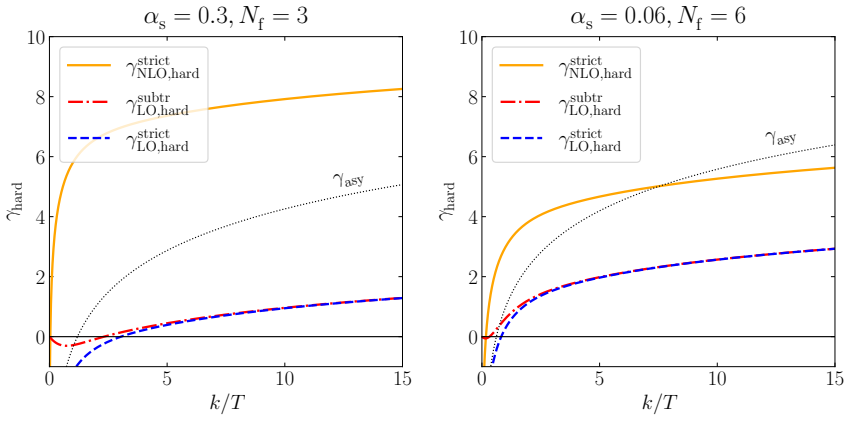
Focussing on soft energies (alpha_s T << omega << pi T), an HTL computation shows how the domains k=0 and k approx omega interpolate to each other for the soft-axion interaction rate. Comparing with lattice data at k=0 and connecting to NLO at higher k, assembling the best input shows that efficient ultrasoft interactions increase Delta N_eff from ~0.03 to ~0.04 at fa = 4*10^8 GeV for light QCD axion decoupling at T >= 200 MeV.
What carries the argument
The HTL-resummed soft-axion interaction rate that depends separately on energy omega and momentum k, interpolating between k=0 and light-like k approx omega.
Load-bearing premise
The hard thermal loop approximation remains valid in the ultrasoft domain without large higher-order corrections, and lattice results at zero momentum can be matched directly to the perturbative calculation.
What would settle it
A higher-order perturbative calculation or lattice measurement of the axion-gauge-field rate at small nonzero momentum that deviates enough to change the final Delta N_eff by more than 0.01 would falsify the reported shift.
Figures


read the original abstract
Axions coupled to thermal non-Abelian gauge fields may have cosmological significance. As the heat bath defines a frame, its influence depends separately on energy and momentum. A light-like momentum ($k \approx \omega$) is relevant for the axion contribution to the effective number of light neutrinos, $\Delta N^{ }_\mathrm{eff}$, whereas a vanishing momentum ($k=0$) plays a role for warm natural inflation or ultralight dark matter, and has been employed in lattice estimates (both classical and quantum-statistical) of the strong sphaleron rate. Focussing on soft energies ($\alpha_\mathrm{s}^{ }T \ll \omega \ll \pi T$), we carry out an HTL computation to show how the domains $k=0$ and $k \approx \omega$ interpolate to each other. We then compare with lattice data at $k=0$, and connect our analysis to NLO computations at $k \approx \omega \ge \pi T$. Assembling the current best input, we re-investigate light QCD axion decoupling dynamics at $T \ge 200$ MeV, showing that efficient interactions in the ultrasoft domain increase $\Delta N^{ }_\mathrm{eff}$ from $\sim 0.03$ to $\sim 0.04$ at $f^{ }_a = 4\times 10^8_{ }$ GeV.
Editorial analysis
A structured set of objections, weighed in public.
Referee Report
Summary. The paper carries out an HTL computation of the soft-axion interaction rate with non-Abelian gauge fields in the regime α_s T ≪ ω ≪ π T, demonstrates the interpolation between the k=0 domain (relevant to lattice sphaleron rates) and the k≈ω domain (relevant to ΔN_eff), compares the result to existing lattice data at k=0, and assembles current best inputs to update light-QCD-axion decoupling, finding that ultrasoft interactions raise ΔN_eff from ∼0.03 to ∼0.04 at f_a=4×10^8 GeV.
Significance. If the HTL rate and its lattice matching hold, the work supplies a refined, momentum-dependent input for axion decoupling at T≳200 MeV that modestly strengthens the predicted contribution to ΔN_eff; this is directly relevant to cosmological bounds on the QCD axion and to the interpretation of future CMB measurements of N_eff.
major comments (2)
- [HTL computation and ultrasoft domain] The central claim that the HTL rate in the ultrasoft window α_s T ≪ ω ≪ π T is sufficiently accurate to produce a reliable 0.01 shift in ΔN_eff rests on an unquantified assumption that NLO corrections remain small; no explicit error estimate or higher-order calculation is supplied to support this, and a 20–30 % correction to the rate would erase the reported increment (see the interpolation and decoupling-dynamics sections).
- [Lattice comparison and interpolation] The direct matching of the perturbative HTL result to lattice sphaleron-rate data at k=0, followed by interpolation to k≈ω, does not include a controlled assessment of lattice artifacts (finite-volume, spacing, or non-perturbative contamination) or a quantified matching uncertainty; this matching is load-bearing for the final ΔN_eff value.
minor comments (2)
- [Abstract] The abstract quotes ΔN_eff ∼0.03 to ∼0.04 without accompanying uncertainties or the temperature range over which the shift is evaluated; adding these would clarify the robustness of the result.
- [Introduction and notation] Notation for the soft scale (α_s T) versus the hard scale (π T) should be introduced once with explicit definitions before being used repeatedly in the rate expressions.
Simulated Author's Rebuttal
We thank the referee for the careful reading and constructive comments on our manuscript. The points raised regarding the reliability of the HTL approximation and the lattice matching procedure are important, and we address them point by point below. We outline revisions that will strengthen the presentation of uncertainties while preserving the core results on the momentum-dependent rate and its implications for ΔN_eff.
read point-by-point responses
-
Referee: The central claim that the HTL rate in the ultrasoft window α_s T ≪ ω ≪ π T is sufficiently accurate to produce a reliable 0.01 shift in ΔN_eff rests on an unquantified assumption that NLO corrections remain small; no explicit error estimate or higher-order calculation is supplied to support this, and a 20–30 % correction to the rate would erase the reported increment (see the interpolation and decoupling-dynamics sections).
Authors: We agree that a dedicated NLO calculation in the ultrasoft regime would be the ideal way to quantify corrections. The present work focuses on the leading HTL resummation, which systematically captures the dominant infrared physics in this window. Existing NLO results for related quantities (such as gluon damping rates at slightly higher momenta) suggest corrections of order 10-20%. In the revised manuscript we will add a dedicated paragraph in the discussion section that reviews these analogies, provides a conservative 25% uncertainty band on the ultrasoft rate, and shows the resulting range for ΔN_eff (still an increase of at least 0.005 relative to the previous estimate). We will also stress that the primary advance is the controlled interpolation between the k=0 and k≈ω limits rather than the precise numerical shift. revision: partial
-
Referee: The direct matching of the perturbative HTL result to lattice sphaleron-rate data at k=0, followed by interpolation to k≈ω, does not include a controlled assessment of lattice artifacts (finite-volume, spacing, or non-perturbative contamination) or a quantified matching uncertainty; this matching is load-bearing for the final ΔN_eff value.
Authors: We acknowledge that the matching procedure relies on published lattice results without an independent re-analysis of their systematics. In the revision we will expand the relevant section to summarize the lattice papers' own assessments of finite-volume, spacing, and non-perturbative effects, quoting their quoted uncertainties. We will also add a sensitivity analysis that varies the matching scale within those reported errors, recomputes the interpolated rate, and propagates the variation into the final ΔN_eff value, thereby providing a quantified matching uncertainty. revision: yes
Circularity Check
No significant circularity; HTL rate computation and lattice/NLO assembly are independent
full rationale
The paper's core derivation is an explicit HTL computation of the axion interaction rate across momentum domains (k=0 to k≈ω), followed by direct comparison to external lattice data at k=0 and connection to separate NLO results at higher scales. The final ΔN_eff update at fa=4×10^8 GeV assembles these pre-existing inputs without fitting any parameter to the target quantity, without self-definitional loops, and without load-bearing self-citations that reduce the claim to its own assumptions. No step renames a known result or imports uniqueness via author-overlapping citations; the chain remains a forward calculation against external benchmarks.
Axiom & Free-Parameter Ledger
axioms (1)
- domain assumption Hard thermal loop approximation is valid for α_s T ≪ ω ≪ π T
Forward citations
Cited by 1 Pith paper
-
Topological Susceptibility and QCD at Finite Theta Angle
A pedagogical review summarizing analytic predictions and recent lattice results for theta-dependence and topological susceptibility in QCD.
Reference graph
Works this paper leans on
-
[1]
R.D. Peccei and H.R. Quinn,CP Conservation in the Presence of Pseudoparticles,Phys. Rev. Lett. 38 (1977) 1440
work page 1977
-
[2]
Weinberg,A New Light Boson?,Phys
S. Weinberg,A New Light Boson?,Phys. Rev. Lett. 40 (1978) 223
work page 1978
-
[3]
Wilczek,Problem of StrongPandTInvariance in the Presence of Instantons,Phys
F. Wilczek,Problem of StrongPandTInvariance in the Presence of Instantons,Phys. Rev. Lett. 40 (1978) 279
work page 1978
-
[4]
J. Preskill, M.B. Wise and F. Wilczek,Cosmology of the invisible axion,Phys. Lett. B 120 (1983) 127
work page 1983
-
[5]
L.F. Abbott and P. Sikivie,A cosmological bound on the invisible axion,Phys. Lett. B 120 (1983) 133
work page 1983
-
[6]
M. Dine and W. Fischler,The not-so-harmless axion,Phys. Lett. B 120 (1983) 137
work page 1983
-
[7]
K. Freese, J.A. Frieman and A.V. Olinto,Natural inflation with pseudo Nambu-Goldstone bosons, Phys. Rev. Lett. 65 (1990) 3233
work page 1990
-
[8]
M.S. Turner and F. Wilczek,Inflationary axion cosmology,Phys. Rev. Lett. 66 (1991) 5
work page 1991
-
[9]
Irastorza,An introduction to axions and their detection,SciPost Phys
I.G. Irastorza,An introduction to axions and their detection,SciPost Phys. Lect. Notes 45 (2022) 1 [2109.07376]
-
[10]
Bediet al.,Heavy QCD Axions at High-Energy Muon Colliders,[2509.10605]
R. Bediet al.,Heavy QCD Axions at High-Energy Muon Colliders,[2509.10605]
- [11]
- [12]
-
[13]
E. Broadberry, A. Hook and S. Mondal,Warm Inflation with Pseudo-scalar couplings, [2505.07943]
work page internal anchor Pith review arXiv
-
[14]
F. D’Eramo, F. Hajkarim and S. Yun,Thermal Axion Production at Low Temperatures: A Smooth Treatment of the QCD Phase Transition,Phys. Rev. Lett. 128 (2022) 152001 [2108.04259]
- [15]
-
[16]
Di Luzioet al.,Axion-pion thermalization rate in unitarized NLO chiral perturbation theory, Phys
L. Di Luzioet al.,Axion-pion thermalization rate in unitarized NLO chiral perturbation theory, Phys. Rev. D 108 (2023) 035025 [2211.05073]
-
[17]
Equilibration, particle production, and self-energy
D. B¨ odeker, M. Sangel and M. W¨ ormann,Equilibration, particle production, and self-energy, Phys. Rev. D 93 (2016) 045028 [1510.06742]
work page internal anchor Pith review Pith/arXiv arXiv 2016
-
[18]
J.N. Benabou, M. Buschmann, J.W. Foster and B.R. Safdi,Axion Mass Prediction from Adap- tive Mesh Refinement Cosmological Lattice Simulations,Phys. Rev. Lett. 134 (2025) 241003 [2412.08699]
-
[19]
Correiaet al.,The spectrum of axions in a scaling string network,[2512.13653]
J. Correiaet al.,The spectrum of axions in a scaling string network,[2512.13653]. 42
-
[20]
S. Hassan, G.R. Kane, J. March-Russell and G. Obied,Chern-Simons induced thermal friction on axion domain walls,JHEP 03 (2025) 022 [2410.19906]
-
[21]
A. Albrecht, P.J. Steinhardt, M.S. Turner and F. Wilczek,Reheating an Inflationary Universe, Phys. Rev. Lett. 48 (1982) 1437
work page 1982
-
[22]
L. McLerran, E. Mottola and M.E. Shaposhnikov,Sphalerons and axion dynamics in high- temperature QCD,Phys. Rev. D 43 (1991) 2027
work page 1991
-
[23]
M. Laine and S. Procacci,Minimal warm inflation with complete medium response,JCAP 06 (2021) 031 [2102.09913]
-
[24]
D. B¨ odeker and J. Nienaber,Scalar field damping at high temperatures,Phys. Rev. D 106 (2022) 056016 [2205.14166]
-
[25]
K.V. Berghaus, M. Drewes and S. Zell,Warm Inflation with the Standard Model,Phys. Rev. Lett. 135 (2025) 17 [2503.18829]
-
[26]
R.O. Ramos and G.S. Rodrigues,Viability of warm inflation with standard model interactions, Phys. Rev. D 111 (2025) 123527 [2504.20943]
- [27]
-
[28]
Next-to-leading order thermal spectral functions in the perturbative domain
M. Laine, A. Vuorinen and Y. Zhu,Next-to-leading order thermal spectral functions in the per- turbative domain,JHEP 09 (2011) 084 [1108.1259]
work page internal anchor Pith review Pith/arXiv arXiv 2011
- [29]
-
[30]
The Sphaleron Rate in SU(N) Gauge Theory
G.D. Moore and M. Tassler,The sphaleron rate in SU(N) gauge theory,JHEP 02 (2011) 105 [1011.1167]
work page internal anchor Pith review Pith/arXiv arXiv 2011
-
[31]
Altenkortet al.,Sphaleron rate from Euclidean lattice correlators: An exploration,Phys
L. Altenkortet al.,Sphaleron rate from Euclidean lattice correlators: An exploration,Phys. Rev. D 103 (2021) 114513 [2012.08279]
-
[32]
M. Barroso Mancha and G.D. Moore,The sphaleron rate from 4D Euclidean lattices,JHEP 01 (2023) 155 [2210.05507]
-
[33]
Bonannoet al.,Sphaleron Rate ofN f = 2 + 1QCD,Phys
C. Bonannoet al.,Sphaleron Rate ofN f = 2 + 1QCD,Phys. Rev. Lett. 132 (2024) 051903 [2308.01287]
-
[34]
E. Braaten and T.C. Yuan,Calculation of screening in a hot plasma,Phys. Rev. Lett. 66 (1991) 2183
work page 1991
-
[35]
On Axion Thermalization in the Early Universe
E. Masso, F. Rota and G. Zsembinszki,On axion thermalization in the early universe,Phys. Rev. D 66 (2002) 023004 [hep-ph/0203221]
work page internal anchor Pith review Pith/arXiv arXiv 2002
-
[36]
Thermal axion production in the primordial quark-gluon plasma
P. Graf and F.D. Steffen,Thermal axion production in the primordial quark-gluon plasma,Phys. Rev. D 83 (2011) 075011 [1008.4528]
work page internal anchor Pith review Pith/arXiv arXiv 2011
-
[37]
A. Salvio, A. Strumia and W. Xue,Thermal axion production,JCAP 01 (2014) 011 [1310.6982]. 43
work page internal anchor Pith review Pith/arXiv arXiv 2014
-
[38]
F. D’Eramo, F. Hajkarim and S. Yun,Thermal QCD Axions across Thresholds,JHEP 10 (2021) 224 [2108.05371]
-
[39]
K. Bouzoud and J. Ghiglieri,Thermal axion production at hard and soft momenta,JHEP 01 (2025) 163 [2404.06113]
- [40]
-
[41]
Pisarski,Scattering amplitudes in hot gauge theories,Phys
R.D. Pisarski,Scattering amplitudes in hot gauge theories,Phys. Rev. Lett. 63 (1989) 1129
work page 1989
-
[42]
J. Frenkel and J.C. Taylor,High-temperature limit of thermal QCD,Nucl. Phys. B 334 (1990) 199
work page 1990
-
[43]
E. Braaten and R.D. Pisarski,Soft amplitudes in hot gauge theories: A general analysis,Nucl. Phys. B 337 (1990) 569
work page 1990
-
[44]
J.C. Taylor and S.M.H. Wong,The effective action of hard thermal loops in QCD,Nucl. Phys. B 346 (1990) 115
work page 1990
-
[45]
Hard thermal loops in the real-time formalism
S. Caron-Huot,Hard thermal loops in the real-time formalism,JHEP 04 (2009) 004 [0710.5726]
work page internal anchor Pith review Pith/arXiv arXiv 2009
-
[46]
O(g) plasma effects in jet quenching
S. Caron-Huot,O(g) plasma effects in jet quenching,Phys. Rev. D 79 (2009) 065039 [0811.1603]
work page internal anchor Pith review Pith/arXiv arXiv 2009
-
[47]
Next-to-leading order thermal photon production in a weakly coupled quark-gluon plasma
J. Ghiglieriet al.,Next-to-leading order thermal photon production in a weakly coupled quark- gluon plasma,JHEP 05 (2013) 010 [1302.5970]
work page internal anchor Pith review Pith/arXiv arXiv 2013
-
[48]
Jet-Medium Interactions at NLO in a Weakly-Coupled Quark-Gluon Plasma
J. Ghiglieri, G.D. Moore and D. Teaney,Jet-medium interactions at NLO in a weakly-coupled quark-gluon plasma,JHEP 03 (2016) 095 [1509.07773]
work page internal anchor Pith review Pith/arXiv arXiv 2016
-
[49]
A simple sum rule for the thermal gluon spectral function and applications
P. Aurenche, F. Gelis and H. Zaraket,A Simple sum rule for the thermal gluon spectral function and applications,JHEP 05 (2002) 043 [hep-ph/0204146]
work page internal anchor Pith review Pith/arXiv arXiv 2002
-
[50]
Thermal production of ultrarelativistic right-handed neutrinos: Complete leading-order results
D. Besak and D. B¨ odeker,Thermal production of ultrarelativistic right-handed neutrinos: com- plete leading-order results,JCAP 03 (2012) 029 [1202.1288]
work page internal anchor Pith review Pith/arXiv arXiv 2012
-
[51]
Linde,Infrared problem in thermodynamics of the Yang-Mills gas,Phys
A.D. Linde,Infrared problem in thermodynamics of the Yang-Mills gas,Phys. Lett. B 96 (1980) 289
work page 1980
- [52]
-
[53]
Hot B violation, the lattice, and hard thermal loops
P.B. Arnold,Hot B violation, the lattice, and hard thermal loops,Phys. Rev. D 55 (1997) 7781 [hep-ph/9701393]
work page internal anchor Pith review Pith/arXiv arXiv 1997
-
[54]
Effective dynamics of soft non-abelian gauge fields at finite temperature
D. B¨ odeker,Effective dynamics of soft non-Abelian gauge fields at finite temperature,Phys. Lett. B 426 (1998) 351 [hep-ph/9801430]
work page internal anchor Pith review Pith/arXiv arXiv 1998
-
[55]
Minkowski-space correlators in AdS/CFT correspondence: recipe and applications
D.T. Son and A.O. Starinets,Minkowski-space correlators in AdS/CFT correspondence: recipe and applications,JHEP 09 (2002) 042 [hep-th/0205051]
work page internal anchor Pith review Pith/arXiv arXiv 2002
-
[56]
M. Escudero, G. Jackson, M. Laine and S. Sandner,Fast and Flexible Neutrino Decoupling Part I: The Standard Model,[2511.04747]. 44
- [57]
-
[58]
Improved axion emissivity from a supernova via nucleon-nucleon bremsstrahlung,
P. Carenzaet al.,Improved axion emissivity from a supernova via nucleon-nucleon bremsstrahlung,JCAP 10 (2019) 016;ibid.05 (2020) E01 (erratum) [1906.11844]
-
[59]
Lattice constraints on the thermal photon rate
J. Ghiglieri, O. Kaczmarek, M. Laine and F. Meyer,Lattice constraints on the thermal photon rate,Phys. Rev. D 94 (2016) 016005 [1604.07544]
work page internal anchor Pith review Pith/arXiv arXiv 2016
-
[60]
Aliet al.[HotQCD],Lattice QCD estimates of thermal photon production from the QGP,Phys
S. Aliet al.[HotQCD],Lattice QCD estimates of thermal photon production from the QGP,Phys. Rev. D 110 (2024) 054518 [2403.11647]
-
[61]
M. C` eet al.,Probing the photon emissivity of the quark-gluon plasma without an inverse problem in lattice QCD,Phys. Rev. D 109 (2024) 014507 [2309.09884]
-
[62]
M. Drewes and S. Zell,On sphaleron heating in the presence of fermions,JCAP 06 (2024) 038 [2312.13739]
-
[63]
Adler,Axial-Vector Vertex in Spinor Electrodynamics,Phys
S.L. Adler,Axial-Vector Vertex in Spinor Electrodynamics,Phys. Rev. 177 (1969) 2426
work page 1969
-
[64]
J.S. Bell and R. Jackiw,A PCAC puzzle:π 0 →γγin theσ-model,Nuovo Cim. A 60 (1969) 47
work page 1969
-
[65]
Kubo relations and radiative corrections for lepton number washout
D. B¨ odeker and M. Laine,Kubo relations and radiative corrections for lepton number washout, JCAP 05 (2014) 041 [1403.2755]
work page internal anchor Pith review Pith/arXiv arXiv 2014
-
[66]
S.Y. Khlebnikov and M.E. Shaposhnikov,The statistical theory of anomalous fermion number non-conservation,Nucl. Phys. B 308 (1988) 885
work page 1988
-
[67]
Equilibration of right-handed electrons
D. B¨ odeker and D. Schr¨ oder,Equilibration of right-handed electrons,JCAP 05 (2019) 010 [1902.07220]
work page internal anchor Pith review Pith/arXiv arXiv 2019
-
[68]
Landau-Pomeranchuk-Migdal effect in thermal field theory
P. Aurenche, F. Gelis and H. Zaraket,Landau-Pomeranchuk-Migdal effect in thermal field theory, Phys. Rev. D 62 (2000) 096012 [hep-ph/0003326]
work page internal anchor Pith review Pith/arXiv arXiv 2000
-
[69]
Photon Emission from Ultrarelativistic Plasmas
P.B. Arnold, G.D. Moore and L.G. Yaffe,Photon emission from ultrarelativistic plasmas,JHEP 11 (2001) 057 [hep-ph/0109064]
work page internal anchor Pith review Pith/arXiv arXiv 2001
-
[70]
A. Anisimov, D. Besak and D. B¨ odeker,Thermal production of relativistic Majorana neutrinos: Strong enhancement by multiple soft scattering,JCAP 03 (2011) 042 [1012.3784]
work page internal anchor Pith review Pith/arXiv arXiv 2011
-
[71]
NLO thermal dilepton rate at non-zero momentum
M. Laine,NLO thermal dilepton rate at non-zero momentum,JHEP 11 (2013) 120 [1310.0164]
work page internal anchor Pith review Pith/arXiv arXiv 2013
-
[72]
Jackson,Two-loop thermal spectral functions with general kinematics,Phys
G. Jackson,Two-loop thermal spectral functions with general kinematics,Phys. Rev. D 100 (2019) 116019 [1910.07552]
-
[73]
High-energy jet quenching in weakly-coupled quark-gluon plasmas
P.B. Arnold and W. Xiao,High-energy jet quenching in weakly-coupled quark-gluon plasmas, Phys. Rev. D 78 (2008) 125008 [0810.1026]
work page internal anchor Pith review Pith/arXiv arXiv 2008
-
[74]
J. Ghiglieri and M. Laine,Smooth interpolation between thermal Born and LPM rates,JHEP 01 (2022) 173 [2110.07149]
-
[75]
J. Ghiglieri, G. Jackson, M. Laine and Y. Zhu,Gravitational wave background from Standard Model physics: complete leading order,JHEP 07 (2020) 092 [2004.11392]. 45
discussion (0)
Sign in with ORCID, Apple, or X to comment. Anyone can read and Pith papers without signing in.