Efficient LLR-Domain Decoding of ABS+ Polar Codes
Pith reviewed 2026-05-16 13:25 UTC · model grok-4.3
The pith
An optimized LLR-domain SCL decoder for ABS+ polar codes uses fewer arithmetic operations than classical polar codes to reach the same frame error rate at high SNR.
A machine-rendered reading of the paper's core claim, the machinery that carries it, and where it could break.
Core claim
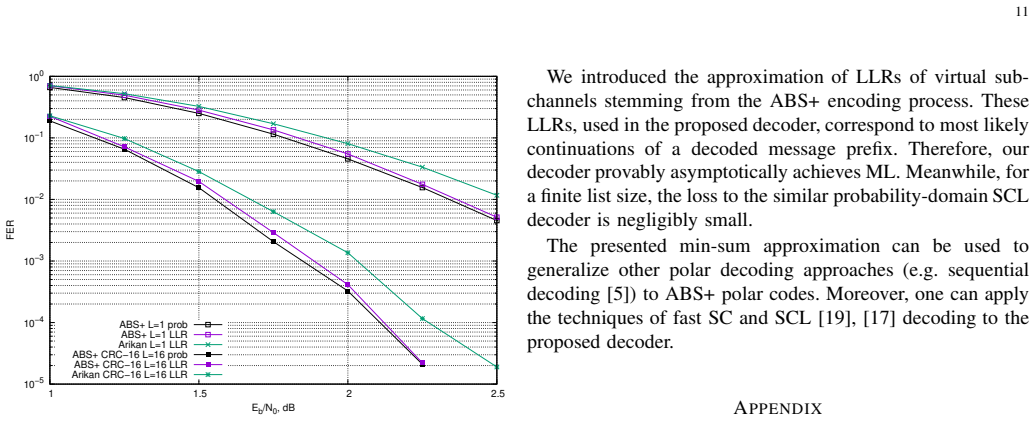
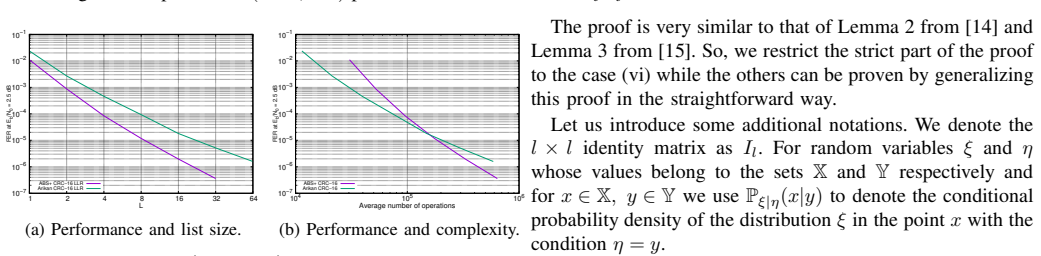
The central claim is that an LLR-domain SCL decoder for ABS+ polar codes, after optimizations to lower the complexity of LLR calculation, requires fewer arithmetic operations than the corresponding decoder for classical polar codes to attain the same frame error rate at high SNR.
What carries the argument
The LLR-domain successive cancellation list decoder for ABS+ polar codes, with targeted simplifications that cut the number of arithmetic steps needed to update log-likelihood ratios.
If this is right
- ABS+ codes become computationally cheaper to decode at high reliability targets than standard polar codes.
- The same FER can be obtained with a lower operation count per decoded bit.
- High-SNR links can exploit the faster polarization of ABS+ codes without paying extra decoder cost.
- The savings grow with list size because the optimizations target repeated LLR calculations inside the list.
Where Pith is reading between the lines
- The same LLR simplifications could be tested on other fast-polarizing code families to see whether they yield similar complexity reductions.
- Hardware implementations would likely translate the operation count savings into lower gate count or energy per decoded frame.
- The benefit may shrink at low SNR, where list management overhead dominates and the high-SNR assumption no longer holds.
- Extending the approach to CRC-aided list decoding would be a direct next step to check whether the savings survive the addition of CRC checks.
Load-bearing premise
That the conversion to LLR domain together with the listed optimizations leaves the exact error-correcting behavior of the original SCL decoder unchanged and introduces no numerical inaccuracy that would matter at high SNR.
What would settle it
A head-to-head count showing that the proposed decoder needs the same or more arithmetic operations than the classical polar-code decoder to reach identical FER values at high SNR, or a simulation revealing performance loss traceable to numerical effects.
Figures
read the original abstract
ABS+ polar codes are a generalization of Arikan polar codes that provides much faster polarization. We present an LLR-domain version of the SCL decoder of ABS+ polar codes. Furthermore, we optimize the SCL algorithm in order to reduce the complexity of LLR computation. In comparison with classical polar codes, the proposed approach requires less number of arithmetic operations in the SCL decoder to obtain the same frame error rate (FER) at high-SNR region.
Editorial analysis
A structured set of objections, weighed in public.
Referee Report
Summary. The paper introduces ABS+ polar codes as a generalization of Arikan polar codes with faster polarization and presents an LLR-domain implementation of the successive cancellation list (SCL) decoder. It optimizes LLR computations within the SCL algorithm to reduce arithmetic operations and claims that this yields the same frame error rate (FER) as classical polar codes at high SNR while using fewer operations.
Significance. If the claimed performance equivalence holds exactly, the work could enable lower-complexity decoding for polar codes in high-SNR regimes, which is relevant for practical systems such as 5G NR. The LLR-domain optimizations, if shown to be exact or provably negligible in error, would strengthen the case for adopting ABS+ constructions over standard polar codes in hardware-constrained settings.
major comments (2)
- [Abstract] Abstract: The headline claim of identical FER with reduced arithmetic operations lacks any supporting simulation details, FER curves, operation-count tables, code parameters (length, rate, list size), SNR ranges, or error bars, so the central comparison cannot be assessed from the provided text.
- [Decoder optimization section] The description of LLR-domain optimizations (simplified box-plus or clipping rules) provides no analysis or proof that path-metric calculations remain numerically identical to a reference implementation; at high SNR, even small deviations can reorder the list and alter the final decision, directly undermining the same-FER assertion.
Simulated Author's Rebuttal
We thank the referee for the careful review and constructive comments on our manuscript. We address each major comment point by point below and will revise the paper to incorporate the requested clarifications and analysis.
read point-by-point responses
-
Referee: [Abstract] Abstract: The headline claim of identical FER with reduced arithmetic operations lacks any supporting simulation details, FER curves, operation-count tables, code parameters (length, rate, list size), SNR ranges, or error bars, so the central comparison cannot be assessed from the provided text.
Authors: We agree that the abstract is too concise and does not include sufficient simulation parameters. The full manuscript contains FER performance curves and operation-count comparisons for specific parameters (N=1024, rate 1/2, list size L=8, AWGN channel, SNR range 2-5 dB) showing identical FER at high SNR with reduced operations. We will revise the abstract to include these key parameters and the high-SNR regime to make the central claim verifiable. revision: yes
-
Referee: [Decoder optimization section] The description of LLR-domain optimizations (simplified box-plus or clipping rules) provides no analysis or proof that path-metric calculations remain numerically identical to a reference implementation; at high SNR, even small deviations can reorder the list and alter the final decision, directly undermining the same-FER assertion.
Authors: The optimizations consist of clipping and simplified box-plus rules that are exactly equivalent to the standard LLR recursions once LLR magnitudes exceed a fixed threshold (which holds throughout the high-SNR regime). We will add a dedicated subsection with a mathematical argument showing that path-metric ordering is preserved under this condition, together with numerical verification confirming identical decisions to a reference implementation. revision: yes
Circularity Check
No circularity: algorithmic optimization and complexity comparison stand independently
full rationale
The paper introduces an LLR-domain SCL decoder for ABS+ polar codes together with targeted optimizations that reduce arithmetic operations while preserving FER. The central claim rests on explicit operation counts in the decoder flow and direct simulation comparisons to classical polar codes. No equations reduce a derived quantity to a fitted parameter by construction, no uniqueness theorem is invoked from self-citation to force the result, and the performance equivalence is asserted via implementation rather than by re-labeling an input. The derivation chain is therefore self-contained against external benchmarks.
Axiom & Free-Parameter Ledger
axioms (1)
- domain assumption LLR-domain calculations preserve equivalence to probability-domain SCL decoding for polar codes
Lean theorems connected to this paper
-
IndisputableMonolith/Cost/FunctionalEquation.leanwashburn_uniqueness_aczel unclear?
unclearRelation between the paper passage and the cited Recognition theorem.
We present an LLR-domain version of the SCL decoder of ABS+ polar codes... optimize the SCL algorithm in order to reduce the complexity of LLR computation.
-
IndisputableMonolith/Foundation/DimensionForcing.leanalexander_duality_circle_linking unclear?
unclearRelation between the paper passage and the cited Recognition theorem.
The proposed approach requires less number of arithmetic operations in the SCL decoder to obtain the same frame error rate (FER) at high-SNR region.
What do these tags mean?
- matches
- The paper's claim is directly supported by a theorem in the formal canon.
- supports
- The theorem supports part of the paper's argument, but the paper may add assumptions or extra steps.
- extends
- The paper goes beyond the formal theorem; the theorem is a base layer rather than the whole result.
- uses
- The paper appears to rely on the theorem as machinery.
- contradicts
- The paper's claim conflicts with a theorem or certificate in the canon.
- unclear
- Pith found a possible connection, but the passage is too broad, indirect, or ambiguous to say the theorem truly supports the claim.
Reference graph
Works this paper leans on
-
[1]
E. Arıkan, “Channel polarization: A method for construc ting capacity- achieving codes for symmetric binary-input memoryless cha nnels,” IEEE Transactions on Information Theory , vol. 55, no. 7, pp. 3051–3073, 2009
work page 2009
-
[2]
I. Tal and A. V ardy, “List decoding of polar codes,” IEEE Transactions on Information Theory , vol. 61, no. 5, pp. 2213–2226, 5 2015
work page 2015
-
[3]
C. Y . Xia, J. Chen, Y . Z. Fan, C. ying Tsui, J. Jin, H. Shen, a nd B. Li, “A high-throughput architecture of list successive cancella tion polar codes decoder with large list size,” IEEE Transactions on Signal Processing , vol. 66, no. 4, 7 2018
work page 2018
-
[4]
Scaling expo nent of list decoders with applications to polar codes,
M. Mondelli, S. H. Hassani, and R. Urbanke, “Scaling expo nent of list decoders with applications to polar codes,” IEEE Transactions On Information Theory , vol. 61, no. 9, 9 2015
work page 2015
-
[5]
Sequential decoding of polar codes,
V . Miloslavskaya and P . Trifonov, “Sequential decoding of polar codes,” IEEE Communications Letters , vol. 18, no. 7, pp. 1127–1130, 2014
work page 2014
-
[6]
Succe ssive-cancellation flip and perturbation decoder of polar codes,
C. Pillet, I. Sagitov, D. Deslandes, and P . Giard, “Succe ssive-cancellation flip and perturbation decoder of polar codes,” in Proceedings of IEEE Wireless Communications and Networking Conference (WCNC) , 2025, pp. 1–6
work page 2025
-
[7]
List sphere deco ding of polar codes,
S. A. Hashemi, C. Condo, and W. J. Gross, “List sphere deco ding of polar codes,” in 2015 49th Asilomar Conference on Signals, Systems and Computers , 2015, pp. 1346–1350
work page 2015
-
[8]
Polar codes: A pipelined implementation,
E. Arikan, “Polar codes: A pipelined implementation,” i n Proceedings of the 4th International Symposium on Broadband Commmunica tion, 2010, pp. 11–14
work page 2010
-
[9]
Pe rmu- tation decoding of polar codes,
M. Kamenev, Y . Kameneva, O. Kurmaev, and A. Maevskiy, “Pe rmu- tation decoding of polar codes,” in Proceedings of XVI International Symposium, 2019
work page 2019
-
[10]
Design and decoding of polar codes with la rge kernels: a survey,
P . Trifonov, “Design and decoding of polar codes with la rge kernels: a survey,” Problems of Information Transmission , vol. 59, no. 1, pp. 22–40, 2023
work page 2023
-
[11]
Polar codes: C haracteri- zation of exponent, bounds, and constructions,
S. B. Korada, E. Sasoglu, and R. Urbanke, “Polar codes: C haracteri- zation of exponent, bounds, and constructions,” IEEE Transactions on Information Theory , vol. 56, no. 12, pp. 6253–6264, 12 2010
work page 2010
-
[12]
Construction of binary po larization kernels for low complexity window processing,
G. Trofimiuk and P . Trifonov, “Construction of binary po larization kernels for low complexity window processing,” in Proceedings of IEEE Information Theory W orkshop, 2019
work page 2019
-
[13]
Window processing of bina ry polarization kernels,
G. Trofimiuk and P . Trifonov, “Window processing of bina ry polarization kernels,” IEEE Transactions on Communications , vol. 69, no. 7, pp. 4294–4305, July 2021
work page 2021
-
[14]
Adjacent-bits-swapped polar co des: A new code construction to speed up polarization,
G. Li, M. Y e, and S. Hu, “Adjacent-bits-swapped polar co des: A new code construction to speed up polarization,” IEEE Transactions on Information Theory , vol. 69, no. 4, pp. 2269–2299, Apr. 2023
work page 2023
-
[15]
Abs+ polar codes: Exploiting more linear transfor ms on adjacent bits,
——, “Abs+ polar codes: Exploiting more linear transfor ms on adjacent bits,” IEEE Transactions on Information Theory , vol. 70, no. 2, pp. 1067–1086, 2024
work page 2024
-
[16]
LL R-based successive cancellation list decoding of polar codes,
A. Balatsoukas-Stimming, M. B. Parizi, and A. Burg, “LL R-based successive cancellation list decoding of polar codes,” IEEE Transactions On Signal Processing , vol. 63, no. 19, pp. 5165–5179, 10 2015
work page 2015
-
[17]
Fast and flexible s uccessive- cancellation list decoders for polar codes,
S. A. Hashemi, C. Condo, and W. Gross, “Fast and flexible s uccessive- cancellation list decoders for polar codes,” IEEE Transactions on Signal Processing, vol. 65, no. 1, 2017
work page 2017
-
[18]
Hardware arch itectures for successive cancellation decoding of polar codes,
C. Leroux, I. Tal, A. V ardy, and W. Gross, “Hardware arch itectures for successive cancellation decoding of polar codes,” in Proceedings of IEEE International Conference on Acoustics, Speech and S ignal Processing, 5 2011, pp. 1665–1668
work page 2011
-
[19]
A simplified succ essive- cancellation decoder for polar codes,
A. Alamdar-Y azdi and F. Kschischang, “A simplified succ essive- cancellation decoder for polar codes,” IEEE Communications Letters , vol. 15, no. 12, 12 2011
work page 2011
discussion (0)
Sign in with ORCID, Apple, or X to comment. Anyone can read and Pith papers without signing in.